Manipulation of information flow and thermodynamic performance in nonreciprocal quantum dot information engines
Pith reviewed 2026-06-30 12:07 UTC · model grok-4.3
The pith
Nonreciprocity modulates inter-dot information flow in a double-quantum-dot engine and maps to an equivalent reciprocal system via reparameterization.
A machine-rendered reading of the paper's core claim, the machinery that carries it, and where it could break.
Core claim
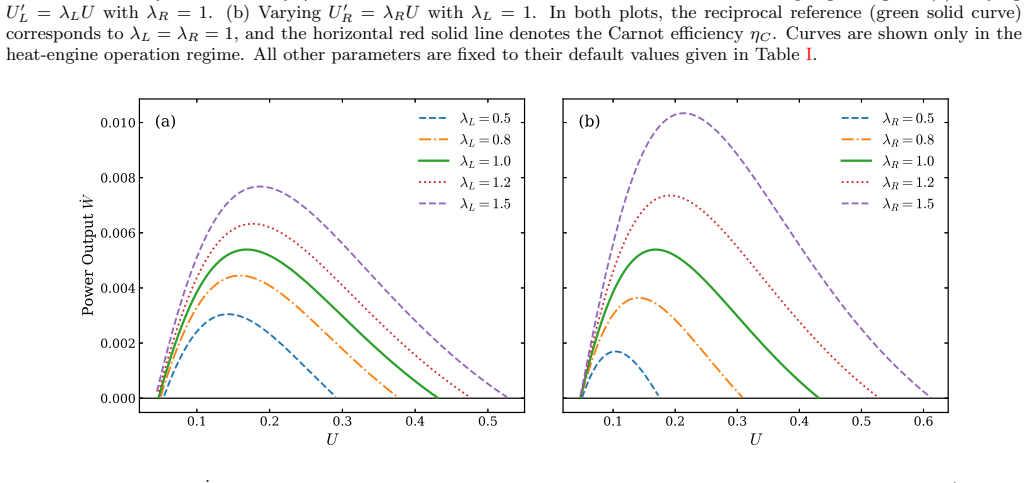
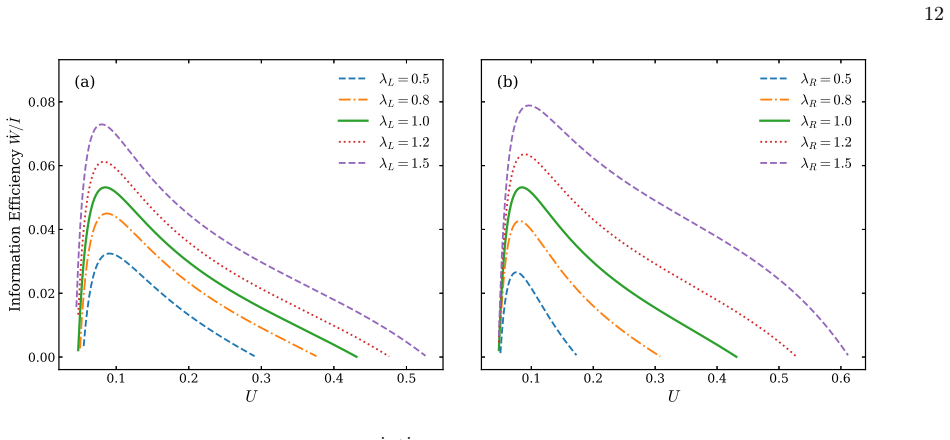
By extending the second law of thermodynamics to incorporate the effects of nonreciprocal couplings between the dots and their electronic reservoirs, we develop a thermodynamic framework that allows us to demonstrate that nonreciprocity can significantly modulate the inter-dot information flow, thereby providing a robust control mechanism. We show that the influence of nonreciprocity can be equivalently understood through a mapping to an effective reciprocal system upon a reparameterization of chemical potentials and the electron-electron coupling strength. We further analyze the impact of nonreciprocity on the engine's performance and operation regime.
What carries the argument
Mapping of the nonreciprocal double-dot system to an effective reciprocal system by reparameterizing chemical potentials and electron-electron coupling strength.
If this is right
- Nonreciprocity supplies a robust control mechanism for inter-dot information flow.
- The engine performance and operation regime can be modulated beyond what reciprocal configurations allow.
- The mapping simplifies analysis by reducing the nonreciprocal case to an equivalent reciprocal problem.
- Nonreciprocal coupling functions as an effective design knob for optimizing quantum dot information engines.
Where Pith is reading between the lines
- The reparameterization technique could be tested by comparing measured currents across a range of coupling asymmetries in fabricated double-dot devices.
- Similar mappings might apply to other autonomous quantum engines that incorporate nonreciprocal reservoir couplings.
- The control offered by nonreciprocity could be combined with gate-voltage tuning to achieve finer performance adjustments.
Load-bearing premise
The extension of the second law of thermodynamics to nonreciprocal couplings between the dots and their electronic reservoirs is valid and permits the claimed mapping to an effective reciprocal system.
What would settle it
A direct computation of steady-state information currents in the nonreciprocal setup that fails to match the currents obtained from the reparameterized reciprocal system after adjusting chemical potentials and coupling strength.
Figures
read the original abstract
Quantum information engines leverage information as a thermodynamic resource to facilitate energy conversion. In the operation of such engines, the information flow between the working substance and the controller is pivotal, however, strategies for its efficient manipulation remain largely unexplored. Here, we investigate an autonomous information engine based on a double-quantum-dot setup, where a downstream dot coupled to two reservoirs acts as the working substance, and an upstream dot coupled to a single reservoir serves as the controller. By extending the second law of thermodynamics to incorporate the effects of nonreciprocal couplings between the dots and their electronic reservoirs, we develop a thermodynamic framework that allows us to demonstrate that nonreciprocity can significantly modulate the inter-dot information flow, thereby providing a robust control mechanism. We show that the influence of nonreciprocity can be equivalently understood through a mapping to an effective reciprocal system upon a reparameterization of chemical potentials and the electron-electron coupling strength. We further analyze the impact of nonreciprocity on the engine's performance and operation regime. Our findings establish nonreciprocal coupling as an effective control knob for designing and optimizing quantum dot information engines, surpassing the capabilities of conventional reciprocal configurations.
Editorial analysis
A structured set of objections, weighed in public.
Referee Report
Summary. The manuscript studies an autonomous quantum-dot information engine consisting of an upstream controller dot (coupled to one reservoir) and a downstream working-substance dot (coupled to two reservoirs). By extending the second law to nonreciprocal dot-reservoir couplings, the authors claim that nonreciprocity modulates inter-dot information flow and that the nonreciprocal dynamics are exactly equivalent to those of a reciprocal system after a reparameterization of the chemical potentials and the inter-dot Coulomb interaction. They further examine how nonreciprocity affects engine performance and the range of operating regimes.
Significance. If the claimed extension of the second law is rigorously justified and the mapping preserves both information flow and thermodynamic quantities without additional constraints, the work would identify nonreciprocal coupling as a tunable control parameter that can outperform conventional reciprocal designs. The mapping itself would be a useful reduction if shown to hold identically.
major comments (2)
- [Section deriving the extended second law] The extension of the second law (the section deriving the modified entropy-production expression) must demonstrate that the non-negativity condition continues to hold for arbitrary nonreciprocity parameters without imposing extra constraints on the transition rates; the abstract states the extension is performed, but the load-bearing step is whether the derivation yields a consistent thermodynamic potential that reduces identically under the reparameterization.
- [Section on the mapping to effective reciprocal system] The mapping to an effective reciprocal system (the section presenting the reparameterization of chemical potentials and electron-electron coupling) must be shown to leave the information-flow term and the entropy-production expression invariant; any implicit assumption about local detailed balance or the functional form of the rates would invalidate the claimed equivalence.
minor comments (2)
- Notation for the nonreciprocity parameters should be introduced with an explicit definition before being used in the thermodynamic relations.
- Figure captions should state whether the plotted quantities are obtained analytically or numerically and which parameter values are held fixed.
Simulated Author's Rebuttal
We thank the referee for their thorough review and valuable comments, which help clarify the presentation of our results. Below we respond point-by-point to the major comments. We will revise the manuscript to strengthen the explicit demonstrations requested.
read point-by-point responses
-
Referee: [Section deriving the extended second law] The extension of the second law (the section deriving the modified entropy-production expression) must demonstrate that the non-negativity condition continues to hold for arbitrary nonreciprocity parameters without imposing extra constraints on the transition rates; the abstract states the extension is performed, but the load-bearing step is whether the derivation yields a consistent thermodynamic potential that reduces identically under the reparameterization.
Authors: The entropy-production expression is obtained directly from the standard Markovian form Σ = Σ_{i,j} W_{ij} p_j ln(W_{ij} p_j / W_{ji} p_i), which is nonnegative for any choice of rates W_{ij} (including nonreciprocal dot-reservoir couplings) by the properties of the logarithm; no additional constraints on the rates are imposed beyond those already required for a valid master equation. The thermodynamic potential is constructed from the same rates and chemical potentials, so that under the reparameterization it reduces identically by algebraic substitution. To make this fully explicit we will add a short subsection that (i) states the non-negativity proof for arbitrary nonreciprocity and (ii) verifies the identical reduction of the potential. revision: yes
-
Referee: [Section on the mapping to effective reciprocal system] The mapping to an effective reciprocal system (the section presenting the reparameterization of chemical potentials and electron-electron coupling) must be shown to leave the information-flow term and the entropy-production expression invariant; any implicit assumption about local detailed balance or the functional form of the rates would invalidate the claimed equivalence.
Authors: The reparameterization is defined so that the steady-state occupation probabilities, the inter-dot transition rates, and therefore the information-flow term (mutual-information rate) are numerically identical in the original and mapped systems. Because the rates continue to satisfy local detailed balance with respect to the reparameterized reservoir chemical potentials, the entropy-production expression is likewise invariant by direct substitution. We will insert an explicit verification (in the main text or a short appendix) that both the information-flow term and the full entropy-production expression remain unchanged under the mapping, without invoking any special functional form beyond the standard Fermi-Dirac rates used throughout the paper. revision: yes
Circularity Check
No circularity: derivation relies on explicit extension of second law and reparameterization mapping without self-referential reduction
full rationale
No load-bearing step reduces to its own inputs by construction. The abstract and described framework introduce an extension of the second law to nonreciprocal couplings as a premise, then derive modulation of information flow and an equivalent mapping via reparameterization of chemical potentials and Coulomb strength. This mapping is presented as an interpretive equivalence rather than a tautological redefinition of the original quantities. No equations are shown that define a performance metric in terms of a fitted parameter later called a prediction, no self-citation chain justifies the uniqueness or the second-law extension, and no ansatz is smuggled via prior work. The derivation chain therefore remains self-contained against external thermodynamic benchmarks.
Axiom & Free-Parameter Ledger
Reference graph
Works this paper leans on
-
[1]
Note that here we work with reciprocal dot- reservoir interaction, as manifested by the identical tun- neling rate Γ for both the 0→1 and 1→0 transitions on theXdot
the dot, conditioned on the fixed stateyof the working substance being fixed, are respec- tively given by W y 10 = Γfy, W y 01 = Γ(1−f y),(2) where Γ is the tunneling rate between theXdot and its reservoir.f y ={1 + exp[(ϵ X +yU−µ D)/TX]}−1 is an effective Fermi-Dirac distribution modulated by electron- electron coupling, which isy-state dependent because...
-
[2]
ln α(R) x α(L) x − ∆µ TY # +J(C)
Model and thermodynamics From the preceding discussion, we see that the transi- tion rates between states are rigidly constrained by LDB. This condition reflects the reciprocal nature of the sys- tem’s coupling to equilibrium reservoirs with fixed tem- peratures and chemical potentials. Here, we relax this re- ciprocal restriction and systematically explo...
-
[3]
For later convenience, we refer to the mapped system as the effective reciprocal system
Effective reciprocal systems through a reparameterization To provide further insight into the essential physics of the generalized nonreciprocal system, we present repa- rameterization strategies that map the nonreciprocal sys- tem onto an equivalent system with effective reciprocal couplings. For later convenience, we refer to the mapped system as the ef...
-
[4]
The transition sequence is (x,0) R − →(x,1) L − →(x,0)
Thermodynamic affinity for local cyclesC 0/1 Y We first consider the local cycleC x Y , which corresponds to an electron entering the working substance (Ydot) from the right reservoir and subsequently leaving to the left reservoir, while the controller (Xdot) remains in a fixed statex∈ {0,1}. The transition sequence is (x,0) R − →(x,1) L − →(x,0). Using t...
-
[5]
This cycle involves transitions of both dots and the exchange of energy and information
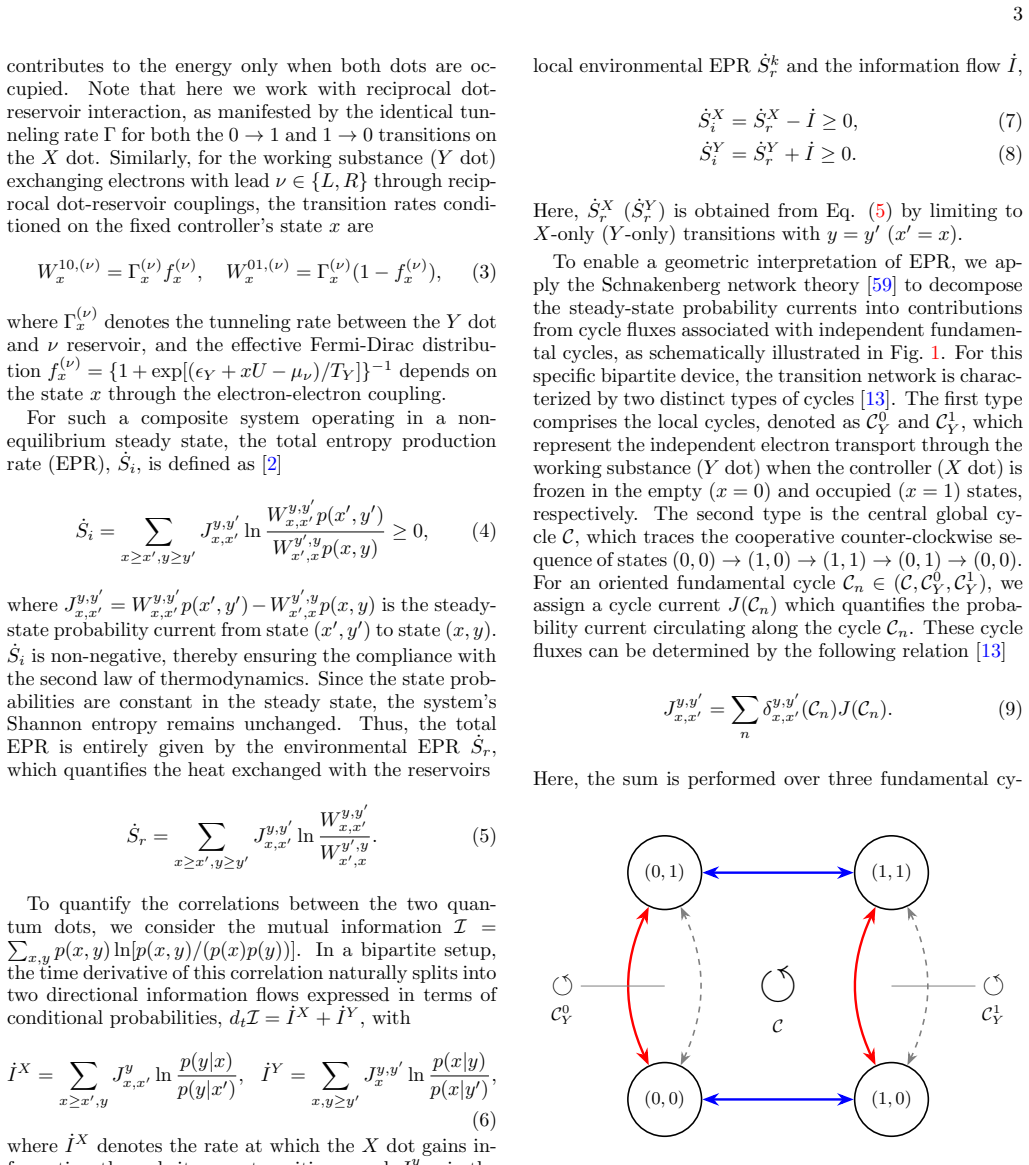
Thermodynamic affinity for the global cycleC Next, we evaluate the thermodynamic affinity for the global cycleC, which follows the path (0,0)→(1,0)→ (1,1)→(0,1)→(0,0). This cycle involves transitions of both dots and the exchange of energy and information. The definition for the associated thermodynamic affinity is given by F(C)≡ln W 0 10W 10,(L) 1 W 1 01...
-
[6]
ln α(R) x α(L) x − ∆µ TY # +J(C)
Evaluating local entropy production rates We now turn to local entropy production rates asso- ciated with each dot. The local environmental entropy production rate for the controller (Xdot) depends solely on the X-only transitions along the global cycle, ˙SX r =J(C) ln W 0 10W 1 01 W 0 01W 1 10 =J(C) ln γ0 γ1 + U TX .(A9) 14 By inserting the continuous in...
-
[7]
Scovil and E
H. Scovil and E. Schulz-DuBois, Three-level masers as heat engines, Phys. Rev. Lett.2, 262 (1959)
1959
-
[8]
Seifert, Stochastic thermodynamics, fluctuation the- orems and molecular machines, Rep
U. Seifert, Stochastic thermodynamics, fluctuation the- orems and molecular machines, Rep. Prog. Phys.75, 126001 (2012)
2012
-
[9]
Vinjanampathy and J
S. Vinjanampathy and J. Anders, Quantum thermody- namics, Contemp. Phys.57, 545 (2016)
2016
-
[10]
Benenti, G
G. Benenti, G. Casati, K. Saito, and R. Whitney, Funda- mental aspects of steady-state conversion of heat to work at the nanoscale, Physics Reports694, 1 (2017)
2017
-
[11]
Cangemi, C
L. Cangemi, C. Bhadra, and A. Levy, Quantum engines and refrigerators, Phys. Rep.1087, 1 (2024)
2024
-
[12]
Parrondo, J
J. Parrondo, J. Horowitz, and T. Sagawa, Thermody- namics of information, Nat. Phys.11, 131 (2015)
2015
-
[13]
Goold, M
J. Goold, M. Huber, A. Riera, L. del Rio, and P. Skrzypczyk, The role of quantum information in ther- modynamicsa topical review, J. Phys. A: Math. Theor. 49, 143001 (2016)
2016
-
[14]
Cao and M
F. Cao and M. Feito, Thermodynamics of feedback con- trolled systems, Phys. Rev. E79, 041118 (2009)
2009
-
[15]
Sagawa and M
T. Sagawa and M. Ueda, Generalized jarzynski equality under nonequilibrium feedback control, Phys. Rev. Lett. 104, 090602 (2010)
2010
-
[16]
Toyabe, T
S. Toyabe, T. Sagawa, M. Ueda, E. Muneyuki, and M. Sano, Experimental demonstration of information- to-energy conversion and validation of the generalized jarzynski equality, Nat. Phys.6, 988 (2010)
2010
-
[17]
Sagawa and M
T. Sagawa and M. Ueda, Role of mutual information in entropy production under information exchanges, New J. Phys.15, 125012 (2013)
2013
-
[18]
Mandal, H
D. Mandal, H. Quan, and C. Jarzynski, Maxwell’s refrig- erator: An exactly solvable model, Phys. Rev. Lett.111, 030602 (2013)
2013
-
[19]
Horowitz and M
J. Horowitz and M. Esposito, Thermodynamics with con- tinuous information flow, Phys. Rev. X4, 031015 (2014)
2014
-
[20]
Bauer, D
M. Bauer, D. Abreu, and U. Seifert, Efficiency of a brow- nian information machine, J. Phys. A: Math. Theor.45, 162001 (2012)
2012
-
[21]
Koski, V
J. Koski, V. Maisi, T. Sagawa, and J. Pekola, Experi- mental observation of the role of mutual information in the nonequilibrium dynamics of a maxwell demon, Phys. Rev. Lett.113, 030601 (2014)
2014
-
[22]
Still, Thermodynamic cost and benefit of memory, Phys
S. Still, Thermodynamic cost and benefit of memory, Phys. Rev. Lett.124, 050601 (2020)
2020
-
[23]
Camati, J
P. Camati, J. Peterson, T. Batalh˜ ao, K. Micadei, A. Souza, R. Sarthour, I. Oliveira, and R. Serra, Exper- imental rectification of entropy production by maxwell’s demon in a quantum system, Phys. Rev. Lett.117, 240502 (2016)
2016
-
[24]
Admon, S
T. Admon, S. Rahav, and Y. Roichman, Experimental realization of an information machine with tunable tem- poral correlations, Phys. Rev. Lett.121, 180601 (2018)
2018
-
[25]
Paneru, D
G. Paneru, D. Lee, T. Tlusty, and H. Pak, Lossless brow- nian information engine, Phys. Rev. Lett.120, 020601 (2018)
2018
-
[26]
T. Saha, J. Lucero, J. Ehrich, D. Sivak, and J. Bech- hoefer, Bayesian information engine that optimally ex- ploits noisy measurements, Phys. Rev. Lett.129, 130601 (2022)
2022
-
[27]
T. Saha, J. Ehrich, M. Gavrilov, S. Still, D. Sivak, and J. Bechhoefer, Information engine in a nonequilibrium bath, Phys. Rev. Lett.131, 057101 (2023)
2023
-
[28]
Fadler, A
P. Fadler, A. Friedenberger, and E. Lutz, Efficiency at maximum power of a carnot quantum information engine, Phys. Rev. Lett.130, 240401 (2023)
2023
-
[29]
Ehrich and D
J. Ehrich and D. Sivak, Energy and information flows in autonomous systems, Front. Phys.11, 1108357 (2023)
2023
-
[30]
Leighton, J
M. Leighton, J. Ehrich, and D. Sivak, Information arbi- trage in bipartite heat engines, Phys. Rev. X14, 041038 (2024)
2024
-
[31]
Aggarwal, A
K. Aggarwal, A. Rolandi, Y. Yang, J. Hickie, D. Jirovec, A. Ballabio, D. Chrastina, G. Isella, M. Mitchison, M. Perarnau-Llobet, and N. Ares, Rapid optimal work extraction from a quantum-dot information engine, Phys. Rev. Res.7, L032017 (2025)
2025
-
[32]
Zhang, P
J. Zhang, P. Wang, W. Chen, Z. Cai, M. Qiao, R. Li, Y. Huang, H. Tian, C. Luan, H. Tu, K. Cui, L. Yan, J. Zhang, J. Zhang, M. Yung, and K. Kim, Single-ion information engine for charging quantum battery, Phys. Rev. Lett.135, 140403 (2025)
2025
-
[33]
Tanogami, T
T. Tanogami, T. Van Vu, and K. Saito, Universal bounds on the performance of information-thermodynamic en- gine, Phys. Rev. Res.5, 043280 (2023)
2023
-
[34]
Castro, J
A. Castro, J. Bechhoefer, and D. Sivak, Harnessing higher-dimensional fluctuations in an information engine, Phys. Rev. Lett.136, 047101 (2026)
2026
-
[35]
Allahverdyan, D
A. Allahverdyan, D. Janzing, and G. Mahler, Thermo- dynamic efficiency of information and heat flow, J. Stat. Mech.2009, P09011 (2009)
2009
-
[36]
Honma and T
R. Honma and T. Van Vu, Information-thermodynamic bounds on precision in interacting quantum systems, Phys. Rev. A113, 032207 (2026)
2026
-
[37]
Geometric decomposition of information flow: New insights into information thermodynamics
Y. Maekawa, R. Nagayama, K. Yoshimura, and S. Ito, Geometric decomposition of information flow: New insights into information thermodynamics (2025), arXiv:2509.21985 [cond-mat.stat-mech]
work page internal anchor Pith review Pith/arXiv arXiv 2025
-
[38]
M. Fruchart and V. Vitelli, Nonreciprocal many-body physics (2026), arXiv:2602.11111 [quant-ph]
-
[39]
S. Barzanjeh, A. Xuereb, A. Al´ u, S. Mann, N. Nefed- kin, V. Peano, and P. Rabl, Nonreciprocity in quantum technology (2025), arXiv:2508.03945 [quant-ph]
-
[40]
Metelmann and A
A. Metelmann and A. Clerk, Nonreciprocal photon trans- mission and amplification via reservoir engineering, Phys. Rev. X5, 021025 (2015)
2015
-
[41]
Hurst, D
D. Hurst, D. Price, C. Bentham, M. Makhonin, B. Royall, E. Clarke, P. Kok, L. R. Wilson, M. Skolnick, and A. Fox, Nonreciprocal transmission and reflection of a chirally coupled quantum dot, Nano Lett.18, 5475 (2018)
2018
-
[42]
Huang, A
R. Huang, A. Miranowicz, J. Liao, F. Nori, and H. Jing, Nonreciprocal photon blockade, Phys. Rev. Lett.121, 153601 (2018)
2018
-
[43]
Tokura and N
Y. Tokura and N. Nagaosa, Nonreciprocal responses from 16 non-centrosymmetric quantum materials, Nat. Commun. 9, 3740 (2018)
2018
-
[45]
Ferreira, T
J. Ferreira, T. Jin, J. Mannhart, T. Giamarchi, and M. Filippone, Transport and nonreciprocity in monitored quantum devices: An exact study, Phys. Rev. Lett.132, 136301 (2024)
2024
-
[46]
Liu and D
J. Liu and D. Segal, Dissipation engineering of nonrecip- rocal quantum dot circuits: An input-output approach, Phys. Rev. B102, 125416 (2020)
2020
-
[47]
D. Lai, J. Huang, X. Yin, B. Hou, W. Li, D. Vitali, F. Nori, and J. Liao, Nonreciprocal ground-state cool- ing of multiple mechanical resonators, Phys. Rev. A102, 011502 (2020)
2020
-
[48]
J. Tang, W. Nie, L. Tang, M. Chen, X. Su, Y. Lu, F. Nori, and K. Xia, Nonreciprocal single-photon band structure, Phys. Rev. Lett.128, 203602 (2022)
2022
-
[49]
Y. Jiao, S. Zhang, Y. Zhang, A. Miranowicz, L. Kuang, and H. Jing, Nonreciprocal optomechanical entangle- ment against backscattering losses, Phys. Rev. Lett.125, 143605 (2020)
2020
-
[50]
Lecocq, L
F. Lecocq, L. Ranzani, G. Peterson, K. Cicak, X. Jin, R. Simmonds, J. Teufel, and J. Aumentado, Efficient qubit measurement with a nonreciprocal microwave am- plifier, Phys. Rev. Lett.126, 020502 (2021)
2021
-
[51]
Rymarz, S
M. Rymarz, S. Bosco, A. Ciani, and D. DiVincenzo, Hardware-encoding grid states in a nonreciprocal super- conducting circuit, Phys. Rev. X11, 011032 (2021)
2021
-
[52]
Y. Wang, C. Wang, and A. Clerk, Quantum nonrecip- rocal interactions via dissipative gauge symmetry, PRX Quantum4, 010306 (2023)
2023
-
[53]
Ahmadi, P
B. Ahmadi, P. Mazurek, P. Horodecki, and S. Barzanjeh, Nonreciprocal quantum batteries, Phys. Rev. Lett.132, 210402 (2024)
2024
-
[54]
Zhang and L
Z. Zhang and L. Zhu, Nonreciprocal thermal photonics for energy conversion and radiative heat transfer, Phys. Rev. Applied18, 027001 (2022)
2022
-
[55]
Lodahl, S
P. Lodahl, S. Mahmoodian, S. Stobbe, A. Rauschenbeu- tel, P. Schneeweiss, J. Volz, H. Pichler, and P. Zoller, Chiral quantum optics, Nature541, 473 (2017)
2017
-
[56]
Mandal, R
S. Mandal, R. Banerjee, E. A. Ostrovskaya, and T. Liew, Nonreciprocal transport of exciton polaritons in a non- hermitian chain, Phys. Rev. Lett.125, 123902 (2020)
2020
-
[57]
W. Gou, T. Chen, D. Xie, T. Xiao, T. Deng, B. Gad- way, W. Yi, and B. Yan, Tunable nonreciprocal quan- tum transport through a dissipative aharonov-bohm ring in ultracold atoms, Phys. Rev. Lett.124, 070402 (2020)
2020
-
[58]
Kamal, J
A. Kamal, J. Clarke, and M. Devoret, Noiseless non- reciprocity in a parametric active device, Nat. Phys.7, 311 (2011)
2011
-
[59]
Busiello, D
D. Busiello, D. Gupta, and A. Maritan, Entropy pro- duction in systems with unidirectional transitions, Phys. Rev. Res.2, 023011 (2020)
2020
-
[60]
A. Pal, S. Reuveni, and S. Rahav, Thermodynamic un- certainty relation for systems with unidirectional transi- tions, Phys. Rev. Res.3, 013273 (2021)
2021
-
[61]
Zhang and R
Z. Zhang and R. Garcia-Millan, Entropy production of nonreciprocal interactions, Phys. Rev. Res.5, L022033 (2023)
2023
-
[62]
Manzano, G
G. Manzano, G. Karde¸ s, E. Rold´ an, and D. Wolpert, Thermodynamics of computations with absolute irre- versibility, unidirectional transitions, and stochastic com- putation times, Phys. Rev. X14, 021026 (2024)
2024
-
[63]
Strasberg, G
P. Strasberg, G. Schaller, T. Brandes, and M. Espos- ito, Thermodynamics of a physical model implementing a maxwell demon, Phys. Rev. Lett.110, 040601 (2013)
2013
-
[64]
Kutvonen, T
A. Kutvonen, T. Sagawa, and T. Ala-Nissila, Thermo- dynamics of information exchange between two coupled quantum dots, Phys. Rev. E93, 032147 (2016)
2016
-
[65]
Schnakenberg, Network theory of microscopic and macroscopic behavior of master equation systems, Rev
J. Schnakenberg, Network theory of microscopic and macroscopic behavior of master equation systems, Rev. Mod. Phys.48, 571 (1976)
1976
discussion (0)
Sign in with ORCID, Apple, or X to comment. Anyone can read and Pith papers without signing in.