Energy-Aware Computing in the Year 2026
Pith reviewed 2026-06-30 12:17 UTC · model grok-4.3
The pith
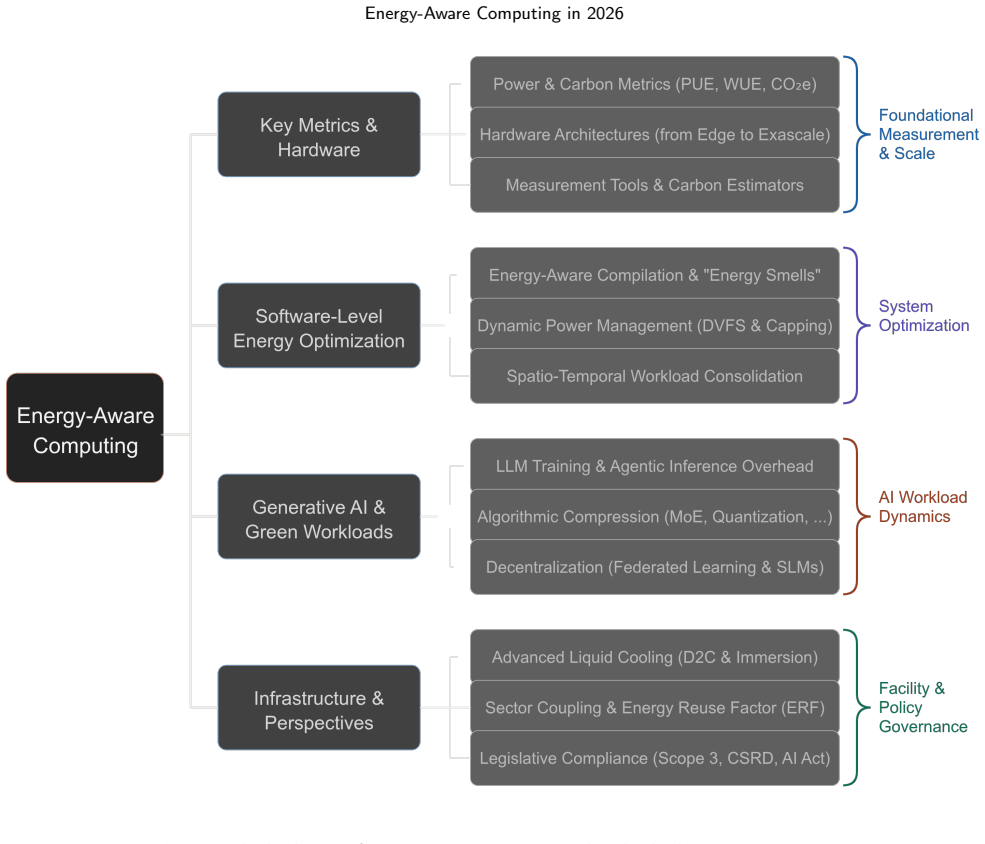
A holistic taxonomy organizes energy-efficient techniques across hardware, software, scheduling, and cooling for the cloud-edge-HPC continuum.
A machine-rendered reading of the paper's core claim, the machinery that carries it, and where it could break.
Core claim
The paper establishes that current publications on energy-efficient computing can be systematically arranged into a holistic taxonomy built around hardware and software aspects, measurement instrumentation, software optimizations, dynamic task scheduling, voltage scaling, workload consolidation, federated learning, and cooling. This structure captures the state of the art for the full cloud-edge-HPC range and places special weight on the demands of large-scale generative AI training and inference. The resulting overview supports a forward roadmap for sustainable computing that accounts for financial, environmental, and supply constraints on energy.
What carries the argument
The holistic taxonomy that groups publications by perspectives including hardware/software aspects, measurement instrumentation, software optimizations, dynamic task scheduling, voltage scaling, workload consolidation, federated learning, and cooling.
If this is right
- Researchers can use the taxonomy to locate under-explored intersections such as federated learning combined with dynamic voltage scaling.
- System designers gain a shared language for comparing hardware and software energy strategies across IoT to HPC scales.
- Roadmap priorities shift toward techniques that jointly address carbon footprint, energy supply limits, and large AI workloads.
- Measurement and cooling methods become more visible as first-class components rather than afterthoughts in energy studies.
Where Pith is reading between the lines
- The taxonomy could be turned into a living database that automatically classifies new papers as they appear.
- Applying the same structure to older literature might reveal whether today's dominant approaches differ in kind from earlier ones.
- If cooling and federated learning remain separate branches, future work may need explicit cross-links when both are used on the same cluster.
Load-bearing premise
The publications chosen for review represent the most recent and significant contributions, so the taxonomy built from them accurately reflects the overall state of the field.
What would settle it
A major 2025 or 2026 paper on energy reduction in exascale AI or data centers whose methods cannot be placed in any of the taxonomy's listed categories without stretching the definitions.
Figures
read the original abstract
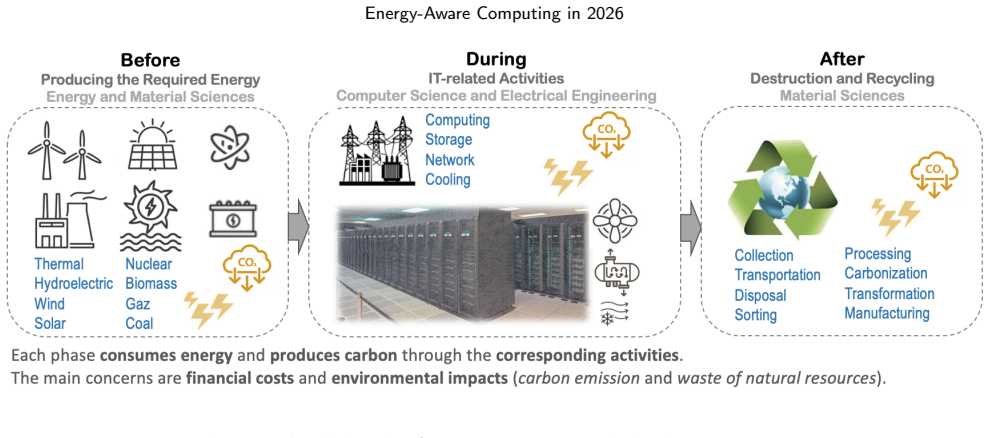
High-Performance Computing (HPC) has recently entered the Exascale era, and considerable efforts are being made to fully harness this potential power for large-scale applications, such as cutting-edge generative AI (training and exploitation). The corresponding energy consumption is very high, and forecasts are alarming, making this metric a critical systemic bottleneck. Addressing this issue presents a genuine challenge for the entire cloud-edge-HPC continuum at all scales, from low-power IoT microcontrollers to multi-megawatt data centers. Beyond financial costs, green computing is driven by considerations related to climate change and environmental concerns such as carbon footprint ($CO_2e$), as well as constraints on energy production and supply, leading to a real need to regulate {\em information and communication technology} (ICT) activities. This article presents a comprehensive overview of energy-efficient computing, taking into account the most recent and significant contributions. Based on this exploration of the state of the art, we design and describe a holistic taxonomy of the aforementioned publications, structured around various perspectives, including {\em hardware and software aspects, measurement instrumentation, software optimizations, dynamic task scheduling, voltage scaling, workload consolidation, federated learning}, and {\em cooling}. Particular emphasis is placed on large-scale AI, which receives significant attention due to its considerable resource requirements. We conclude with an analysis of a forward-looking roadmap that considers the main perspectives of sustainable computing.
Editorial analysis
A structured set of objections, weighed in public.
Referee Report
Summary. The manuscript surveys energy-efficient computing across the cloud-edge-HPC-IoT continuum, with emphasis on large-scale AI workloads. It reviews recent contributions and constructs a holistic taxonomy organized by hardware/software aspects, measurement instrumentation, software optimizations, dynamic task scheduling, voltage scaling, workload consolidation, federated learning, and cooling, concluding with a forward-looking roadmap for sustainable computing.
Significance. A structured taxonomy of energy-aware methods could usefully organize an interdisciplinary field and surface connections among hardware, software, and system-level techniques, particularly for AI. The survey's value as a reference depends on the taxonomy's coverage; the absence of documented selection criteria reduces its reliability as a definitive state-of-the-art map.
major comments (1)
- [Abstract] Abstract: the central claim that a 'holistic taxonomy' can be constructed from 'the most recent and significant contributions' across the listed perspectives cannot be evaluated, because no section describes the literature search (databases, keywords, date range, screening process, or total papers considered). This omission is load-bearing for the taxonomy's asserted completeness.
Simulated Author's Rebuttal
We thank the referee for the constructive feedback. We address the major comment below and will incorporate changes in the revised manuscript.
read point-by-point responses
-
Referee: [Abstract] Abstract: the central claim that a 'holistic taxonomy' can be constructed from 'the most recent and significant contributions' across the listed perspectives cannot be evaluated, because no section describes the literature search (databases, keywords, date range, screening process, or total papers considered). This omission is load-bearing for the taxonomy's asserted completeness.
Authors: We agree that the absence of an explicit literature search methodology section limits the ability to assess the taxonomy's scope and completeness. In the revised version, we will add a dedicated subsection (likely in Section 1 or as a new Section 2) that documents the search process. This will include the academic databases queried (e.g., IEEE Xplore, ACM DL, arXiv, ScienceDirect), search keywords and Boolean strings, the date range (primarily 2020–2025 with selected foundational works), inclusion/exclusion criteria, and approximate totals of papers screened and retained. This addition will directly support the claim of a holistic taxonomy derived from recent contributions. revision: yes
Circularity Check
No circularity: survey taxonomy has no derivations or self-referential reductions
full rationale
This is a literature review paper that surveys energy-efficient computing publications and organizes them into a taxonomy across listed perspectives. No equations, fitted parameters, predictions, or derivations appear anywhere in the manuscript. The taxonomy is explicitly constructed from the reviewed works rather than claiming to derive new results from first principles or reduce to self-citation chains. Absence of a documented search protocol affects verifiability of completeness but does not create any of the enumerated circularity patterns (self-definitional, fitted-input prediction, load-bearing self-citation, etc.). The paper is self-contained as a descriptive overview.
Axiom & Free-Parameter Ledger
Reference graph
Works this paper leans on
-
[1]
IEA dataset/report reference
International Energy Agency, Co2 emissions associated with electricity generation for data centres,https: //www.iea.org/data-and-statistics/charts/co2-emissions-\ associated-with-electricity-generation-for-data-centres-by-case\ -2020-2035, 2025. IEA dataset/report reference
2020
-
[2]
top500.org/lists/top500/, 2025
TOP500 Organization, Top500 supercomputer sites,https://www. top500.org/lists/top500/, 2025. June/November 2025 edition
2025
-
[3]
Official blog and technical overview
Meta AI, Introducing meta llama 3,https://ai.meta.com/blog/ meta-llama-3/, 2024. Official blog and technical overview
2024
-
[4]
NVIDIA, Nvidia blackwell platform arrives to power a new era of computing,https://nvidianews.nvidia.com/news/ nvidia-blackwell-platform-arrives-to-power-a-new-era-of-computing,
-
[5]
Official announcement (whitepaper-style content)
-
[6]
com/en/products/accelerators/instinct/mi300.html, 2024
AMD, Amd instinct mi300 series accelerators,https://www.amd. com/en/products/accelerators/instinct/mi300.html, 2024. Product whitepaper/specifications
2024
-
[7]
United Nations Framework Convention on Climate Change, Paris agreement,https://unfccc.int/process-and-meetings/ the-paris-agreement/the-paris-agreement, 2015
2015
-
[8]
A.G.Philipo,H.Ning,D.S.Sarwatt,J.A.Mohamed,A.S.Yusufu, F.Shi,S.Urenje,J.Ding, Sustainableai:Emergingtrends,impacts, and future challenges, IEEE Trans. Sustain. Comput. 10 (2025) 1278–1291
2025
-
[9]
W.Lin,J.Lin,Z.Peng,H.Huang,W.Lin,K.Li,Asystematicreview of green-aware management techniques for sustainable data center, Sustain. Comput. Inf. Syst. 42 (2024) 100989
2024
-
[10]
S.M.Hasan,T.Islam,M.Saifuzzaman,K.R.Ahmed,C.-H.Huang, A. R. Shahid, Carbon emission quantification of machine learning: A review, IEEE Trans. Sustain. Comput. 10 (2025) 1085–1102
2025
-
[11]
Representthemall: A universal learning representation of bug reports
S.McGuire,E.Schultz,B.Ayoola,P.Ralph, Sustainabilityisstrati- fied:Towardabettertheoryofsustainablesoftwareengineering, in: IEEE/ACM45thInt.Conf.Soft.Eng.(ICSE),2023,pp.1996–2008. doi:10.1109/ICSE48619.2023.00169
-
[12]
Accessed: 2026-04-16
Google Cloud, Introducing trillium: Google’s 6th generation tpu,https://cloud.google.com/blog/products/compute/ introducing-trillium-6th-gen-tpus, 2024. Accessed: 2026-04-16
2024
-
[13]
Parallel
G.Raffin,D.Trystram, Dissectingthesoftware-basedmeasurement of cpu energy consumption: A comparative analysis, IEEE Trans. Parallel. Distrib. Syst. 36 (2025) 96–107
2025
-
[14]
Z. Yang, K. Adamek, W. Armour, Accurate and convenient energy measurements for gpus: A detailed study of nvidia gpu’s built-in power sensor, in: SC24: Proc. Int. Conf. High Perform. Comput., Netw., Storage Anal, 2024, pp. 1–17. doi:10.1109/SC41406.2024. 00028
work page internal anchor Pith review Pith/arXiv arXiv doi:10.1109/sc41406.2024 2024
- [15]
-
[16]
S.Rajput,T.Widmayer,Z.Shang,M.Kechagia,F.Sarro,T.Sharma, Enhancing energy-awareness in deep learning through fine-grained energymeasurement,ACMTrans.Softw.Eng.Methodol.33(2024)
2024
-
[17]
Guldner, R
A. Guldner, R. Bender, C. Calero, G. S. Fernando, M. Funke, J. Gröger, L. M. Hilty, J. Hörnschemeyer, G.-D. Hoffmann, D.Junger,T.Kennes,S.Kreten,P.Lago,F.Mai,I.Malavolta,J.Mu- rach, K. Obergöker, B. Schmidt, A. Tarara, J. P. De Veaugh-Geiss, S. Weber, M. Westing, V. Wohlgemuth, S. Naumann, Development and evaluation of a reference measurement model for as...
2024
-
[18]
Zhang, Z
J. Zhang, Z. Wang, H. Wang, T. Song, H.-a. Su, R. Chen, Y. Hua, X. Zhou, R. Ma, M. Pan, H. Guan, Ampere: A generic energy R.N. Tchakoute and C. Tadonki:Preprint submitted to ElsevierPage 18 of 26 Energy-Aware Computing in 2026 estimationapproachforon-devicetraining, SIGMETRICSPerform. Eval. Rev. 53 (2025) 27–32
2026
-
[19]
Z.Zong,R.Ge,Q.Gu,Marcher:Aheterogeneoussystemsupporting energy-aware high performance computing and big data analytics, BigDataResearch8(2017)27–38.TutorialsonToolsandMethods using High Performance Computing resources for Big Data
2017
-
[20]
M.Weber,J.Dorn,S.Apel,N.Siegmund, Famlem,thefastmodular energy meter at code level, in: Proc. 33rd ACM Int. Conf. Found. Soft.Eng.,FSECompanion’25,ACM,2025,p.1129–1133.doi:10. 1145/3696630.3728595
-
[21]
Treibig, G
J. Treibig, G. Hager, G. Wellein, Likwid: A lightweight performance-orientedtoolsuiteforx86multicoreenvironments, in: 2010 39th International Conference on Parallel Processing Work- shops, 2010, pp. 207–216
2010
-
[22]
IEEE/ACM 21st Int
S.Rajput,M.Kechagia,F.Sarro,T.Sharma, Greenlight:Highlight- ing tensorflow apis energy footprint, in: Proc. IEEE/ACM 21st Int. Conf. Min. Softw. Repos. (MSR), 2024, pp. 304–308
2024
-
[23]
SC ’24 Workshops, SC-W ’24, IEEE Press, 2025, p
M. Paipuri, Ceems: A resource manager agnostic energy and emissionsmonitoringstack, in:Proc.SC’24Workshops,SC-W’24, IEEE Press, 2025, p. 1862–1866. doi:10.1109/SCW63240.2024.00233
-
[24]
Terboven, R
C. Terboven, R. Liem, J. Gracia, K. Haldar, J. Engels, P. Gies- selmann, D. Brayford, T. Wilde, C. Simmendinger, M. Marquardt, J. Eitzinger, T. Gruber, Ee-hpc a framework for energy efficient hpc system management, in: Proc. SC ’24 Workshops, 2024, pp. 1878–
2024
-
[25]
doi:10.1109/SCW63240.2024.00236
-
[26]
T. A. Rahmani, G. Belalem, S. A. Mahmoudi, O. R. Merad-Boudia, Real-time ai-powered monitoring for energy-efficient scheduling in multi-nodeheterogeneoussystems,FutureGener.Comput.Syst.181 (2026) 108428
2026
-
[27]
K.A.Sanni,A.G.Andreou, Ahistoricalperspectiveonhardwareai inference, charge-based computational circuits and an 8 bit charge- based multiply-add core in 16 nm finfet cmos, IEEE J. Emerg. Sel Top. Circ. Syst. 9 (2019) 532–543
2019
-
[28]
K.Wang,H.Zheng,Y.Li,A.Louri, Securenoc:Alearning-enabled, high-performance,energy-efficient,andsecureon-chipcommunica- tionframeworkdesign, IEEETrans.Sustain.Comput.7(2022)709– 723
2022
-
[29]
M. H. Sadi, C. Sudarshan, S. R. Nassif, N. Wehn, Efficient deep neuralnetworktrainingwithanovel5.3-bitblockfloatingpointdata format, IEEE Trans. Circ Syst. A.I. 2 (2025) 150–161
2025
-
[30]
Symp.High-Perform.Comput.Archit.(HPCA),2025,pp.409–422
G.Li,S.Ye,C.Chen,Y.Wang,F.Yang,T.Cao,C.Liu,M.M.S.Aly, M. Yang, Lut-dla: Lookup table as efficient extreme low-bit deep learning accelerator, in: IEEE Int. Symp. High-Perform. Comput. Archit. (HPCA), 2025, pp. 671–684. doi:10.1109/HPCA61900.2025. 00057
-
[31]
S. Laskar, P. Majhi, A. Muzahid, E. J. Kim, Supermesh: Energy- efficientcollectivecommunicationsforaccelerators, in:Proceedings ofthe58thIEEE/ACMInternationalSymposiumonMicroarchitec- ture, MICRO ’25, ACM, 2025, p. 1640–1655. doi:10.1145/3725843. 3756085
-
[32]
Y. Liu, Y. Xue, N. Crawford, J. Xue, J. Huang, Elk: Exploring the Efficiency of Inter-core Connected AI Chips with Deep Learning Compiler Techniques, ACM, 2025, p. 1284–1299
2025
-
[33]
T. Li, H. Zhong, Y. Xu, V. Narayanan, K. Ni, H. Yang, T. Kämpfe, X. Li, Remna: Variation-resilient and energy-efficient mlc fefet computing-in-memory using nand flash-like read and adaptive con- trol, in: Proc. 43rd IEEE/ACM Int. Conf. Computer Aided Des. (ICCAD), ICCAD ’24, ACM, 2025. doi:10.1145/3676536.3676715
-
[34]
D. R. Dipta, B. Gulmezoglu, Mad-en: Microarchitectural attack detection through system-wide energy consumption, IEEE Trans. Inform. Forens. Secur. 18 (2023) 3006–3017
2023
-
[35]
Ebrahimi, A
Z. Ebrahimi, A. Kumar, Green: An approximate simd/mimd cgra forenergy-efficientprocessingattheedge, IEEETrans.Comp.-Aid. Des. Integr. Circ. Syst. 43 (2024) 2874–2887
2024
-
[36]
F.Fayza,C.Demirkiran,S.P.Rao,D.Bunandar,U.Gupta,A.Joshi, Epicarbon: A carbon modeling tool for electro-photonic accelera- tors,in:2025IEEE/ACMInt.Conf.ComputerAidedDes.(ICCAD), 2025, pp. 1–9. doi:10.1109/ICCAD66269.2025.11240809
-
[37]
U.Gupta,M.Elgamal,G.Hills,G.-Y.Wei,H.-H.S.Lee,D.Brooks, C.-J. Wu, Act: designing sustainable computer systems with an architectural carbon modeling tool, in: ACM/IEEE 49th Annu. Int. Symp.Comput.Archit.(ISCA),ISCA’22,ACM,2022,p.784–799. doi:10.1145/3470496.3527408
-
[38]
Pashaeifar, M
M. Pashaeifar, M. Kamal, A. Afzali-Kusha, M. Pedram, A the- oretical framework for quality estimation and optimization of dsp applicationsusinglow-powerapproximateadders, IEEETrans.Circ Syst. 66 (2019) 327–340
2019
-
[39]
Danopoulos, G
D. Danopoulos, G. Zervakis, D. Soudris, J. Henkel, Transaxx: Efficient transformers with approximate computing, IEEE Trans. Circ Syst. Art. Intell. 2 (2025) 288–301
2025
-
[40]
Golden, M
A. Golden, M. Elgamal, A. Mahmoud, G. Hills, C.-J. Wu, G.- Y. Wei, D. Brooks, Wafer-scale systems: A carbon perspective, SIGENERGY Energy Inform. Rev. 5 (2025) 118–124
2025
-
[41]
Kalyanapu, F
J. Kalyanapu, F. Dizani, D. Asher, A. Ghanbari, R. Cammarota, A.Aysu,S.M.Ajorpaz,GateBleed:ExploitingOn-CoreAccelerator Power Gating for High Performance and Stealthy Attacks on AI, ACM, 2025, p. 308–325
2025
-
[42]
W. Abu Ahmad, A. Bartolini, F. Beneventi, L. Benini, A. Borghesi, M.Cicala,P.Forestieri,C.Gianfreda,D.Gregori,A.Libri,F.Spiga, S.Tinti, Designofanenergyawarepetaflopsclasshighperformance clusterbasedonpowerarchitecture,in:IEEEIPDPS’17Workshops, 2017, pp. 964–973. doi:10.1109/IPDPSW.2017.22
-
[43]
Splitwise: Efficient generative LLM inference using phase splitting,
M. Cochet, K. Swaminathan, E. Loscalzo, J. Zuckerman, M. C. D. Santos, D. Giri, A. Buyuktosunoglu, T. Jia, D. Brooks, G.-Y. Wei, K. Shepard, L. P. Carloni, P. Bose, Blitzcoin: Fully decentral- ized hardware power management for accelerator-rich socs, in: ACM/IEEE 51st Annu. Int. Symp. Comput. Archit. (ISCA), 2024, pp. 801–817. doi:10.1109/ISCA59077.2024.00063
-
[44]
A. M. Panteleaki, K. Balaskas, G. Zervakis, H. Amrouch, I. Anag- nostopoulos, Late breaking results: Leveraging approximate com- putingforcarbon-awarednnaccelerators, in:Des.Autom.TestEur. Conf. Exhib. (DATE), 2025, pp. 1–2. doi:10.23919/DATE64628.2025. 10993191
-
[45]
C. C. Sudarshan, A. Arora, V. A. Chhabria, Greenfpga: Evaluating fpgas as environmentally sustainable computing solutions, in: 2024 61st ACM/IEEE Design Autom. Conf. (DAC), 2024, pp. 1–6
2024
-
[46]
Darabi, E
A. Darabi, E. Abiri, Cgi-sram: Memory cell with data-aware write bitline-free and inner readout features for energy-efficient bitwise logic-in-memory operations, Sustain. Comput. Inf. Syst. 50 (2026) 101307
2026
-
[47]
J.Spieck,D.Walter,J.Waschkeit,J.Teich, Co-designofsustainable embedded systems-on-chip, in: Des. Autom. Test Eur. Conf. Exhib. (DATE), 2025, pp. 1–2. doi:10.23919/DATE64628.2025.10992914
-
[48]
K. Shiflett, A. Karanth, R. Bunescu, A. Louri, Albireo: Energy- efficient acceleration of convolutional neural networks via silicon photonics, in: ACM/IEEE 48th Annu. Int. Symp. Comput. Archit. (ISCA), 2021, pp. 860–873. doi:10.1109/ISCA52012.2021.00072
-
[49]
J. Li, A. Louri, A. Karanth, R. Bunescu, Gcnax: A flexible and energy-efficientacceleratorforgraphconvolutionalneuralnetworks, in:IEEEInt. Symp.High-Perform.Comput.Archit. (HPCA),2021, pp. 775–788. doi:10.1109/HPCA51647.2021.00070
-
[50]
X. Li, T. Zhou, H. Wang, M. Lin, Energy-efficient computation with dvfs using deep reinforcement learning for multi-task systems in edge computing, IEEE Trans. Sustain. Comput. 10 (2025) 1116– 1127
2025
-
[51]
A.Swaraj,S.Kumar, Ischatgpt-generatedcodereallygreen?:Eval- uating ai-generated solutions for energy-efficient coding practices, IEEE Software 43 (2026) 42–50
2026
-
[52]
S. Georgiou, M. Kechagia, T. Sharma, F. Sarro, Y. Zou, Green ai: do deep learning frameworks have different costs?, in: Proc. 44th Int. Conf. Soft. Eng., ICSE ’22, ACM, 2022, p. 1082–1094. doi:10.1145/3510003.3510221
-
[53]
Twin graph-based anomaly detection via attentive multi-modal learning for microservice system
S. Sikand, V. S. Sharma, V. Kaulgud, S. Podder, Green ai quotient: Assessing greenness of ai-based software and the way forward, in: Proceedings of the 38th IEEE/ACM International Conference on Automated Software Engineering, ASE ’23, IEEE Press, 2024, p. R.N. Tchakoute and C. Tadonki:Preprint submitted to ElsevierPage 19 of 26 Energy-Aware Computing in 2...
-
[54]
D.Cesarini,A.Bartolini,P.Bonfà,C.Cavazzoni,L.Benini, Count- down: A run-time library for performance-neutral energy saving in mpi applications, IEEE Trans. Comput. 70 (2021) 682–695
2021
-
[55]
V. Stoico, A. C. Dragomir, P. Lago, An empirical study on the performance and energy usage of compiled python code, in: Proc. 29thInt.Conf.Eval.Assess.Softw.Eng.(EASE),EASE’25,ACM, 2025, p. 46–56. doi:10.1145/3756681.3756972
-
[56]
J. Song, P. Zhu, Y. Zhang, G. Yu, Cloudsimper: Simulating geo- distributed datacenters powered by renewable energy mix, IEEE Trans. Parallel. Distrib. Syst. 35 (2024) 531–547
2024
-
[57]
Tunzina, M
T. Tunzina, M. Mashira, M. M. Islam, Greenai: A comparative analysis of environmental efficiency in llm-generated code, IEEE Access 14 (2026) 18654–18672
2026
-
[58]
V. De Martino, S. Martínez-Fernández, F. Palomba, Do developers adopt green architectural tactics for ml-enabled systems? a mining softwarerepositorystudy, in:IEEE/ACM47thInt.Conf.Soft.Eng. (ICSE-SEIS),2025,pp.135–139.doi:10.1109/ICSE-SEIS66351.2025. 00019
- [59]
-
[60]
M. Hort, A. Grishina, L. Moonen, An exploratory literature study on sharing and energy use of language models for source code, in: ACM/IEEE Int. Symp. Emp. Soft. Eng Meas. (ESEM), 2023, pp. 1–12. doi:10.1109/ESEM56168.2023.10304803
-
[61]
B. Ayoola, M. Kuutila, R. R. Wehbe, P. Ralph, User personas improvesocialsustainabilitybyencouragingsoftwaredevelopersto deprioritize antisocial features, in: IEEE/ACM 47th In. Conf. Soft. Eng.(ICSE),2025,pp.833–845.doi:10.1109/ICSE55347.2025.00135
-
[62]
J. Chen, L. Tan, P. Wu, D. Tao, H. Li, X. Liang, S. Li, R. Ge, L.Bhuyan,Z.Chen, Greenla:Greenlinearalgebrasoftwareforgpu- accelerated heterogeneous computing, in: SC ’16: Proc. Int. Conf. High Perform. Comput., Netw., Storage Anal, 2016, pp. 667–677. doi:10.1109/SC.2016.56
-
[63]
N.v.Kempen,H.-J.Kwon,D.T.Nguyen,E.D.Berger, It’snoteasy beinggreen:Ontheenergyefficiencyofprogramminglanguages,in: 40th IEEE/ACM Int. Conf. Aut. Soft. Eng. (ASE), 2025, pp. 1553–
2025
-
[64]
doi:10.1109/ASE63991.2025.00131
-
[65]
L. Cruz, X. Franch, S. Martínez-Fernández, Innovating for tomor- row: The convergence of software engineering and green ai, ACM Trans. Softw. Eng. Methodol. 34 (2025)
2025
-
[66]
De Martino, S
V. De Martino, S. Lambiase, F. Pecorelli, W.-J. van den Heuvel, F.Ferrucci,F.Palomba, Sustainabilityofmachinelearning-enabled systems: The machine learning practitioner’s perspective, ACM Trans. Softw. Eng. Methodol. (2025). Just Accepted
2025
-
[67]
2406–2418
E.B.Roque,L.Cruz,T.Durieux,UnveilingtheEnergyVampires:A Methodology for Debugging Software Energy Consumption, IEEE Press, 2025, p. 2406–2418
2025
-
[68]
J. Maquoi, M. Cauz, B. Vanderose, X. Devroey, Energy codesump- tion, leveraging test execution for source code energy consumption analysis, in: Proc.33rd ACM Int. Conf. Found. Soft. Eng., FSE Companion ’25, ACM, 2025, p. 1432–1436. doi:10.1145/3696630. 3728707
-
[69]
N.Alizadeh,B.Belchev,N.Saurabh,P.Kelbert,F.Castor,Language models in software development tasks: An experimental analysis of energy and accuracy, in: Proc. IEEE/ACM 22nd Int. Conf. Min. Softw. Repos. (MSR), IEEE Press, 2025, p. 725–736. doi:10.1109/ MSR66628.2025.00109
-
[70]
G. Zanfardino, M. A. Memon, M. Tucci, Enhancing energy effi- ciency with reusable software ecosystems and persona-based ui/ux, in: Proc.33rd ACM Int. Conf. Found. Soft. Eng., FSE Companion ’25, ACM, 2025, p. 1449–1452. doi:10.1145/3696630.3728710
-
[71]
A.Tundo,M.Mobilio,S.Ilager,I.Brandić,E.Bartocci,L.Mariani, An energy-aware approach to design self-adaptive ai-based applica- tions on the edge, in: Proceedings of the 38th IEEE/ACM Interna- tional Conference on Automated Software Engineering, ASE ’23, IEEE Press, 2024, p. 281–293. doi:10.1109/ASE56229.2023.00046
-
[72]
Andrés Larracoechea, P
J. Andrés Larracoechea, P. Roose, S. Ilarri, Energy-aware software design: A hardware and behavioural consumption scoring and la- belling algorithm, Expert Systems with Applications 299 (2026) 130046
2026
-
[73]
Dhawan, M
R. Dhawan, M. Suresh Patel, Carbon-aware ai control plane for devops automation: A reference architecture and next-generation sustainability framework, IEEE Access 14 (2026) 11163–11184
2026
-
[74]
Marahatta, Q
A. Marahatta, Q. Xin, C. Chi, F. Zhang, Z. Liu, Pefs: Ai-driven prediction based energy-aware fault-tolerant scheduling scheme for clouddatacenter, IEEETrans.Sustain.Comput.6(2021)655–666
2021
-
[75]
J. S. Shim, B. Han, Y. Kim, J. Kim, Deeppm: Transformer-based power and performance prediction for energy-aware software, in: Des. Autom. Test Eur. Conf. Exhib. (DATE), 2022, pp. 1491–1496. doi:10.23919/DATE54114.2022.9774589
-
[76]
M. A. N. Al-hayanni, A. Rafiev, F. Xia, R. Shafik, A. Romanovsky, A.Yakovlev, Parma:Parallelization-awarerun-timemanagementfor energy-efficientmany-coresystems,IEEETrans.Comput.69(2020) 1507–1518
2020
-
[77]
L.Eeckhout, Assessingprocessorsustainabilityusingthefirst-order focal carbon model, IEEE Micro 45 (2025) 11–18
2025
-
[78]
Z. Zhou, M. Shojafar, J. Abawajy, H. Yin, H. Lu, Ecms: An edge intelligent energy efficient model in mobile edge computing, IEEE Trans. Green Comm. Network. 6 (2022) 238–247
2022
-
[79]
Conficoni, A
C. Conficoni, A. Bartolini, A. Tilli, C. Cavazzoni, L. Benini, Inte- grated energy-aware management of supercomputer hybrid cooling systems, IEEE Trans. Indus. Inform. 12 (2016) 1299–1311
2016
-
[80]
Vahabi, F
S. Vahabi, F. Righetti, C. Vallati, N. Tonellotto, The impact of prediction models on energy-aware resource management in faas platforms, IEEE Access 13 (2025) 85711–85727
2025
discussion (0)
Sign in with ORCID, Apple, or X to comment. Anyone can read and Pith papers without signing in.