Artificial Intelligence · arXiv:2605.24598 v1 · submitted 23 May 2026 · 12 references
Hera: Learning Long-Horizon Coordination for Device-Cloud Collaborative LLM Agents
The paper says
“Large language model (LLM) agents excel at solving complex long-horizon tasks through autonomous interaction with environments.”
more of the abstract
However, their real-world deployment faces a fundamental device–cloud dilemma: on-device models are efficient but often brittle, while cloud models are stronger but costly in computation. State-of-the-art LLM device–cloud routers usually make coarse task-level decisions, which cannot adapt to the changing difficulty of multi-step agent interactions. To address this issue, we present Hera, a step-level device–cloud LLM agent coordinator for long-horizon tasks achieving a strong performance–cost Pareto frontier. Hera adopts a novel two-stage training paradigm: (1) imitation learning for cold-start, followed by (2) reinforcement learning that jointly optimizes task success and cloud usage efficiency. The first stage casts step-level routing as a supervised classification problem: the device agent is replayed on cloud trajectories, with each state labeled by the agreement between device and cloud actions. In the second stage, we perform cost-aware reinforcement learning by grouping identical states across trajectories and updating Hera with labels favoring higher expected return and fewer future cloud calls. We evaluate Hera on ALFWorld, WebShop, and AppWorld, where it consistently outperforms prior methods, achieving 92.5% of the cloud-only success rate with cloud use in only 46.3% of steps.
from the abstract
Pith says
Machine review · grok-4.3 · 30 Jun 2026 · what was read was not recorded · not checked by a person
It can be wrong. Challenge this review or reply to it.
No verdict was given on this paper.
2 major objections · 2 minor
How often objections from reviews like this one are right: not yet measured
Not checked: figures, code, what the 12 references say.
The paper says, at Abstract / Experiments
The review did not quote this passage.
Pith says: Objection 1 of 2 · major
The abstract headline metrics (92.5% success, 46.3% cloud usage) are presented without reference to the corresponding tables or figures that would show per-environment breakdowns, variance across seeds, or the exact baselines and ablations used; this makes it impossible to verify the central performance-cost claim from the provided text alone.
The paper says, at Method (two-stage paradigm)
The review did not quote this passage.
Pith says: Objection 2 of 2 · major
The description of the imitation-learning labeling rule (agreement between device and cloud actions) and the subsequent grouped-state RL update does not include an ablation that isolates whether the imitation stage supplies a useful initialization versus training the RL stage from scratch; without this, the necessity of the two-stage design for the reported gains remains untested.
2 minor objections
The paper says, at Method
Pith says: minor objection 1 of 2
Notation for the cost-aware reward (success minus cloud-usage penalty) should be defined explicitly with the weighting hyper-parameter before the RL update rule is stated.
The paper says, at Experiments
Pith says: minor objection 2 of 2
The environments (ALFWorld, WebShop, AppWorld) are named but the precise task splits, episode lengths, and device vs. cloud model sizes used in each are not summarized in a table; adding this would improve reproducibility.
What would settle it
Reproduce the full training pipeline on ALFWorld using the exact state-grouping rule from §3.2 and compare the final success/cloud-use numbers against the reported 92.5 % / 46.3 %; if the gap to cloud-only exceeds 10 % the headline claim is sensitive to implementation details of the grouping step.
from the skeptic's reading
How the review went
5 readings by grok-4.3 · 30 Jun 2026
- Reader no verdict given
- Skeptic agrees
- Editor wrote the review in brief
- Referee 2 major objections, 2 minor
- Strongest defence (simulated, not the authors)
Pith did not check this review's objections against the paper.
The review in full
The review in brief, machine-written
Hera's contribution is a step-level device-cloud router for long-horizon LLM agents. It trains first by imitation on states labeled by device-cloud action agreement, then runs cost-aware RL that groups matching states across trajectories to trade off success against cloud calls. The reported result is 92.5% of cloud-only success rate at 46.3% cloud usage on ALFWorld, WebShop, and AppWorld.
The two-stage setup is a straightforward way to get past cold-start issues in routing, and grouping states makes the RL updates tractable. The method is internally consistent with the claimed Pareto gain over task-level baselines, and it targets a real constraint in edge deployment.
The main limitation is that the abstract supplies almost no experimental detail on variance, exact baselines, ablations, or how states are represented for grouping. Without those, it is difficult to judge whether the gains are robust or sensitive to environment specifics. The agreement labeling step also rests on the assumption that model agreement is a reliable proxy for device capability; that may not hold uniformly.
This is the kind of paper that matters for groups building production agents on phones or other constrained hardware. It has a clear method and concrete numbers that can be tested, so it deserves a serious referee even if the review will likely ask for more controls and reproducibility checks.
The strongest objection
The two-stage procedure (agreement-based imitation labels followed by grouped-state cost-aware RL) is described at a level that is internally consistent with the reported Pareto improvement. No hidden assumption in the abstract or method sketch is obviously violated by the environments or the claimed metrics.
Reader correctly flagged the IL-to-RL handoff as the pivotal assumption; after examining the method description no additional internal inconsistency or unsupported leap appears that would move the provisional UNVERDICTED verdict.
The referee's report
If the empirical claims are substantiated with full experimental controls, the work offers a concrete, fine-grained alternative to task-level routing that directly targets the device-cloud performance-cost trade-off for multi-step agent tasks. The two-stage imitation-then-RL procedure is internally consistent with the reported Pareto improvement and could be reusable for other routing or resource-aware agent problems.
Pith's reading of the paper (a machine's summary, not the authors')
The paper presents Hera as a coordinator that decides at each step whether a device LLM or cloud LLM should act next in long-horizon agent tasks. It first runs imitation learning by replaying device actions on cloud trajectories and labeling states according to whether the two agents agree. It then applies cost-aware reinforcement learning that groups matching states across trajectories and updates the router to favor sequences with high task return and fewer future cloud calls. This produces a Pareto frontier that prior task-level routers do not reach on ALFWorld, WebShop, and AppWorld. A sympathetic reader would care because real-world agents must balance capability against repeated cloud expense without losing the ability to finish multi-step goals.
What carries the argument. Two-stage training paradigm of imitation learning on action-agreement labels followed by cost-aware reinforcement learning that groups identical states and optimizes joint success and cloud efficiency.
Core claim. Hera is a step-level device-cloud coordinator trained in two stages. The first stage casts routing as supervised classification by replaying the device agent on cloud trajectories and labeling each state by action agreement. The second stage performs cost-aware reinforcement learning by grouping identical states across trajectories and updating the policy toward higher expected return with fewer future cloud calls. On ALFWorld, WebShop, and AppWorld this yields 92.5 percent of cloud-only success rate while invoking the cloud in only 46.3 percent of steps.
The premise it rests on. The imitation-learning stage that labels states by agreement between device and cloud actions produces a useful initialization for the subsequent cost-aware reinforcement learning stage.
If the paper is right (Pith's inferences, not the authors')
Step-level routing adapts to changing difficulty inside a single trajectory rather than committing to one model for the whole task.
The same two-stage procedure produces consistent gains across ALFWorld, WebShop, and AppWorld environments.
Grouping identical states allows the reinforcement learning stage to learn from aggregate future returns and cloud costs without per-trajectory noise.
The resulting policy maintains high task completion while cutting cloud model invocations by more than half relative to cloud-only execution.
The state-grouping step in the reinforcement learning stage could be reused in other hybrid compute settings where identical observations recur across episodes.
If the imitation stage is removed, the reinforcement learning phase might require substantially more samples to reach the same frontier.
The approach suggests that future device-cloud systems could add a third tier such as a mid-size model without changing the overall training recipe.
Strongest defence (simulated, not the authors)
We thank the referee for the constructive comments on our manuscript. We address each major point below and indicate where revisions will be made to strengthen the presentation.
-
Referee: [Abstract / Experiments] The abstract headline metrics (92.5% success, 46.3% cloud usage) are presented without reference to the corresponding tables or figures that would show per-environment breakdowns, variance across seeds, or the exact baselines and ablations used; this makes it impossible to verify the central performance-cost claim from the provided text alone.
Simulated defence: We agree that the abstract, as a concise summary, does not itself contain references to specific tables or figures. The headline metrics are substantiated with per-environment results, standard deviations over seeds, and full baseline/ablations comparisons in Section 4 and Tables 1–3. To improve verifiability from the abstract alone, we will revise it to include a parenthetical reference directing readers to the experimental results for these details.
-
Referee: [Method (two-stage paradigm)] The description of the imitation-learning labeling rule (agreement between device and cloud actions) and the subsequent grouped-state RL update does not include an ablation that isolates whether the imitation stage supplies a useful initialization versus training the RL stage from scratch; without this, the necessity of the two-stage design for the reported gains remains untested.
Simulated defence: This is a fair critique. Our experiments evaluate the complete two-stage pipeline but do not report an ablation that trains the RL stage from scratch (i.e., without the imitation initialization). We acknowledge that such an ablation would directly test the contribution of the imitation stage. We will add this experiment in the revised version, including performance and cloud-usage metrics for the from-scratch RL baseline.
Check this review
Pith stored no record of this review's passes and took no fingerprint of it. Reviews made by code from 13 Nov 2026 on carry both.
How often reviews like this one are right
Reviews like this one: written by grok-4.3, where what was read was not recorded.
How often objections from reviews like this one are right: not yet measured
Reviews by people
This review was written by a machine. No person has reviewed this paper on Pith yet. A scientist listed on Pith can review it for a fee, and their review is published here whatever it concludes.
The paper
Abstract
Large language model (LLM) agents excel at solving complex long-horizon tasks through autonomous interaction with environments. However, their real-world deployment faces a fundamental device–cloud dilemma: on-device models are efficient but often brittle, while cloud models are stronger but costly in computation. State-of-the-art LLM device–cloud routers usually make coarse task-level decisions, which cannot adapt to the changing difficulty of multi-step agent interactions. To address this issue, we present Hera, a step-level device–cloud LLM agent coordinator for long-horizon tasks achieving a strong performance–cost Pareto frontier. Hera adopts a novel two-stage training paradigm: (1) imitation learning for cold-start, followed by (2) reinforcement learning that jointly optimizes task success and cloud usage efficiency. The first stage casts step-level routing as a supervised classification problem: the device agent is replayed on cloud trajectories, with each state labeled by the agreement between device and cloud actions. In the second stage, we perform cost-aware reinforcement learning by grouping identical states across trajectories and updating Hera with labels favoring higher expected return and fewer future cloud calls. We evaluate Hera on ALFWorld, WebShop, and AppWorld, where it consistently outperforms prior methods, achieving 92.5% of the cloud-only success rate with cloud use in only 46.3% of steps.
The paper's own sentences, arranged, kept beside the review and separate from it. Each label is drawn from a closed vocabulary; the number beside it is the probability the classifier gave that label. No sentence in this record was written by a model.
abstract compiled · 2026-09-23
The authors' main claim, as the classifier picked it out 0.78
“We evaluate Hera on ALFWorld, WebShop, and AppWorld, where it consistently outperforms prior methods, achieving 92.5% of the cloud-only success rate with cloud use in only 46.3% of steps.”
How the main claim is stated: asserted 1.00
What the abstract itself states, as probabilities: claims first 0.08 · states limitation 0.13 · human participants 0.04 · controlled comparison 0.75 · randomized assignment 0.02 · states quantitative result 0.99 · compares with prior results 0.97 · mentions code or data availability 0.02
The abstract, sentence by sentence
This table labels the abstract only (arXiv listing abstract v1). The number is the probability the classifier gave the label.
| Sentence | Role | The authors' own work | States the main conclusion | Strength |
|---|---|---|---|---|
| Large language model (LLM) agents excel at solving complex long-horizon tasks through autonomous interaction with environments. | background 1.00 | 0.06 | 0.02 | asserted 1.00 |
| However, their real-world deployment faces a fundamental device--cloud dilemma: on-device models are efficient but often brittle, while cloud models are stronger but costly in computation. | background 0.86 | 0.08 | 0.03 | asserted 0.99 |
| State-of-the-art LLM device--cloud routers usually make coarse task-level decisions, which cannot adapt to the changing difficulty of multi-step agent interactions. | gap 0.85 | 0.06 | 0.03 | asserted 1.00 |
| To address this issue, we present Hera, a step-level device--cloud LLM agent coordinator for long-horizon tasks achieving a strong performance--cost Pareto frontier. | contribution 1.00 | 0.86 | 0.41 | asserted 1.00 |
| Hera adopts a novel two-stage training paradigm: (1) imitation learning for cold-start, followed by (2) reinforcement learning that jointly optimizes task success and cloud usage efficiency. | method 0.86 | 0.92 | 0.16 | asserted 1.00 |
| The first stage casts step-level routing as a supervised classification problem: the device agent is replayed on cloud trajectories, with each state labeled by the agreement between device and cloud actions. | method 1.00 | 0.88 | 0.03 | asserted 0.99 |
| In the second stage, we perform cost-aware reinforcement learning by grouping identical states across trajectories and updating Hera with labels favoring higher expected return and fewer future cloud calls. | method 1.00 | 0.95 | 0.04 | asserted 0.99 |
| We evaluate Hera on ALFWorld, WebShop, and AppWorld, where it consistently outperforms prior methods, achieving 92.5% of the cloud-only success rate with cloud use in only 46.3% of steps. | result 1.00 | 0.97 | 0.67 | asserted 1.00 |
What kind of paper the classifier reports this is: method or tool 1.00 · evidence from observation or experiment 0.92
What was examined, and what was not
Sources read
- arXiv listing abstract v1
Not examined
- full text
- figures and tables
- references and citing sentences
- relations to other papers
Levels run
- P abstract
Not run
- S sections
- T body sentences
- C citations
- R cross-paper relations
How the labels were made
Compiled by classifier-1.13.0 via TypeSafe API, question bank abstract-p1-20260923, 2026-09-23: 1 request, 6,385 input tokens.
Every quoted sentence on this record is the authors'. Every label is from Pith's closed vocabulary, with the probability shown beside it. This record as JSON
Figures (7)


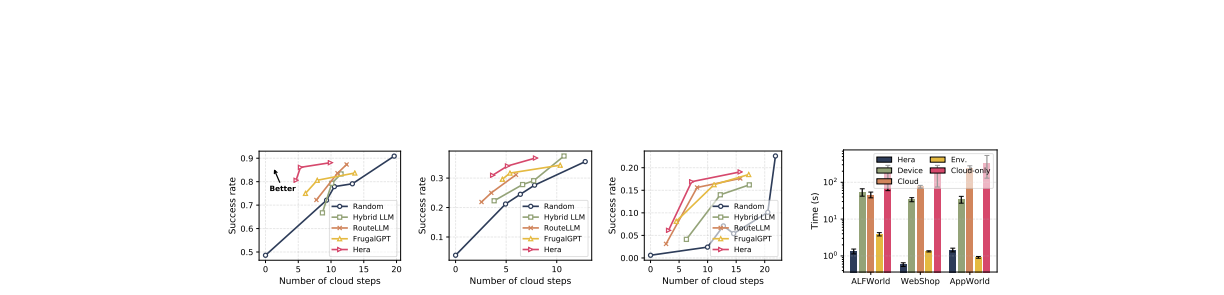

Showing 6 of the paper's 7 figures. Figures are the authors', reproduced from the paper.
References (12)
- [1] I have moved the glassbottle 1 to the diningtable 1 on Pith
- [2] However, there was no winebottle on the diningtable 1 during the last observation on Pith
- [3] The task requires me to cool a winebottle and put it on the diningtable on Pith
- [4] Since the winebottle is not on the diningtable, I need to find it elsewhere in the environment on Pith
- [5] The winebottle could be in one of the cabinets or on another countertop on Pith
- [6] I will check the cabinets and countertops systematically to find the winebottle. 8</think> 9<action> 10go to cabinet 15 11</action> Step 24: environment 1You arrive at diningtable 1. On the diningtable 1, you see a bowl 2, a bread 1, a butterknife 1, a dishsponge 1, a glassbot... on Pith
- [7] Identify the current song playing on Spotify on Pith
- [8] Check if the current song has been downloaded on Pith
- [9] If the current song has not been downloaded, skip to the next song on Pith
- [10] Repeat steps 1-3 until we find a song that has been downloaded. 7First, we need to find out the list of songs available on Spotify. We can use the ‘show_account_passwords‘ API from the ‘supervisor‘ app to get the Spotify password, then use that to authenticate with the Spotify... on Pith
- [11] Get a list of all my downloaded songs on Spotify on Pith
- [12] Continuously skip to the next song in the current playback until I find a song that is in the list of downloaded songs. 5First, I need to check if there are any APIs available for Spotify that can provide the list of downloaded songs and control the playback. I will start by l... on Pith
Cited by 3 Pith papers
Reviewed papers on Pith that cite this one. The full citation record
- AgBench: Agentic AI Benchmarks for Personal AI Devices cs.AI · Sep 2026
- Uncertainty-Guided Counterfactual Sensor Selection and Safety-Gated Recognition for Autonomous Sensing Agents in IoT Systems cs.NI · Oct 2026
- REBASE: Device-Cloud Experience Coherence for GUI Agents Across App Updates cs.DC · Sep 2026
How the literature uses it
1 arXiv paper cite this in 1 sentence
What it cites · 3 sentences without a confident label
Uses the method or tool of 1 paper
-
We use the Qwen2.5-7B-Instruct [ref] as the on-device model and the closed-source Qwen-Max API [ref] as the strong cloud oracle, respectively (other model pairs in Appendix [ref]). is initialized from the Qwen2.5-0.5B backbone [ref] and replaces the LM head with a binary classification head, resulting in a 494M-parameter model.
Qwen2.5 Technical Report · Experimental Settings · 0.99
Cites as background 8 papers
-
Recent work uses supervised fine-tuning [ref] and, in particular, reinforcement learning [ref] to enable LLM agents to learn directly from environment interactions rather than static prompts or handcrafted workflows, significantly enhancing long-horizon reasoning and multi-step decision-making and forming a promising paradigm for general-purpose autonomous intelligence [ref] .
DeepSeek-V3.2: Pushing the Frontier of Open Large Language Models · Related work · 0.83
-
Recent work uses supervised fine-tuning [ref] and, in particular, reinforcement learning [ref] to enable LLM agents to learn directly from environment interactions rather than static prompts or handcrafted workflows, significantly enhancing long-horizon reasoning and multi-step decision-making and forming a promising paradigm for general-purpose autonomous intelligence [ref] .
Gemini 2.5: Pushing the Frontier with Advanced Reasoning, Multimodality, Long Context, and Next Generation Agentic Capabilities · Related work · 0.83
-
Recent work uses supervised fine-tuning [ref] and, in particular, reinforcement learning [ref] to enable LLM agents to learn directly from environment interactions rather than static prompts or handcrafted workflows, significantly enhancing long-horizon reasoning and multi-step decision-making and forming a promising paradigm for general-purpose autonomous intelligence [ref] .
Reasoning and Tool-use Compete in Agentic RL:From Quantifying Interference to Disentangled Tuning · Related work · 0.83
Challenges and discussion
Disagree with the review, or know something it missed? Leave a comment, or challenge this review formally: a challenge becomes a permanent entry in this paper's record, and its decision is published here.
Come back by email
A short list of the week's newly reviewed papers. Nothing is sent until you confirm from your inbox, and every email has a link that stops it. No account.
No comments yet.
Sign in to comment