pith. sign in

arxiv: 2605.24621 · v1 · pith:PZHUAERNnew · submitted 2026-05-23 · 💻 cs.CV · cs.AI· cs.LG

Phase-Aware Wavelet-Based-Scattering Encoder-Decoder for Dense Predictions

Pith reviewed 2026-06-30 14:02 UTC · model grok-4.3

classification 💻 cs.CV cs.AIcs.LG
keywords scattering transformsphase preservationdense predictionimage denoisingskip connectionswaveletencoder-decoder
0
0 comments X

The pith

Preserving phase in scattering skip connections restores spatial structure for dense predictions.

A machine-rendered reading of the paper's core claim, the machinery that carries it, and where it could break.

The paper proposes a Phase-Aware Scattering Encoder-Decoder to restore spatial structure that scattering transforms lose through global averaging and translation invariance. It does so by explicitly preserving phase information inside the skip connections of the encoder-decoder. On BSD68 denoising the work reports that removing translation invariance improves PSNR by 2.17 dB while adding phase preservation supplies an extra 1.03 dB. A spatial-shuffling ablation that drops performance by 1.26 dB is used to argue that phase specifically encodes location-dependent structure. Preliminary results on ISIC segmentation are noted as work in progress.

Core claim

Scattering transforms supply Lipschitz stability and translation invariance yet discard the spatial structure required by dense prediction tasks; the Phase-Aware Scattering Encoder-Decoder restores that structure by carrying phase explicitly through skip connections, yielding measurable gains on pixel-level tasks.

What carries the argument

Phase-Aware Scattering Encoder-Decoder whose skip connections explicitly preserve phase to recover location-dependent information lost in scattering averaging.

If this is right

  • Breaking translation invariance alone improves PSNR by 2.17 dB on BSD68 denoising.
  • Phase preservation supplies an additional 1.03 dB on the same task.
  • Spatial shuffling of phase produces a 1.26 dB penalty, indicating that phase carries location-specific information.
  • The same phase-preserving mechanism shows initial applicability to skin-lesion segmentation.

Where Pith is reading between the lines

These are editorial extensions of the paper, not claims the author makes directly.

  • The same skip-connection design could be tested on other wavelet or invariant feature pipelines that currently discard phase.
  • Full cross-validation on segmentation would clarify whether the reported denoising gains generalize to other dense-prediction regimes.
  • Phase preservation might interact with downsampling choices or with other forms of invariance beyond translation.

Load-bearing premise

That preserving phase inside skip connections is what restores the spatial structure lost when scattering transforms perform global averaging.

What would settle it

An experiment on BSD68 in which phase is preserved in the skip connections yet PSNR shows no improvement, or in which spatial shuffling of phase produces no performance drop.

Figures
Figures reproduced from arXiv: 2605.24621 by Basarab Matei, Ghassen Marrakchi.

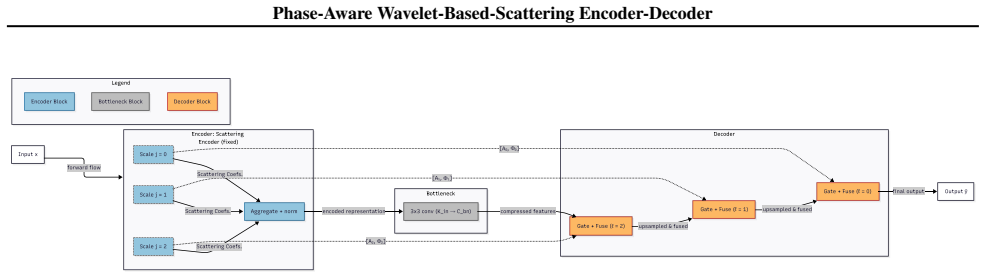
Figure 1
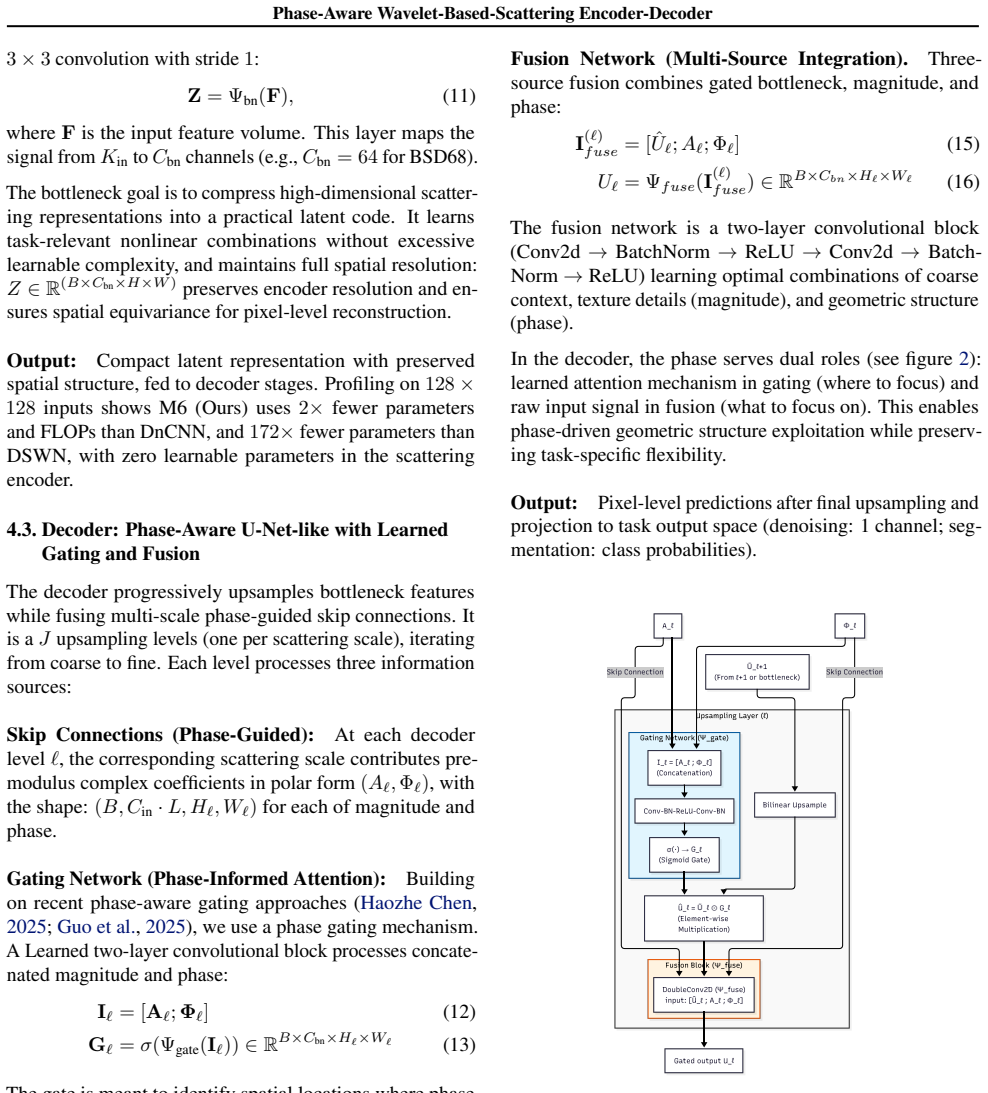
Figure 1. Figure 1: Phase Aware Wavelet-Based Scattering Encoder-Decoder: input → scattering encoder (3 scales, 8 orientations, stride-1) → aggregation and normalization → bottleneck (single 3×3 conv) → 3 decoder levels with phase-aware gating and fusion → output, with skip connection paths for (Aj , Φj ) explicitly labeled 4.1. Encoder: Scattering Transform with Stride-1 and Phase Preservation The encoder (depicted in figure… view at source ↗
Figure 2
Figure 2. Figure 2: Polar phase-aware learned gating mechanism — Showing two components: Gating and Fusion. U˜ℓ: upsampled bottleneck features (bilinear interpolation from Z at the coarsest level, or from the previous decoder output Uℓ+1 at finer levels). 4.4. Mathematical Interpretability and Task-Specific Learning Mathematical interpretability in this work refers specifically to the encoder: the fixed complex Morlet filters… view at source ↗
Figure 3
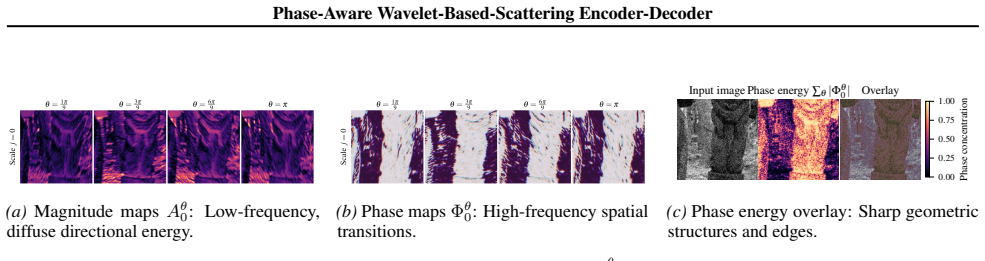
Figure 3. Figure 3: Visualizing the representational split at scale j = 0. (a) Magnitude maps A θ 0 show low-frequency, diffuse directional energy. (b) Phase maps Φ θ 0 capture high-frequency spatial transitions. (c) Phase energy overlay confirms that phase explicitly encodes the sharp geometric structures and edges, explaining the severe -1.26 dB penalty when phase is spatially shuffled ( [PITH_FULL_IMAGE:figures/full_fig_p… view at source ↗
Figure 4
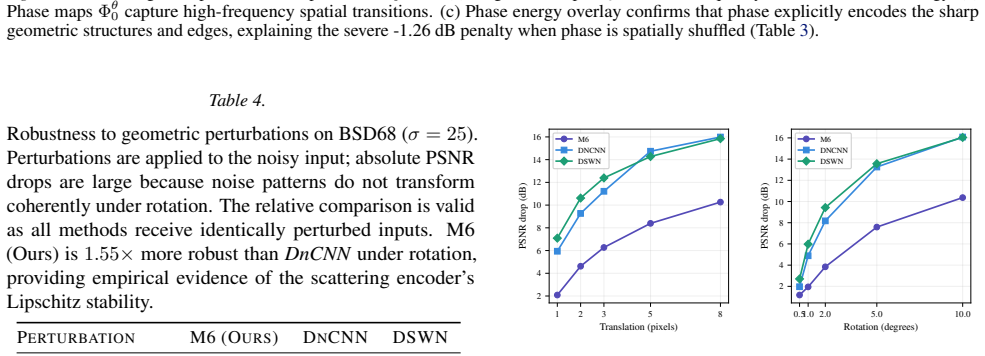
Figure 4. Figure 4: Perturbation robustness: PSNR drop from unperturbed baseline under increasing translation (left) and rotation (right) for M6 (Ours), DnCNN, and DSWN on BSD68 (σ = 25). Perturba￾tions are applied to the noisy input; all methods receive identically perturbed inputs. M6 (Ours) degrades more slowly than DnCNN and DSWN, consistent with the Lipschitz stability guarantee of the fixed scattering encoder. by compar… view at source ↗
Figure 5
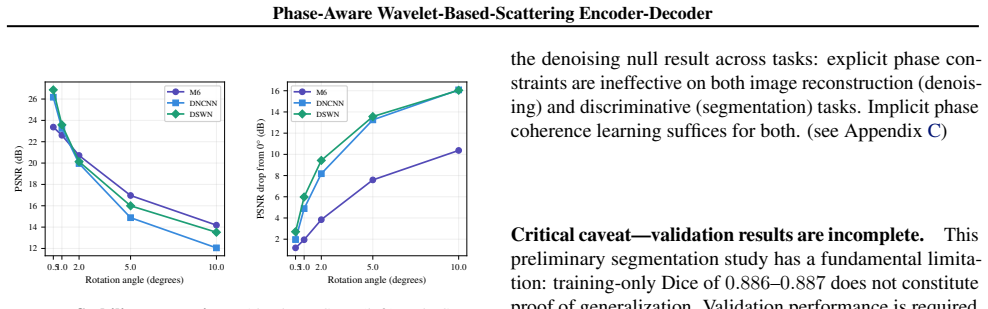
Figure 5. Figure 5: Stability comparison. Absolute PSNR (left) and PSNR drop from unperturbed baseline (right) as a function of rotation angle. M6 (Ours) starts lower in absolute PSNR but degrades more slowly: at 10◦, M6 (Ours) drops 10.4 dB vs. 16.1 dB for DnCNN (1.55× more robust). At large rotations the stability advantage partially compensates the clean-image performance gap. native methods are preferable. Consequently, t… view at source ↗
Figure 6
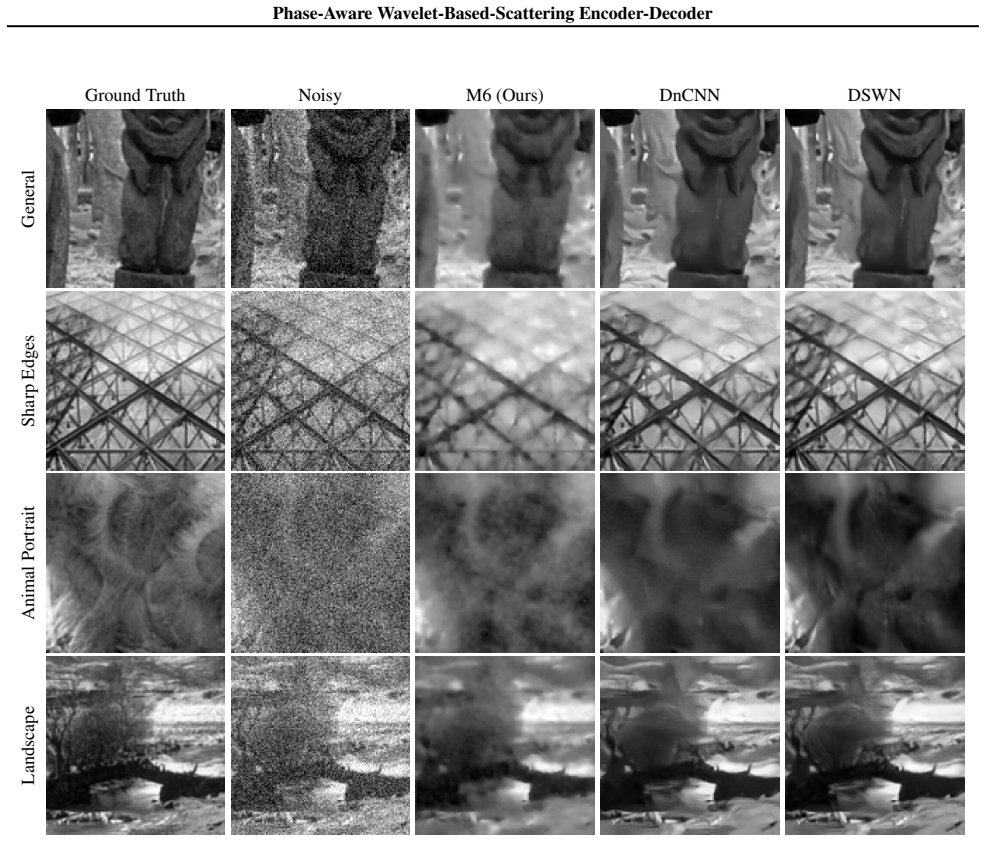
Figure 6. Figure 6: Qualitative denoising results on BSD68 (σ = 25). While DnCNN (learned) achieves higher absolute PSNR by aggressively smoothing, M6 (Ours) leverages the phase-aware scattering encoder to preserve structural integrity without relying on a black-box feature extractor. 6.1. What Didn’t Work Two design choices underperformed their theoretical mo￾tivation, yielding valuable insights into what mechanisms genuinel… view at source ↗
Figure 7
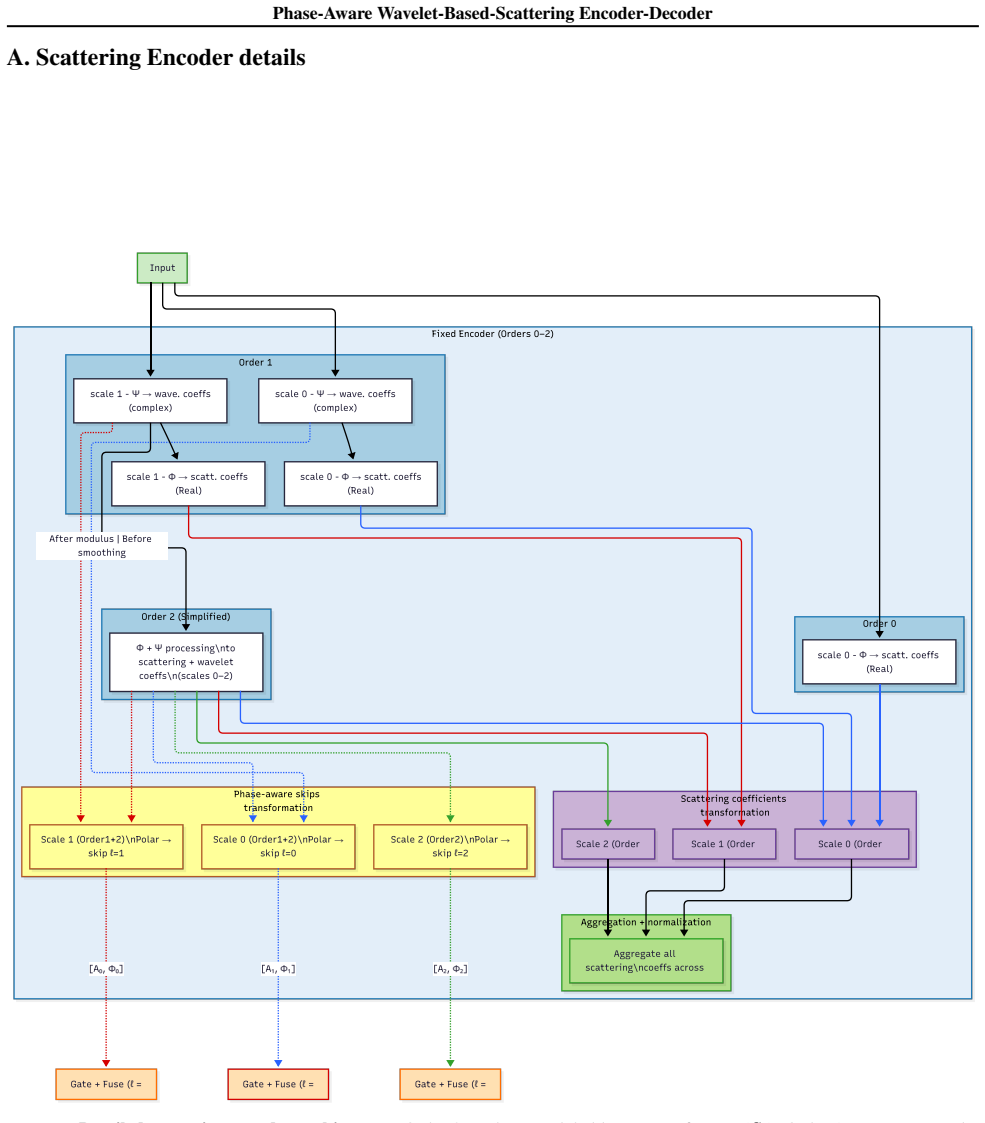
Figure 7. Figure 7: Detailed scattering encoder architecture. Order-0 produces a global low-pass reference (S0). Order-1 computes wavelet responses at each scale and orientation, then applies scale-dependent smoothing. Order-2 processes second-order paths (sibling paths). Pre-modulus complex coefficients at each scale are stored and converted to polar form (Aj , Φj ) for use in phase-aware skip connections. 12 [PITH_FULL_IMA… view at source ↗
Figure 8
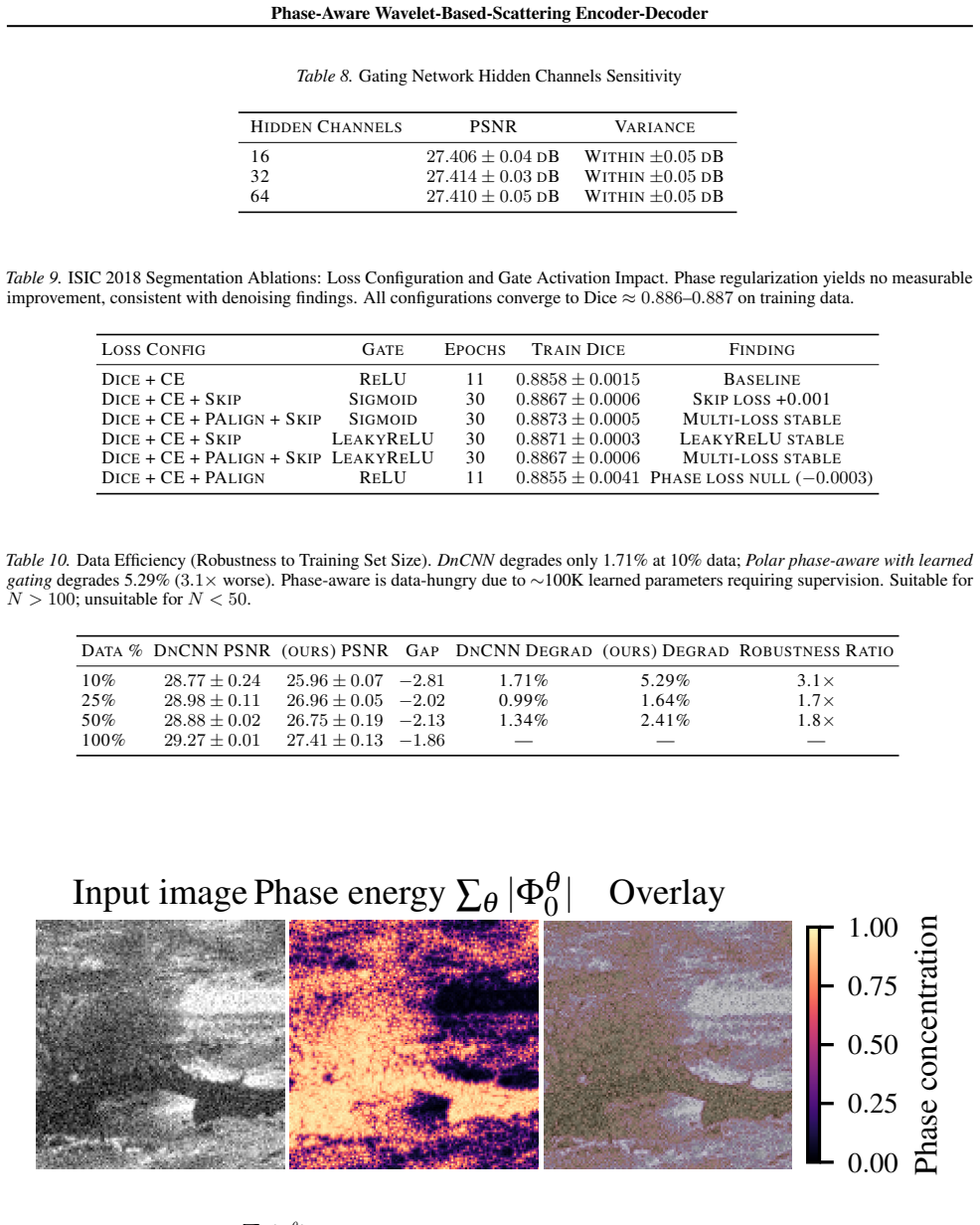
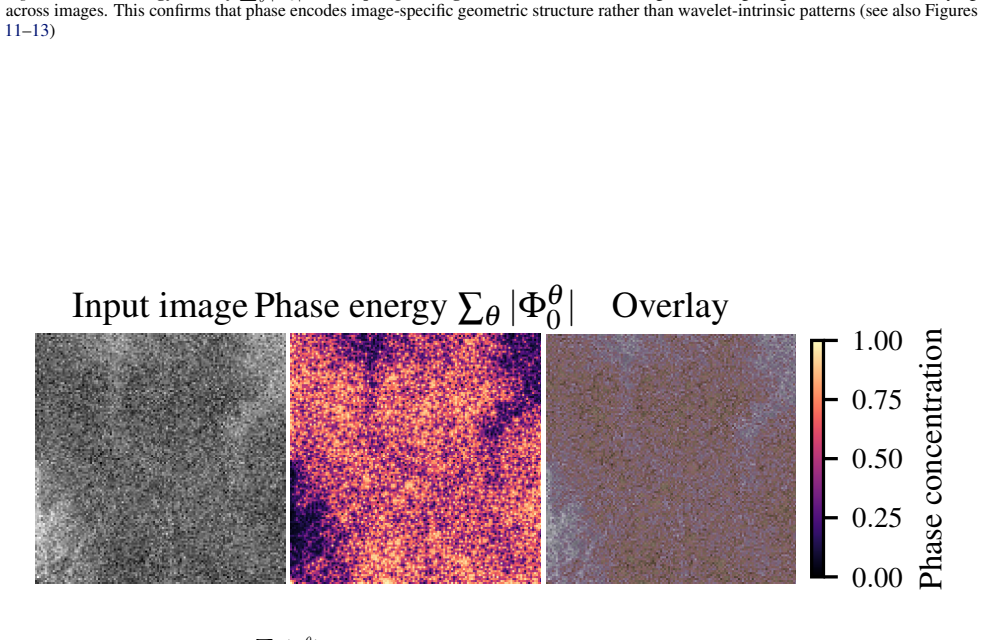
Figure 8. Figure 8: Phase energy overlay P θ |Φ θ 0| for landscape image. Phase concentration is highest at image edges and boundaries, varying across images. This confirms that phase encodes image-specific geometric structure rather than wavelet-intrinsic patterns (see also Figures 11–13) 14 [PITH_FULL_IMAGE:figures/full_fig_p014_8.png] view at source ↗
Figure 9
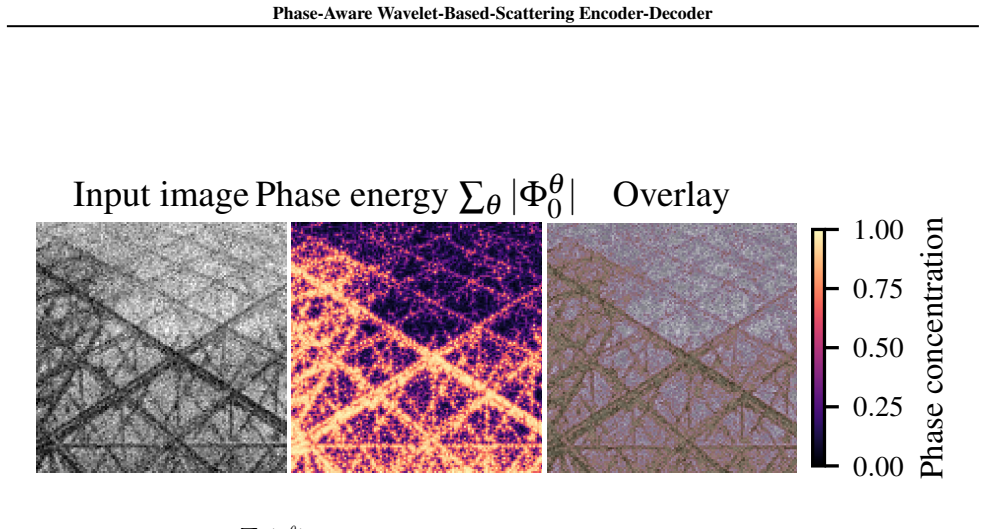
Figure 9. Figure 9: Phase energy overlay P θ |Φ θ 0| for sharp edges image. Phase concentration is highest at image edges and boundaries, varying across images. This confirms that phase encodes image-specific geometric structure rather than wavelet-intrinsic patterns (see also Figures 11–13) Input image Phase energy ∑θ |Φθ 0 | Overlay 0.00 0.25 0.50 0.75 1.00 Phase concentration [PITH_FULL_IMAGE:figures/full_fig_p015_9.png] view at source ↗
Figure 10
Figure 10. Figure 10: Phase energy overlay P θ |Φ θ 0| for animal portrait image. Phase concentration is highest at image edges and boundaries, varying across images. This confirms that phase encodes image-specific geometric structure rather than wavelet-intrinsic patterns (see also Figures 11–13) 15 [PITH_FULL_IMAGE:figures/full_fig_p015_10.png] view at source ↗
Figure 11
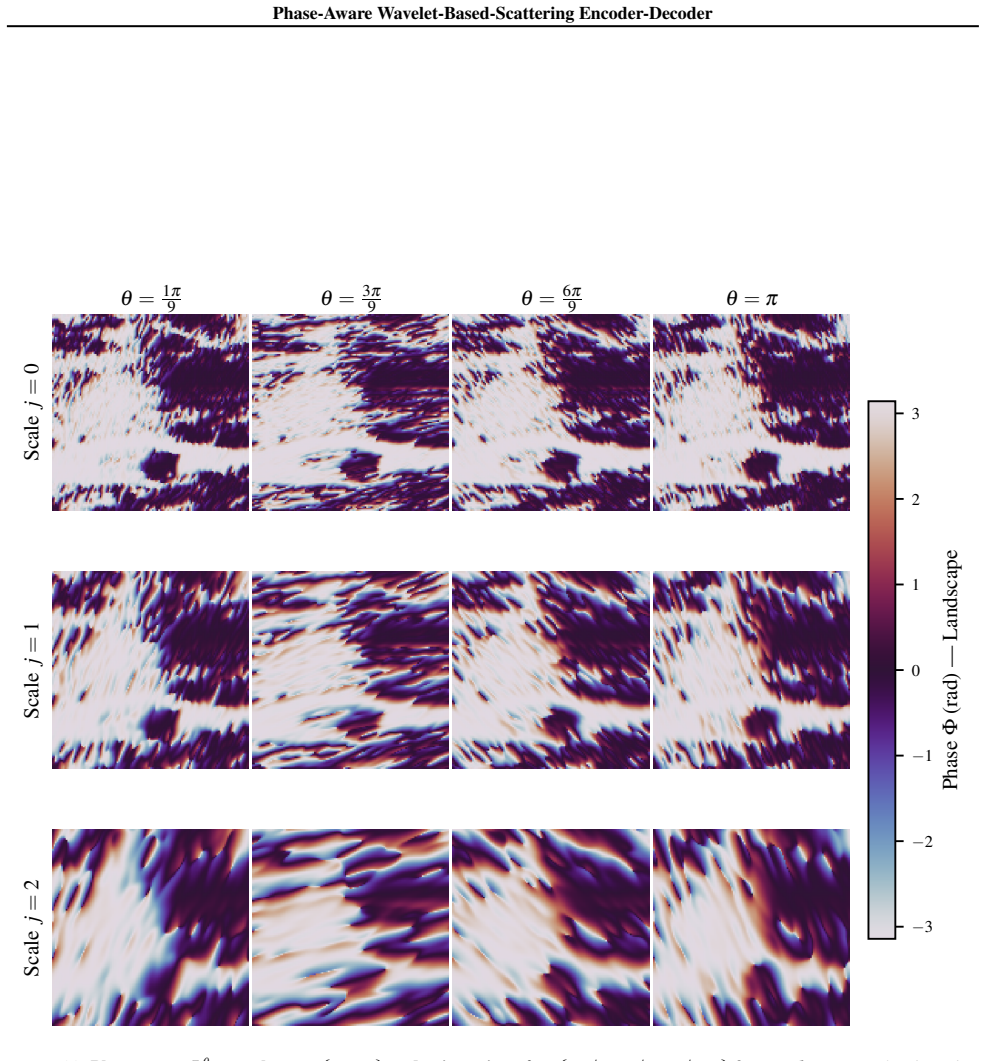
Figure 11. Figure 11: Phase maps Φ θ j at scales j ∈ {0, 1, 2} and orientations θ ∈ {1π/9, 3π/9, 6π/9, π} for Landscape. Each orientation selectively highlights edges aligned with that direction. Phase structure varies significantly across scales and across images, confirming image-dependent encoding. 16 [PITH_FULL_IMAGE:figures/full_fig_p016_11.png] view at source ↗
Figure 12
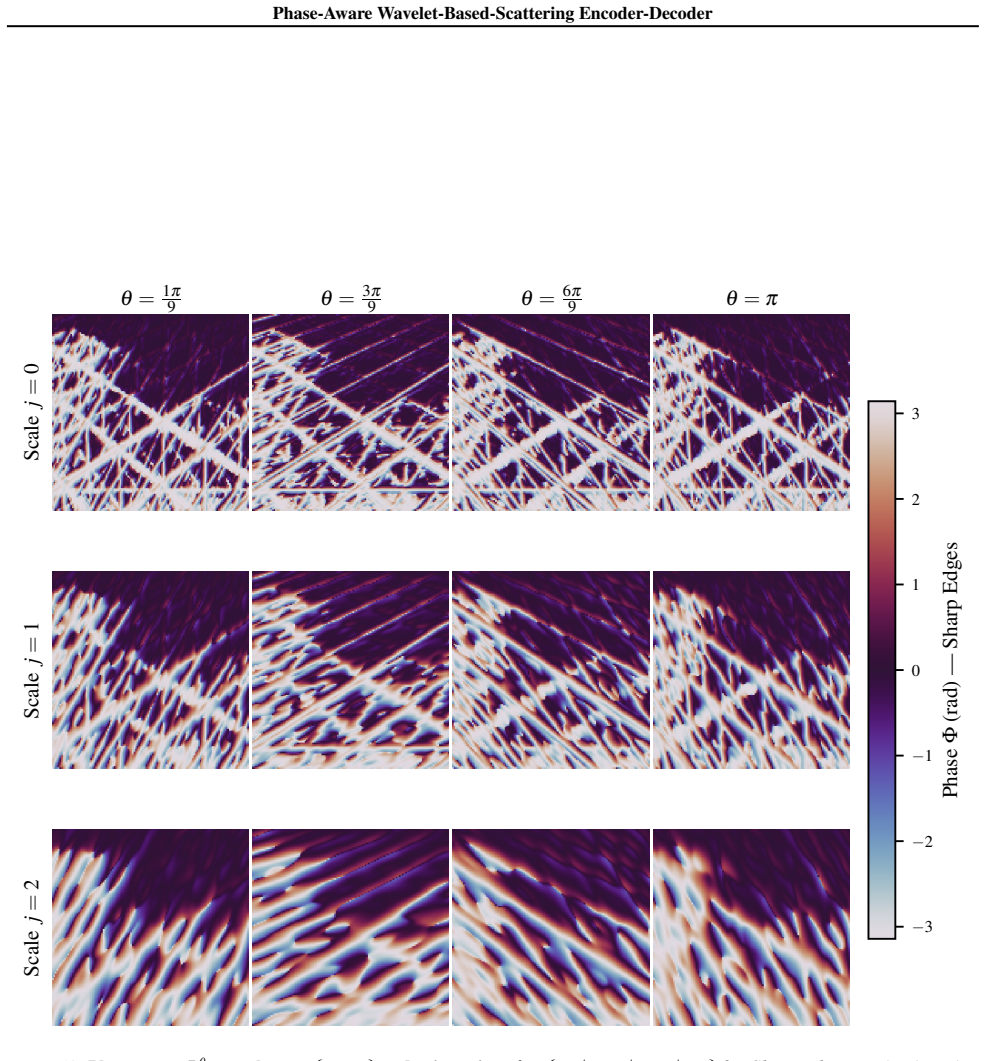
Figure 12. Figure 12: Phase maps Φ θ j at scales j ∈ {0, 1, 2} and orientations θ ∈ {1π/9, 3π/9, 6π/9, π} for Sharp Edges. Each orientation selectively highlights edges aligned with that direction. Phase structure varies significantly across scales and across images, confirming image-dependent encoding. 17 [PITH_FULL_IMAGE:figures/full_fig_p017_12.png] view at source ↗
Figure 13
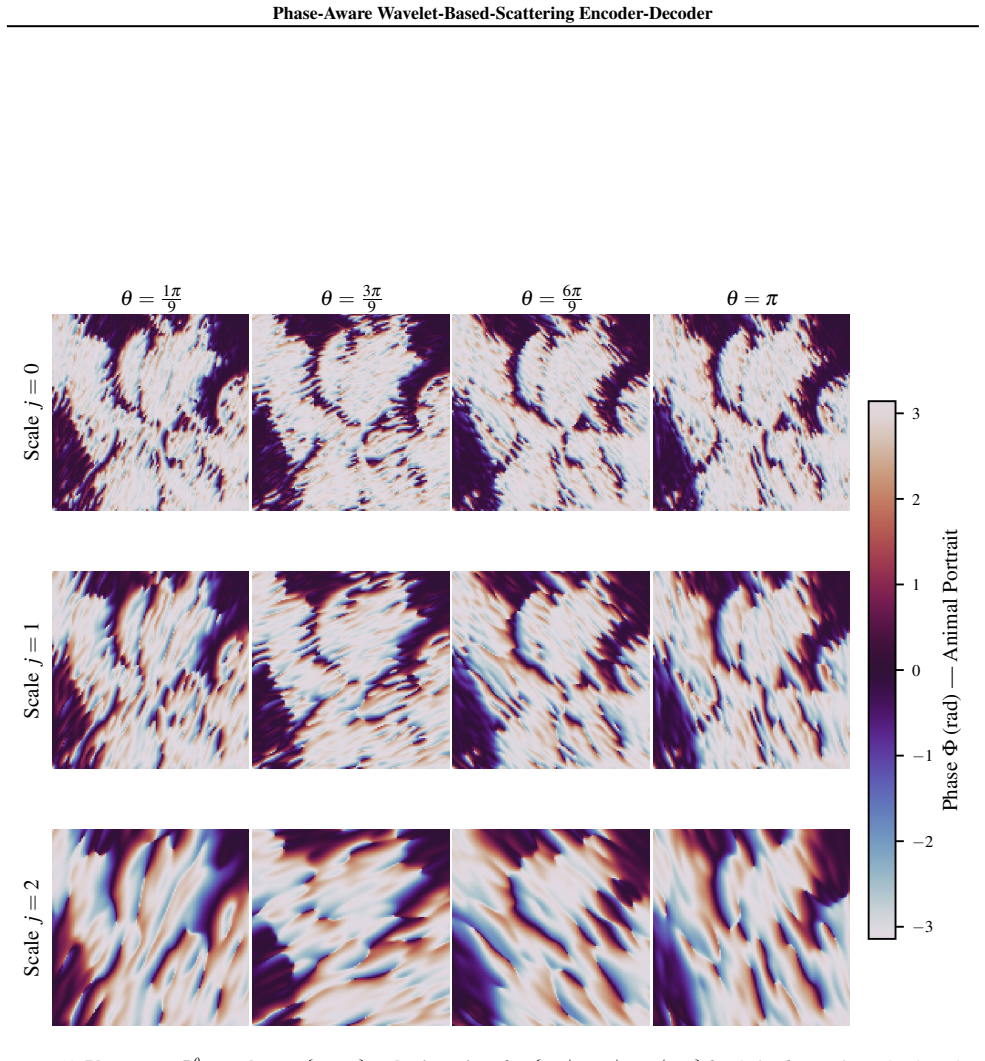
Figure 13. Figure 13: Phase maps Φ θ j at scales j ∈ {0, 1, 2} and orientations θ ∈ {1π/9, 3π/9, 6π/9, π} for Animal Portrait. Each orientation selectively highlights edges aligned with that direction. Phase structure varies significantly across scales and across images, confirming image-dependent encoding. 18 [PITH_FULL_IMAGE:figures/full_fig_p018_13.png] view at source ↗
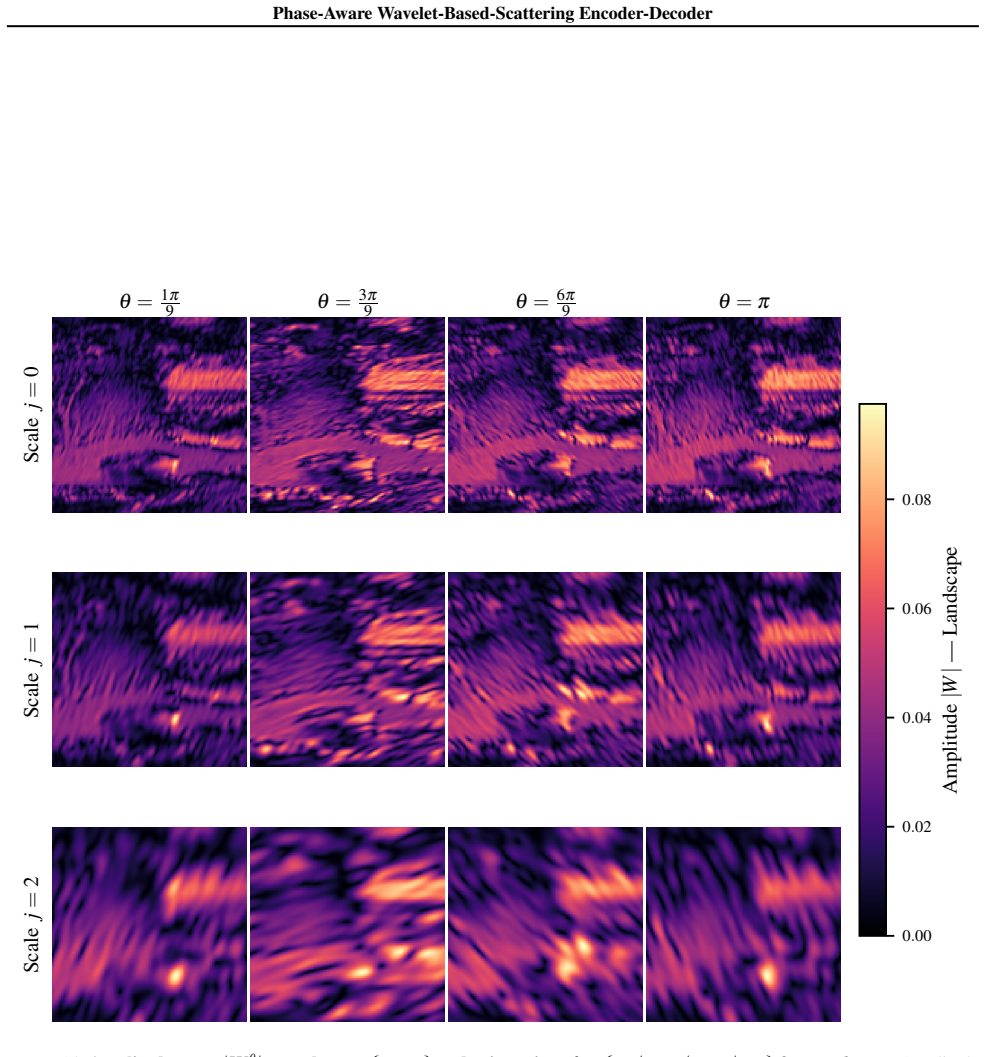
Figure 14
Figure 14. Figure 14: Amplitude maps |Wθ j | at scales j ∈ {0, 1, 2} and orientations θ ∈ {1π/9, 3π/9, 6π/9, π} for Landscape. Amplitude encodes directional energy and is smoother and less spatially localized than the corresponding phase maps (Figures 11–13), consistent with the 5.14× importance ratio in [PITH_FULL_IMAGE:figures/full_fig_p019_14.png] view at source ↗
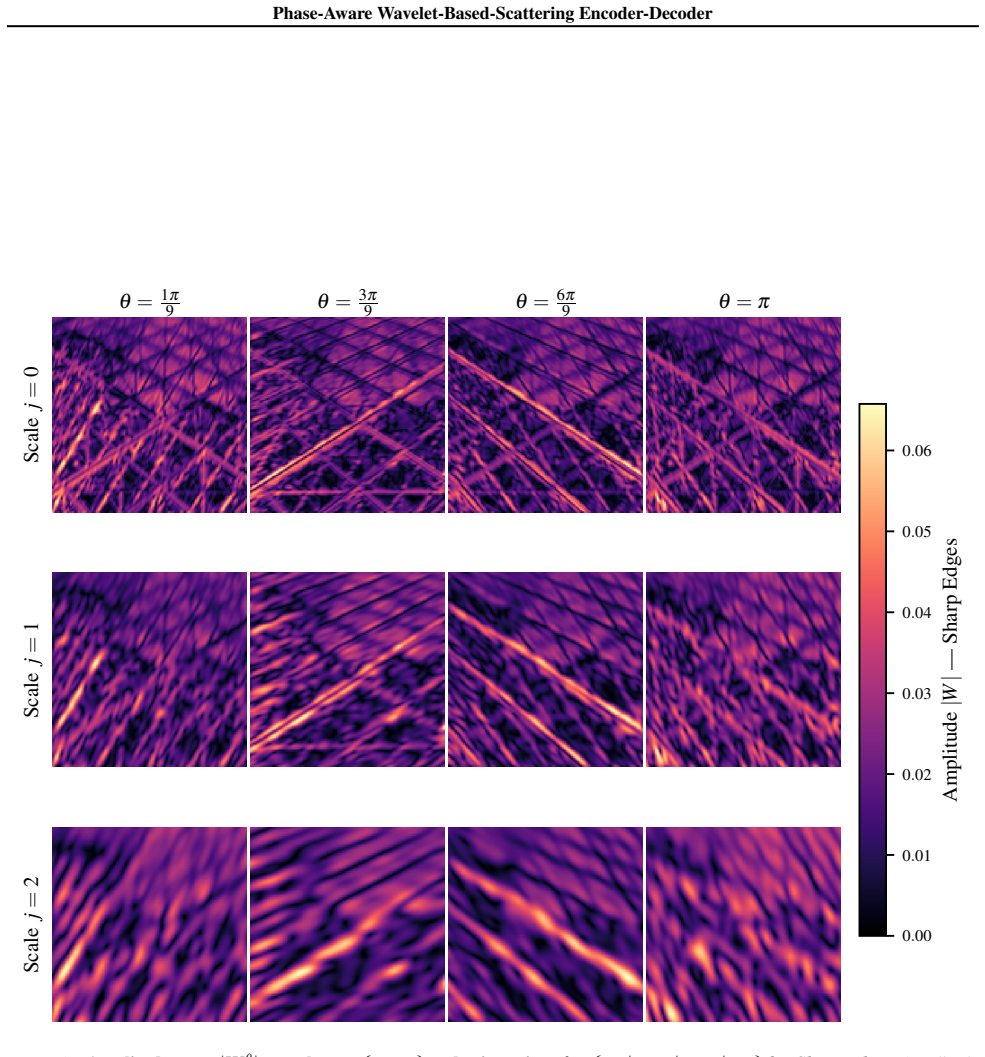
Figure 15
Figure 15. Figure 15: Amplitude maps |Wθ j | at scales j ∈ {0, 1, 2} and orientations θ ∈ {1π/9, 3π/9, 6π/9, π} for Sharp Edges. Amplitude encodes directional energy and is smoother and less spatially localized than the corresponding phase maps (Figures 11–13), consistent with the 5.14× importance ratio in [PITH_FULL_IMAGE:figures/full_fig_p020_15.png] view at source ↗
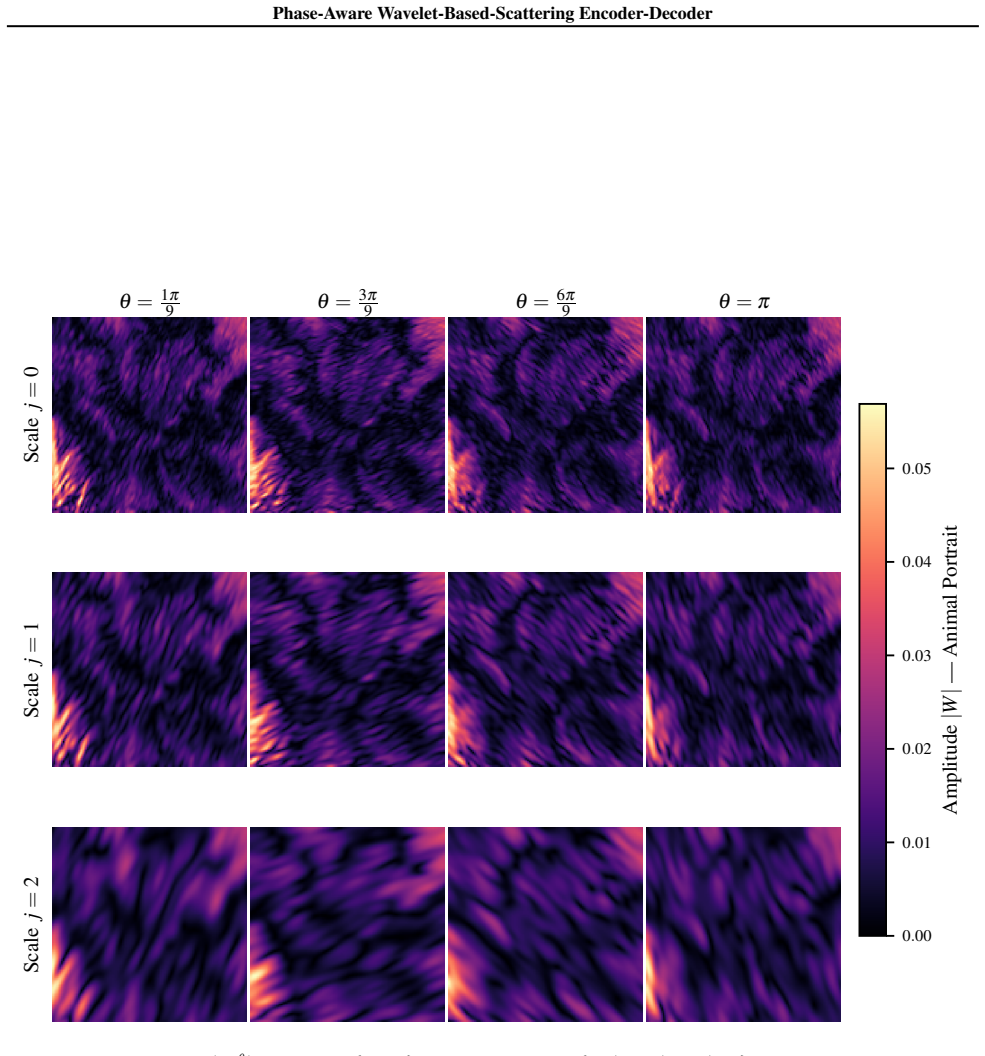
Figure 16
Figure 16. Figure 16: Amplitude maps |Wθ j | at scales j ∈ {0, 1, 2} and orientations θ ∈ {1π/9, 3π/9, 6π/9, π} for Animal Portrait. Amplitude encodes directional energy and is smoother and less spatially localized than the corresponding phase maps (Figures 11–13), consistent with the 5.14× importance ratio in [PITH_FULL_IMAGE:figures/full_fig_p021_16.png] view at source ↗
read the original abstract

Scattering transforms achieve Lipschitz stability and translation invariance, but dense prediction tasks require preserving spatial structure lost in global averaging. We propose Phase-Aware Scattering Encoder-Decoder, which restores this information by explicitly preserving phase in skip connections. On image denoising (BSD68), breaking translation invariance improves PSNR by $+2.17$~dB; phase preservation adds $+1.03$~dB. A novel spatial shuffling ablation ($-1.26$~dB penalty) demonstrates phase encodes location-dependent structure. We conduct a preliminary extensibility study on a second dense prediction task (ISIC skin lesion segmentation), with full cross-validation as ongoing work. This work advances principled wavelet-deep learning integration, showing how phase information complements scattering's stability-expressiveness trade-off in pixel-level prediction.

Editorial analysis

A structured set of objections, weighed in public.

Desk editor's note, referee report, simulated authors' rebuttal, and a circularity audit. Tearing a paper down is the easy half of reading it; the pith above is the substance, this is the friction.

Referee Report

0 major / 1 minor

Summary. The manuscript proposes a Phase-Aware Scattering Encoder-Decoder architecture that restores spatial structure for dense prediction tasks by explicitly preserving phase information in skip connections of a scattering-based network. It reports quantitative PSNR gains on BSD68 denoising (+2.17 dB from breaking translation invariance, +1.03 dB from phase preservation) and a spatial shuffling ablation (-1.26 dB penalty) to demonstrate that phase encodes location-dependent structure, along with a preliminary extensibility study on ISIC skin lesion segmentation.

Significance. If the results hold, this provides a targeted mechanism to address the stability-expressiveness trade-off in scattering transforms for pixel-level tasks, with the reported ablations offering direct empirical support for the role of phase preservation. The work contributes to principled wavelet-deep learning hybrids by showing how phase complements translation invariance without sacrificing the core stability properties.

minor comments (1)
  1. [Abstract] Abstract: the extensibility study on segmentation is described as preliminary with full cross-validation listed as ongoing work; this should be clarified in the main text to better bound the scope of the generalizability claims.

Simulated Author's Rebuttal

0 responses · 0 unresolved

We thank the referee for the constructive and positive assessment of our manuscript, including the recognition of the targeted mechanism for addressing the stability-expressiveness trade-off and the empirical support from the ablations. The recommendation for minor revision is noted, and we will incorporate any minor suggestions in the revised version. Since no specific major comments were raised in the report, we provide no point-by-point responses below.

Circularity Check

0 steps flagged

No significant circularity; empirical architecture with ablations

full rationale

The paper proposes an encoder-decoder architecture that preserves phase in skip connections to address spatial structure loss in scattering transforms, then reports direct empirical gains on BSD68 denoising (+2.17 dB from breaking invariance, +1.03 dB from phase preservation) plus a spatial-shuffling ablation (-1.26 dB). No derivation chain, fitted parameters renamed as predictions, self-definitional equations, or load-bearing self-citations appear in the provided text; the central claims rest on quantitative ablations that test the stated mechanism rather than reducing to it by construction. The work is self-contained against external benchmarks.

Axiom & Free-Parameter Ledger

0 free parameters · 2 axioms · 0 invented entities

Review based on abstract only; the approach rests on standard properties of scattering transforms and the premise that phase carries recoverable spatial information, with no free parameters, invented entities, or ad-hoc axioms explicitly listed.

axioms (2)
  • domain assumption Scattering transforms achieve Lipschitz stability and translation invariance
    Stated directly in the abstract as background property of scattering transforms.
  • domain assumption Dense prediction tasks require preserving spatial structure lost in global averaging
    Core premise invoked to motivate the phase-preserving skip connections.

pith-pipeline@v0.9.1-grok · 5662 in / 1276 out tokens · 43181 ms · 2026-06-30T14:02:27.363131+00:00 · methodology

discussion (0)

Sign in with ORCID, Apple, or X to comment. Anyone can read and Pith papers without signing in.

Reference graph

Works this paper leans on

2 extracted references · 2 canonical work pages

  1. [1]

    URL https://www.sciencedirect.com/ science/article/pii/S1361841524002056

    doi: https://doi.org/10.1016/j.media.2024.103280. URL https://www.sciencedirect.com/ science/article/pii/S1361841524002056. Cole, E., Cheng, J., Pauly, J., and Vasanawala, S. Analysis of deep complex-valued convolutional neural networks for MRI reconstruction and phase-focused applications. Magn Reson Med, 86(2):1093–1109, March 2021. Dabov, K., Foi, A., ...

  2. [2]

    Lizard: A Large -Scale Dataset for Colonic Nuclear Instance Segmentation and Classification,

    doi: 10.1109/ICCVW54120.2021.00210. Liu, P., Zhang, H., Zhang, K., Lin, L., and Zuo, W. Multi- level wavelet-cnn for image restoration. InProceedings of the IEEE conference on computer vision and pattern recognition workshops, pp. 773–782, 2018. Liu, W., Yan, Q., and Zhao, Y . Densely self-guided wavelet network for image denoising. InProceedings of the I...