REVIEW 2 major objections 1 minor 4 references
The time equation for small-amplitude pendulum motion follows from indefinite integration of an energy conservation relation.
Reviewed by Pith at T0; open to challenge. T0 means a machine referee read the full paper against a public rubric. the ladder, T0–T4 →
T0 review · grok-4.3
2026-06-30 11:56 UTC pith:KL7NSVYF
load-bearing objection This recycles the standard energy-integral route to pendulum SHM time dependence, but the arcsin step implicitly uses the same trig substitution that encodes the sinusoidal solution. the 2 major comments →
Simple Pendulums in Simple Harmonic motion
The pith
A machine-rendered reading of the paper's core claim, the machinery that carries it, and where it could break.
Core claim
By conserving mechanical energy, a relation is obtained that expresses time in terms of an integral over angle. For small angles, this integral evaluates to an inverse sine function, which inverts to give the angle as a sine function of time, all without recourse to solving the differential equation of motion.
What carries the argument
Indefinite integration of the dt = d theta / omega(theta) relation obtained from energy conservation, where omega is angular speed.
Load-bearing premise
Performing the indefinite integral produces the explicit sinusoidal time dependence without implicitly requiring mathematical operations equivalent in complexity to solving the small-angle differential equation.
What would settle it
Execute the indefinite integral starting from the energy relation for small angles and check if the result inverts to theta(t) proportional to sin(omega t) using only elementary functions and algebra.
If this is right
- The sinusoidal time dependence arises directly from the integral under the small-angle approximation.
- Mechanical energy conservation alone suffices to derive the explicit solution for time.
- No differential equation solving skills are required to find the time equation.
- The period of oscillation can be extracted from the resulting expression.
Where Pith is reading between the lines
- If the integral method works, it suggests that for other systems with quadratic potentials, energy methods can yield time dependence without DEs.
- Extending the integral without approximation would give the elliptic integral for large amplitudes.
- The method separates finding the functional form from determining the frequency constant.
Editorial analysis
A structured set of objections, weighed in public.
Referee Report
Summary. The manuscript claims to derive the explicit time-dependent solution θ(t) = θ₀ sin(ωt) for small-amplitude pendulum motion by performing an indefinite integral on the relation dθ/dt = ω √(θ₀² - θ²) obtained from mechanical-energy conservation, without solving the governing second-order differential equation.
Significance. A non-circular derivation of this form would supply a pedagogical route to SHM that begins from energy rather than from the differential equation, which could be useful in introductory mechanics if the integral step is shown to be independent of the target sinusoidal solution. The manuscript supplies no machine-checked proofs, reproducible code, or falsifiable predictions beyond the standard result.
major comments (2)
- [integral step (described in abstract and implied in the energy-derived relation)] The central derivation requires evaluating ∫ dθ / √(θ₀² - θ²) = (1/ω) arcsin(θ/θ₀) followed by inversion to obtain the sinusoidal time dependence. The standard antiderivative is obtained via the substitution θ = θ₀ sin ϕ (or equivalent trigonometric identity), which directly encodes the sinusoidal form being derived; without that substitution the integral does not yield an elementary inverse-sine expression. This step therefore rests on an implicit assumption whose technical cost is equivalent to solving d²θ/dt² + (g/L)θ = 0.
- [Abstract] No explicit integral, substitution steps, or verification that the result matches the known SHM solution is supplied in the abstract or described method; soundness of the claim that the procedure avoids the differential equation therefore cannot be assessed from the provided text.
minor comments (1)
- [Title] The title contains a grammatical inconsistency ('Simple Harmonic motion' should be 'Simple Harmonic Motion').
Simulated Author's Rebuttal
We thank the referee for the constructive comments on our manuscript. We address each major comment point by point below, with honest assessment of where revisions are warranted.
read point-by-point responses
-
Referee: [integral step (described in abstract and implied in the energy-derived relation)] The central derivation requires evaluating ∫ dθ / √(θ₀² - θ²) = (1/ω) arcsin(θ/θ₀) followed by inversion to obtain the sinusoidal time dependence. The standard antiderivative is obtained via the substitution θ = θ₀ sin ϕ (or equivalent trigonometric identity), which directly encodes the sinusoidal form being derived; without that substitution the integral does not yield an elementary inverse-sine expression. This step therefore rests on an implicit assumption whose technical cost is equivalent to solving d²θ/dt² + (g/L)θ = 0.
Authors: We agree that the standard evaluation of ∫ dθ / √(θ₀² - θ²) employs the substitution θ = θ₀ sin ϕ, which is the same trigonometric identity underlying the small-angle SHM solution. This is a substantive point. Our manuscript derives the first-order relation dθ/dt = ω √(θ₀² - θ²) directly from energy conservation (without invoking the second-order DE), then performs the indefinite integral and inverts. While the integral step uses a known antiderivative, we maintain that the overall procedure begins from energy rather than from the governing DE. Nevertheless, to address the concern we will revise the manuscript to display the substitution explicitly, note its connection to the sinusoidal form, and clarify that the pedagogical value lies in separating the energy step from direct DE solution. revision: partial
-
Referee: [Abstract] No explicit integral, substitution steps, or verification that the result matches the known SHM solution is supplied in the abstract or described method; soundness of the claim that the procedure avoids the differential equation therefore cannot be assessed from the provided text.
Authors: The abstract is deliberately concise. The full manuscript text contains the energy-derived relation and the integration step. We accept that the abstract and method description should be expanded for clarity and verifiability. We will revise both to include the explicit integral evaluation, the substitution, and a direct comparison to the standard SHM solution. revision: yes
Circularity Check
Energy integral derivation is self-contained; no reduction to inputs by construction
full rationale
The paper derives the time-of-motion relation from mechanical energy conservation followed by an indefinite integral, then inverts to obtain θ(t). No quoted equations or steps in the provided text exhibit self-definitional structure, a fitted parameter renamed as prediction, or load-bearing self-citation. The method is presented as an alternative route whose mathematical steps are independent of directly solving the small-angle DE. Standard integral tables or substitutions are external to the paper and do not constitute circularity under the rules requiring explicit paper-internal reduction.
Axiom & Free-Parameter Ledger
axioms (1)
- domain assumption Mechanical energy of the pendulum-Earth system is conserved
read the original abstract
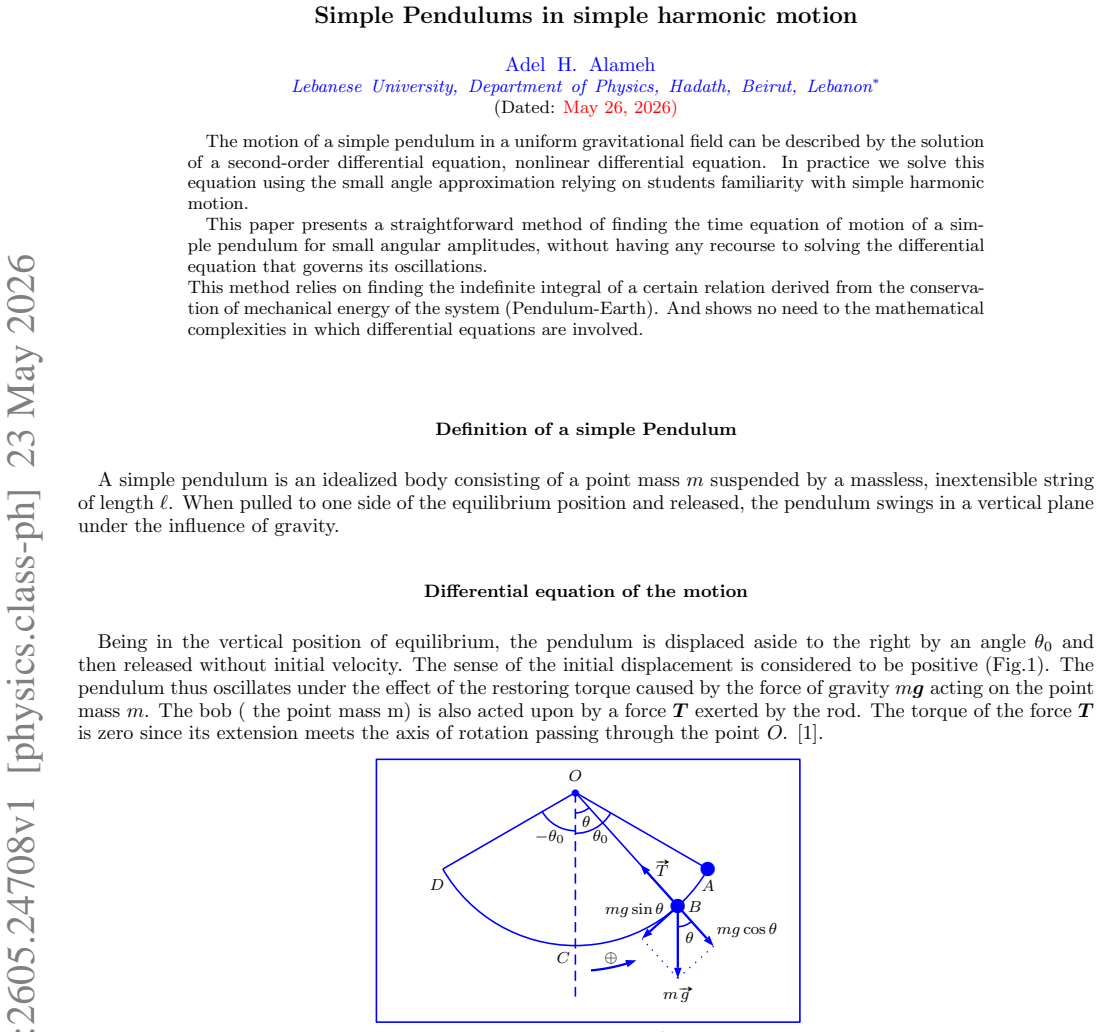
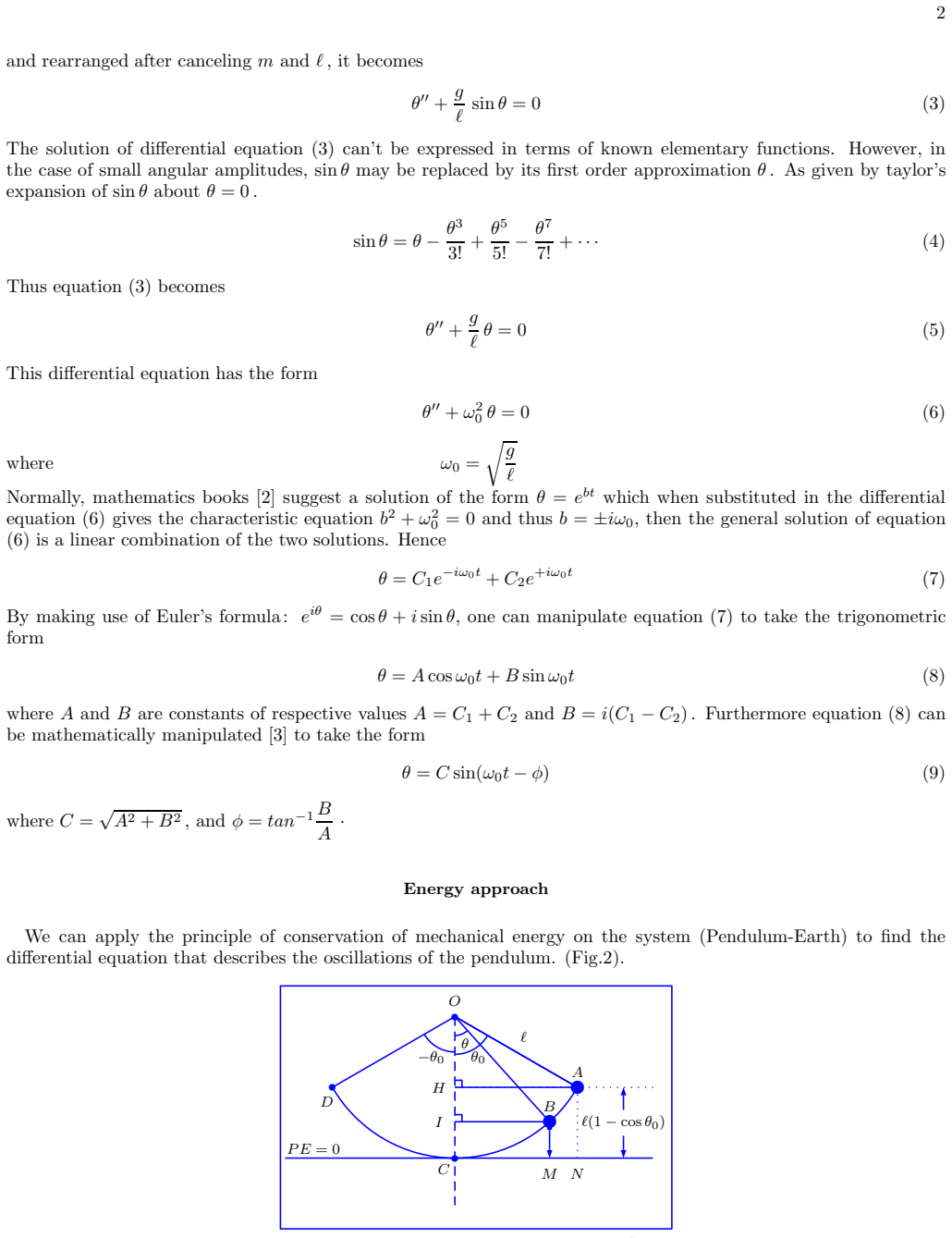
The motion of a simple pendulum in a uniform gravitational field can be described by the solution of a second-order differential equation, nonlinear differential equation. In practice we solve this equation using the small angle approximation relying on students familiarity with simple harmonic motion. This paper presents a straightforward method of finding the time equation of motion of a simple pendulum for small angular amplitudes, without having any recourse to solving the differential equation that governs its oscillations. This method relies on finding the indefinite integral of a certain relation derived from the conservation of mechanical energy of the system (Pendulum-Earth). And shows no need to the mathematical complexities in which differential equations are involved.
Figures
Reference graph
Works this paper leans on
-
[1]
Adel Alameh. Phys Teach. 61, 298-301 (2023) https://doi.org/10.1119/5.0060067. 5
-
[2]
Differential Equations and the Calculus of Variations (Mir Publishers, Moscow), p.102
L.Elsgolts. Differential Equations and the Calculus of Variations (Mir Publishers, Moscow), p.102
-
[3]
Theoretical mechanics (Schaums outline series, New York), p.92
Murray R Speigel. Theoretical mechanics (Schaums outline series, New York), p.92
-
[4]
Finding the period of a simple pendulum
Nicolas Graber- Mutchell. arXiv:1805.00002v1, [physics.class-ph] 28 Apr 2018
work page internal anchor Pith review Pith/arXiv arXiv 2018
discussion (0)
Sign in with ORCID, Apple, or X to comment. Anyone can read and Pith papers without signing in.