REVIEW 2 major objections 2 minor 99 references
Strain modifies the Dirac dispersion in WSe2 to produce controllable spin and valley polarizations through an electrostatic barrier.
Reviewed by Pith at T0; open to challenge. T0 means a machine referee read the full paper against a public rubric. the ladder, T0–T4 →
T0 review · grok-4.3
2026-06-30 00:10 UTC pith:OAP4U6G7
load-bearing objection Routine application of the strained Dirac model to WSe2 shows strain-tuned polarizations but skips lattice-level checks. the 2 major comments →
Tuning quantum tunneling in WSe₂ via strain engineering
The pith
A machine-rendered reading of the paper's core claim, the machinery that carries it, and where it could break.
Core claim
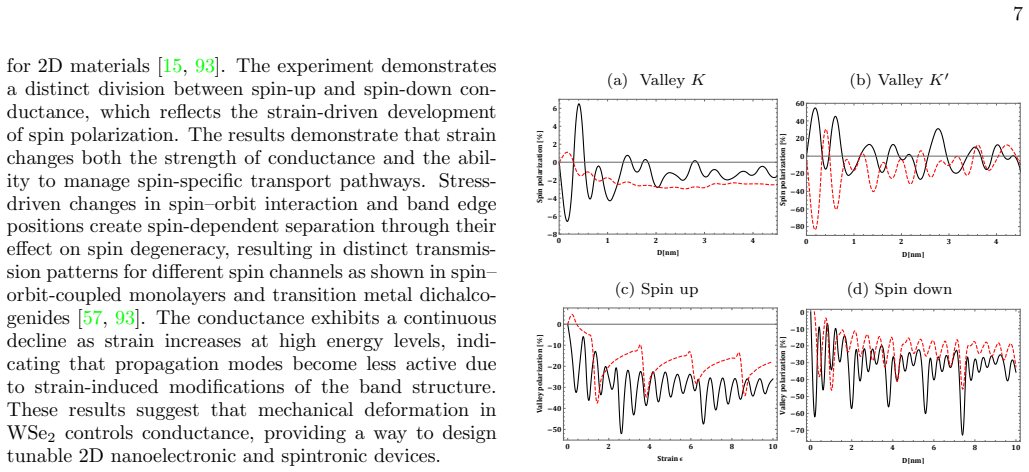
By embedding strain into the low-energy Dirac Hamiltonian for monolayer WSe2 and solving the scattering problem across an electrostatic scalar potential barrier, the authors obtain closed-form transmission amplitudes. Numerical evaluation of the resulting transmission probability, conductance, and spin/valley polarizations shows pronounced oscillatory dependence on strain, barrier height, and incident energy, with both polarizations exhibiting large and tunable variations.
What carries the argument
Strain-dependent Dirac Hamiltonian whose wave vectors are matched analytically across the three regions defined by the electrostatic barrier.
Load-bearing premise
The low-energy Dirac approximation remains valid for describing the band structure and transport of strained monolayer WSe2 in the presence of an electrostatic scalar potential barrier.
What would settle it
Transport measurements on a strained WSe2 device with a gate-defined barrier that show polarization values independent of applied strain or that lack the predicted oscillatory dependence on barrier height and energy.
If this is right
- Transmission and conductance display oscillatory behavior arising from quantum interference and resonant tunneling that varies with strain.
- Spin polarization changes substantially and systematically with strain, barrier height, and incident energy.
- Valley polarization exhibits similarly large and controllable dependence on the same parameters.
- Strain combined with electrostatic gating supplies an efficient platform for manipulating spin-valley degrees of freedom.
- The approach suggests design routes for spintronic, valleytronic, and optoelectronic devices based on transition-metal dichalcogenides.
Where Pith is reading between the lines
- The same strain-tuning mechanism could be examined in other monolayer TMDs such as MoS2 or WS2 to test material generality.
- Experimental tests would require fabricating devices with controlled uniaxial or biaxial strain and measuring valley- or spin-polarized currents through gate-defined barriers.
- The oscillatory transmission features imply possible use in strain-tunable interference filters or resonant-tunneling transistors not explicitly discussed in the work.
- Coupling the strain degree of freedom to additional perturbations such as magnetic fields or light could produce composite control schemes beyond the scope of the present model.
Editorial analysis
A structured set of objections, weighed in public.
Referee Report
Summary. The manuscript presents an analytical study of quantum transport in strained monolayer WSe₂ subject to an electrostatic scalar potential barrier. Within a low-energy Dirac Hamiltonian that incorporates strain-renormalized parameters, the authors partition the system into three regions, match wave functions at the interfaces, and obtain exact transmission amplitudes. Conductance follows from the Landauer-Büttiker formula, from which spin and valley polarizations are extracted. Numerical results are reported to show pronounced oscillatory transmission, resonant tunneling, and substantial, controllable variations in both polarizations as functions of strain, barrier height, and incident energy.
Significance. If the low-energy Dirac description remains quantitatively reliable, the work supplies an analytically tractable demonstration that strain can serve as an independent tuning knob for spin-valley polarized transport in a TMD monolayer. The explicit wave-function matching and closed-form transmission expressions allow transparent identification of interference and resonance mechanisms, which is a useful complement to purely numerical studies in the mesoscopic-transport literature.
major comments (2)
- [low-energy Dirac framework and numerical analysis sections] The central claim that strain produces 'substantial and highly controllable variations' in spin and valley polarizations rests entirely on the quantitative accuracy of the low-energy Dirac model (including any strain-induced velocity renormalization, gap modification, or pseudo-gauge terms) for the barrier heights, incident energies, and strain magnitudes considered. No tight-binding, DFT, or full-band benchmark is supplied for the same parameter set, so it is impossible to assess the size of higher-band corrections or the breakdown of linear dispersion.
- [transmission and conductance derivations] The transmission probability is obtained from current-density matching and the conductance from the Landauer-Büttiker integral, both performed inside the effective theory. Because the polarization results are exact only within this model, the absence of an error estimate or validity window (e.g., maximum strain or energy beyond which the approximation fails) makes the reported 'highly controllable' behavior difficult to translate into device-relevant predictions.
minor comments (2)
- [abstract] The abstract states that 'exact expressions for the transmission and reflection amplitudes' are derived, yet no explicit formulas or intermediate steps appear in the provided text; including at least the key matching conditions or the final transmission coefficient would improve readability.
- [model Hamiltonian] Notation for the strain-renormalized parameters (velocity, gap, etc.) should be defined once at first use and used consistently; occasional redefinition risks confusion when comparing different strain values.
Simulated Author's Rebuttal
We thank the referee for the positive summary and significance assessment. We address the two major comments below regarding the low-energy model and its implications for the reported results.
read point-by-point responses
-
Referee: The central claim that strain produces 'substantial and highly controllable variations' in spin and valley polarizations rests entirely on the quantitative accuracy of the low-energy Dirac model (including any strain-induced velocity renormalization, gap modification, or pseudo-gauge terms) for the barrier heights, incident energies, and strain magnitudes considered. No tight-binding, DFT, or full-band benchmark is supplied for the same parameter set, so it is impossible to assess the size of higher-band corrections or the breakdown of linear dispersion.
Authors: We acknowledge that the study is conducted entirely within the low-energy Dirac framework and that no direct tight-binding or DFT benchmarks for the specific parameter regime are provided. The model parameters are taken from established literature values for strained WSe2. In the revised manuscript we will add an explicit discussion of the model's validity range, referencing known energy scales (typically energies << bandwidth) and strain limits (a few percent) where the linear dispersion approximation holds for TMD monolayers. This addition will clarify the scope of the analytical results without requiring new numerical benchmarks. revision: partial
-
Referee: The transmission probability is obtained from current-density matching and the conductance from the Landauer-Büttiker integral, both performed inside the effective theory. Because the polarization results are exact only within this model, the absence of an error estimate or validity window (e.g., maximum strain or energy beyond which the approximation fails) makes the reported 'highly controllable' behavior difficult to translate into device-relevant predictions.
Authors: We agree that an explicit validity window strengthens the presentation. In revision we will insert estimates for the applicable regime, including incident energies up to ~0.5 eV and strains up to ~5-10% before nonlinear effects dominate, drawn from established properties of WSe2. This will help readers evaluate the device relevance of the polarization tunability while preserving the exact analytical expressions derived within the model. revision: yes
Circularity Check
No circularity; standard low-energy Dirac model with analytical matching
full rationale
The derivation begins from the established low-energy Dirac Hamiltonian for monolayer WSe2 (with strain-renormalized parameters), partitions the system into regions separated by a scalar barrier, solves the Dirac equation analytically in each region, and enforces continuity to obtain exact transmission amplitudes. Conductance and polarizations follow from the Landauer-Büttiker formula applied to those amplitudes. No parameters are fitted to the output quantities, no self-citation supplies a uniqueness theorem or ansatz that is itself unverified, and the central results are direct consequences of the model assumptions rather than reductions to the inputs by construction. This is the normal, non-circular workflow for effective-theory transport calculations.
Axiom & Free-Parameter Ledger
axioms (1)
- domain assumption Low-energy Dirac framework accurately captures the electronic structure of monolayer WSe2 under strain and electrostatic potential
read the original abstract
We present a comprehensive theoretical study of strain-engineered quantum transport in monolayer tungsten diselenide (WSe$_2$) in the presence of an electrostatic scalar potential. By incorporating strain effects within a low-energy Dirac framework, we analyze their impact on spin- and valley-resolved transmission, conductance, and polarization. The applied potential barrier partitions the system into three distinct regions, allowing for an analytical derivation of the wave functions in each domain. Enforcing continuity conditions at the interfaces yields exact expressions for the transmission and reflection amplitudes. The transmission probability is evaluated from the corresponding current densities, while the conductance is obtained using the Landauer-B\"uttiker formalism, enabling a quantitative determination of spin and valley polarizations. Our numerical analysis reveals that strain acts as a powerful tuning parameter that reshapes the electronic dispersion and strongly modifies transport characteristics. In particular, the transmission and conductance exhibit pronounced oscillatory behavior driven by quantum interference and resonant tunneling mechanisms. More importantly, both spin and valley polarizations display substantial and highly controllable variations as functions of strain, barrier height, and incident energy. These results demonstrate that strain and electrostatic engineering provide an efficient and versatile platform for manipulating spin-valley degrees of freedom in WSe$_2$. The ability to tailor polarization and interference effects suggests promising opportunities for the design of next-generation spintronic, valleytronic, and optoelectronic devices based on two-dimensional transition-metal dichalcogenides.
Figures



Reference graph
Works this paper leans on
-
[1]
S. Zeng, C. Liu, and P. Zhou, Nat. Rev. Electr. Eng. 1, 335 (2024)
2024
-
[2]
Y. Li, Adv. Eng. Innov. 16, 117 (2025)
2025
-
[3]
X. Zhao, P. Kumar, and S. Lee, Mater. Chem. Phys. 297, 127332 (2023)
2023
-
[4]
Ahmed and J
S. Ahmed and J. Yi, Nano-Micro Lett. 9, 50 (2017)
2017
-
[5]
Sarkar, M
S. Sarkar, M. Penumatcha, and W. H. Chang, ACS Omega 5, 12345 (2020)
2020
-
[6]
Chaves, J
A. Chaves, J. G. Azadani, H. Alsalman, D. R. da Costa, R. Frisenda, A. J. Chaves, S. H. Song, Y. D. Kim, D. He, J. Zhou, A. Castellanos-Gomez, F. M. Peeters, Z. Liu, C. L. Hinkle, S. Oh, P. D. Ye, S. Koester, Y. H. Lee, P. Avouris, X. Wang, and T. Low, npj 2D Mater. Appl. 4, 29 (2020)
2020
-
[7]
Wurstbauer, B
U. Wurstbauer, B. Miller, E. Parzinger, and A. W. Holleitner, J. Phys. D: Appl. Phys. 50, 173001 (2017)
2017
-
[8]
Li and J
H. Li and J. Wang, J. Optoelectron. Mater. 10, 321 (2022)
2022
-
[9]
Fujisawa, N
T. Fujisawa, N. Hu, T. Kojima, T. Egawa, and M. Miyoshi, Semicond. Sci. Technol. 39, 045010 (2024). 10
2024
-
[10]
Li and X
J. Li and X. Wang, J. Semicond. 38, 031002 (2017)
2017
-
[11]
Zhang, X
Q. Zhang, X. Zhang, Z. Zhu, and C. Guo, Nanomaterials 15, 1124 (2025)
2025
-
[12]
Thayil, S
R. Thayil, S. Reddy Parne, and C. V. Ramana, Small 21, e2412467 (2025)
2025
-
[13]
K. S. Novoselov, A. K. Geim, S. V. Morozov, D. Jiang, Y. Zhang, S. V. Dubonos, I. V. Grigorieva, and A. A. Firsov, Science 306, 666 (2004)
2004
-
[14]
A. K. Geim and K. S. Novoselov, Nat. Mater. 6, 183 (2007)
2007
-
[15]
A. H. Castro Neto, F. Guinea, N. M. R. Peres, K. S. Novoselov, and A. K. Geim, Rev. Mod. Phys. 81, 109 (2009)
2009
-
[16]
K. S. Novoselov, A. K. Geim, S. V. Morozov, D. Jiang, M. I. Katsnelson, I. V. Grigorieva, S. V. Dubonos, and A. A. Firsov, Nature 438, 197 (2005)
2005
-
[17]
Avouris, Nano Lett
P. Avouris, Nano Lett. 10, 4285 (2010)
2010
-
[18]
A. A. Balandin, S. Ghosh, W. Bao, I. Calizo, D. Teweldebrhan, F. Miao, and C. N. Lau, Nano Lett. 8, 902 (2008)
2008
-
[19]
F. Xia, D. B. Farmer, Y.-M. Lin, and P. Avouris, Nano Lett. 10, 715 (2010)
2010
-
[20]
Schwierz, Nat
F. Schwierz, Nat. Nanotechnol. 5, 487 (2010)
2010
-
[21]
M. Y. Han, B. ¨Ozyilmaz, Y. Zhang, and P. Kim, Phys. Rev. Lett. 98, 206805 (2007)
2007
-
[22]
N. Huo, Y. Yang, and J. Li, J. Semicond. 38, 031002 (2017)
2017
-
[23]
Podzorov, M
V. Podzorov, M. E. Gershenson, C. Kloc, R. Zeis, and E. Bucher, Appl. Phys. Lett. 84, 3301 (2004)
2004
-
[24]
Li and H
X. Li and H. Zhu, J. Materiomics 1, 33 (2015)
2015
-
[25]
Q. H. Wang, K. Kalantar-Zadeh, A. Kis, J. N. Coleman, and M. S. Strano, Nat. Nanotechnol. 7, 699 (2012)
2012
-
[26]
Chhowalla, H
M. Chhowalla, H. S. Shin, G. Eda, L.-J. Li, K. P. Loh, and H. Zhang, Nat. Chem. 5, 263 (2013)
2013
-
[27]
Manzeli, D
S. Manzeli, D. Ovchinnikov, D. Pasquier, O. V. Yazyev, and A. Kis, Nat. Rev. Mater. 2, 17033 (2017)
2017
-
[28]
J. N. Coleman, M. Lotya, A. O’Neill, S. D. Bergin, P. J. King, U. Khan, K. Young, A. Gaucher, S. De, R. J. Smith, I. V. Shvets, S. K. Arora, G. Stanton, H.-Y. Kim, K. Lee, G. T. Kim, G. S. Duesberg, T. Hallam, J. J. Boland, J. J. Wang, J. F. Donegan, J. C. Grunlan, G. Moriarty, A. Shmeliov, R. J. Nicholls, J. M. Perkins, E. M. Grieveson, K. Theuwissen, D....
2011
-
[29]
W. Zhao, Z. Ghorannevis, L. Chu, M. Toh, C. Kloc, P.-H. Tan, and G. Eda, ACS Nano 7, 791 (2013)
2013
-
[30]
H. Li, Q. Zhang, C. C. R. Yap, B. K. Tay, T. H. T. Ed- win, A. Olivier, and D. Baillargeat, Adv. Funct. Mater. 22, 1385 (2013)
2013
-
[31]
Bertolazzi, J
S. Bertolazzi, J. Brivio, and A. Kis, ACS Nano 5, 9703 (2011)
2011
-
[32]
R. C. Cooper, C. Lee, C. A. Marianetti, X. Wei, J. Hone, and J. W. Kysar, Phys. Rev. B 87, 035423 (2013)
2013
-
[33]
Voiry, J
D. Voiry, J. Yang, and M. Chhowalla, Chem. Soc. Rev. 44, 2702 (2015)
2015
-
[34]
G. Eda, T. Fujita, H. Yamaguchi, D. Voiry, M. Chen, and M. Chhowalla, ACS Nano 6, 7311 (2012)
2012
-
[35]
Y.-C. Lin, D. O. Dumcenco, Y.-S. Huang, and K. Sue- naga, Nat. Nanotechnol. 9, 391 (2014)
2014
-
[36]
Z. Y. Zhu, Y. C. Cheng, and U. Schwingenschl¨ ogl, Phys. Rev. B 84, 153402 (2011)
2011
-
[38]
G. Wang, L. Bouet, D. Lagarde, M. Vidal, A. Balocchi, T. Amand, X. Marie, and B. Urbaszek, Phys. Rev. B 92, 075408 (2015)
2015
-
[39]
B. Amin, T. P. Kaloni, and U. Schwingenschl¨ ogl, RSC Adv. 4, 34561 (2014)
2014
-
[40]
O. B. Aslan, M. Deng, M. L. Brongersma, and T. F. Heinz, Phys. Rev. B 101, 115305 (2020)
2020
-
[41]
H. J. Conley, B. Wang, J. I. Ziegler, R. F. Haglund, S. T. Pantelides, and K. I. Bolotin, Nano Lett. 13, 3626 (2013)
2013
-
[42]
K. L. Seyler, W. Wang, X. Xu, X. Yang, Y. Liu, and M. S. Fuhrer, Nat. Mater. 16, 991–995 (2017)
2017
-
[43]
Yang, W.-H
Y. Yang, W.-H. Fang, A. Benderskii, R. Long, and O. V. Prezhdo, J. Phys. Chem. Lett. 10, 7732 (2019)
2019
-
[44]
X. Cui, C. Wang, H. Wang, X. Zhang, and C. Zhang, Nat. Commun. 5, 3663 (2014)
2014
-
[45]
X. Wang, X. Li, and C. Mi, J. Chem. Phys. 163, 074703 (2025)
2025
-
[46]
K. Kim, Y. A. Lee, J. C. Park, and J. Hone, Nano Lett. 10, 946 (2010)
2010
-
[47]
H. Zhou, Y. Xu, S. Liu, and L. Wang, J. Mater. Chem. C 3, 3331 (2015)
2015
-
[48]
S. Yang, Y. Chen, and C. Jiang, InfoMat 3, 397 (2021)
2021
-
[49]
Z. Peng, X. Chen, Y. Fan, D. J. Srolovitz, and D. Y. Lei, Light Sci. Appl. 9, 190 (2020)
2020
-
[50]
Y.-M. He, G. Clark, J. R. Schaibley, Y. He, M.-C. Chen, Y.-J. Wei, X. Ding, Q. Zhang, W. Yao, X. Xu, and C.-Y. Lu, J.-W. Pan, Nature Nanotechnol. 10, 497 (2015)
2015
-
[51]
Kumar, A
S. Kumar, A. Kaczmarczyk, and B. D. Gerardot, Nano Lett. 15, 7567 (2015)
2015
-
[52]
Branny, S
A. Branny, S. Kumar, R. Proux, and B. D. Gerardot, Nat. Commun. 8, 15053 (2017)
2017
-
[53]
Palacios-Berraquero, D
C. Palacios-Berraquero, D. M. Kara, A. R.-P. Mont- blanch, M. Barbone, P. Latawiec, D. Yoon, A. K. Ott, M. Loncar, A. C. Ferrari, and M. Atat¨ ure, Nat. Com- mun. 8, 15093 (2017)
2017
-
[54]
Linglong Zhang, Yilin Tang, Ahmed Raza Khan, Md Mehedi Hasan, Ping Wang, and Han Yan, Adv. Sci. 7, 2002697 (2020)
2020
-
[55]
H. Fang, C. Battaglia, C. Carraro, S. Nemsak, B. ¨Ozdol, J. S. Kang, H. A. Bechtel, S. B. Desai, F. Kronast, A. A. ¨Unal, G. Conti, C. Conlon, G. K. Palsson, M. C. Martin, A. M. Minor, C. S. Fadley, E. Yablonovitch, R. Maboudian, and A. Javey, Proc. Natl. Acad. Sci. U.S.A. 111, 6198 (2014)
2014
-
[56]
A. K. Geim and I. V. Grigorieva, Nature 499, 419 (2013)
2013
-
[57]
Xiao, G.-B
D. Xiao, G.-B. Liu, W. Feng, X. Xu, and W. Yao, Phys. Rev. Lett. 108, 196802 (2012)
2012
-
[58]
Korm´ anyos, G
A. Korm´ anyos, G. Burkard, M. Gmitra, J. Fabian, V. Z´ olyomi, N. D. Drummond, and V. Fal’ko, 2D Mater. 2, 022001 (2015)
2015
-
[59]
J. Seo, K. Cho, W. Lee, J. Shin, J.-K. Kim, S. Kim, and H. Kim, Nanoscale Res. Lett. 14, 3137 (2019)
2019
-
[60]
N. R. Pradhan, D. Rhodes, S. Memaran, J. M. Poumirol, D. Smirnov, S. Talapatra, S. Feng, N. Perea-Lopez, A. L. Elias, M. Terrones, P. M. Ajayan, and L. Balicas, Sci. Rep. 5, 8979 (2015)
2015
-
[61]
P. R. Pudasaini, M. G. Stanford, A. Oyedele, A. T. Wong, A. N. Hoffman, D. P. Briggs, K. Xiao, D. G. Mandrus, Th. Z. Ward, and P. D. Rack, Nanotechnology 28, 475202 (2017)
2017
-
[62]
S. Chen, Y. Zhang, W. P. King, R. Bashir, and A. 11 M. van der Zande, Adv. Electron. Mater. 11, 2400843 (2025)
2025
-
[63]
Fathipour, T
S. Fathipour, T. A. Zeylikovich, and A. A. Balandin, J. Appl. Phys. 120, 234902 (2016)
2016
-
[64]
Ghosh, A
S. Ghosh, A. R. Graves, M. U. K. Sadaf, L. Wang, and D. Zhang, Nat. Commun. 16, 59684 (2025)
2025
-
[65]
K. F. Mak, K. He, J. Shan, and T. F. Heinz, Nat. Nan- otechnol. 7, 494 (2012)
2012
-
[66]
O. L. S´ anchez, D. Ovchinnikov, S. Misra, A. Allain, and A. Kis, Nano Lett. 16, 5792 (2016)
2016
-
[67]
J. R. Schaibley, H. Yu, G. Clark, P. Rivera, J. S. Ross, K. L. Seyler, W. Yao, and X. Xu, Nat. Rev. Mater. 1, 16055 (2016)
2016
-
[68]
Huard, J
B. Huard, J. A. Sulpizio, N. Stander, K. Todd, B. Yang, and D. Goldhaber-Gordon, Phys. Rev. Lett, 98, 236803 (2007)
2007
-
[69]
S. Yang, Y. Chen, and C. Jiang, InfoMat, 3, 397 (2021)
2021
-
[70]
C. Sun, J. Zhong, Z. Gan, Y. Li, X. Wang, H. Zhang, Q. Liu, M. Chen, L. Zhou, J. Zhao, P. Huang, T. Wu, and K. Xu, Microsyst Nanoeng, 10, 49 (2024)
2024
-
[71]
Ramasubramaniam, Phys
A. Ramasubramaniam, Phys. Rev. B 86, 115409 (2012)
2012
-
[72]
S. Fang, S. Carr, M. A. Cazalilla, and E. Kaxiras, Phys. Rev. B 98, 075106 (2018)
2018
-
[73]
Q. Yue, J. Kang, Z. Shao, X. Zhang, S. Chang, G. Wang, S. Qin, and J. Li, Phys. Lett. A 376, 1166 (2012)
2012
-
[74]
M. I. Katsnelson, K. S. Novoselov, and A. K. Geim, Nat. Phys. 2, 620 (2006)
2006
-
[75]
N. Gu, M. Rudner, and L. S. Levitov, Phys. Rev. Lett. 107, 156603 (2011)
2011
-
[76]
C. W. J. Beenakker, Rev. Mod. Phys. 80, 1337 (2008)
2008
-
[77]
J. M. Pereira, V. Mlinar, and F. M. Peeters, Phys. Rev. B 74, 045424 (2006)
2006
-
[78]
Zarenia, J
M. Zarenia, J. M. Pereira, G. A. Farias, and F. M. Peeters, Phys. Rev. B 87, 035426 (2013)
2013
-
[79]
G.-B. Liu, D. Xiao, Y. Yao, X. Xu, and W. Yao, Chem. Soc. Rev. 44, 2643 (2015)
2015
-
[80]
Rostami and R
H. Rostami and R. Asgari, Phys. Rev. B 91, 075433 (2015)
2015
-
[81]
Rold´ an, A
R. Rold´ an, A. Castellanos-Gomez, E. Cappelluti, and F. Guinea, Phys. Rev. B 88, 115420 (2013)
2013
discussion (0)
Sign in with ORCID, Apple, or X to comment. Anyone can read and Pith papers without signing in.