REVIEW 2 major objections 18 references
Time-Symmetry of Lagrangian Coherent Structures in Active Turbulence
T0 review · 2 major / 0 minor · reviewed 2026-06-29 · grok-4.3
Pith's one-line read Active turbulence displays time symmetry between attracting and repelling Lagrangian structures.
desk verdict The paper reports time-symmetry in LCS for active turbulence as a new observation, but the abstract leaves the numerical robustness uncheckable. read the letter →
The pith
A machine-rendered reading of the paper's core claim, the machinery that carries it, and where it could break.
The reading
What carries the argument
Lagrangian Coherent Structures ridges extracted from Finite-Time Lyapunov Exponent fields, which locate the hyperbolic attracting and repelling surfaces that organize mixing.
What would settle it
An experimental measurement of particle trajectories in a real bacterial suspension that yields statistically significant asymmetry between forward-time and backward-time LCS ridge statistics at matched activity levels.
Extended reading notes
Core claim
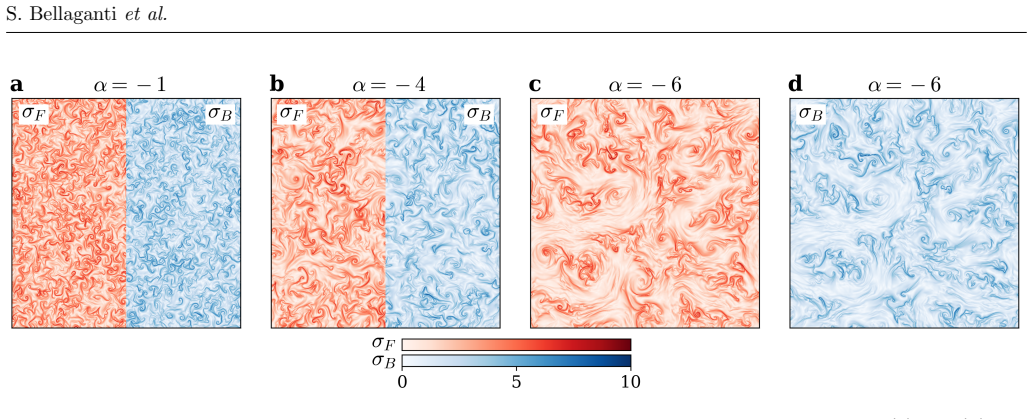
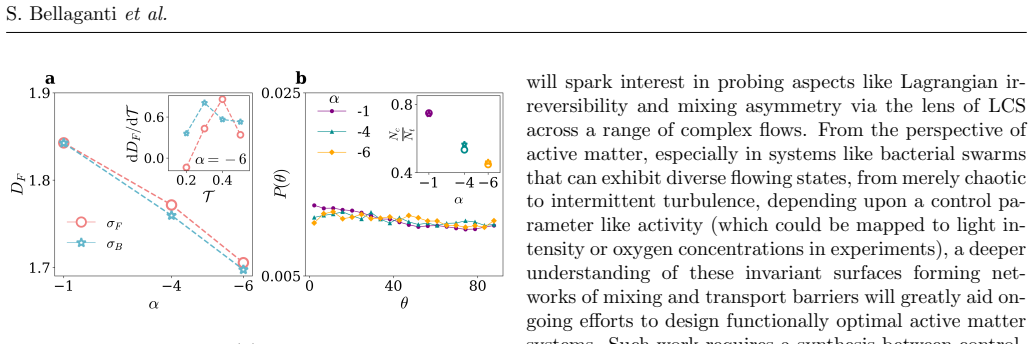
Using Lagrangian Coherent Structures we uncover networks of attracting and repelling hyperbolic surfaces in active turbulence. Despite vorticity dominance, extreme forward and backward chaotic mixing originates from straining regions. Fractal dimensions of the ridges show morphological simplification with rising activity while isotropy of crossings is retained. Signatures of Lagrangian irreversibility are absent; instead a striking time symmetry appears between attracting and repelling structures. The work therefore links flow structures in active turbulence to invariant mixing surfaces.
Load-bearing premise
The Finite-Time Lyapunov Exponent fields computed in the numerical model faithfully identify the dominant mixing structures without artifacts from the specific activity range or vorticity dominance.
Editorial extensions
If this is right
- Increasing activity alters FTLE distributions and spectra, producing simpler LCS networks.
- Straining saddles, not vortical regions, account for the extreme chaotic mixing observed.
- LCS networks retain isotropic crossing angles even after morphological simplification.
- Attracting and repelling structures remain statistically indistinguishable in forward and backward time.
Reading between the lines
- Activity modulation protocols could therefore seed or suppress mixing surfaces symmetrically in time.
- The observed symmetry may indicate a hidden conservation property in the Lagrangian description of active flows.
- Similar time-symmetric LCS behavior could be tested in other dense active-matter systems that exhibit anomalous transport.
Signed reviews
Editorial analysis
A structured set of objections, weighed in public.
Referee Report
Summary. The manuscript examines Lagrangian Coherent Structures (LCS) in active turbulence via forward and backward Finite-Time Lyapunov Exponent (FTLE) fields. It reports networks of attracting and repelling hyperbolic surfaces, changes in FTLE distribution and spectra with increasing activity, extreme mixing originating from straining regions (saddles) despite vorticity dominance, morphological simplification of LCS ridges (via fractal dimensions) with retained isotropic crossing, and a striking time-symmetry between forward and backward LCS with no signatures of Lagrangian irreversibility. The work positions these findings as initial steps toward linking active-turbulence structures to invariant mixing surfaces.
Significance. If the reported time-symmetry and straining-region dominance hold without model artifacts, the results would provide a novel connection between hyperbolic LCS and mixing in vorticity-dominated active flows, with implications for activity-modulation protocols to control transport in living fluids.
major comments (2)
- [Abstract] Abstract: the central claim of 'striking time-symmetry' (no Lagrangian irreversibility) and the assertion that extreme mixing originates from straining regions rest on the unverified assumption that FTLE ridges are free of artifacts from numerical discretization, activity parameter range, or active-stress modeling; no verification steps, error bars, or robustness tests are supplied.
- [Abstract] Abstract: the reported changes in FTLE spectra, fractal dimensions of ridges, and isotropic crossing with activity cannot be assessed for load-bearing status because the abstract supplies no data, methods details, or comparison against passive-turbulence baselines.
Simulated Author's Rebuttal
We thank the referee for their thoughtful review of our manuscript on Lagrangian Coherent Structures in active turbulence. We address the major comments below, providing clarifications and offering revisions where appropriate.
read point-by-point responses
-
Referee: [Abstract] Abstract: the central claim of 'striking time-symmetry' (no Lagrangian irreversibility) and the assertion that extreme mixing originates from straining regions rest on the unverified assumption that FTLE ridges are free of artifacts from numerical discretization, activity parameter range, or active-stress modeling; no verification steps, error bars, or robustness tests are supplied.
Authors: The full manuscript details the numerical methods, including the use of a specific active stress model and the range of activity parameters explored. Convergence tests with respect to integration time and spatial resolution are presented in the Methods section and Supplementary Information to confirm that the FTLE ridges are not numerical artifacts. Error bars on the FTLE spectra are included in the relevant figures. The time-symmetry is robust across the parameter space. We can add a sentence to the abstract summarizing these robustness checks if the referee recommends it. revision: partial
-
Referee: [Abstract] Abstract: the reported changes in FTLE spectra, fractal dimensions of ridges, and isotropic crossing with activity cannot be assessed for load-bearing status because the abstract supplies no data, methods details, or comparison against passive-turbulence baselines.
Authors: As an abstract, space constraints prevent inclusion of detailed data or methods. These are fully reported in the main text, with quantitative values for fractal dimensions and spectra shown in Figures 3 and 4. Comparisons to passive turbulence are discussed in Section 4, highlighting differences in Lagrangian irreversibility. We agree that the abstract could benefit from a brief mention of the key quantitative trends and will revise it accordingly. revision: yes
Circularity Check
No circularity: time-symmetry is an empirical observation from FTLE computations, not a reduction to inputs
full rationale
The manuscript reports results from direct numerical simulations of active turbulence. FTLE fields are computed in forward and backward time, ridges are extracted, and spectra/fractal dimensions are measured as functions of activity. The reported time-symmetry is presented as a numerical finding, not derived from an equation that is defined in terms of itself or from a parameter fitted to the same data. No self-citation chains, uniqueness theorems, or ansatzes are invoked to force the symmetry result. The work is therefore self-contained; the central claim does not reduce to its own inputs by construction.
Assumptions & free parameters
Cite this review
Pith. "Pith review of Time-Symmetry of Lagrangian Coherent Structures in Active Turbulence." pith.science (2026). https://pith.science/paper/ABCHXWNV
@misc{pith2026260525056,
  author       = {Pith},
  title        = {Pith review of: Time-Symmetry of Lagrangian Coherent Structures in Active Turbulence},
  year         = {2026},
  howpublished = {\url{https://pith.science/paper/ABCHXWNV}},
  note         = {Machine review of arXiv:2605.25056}
}
read the original abstract
Active flows are central to mixing and transport across living systems. While Newtonian fluids remain laminar, diffusive and predictable at the microscale, living fluids like dense bacterial suspensions can exhibit highly chaotic flows like active turbulence, with anomalous transport capabilities. The underlying spatiotemporally persistent structures that drive mixing in active flows, however, remain uncharted. Using Lagrangian Coherent Structures, we now uncover networks of attracting and repelling hyperbolic surfaces. We study changes in the distribution and spectra of Finite-Time Lyapunov Exponent fields in response to increasing activity. Despite the dominance of vorticity in the flow, extreme forward and backward time chaotic mixing is found to originate from straining regions, emphasizing the role of saddles. Fractal dimensions of ridges reveal a morphological simplification of LCS networks with increasing activity, while retaining isotropic crossing. Throughout our work, we also probe a hitherto unasked question-Are signatures of Lagrangian irreversibility manifest in attracting and repelling LCS? To the contrary, we find there is a striking time-symmetry. Our work takes the first steps towards linking flow structures in active turbulence to invariant mixing surfaces. These findings will crucially help in designing activity modulation protocols to seed or inhibit flow structures, and thence mixing, in a bid to tame active turbulence for varied applications.
Figures


Figures from the paper (1 more)
Reference graph
Works this paper leans on
-
[1]
[1]Verstraeten N., Braeken K., Debkumari B., F au- vart M., Fransaer J., Vermant J.andMichiels J., Trends in microbiology,16(2008)
2008
-
[2]
[2]Hill N.andPedley T.,Fluid Dynamics Research,37 (2005)
2005
-
[3]
C., Joanny J.-F., Ramaswamy S., Liv- erpool T
[3]Marchetti M. C., Joanny J.-F., Ramaswamy S., Liv- erpool T. B., Prost J., Rao M.andSimha R. A., Reviews of modern physics,85(2013)
2013
-
[4]
[5]Hoffmann L
[4]V afa F.andMahadevan L.,Physical Review Letters, 129(2022) 098102. [5]Hoffmann L. A., Carenza L. N., Eckert J.and Giomi L.,Science advances,8(2022) eabk2712. [6]Narayanasamy N., Bingham E., F adero T., Bozdag G. O., Ratcliff W. C., Yunker P.andThutupalli S.,Science Advances,11(2025) eadr6399. [7]Plum A. M.andSerra M.,PRX Life,3(2025) 043009. [8]Wensink...
2022
-
[5]
[12]Mukherjee S., Singh R
p-6 Time-Symmetry of Lagrangian Coherent Structures in Active Turbulence [11]Bratanov V., Jenko F.andFrey E.,Proceedings of the National Academy of Sciences,112(2015) 15048. [12]Mukherjee S., Singh R. K., James M.andRay S. S., Nature Physics,19(2023)
2015
-
[6]
V., Kumar K., Gupta A., Pandit R.and Ray S
[13]Kiran K. V., Kumar K., Gupta A., Pandit R.and Ray S. S.,Phys. Rev. Lett.,134(2025) 088302. [14]Mukherjee S., Singh R. K., James M.andRay S. S., Physical Review Letters,127(2021) 118001. [15]Puggioni L., Boffetta G.andMusacchio S.,Physical Review E,107(2023) 055107. [16]Kashyap K., Kiran K. V.andGupta A.,Physical Re- view Letters,136(2026) 108301. [17]...
2025
-
[7]
J.,Jour- nal of the Atmospheric Sciences,73(2016)
[22]Mukherjee S., Schalkwijk J.andJonker H. J.,Jour- nal of the Atmospheric Sciences,73(2016)
2016
-
[8]
[24]Banerjee A., Mukherjee R., Murugan S
[23]Boffetta G.andMusacchio S.,Physical review letters, 119(2017) 054102. [24]Banerjee A., Mukherjee R., Murugan S. D., Bhattacharjee S.andRay S. S.,arXiv preprint arXiv:2505.09538, (2025) . [25]Boutros D. W., Kiran K. V., Gibbon J. D.andPan- dit R.,arXiv preprint arXiv:2601.18233, (2026) . [26]Lorenz E. N.,Tellus,21(1969)
Show all 18 references
-
[9]
[27]Rotunno R.andSnyder C.,Journal of the Atmospheric Sciences,65(2008)
2008
-
[10]
N., D ¨oring A.andSeregin G.,Nonlinear- ity,27(2014) R123
[28]Palmer T. N., D ¨oring A.andSeregin G.,Nonlinear- ity,27(2014) R123. [29]Cencini M.andVulpiani A.,Journal of Physics A: Mathematical and Theoretical,46(2013) 254019. [30]Haller G.andYuan G.,Physica D: Nonlinear Phenom- ena,147(2000)
2014
-
[11]
E.andSwinney H
[31]Mathur M., Haller G., Peacock T., Ruppert- Felsot J. E.andSwinney H. L.,Physical Review Let- ters,98(2007) 144502. [32]Haller G.andSapsis T.,Chaos: An Interdisciplinary Journal of Nonlinear Science,21(2011) . [33]Peacock T.andHaller G.,Physics today,66(2013)
2007
-
[12]
[34]Haller G.,Annual review of fluid mechanics,47(2015)
2015
-
[13]
J.and Mahadevan L.,Proceedings of the National Academy of Sciences,117(2020) 11444
[35]Serra M., Streichan S., Chuai M., Weijer C. J.and Mahadevan L.,Proceedings of the National Academy of Sciences,117(2020) 11444. [36]Ran R., Brosseau Q., Blackwell B. C., Qin B., Winter R. L.andArratia P. E.,Proceedings of the National Academy of Sciences,118(2021) e2108548...
2020
-
[14]
[39]Xu H., Pumir A., F alkovich G., Bodenschatz E., Shats M., Xia H., Francois N.andBoffetta G.,Pro- ceedings of the National Academy of Sciences,111(2014)
[38]Si X.andF ang L.,Physical Review Fluids,9(2024) 033101. [39]Xu H., Pumir A., F alkovich G., Bodenschatz E., Shats M., Xia H., Francois N.andBoffetta G.,Pro- ceedings of the National Academy of Sciences,111(2014)
2024
-
[15]
R., Bhatnagar A.andRay S
[40]Picardo J. R., Bhatnagar A.andRay S. S.,Physical Review Fluids,5(2020) 042601. [41]Kiran K. V., Gupta A., Verma A. K.andPandit R., Phys. Rev. Fluids,8(2023) 023102. [42]Shnapp R.,Physical Review Fluids,10(2025) L082601. [43]James M., Bos W. J.andWilczek M.,Physical Review ...
2020
-
[16]
[46]Perlekar P.,arXiv preprint arXiv:2601.17674, (2026)
[45]CP S.andJoy A.,Physical Review Fluids,5(2020) 024302. [46]Perlekar P.,arXiv preprint arXiv:2601.17674, (2026) . https://arxiv.org/abs/2601.17674 [47]Sawford B. L., Yeung P.andBorgas M. S.,Physics of Fluids,17(2005) . [48]Berg J., L ¨uthi B., Mann J.andOtt S.,Physical Re- v...
2020
-
[17]
D., Ireland P
[50]Bragg A. D., Ireland P. J.andCollins L. R.,Physics of Fluids,28(2016) . [51]Witt A., Braun R., Feudel F., Grebogi C.and Kurths J.,Physical Review E,59(1999)
2016
-
[18]
[52]Lapeyre G.,Chaos: An Interdisciplinary Journal of Nonlinear Science,12(2002)
2002
Reviewed June 29, 2026 · model on record in the stance chip above.
Discussion (0). Continue with ORCID to comment.