Separable Force Matching of PBE0 Hybrid-Functional Reference Forces for Path-Integral Simulations of Liquid Water
Pith reviewed 2026-06-29 23:41 UTC · model grok-4.3
The pith
Separable nonlinear least-squares fitting to PBE0 forces produces a stable flexible four-site water model for path-integral simulations.
A machine-rendered reading of the paper's core claim, the machinery that carries it, and where it could break.
Core claim
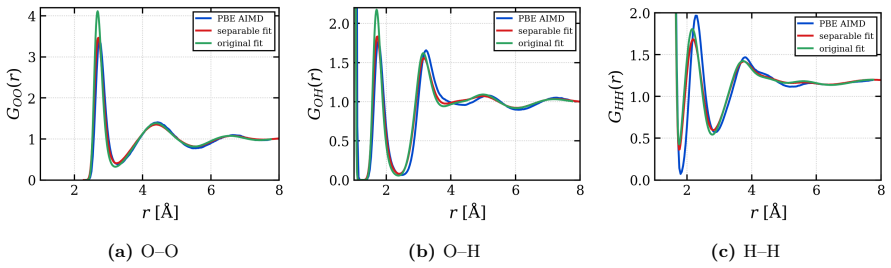
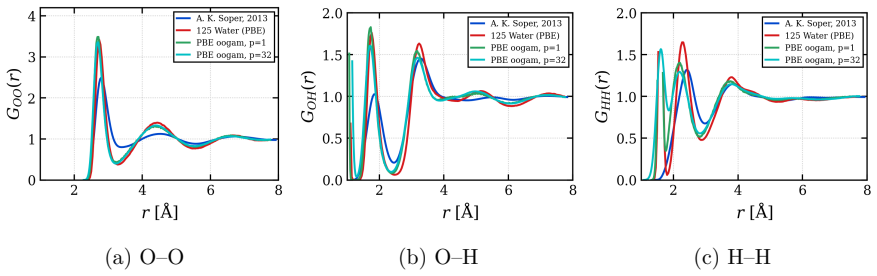
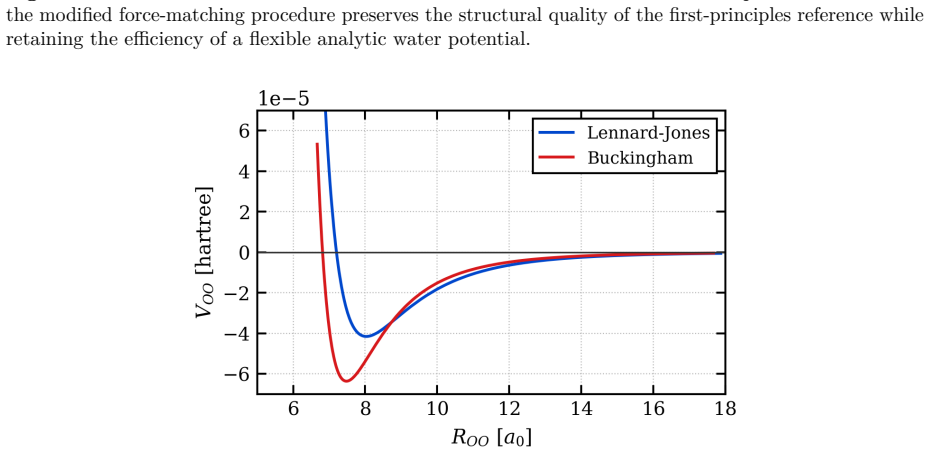
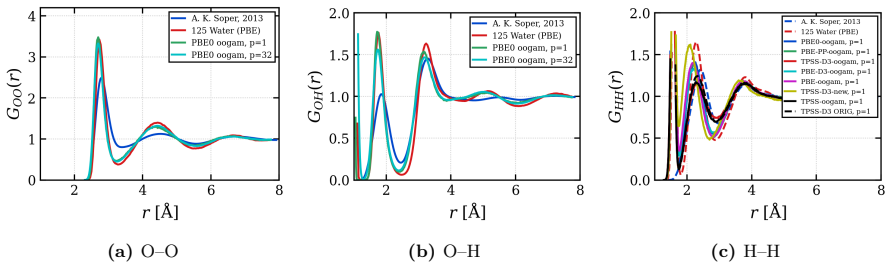
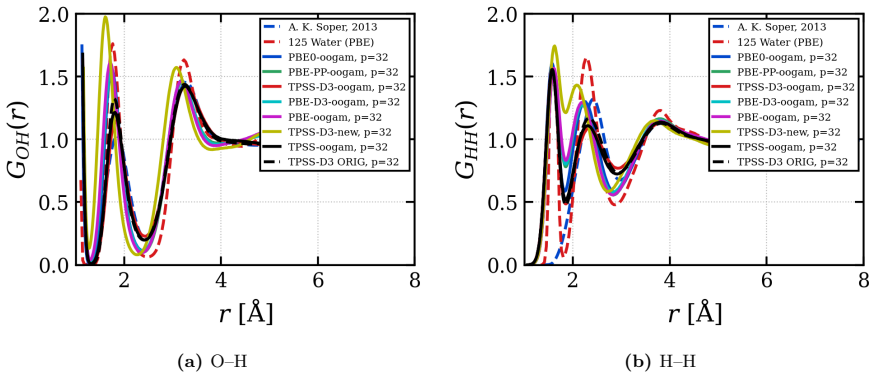
The projected optimization reproduces target force distributions and yields radial distribution functions close to first-principles and neutron-scattering benchmarks. The Buckingham representation gives a more flexible short-range repulsive wall than a purely Lennard-Jones form, and the final flexible model remains stable in path-integral simulations.
What carries the argument
Separable nonlinear least-squares optimization that analytically eliminates all linear force-field amplitudes for every trial set of nonlinear shape parameters, applied to PBE0 reference forces from CP2K.
If this is right
- The Buckingham short-range repulsion term supplies greater flexibility than a Lennard-Jones form for the oxygen-oxygen wall.
- Radial distribution functions from the fitted model stay close to both first-principles and experimental benchmarks.
- The final flexible four-site model executes stable path-integral molecular dynamics runs without numerical instability.
- The workflow supplies a transparent route from hybrid-functional forces to simulation-ready water potentials.
Where Pith is reading between the lines
- The separable formulation could be applied to force-matching for other molecular liquids using the same hybrid-functional references.
- Direct head-to-head comparison of repulsion functional forms becomes feasible once linear-parameter compensation is removed.
- Lower effective search dimension may reduce the chance of unphysical parameter sets in future water-model derivations.
Load-bearing premise
PBE0 reference forces computed for liquid water configurations are sufficiently accurate and representative that a classical flexible four-site model fitted to them will reproduce the structural and dynamical behavior of real liquid water under path-integral sampling.
What would settle it
If the fitted model's radial distribution functions deviate substantially from independent PBE0 molecular dynamics trajectories or from neutron-scattering measurements, the accuracy claim would be falsified.
Figures
read the original abstract
Force-matched water models provide a practical route from first-principles reference data to long classical and path-integral molecular simulations. Previous flexible four-site potentials in the spirit of q-TIP4P/F showed that fitting analytic models to density-functional-theory forces can reproduce key structural features of liquid water while retaining the efficiency required for quantum-nuclear sampling. Here we introduce two refinements aimed at making this strategy more accurate and more reproducible for molecular simulation. First, the production fit is based on PBE0 hybrid-functional reference forces and therefore includes the Hartree--Fock exact-exchange contribution in the electronic-structure target. Second, the parametrization is formulated as a separable nonlinear least-squares problem in which all linear force-field amplitudes are eliminated analytically for every trial set of nonlinear shape parameters. The resulting force-matching protocol lowers the dimension of the nonlinear search, reduces compensation between heterogeneous parameters, and enables a controlled comparison of Lennard-Jones and Buckingham oxygen--oxygen repulsion terms. Applied to CP2K reference forces for liquid water, the projected optimization reproduces target force distributions and yields radial distribution functions close to first-principles and neutron-scattering benchmarks. The Buckingham representation gives a more flexible short-range repulsive wall than a purely Lennard-Jones form, and the final flexible model remains stable in path-integral simulations. The method provides a transparent workflow for deriving simulation-ready water potentials from accurate hybrid density-functional reference forces.
Editorial analysis
A structured set of objections, weighed in public.
Referee Report
Summary. The manuscript introduces a separable nonlinear least-squares force-matching protocol to parametrize a flexible four-site water model against PBE0 hybrid-functional forces computed in CP2K for liquid water. Linear amplitudes are eliminated analytically for each trial set of nonlinear shape parameters, enabling a controlled comparison of Lennard-Jones versus Buckingham oxygen-oxygen repulsion. The resulting models are reported to reproduce target force distributions, yield radial distribution functions close to both the PBE0 reference and neutron-scattering benchmarks, and remain stable under path-integral sampling.
Significance. If the quantitative claims hold, the work supplies a reproducible, lower-dimensional workflow for deriving classical potentials directly from hybrid-DFT reference forces that are suitable for quantum-nuclear simulations. The separable formulation is a clear methodological advance over earlier ad-hoc fitting of q-TIP4P/F-style models, and the explicit LJ-versus-Buckingham comparison is useful for the community.
major comments (3)
- [Abstract] Abstract and results section: the central claims that the projected optimization 'reproduces target force distributions' and 'yields radial distribution functions close to first-principles and neutron-scattering benchmarks' are presented without any quantitative error metrics (RMSE, MAE, Kolmogorov-Smirnov statistics), error bars, or measures of agreement. This absence makes it impossible to judge the degree of reproduction or improvement relative to prior models.
- [Methods] Methods and results: no description is given of the training/test split, the number of independent configurations, or any cross-validation procedure used in the force-matching optimization. Without this information the generalization of the fitted parameters beyond the reference set cannot be assessed.
- [Results] Results: the assertion that the Buckingham form provides a 'more flexible short-range repulsive wall' and that the final model 'remains stable in path-integral simulations' is stated without supporting quantitative diagnostics (e.g., force-component histograms, energy conservation plots, or diffusion constants) that would allow independent verification.
Simulated Author's Rebuttal
We thank the referee for the constructive comments on our manuscript. We address each major point below and have revised the manuscript to incorporate additional quantitative information and clarifications where the original presentation was incomplete.
read point-by-point responses
-
Referee: [Abstract] Abstract and results section: the central claims that the projected optimization 'reproduces target force distributions' and 'yields radial distribution functions close to first-principles and neutron-scattering benchmarks' are presented without any quantitative error metrics (RMSE, MAE, Kolmogorov-Smirnov statistics), error bars, or measures of agreement. This absence makes it impossible to judge the degree of reproduction or improvement relative to prior models.
Authors: We agree that explicit quantitative metrics strengthen the claims. The revised manuscript now reports RMSE values for the force components relative to the PBE0 reference, MAE and Kolmogorov-Smirnov statistics for the oxygen-oxygen, oxygen-hydrogen, and hydrogen-hydrogen radial distribution functions against both the reference data and neutron-scattering benchmarks, together with statistical error bars obtained from block averaging of independent trajectories. revision: yes
-
Referee: [Methods] Methods and results: no description is given of the training/test split, the number of independent configurations, or any cross-validation procedure used in the force-matching optimization. Without this information the generalization of the fitted parameters beyond the reference set cannot be assessed.
Authors: The revised Methods section now specifies the size and provenance of the reference dataset (configurations drawn from the CP2K PBE0 trajectory), describes the selection of a held-out test set of configurations not used during optimization, and reports force-matching errors on that test set to demonstrate generalization. Formal cross-validation was omitted because of the high cost of the hybrid-functional reference calculations; this limitation is now stated explicitly. revision: yes
-
Referee: [Results] Results: the assertion that the Buckingham form provides a 'more flexible short-range repulsive wall' and that the final model 'remains stable in path-integral simulations' is stated without supporting quantitative diagnostics (e.g., force-component histograms, energy conservation plots, or diffusion constants) that would allow independent verification.
Authors: We accept that additional diagnostics improve verifiability. The revised Results section includes force-component histograms contrasting the Lennard-Jones and Buckingham short-range terms, total-energy conservation traces from the path-integral trajectories, and self-diffusion constants for the final model. These quantities directly support the statements on repulsive-wall flexibility and long-term stability. revision: yes
Circularity Check
Fitting to independent PBE0 forces; minor background self-citation not load-bearing
full rationale
The paper presents a force-matching protocol that optimizes a flexible four-site water model against external CP2K PBE0 hybrid-functional forces on liquid water configurations. The separable nonlinear least-squares formulation analytically eliminates linear amplitudes for each trial set of nonlinear parameters, but this is a standard numerical technique that does not render the fitted outputs equivalent to the reference data by definition. Target force distributions are reproduced by construction of the fit, yet the paper additionally validates derived radial distribution functions against independent neutron-scattering data. No equation reduces the reported structural or dynamical observables to quantities defined solely by the fitted parameters. Background reference to prior q-TIP4P/F-style models constitutes at most a minor self-citation that is not invoked to establish uniqueness theorems or to forbid alternative functional forms. The procedure therefore remains self-contained against external benchmarks, consistent with a low circularity score.
Axiom & Free-Parameter Ledger
free parameters (1)
- nonlinear shape parameters
Reference graph
Works this paper leans on
-
[1]
J. L. F. Abascal, C. Vega, A general purpose model for the condensed phases of water: TIP4P/2005,J. Chem. Phys.123, 234505 (2005).https://doi.org/10.1063/1.2121687
-
[2]
C. Vega, J. L. F. Abascal, Simulating water with rigid non-polarizable models: a general perspective,Phys. Chem. Chem. Phys.13, 19663–19688 (2011). https://doi.org/10.1039/ C1CP22168J
2011
-
[3]
D. Marx, M. Parrinello, Ab initio path-integral molecular dynamics,Z. Phys. B Condens. Matter95, 143–144 (1994).https://doi.org/10.1007/BF01312185
-
[4]
D. Marx, M. Parrinello, Ab initio path integral molecular dynamics: basic ideas,J. Chem. Phys.104, 4077–4082 (1996).https://doi.org/10.1063/1.471221
-
[5]
M. E. Tuckerman, D. Marx, M. L. Klein, M. Parrinello, Efficient and general algorithms for path integral Car–Parrinello molecular dynamics,J. Chem. Phys.104, 5579–5588 (1996). https://doi.org/10.1063/1.471771
-
[6]
B. Chen, I. Ivanov, M. L. Klein, M. Parrinello, Hydrogen bonding in water,Phys. Rev. Lett. 91, 215503 (2003).https://doi.org/10.1103/PhysRevLett.91.215503
-
[7]
D. Marx, M. E. Tuckerman, J. Hutter, M. Parrinello, The nature of the hydrated excess proton in water,Nature397, 601–604 (1999).https://doi.org/10.1038/17579
-
[8]
T. Spura, C. John, S. Habershon, T. D. Kühne, Nuclear quantum effects in liquid water from path-integral simulations using an ab initio force-matching approach,Mol. Phys.113, 808–822 (2015).https://doi.org/10.1080/00268976.2014.981231
-
[9]
J. Kessler, H. Elgabarty, T. Spura, K. Karhan, P. Partovi-Azar, A. A. Hassanali, T. D. Kühne, Structure and dynamics of the instantaneous water/vapor interface revisited by path-integral and ab initio molecular dynamics simulations,J. Phys. Chem. B119, 10079–10086 (2015). https://doi.org/10.1021/acs.jpcb.5b04185 13
-
[10]
T. Spura, H. Elgabarty, T. D. Kühne, “On-the-fly” coupled cluster path-integral molecular dynamics: impact of nuclear quantum effects on the protonated water dimer,Phys. Chem. Chem. Phys.17, 14355–14359 (2015).https://doi.org/10.1039/C4CP05192K
-
[11]
Ercolessi, J
F. Ercolessi, J. B. Adams, Interatomic potentials from first-principles calculations: the force-matching method,Europhys. Lett.26, 583–588 (1994). https://doi.org/10.1209/ 0295-5075/26/8/005
1994
-
[12]
Köster, T
A. Köster, T. Spura, G. Rutkai, J. Kessler, H. Wiebeler, J. Vrabec, T. D. Kühne, Assessing the accuracy of improved force-matched water models derived from ab initio molecular dynamics simulations,J. Comput. Chem.37, 1828–1838 (2016).https://doi.org/10.1002/ jcc.24398
2016
-
[13]
W. L. Jorgensen, J. Chandrasekhar, J. D. Madura, R. W. Impey, M. L. Klein, Comparison of simple potential functions for simulating liquid water,J. Chem. Phys.79, 926–935 (1983). https://doi.org/10.1063/1.445869
-
[14]
J. Tao, J. P. Perdew, V. N. Staroverov, G. E. Scuseria, Climbing the density functional ladder: nonempirical meta-generalized gradient approximation designed for molecules and solids, Phys. Rev. Lett.91, 146401 (2003).https://doi.org/10.1103/PhysRevLett.91.146401
-
[15]
S.Grimme, J.Antony, S.Ehrlich, H.Krieg, Aconsistentandaccurateabinitioparametrization of density functional dispersion correction (DFT-D) for the 94 elements H–Pu,J. Chem. Phys.132, 154104 (2010).https://doi.org/10.1063/1.3382344
-
[16]
J. P. Perdew, K. Burke, M. Ernzerhof, Generalized gradient approximation made simple, Phys. Rev. Lett.77, 3865–3868 (1996).https://doi.org/10.1103/PhysRevLett.77.3865
-
[17]
Adamo, V
C. Adamo, V. Barone, Toward reliable density functional methods without adjustable pa- rameters: the PBE0 model,J. Chem. Phys.110, 6158–6170 (1999).https://doi.org/10. 1063/1.478522
1999
-
[18]
T. Todorova, A. P. Seitsonen, J. Hutter, I.-F. W. Kuo, C. J. Mundy, Molecular dynamics simulation of liquid water: hybrid density functionals,J. Phys. Chem. B110, 3685–3691 (2006).https://doi.org/10.1021/jp055127v
-
[19]
T. D. Kühneet al., CP2K: An electronic structure and molecular dynamics software package – Quickstep: efficient and accurate electronic structure calculations,J. Chem. Phys.152, 194103 (2020).https://doi.org/10.1063/5.0007045
-
[20]
Iannuzziet al., The CP2K program package made simple,J
M. Iannuzziet al., The CP2K program package made simple,J. Phys. Chem. B130, 1237–1310 (2026).https://doi.org/10.1021/acs.jpcb.5c05851
-
[21]
M. Guidon, J. Hutter, J. VandeVondele, Auxiliary density matrix methods for Hartree–Fock exchange calculations,J. Chem. Theory Comput.6, 2348–2364 (2010). https://doi.org/ 10.1021/ct1002225
-
[22]
G. H. Golub, V. Pereyra, The differentiation of pseudo-inverses and nonlinear least squares problems whose variables separate,SIAM J. Numer. Anal.10, 413–432 (1973). https: //doi.org/10.1137/0710036
-
[23]
https://doi.org/10.1088/0266-5611/ 19/2/201
G.H.Golub, V.Pereyra, Separablenonlinearleastsquares: thevariableprojectionmethodand its applications,Inverse Probl.19, R1–R26 (2003). https://doi.org/10.1088/0266-5611/ 19/2/201
-
[24]
D. P. O’Leary, B. W. Rust, Variable projection for nonlinear least squares problems,Comput. Optim. Appl.54, 579–593 (2013).https://doi.org/10.1007/s10589-012-9492-9 14
-
[25]
S. Habershon, T. E. Markland, D. E. Manolopoulos, Competing quantum effects in the dynamics of a flexible water model,J. Chem. Phys.131, 024501 (2009). https://doi.org/ 10.1063/1.3167790
-
[26]
T. E. Markland, D. E. Manolopoulos, An efficient ring polymer contraction scheme for imaginary time path integral simulations,J. Chem. Phys.129, 024105 (2008). https://doi. org/10.1063/1.2953308
-
[27]
T. E. Markland, D. E. Manolopoulos, A refined ring polymer contraction scheme for systems with electrostatic interactions,Chem. Phys. Lett.464, 256–261 (2008).https://doi.org/ 10.1016/j.cplett.2008.09.019
-
[28]
Available at:https://github.com/DCM-UPB/RPMD_Mainz
DCM-UPB, RPMD_Mainz: ring-polymer molecular dynamics code for flexible water models, GitHub repository. Available at:https://github.com/DCM-UPB/RPMD_Mainz
-
[29]
G. Lippert, J. Hutter, M. Parrinello, A hybrid Gaussian and plane wave density functional scheme,Mol. Phys.92, 477–488 (1997).https://doi.org/10.1080/002689797170220
-
[30]
R. P. Feynman, A. R. Hibbs,Quantum Mechanics and Path Integrals, McGraw–Hill, New York (1965)
1965
-
[31]
M. E. Tuckerman, B. J. Berne, G. J. Martyna, M. L. Klein, Efficient molecular dynamics and hybrid Monte Carlo algorithms for path integrals,J. Chem. Phys.99, 2796–2808 (1993). https://doi.org/10.1063/1.465188
-
[32]
M. Ceriotti, M. Parrinello, T. E. Markland, D. E. Manolopoulos, Efficient stochastic thermostatting of path integral molecular dynamics,J. Chem. Phys.133, 124104 (2010). https://doi.org/10.1063/1.3489925
-
[33]
K. A. F. Röhrig, T. D. Kühne, Optimal calculation of the pair correlation function for an orthorhombic system,Phys. Rev. E87, 045301 (2013). https://doi.org/10.1103/ PhysRevE.87.045301
2013
-
[34]
A. K. Soper, The radial distribution functions of water as derived from radiation total scattering experiments: is there anything we can say for sure?,ISRN Phys. Chem.2013, 279463 (2013).https://doi.org/10.1155/2013/279463 15
discussion (0)
Sign in with ORCID, Apple, or X to comment. Anyone can read and Pith papers without signing in.