REVIEW 2 major objections 1 minor 64 references
Unsupervised learning identifies nondispersive wave packets in driven helium without prior labels.
Reviewed by Pith at T0; open to challenge. T0 means a machine referee read the full paper against a public rubric. the ladder, T0–T4 →
2026-06-29 22:03 UTC pith:CZS2XUCG
load-bearing objection The paper shows a CNN embedding plus clustering recovers known NDWP regimes in driven helium from Floquet states without labels, but supplies no quantitative metrics or robustness checks. the 2 major comments →
Unsupervised learning for the systematic identification of nondispersive wave packets in driven helium
The pith
A machine-rendered reading of the paper's core claim, the machinery that carries it, and where it could break.
Core claim
Using a convolutional neural network on probability distributions of Floquet states, the approach constructs a low-dimensional embedding where clustering identifies distinct classes of quantum states, including nondispersive wave packets, which are confirmed through geometric analysis, physical parameters, and time evolution.
What carries the argument
Convolutional neural network embedding of configuration and phase space probability distributions of Floquet states, followed by clustering.
Load-bearing premise
The clusters found in the embedding space represent physically distinct classes of quantum states.
What would settle it
Observing that states from a single cluster exhibit dispersive behavior in time evolution or that known nondispersive wave packet parameters do not cluster together would falsify the claim.
Editorial analysis
A structured set of objections, weighed in public.
Referee Report
Summary. The manuscript introduces an unsupervised learning pipeline to identify nondispersive wave packets (NDWPs) in driven helium. Floquet states are represented as probability distributions in configuration and phase space and embedded via a convolutional neural network; clustering in the embedding space is followed by post-hoc geometric, parameter, and time-evolution analysis to label clusters as frozen-planet states or NDWPs. The central claim is that this recovers known NDWP regimes without prior labeling, showing that the learned representation captures physically meaningful structures systematically.
Significance. If the embedding and clustering prove robust, the work could automate exploration of complex driven quantum systems and reduce reliance on manual phase-space analysis. The combination of standard representation learning with explicit physical validation is a constructive approach for quantum datasets.
major comments (2)
- [Results] Results section: the claim that the method 'successfully recovers known NDWP regimes' is asserted without quantitative metrics (e.g., cluster purity, adjusted Rand index against known labels, silhouette scores, or sensitivity to embedding dimension). This absence directly weakens the assertion that the approach is systematic and automated.
- [Methods] Methods and Results: the manuscript provides no error analysis, data-processing details (normalization of probability distributions, handling of grid resolution), or ablation on CNN hyperparameters and clustering choices. These are load-bearing for reproducibility and for confirming that identified clusters are not artifacts of post-hoc selection.
minor comments (1)
- [Figures] Figure captions should explicitly state the embedding dimension and clustering algorithm used for each panel.
Simulated Author's Rebuttal
We thank the referee for the constructive comments. We address each major point below and will revise the manuscript accordingly to strengthen the quantitative support and reproducibility.
read point-by-point responses
-
Referee: [Results] Results section: the claim that the method 'successfully recovers known NDWP regimes' is asserted without quantitative metrics (e.g., cluster purity, adjusted Rand index against known labels, silhouette scores, or sensitivity to embedding dimension). This absence directly weakens the assertion that the approach is systematic and automated.
Authors: We agree that the current presentation would benefit from explicit quantitative metrics. Because the pipeline is unsupervised, adjusted Rand index against full ground-truth labels is not applicable; the validation relies on post-hoc physical identification of known regimes. We will add silhouette scores to assess cluster separation and a sensitivity analysis with respect to embedding dimension in a revised Results section. These additions will provide quantitative backing for the systematic character of the recovery. revision: yes
-
Referee: [Methods] Methods and Results: the manuscript provides no error analysis, data-processing details (normalization of probability distributions, handling of grid resolution), or ablation on CNN hyperparameters and clustering choices. These are load-bearing for reproducibility and for confirming that identified clusters are not artifacts of post-hoc selection.
Authors: We concur that these details are required for reproducibility. The revised Methods section will specify the normalization applied to the probability distributions, the treatment of grid resolution, any convergence/error analysis performed on the Floquet states, and ablations on CNN hyperparameters (layer count, kernel sizes) together with clustering parameters (algorithm choice, number of clusters). These expansions will allow readers to assess whether the clusters arise from the data structure rather than post-hoc choices. revision: yes
Circularity Check
No significant circularity detected
full rationale
The paper computes Floquet states from first principles, feeds probability distributions into a standard CNN embedding, performs unsupervised clustering, and validates clusters post-hoc against independently known NDWP regimes via geometric and time-evolution analysis. No equation or claim reduces by construction to a fitted parameter, self-definition, or self-citation chain; the recovery of known regimes is an external benchmark rather than an internal tautology.
Axiom & Free-Parameter Ledger
free parameters (1)
- CNN embedding dimension and clustering hyperparameters
axioms (2)
- domain assumption Floquet theory provides an accurate time-periodic description of the driven helium states
- domain assumption Probability distributions in configuration and phase space are sufficient input features for physically meaningful clustering
read the original abstract
Nondispersive wave packets in driven helium are long-lived quantum states that follow classical resonant orbits without spreading. Their identification typically requires detailed analysis of phase-space structures and extensive exploration of parameter regimes. In this work, we introduce an unsupervised learning approach to automate the identification of physically relevant states in the driven helium atom. Using a Floquet-based description, quantum states are computed and represented as probability distributions in configuration and phase space, which serve as input to a convolutional neural network that constructs a low-dimensional embedding of the data. Clustering in the embedding space reveals distinct classes of quantum states. By combining geometric analysis, physical parameter inspection, and time-evolution studies, we identify clusters corresponding to frozen planet states and nondispersive wave packets. The method successfully recovers known NDWP regimes without prior labeling, demonstrating that the learned representation captures physically meaningful structures in a systematic and automated manner. These results establish unsupervised representation learning as an effective tool for the systematic analysis of complex quantum datasets.
Figures


Reference graph
Works this paper leans on
-
[1]
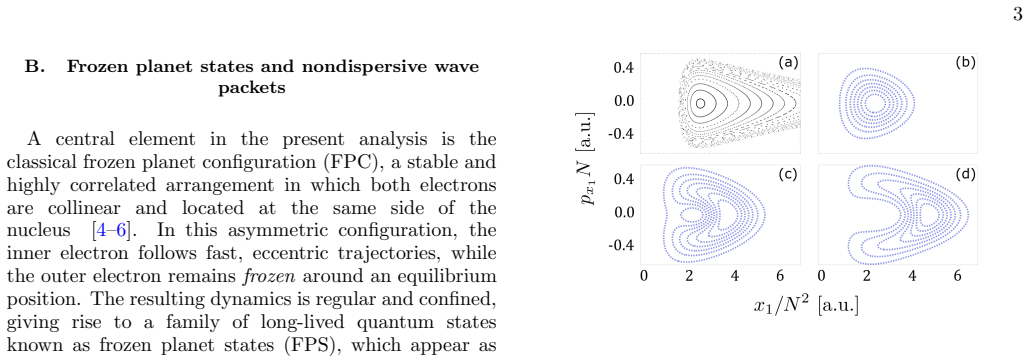
and exhibit long lifetimes [4, 13]. These states are characterized by the rapid oscillations of the inner electron, while the outer electron remains nearly frozen around a certain equilibrium position. For all these reasons, FPS are of particular interest as they can be controlled using external fields [15]. When the FPS is periodically driven, it exhibit...
work page internal anchor Pith review Pith/arXiv arXiv 2026
-
[2]
V. N. Ostrovsky and N. V. Prudov, Three-body coulomb problem in the dipole approximation: p0 and d0 states, J. Phys. B. 30, 151 (1997)
1997
-
[3]
Piraux, J
B. Piraux, J. Bauer, S. Laulan, and H. Bachau, Probing electron-electron correlation with attosecond pulses, Eur. Phys. J. D. 26, 7 (2003)
2003
-
[4]
A. J. Lichtenberg and M. A. Lieberman, Regular and stochastic motion (Springer-Verlag New York, 1983)
1983
-
[5]
Schlagheck and A
P. Schlagheck and A. Buchleitner, Stable classical configurations in strongly driven helium, Physica D 131, 110 (1999)
1999
-
[6]
Richter and D
K. Richter and D. Wintgen, Stable planetary atom configurations, Phys. Rev. Lett. 65, 1965 (1990)
1965
-
[7]
Wintgen, K
D. Wintgen, K. Richter, and G. Tanner, The semiclassical helium atom, Chaos 2, 19 (1992)
1992
-
[8]
Madro˜ nero and A
J. Madro˜ nero and A. Buchleitner, Ab initio quantum approach to planar helium under periodic driving, Phys. Rev. A 77, 053402 (2008)
2008
-
[9]
G. J. M. Pab´ on, Spectral properties of planar helium under periodic driving, Ph.D. thesis (2004)
2004
-
[10]
Eiglsperger, B
J. Eiglsperger, B. Piraux, and J. Madro˜ nero, Spectral representation of the three-body coulomb problem: Perspectives for highly doubly excited states of helium, Phys. Rev. A 80, 022511 (2009)
2009
-
[11]
V. N. Ostrovsky and N. V. Prudov, Planetary atom states: adiabatic invariant theory, J. Phys. B. 28, 4435 (1995)
1995
-
[12]
Richter and D
K. Richter and D. Wintgen, Intra-shell states of doubly excited atoms: diagonalization within a basis of symmetrically excited electrons, J. Phys. B. 26, 3719 (1993)
1993
-
[13]
Gonz´ alez-Melan and J
A. Gonz´ alez-Melan and J. Madro˜ nero, Nondispersive wave packets in planar helium, Phys. Rev. A101, 013414 (2020)
2020
-
[14]
Schlagheck and A
P. Schlagheck and A. Buchleitner, Nondispersive two-electron wave packets in the collinear driven helium atom, Europhysics Letters 46, 24 (1999)
1999
-
[15]
Miheliˇ c and M
A. Miheliˇ c and M. v. ˇZitnik, Ab Initio calculation of photoionization and inelastic photon scattering spectra of he below the n = 2 threshold in a dc electric field, Phys. Rev. Lett. 98, 243002 (2007)
2007
-
[16]
J. F. Le´ on Ocampo,Static electric field effects on frozen planet states of helium, Msc. thesis, Universidad del Valle (2021)
2021
-
[17]
Gonz´ alez Melan,Highly doubly excited states of helium under periodic driving and the formation of nondispersive wave packets, Phd thesis, Universidad del Valle (2018)
A. Gonz´ alez Melan,Highly doubly excited states of helium under periodic driving and the formation of nondispersive wave packets, Phd thesis, Universidad del Valle (2018)
2018
-
[18]
Gonz´ alez-Melan, J
A. Gonz´ alez-Melan, J. F. L. Ocampo, and J. Madro˜ nero, Floquet-engineered nondispersive wave packets in helium under combined periodic and static fields, Phys. Rev. A 112, 022822 (2025)
2025
-
[19]
Foumouo, G
E. Foumouo, G. L. Kamta, G. Edah, and B. Piraux, Theory of multiphoton single and double ionization of two-electron atomic systems driven by short-wavelength electric fields: An ab initio treatment, Phys. Rev. A 74, 063409 (2006)
2006
-
[20]
Ho, The method of complex coordinate rotation and its applications to atomic collision processes, Physics Reports 99, 1 (1983)
Y. Ho, The method of complex coordinate rotation and its applications to atomic collision processes, Physics Reports 99, 1 (1983)
1983
-
[21]
Madro˜ nero, P
J. Madro˜ nero, P. Schlagheck, L. Hilico, B. Gr´ emaud, D. Delande, and A. Buchleitner, Decay rates of planar helium, Europhysics Letters 70, 183 (2005)
2005
-
[22]
Eiglsperger, M
J. Eiglsperger, M. Sch¨ onwetter, B. Piraux, and J. Madro˜ nero, Spectral data for doubly excited states of helium with non-zero total angular momentum, At. Data Nucl. Data Tables. 98, 120–148 (2012)
2012
- [23]
- [24]
- [25]
-
[26]
Goodfellow, Y
I. Goodfellow, Y. Bengio, and A. Courville, Deep Learning (The MIT Press, Cambridge, Massachusetts, 2016)
2016
-
[27]
Radhakrishnan, D
A. Radhakrishnan, D. Beaglehole, P. Pandit, and M. Belkin, Mechanism for feature learning in neural networks and backpropagation-free machine learning models, Science 383, 1461 (2024)
2024
-
[28]
Floquet, Sur les ´ equations diff´ erentielles lin´ eaires ` a coefficients p´ eriodiques, Annales scientifiques de l’´Ecole Normale Sup´ erieure2e s´ erie, 12, 47 (1883)
G. Floquet, Sur les ´ equations diff´ erentielles lin´ eaires ` a coefficients p´ eriodiques, Annales scientifiques de l’´Ecole Normale Sup´ erieure2e s´ erie, 12, 47 (1883)
-
[29]
J. H. Shirley, Solution of the schr¨ odinger equation with a hamiltonian periodic in time, Phys. Rev. 138, B979 (1965)
1965
-
[30]
Balslev and J
E. Balslev and J. M. Combes, Spectral properties of many-body schr¨ odinger operators with 10 dilatation-analytic interactions, Comm. Math. Phys. 22, 280 (1971)
1971
-
[31]
W. P. Reinhardt, Complex coordinates in the theory of atomic and molecular structure and dynamics, Annu. Rev. Phys. Chem. 33, 223 (1982)
1982
-
[32]
Schlagheck and A
P. Schlagheck and A. Buchleitner, Nondispersive two-electron wave packets in driven helium, Eur. Phys. J. D. 22, 401–415 (2003)
2003
-
[33]
Schlagheck and A
P. Schlagheck and A. Buchleitner, J. Phys. B. 31, L489 (1998)
1998
- [34]
- [35]
- [36]
-
[37]
Gao and L
B. Gao and L. Pavel, On the properties of the softmax function with application in game theory and reinforcement learning (2017)
2017
-
[38]
Paszke, S
A. Paszke, S. Gross, S. Chintala, G. Chanan, E. Yang, Z. DeVito, Z. Lin, A. Desmaison, L. Antiga, and A. Lerer, Automatic differentiation in pytorch, in NIPS-W (2017)
2017
-
[39]
Salman, V
R. Salman, V. Kecman, Q. Li, R. Strack, and E. Test, Fast k-means algorithm clustering, Int. J. Comput. Netw. Commun. 3, 17–31 (2011)
2011
-
[40]
Kanungo, D
T. Kanungo, D. Mount, N. Netanyahu, C. Piatko, R. Silverman, and A. Wu, An efficient k-means clustering algorithm: analysis and implementation, IEEE Trans. Pattern Anal. Mach. Intell. 24, 881 (2002)
2002
-
[41]
A. M. Ikotun, A. E. Ezugwu, L. Abualigah, B. Abuhaija, and J. Heming, K-means clustering algorithms: A comprehensive review, variants analysis, and advances in the era of big data, Information Sciences622, 178 (2023)
2023
-
[42]
D.-T. Dinh, T. Fujinami, and V.-N. Huynh, Estimating the optimal number of clusters in categorical data clustering by silhouette coefficient, in Knowledge and Systems Sciences (Springer Singapore, 2019) p. 1–17
2019
-
[43]
P. J. Rousseeuw, Silhouettes: A graphical aid to the interpretation and validation of cluster analysis, J. Comput. Appl. Math. 20, 53 (1987)
1987
-
[44]
Schubert, Stop using the elbow criterion for k-means and how to choose the number of clusters instead, ACM SIGKDD Explorations Newsletter 25, 36–42 (2023)
E. Schubert, Stop using the elbow criterion for k-means and how to choose the number of clusters instead, ACM SIGKDD Explorations Newsletter 25, 36–42 (2023)
2023
-
[45]
S. Nanjundan, S. Sankaran, C. R. Arjun, and G. P. Anand, Identifying the number of clusters for k-means: A hypersphere density based approach (2019), arXiv:1912.00643 [cs.LG]
-
[46]
Liu, M.-K
C.-N. Liu, M.-K. Chen, and C. D. Lin, Radiative decay of helium doubly excited states, Phys. Rev. A 64, 010501 (2001)
2001
-
[47]
Coreno, K
M. Coreno, K. C. Prince, R. Richter, M. de Simone, K. Buˇ car, and M. ˇZitnik, Branching ratios in the radiative decay of helium doubly excited states, Phys. Rev. A 72, 052512 (2005)
2005
- [48]
-
[49]
Y. Tao, A. Both, R. I. Silveira, K. Buchin, S. Sijben, R. S. Purves, P. Laube, D. Peng, K. Toohey, and M. D. and, A comparative analysis of trajectory similarity measures, GIScience & Remote Sensing 58, 643 (2021)
2021
-
[50]
Portugal, P
I. Portugal, P. Alencar, and D. Cowan, A framework for spatial-temporal cluster evolution representation and analysis based on graphs, Scientific Reports 14, 22137 (2024)
2024
-
[51]
A. I. Masker, K. Zhou, J. P. Molnar, and S. J. Grauer, Neural optical flow for planar and stereo piv, Experiments in Fluids 66, 10.1007/s00348-025-04058-1 (2025)
-
[52]
D. Tran, L. Bourdev, R. Fergus, L. Torresani, and M. Paluri, Learning spatiotemporal features with 3d convolutional networks (2015), arXiv:1412.0767 [cs.CV]
work page internal anchor Pith review Pith/arXiv arXiv 2015
-
[53]
T. M. Cover and J. A. Thomas, Elements of Information Theory (Wiley Series in Telecommunications and Signal Processing) (Wiley-Interscience, USA, 2006)
2006
-
[54]
Abdouraman, A
A. Abdouraman, A. L. Frapiccini, A. Hamido, F. Mota-Furtado, P. F. O’Mahony, D. Mitnik, G. Gasaneo, and B. Piraux, Sturmian bases for two-electron systems in hyperspherical coordinates, J. Phys. B. 49, 235005 (2016)
2016
-
[55]
H. Zhao, Z. Lai, H. Leung, and X. Zhang, Neural-network-based feature learning: Convolutional neural network, in Feature Learning and Understanding: Algorithms and Applications (Springer International Publishing, Cham, 2020) pp. 219–251
2020
-
[56]
Hilico, B
L. Hilico, B. Gr´ emaud, T. Jonckheere, N. Billy, and D. Delande, Quantum three-body coulomb problem in two dimensions, Phys. Rev. A 66, 022101 (2002)
2002
-
[57]
Rotenberg, Theory and application of sturmian functions (Academic Press, 1970) pp
M. Rotenberg, Theory and application of sturmian functions (Academic Press, 1970) pp. 233–268
1970
-
[58]
D. A. Varshalovich, A. N. Moskalev, and V. K. Khersonskii, eds., Quantum Theory of Angular Momentum (World Scientific, Singapore, 2008) p. 524
2008
-
[59]
J. e. a. Zamastil, The use of so(2, 1) algebra for the evaluation of atomic integrals: The study of two-electron atoms, J. Math. Phys. 45, 2674 (2004)
2004
-
[60]
Zamastil, F
J. Zamastil, F. Vinette, and M. ˇSim´ anek, Calculation of atomic integrals using commutation relations, Phys. Rev. A 75, 022506 (2007)
2007
-
[61]
Buchleitner, B
A. Buchleitner, B. Gremaud, and D. Delande, Wavefunctions of atomic resonances, J. Phys. B.27, 2663 (1994)
1994
-
[62]
T. L. Curtright and C. K. Zachos, Quantum mechanics in phase space, Asia Pac. Phys. Newsl. 01, 37–46 (2012)
2012
-
[63]
V. N. Vapnik, The nature of statistical learning theory (Springer New York, 2018)
2018
-
[64]
Burgers, D
A. Burgers, D. Wintgen, and J. M. Rest, Highly doubly excited s states of the helium atom, J. Phys. B. 28, 3163 (1995)
1995
This paper was first reviewed by grok-4.3 on June 29, 2026.
discussion (0)
Sign in with ORCID, Apple, or X to comment. Anyone can read and Pith papers without signing in.