The Pseudospectral Method for the Dirac Equation with Confining Potential
Pith reviewed 2026-06-29 19:54 UTC · model grok-4.3
The pith
The mono-kinetically-balanced generalized pseudospectral method yields converged energy eigenvalues and smooth wave functions for the Dirac equation with confining potentials.
A machine-rendered reading of the paper's core claim, the machinery that carries it, and where it could break.
Core claim
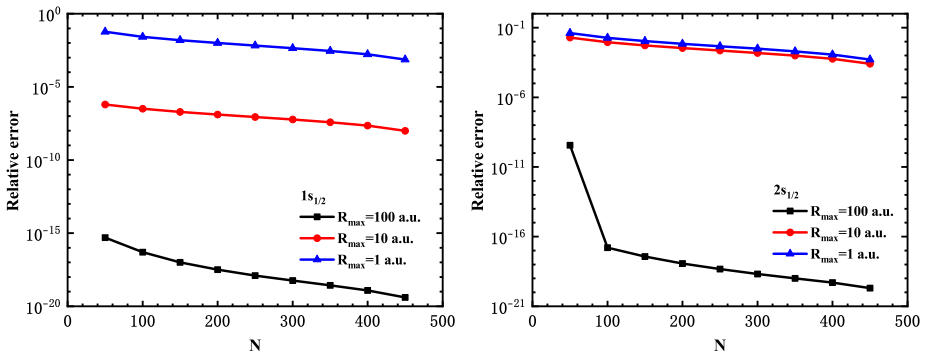
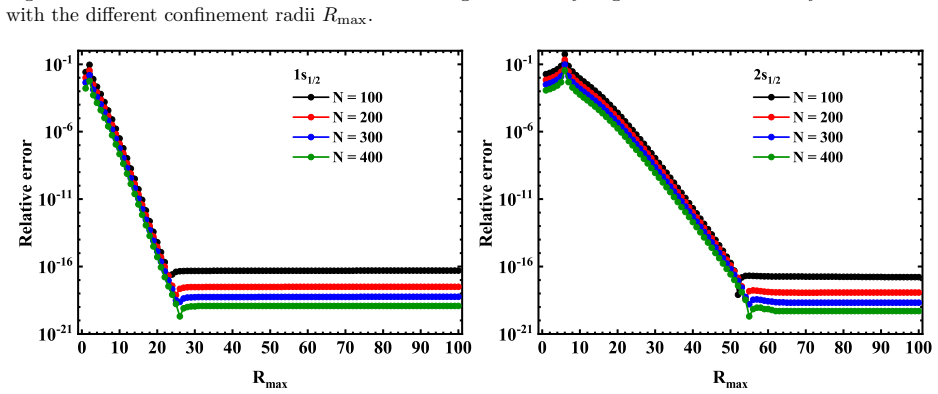
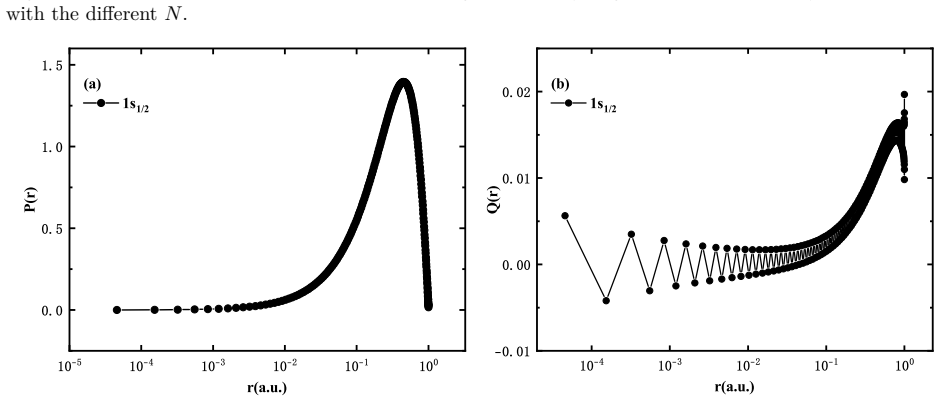
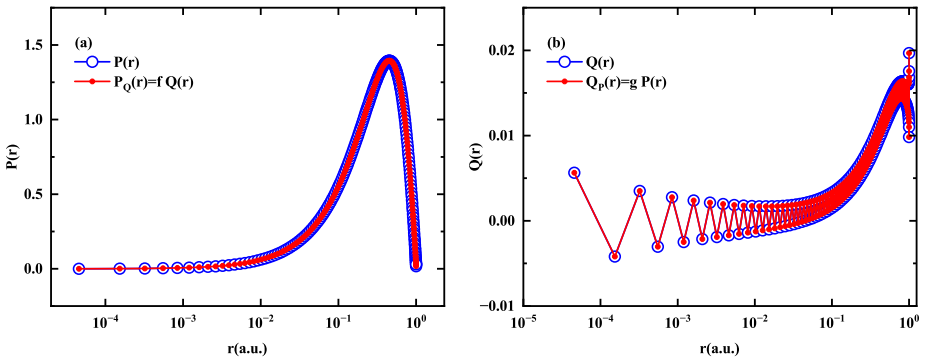
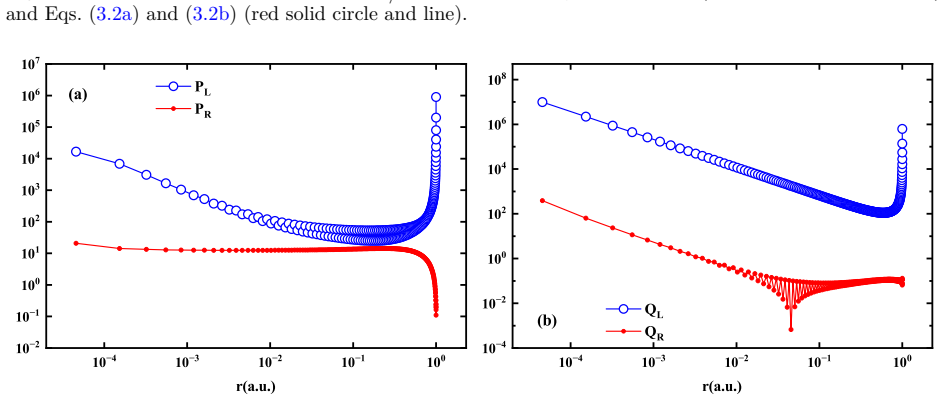
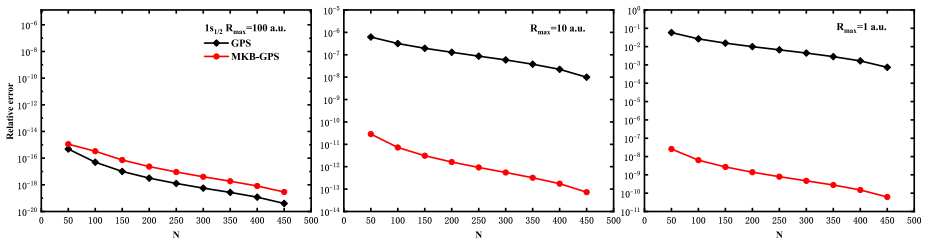
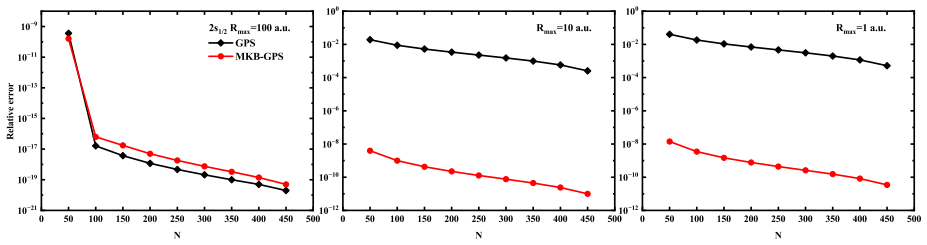
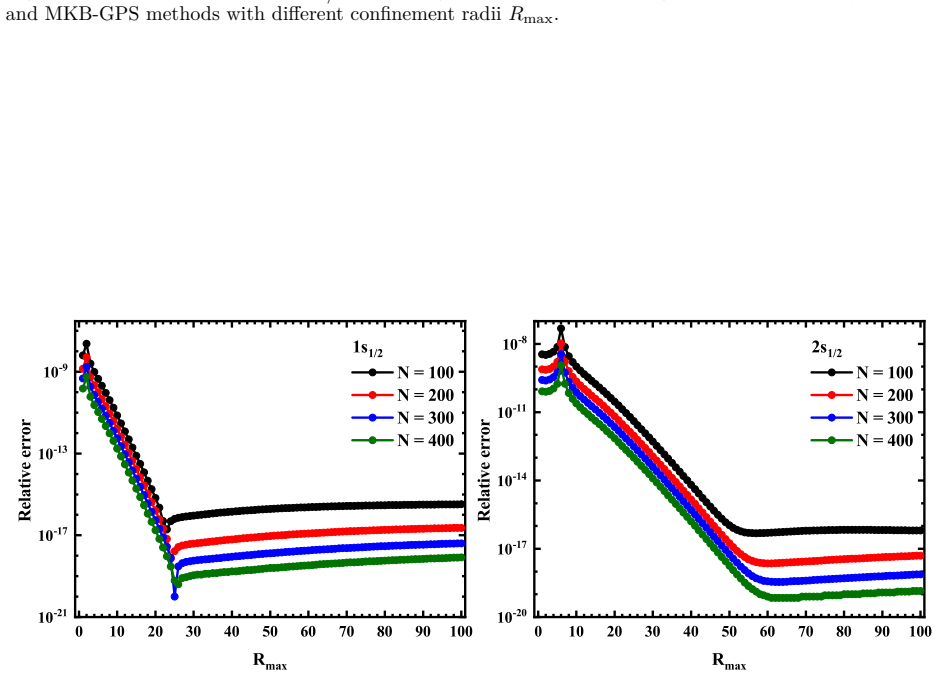
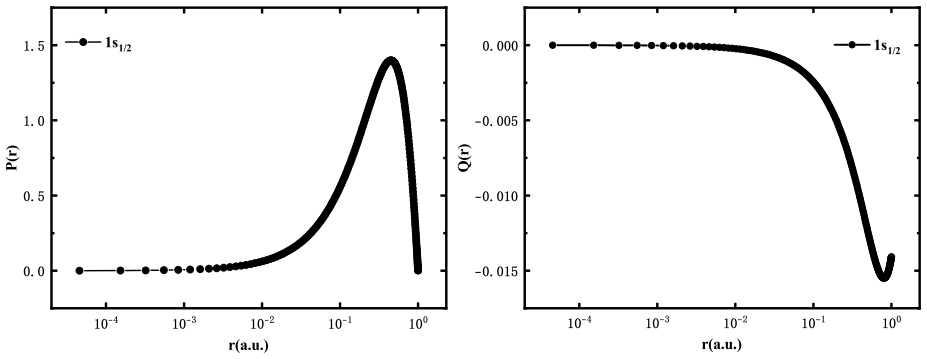
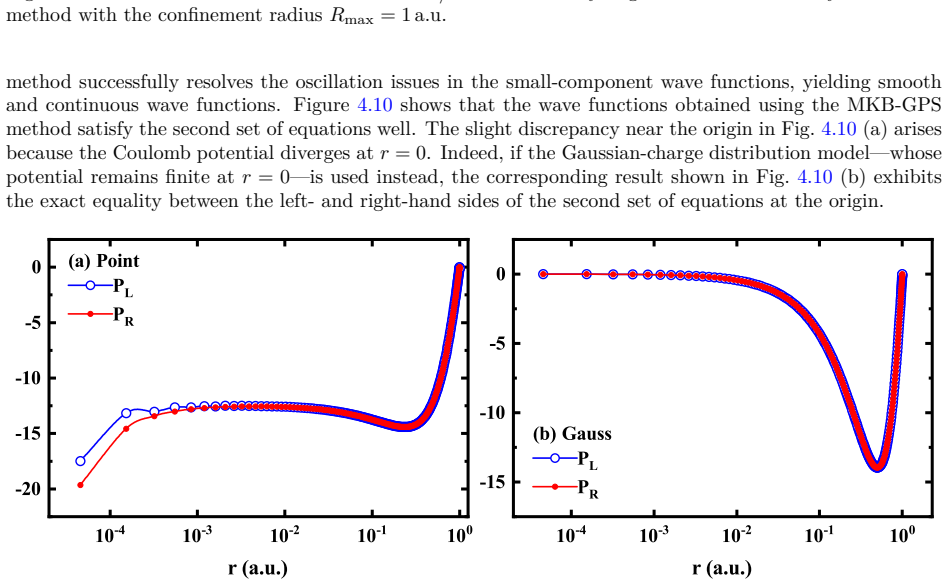
Solving the Dirac equation for confined potentials with the generalized pseudospectral method leads to deteriorating convergence of energy eigenvalues and highly oscillatory wave functions as the confinement radius decreases because of the first-order differentiation formulation. Adopting the mono-kinetically-balanced generalized pseudospectral method incorporates the kinetically-balanced condition and produces converged energy eigenvalues along with smooth, continuous wave functions. This is the first application to confined potentials with effectiveness shown for small confinement radii.
What carries the argument
The mono-kinetically-balanced generalized pseudospectral (MKB-GPS) method that incorporates the kinetically-balanced condition into the GPS method to overcome differentiation-related instabilities.
If this is right
- Energy eigenvalues converge reliably even as confinement radius decreases.
- Wave functions become smooth and continuous rather than oscillatory.
- The method works effectively for small confinement radii where standard GPS fails.
Where Pith is reading between the lines
- Kinetic balance conditions may stabilize pseudospectral discretizations in other relativistic equations.
- The approach could be applied to different confining potential shapes beyond those tested.
Load-bearing premise
The deteriorating convergence and oscillatory wave functions in the standard GPS method stem from the first-order differentiation formulation employed in the GPS method.
What would settle it
If applying the MKB-GPS method to the Dirac equation with small confinement radii still results in non-converged energy eigenvalues or highly oscillatory wave functions, the claim would be falsified.
Figures
read the original abstract
We observe that solving the Dirac equation for confined potentials using the generalized pseudospectral (GPS) method leads to deteriorating convergence of energy eigenvalues and highly oscillatory in wave functions as the confinement radius decreases. It is found that this issue stems from the first-order differentiation formulation employed in GPS method. Motivated by this insight, we adopt the kinetically balanced generalized pseudospectral method, which incorporates the kinetically-balanced condition into the GPS method. Numerical results demonstrate that the mono-kinetically-balanced generalized pseu dospectral (MKB-GPS) method yields converged energy eigenvalues and generates smooth, continuous wave functions. This is the first application of the MKB-GPS method to confined potentials, and its effectiveness is validated for small confinement radii.
Editorial analysis
A structured set of objections, weighed in public.
Referee Report
Summary. The manuscript introduces the mono-kinetically-balanced generalized pseudospectral (MKB-GPS) method for the Dirac equation with confining potentials. It reports that the standard GPS method exhibits deteriorating eigenvalue convergence and oscillatory wave functions as the confinement radius decreases, attributes this behavior to the first-order differentiation formulation, and presents numerical results claiming that MKB-GPS produces converged energies and smooth wave functions. The work positions itself as the first application of MKB-GPS to confined potentials and validates effectiveness for small radii.
Significance. If the numerical demonstrations are robust, the MKB-GPS approach could supply a practical route to accurate solutions of the Dirac equation under hard-wall confinement, a setting relevant to atomic physics models of confined systems. The paper supplies the first reported use of this variant for such potentials.
major comments (2)
- [Abstract] Abstract: The statement that the observed deterioration 'stems from the first-order differentiation formulation employed in GPS method' is presented without an isolating numerical test that rules out alternative explanations such as mismatch in boundary-condition enforcement at the hard wall or aliasing on the pseudospectral grid near the discontinuity. Because the MKB construction is introduced specifically to address this diagnosed cause, the attribution is load-bearing for the central claim.
- [Abstract] The abstract asserts that 'numerical results demonstrate' converged eigenvalues and smooth wave functions, yet supplies no concrete error metrics, convergence tables, basis-size scaling, or comparison against known analytic limits or other methods. This absence prevents independent assessment of the claimed effectiveness.
minor comments (1)
- [Abstract] Abstract contains a typographical spacing error: 'pseu dospectral' should read 'pseudospectral'.
Simulated Author's Rebuttal
We thank the referee for their thorough review and valuable feedback on our manuscript. We address each major comment below and indicate the revisions we will make to the manuscript.
read point-by-point responses
-
Referee: [Abstract] Abstract: The statement that the observed deterioration 'stems from the first-order differentiation formulation employed in GPS method' is presented without an isolating numerical test that rules out alternative explanations such as mismatch in boundary-condition enforcement at the hard wall or aliasing on the pseudospectral grid near the discontinuity. Because the MKB construction is introduced specifically to address this diagnosed cause, the attribution is load-bearing for the central claim.
Authors: We agree that the abstract's attribution would benefit from stronger supporting evidence in the form of an isolating test. In the full manuscript, the conclusion is drawn from the contrast in performance between the standard GPS and the MKB-GPS methods, along with analysis of the formulation. To directly address this concern, we will add a new subsection in the revised manuscript presenting additional numerical tests designed to isolate the effect of the first-order differentiation, for example by examining the behavior under modified boundary conditions and grid resolutions. This will provide a more rigorous basis for the claim. revision: yes
-
Referee: [Abstract] The abstract asserts that 'numerical results demonstrate' converged eigenvalues and smooth wave functions, yet supplies no concrete error metrics, convergence tables, basis-size scaling, or comparison against known analytic limits or other methods. This absence prevents independent assessment of the claimed effectiveness.
Authors: The abstract is constrained by length requirements and thus summarizes the findings without detailed metrics. The full manuscript contains extensive numerical results, including convergence with respect to the number of grid points, error estimates for the eigenvalues, and plots demonstrating the smoothness of the wave functions. To enhance the abstract, we will include brief quantitative statements, such as the achieved precision for small radii and the basis size used. Regarding comparisons to analytic limits, since this is the first application to confined potentials, no direct analytic solutions are available for the tested cases; however, we compare against the unconfined limit and other numerical methods where applicable. We will clarify this in the revision. revision: partial
Circularity Check
No circularity: numerical validation of method modification stands independently
full rationale
The paper reports an observed numerical failure mode in standard GPS for small confinement radii, attributes it observationally to first-order differentiation, introduces the MKB-GPS variant, and demonstrates via direct computation that the variant produces converged eigenvalues and smooth wave functions. No mathematical derivation is presented whose output is forced by construction to equal its inputs; no parameters are fitted and then relabeled as predictions; no self-citations are invoked as load-bearing uniqueness theorems; and the central claims rest on reproducible numerical benchmarks rather than self-referential definitions or ansatzes smuggled through prior work. The attribution of the failure mode is an untested diagnostic assumption, but that is a question of evidential strength, not circularity.
Axiom & Free-Parameter Ledger
Reference graph
Works this paper leans on
-
[1]
Canuto et al
C. Canuto et al. Spectral Methods: Fundamentals in Single Domains . Berlin, Heidelberg: Springer- Verlag, 2006
2006
-
[2]
Beyond the Floquet theorem: generalized Floquet formalisms and quasienergy methods for atomic and molecular multiphoton processes in intense laser fields
Shih-I Chu and Dmitry A. Telnov. “Beyond the Floquet theorem: generalized Floquet formalisms and quasienergy methods for atomic and molecular multiphoton processes in intense laser fields” . In: Phys. Rep. 390.1 (2004), p. 1. issn: 0370-1573. doi: 10 . 1016 / j . physrep . 2003 . 10 . 001. url: https : //www.sciencedirect.com/science/article/pii/S0370157303003946
2004
-
[3]
Solution to the Dirac equation using the finite difference method
Ji-Yu Fang, Shou-Wan Chen, and Tai-Hua Heng. “Solution to the Dirac equation using the finite difference method” . In: Nucl. Sci. Tech. 31.2 (2020), p. 15. doi: 10.1007/s41365-020-0728-6
-
[4]
A fresh computational approach to atomic structures, processes and cascades
Stephan Fritzsche. “A fresh computational approach to atomic structures, processes and cascades” . In: Comput. Phys. Commun. 240 (2019), p. 1. issn: 0010-4655. doi: 10.1016/j.cpc.2019.01.012. url: https://www.sciencedirect.com/science/article/pii/S0010465519300189
-
[5]
Kinetically Balanced B-Spline Expansions in Radial Dirac Equation
Akinori Igarashi. “Kinetically Balanced B-Spline Expansions in Radial Dirac Equation” . In: J. Phys. Soc. Jpn. 76.5 (2007), p. 054301. doi: 10.1143/JPSJ.76.054301 . url: https://doi.org/10.1143/ JPSJ.76.054301
-
[6]
Development of the kinetically and atomically balanced generalized pseudospec- tral method
Li Guang Jiao et al. “Development of the kinetically and atomically balanced generalized pseudospec- tral method” . In: Phys. Rev. A 104 (2 Aug. 2021), p. 022801. doi: 10.1103/PhysRevA.104.022801 . url: https://link.aps.org/doi/10.1103/PhysRevA.104.022801
-
[7]
CI-MBPT: A package of programs for relativistic atomic calculations based on a method combining configuration interaction and many-body perturbation theory
M. G. Kozlov et al. “CI-MBPT: A package of programs for relativistic atomic calculations based on a method combining configuration interaction and many-body perturbation theory” . In: Comput. Phys. Commun. 195 (2015), p. 199. issn: 0010-4655. doi: 10 . 1016 / j . cpc . 2015 . 05 . 007. url: https : //www.sciencedirect.com/science/article/pii/S001046551500185X
2015
-
[8]
Spectral pollution and how to avoid it
Mathieu Lewin and Éric Séré. “Spectral pollution and how to avoid it” . In: Proc. London Math. Soc. 100.3 (2010), p. 864. doi: 10 . 1112 / plms / pdp046. url: https : / / londmathsoc . onlinelibrary . wiley.com/doi/abs/10.1112/plms/pdp046. 13
-
[9]
Finite element formulation of the Dirac equation and the prob- lem of fermion doubling
C. Müller, N. Grün, and W. Scheid. “Finite element formulation of the Dirac equation and the prob- lem of fermion doubling” . In: Phys. Lett. A 242.4 (1998), p. 245. issn: 0375-9601. doi: 10 . 1016 / S0375 - 9601(98 ) 00218 - 7. url: https : / / www . sciencedirect . com / science / article / pii / S0375960198002187
1998
-
[10]
Relativistic all-order pair functions from a discretized single-particle Dirac Hamiltonian
Sten Salomonson and Per Öster. “Relativistic all-order pair functions from a discretized single-particle Dirac Hamiltonian” . In: Phys. Rev. A 40 (10 Nov. 1989), p. 5548. doi: 10.1103/PhysRevA.40.5548 . url: https://link.aps.org/doi/10.1103/PhysRevA.40.5548
-
[11]
A fully relativistic approach for calculating atomic data for highly charged ions
Douglas H. Sampson, Hong Lin Zhang, and Christopher J. Fontes. “A fully relativistic approach for calculating atomic data for highly charged ions” . In: Phys. Rep. 477.4 (2009), p. 111. issn: 0370-1573. doi: 10.1016/j.physrep.2009.04.002. url: https://www.sciencedirect.com/science/article/ pii/S037015730900129X
-
[12]
Dual kinetic balance approach to basis-set expansions for the Dirac equation
V. M. Shabaev et al. “Dual kinetic balance approach to basis-set expansions for the Dirac equation” . In: Phys. Rev. Lett. 93.13 (2004), p. 130405. doi: 10.1103/PhysRevLett.93.130405
-
[13]
Finite-difference method for Dirac electrons in circular quantum dots
Bartłomiej Szafran, Alina Mreńca-Kolasińska, and Dariusz Żebrowski. “Finite-difference method for Dirac electrons in circular quantum dots” . In: Phys. Rev. B 99 (19 May 2019), p. 195406. doi: 10. 1103/PhysRevB.99.195406. url: https://link.aps.org/doi/10.1103/PhysRevB.99.195406
-
[14]
3D mesh calculations for covariant density functional theory
Y. Tanimura, K. Hagino, and H. Z. Liang. “3D mesh calculations for covariant density functional theory” . In: Prog. Theor. Exp. Phys. 2015.7 (July 2015), p. 073D01. issn: 2050-3911. doi: 10.1093/ ptep/ptv083. url: https://doi.org/10.1093/ptep/ptv083
-
[15]
Dmitry A. Telnov et al. “Exterior complex scaling method in time-dependent density-functional theory: Multiphoton ionization and high-order-harmonic generation of Ar atoms” . In: Phys. Rev. A 87 (5 May 2013), p. 053406. doi: 10.1103/PhysRevA.87.053406 . url: https://link.aps.org/doi/10.1103/ PhysRevA.87.053406
-
[16]
Spurious states of the dirac equation in a finite basis set
I. I. Tupitsyn and V. M. Shabaev. “Spurious states of the dirac equation in a finite basis set” . In: Opt. Spectrosc. 105.2 (2008), p. 183. doi: 10.1134/S0030400X08080043
-
[17]
A deep neural network approach to solve the Dirac equation
Chuanxin Wang et al. “A deep neural network approach to solve the Dirac equation” . In: Eur. Phys. J. A 61.7 (July 2025), p. 162. issn: 1434-601X. doi: 10 . 1140 / epja / s10050 - 025 - 01630 - 5. url: https://doi.org/10.1140/epja/s10050-025-01630-5
-
[18]
Generalized pseudospectral methods with mappings for bound and resonance state problems
Guanhua Yao and Shih-I Chu. “Generalized pseudospectral methods with mappings for bound and resonance state problems” . In: Chem. Phys. Lett. 204.3 (1993), p. 381. issn: 0009-2614. doi: 10 . 1016/0009- 2614(93)90025- V . url: https://www.sciencedirect.com/science/article/pii/ 000926149390025V
1993
-
[19]
DBSR_HF: A B-spline Dirac–Hartree–Fock program
Oleg Zatsarinny and Charlotte Froese Fischer. “DBSR_HF: A B-spline Dirac–Hartree–Fock program” . In: Comput. Phys. Commun. 202 (2016), p. 287. issn: 0010-4655. doi: 10.1016/j.cpc.2015.12.023. url: https://www.sciencedirect.com/science/article/pii/S0010465516000047
-
[20]
Resolving the spurious-state problem in the Dirac equation with the finite-difference method
Ying Zhang et al. “Resolving the spurious-state problem in the Dirac equation with the finite-difference method” . In: Phys. Rev. C 106 (5 Nov. 2022), p. L051303. doi: 10.1103/PhysRevC.106.L051303 . url: https://link.aps.org/doi/10.1103/PhysRevC.106.L051303
-
[21]
Spherical Dirac equation on the lattice and the problem of the spurious states
Bin Zhao. “Spherical Dirac equation on the lattice and the problem of the spurious states” . In: Acta Phys. Sin. 65 (2016), p. 052401. issn: 1000-3290. doi: 10 . 7498 / aps . 65 . 052401. url: https : / / wulixb.iphy.ac.cn//article/id/66841
2016
-
[22]
Lin Zhu et al. “Revisiting the generalized pseudospectral method: Radial expectation values, fine structure, and hyperfine splitting of confined atom” . In: Int. J. Quantum Chem. 120.14 (2020), e26245. doi: 10.1002/qua.26245. url: https://onlinelibrary.wiley.com/doi/abs/10.1002/qua.26245. 14
discussion (0)
Sign in with ORCID, Apple, or X to comment. Anyone can read and Pith papers without signing in.