Beyond Logical Circuits: Hardware-Aware Analysis of Expressibility and Trainability in Variational Quantum Algorithms
Pith reviewed 2026-06-29 21:50 UTC · model grok-4.3
The pith
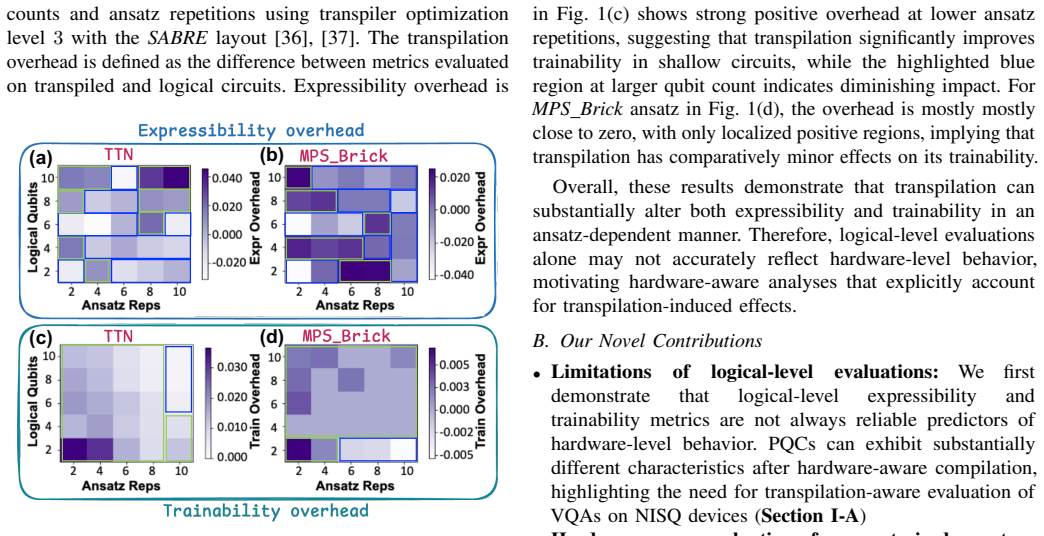
Transpilation perturbs variational quantum circuits enough to change their expressibility by up to 125 percent and trainability by up to 25 percent depending on the ansatz.
A machine-rendered reading of the paper's core claim, the machinery that carries it, and where it could break.
Core claim
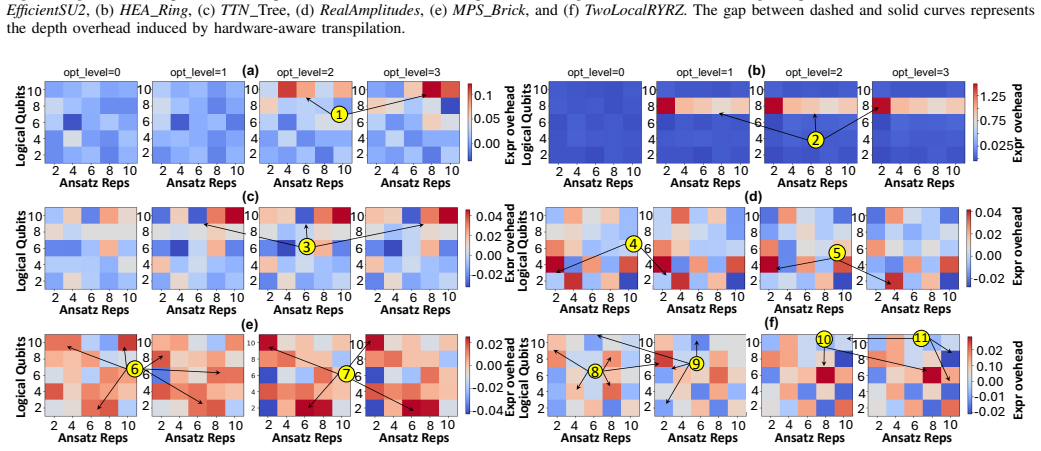
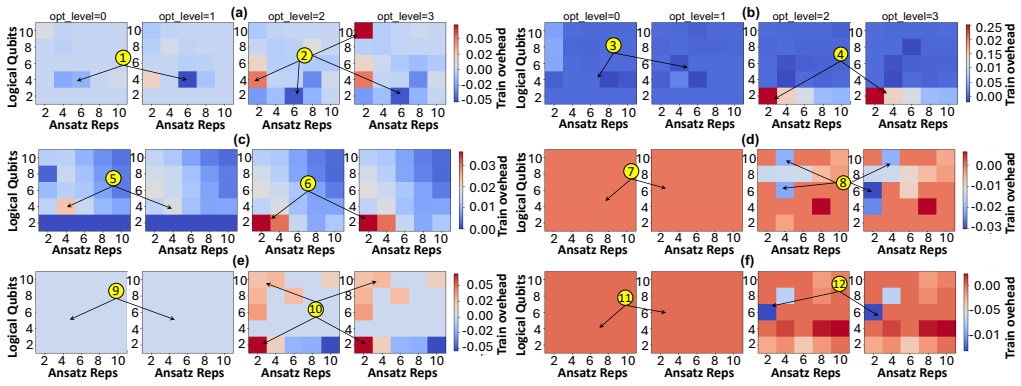
Transpilation acts as an implicit architectural perturbation, producing strongly ansatz-dependent effects. Expressibility deviations exceed 125 percent in some cases while trainability variations reach up to 25 percent. Structured ansatzes are generally more robust, whereas highly entangled architectures are more sensitive to transpilation-induced transformations. Transpilation can alter the commonly assumed expressibility-trainability trade-off, demonstrating that logical-level analyses may not reliably predict hardware-level behavior.
What carries the argument
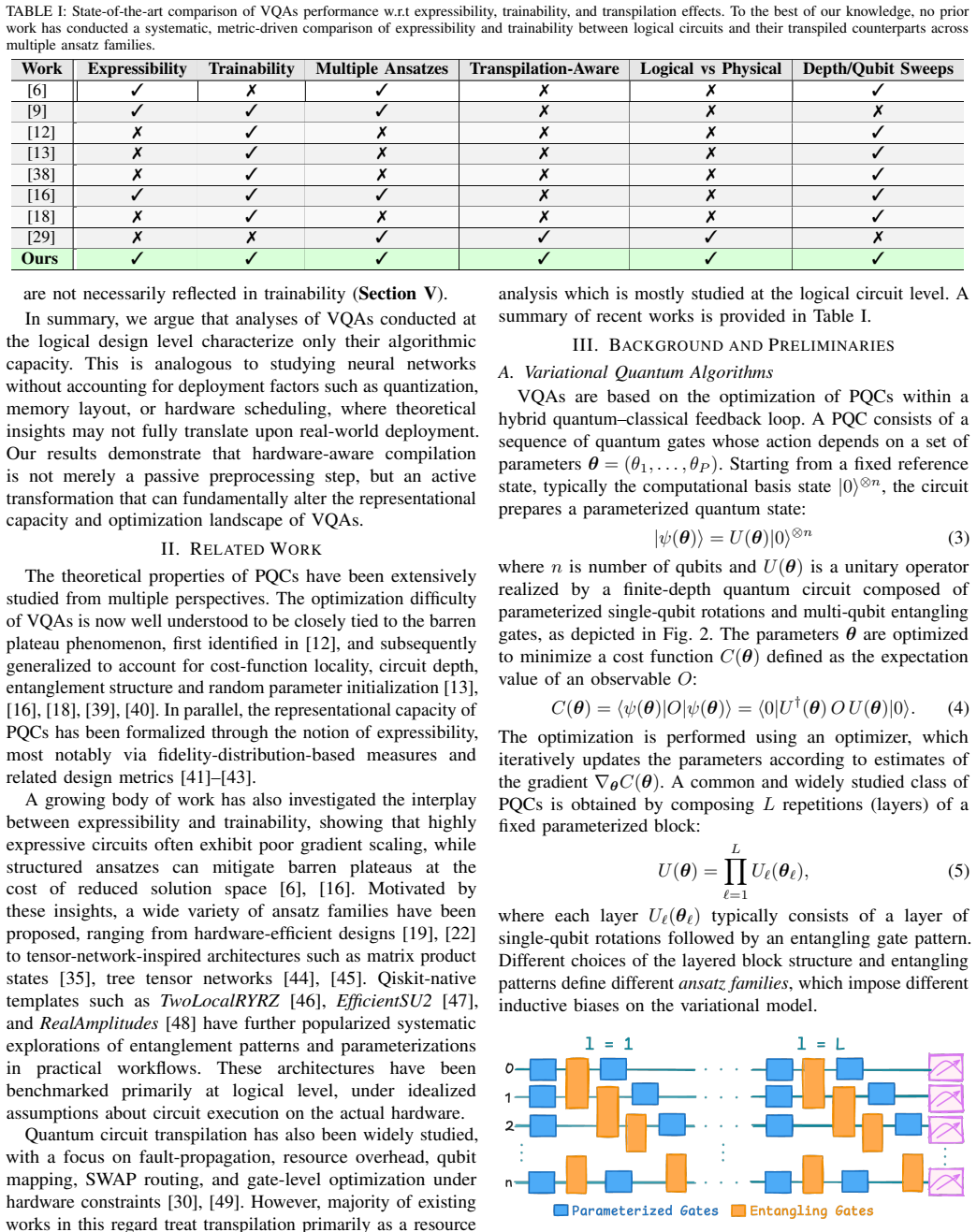
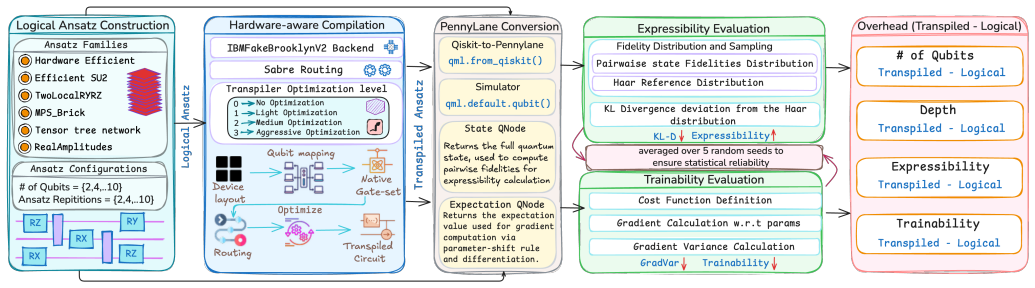
Comparison of logical versus transpiled parameterized quantum circuits, with expressibility measured by fidelity-based KL divergence and trainability by gradient variance after standard transpilation steps.
If this is right
- Structured ansatzes maintain more stable expressibility and trainability after transpilation than highly entangled ones.
- The expressibility-trainability trade-off observed at the logical level can reverse or disappear once the circuit is transpiled.
- Logical-only studies of variational quantum algorithms can produce misleading rankings of which ansatzes perform best on hardware.
- Hardware-aware evaluation is required to characterize variational quantum algorithm performance accurately.
Where Pith is reading between the lines
- Ansatz selection for near-term devices may need to include robustness to mapping and routing as an explicit design criterion.
- Different qubit-connectivity graphs on real hardware could produce different sizes of these deviations, suggesting topology-specific ansatz libraries.
- Future circuit compilers might incorporate expressibility or trainability preservation as an optimization objective alongside gate count.
Load-bearing premise
The analysis assumes that fidelity-based KL divergence and gradient variance computed after standard transpilation steps capture the dominant hardware-induced changes without requiring device-specific noise models or calibration data.
What would settle it
Running the same set of ansatzes on actual quantum hardware, measuring the real gradient variance and state fidelity distribution after transpilation, and finding that the deviations stay below 10 percent across all tested depths and qubit counts would falsify the reported magnitude of change.
Figures
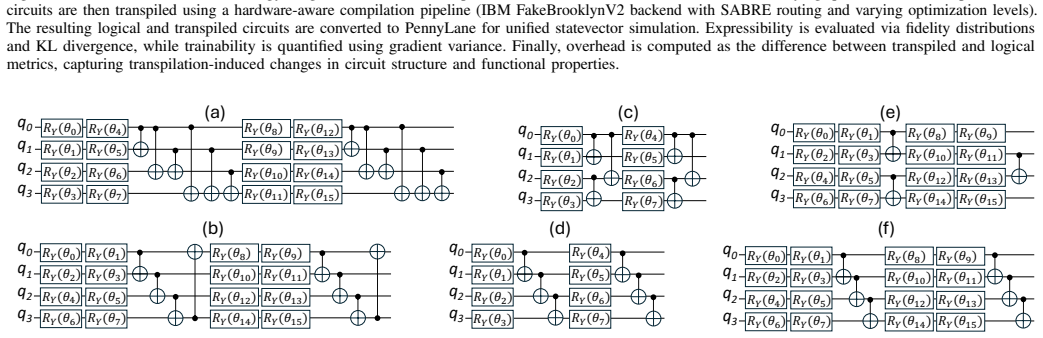

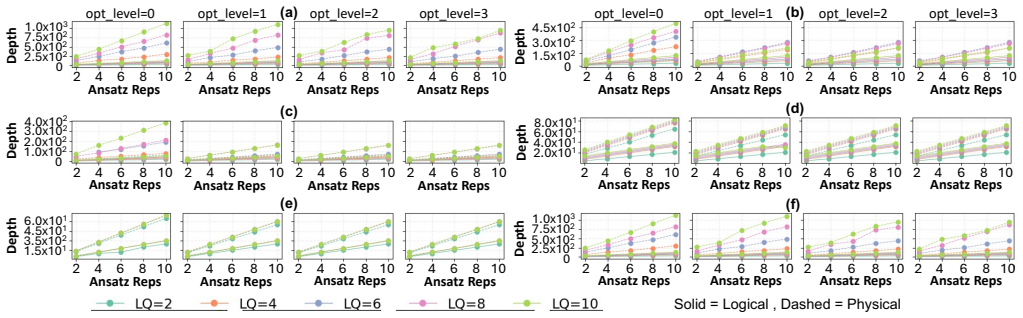
read the original abstract
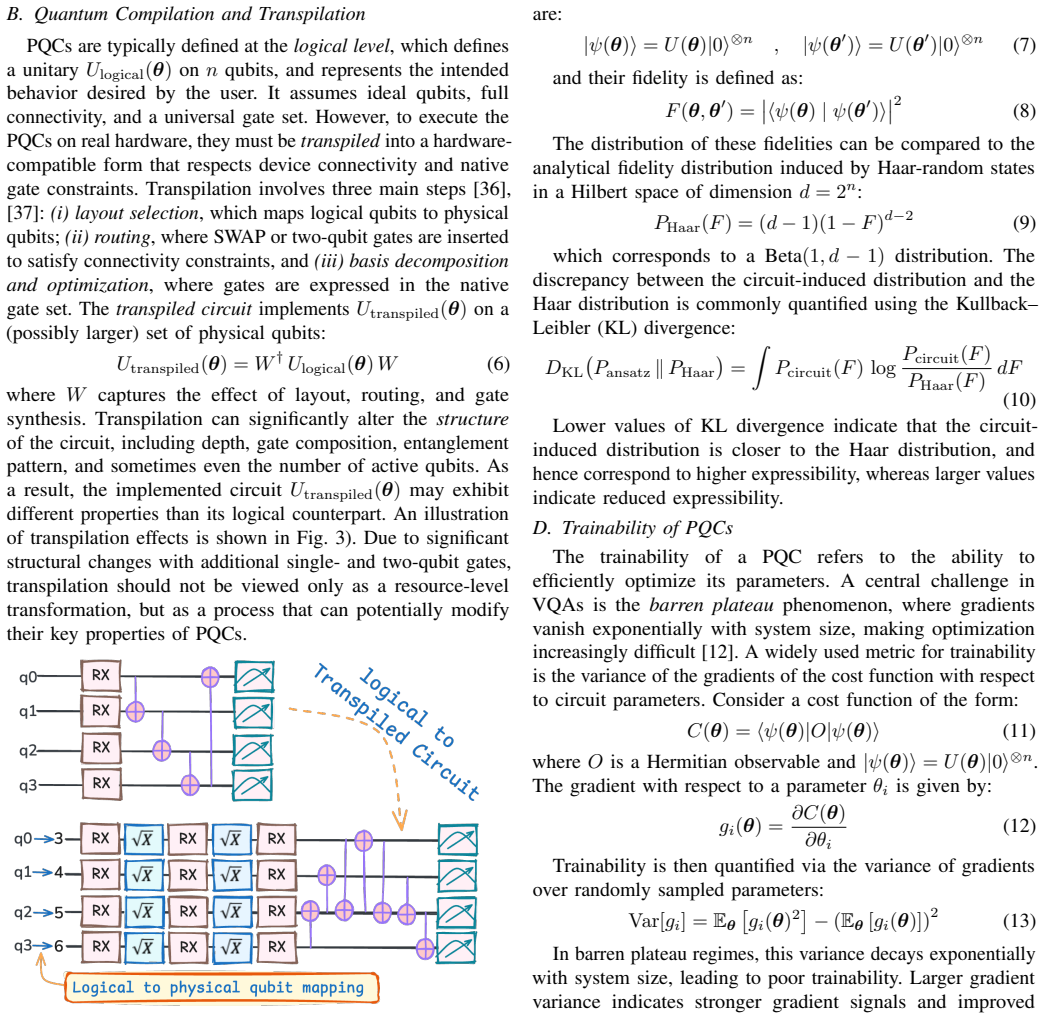
Variational quantum algorithms (VQAs) rely on parameterized quantum circuits (PQCs), whose performance is governed by expressibility and trainability. Existing studies typically evaluate these properties at the logical circuit level, implicitly assuming that designed PQCs remain unchanged during hardware execution. In practice, however, hardware-aware transpilation modifies circuit structure through qubit mapping, routing, and basis decomposition, potentially altering PQC behavior. In this paper, we perform a systematic hardware-aware analysis of expressibility and trainability by comparing logical and transpiled PQCs across multiple ansatz families, qubit counts, and circuit depths. Expressibility is measured using fidelity-based KL divergence, while trainability is quantified through gradient variance. Our results show that transpilation acts as an implicit architectural perturbation, producing strongly ansatz-dependent effects. Expressibility deviations exceed upto 125% in some cases, while trainability variations reach up to 25%. Structured ansatzes are generally more robust, whereas highly entangled architectures are more sensitive to transpilation-induced transformations. We further show that transpilation can alter the commonly assumed expressibility-trainability trade-off, demonstrating that logical-level analyses may not reliably predict hardware-level behavior. These findings highlight the importance of hardware-aware evaluation for accurate characterization of VQAs.
Editorial analysis
A structured set of objections, weighed in public.
Referee Report
Summary. The manuscript claims that transpilation of parameterized quantum circuits (PQCs) in variational quantum algorithms acts as an implicit architectural perturbation. By comparing logical and transpiled circuits across ansatz families, qubit counts, and depths using fidelity-based KL divergence for expressibility and gradient variance for trainability, it reports ansatz-dependent deviations exceeding 125% in expressibility and reaching 25% in trainability. Structured ansatzes are more robust while entangled ones are sensitive, and transpilation can alter the expressibility-trainability trade-off, implying logical-level analyses do not reliably predict hardware behavior.
Significance. If the empirical findings hold under the stated metrics, the work is significant for highlighting that standard logical-circuit evaluations of VQAs can miss hardware-induced changes from mapping, routing, and decomposition. The systematic comparison across multiple ansatzes provides concrete, ansatz-specific evidence that could guide more reliable hardware-aware VQA design and evaluation practices.
major comments (1)
- [Abstract] Abstract: the central claim that 'logical-level analyses may not reliably predict hardware-level behavior' is load-bearing on the premise that noiseless post-transpilation metrics (fidelity KL divergence and gradient variance) capture dominant hardware effects. No device noise models, T1/T2 times, two-qubit error rates, or calibration data are incorporated, so the reported 125% and 25% deviations may not persist or could be reversed when realistic noise channels are added.
minor comments (1)
- [Abstract] Abstract: 'exceed upto 125%' contains a grammatical/typographical error and should read 'exceed up to 125%' or 'exceeds 125%'.
Simulated Author's Rebuttal
We thank the referee for their detailed review and constructive feedback on our manuscript. We address the major comment point-by-point below, focusing on the scope of our hardware-aware analysis.
read point-by-point responses
-
Referee: [Abstract] Abstract: the central claim that 'logical-level analyses may not reliably predict hardware-level behavior' is load-bearing on the premise that noiseless post-transpilation metrics (fidelity KL divergence and gradient variance) capture dominant hardware effects. No device noise models, T1/T2 times, two-qubit error rates, or calibration data are incorporated, so the reported 125% and 25% deviations may not persist or could be reversed when realistic noise channels are added.
Authors: We appreciate the referee's point on the distinction between structural and noisy hardware effects. Our work deliberately isolates the impact of transpilation (mapping, routing, and decomposition) as an implicit architectural change that occurs prior to and independently of noise during hardware execution. The reported deviations arise purely from these structural modifications to the PQC, which are mandatory for any hardware run and are not captured in logical-circuit analyses. While we agree that device noise would introduce further perturbations (potentially amplifying or mitigating the observed shifts), the core finding—that logical evaluations miss transpilation-induced changes—holds under the noiseless post-transpilation metrics used. We will revise the abstract and discussion sections to explicitly qualify the claim as applying to 'noiseless hardware-level circuit structure' and to note noise incorporation as valuable future work, without altering the empirical results or metrics. revision: partial
Circularity Check
Empirical comparison with no derivations or self-referential reductions
full rationale
The paper conducts a direct empirical comparison of expressibility (via fidelity-based KL divergence) and trainability (via gradient variance) between logical and transpiled PQCs across ansatz families. No equations, parameter fittings, or derivations are present in the provided text; results are obtained by applying standard transpilation steps and computing the metrics on the resulting circuits. No self-citations are invoked as load-bearing premises, and no ansatz or uniqueness theorem is smuggled in. The work is self-contained as a hardware-aware simulation study without any reduction of outputs to inputs by construction.
Axiom & Free-Parameter Ledger
Reference graph
Works this paper leans on
-
[1]
Position paper: Quantum neural networks - a paradigm shift in ai or a theoretical promise?
M. Kashif and M. Shafique, “Position paper: Quantum neural networks - a paradigm shift in ai or a theoretical promise?” in2025 International Joint Conference on Neural Networks (IJCNN), 2025, pp. 1–10
2025
-
[2]
Cerezo, Andrew Arrasmith, Ryan Babbush, Simon C
M. Cerezo, A. Arrasmith, R. Babbush, S. C. Benjamin, S. Endo, K. Fujii, J. R. McClean, K. Mitarai, X. Yuan, L. Cincio, and P. J. Coles, “Variational quantum algorithms,”Nature Reviews Physics, vol. 3, no. 9, p. 625–644, Aug. 2021. [Online]. Available: http://dx.doi.org/10.1038/s42254-021-00348-9
-
[3]
Design space exploration of hybrid quantum–classical neural networks,
M. Kashif and S. Al-Kuwari, “Design space exploration of hybrid quantum–classical neural networks,”Electronics, vol. 10, no. 23, p. 2980, 2021
2021
-
[4]
Quav: Quantum-assisted path planning and optimization for uav navigation with obstacle avoidance,
N. Innanet al., “Quav: Quantum-assisted path planning and optimization for uav navigation with obstacle avoidance,” in2025 IEEE International Conference on Quantum Artificial Intelligence (QAI). IEEE, 2025, pp. 208–215
2025
-
[5]
Computational advantage in hybrid quantum neural networks: Myth or reality?
M. Kashif, A. Marchisio, and M. Shafique, “Computational advantage in hybrid quantum neural networks: Myth or reality?” in2025 62nd ACM/IEEE Design Automation Conference (DAC). IEEE, 2025, pp. 1–7
2025
-
[6]
S. Sim, P. D. Johnson, and A. Aspuru-Guzik, “Expressibility and entangling capability of parameterized quantum circuits for hybrid quantum-classical algorithms,”Advanced Quantum Technologies, vol. 2, no. 12, Oct. 2019. [Online]. Available: http://dx.doi.org/10.1002/qute. 201900070
-
[7]
Analysis of parameterized quantum circuits: on the connection between expressibility and types of quantum gates,
Y . Liu, K. Kaneko, K. Baba, J. Koyama, K. Kimura, and N. Takeda, “Analysis of parameterized quantum circuits: on the connection between expressibility and types of quantum gates,”IEEE Transactions on Quantum Engineering, 2025
2025
-
[8]
How to find expressible and trainable parameterized quantum circuits?
P. R ¨oseler, D. Willsch, and K. Michielsen, “How to find expressible and trainable parameterized quantum circuits?”arXiv preprint arXiv:2603.14451, 2026
-
[9]
Designing robust quantum neural networks via optimized circuit metrics,
W. El Maouaki, A. Marchisio, T. Said, M. Shafique, and M. Bennai, “Designing robust quantum neural networks via optimized circuit metrics,”Advanced Quantum Technologies, vol. 8, no. 6, Mar. 2025. [Online]. Available: http://dx.doi.org/10.1002/qute.202400601
-
[10]
Diagnosing quantum circuits: Noise robustness, trainability, and expressibility,
Y . Shaoet al., “Diagnosing quantum circuits: Noise robustness, trainability, and expressibility,”arXiv preprint arXiv:2509.11307, 2025
-
[11]
Resqnets: a residual approach for mitigating barren plateaus in quantum neural networks,
M. Kashif and S. Al-Kuwari, “Resqnets: a residual approach for mitigating barren plateaus in quantum neural networks,”EPJ Quantum Technology, vol. 11, no. 1, Jan. 2024
2024
-
[12]
Barren plateaus in quantum neural network training landscapes,
J. R. McClean, S. Boixo, V . N. Smelyanskiy, R. Babbush, and H. Neven, “Barren plateaus in quantum neural network training landscapes,”Nature communications, vol. 9, no. 1, p. 4812, 2018
2018
-
[13]
Alleviating barren plateaus in parameterized quantum machine learning circuits: Investigating advanced parameter initialization strategies,
M. Kashifet al., “Alleviating barren plateaus in parameterized quantum machine learning circuits: Investigating advanced parameter initialization strategies,” inDATE, 2024
2024
-
[14]
Investigating different barren plateaus mitigation strategies in variational quantum eigensolver,
M. Atallahet al., “Investigating different barren plateaus mitigation strategies in variational quantum eigensolver,”arXiv preprint arXiv:2512.11171, 2025
-
[15]
The impact of cost function globality and locality in hybrid quantum neural networks on nisq devices,
M. Kashif and S. Al-Kuwari, “The impact of cost function globality and locality in hybrid quantum neural networks on nisq devices,”Machine Learning: Science and Technology, vol. 4, no. 1, p. 015004, 2023
2023
-
[16]
Connecting ansatz expressibility to gradient magnitudes and barren plateaus,
Z. Holmes, K. Sharma, M. Cerezo, and P. J. Coles, “Connecting ansatz expressibility to gradient magnitudes and barren plateaus,” PRX Quantum, vol. 3, no. 1, Jan. 2022. [Online]. Available: http://dx.doi.org/10.1103/PRXQuantum.3.010313
-
[17]
The unified effect of data encoding, ansatz expressibility and entanglement on the trainability of hqnns,
M. Kashif and S. Al-Kuwari, “The unified effect of data encoding, ansatz expressibility and entanglement on the trainability of hqnns,” International Journal of Parallel, Emergent and Distributed Systems, vol. 38, no. 5, pp. 362–400, 2023
2023
-
[18]
Cost function dependent barren plateaus in shallow parametrized quantum circuits,
M. Cerezo, A. Sone, T. V olkoff, L. Cincio, and P. J. Coles, “Cost function dependent barren plateaus in shallow parametrized quantum circuits,”Nature Communications, vol. 12, no. 1, Mar. 2021. [Online]. Available: http://dx.doi.org/10.1038/s41467-021-21728-w
-
[19]
Entanglement-variational hardware-efficient ansatz for eigensolvers,
X. Wang, B. Qi, Y . Wang, and D. Dong, “Entanglement-variational hardware-efficient ansatz for eigensolvers,”Physical Review Applied, vol. 21, no. 3, p. 034059, 2024
2024
-
[20]
A comparative analysis and noise robustness evaluation in quantum neural networks,
T. Ahmed, M. Kashif, A. Marchisio, and M. Shafique, “A comparative analysis and noise robustness evaluation in quantum neural networks,” Scientific Reports, vol. 15, no. 1, p. 33654, 2025
2025
-
[21]
Hardware-efficient variational quantum eigensolver for small molecules and quantum magnets,
A. Kandalaet al., “Hardware-efficient variational quantum eigensolver for small molecules and quantum magnets,”Nature, vol. 549, no. 7671, p. 242–246, Sep. 2017. [Online]. Available: http: //dx.doi.org/10.1038/nature23879
-
[22]
Hardware-efficient ansatz without barren plateaus in any depth,
C.-Y . Park, M. Kang, and J. Huh, “Hardware-efficient ansatz without barren plateaus in any depth,”arXiv, 2024. [Online]. Available: https://arxiv.org/abs/2403.04844
-
[23]
Tensor networks for quantum computing,
A. Berezutskii, M. Liu, A. Acharya, R. Ellerbrock, J. Gray, R. Haghshenas, Z. He, A. Khan, V . Kuzmin, D. Lyakhet al., “Tensor networks for quantum computing,”Nature Reviews Physics, vol. 7, no. 10, pp. 581–593, 2025
2025
-
[24]
Embedding of tree tensor networks into shallow quantum circuits,
S. Sugawara, K. Inomata, T. Okubo, and S. Todo, “Embedding of tree tensor networks into shallow quantum circuits,”arXiv:2501.18856, 2025. [Online]. Available: https://arxiv.org/abs/2501.18856
-
[25]
Variational quantum eigensolver with linear depth problem-inspired ansatz for solving portfolio optimization in finance,
S. Wanget al., “Variational quantum eigensolver with linear depth problem-inspired ansatz for solving portfolio optimization in finance,” Science China Information Sciences, vol. 68, no. 8, p. 180504, 2025
2025
-
[26]
IBM Quantum
(2026) Qiskit documentation: Introduction to transpilation. IBM Quantum. Accessed: April 2026. [Online]. Available: https://quantum. cloud.ibm.com/docs/en/guides/transpile
2026
-
[27]
M. M. Louamri, N. e. Belaloui, A. Tounsi, and M. T. Rouabah, “Comparative study of quantum transpilers: Evaluating the performance of qiskit-braket-provider, qbraid-sdk, and pytket extensions,” in2024 1st International Conference on Innovative and Intelligent Information Technologies (IC3IT). IEEE, Dec. 2024, p. 1–6. [Online]. Available: http://dx.doi.org...
-
[28]
M. Kashif and M. Shafique, “Late breaking results: Hardware-aware compilation reshapes trainability in variational quantum circuits,”arXiv preprint arXiv:2604.16527, 2026
work page internal anchor Pith review Pith/arXiv arXiv 2026
-
[29]
An empirical study into the effects of transpilation on quantum circuit smells,
M. D. Stefanoet al., “An empirical study into the effects of transpilation on quantum circuit smells,”Empirical Software Engineering, vol. 29, no. 3, p. 61, 2024
2024
-
[30]
Understanding the effect of transpilation in the reliability of quantum circuits,
N. Dililloet al., “Understanding the effect of transpilation in the reliability of quantum circuits,” in2023 IEEE International Conference on Quantum Computing and Engineering (QCE), vol. 2. IEEE, 2023, pp. 232–235
2023
-
[31]
Faqnas: Flops-aware hybrid quantum neural architecture search using genetic algorithm,
M. Kashif, S. Khalid, A. Marchisio, N. Innan, and M. Shafique, “Faqnas: Flops-aware hybrid quantum neural architecture search using genetic algorithm,”arXiv preprint arXiv:2511.10062, 2025
-
[32]
Revisiting noise-adaptive transpilation in quantum computing: How much impact does it have?
Y . Huoet al., “Revisiting noise-adaptive transpilation in quantum computing: How much impact does it have?” in2025 IEEE/ACM International Conference On Computer Aided Design (ICCAD). IEEE, 2025, pp. 1–9
2025
-
[33]
Forensics of transpiled quantum circuits,
R. Roy, A. Ghosh, and S. Ghosh, “Forensics of transpiled quantum circuits,” inProceedings of the Great Lakes Symposium on VLSI 2025, 2025, pp. 354–359
2025
-
[34]
M. Kashif, A. Marchisio, and M. Shafique, “Closing the loop: Resource- aware hybrid nas guided by analytical and hardware-calibrated quantum cost modeling,”arXiv preprint arXiv:2603.00625, 2026
-
[35]
Quantum circuit matrix product state ansatz for large-scale simulations of molecules,
Y . Fan, J. Liu, Z. Li, and J. Yang, “Quantum circuit matrix product state ansatz for large-scale simulations of molecules,”Journal of Chemical Theory and Computation, vol. 19, no. 16, pp. 5407–5417, 2023
2023
-
[36]
Lightsabre: A lightweight and enhanced sabre algorithm,
H. Zouet al., “Lightsabre: A lightweight and enhanced sabre algorithm,”arXiv:2409.08368, 2024. [Online]. Available: https: //arxiv.org/abs/2409.08368
-
[37]
IBM Quantum
(2026) Qiskit documentation: Transpilation optimizations with sabre. IBM Quantum. Accessed: Jan 2026. [Online]. Available: https://quantum. cloud.ibm.com/docs/en/tutorials/transpilation-optimizations-with-sabre
2026
-
[38]
Efficient estimation of trainability for variational quantum circuits,
V . Heyraud, Z. Li, K. Donatella, A. Le Boit ´e, and C. Ciuti, “Efficient estimation of trainability for variational quantum circuits,”PRX Quantum, vol. 4, no. 4, p. 040335, 2023
2023
-
[39]
Entanglement induced barren plateaus,
C. O. Marrero, M. Kieferov ´a, and N. Wiebe, “Entanglement induced barren plateaus,”arXiv, 2020. [Online]. Available: https: //arxiv.org/abs/2010.15968
-
[40]
The Dilemma of Random Parameter Initialization and Barren Plateaus in Variational Quantum Algorithms ,
M. Kashif and M. Shafique, “ The Dilemma of Random Parameter Initialization and Barren Plateaus in Variational Quantum Algorithms ,” in2024 IEEE International Conference on Rebooting Computing (ICRC). CA, USA: IEEE Computer Society, Dec. 2024, pp. 1–8
2024
-
[41]
Expressibility of the alternating layered ansatz for quantum computation,
K. Nakaji and N. Yamamoto, “Expressibility of the alternating layered ansatz for quantum computation,”Quantum, vol. 5, p. 434, 2021
2021
-
[42]
Representation theory for geometric quantum machine learning (2022),
M. Ragoneet al., “Representation theory for geometric quantum machine learning (2022),”arXiv preprint arXiv:2210.07980
-
[43]
Learning the expressibility of quantum circuit ansatz using transformer,
F. Zhang, J. Li, Z. He, and H. Situ, “Learning the expressibility of quantum circuit ansatz using transformer,”Advanced Quantum Technologies, vol. 8, no. 6, p. 2400366, 2025
2025
-
[44]
Multi-class quantum classifiers with tensor network circuits for quantum phase recognition,
M. Lazzarin, D. E. Galli, and E. Prati, “Multi-class quantum classifiers with tensor network circuits for quantum phase recognition,”Physics Letters A, vol. 434, p. 128056, 2022
2022
-
[45]
Quantum phase recognition using quantum tensor networks,
S. Sahoo, U. Azad, and H. Singh, “Quantum phase recognition using quantum tensor networks,”The European Physical Journal Plus, vol. 137, no. 12, p. 1373, 2022
2022
-
[46]
IBM Quantum
Qiskit documentation: Twolocal ansatz. IBM Quantum. Accessed: March
-
[47]
Available: https://quantum.cloud.ibm.com/docs/en/api/ qiskit/qiskit.circuit.library.TwoLocal
[Online]. Available: https://quantum.cloud.ibm.com/docs/en/api/ qiskit/qiskit.circuit.library.TwoLocal
-
[48]
IBM Quantum
Qiskit documentation: Efficient su2 ansatz. IBM Quantum. Accessed: March 2026. [Online]. Available: https://quantum.cloud.ibm.com/docs/ en/api/qiskit/qiskit.circuit.library.EfficientSU2l
2026
-
[49]
IBM Quantum
Qiskit documentation: Real amplitudes ansatz. IBM Quantum. Accessed: March 2026. [Online]. Available: https://quantum.cloud.ibm.com/docs/ en/api/qiskit/qiskit.circuit.library.RealAmplitudes
2026
-
[50]
Quantum circuit optimization and transpilation via parameterized circuit instantiation,
E. Younis and C. Iancu, “Quantum circuit optimization and transpilation via parameterized circuit instantiation,” in2022 IEEE International Conference on Quantum Computing and Engineering (QCE). IEEE, 2022, pp. 465–475
2022
-
[51]
IBM Quantum
The ibm quantum heavy hex lattice. IBM Quantum. Accessed: March 2026. [Online]. Available: https://www.ibm.com/quantum/blog/ heavy-hex-lattice
2026
-
[52]
PennyLane: Automatic differentiation of hybrid quantum-classical computations
V . Bergholmet al., “Pennylane: Automatic differentiation of hybrid quantum-classical computations,”arXiv preprint arXiv:1811.04968, 2018
work page internal anchor Pith review Pith/arXiv arXiv 2018
discussion (0)
Sign in with ORCID, Apple, or X to comment. Anyone can read and Pith papers without signing in.