Homomorphic Quantum Error Correction
Pith reviewed 2026-06-29 21:40 UTC · model grok-4.3
The pith
A necessary and sufficient criterion determines when [[n,1,d]] stabilizer codes stay compatible with block-Pauli masking in homomorphic quantum encryption.
A machine-rendered reading of the paper's core claim, the machinery that carries it, and where it could break.
Core claim
A necessary and sufficient criterion exists for an [[n,1,d]] stabilizer code to remain compatible with the restricted transversal block-Pauli masking U_enc(a,b)=(X^a Z^b)^{\otimes n}, such that the masked encoded state stays inside the code space. The same criterion applies directly to code-space preservation for [[n,k,d]] codes. The condition is verified for the bit-flip and Shor codes, a practical form is derived for CSS codes, and the analysis is extended to three-dimensional color codes. Two approaches address the lack of a naive transversal T-gate on the Shor code: triorthogonal codes that admit transversal T-type implementations up to Clifford corrections, and logical-gate masking that
What carries the argument
The restricted transversal block-Pauli masking U_enc(a,b)=(X^a Z^b)^{\otimes n} together with the algebraic test for whether its action on encoded states preserves the code space.
If this is right
- Bit-flip and Shor codes satisfy the compatibility criterion.
- A practical algebraic test exists for all Calderbank-Shor-Steane codes.
- Three-dimensional color codes meet the same code-space preservation requirement.
- Triorthogonal codes permit transversal T-type logical gates up to Clifford corrections.
- Logical-gate masking restores compatibility for any stabilizer code once suitable unitary representatives are chosen.
Where Pith is reading between the lines
- The separation of code-space compatibility from a full cryptographic security proof lets researchers check the error-correction layer independently of the encryption security layer.
- The same masking form and criterion could be tested on other families of codes beyond CSS and color codes to identify further candidates for homomorphic processing.
- If logical-gate masking proves practical, it removes the need to restrict the code family when non-Clifford operations are required.
Load-bearing premise
Compatibility is defined solely by whether the masked encoded state remains inside the code space when the homomorphic scheme uses exactly this block-Pauli transversal form.
What would settle it
Applying U_enc(a,b) to a codeword of a candidate [[n,1,d]] code and finding the resulting state lies outside the code space for some a,b would show the criterion fails for that code.
Figures

read the original abstract
Homomorphic quantum error correction aims to protect quantum data against both unauthorized access and environmental noise during server-based processing. We investigate the algebraic compatibility between quantum homomorphic encryption and quantum error correction, determining precise conditions under which encrypted encoded states remain inside the relevant code space during storage and computation. Our work establishes a necessary and sufficient criterion for an $[[n,1,d]]$ stabilizer code to remain compatible with the restricted transversal block-Pauli masking $U_{\rm enc}(a,b)=(X^aZ^b)^{\otimes n}$, stated explicitly for $[[n,1,d]]$ codes and extending directly to code-space preservation for $[[n,k,d]]$ codes. We verify this condition for standard examples (bit-flip and Shor codes, with the phase-flip repetition code following analogously), derive a practical criterion for Calderbank-Shor-Steane codes, and extend the analysis to three-dimensional color codes. A critical challenge emerges for non-Clifford gate implementation: the Shor code lacks a naive transversal $T$-gate implementation of the desired logical operation on encrypted encoded data. We present two routes around this obstruction. First, suitable triorthogonal codes admit transversal $T$-type logical implementations, up to Clifford corrections. Second, logical-gate masking gives code-space compatibility for arbitrary stabilizer codes, provided that suitable unitary representatives of the required logical gates are available. These results separate code-space compatibility from a full cryptographic security proof and provide explicit criteria for combining error correction with homomorphic processing in cloud quantum computing.
Editorial analysis
A structured set of objections, weighed in public.
Referee Report
Summary. The paper claims to establish a necessary and sufficient algebraic criterion for an [[n,1,d]] stabilizer code to remain compatible with the restricted transversal block-Pauli masking U_enc(a,b)=(X^a Z^b)^{\otimes n}, ensuring the masked encoded state remains inside the code space. The criterion is stated explicitly for [[n,1,d]] codes with direct extension to [[n,k,d]] codes, verified on bit-flip, phase-flip, and Shor codes, supplied in practical form for CSS codes, and extended to 3D color codes. The work also addresses the non-Clifford gate obstruction via triorthogonal codes (with transversal T up to Clifford corrections) or logical-gate masking, while explicitly separating code-space compatibility from any claim of full cryptographic security.
Significance. If the derivations and verifications hold, the result would be significant for quantum cloud computing by supplying explicit algebraic tests for combining stabilizer codes with homomorphic encryption schemes. The separation of compatibility from security and the concrete treatment of the non-Clifford issue are strengths; the verifications on standard codes (bit-flip, Shor, CSS) add practical value.
major comments (2)
- [Criterion derivation and verification sections] The abstract and main text assert that a necessary-and-sufficient criterion is derived from the code and masking definitions and verified on examples, but the explicit algebraic steps, stabilizer-generator calculations, and code-space preservation checks (including edge cases) are not visible. This is load-bearing for the central claim.
- [Extension to [[n,k,d]] codes] The extension from [[n,1,d]] to [[n,k,d]] codes is stated as direct, but the manuscript does not show how the algebraic test generalizes when k>1 (e.g., action on multiple logical qubits under the same transversal masking).
minor comments (2)
- [Notation throughout] The notation U_enc(a,b) is introduced clearly, but repeated use of the full expression (X^a Z^b)^{\otimes n} versus the shorthand could be made uniform for readability.
- [Non-Clifford gate section] The discussion of triorthogonal codes for transversal T would benefit from an explicit reference to the relevant prior work on triorthogonal matrices.
Simulated Author's Rebuttal
We thank the referee for the careful reading and constructive feedback on our manuscript. We address each major comment below.
read point-by-point responses
-
Referee: [Criterion derivation and verification sections] The abstract and main text assert that a necessary-and-sufficient criterion is derived from the code and masking definitions and verified on examples, but the explicit algebraic steps, stabilizer-generator calculations, and code-space preservation checks (including edge cases) are not visible. This is load-bearing for the central claim.
Authors: The derivation begins from the requirement that U_enc(a,b) maps the code space to itself, which is equivalent to the masked stabilizers remaining in the stabilizer group (up to phase). This yields the algebraic condition on the logical operators given in Theorem 1. Explicit stabilizer-generator calculations for the bit-flip and Shor codes appear in Section III, together with the verification that the condition is both necessary and sufficient. We agree, however, that intermediate algebraic steps and additional edge-case checks (trivial masking, weight-1 stabilizers) are not presented at the level of detail the referee requests. We will expand these sections with the requested step-by-step calculations and explicit checks. revision: yes
-
Referee: [Extension to [[n,k,d]] codes] The extension from [[n,1,d]] to [[n,k,d]] codes is stated as direct, but the manuscript does not show how the algebraic test generalizes when k>1 (e.g., action on multiple logical qubits under the same transversal masking).
Authors: Because the masking operator is strictly transversal, it acts identically on every physical qubit and therefore acts independently on the logical operators of each of the k logical qubits. The necessary-and-sufficient condition therefore applies separately to the logical X and Z operators of each logical qubit. We will add a short subsection that states this generalization explicitly and illustrates it with a small [[n,k>1,d]] example. revision: yes
Circularity Check
No significant circularity; algebraic criterion derived directly from definitions
full rationale
The paper derives an explicit necessary-and-sufficient algebraic criterion for [[n,1,d]] stabilizer codes to preserve code space under the given transversal block-Pauli masking U_enc(a,b)=(X^a Z^b)^⊗n, extending to [[n,k,d]] codes. This is obtained by direct inspection of the stabilizer generators and the action of the masking operator on codewords, with verification on standard codes (bit-flip, phase-flip, Shor) and a practical form for CSS codes. No step reduces a prediction to a fitted parameter, invokes a self-citation as the sole justification for a uniqueness claim, or renames an input as an output. The non-Clifford obstruction is handled by referencing triorthogonal codes and logical-gate masking as separate routes, without circular dependence on the main criterion. The derivation remains self-contained against the stated definitions of compatibility and masking.
Axiom & Free-Parameter Ledger
axioms (2)
- standard math Stabilizer codes are defined via their stabilizer group with the usual code-space and distance properties.
- domain assumption The homomorphic encryption masking is restricted to the transversal block-Pauli form U_enc(a,b)=(X^a Z^b)^{\otimes n}.
Reference graph
Works this paper leans on
-
[1]
keep quantum data encrypted at all times,
-
[2]
perform error correction directly on encrypted states, and
-
[3]
Cloud quantum computing, however, demands more than robust data protection: it also requires the ability to carry out nontrivial quantum computations on encrypted data
preserve the code space under both encryption and error-correction operations. Cloud quantum computing, however, demands more than robust data protection: it also requires the ability to carry out nontrivial quantum computations on encrypted data. This leads to a central question: can quantum gates be applied to encrypted quantum states in such a way that...
-
[4]
MADQuantum-CM
Triorthogonal codes and the CSS code construction In the previous sections, the discussion focused on gen- eral stabilizer and CSS codes as the basic framework for encoding and protecting quantum information. However, when aiming to perform quantum computation with non- CliffordTgates on encrypted data, not every CSS code is equally suitable. For this tas...
2026
-
[5]
(b) Application of a non-Clifford gate,T
On the first qubit,w 1: (a) Application of a Clifford gate,H. (b) Application of a non-Clifford gate,T. 21
-
[6]
(b) Application of a Clifford gate,S
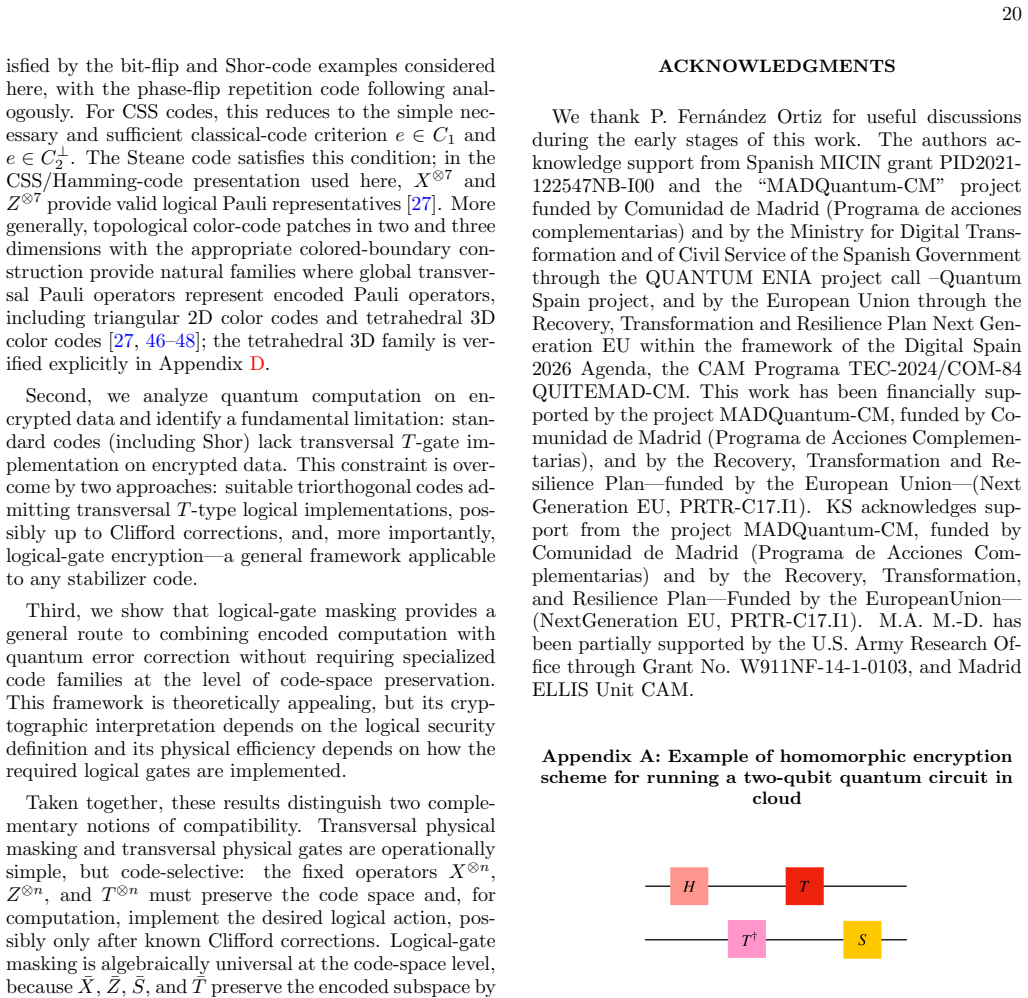
On the second qubit,w 2: (a) Application of a non-Clifford gate,T †. (b) Application of a Clifford gate,S. The client wants to act the circuit on the initial two- qubit state,|ψ⟩ w1w2, and prepare the final state (T H⊗ ST †)|ψ⟩ w1w2 through cloud computation. To evaluate the circuit on|ψ⟩ w1w2 in the cloud, the client and server follow the steps described...
-
[7]
Finally, after encryption, the client sends the en- crypted state|ψ enc⟩w1w2 to the server for the application of the circuit on the qubits,w 1 andw 2
and (a 0 2, b0 2), applies the gatesX a0 1 Z b0 1 ⊗X a0 2 Z b0 2 on the state,|ψ⟩ w1w2, and forms the encrypted state |ψenc⟩w1w2 =X a0 1 Z b0 1 ⊗X a0 2 Z b0 2 |ψ⟩w1w2 .(A1) In this scheme,{(a 0 1, b0 1),(a 0 2, b0 2)}is the set of secret keys, knowing which one can recover the original state, |ψ⟩w1w2, by applyingXandZgates appropriately on the encrypted s...
-
[8]
(b) The qubits,c 1,s 1,c 2,s 2, prepared in the Bell states, remain untouched
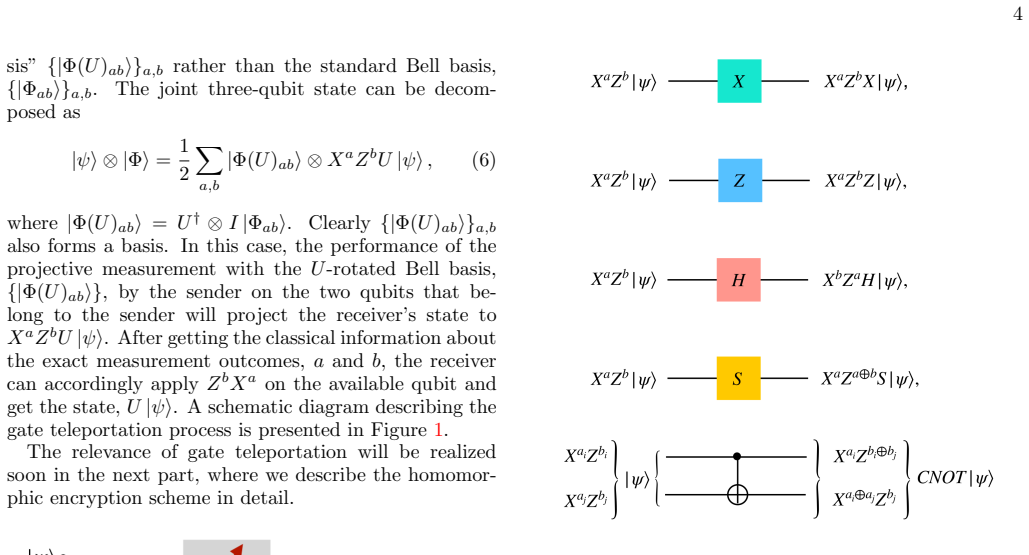
Application ofHonw 1: (a) It actsHgate on the first qubit of|ψ enc⟩w1w2 and prepares the state (H⊗I)(X a0 1 Z b0 1 ⊗X a0 2 Z b0 2)|ψ⟩ w1w2 = (X b0 1 Z a0 1 ⊗X a0 2 Z b0 2)(H⊗I)|ψ⟩ w1w2 . (b) The qubits,c 1,s 1,c 2,s 2, prepared in the Bell states, remain untouched. The complete state of the six qubits is (X b0 1 Z a0 1 ⊗X a0 2 Z b0 2)(H⊗I)|ψ⟩ w1w2 |Φ⟩s1c1...
-
[9]
(b) Swaps the qubitw 1 withs 1 and keeps the qubitsw 2 ands 2 as it is
Application ofTonw 1: (a) It actsTgate on the first qubit,w 1, and gets (T⊗I)(X a1 1 Z b1 1 ⊗X a1 2 Z b1 2)(H⊗I)|ψ⟩ w1w2 = ((S †)a1 1 X a1 1 Z a1 1⊕b1 1 ⊗X a1 2 Z b1 2)(T H⊗I)|ψ⟩ w1w2 . (b) Swaps the qubitw 1 withs 1 and keeps the qubitsw 2 ands 2 as it is. The complete state of the six qubits at the end of this action is ((S†)a1 1 X a1 1 Z a1 1⊕b1 1 ⊗X a...
-
[10]
(b) Swaps the qubitw 2 withs 2
Application ofT † onw 2: (a) It actsT † gate on qubit,w 2, and gets (I⊗T †)(X a2 1 Z b2 1 ⊗X a2 2 Z b2 2)(T H⊗I)|ψ⟩ w1w2 = (X a2 1 Z b2 1 ⊗S a2 2 X a2 2 Z a2 2⊕b2 2)(T H⊗T †)|ψ⟩ w1w2 . (b) Swaps the qubitw 2 withs 2. Keeps the qubits w1 ands 1 as they are. Hence the complete state of the six qubits is 1 2 X ra,rb Φ(Sa1 1)rarb E s1c1 (X a2 1 Z b2 1 ⊗S a2 2...
-
[11]
22 (b) Does not change the state of the other qubits
Application ofSgate onw 2: (a) It actsSgate on qubit,w 2, and gets (I⊗S)(X a3 1 Z b3 1 ⊗X a3 2 Z b3 2)(T H⊗T †)|ψ⟩ w1w2 = (X a3 1 Z b3 1 ⊗X a3 2 Z a3 2⊕b3 2)(T H⊗ST †)|ψ⟩ w1w2 . 22 (b) Does not change the state of the other qubits. The entire state of the six qubits is 1 4 X ra,rb,r′a,r′ b Φ(Sa1 1)rarb E s1c1 Φ((S†)a2 2)r′ar′ b E s2c2 (X a3 1 Z b3 1 ⊗X a3...
-
[12]
The keys (a1 2, b1
Knowing the key updating functions,f H x1 andf H z1 , the client finds (a1 1, b1 1). The keys (a1 2, b1
-
[13]
are known to be the same as (a 0 2, b0 2)
-
[14]
From the measurement outcomes, sayr a andr b, the client gets the keys,a 2 1 =a 1 1 ⊕r a andb 2 1 =a 1 1 ⊕b 1 1 ⊕r b
The client performs a measurement on then Φ(Sa1 1)rarb Eo basis ons 1c1 qubits. From the measurement outcomes, sayr a andr b, the client gets the keys,a 2 1 =a 1 1 ⊕r a andb 2 1 =a 1 1 ⊕b 1 1 ⊕r b. The keys of the second qubits remain the same, i.e., a2 2 =a 1 2 andb 2 2 =b 1 2
-
[15]
Depending on the measurement outcomes,r ′ a andr ′ b,it updates the keys asa 3 2 =a 2 2 ⊕r ′ a andb 3 2 =a 2 2 ⊕b 2 2 ⊕r ′ b
Again the client performs a measurement in another rotated Bell basis, which is { Φ((S†)a2 2)r′ar′ b E }, ons 2c2. Depending on the measurement outcomes,r ′ a andr ′ b,it updates the keys asa 3 2 =a 2 2 ⊕r ′ a andb 3 2 =a 2 2 ⊕b 2 2 ⊕r ′ b. The keys corresponding to the first qubit are kept unchanged, i.e.,a 3 1 =a 2 1 andb 3 1 =b 2 1
-
[16]
The keys of the first pair of qubits are kept fixed ata 4 1 =a 3 1,b 4 1 =b 3 1
From the key updating functions,f S x2 andf S z2, the client evaluates (a 4 2, b4 2). The keys of the first pair of qubits are kept fixed ata 4 1 =a 3 1,b 4 1 =b 3 1. At the end of the measurements, the state of the qubits, w1 andw 2, collapses to ψenc f inal = (X a4 1 Z b4 1 ⊗X a4 2 Z b4 2)(T H⊗ST †)|ψ⟩ w1w2 . The client finally gets the targeted state b...
-
[17]
on the state ψenc f inal E , which is (Z b4 1 X a4 1 ⊗Z b4 2 X a4 2) ψenc f inal = (T H⊗ST †)|ψ⟩ w1w2 , that is the final desired state. Appendix B: Table related to bit-flip error correction of encrypted data To protect a logical qubit in the state ¯ψ =c 0 |¯0⟩+ c1 |¯1⟩from bit-flip errors, the three-qubit bit-flip code encodes| ¯0⟩=|000⟩and| ¯1⟩=|111⟩, ...
-
[18]
By definition, this requires that every pair of distinct rows have even overlap and that every triple of distinct rows also have even overlap
Triorthogonality We first verify that the matrixGis triorthogonal. By definition, this requires that every pair of distinct rows have even overlap and that every triple of distinct rows also have even overlap. For the pairwise overlaps, one finds |r0 ∧r i|= 8, i= 1,2,3,4,(A3) 24 and, fori̸=jwithi, j∈ {1,2,3,4}, |ri ∧r j|= 4.(A4) Hence, every pairwise over...
-
[19]
IV, the even-weight rows inG 0 generate theX-type stabilizer sector of the CSS code, while the full matrixGde- termines the logical structure of the encoded subspace
CSS code associated withG Following the construction described in Sec. IV, the even-weight rows inG 0 generate theX-type stabilizer sector of the CSS code, while the full matrixGde- termines the logical structure of the encoded subspace. SinceG 1 contains a single odd-weight row, the corre- sponding CSS code encodes one logical qubit. TheX-type stabilizer...
-
[20]
In the notation of the main text, the encryption is imple- mented by the transversal physical operatorsX ⊗15 and Z ⊗15
Compatibility with transversal Pauli encryption We now verify that this code satisfies Theorem 1. In the notation of the main text, the encryption is imple- mented by the transversal physical operatorsX ⊗15 and Z ⊗15. Theorem 1 states that the homomorphic encryp- tion scheme is compatible with the stabilizer code if and only if [X ⊗15, gi] = 0,[Z ⊗15, gi]...
-
[21]
The compatibility argument used above extends to the tetrahedral family considered here once one re- formulates the Pauli-encryption condition in geometric terms
Extension to larger tetrahedral 3D color codes The [[15,1,3]] triorthogonal code considered above is the smallest member of a broader family of tetrahedral 3D color codes constructed from punctured 3-colexes [46, 47]. The compatibility argument used above extends to the tetrahedral family considered here once one re- formulates the Pauli-encryption condit...
-
[22]
Stabilizer formalism of the Shor code We first recall the stabilizer description of the Shor code. 26 Stabilizer generators.—The following independent com- muting stabilizers generate a stabilizer group: g1 =Z 1 ⊗Z 2,g 2 =Z 2 ⊗Z 3,g 3 =Z 4 ⊗Z 5,(E1) g4 =Z 5 ⊗Z 6,g 5 =Z 7 ⊗Z 8,g 6 =Z 8 ⊗Z 9,(E2) g7 =X 1 ⊗X 2 ⊗X 3 ⊗X 4 ⊗X 5 ⊗X 6,(E3) g8 =X 4 ⊗X 5 ⊗X 6 ⊗X 7 ...
-
[23]
The physical gates encoding action of the logical gates Now we focus only on the two-dimensional code space spanned by{| ¯0⟩,| ¯1⟩}. The physical representatives ¯X= Z ⊗9 and ¯Z=X ⊗9 reproduce the logical bit-flip and phase-flip actions on this code space: ¯X| ¯0⟩=| ¯1⟩and ¯X| ¯1⟩=| ¯0⟩,(E7) ¯Z| ¯0⟩=| ¯0⟩and ¯Z| ¯1⟩=− | ¯1⟩.(E8) With the phase-repetition ...
-
[24]
The steps of the process are described below in 27 detail
Homomorphic encryption scheme Once the gates ¯X, ¯Z, ¯S, and ¯Thave been specified, the application of the logical ¯Tgate to a logical qubit can be performed following the conventional gate-teleportation steps. The steps of the process are described below in 27 detail. Setup.—Since we want to apply only a single logical ¯T gate to a single logical qubit, ...
-
[25]
M. A. Nielsen and I. L. Chuang,Quantum Computation and Quantum Information(Cambridge University Press, Cambridge, 2000)
2000
-
[26]
Information and computation: Classical and quantum aspects,
A. Galindo and M. A. Martin-Delgado, “Information and computation: Classical and quantum aspects,” Rev. Mod. Phys.74, 347–423 (2002)
2002
-
[27]
The physical implementation of quantum computation,
D. P. DiVincenzo, “The physical implementation of quantum computation,” Fortschritte der Physik48, 771 (2000)
2000
-
[28]
Su- perconducting qubits: A short review,
M. H. Devoret, A. Wallraff, and J. M. Martinis, “Su- perconducting qubits: A short review,” arXiv:cond- mat/0411174
-
[29]
Quantum simulation of Anderson and Kondo lattices with superconducting qubits,
J. J. Garc´ ıa-Ripoll, E. Solano, and M. A. Martin- Delgado, “Quantum simulation of Anderson and Kondo lattices with superconducting qubits,” Phys. Rev. B77, 024522 (2008)
2008
-
[30]
Superconducting circuits for quantum information: An outlook,
M. H. Devoret and R. J. Schoelkopf, “Superconducting circuits for quantum information: An outlook,” Science 339, 1169 (2013)
2013
-
[31]
Quantum information processing with su- perconducting circuits: a review,
G. Wendin, “Quantum information processing with su- perconducting circuits: a review,” Reports on Progress in Physics80, 106001 (2017)
2017
-
[32]
Building logical qubits in a superconducting quantum computing system,
J. M. Gambetta, J. M. Chow, and M. Steffen, “Building logical qubits in a superconducting quantum computing system,” npj Quantum Information3, 2 (2017)
2017
-
[33]
Scal- ing and logic in the colour code on a superconducting quantum processor,
N. Lacroix, A. Bourassa, F. J. H. Heras, L. M. Zhang, J. Bausch, A. W. Senior, K. J. Satzinger,et al., “Scal- ing and logic in the colour code on a superconducting quantum processor,” Nature645, 614–619 (2025)
2025
-
[34]
Quantum computations with cold trapped ions,
J. I. Cirac and P. Zoller, “Quantum computations with cold trapped ions,” Phys. Rev. Lett.74, 4091 (1995)
1995
-
[35]
Quantum computing with trapped ion hy- perfine qubits,
B. B. Blinov, D. Leibfried, C. Monroe, and D. J. Wineland, “Quantum computing with trapped ion hy- perfine qubits,” Quantum Information Processing3, 45 (2004)
2004
-
[36]
A race-track trapped-ion quantum processor,
S. A. Moses et al., “A race-track trapped-ion quantum processor,” Phys. Rev. X13, 041052 (2023)
2023
-
[37]
Quantum computations on a topologically en- coded qubit,
D. Nigg, M. M¨ uller, E. A. Martinez, P. Schindler, M. Hennrich, T. Monz, M. A. Martin-Delgado, and R. Blatt, “Quantum computations on a topologically en- coded qubit,” Science345, 302–305 (2014). 28
2014
-
[38]
Quan- tum simulations with ultracold quantum gases,
I. Bloch, J. Dalibard, and S. Nascimb` ene, “Quan- tum simulations with ultracold quantum gases,” Nature Physics8, 267 (2012)
2012
-
[39]
Logical quantum processor based on reconfigurable atom arrays,
D. Bluvstein et al., “Logical quantum processor based on reconfigurable atom arrays,” Nature626, 58 (2023)
2023
-
[40]
A fault-tolerant neutral-atom ar- chitecture for universal quantum computation,
S. J. Everedet al., “A fault-tolerant neutral-atom ar- chitecture for universal quantum computation,” Nature (2025), 10.1038/s41586-025-09848-5
-
[41]
Permutational-key quan- tum homomorphic encryption with homomorphic quan- tum error-correction,
Y. Ouyang and P. P. Rohde, “Permutational-key quan- tum homomorphic encryption with homomorphic quan- tum error-correction,” arXiv preprint arXiv:2204.10471 (2022), 10.48550/arXiv.2204.10471
-
[42]
Er- ror correctable efficient quantum homomorphic en- cryption,
I. Sohn, B. Kim, K. Bae, and W. Lee, “Er- ror correctable efficient quantum homomorphic en- cryption,” arXiv preprint arXiv:2401.08059 (2024), 10.48550/arXiv.2401.08059
-
[43]
An Introduction to Quantum Error Correction and Fault-Tolerant Quantum Computation
D. Gottesman, “An introduction to quantum error correction and fault-tolerant quantum computation,” arXiv:0904.2557
work page internal anchor Pith review Pith/arXiv arXiv
-
[44]
Quantum error correction: an introductory guide,
J. Roffe, “Quantum error correction: an introductory guide,” Contemporary Physics60, 226 (2019)
2019
-
[45]
Scheme for reducing decoherence in quan- tum computer memory,
P. W. Shor, “Scheme for reducing decoherence in quan- tum computer memory,” Phys. Rev. A52, R2493 (1995)
1995
-
[46]
Perfect quantum error correcting code,
R. Laflamme, C. Miquel, J. P. Paz, and W. H. Zurek, “Perfect quantum error correcting code,” Phys. Rev. Lett.77, 198 (1996)
1996
-
[47]
Class of quantum error-correcting codes saturating the quantum hamming bound,
D. Gottesman, “Class of quantum error-correcting codes saturating the quantum hamming bound,” Phys. Rev. A 54, 1862 (1996)
1996
-
[48]
Quantum codes on a lattice with boundary
S. B. Bravyi and A. Y. Kitaev, “Quantum codes on a lattice with boundary,” arXiv:quant-ph/9811052
work page internal anchor Pith review Pith/arXiv arXiv
-
[49]
Fault-tolerant quantum computation by anyons,
A. Y. Kitaev, “Fault-tolerant quantum computation by anyons,” Annals of Physics303, 2 (2003)
2003
-
[50]
Phenomenological noise models and opti- mal thresholds of the 3D toric code,
J.-Z. Xu, Y. Zhong, M. A. Martin-Delgado, H. Song, and K. Liu, “Phenomenological noise models and opti- mal thresholds of the 3D toric code,” arXiv:2510.20489
-
[51]
Topological quantum distillation,
H. Bombin and M. A. Martin-Delgado, “Topological quantum distillation,” Phys. Rev. Lett.97, 180501 (2006)
2006
-
[52]
Multiple-particle interference and quantum error correction,
A. Steane, “Multiple-particle interference and quantum error correction,” Proceedings of the Royal Society of London. Series A: Mathematical, Physical and Engineer- ing Sciences452, 2551 (1996)
1996
-
[53]
Good quantum error- correcting codes exist,
A. R. Calderbank and P. W. Shor, “Good quantum error- correcting codes exist,” Phys. Rev. A54, 1098 (1996)
1996
-
[54]
Quan- tum walks with encrypted data,
P. P. Rohde, J. F. Fitzsimons, and A. Gilchrist, “Quan- tum walks with encrypted data,” Phys. Rev. Lett.109, 150501 (2012)
2012
-
[55]
Symmetric quantum fully homomorphic en- cryption with perfect security,
M. Liang, “Symmetric quantum fully homomorphic en- cryption with perfect security,” Quantum Information Processing12, 3675 (2013)
2013
-
[56]
A quantum approach to homomorphic encryption,
S.-H. Tan, J. A. Kettlewell, Y. Ouyang, L. Chen, and J. F. Fitzsimons, “A quantum approach to homomorphic encryption,” Scientific Reports6, 33467 (2016)
2016
-
[57]
Teleportation-based quantum homomorphic encryption scheme with quasi-compactness and per- fect security,
M. Liang, “Teleportation-based quantum homomorphic encryption scheme with quasi-compactness and per- fect security,” Quantum Information Processing19, 28 (2020)
2020
-
[58]
Implement- ing the Grover algorithm in homomorphic encryption schemes,
P. Fern´ andez and M. A. Martin-Delgado, “Implement- ing the Grover algorithm in homomorphic encryption schemes,” Phys. Rev. Res.6, 043109 (2024)
2024
-
[59]
Homomorphic encryption of the k=2 Bernstein-Vazirani algorithm,
P. Fern´ andez and M. A. Martin-Delgado, “Homomorphic encryption of the k=2 Bernstein-Vazirani algorithm,” arXiv:2303.17426
-
[60]
Implementing semiclassical Szegedy walks in classical- quantum circuits for homomorphic encryption,
S. A. Ortega, P. Fern´ andez, and M. A. Martin-Delgado, “Implementing semiclassical Szegedy walks in classical- quantum circuits for homomorphic encryption,” Journal of Physics: Complexity6, 025010 (2025)
2025
-
[61]
Grover algorithm-based quantum homomorphic encryption ciphertext retrieval scheme in quantum cloud computing,
C. Gong, J. Du, Z. Dong, Z. Guo, A. Gani, L. Zhao, and H. Qi, “Grover algorithm-based quantum homomorphic encryption ciphertext retrieval scheme in quantum cloud computing,” Quantum Inf Process19, 105 (2020)
2020
-
[62]
Experimental Quantum Homomorphic Encryption
J. Zeuner, I. Pitsios, S.-H. Tan, A. N. Sharma, J. F. Fitzsimons, R. Osellame, and P. Walther, “Experimental quantum homomorphic encryption,” arXiv:1803.10246
work page internal anchor Pith review Pith/arXiv arXiv
-
[63]
Experimental demonstration of quantum fully homo- morphic encryption with application in a two-party se- cure protocol,
W. K. Tham, H. Ferretti, K. Bonsma-Fisher, A. Bro- dutch, B. C. Sanders, A. M. Steinberg, and S. Jeffery, “Experimental demonstration of quantum fully homo- morphic encryption with application in a two-party se- cure protocol,” Phys. Rev. X10, 011038 (2020)
2020
-
[64]
Teleporting an unknown quantum state via dual classical and Einstein-Podolsky- Rosen channels,
C. H. Bennett, G. Brassard, C. Cr´ epeau, R. Jozsa, A. Peres, and W. K. Wootters, “Teleporting an unknown quantum state via dual classical and Einstein-Podolsky- Rosen channels,” Phys. Rev. Lett.70, 1895 (1993)
1993
-
[65]
M. A. Nielsen and I. L. Chuang,Quantum Computa- tion and Quantum Information: 10th Anniversary Edi- tion(Cambridge University Press, 2010)
2010
-
[66]
Magic-state distillation with low overhead,
S. Bravyi and J. Haah, “Magic-state distillation with low overhead,” Phys. Rev. A86, 052329 (2012)
2012
-
[67]
Binary triorthog- onal and CSS-T codes for quantum error correction,
E. Camps-Moreno, H. H. L´ opez, G. L. Matthews, D. Ru- ano, R. San–Jos´ e, and I. Soprunov, “Binary triorthog- onal and CSS-T codes for quantum error correction,” 2024 60th Annual Allerton Conference on Communica- tion, Control, and Computing , 01 (2024)
2024
-
[68]
Triorthogonal codes and self-dual codes,
M. Shi, H. Lu, J.-L. Kim, and P. Sole, “Triorthogonal codes and self-dual codes,” arXiv:2408.09685
-
[69]
A. Steane, “Quantum Reed-Muller codes,” arXiv:quant- ph/9608026
-
[70]
Topological computation without braiding,
H. Bombin and M. A. Martin-Delgado, “Topological computation without braiding,” Phys. Rev. Lett.98, 160502 (2007)
2007
-
[71]
Exact topologi- cal quantum order inD= 3 and beyond: Branyons and brane-net condensates,
H. Bombin and M. A. Martin-Delgado, “Exact topologi- cal quantum order inD= 3 and beyond: Branyons and brane-net condensates,” Phys. Rev. B75, 075103 (2007)
2007
-
[72]
Univer- sal transversal gates with color codes: A simplified ap- proach,
Aleksander Kubica and Michael E. Beverland, “Univer- sal transversal gates with color codes: A simplified ap- proach,” Phys. Rev. A91, 032330 (2015)
2015
discussion (0)
Sign in with ORCID, Apple, or X to comment. Anyone can read and Pith papers without signing in.