Cluster moves with an entropic reservoir accelerate low-temperature simulations of three-dimensional spin glasses
Pith reviewed 2026-06-29 19:24 UTC · model grok-4.3
The pith
Parallel Tempering with Houdayer moves and an entropic reservoir equilibrates L=16 three-dimensional spin glasses at T>=0.2
A machine-rendered reading of the paper's core claim, the machinery that carries it, and where it could break.
Core claim
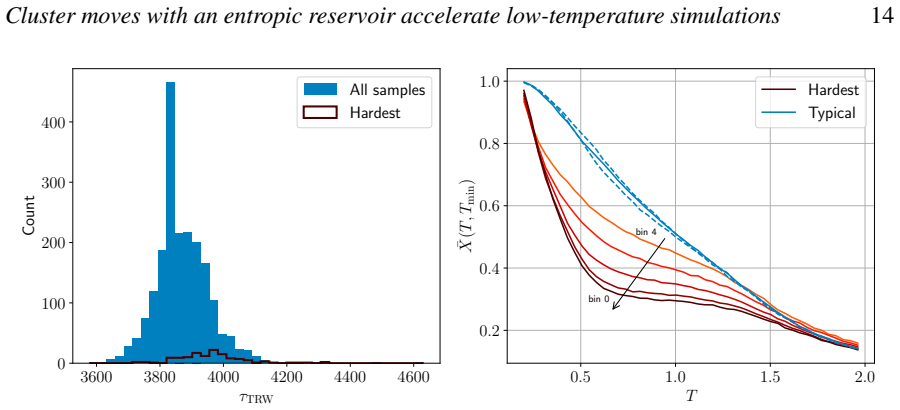
PTHR allows equilibration of a large number of L=16 three-dimensional spin-glass samples with Gaussian couplings for T greater than or equal to 0.2, exhibits better size scaling of computational complexity than standard parallel tempering, and outperforms other cluster algorithms by a speedup factor of around 64, with complexity strongly linked to temperature chaos.
What carries the argument
PTHR (Parallel Tempering enhanced with Houdayer moves and entropic reservoir), which augments replica-exchange dynamics with cluster updates and an auxiliary reservoir to accelerate mixing while aiming to preserve the correct equilibrium distribution.
If this is right
- Equilibration of L=16 systems becomes practical at temperatures previously inaccessible with standard parallel tempering.
- The computational cost grows more slowly with linear size L than in conventional parallel tempering.
- A roughly 64-fold reduction in wall-clock time is realized compared with alternative cluster-based methods at fixed finite size.
- The dominant computational bottleneck remains governed by temperature chaos, as in ordinary parallel tempering.
Where Pith is reading between the lines
- The entropic-reservoir construction may be portable to other frustrated systems whose slow dynamics arise from similar overlap distributions.
- If the scaling advantage persists to larger L, PTHR could enable controlled studies of the thermodynamic limit for three-dimensional spin glasses.
- Because the method is built on top of existing parallel-tempering infrastructure, it can be combined with other acceleration techniques such as population annealing without major redesign.
Load-bearing premise
Adding the Houdayer moves and entropic reservoir leaves the long-time sampling unbiased with respect to the Boltzmann measure.
What would settle it
Direct comparison of energy histograms or overlap distributions obtained from PTHR against exact enumeration results on small lattices to detect any systematic deviation from the expected equilibrium statistics.
Figures
read the original abstract
We present an algorithm for the simulation of three-dimensional spin glasses deep in the low-temperature phase: Parallel Tempering enhanced with Houdayer moves and with an entropic reservoir (PTHR). Although differences with the standard Houdayer algorithm are small, PTHR allows us to equilibrate a large number of samples of $L=16$ lattices with Gaussian couplings for temperatures $T\geq 0.2$. We show that the computational complexity displays better size scaling than standard Parallel Tempering. For finite sizes, our method outperforms other cluster algorithms by a speedup factor of around 64. In close analogy with standard Parallel Tempering, PTHR's computational complexity strongly relates to temperature chaos.
Editorial analysis
A structured set of objections, weighed in public.
Referee Report
Summary. The manuscript introduces Parallel Tempering enhanced with Houdayer moves and an entropic reservoir (PTHR) for Monte Carlo simulation of three-dimensional Edwards-Anderson spin glasses. It claims that PTHR equilibrates large numbers of L=16 samples with Gaussian couplings down to T=0.2, exhibits improved finite-size scaling relative to standard Parallel Tempering, and delivers an approximately 64-fold speedup over other cluster algorithms, with computational cost governed by temperature chaos in close analogy to PT.
Significance. If the sampling remains unbiased and the reported performance metrics are reproducible, the algorithm would constitute a practical advance for accessing the low-temperature phase of 3D spin glasses, where conventional methods struggle with equilibration.
major comments (2)
- [Algorithm description (likely §2–3)] The central performance claims (equilibration of L=16 at T≥0.2 and the 64× speedup) rest on the assertion that the entropic reservoir plus modified Houdayer updates leave the stationary distribution unchanged. No derivation is supplied showing that the reservoir acceptance probabilities satisfy detailed balance with respect to the target Boltzmann measure, nor are any numerical diagnostics (e.g., overlap histograms or energy distributions compared against plain PT on identical instances) presented to confirm unbiased sampling.
- [Results section (performance claims)] The statement that “PTHR allows us to equilibrate” L=16 systems is unsupported by any reported equilibration diagnostics, autocorrelation times, or convergence tests in the results. Without these, the scaling and speedup comparisons cannot be interpreted as evidence of correct thermalization.
minor comments (2)
- The abstract and results should include error bars on all timing and speedup figures together with the number of independent disorder realizations used.
- Clarify the precise differences between the “modified” Houdayer moves employed here and the original Houdayer algorithm; a side-by-side pseudocode comparison would help.
Simulated Author's Rebuttal
We thank the referee for the careful and constructive review. The points raised identify areas where the manuscript can be strengthened by adding explicit derivations and diagnostics. We address each major comment below and will incorporate the suggested material in a revised version.
read point-by-point responses
-
Referee: [Algorithm description (likely §2–3)] The central performance claims (equilibration of L=16 at T≥0.2 and the 64× speedup) rest on the assertion that the entropic reservoir plus modified Houdayer updates leave the stationary distribution unchanged. No derivation is supplied showing that the reservoir acceptance probabilities satisfy detailed balance with respect to the target Boltzmann measure, nor are any numerical diagnostics (e.g., overlap histograms or energy distributions compared against plain PT on identical instances) presented to confirm unbiased sampling.
Authors: We acknowledge that an explicit derivation of detailed balance for the entropic-reservoir acceptance probabilities and the modified Houdayer moves was omitted from the original manuscript. In the revision we will add a dedicated subsection deriving that these updates satisfy detailed balance with respect to the target Boltzmann distribution. We will also include direct numerical comparisons—overlap histograms and energy distributions—between PTHR and standard parallel tempering performed on identical disorder realizations to confirm that the stationary distribution remains unbiased. revision: yes
-
Referee: [Results section (performance claims)] The statement that “PTHR allows us to equilibrate” L=16 systems is unsupported by any reported equilibration diagnostics, autocorrelation times, or convergence tests in the results. Without these, the scaling and speedup comparisons cannot be interpreted as evidence of correct thermalization.
Authors: We agree that the results section would be strengthened by explicit equilibration diagnostics. In the revised manuscript we will report integrated autocorrelation times for the overlap and energy, present convergence tests that demonstrate stabilization of observables with increasing run length, and include checks for the absence of systematic drift in running averages. These additions will directly support the claim that the reported L=16 ensembles are thermalized at T ≥ 0.2. revision: yes
Circularity Check
No circularity in algorithmic performance claims
full rationale
The paper presents PTHR as a practical algorithmic enhancement to Parallel Tempering, with claims of equilibration for L=16 instances, improved size scaling, and ~64x speedup framed as empirical simulation outcomes rather than any closed mathematical derivation. No equations, fitted parameters renamed as predictions, or self-citation chains appear in the abstract or description that would reduce the reported results to their inputs by construction. The analogy to standard PT is stated explicitly but does not carry load-bearing uniqueness theorems or ansatzes from prior self-work. The derivation chain is therefore self-contained against external benchmarks of runtime and equilibration metrics.
Axiom & Free-Parameter Ledger
Forward citations
Cited by 3 Pith papers
-
Cluster-based Message-Passing (CluMP) Optimization for Complex QUBO Problems
CluMP introduces cluster-based message-passing updates informed by belief propagation to reach lower energies in complex QUBO problems on sparse graphs.
-
High Resolution Study of the 2D ANNNI Model Using a Two-replica Cluster Algorithm and Population Annealing
A two-replica cluster algorithm with population annealing fully resolves the sequence of sharp specific heat peaks in the finite-size incommensurate floating phase of the 2D ANNNI model and outperforms single-replica ...
-
On the true low-energy excitations of the three-dimensional spin glass
Monte Carlo simulations up to L=18 yield evidence supporting replica symmetry breaking for low-energy excitations in 3D spin glasses and confirm the overlap-equivalence hypothesis.
Reference graph
Works this paper leans on
-
[1]
Mydosh J A 1993Spin Glasses: an Experimental Introduction(London: Taylor and Francis)
-
[2]
Young A P 1998Spin Glasses and Random Fields(Singapore: World Scientific)
-
[3]
M ´ezard M, Parisi G and Virasoro M 1987Spin-Glass Theory and Beyond(Singapore: World Scientific)
-
[4]
Charbonneau P, Marinari E, M ´ezard M, Parisi G, Ricci-Tersenghi F, Sicuro G and Zamponi F (eds) 2023 Spin Glass Theory and Far Beyond(World Sientific)
2023
-
[5]
Parisi G 2023Rev. Mod. Phys.95(3) 030501 URLhttps://link.aps.org/doi/10.1103/ RevModPhys.95.030501
-
[6]
Dahlberg E, Gonz ´alez-Adalid Pemart´ın I, Marinari E, Martin-Mayor V , Moreno-Gordo J, Orbach R, Paga I, Parisi G, Ricci-Tersenghi F, Ruiz-Lorenzo J and Yllanes D 2025Rev. Mod. Phys.97045005 URL https://doi.org/10.1103/ctp2-zwyr Cluster moves with an entropic reservoir accelerate low-temperature simulations22
-
[7]
Edwards S F and Anderson P W 1975Journal of Physics F: Metal PhysicsF5965 URLhttp: //stacks.iop.org/0305-4608/5/i=5/a=017
-
[8]
Phys.F61927 URLhttp://stacks.iop.org/ 0305-4608/6/i=10/a=022
Edwards S F and Anderson P W 1976J. Phys.F61927 URLhttp://stacks.iop.org/ 0305-4608/6/i=10/a=022
-
[9]
iop.org/0305-4470/15/i=10/a=028
Barahona F 1982Journal of Physics A: Mathematical and General153241 URLhttp://stacks. iop.org/0305-4470/15/i=10/a=028
-
[10]
Istrail S 2000 Statistical mechanics, three-dimensionality and np-completeness: I. universality of intracatability for the partition function of the ising model across non-planar surfaces (extended abstract) Proceedings of the thirty-second annual ACM symposium on Theory of computingpp 87–96
2000
-
[11]
Rev.B327384 URLhttps://doi.org/10.1103/PhysRevB.32.7384
Ogielski A T 1985Phys. Rev.B327384 URLhttps://doi.org/10.1103/PhysRevB.32.7384
-
[12]
Cruz A, Pech J, Tarancon A, Tellez P, Ullod C L and Ungil C 2001Comp. Phys. Comm133165–176 URL https://doi.org/10.1016/S0010-4655(00)00170-3
-
[13]
Belletti F, Cotallo M, Cruz A, Fernandez L A, Gordillo A, Maiorano A, Mantovani F, Marinari E, Mart ´ın- Mayor V , Mu˜noz Sudupe A, Navarro D, Perez-Gaviro S, Ruiz-Lorenzo J J, Schifano S F, Sciretti D, Tarancon A, Tripiccione R and Velasco J L (Janus Collaboration) 2008Comp. Phys. Comm.178208– 216 URLhttps://doi.org/10.1016/j.cpc.2007.09.006
-
[14]
Matsubara S, Takatsu M, Miyazawa T, Shibasaki T, Watanabe Y , Takemoto K and Tamura H 2020 Digital annealer for high-speed solving of combinatorial optimization problems and its applications2020 25th Asia and South Pacific Design Automation Conference (ASP-DAC)pp 667–672
2020
-
[15]
McGeoch C and Farr ´e P 2022D-Wave Technical Report SeriesURLhttps://www.dwavesys.com/ media/3xvdipcn/14-1058a-a_advantage_processor_overview.pdf
-
[16]
McMahon P L, Marandi A, Haribara Y , Hamerly R, Langrock C, Tamate S, Inagaki T, Takesue H, Utsunomiya S, Aihara K, Byer R L, Fejer M M, Mabuchi H and Yamamoto Y 2016Science354614–617 URLhttps://www.science.org/doi/abs/10.1126/science.aah5178
-
[17]
Baity-Jesi M, Ba ˜nos R A, Cruz A, Fernandez L A, Gil-Narvion J M, Gordillo-Guerrero A, Guidetti M, Iniguez D, Maiorano A, Mantovani F, Marinari E, Mart´ın-Mayor V , Monforte-Garcia J, Munoz Sudupe A, Navarro D, Parisi G, Pivanti M, Perez-Gaviro S, Ricci-Tersenghi F, Ruiz-Lorenzo J J, Schifano S F, Seoane B, Tarancon A, Tellez P, Tripiccione R and Yllanes...
-
[18]
Baity-Jesi M, Ba ˜nos R A, Cruz A, Fernandez L A, Gil-Narvion J M, Gordillo-Guerrero A, Iniguez D, Maiorano A, Mantovani F, Marinari E, Mart´ın-Mayor V , Monforte-Garcia J, Mu˜noz Sudupe A, Navarro D, Parisi G, Perez-Gaviro S, Pivanti M, Ricci-Tersenghi F, Ruiz-Lorenzo J J, Schifano S F, Seoane B, Tarancon A, Tripiccione R and Yllanes D (Janus Collaborati...
-
[19]
Sajeeb M, Delacour C, Callahan-Coray K, Seshan S, Srimani T and Camsari K Y 2026 Probabilistic computers for mimo detection: From sparsification to 2d parallel tempering (PreprintarXiv:2601. 09037)
2026
-
[20]
Zhu R, Singh A K, Laydevant J, Wu F O, Kapelyan A, Venturelli D, Jamieson K and McMahon P L 2026 A fully parallel densely connected probabilistic ising machine with inertia for real-time applications (PreprintarXiv:2604.17109)
work page internal anchor Pith review Pith/arXiv arXiv 2026
-
[21]
Caracciolo S, Hartmann A K, Kirkpatrick S and Weigel M 2023 Simulated annealing, optimization, searching for ground statesSpin Glass Theory and Far Beyond Replica Symmetry Breaking after 40 Years(Singapur: World Scientific)
2023
-
[22]
Palassini M and Young A P 2000Phys. Rev. Lett.85(14) 3017–3020 URLhttps://link.aps.org/ doi/10.1103/PhysRevLett.85.3017
-
[23]
Palassini M, Liers F, Juenger M and Young A P 2003Phys. Rev.B68064413 URLhttps://doi. org/10.1103/PhysRevB.68.064413
-
[24]
Shen M, Ortiz G, Liu Y Y , Weigel M and Nussinov Z 2024Phys. Rev. Lett.132(24) 247101 URL https://link.aps.org/doi/10.1103/PhysRevLett.132.247101
-
[25]
sciencedirect.com/science/article/pii/S0378437196002415 Cluster moves with an entropic reservoir accelerate low-temperature simulations23
P ´al K F 1996Physica A: Statistical Mechanics and its Applications23360–66 URLhttps://www. sciencedirect.com/science/article/pii/S0378437196002415 Cluster moves with an entropic reservoir accelerate low-temperature simulations23
-
[26]
com/science/article/pii/S0378437109002544
Rom ´a F, Risau-Gusman S, Ramirez-Pastor A, Nieto F and V ogel E 2009Physica A: Statistical Mechanics and its Applications3882821–2838 ISSN 0378-4371 URLhttps://www.sciencedirect. com/science/article/pii/S0378437109002544
-
[27]
Marinari E and Parisi G 2001Phys. Rev. Lett.86(17) 3887–3890 URLhttps://link.aps.org/ doi/10.1103/PhysRevLett.86.3887
-
[28]
Del Bono L M, Ricci-Tersenghi F and Zamponi F 2026PNAS123e2534768123 URLhttps://doi. org/10.1073/pnas.2534768123
-
[29]
Hukushima K and Nemoto K 1996J. Phys. Soc. Japan651604 URLhttps://doi.org/10.1143/ JPSJ.65.1604
-
[30]
Marinari E 1998 Optimized Monte Carlo methodsAdvances in Computer Simulationed Kerst ´esz J and Kondor I (Springer-Verlag)
1998
-
[31]
Hukushima K and Iba Y 2003AIP Conference Proceedings690200–206 ISSN 0094-243X URLhttps: //doi.org/10.1063/1.1632130
-
[32]
Machta J 2010Phys. Rev. E82(2) 026704 URLhttps://link.aps.org/doi/10.1103/ PhysRevE.82.026704
-
[33]
Wang W, Machta J and Katzgraber H G 2015Phys. Rev. E92(6) 063307 URLhttps://link.aps. org/doi/10.1103/PhysRevE.92.063307
-
[34]
Barash L Y , Weigel M, Borovsk´y M, Janke W and Shchur L N 2017Computer Physics Communications 220341–350 ISSN 0010-4655 URLhttps://doi.org/10.1016/j.cpc.2017.06.020
-
[35]
Alvarez Ba ˜nos R, Cruz A, Fernandez L A, Gil-Narvion J M, Gordillo-Guerrero A, Guidetti M, Maiorano A, Mantovani F, Marinari E, Mart´ın-Mayor V , Monforte-Garcia J, Mu˜noz Sudupe A, Navarro D, Parisi G, Perez-Gaviro S, Ruiz-Lorenzo J J, Schifano S F, Seoane B, Tarancon A, Tripiccione R and Yllanes D (Janus Collaboration) 2010J. Stat. Mech.2010P06026 URLh...
2010
-
[36]
Alvarez Ba ˜nos R, Cruz A, Fernandez L A, Gil-Narvion J M, Gordillo-Guerrero A, Guidetti M, Maiorano A, Mantovani F, Marinari E, Mart´ın-Mayor V , Monforte-Garcia J, Mu˜noz Sudupe A, Navarro D, Parisi G, Perez-Gaviro S, Ruiz-Lorenzo J J, Schifano S F, Seoane B, Tarancon A, Tripiccione R and Yllanes D (Janus Collaboration) 2010Phys. Rev. Lett.105177202 URL...
-
[37]
Baity-Jesi M, Ba ˜nos R A, Cruz A, Fernandez L A, Gil-Narvion J M, Gordillo-Guerrero A, Iniguez D, Maiorano A, Mantovani F, Marinari E, Mart´ın-Mayor V , Monforte-Garcia J, Mu˜noz Sudupe A, Navarro D, Parisi G, Perez-Gaviro S, Pivanti M, Ricci-Tersenghi F, Ruiz-Lorenzo J J, Schifano S F, Seoane B, Tarancon A, Tripiccione R and Yllanes D (Janus Collaborati...
-
[38]
Marinari E, Parisi G and Ruiz-Lorenzo J J 1998Phys. Rev. B58(22) 14852–14863 URLhttps: //link.aps.org/doi/10.1103/PhysRevB.58.14852
-
[39]
Rev.B63184422 URLhttps://doi.org/ 10.1103/PhysRevB.63.184422
Katzgraber H G, Palassini M and Young A P 2001Phys. Rev.B63184422 URLhttps://doi.org/ 10.1103/PhysRevB.63.184422
-
[40]
Katzgraber H G and Krzakala F 2007Phys. Rev. Lett.98017201 URLhttps://doi.org/10.1103/ PhysRevLett.98.017201
-
[41]
Wang W 2026Phys. Rev. B113(1) 014203 URLhttps://link.aps.org/doi/10.1103/ r17n-lg5f
-
[42]
Wang W, Machta J, Munoz-Bauza H and Katzgraber H G 2017Phys. Rev. B96(18) 184417 URL https://link.aps.org/doi/10.1103/PhysRevB.96.184417
-
[43]
Wang W, Wallin M and Lidmar J 2020Phys. Rev. Res.2(4) 043241 URLhttps://link.aps.org/ doi/10.1103/PhysRevResearch.2.043241
-
[44]
org/10.1209/0295-5075/103/67003
Fernandez L A, Mart ´ın-Mayor V , Parisi G and Seoane B 2013EPL10367003 URLhttps://doi. org/10.1209/0295-5075/103/67003
-
[45]
Billoire A, Fernandez L A, Maiorano A, Marinari E, Martin-Mayor V , Moreno-Gordo J, Parisi G, Ricci- Tersenghi F and Ruiz-Lorenzo J J 2018Journal of Statistical Mechanics: Theory and Experiment2018 033302 URLhttp://stacks.iop.org/1742-5468/2018/i=3/a=033302 Cluster moves with an entropic reservoir accelerate low-temperature simulations24
2018
-
[46]
Fernandez L A, Marinari E, Martin-Mayor V , Parisi G and Ruiz-Lorenzo J J 2016Phys. Rev. B94(2) 024402 URLhttps://link.aps.org/doi/10.1103/PhysRevB.94.024402
-
[47]
Houdayer J 2001The European Physical Journal B - Condensed Matter and Complex Systems22479–484 URLhttp://dx.doi.org/10.1007/PL00011151
-
[48]
Zhu Z, Ochoa A J and Katzgraber H G 2015Phys. Rev. Lett.115(7) 077201 URLhttp://link.aps. org/doi/10.1103/PhysRevLett.115.077201
-
[49]
Jacobs L and Rebbi C 1981J.Comput.Phys.41203 URLhttps://doi.org/10.1016/ 0021-9991(81)90089-9
-
[50]
Chilin C, Marinari E, Mart ´ın-Mayor V , Parisi G, Ruiz-Lorenzo J J and Yllanes D 2026 On the true low- energy excitations of the three-dimensional spin glass in preparation
2026
-
[51]
Y .: Plenum)
Sokal A D 1997 Monte Carlo methods in statistical mechanics: Foundations and new algorithmsFunctional Integration: Basics and Applications (1996 Carg`ese School)ed DeWitt-Morette C, Cartier P and Folacci A (N. Y .: Plenum)
1997
-
[52]
Swendsen R H and Wang J S 1987Phys. Rev. Lett.58(2) 86–88 URLhttps://link.aps.org/doi/ 10.1103/PhysRevLett.58.86
-
[53]
Wolff U 1989Phys. Rev. Lett.62(4) 361–364 URLhttp://link.aps.org/doi/10.1103/ PhysRevLett.62.361
-
[54]
Rev.B80024422 URLhttps://doi.org/10.1103/PhysRevB.80.024422
Fernandez L A, Mart´ın-Mayor V , Perez-Gaviro S, Tarancon A and Young A P 2009Phys. Rev.B80024422 URLhttps://doi.org/10.1103/PhysRevB.80.024422
- [55]
-
[56]
Krzakala F and Martin O C 2000Phys. Rev. Lett.853013 URLhttps://doi.org/10.1103/ PhysRevLett.85.3013
-
[57]
iop.org/0022-3719/13/i=19/a=002
Bray A and Moore M 1980Journal of Physics C: Solid State Physics13L469 URLhttp://stacks. iop.org/0022-3719/13/i=19/a=002
-
[58]
Bernaschi M, Chilin C, Fernandez L A, Gonz ´alez-Adalid Pemart´ın I, Marinari E, Martin-Mayor V , Parisi G, Ricci-Tersenghi F, Ruiz-Lorenzo J J and Yllanes D 2026Comp. Phys. Comm.325110182 URL https://doi.org/10.1016/j.cpc.2026.110182
-
[59]
Marinari E, Parisi G and Ruiz-Lorenzo J J 1998 Numerical Simulations of Spin Glass SystemsSpin glasses and random fieldsed Young A P (Singapore: World Scientific)
1998
-
[60]
Rugged free-energy landscapes in disordered spin systems
Yllanes D 2011Rugged Free-Energy Landscapes in Disordered Spin SystemsPh.D. thesis Universidad Complutense de Madrid (PreprintarXiv:1111.0266)
work page internal anchor Pith review Pith/arXiv arXiv
-
[61]
Fern ´andez L A, Marinari E, Mart´ın-Mayor V , Parisi G and Yllanes D 2016Journal of Statistical Mechanics: Theory and Experiment2016123301 URLhttp://stacks.iop.org/1742-5468/2016/i= 12/a=123301
2016
-
[62]
Newman M E J and Barkema G T 1999Monte Carlo Methods in Statistical Physics(Oxford: Clarendon Press)
-
[63]
Blackman D and Vigna S 2021ACM Trans. Math. Softw.47ISSN 0098-3500 URLhttps://doi.org/ 10.1145/3460772
discussion (0)
Sign in with ORCID, Apple, or X to comment. Anyone can read and Pith papers without signing in.