Predicted Exotic Doubly Heavy-Strange Pentaquarks
Pith reviewed 2026-06-29 21:39 UTC · model grok-4.3
The pith
A unitary coupled-channel model predicts multiple exotic pentaquarks containing two heavy quarks and one strange antiquark.
A machine-rendered reading of the paper's core claim, the machinery that carries it, and where it could break.
Core claim
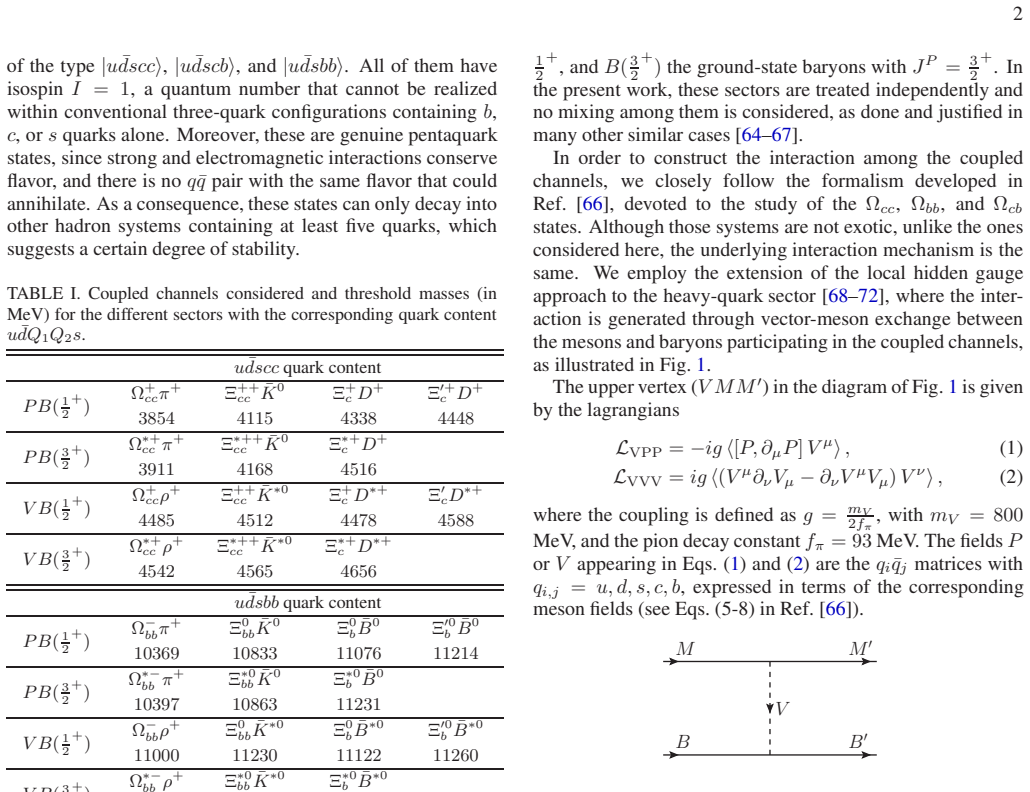
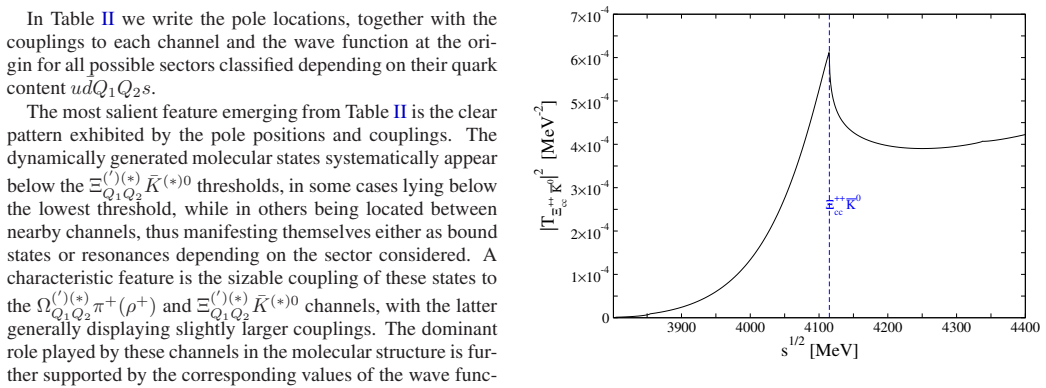
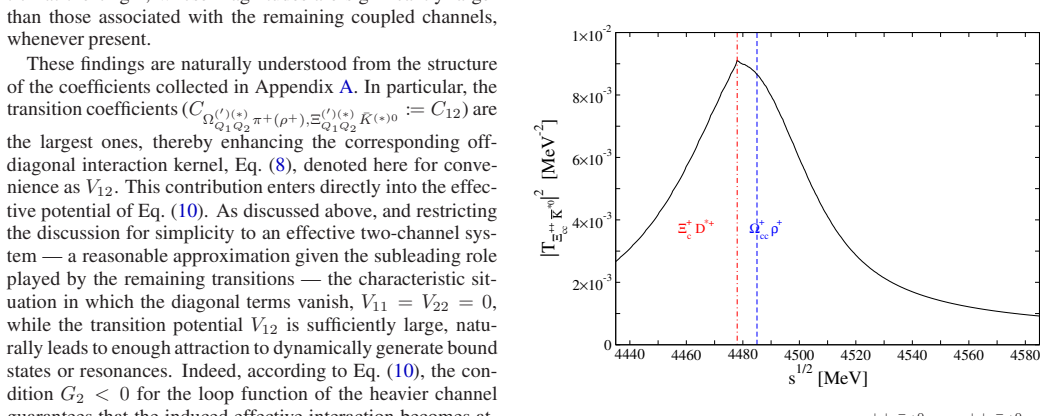
We obtain a robust spectrum of manifestly exotic states; two states appear in the u d-bar s cc sector, three in u d-bar s cb, and four in u d-bar s bb. These emerge either as bound states or resonances, along with five additional virtual states manifested as threshold cusps. The binding mechanism is dominated by off-diagonal transitions among heavy-baryon--light-meson channels, while diagonal interactions are strongly suppressed.
What carries the argument
Coupled-channel unitary framework with interactions from the extension of the local hidden gauge approach to the heavy-quark sector, where off-diagonal transitions among heavy-baryon--light-meson channels dominate binding.
If this is right
- These states constitute concrete targets for experimental searches in the doubly heavy-strange sector.
- The spectrum extends exotic hadron spectroscopy into new flavor combinations with two heavy quarks and strangeness.
- The dominance of off-diagonal transitions provides a specific mechanism that can be tested in related multi-quark systems.
Where Pith is reading between the lines
- If confirmed, the results would encourage application of the same framework to other combinations such as those with different light-quark content.
- The predicted states could appear in production channels at facilities that produce heavy-flavor hadrons.
- Discrepancies between predicted and observed masses might point to additional higher-order effects not included in the present calculation.
Load-bearing premise
The local hidden gauge approach remains valid when extended to the heavy-quark sector and the off-diagonal transitions dominate while diagonal interactions stay suppressed.
What would settle it
Experimental searches that fail to observe any of the predicted states near the calculated masses or that find resonances at positions inconsistent with the spectrum would falsify the central claim.
Figures
read the original abstract
We predict exotic doubly heavy--strange pentaquarks with minimal quark content $u\bar d sQQ'$ ($QQ'=cc,bc,bb$) within a coupled-channel unitary framework where the interaction is derived from an extension of the local hidden gauge approach to the heavy-quark sector. We obtain a robust spectrum of manifestly exotic states; two states appear in the $u\bar d scc$ sector, three in $u\bar d scb$, and four in $u\bar d sbb$. These emerge either as bound states or resonances, along with five additional virtual states manifested as threshold cusps. The binding mechanism is dominated by off-diagonal transitions among heavy-baryon--light-meson channels, while diagonal interactions are strongly suppressed. These results extend exotic hadron spectroscopy into the doubly heavy--strange sector and provide concrete targets for future experimental searches.
Editorial analysis
A structured set of objections, weighed in public.
Referee Report
Summary. The paper claims to predict exotic doubly heavy-strange pentaquarks with minimal quark content u d-bar s QQ' (QQ'=cc, bc, bb) in a coupled-channel unitary framework. The interaction kernel is derived from an extension of the local hidden gauge approach to the heavy-quark sector. It reports a spectrum of two states in the udscc sector, three in udscb, and four in udsbb, appearing as bound states or resonances, plus five additional virtual states as threshold cusps. Binding is attributed to dominant off-diagonal heavy-baryon--light-meson transitions with strongly suppressed diagonal interactions.
Significance. If the model assumptions hold, the work supplies specific, testable predictions for manifestly exotic states in a new sector, extending unitary coupled-channel methods and offering targets for LHCb or other experiments. The separation of resonant/bound states from virtual threshold cusps is a useful technical distinction. The significance is reduced by the dependence on an unvalidated extension whose key features (off-diagonal dominance) are asserted rather than independently tested.
major comments (2)
- Abstract: The assertion that binding is 'dominated by off-diagonal transitions ... while diagonal interactions are strongly suppressed' is load-bearing for the reported state counts (2/3/4); no explicit ratio of diagonal to off-diagonal amplitudes or variation with the regularization cutoff and heavy-sector couplings is shown, so the robustness of the spectrum under modest parameter changes cannot be assessed.
- Model section (interaction kernel): The extension of the local hidden gauge approach is used to generate the kernel without deriving the claimed diagonal suppression from the heavy-quark limit, lattice input, or explicit calculation; because the same two parameters control both the extension and the off-diagonal dominance, the predicted state numbers rest on an untested assumption rather than a first-principles result.
minor comments (2)
- Abstract: A short statement of the numerical cutoff value employed and the specific channels included would help readers gauge the setup without needing the full text.
- Results: Consider adding a compact table of pole positions, binding energies, and widths for the reported states to improve readability and allow direct comparison with future data.
Simulated Author's Rebuttal
We thank the referee for the careful reading and constructive comments. We address each major comment below, offering clarifications on the model while agreeing to strengthen the presentation where appropriate.
read point-by-point responses
-
Referee: Abstract: The assertion that binding is 'dominated by off-diagonal transitions ... while diagonal interactions are strongly suppressed' is load-bearing for the reported state counts (2/3/4); no explicit ratio of diagonal to off-diagonal amplitudes or variation with the regularization cutoff and heavy-sector couplings is shown, so the robustness of the spectrum under modest parameter changes cannot be assessed.
Authors: We acknowledge that an explicit ratio of diagonal to off-diagonal amplitudes would make the claim more transparent. The suppression follows directly from the flavor structure of the extended local hidden gauge vertices, where diagonal heavy-baryon–light-meson transitions lack the leading vector-meson exchange contributions present in off-diagonal channels. The manuscript already employs standard cutoff values fixed in prior heavy-sector applications, but we agree that a sensitivity check is useful. In revision we will add a short table of representative coupling ratios and a one-paragraph discussion of cutoff variation. revision: partial
-
Referee: Model section (interaction kernel): The extension of the local hidden gauge approach is used to generate the kernel without deriving the claimed diagonal suppression from the heavy-quark limit, lattice input, or explicit calculation; because the same two parameters control both the extension and the off-diagonal dominance, the predicted state numbers rest on an untested assumption rather than a first-principles result.
Authors: The diagonal suppression is a direct consequence of the Lagrangian construction in the extended local hidden gauge framework, not an extra assumption; the same two parameters (regularization scale and heavy-sector coupling) are fixed once from light-sector phenomenology and then applied uniformly, as done in earlier works on heavy baryon–meson scattering. While we do not re-derive the vertices from the heavy-quark limit or lattice data in this paper, the kernel is built consistently with established results. We will insert a brief explanatory paragraph in the model section referencing the vertex structure that produces the suppression. revision: partial
Circularity Check
No significant circularity in derivation chain
full rationale
The paper presents a unitary coupled-channel calculation whose interaction kernel is obtained from an extension of the local hidden gauge approach applied to the heavy sector. The spectrum (bound states, resonances, and virtual states) is reported as the output of solving the Bethe-Salpeter equation with that kernel. No equation in the supplied text reduces a reported state count or binding energy to a fitted parameter by algebraic identity, nor does any load-bearing premise collapse to a self-citation whose validity is presupposed rather than independently justified. The statement that off-diagonal transitions dominate is presented as a finding of the calculation, not an inserted ansatz. The framework is therefore self-contained within its stated assumptions and does not exhibit the enumerated circularity patterns.
Axiom & Free-Parameter Ledger
free parameters (2)
- regularization cutoff
- heavy-sector coupling strengths
axioms (2)
- domain assumption The local hidden gauge approach extends reliably to the heavy-quark sector
- domain assumption Off-diagonal transitions dominate binding while diagonal interactions are strongly suppressed
Reference graph
Works this paper leans on
-
[1]
The lower vertex in Fig
and (2) formally equivalent up to the additional polarization fact or, ⃗ ǫ⃗ ǫ′, in the vector-meson case. The lower vertex in Fig. 1 is most conveniently evaluated following the formalism of Ref. [ 64], where the interaction is written in terms of the quark wave functions of the exchanged vector meson and the baryons, LVBB′ = ⟨B′|gqV ¯qVγν ′ Vν ′ |B⟩ (3) ...
2020
-
[2]
TABLE III
among the coupled channels. TABLE III. Coefficients Cij for the P B( 1 2 + ) sector of u ¯dscc states. Ω + ccπ + Ξ ++ cc ¯K 0 Ξ + c D+ Ξ ′+ c D+ Ω + ccπ + 0 − 1 √ 3 2 √ 2 λ 1 1 2 √ 2 λ 1 Ξ ++ cc ¯K 0 0 − √ 3 2 √ 2 λ 2 1 2 √ 2 λ 2 Ξ + c D+ − λ 3 0 Ξ ′+ c D+ − λ 3 The coefficients λ 1, λ 2, and λ 3 account for the suppres- sion factors associated with the exc...
-
[3]
R. Aaij et al. (LHCb), Phys. Rev. Lett. 115, 072001 (2015) , arXiv:1507.03414 [hep-ex]
work page internal anchor Pith review Pith/arXiv arXiv 2015
-
[4]
J.-J. Wu, R. Molina, E. Oset, and B. S. Zou, Phys. Rev. Lett. 105, 232001 (2010) , arXiv:1007.0573 [nucl-th]
work page internal anchor Pith review Pith/arXiv arXiv 2010
-
[5]
J.-J. Wu, R. Molina, E. Oset, and B. S. Zou, Phys. Rev. C 84, 015202 (2011) , arXiv:1011.2399 [nucl-th]
work page internal anchor Pith review Pith/arXiv arXiv 2011
-
[6]
The possible hidden-charm molecular baryons composed of anti-charmed meson and charmed baryon
Z.-C. Yang, Z.-F. Sun, J. He, X. Liu, and S.-L. Zhu, Chin. Phys. C 36, 6 (2012) , arXiv:1105.2901 [hep-ph]
work page internal anchor Pith review Pith/arXiv arXiv 2012
-
[7]
C. W. Xiao, J. Nieves, and E. Oset, Phys. Rev. D 88, 056012 (2013) , arXiv:1304.5368 [hep-ph]
work page internal anchor Pith review Pith/arXiv arXiv 2013
-
[8]
New Exotic Meson and Baryon Resonances from Doubly-Heavy Hadronic Molecules
M. Karliner and J. L. Rosner, Phys. Rev. Lett. 115, 122001 (2015) , arXiv:1506.06386 [hep-ph]
work page internal anchor Pith review Pith/arXiv arXiv 2015
-
[9]
W. L. Wang, F. Huang, Z. Y . Zhang, and B. S. Zou, Phys. Rev. C 84, 015203 (2011) , arXiv:1101.0453 [nucl-th]
work page internal anchor Pith review Pith/arXiv arXiv 2011
-
[10]
S. G. Y uan, K. W. Wei, J. He, H. S. Xu, and B. S. Zou, Eur. Phys. J. A 48, 61 (2012) , arXiv:1201.0807 [nucl-th]
work page internal anchor Pith review Pith/arXiv arXiv 2012
-
[11]
R. Aaij et al. (LHCb), Phys. Rev. Lett. 128, 062001 (2022) , arXiv:2108.04720 [hep-ex]
-
[12]
R. Chen, X. Liu, X.-Q. Li, and S.- L. Zhu, Phys. Rev. Lett. 115, 132002 (2015) , arXiv:1507.03704 [hep-ph]
work page internal anchor Pith review Pith/arXiv arXiv 2015
-
[13]
$\bar{D}\Sigma^*_c$ and $\bar{D}^*\Sigma_c$ interactions and the LHCb hidden-charmed pentaquarks
J. He, Phys. Lett. B 753, 547 (2016) , arXiv:1507.05200 [hep-ph]
work page internal anchor Pith review Pith/arXiv arXiv 2016
-
[14]
M.-Z. Liu, Y .-W. Pan, F.-Z. Peng, M. S´ anchez S´ anchez, L.-S. Geng, A. Hosaka, and M. Pavon V alder- rama, Phys. Rev. Lett. 122, 242001 (2019) , arXiv:1903.11560 [hep-ph]
work page internal anchor Pith review Pith/arXiv arXiv 2019
- [15]
-
[16]
H.-X. Chen, W. Chen, X. Liu, T. G. Steele, and S.-L. Zhu, Phys. Rev. Lett. 115, 172001 (2015) , arXiv:1507.03717 [hep-ph]
work page internal anchor Pith review Pith/arXiv arXiv 2015
-
[17]
Z.-G. Wang, Eur. Phys. J. C 76, 70 (2016) , arXiv:1508.01468 [hep-ph]
work page internal anchor Pith review Pith/arXiv arXiv 2016
- [18]
-
[19]
P . G. Ortega, D. R. Entem, and F. Fern´ andez, Phys. Lett. B 764, 207 (2017) , arXiv:1606.06148 [hep-ph]
work page internal anchor Pith review Pith/arXiv arXiv 2017
-
[20]
W. Park, A. Park, S. Cho, and S. H. Lee, Phys. Rev. D 95, 054027 (2017) , arXiv:1702.00381 [hep-ph]
work page internal anchor Pith review Pith/arXiv arXiv 2017
-
[21]
Hidden-charm pentaquarks and $P_c$ states
X.-Z. Weng, X.-L. Chen, W.-Z. Deng, and S.-L. Zhu, Phys. Rev. D 100, 016014 (2019) , arXiv:1904.09891 [hep-ph]
work page internal anchor Pith review Pith/arXiv arXiv 2019
- [22]
-
[23]
C.-R. Deng, Phys. Rev. D 105, 116021 (2022) , arXiv:2202.13570 [hep-ph]
-
[24]
How to reveal the exotic nature of the P_c(4450)
F.-K. Guo, U.-G. Meißner, W. Wang, and Z. Yang, Phys. Rev. D 92, 071502 (2015) , arXiv:1507.04950 [hep-ph]
work page internal anchor Pith review Pith/arXiv arXiv 2015
-
[25]
X.-H. Liu, Q. Wang, and Q. Zhao, Phys. Lett. B 757, 231 (2016) , arXiv:1507.05359 [hep-ph]
work page internal anchor Pith review Pith/arXiv arXiv 2016
-
[26]
A triangle singularity and the LHCb pentaquarks
M. Mikhasenko, (2015), arXiv:1507.06552 [hep-ph]
work page internal anchor Pith review Pith/arXiv arXiv 2015
- [27]
-
[28]
Coupled-channel study of crypto-exotic baryons with charm
J. Hofmann and M. F. M. Lutz, Nucl. Phys. A 763, 90 (2005) , arXiv:hep-ph/0507071
work page internal anchor Pith review Pith/arXiv arXiv 2005
- [29]
- [30]
-
[31]
V . V . Anisovich, M. A. Matveev, J. Nyiri, A. V . Sarantsev , and A. N. Semenova, Int. J. Mod. Phys. A 30, 1550190 (2015) , arXiv:1509.04898 [hep-ph]
work page internal anchor Pith review Pith/arXiv arXiv 2015
-
[32]
Z.-G. Wang, Eur. Phys. J. C 76, 142 (2016) , arXiv:1509.06436 [hep-ph]
work page internal anchor Pith review Pith/arXiv arXiv 2016
-
[33]
A hidden-charm $S=-1$ pentaquark from the decay of $\Lambda_b$ into $J/\psi \eta \Lambda$
A. Feijoo, V . K. Magas, A. Ramos, and E. Oset, Eur. Phys. J. C 76, 446 (2016) , arXiv:1512.08152 [hep-ph]
work page internal anchor Pith review Pith/arXiv arXiv 2016
-
[34]
J.-X. Lu, E. Wang, J.-J. Xie, L.-S. Geng, and E. Oset, Phys. Rev. D 93, 094009 (2016) , arXiv:1601.00075 [hep-ph]
work page internal anchor Pith review Pith/arXiv arXiv 2016
-
[35]
H.-X. Chen, L.-S. Geng, W.-H. Liang, E. Oset, E. Wang, and J.-J. Xie, Phys. Rev. C 93, 065203 (2016) , arXiv:1510.01803 [hep-ph]
work page internal anchor Pith review Pith/arXiv arXiv 2016
-
[36]
C.-W. Shen, H.-J. Jing, F.-K. Guo, and J.-J. Wu, Symmetry 12, 1611 (2020) , arXiv:2008.09082 [hep-ph]
-
[37]
R. Aaij et al. (LHCb), Sci. Bull. 66, 1278 (2021) , arXiv:2012.10380 [hep-ex]
-
[38]
R. Aaij et al. (LHCb), Phys. Rev. Lett. 131, 031901 (2023) , arXiv:2210.10346 [hep-ex]
- [39]
-
[40]
H.-X. Chen, Chin. Phys. C 46, 093105 (2022) , arXiv:2011.07187 [hep-ph]
-
[41]
M.-Z. Liu, Y .-W. Pan, and L.-S. Geng, Phys. Rev. D 103, 034003 (2021) , arXiv:2011.07935 [hep-ph]
-
[42]
A. Feijoo, W.-F. Wang, C.-W. Xiao, J.-J. Wu, E. Oset, J. Nieves, and B.-S. Zou, Phys. Lett. B 839, 137760 (2023) , arXiv:2212.12223 [hep-ph]
-
[43]
M. Karliner and J. L. Rosner, Phys. Rev. D 106, 036024 (2022) , arXiv:2207.07581 [hep-ph]
-
[44]
F.-L. Wang and X. Liu, Phys. Lett. B 835, 137583 (2022) , arXiv:2207.10493 [hep-ph]
- [45]
-
[46]
U. ¨Ozdem, Phys. Lett. B 836, 137635 (2023) , 8 arXiv:2208.07684 [hep-ph]
- [47]
-
[48]
F.-L. Wang, H.-Y . Zhou, Z.-W. Liu, and X. Liu, Phys. Rev. D 106, 054020 (2022) , arXiv:2208.10756 [hep-ph]
-
[49]
F.-Z. Peng, M.-J. Yan, M. S´ anchez S´ anchez, and M. P . V alderrama, Eur. Phys. J. C 81, 666 (2021) , arXiv:2011.01915 [hep-ph]
- [50]
- [51]
- [52]
- [53]
- [54]
-
[55]
Q. Wu and D.-Y . Chen, Phys. Rev. D 109, 094003 (2024) , arXiv:2402.14467 [hep-ph]
- [56]
-
[57]
J. Ferretti and E. Santopinto, JHEP 04, 119 (2020) , arXiv:2001.01067 [hep-ph]
- [58]
- [59]
- [60]
-
[61]
J. Song, M.-Y . Duan, L. Roca, and E. Oset, Eur. Phys. J. C 84, 1055 (2024) , arXiv:2406.14895 [hep-ph]
- [62]
-
[63]
Odd Parity Light Baryon Resonances
D. Gamermann, C. Garcia-Recio, J. Nieves, and L. L. Salc edo, Phys. Rev. D 84, 056017 (2011) , arXiv:1104.2737 [hep-ph]
work page internal anchor Pith review Pith/arXiv arXiv 2011
-
[64]
A. Feijoo and I. Vida˜ na, Eur. Phys. J. A 61, 196 (2025) , arXiv:2411.18248 [hep-ph]
- [65]
-
[66]
V . R. Debastiani, J. M. Dias, W. H. Liang, and E. Oset, Phys. Rev. D 97, 094035 (2018) , arXiv:1710.04231 [hep-ph]
work page internal anchor Pith review Pith/arXiv arXiv 2018
-
[67]
Q. X. Y u, R. Pavao, V . R. Debastiani, and E. Oset, Eur. Phys. J. C 79, 167 (2019) , arXiv:1811.11738 [hep-ph]
work page internal anchor Pith review Pith/arXiv arXiv 2019
- [68]
-
[69]
J. Song and E. Oset, Phys. Rev. D 112, 074026 (2025) , arXiv:2506.09262 [hep-ph]
-
[70]
Bando, T
M. Bando, T. Kugo, S. Uehara, K. Yamawaki, and T. Yanagid a, Phys. Rev. Lett. 54, 1215 (1985)
1985
-
[71]
Bando, T
M. Bando, T. Kugo, and K. Yamawaki, Physics Reports 164, 217 (1988)
1988
-
[72]
M. Harada and K. Yamawaki, Phys. Rept. 381, 1 (2003) , arXiv:hep-ph/0302103
-
[73]
U. G. Meissner, Phys. Rept. 161, 213 (1988)
1988
-
[74]
Hidden gauge formalism for the radiative decays of axial-vector mesons
H. Nagahiro, L. Roca, A. Hosaka, and E. Oset, Phys. Rev. D 79, 014015 (2009) , arXiv:0809.0943 [hep-ph]
work page internal anchor Pith review Pith/arXiv arXiv 2009
-
[75]
Capstick and N
S. Capstick and N. Isgur, Phys. Rev. D 34, 2809 (1986)
1986
-
[76]
Heavy Baryons in a Quark Model
W. Roberts and M. Pervin, Int. J. Mod. Phys. A 23, 2817 (2008) , arXiv:0711.2492 [nucl-th]
work page internal anchor Pith review Pith/arXiv arXiv 2008
-
[77]
Structure and compositeness of hadron resonances
T. Hyodo, Int. J. Mod. Phys. A 28, 1330045 (2013) , arXiv:1310.1176 [hep-ph]
work page internal anchor Pith review Pith/arXiv arXiv 2013
-
[78]
Z.-L. Wang and B.-S. Zou, Eur. Phys. J. C 82, 509 (2022) , arXiv:2203.02899 [hep-ph]
-
[79]
Meson baryon components in the states of the baryon decuplet
F. Aceti, L. R. Dai, L. S. Geng, E. Oset, and Y . Zhang, Eur. Phys. J. A 50, 57 (2014) , arXiv:1301.2554 [hep-ph]
work page internal anchor Pith review Pith/arXiv arXiv 2014
-
[80]
Couplings in coupled channels versus wave functions: application to the X(3872) resonance
D. Gamermann, J. Nieves, E. Oset, and E. Ruiz Arriola, Phys. Rev. D 81, 014029 (2010) , arXiv:0911.4407 [hep-ph]
work page internal anchor Pith review Pith/arXiv arXiv 2010
discussion (0)
Sign in with ORCID, Apple, or X to comment. Anyone can read and Pith papers without signing in.