A possible Sigma^* or Λ^* resonance with J^P=3/2^- in K^-pto KXi scattering
Pith reviewed 2026-06-29 21:29 UTC · model grok-4.3
The pith
A 3/2^- hyperon resonance near 1.9 GeV is required to fit the structure at 2.0 GeV in K^-p to K Ξ cross sections.
A machine-rendered reading of the paper's core claim, the machinery that carries it, and where it could break.
Core claim
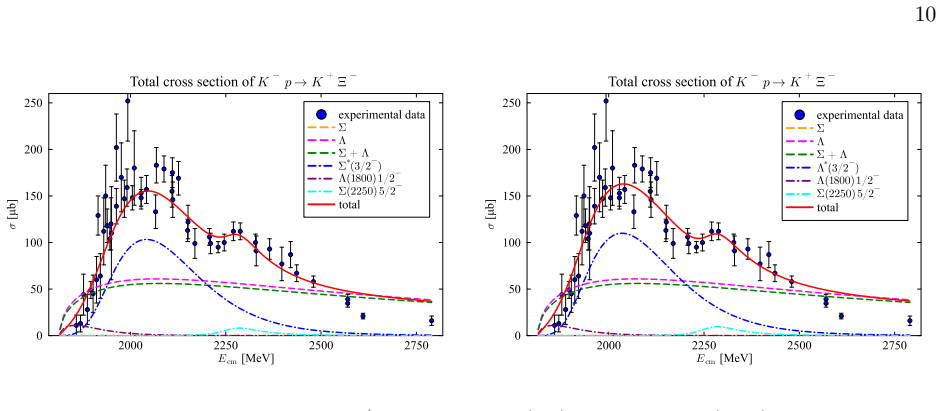
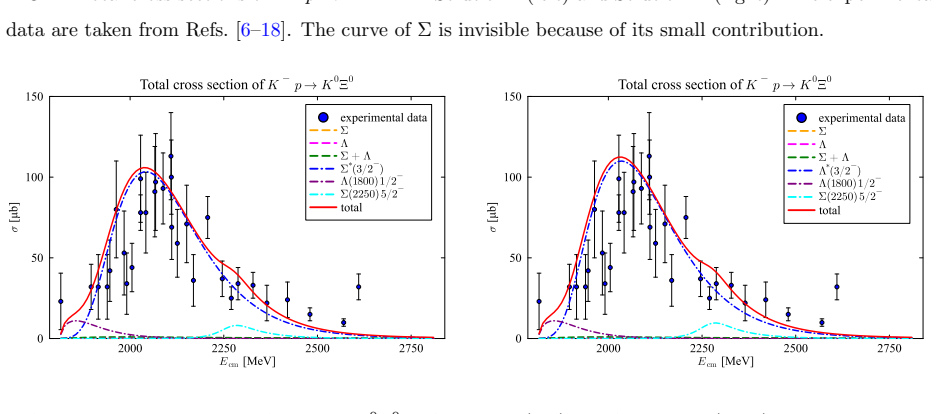
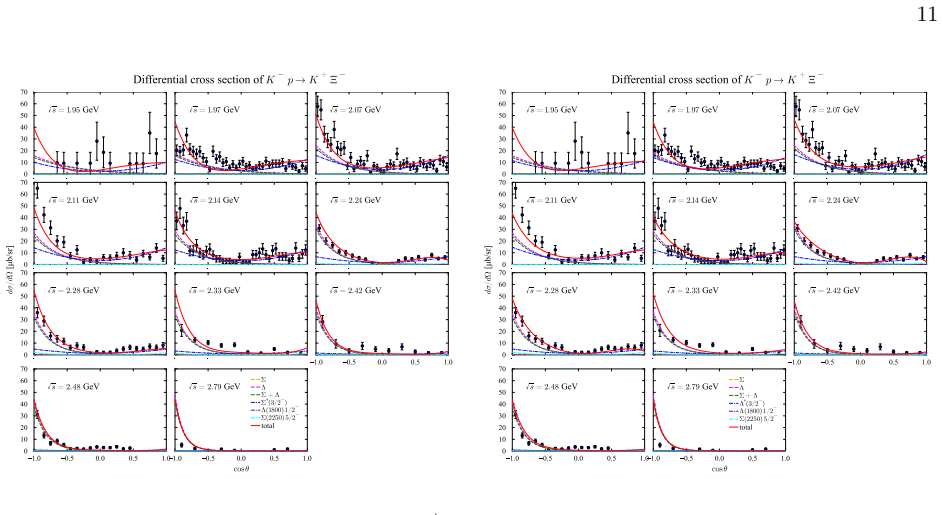
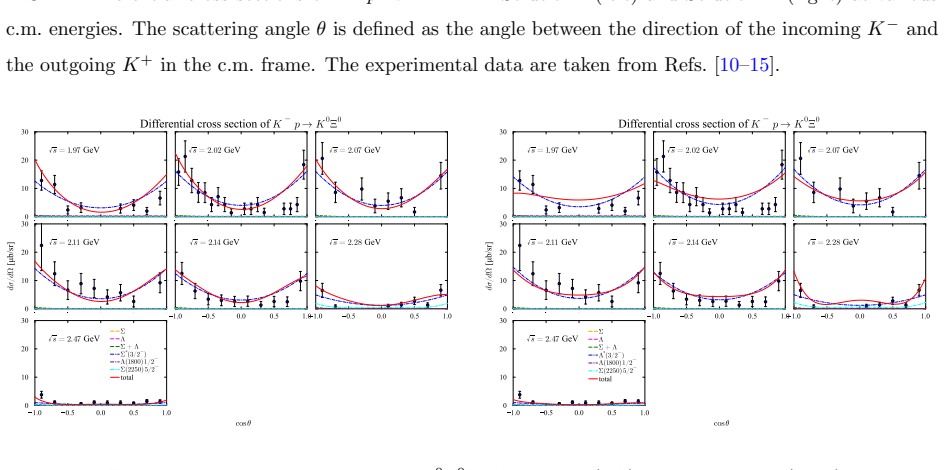
Within an effective Lagrangian approach to the K^-p → K Ξ processes, the inclusion of a J^P=3/2^- resonance with mass around 1.9 GeV and width approximately 200 MeV is required to reproduce the structure at 2.0 GeV in the total cross section and the threshold behavior; the two possible assignments (Σ* or Λ*) cannot be distinguished by existing cross-section data, although polarization observables favor the Λ* solution.
What carries the argument
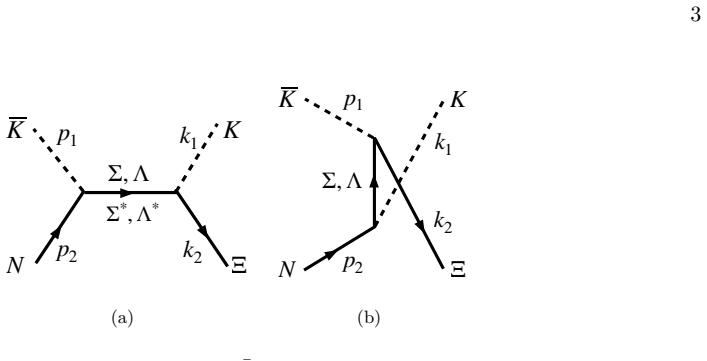
The added J^P=3/2^- resonance pole in the effective Lagrangian amplitude that supplies the missing contribution to the 2.0 GeV structure.
If this is right
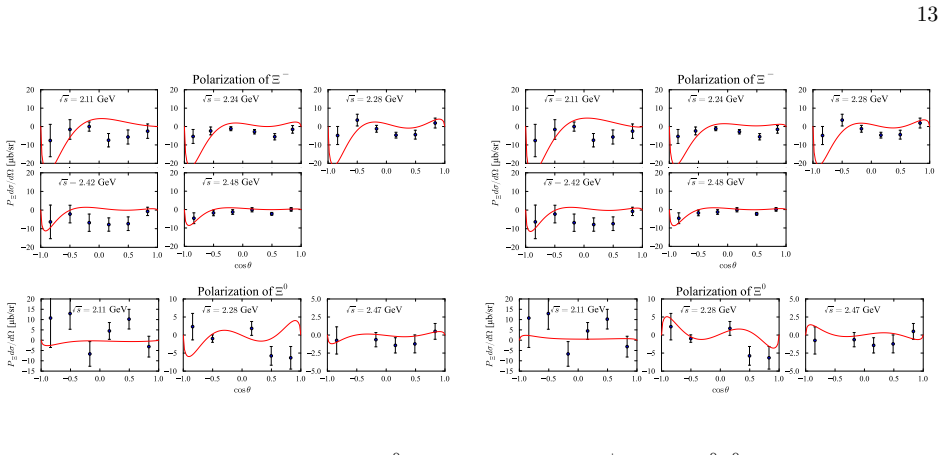
- Polarization of the final-state Ξ is better described by the Λ* solution than by the Σ* solution.
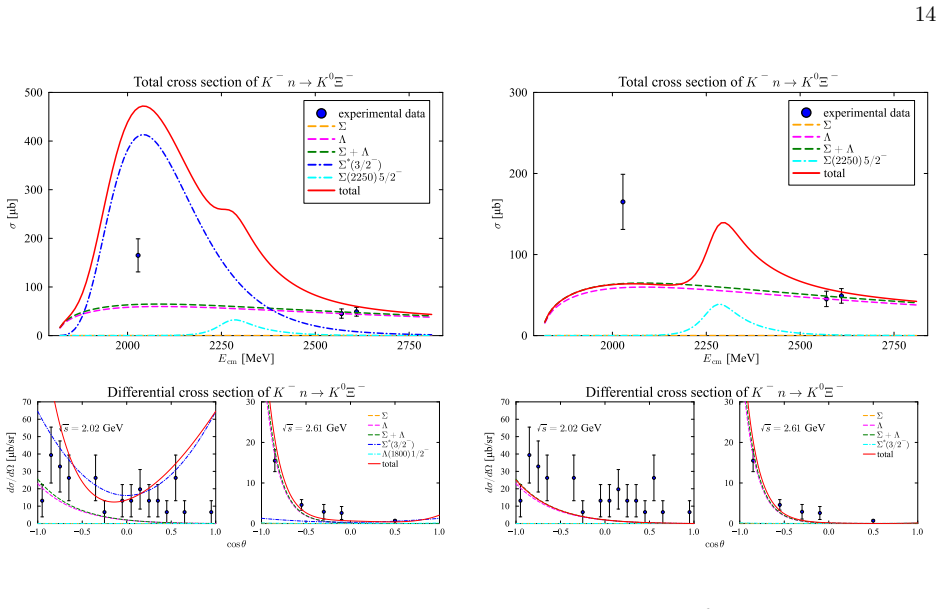
- Predictions for the K^-n → K^0 Ξ^- cross section can be compared directly with data.
- The introduced resonance admits a possible interpretation as an S-wave K Ξ(1530) hadronic molecule or pentaquark state.
Where Pith is reading between the lines
- Higher-statistics polarization data from facilities such as J-PARC or JLab could cleanly separate the Σ* and Λ* assignments.
- If the resonance exists, analogous structures may appear in other hyperon-production channels not yet measured with comparable precision.
- Confirmation would increase the number of candidate exotic states in the 1.9 GeV region and motivate coupled-channel analyses that include additional final states.
Load-bearing premise
The resonances already included plus non-resonant background cannot be adjusted to fit the 2.0 GeV structure and threshold behavior without adding a new resonance pole.
What would settle it
A high-precision measurement of Ξ polarization in K^-p → K Ξ that shows no preference for the Λ* solution or that rules out both solutions would falsify the need for or the assignment of the added resonance.
Figures
read the original abstract
We analyze the $K^-p\to K^+\Xi^-$ and $K^-p\to K^0\Xi^0$ processes in the energy region $1.8<\sqrt{s}<2.8$ GeV within an effective Lagrangian approach. The $\Lambda(1800)$ and $\Sigma(2250)$ resonances, along with the ground states $\Sigma$ and $\Lambda$, are included. Additionally, a possible $J^P=3/2^-$ $\Sigma^*$ or $\Lambda^*$ resonance with a mass around 1.9 GeV and a width of approximately 200 MeV is introduced to describe the structure at 2.0 GeV in the total cross section and reproducing the threshold behavior. The two possible solutions corresponding to $\Sigma^*(3/2^-)$ and $\Lambda^*(3/2^-)$ cannot be distinguished by the existing data. Predictions for the polarization of the final-state $\Xi$ and the cross section of $K^-n \to K^0\Xi^-$ are compared with the experimental data, we find that the results of solution-II with $\Lambda^*(3/2^-)$ are much better. We also discuss the possible interpretations of the introduced $3/2^-$ hyperon as a pentaquark candidate, e.g. an $S$-wave $K\Xi(1530)$ hadronic molecule. However, since the polarization data suffer from rather large uncertainties, more data inputs are needed in future experiments, for example, J-PARC, HIAF and JLab.
Editorial analysis
A structured set of objections, weighed in public.
Referee Report
Summary. The manuscript analyzes K^-p → K^+ Ξ^- and K^-p → K^0 Ξ^0 scattering for 1.8 < √s < 2.8 GeV in an effective Lagrangian framework. It includes the Λ(1800), Σ(2250), and ground-state Σ/Λ resonances plus non-resonant background, then introduces an additional J^P=3/2^- Σ* or Λ* pole (mass ≈1.9 GeV, width ≈200 MeV) to reproduce the cross-section structure near 2.0 GeV and threshold behavior. Two solutions are obtained; polarization observables are said to favor the Λ* assignment. Predictions for Ξ polarization and the K^-n → K^0 Ξ^- channel are compared with data, and a possible pentaquark or KΞ(1530) molecular interpretation is discussed.
Significance. If the necessity of the new resonance were demonstrated by quantitative comparison, the result would add a concrete candidate to the sparse hyperon spectrum above 1.8 GeV and motivate targeted searches at J-PARC or JLab. The paper supplies explicit predictions for polarization and an isospin-related channel that could be tested experimentally.
major comments (2)
- [§3] §3 (numerical results): No χ² value, residual plot, or explicit fit without the additional 3/2^- pole is shown. The central claim that the listed resonances plus background are insufficient therefore rests on an untested assumption; it remains possible that re-optimization of the existing couplings or background parameters could absorb the 2.0 GeV feature without introducing three new parameters.
- [§4] §4 (polarization observables): The Ξ polarization predictions are generated from the same effective-Lagrangian amplitude whose resonance parameters were adjusted to the total cross sections. Consequently they do not constitute independent tests of the resonance hypothesis, especially given the large experimental uncertainties already noted in the abstract.
Simulated Author's Rebuttal
We thank the referee for the careful reading and constructive comments on our manuscript. We address the two major comments point by point below.
read point-by-point responses
-
Referee: [§3] §3 (numerical results): No χ² value, residual plot, or explicit fit without the additional 3/2^- pole is shown. The central claim that the listed resonances plus background are insufficient therefore rests on an untested assumption; it remains possible that re-optimization of the existing couplings or background parameters could absorb the 2.0 GeV feature without introducing three new parameters.
Authors: We agree that an explicit quantitative comparison would strengthen the manuscript. In the revised version we will report the χ² per degree of freedom for the fit that excludes the additional 3/2^- resonance (with all other parameters re-optimized) together with a brief residual discussion. The figures already show that the structure near 2.0 GeV is not reproduced by the listed resonances and background alone, but the requested numbers will make this explicit. revision: yes
-
Referee: [§4] §4 (polarization observables): The Ξ polarization predictions are generated from the same effective-Lagrangian amplitude whose resonance parameters were adjusted to the total cross sections. Consequently they do not constitute independent tests of the resonance hypothesis, especially given the large experimental uncertainties already noted in the abstract.
Authors: While the resonance parameters are fixed by the total cross sections, the polarization observables depend on interference terms and relative phases that are not directly constrained by the unpolarized cross sections. The comparison with existing polarization data therefore still discriminates between the two solutions, even though the uncertainties are large (as already stated in the abstract). We will add a short clarifying sentence in the revised text to emphasize this point. revision: partial
Circularity Check
No significant circularity; standard effective-Lagrangian fit with external validation
full rationale
The paper introduces a new 3/2^- resonance pole by adjusting its mass, width, and couplings within an effective Lagrangian to reproduce the 2.0 GeV structure and threshold behavior in K^-p → KΞ total cross sections. Polarization observables and the K^-n channel are then computed from the same parameters and compared to data, but these are distinct observables not used to determine the pole parameters. No self-citation chain, self-definitional loop, or renaming of a fitted quantity as a prediction is present. The derivation remains self-contained: the model equations plus explicit resonance terms generate outputs that can be tested against independent measurements.
Axiom & Free-Parameter Ledger
free parameters (3)
- resonance mass =
~1.9 GeV
- resonance width =
~200 MeV
- coupling strengths
axioms (1)
- domain assumption The effective Lagrangian approach with s-channel resonance exchanges is adequate to describe the reaction in the 1.8-2.8 GeV region
invented entities (1)
-
new J^P=3/2- hyperon resonance
no independent evidence
Reference graph
Works this paper leans on
-
[1]
Gell-Mann, A Schematic Model of Baryons and Mesons, Phys
M. Gell-Mann, A Schematic Model of Baryons and Mesons, Phys. Lett.8, 214 (1964)
1964
-
[2]
Zweig, An SU(3) model for strong interaction symmetry and its breaking
G. Zweig, An SU(3) model for strong interaction symmetry and its breaking. Version 1 10.17181/CERN- TH-401 (1964)
-
[3]
Navas, C
S. Navas, C. Amsler, T. Gutsche,et al.(Particle Data Group), Review of particle physics, Phys. Rev. D110, 030001 (2024)
2024
-
[4]
F.-K. Guo, C. Hanhart, U.-G. Meißner, Q. Wang, Q. Zhao, and B.-S. Zou, Hadronic molecules, Rev. Mod. Phys.90, 015004 (2018), arXiv:1705.00141 [hep-ph]
work page internal anchor Pith review Pith/arXiv arXiv 2018
-
[5]
Capstick and N
S. Capstick and N. Isgur, Baryons in a relativized quark model with chromodynamics, Phys. Rev. D 34, 2809 (1986)
1986
-
[6]
W. A. Cooperet al., Interactions of 1.47 GeV/cnegativeK −-mesons in hydrogen, in11th International Conference on High-energy Physics(1962) pp. 298–302
1962
-
[7]
Carmony, G
D. Carmony, G. Pjerrou, P. Schlein, W. Slater, and D. Stork, Properties of Ξ hyperons, Phys. Rev. Lett.12, 482 (1964)
1964
-
[8]
Badier, M
J. Badier, M. Demoulin, J. Goldberg, B. P. Gregory, C. Pelletier, A. Rouge, M. Ville, R. Barloutaud, A. Leveque, C. Louedec, J. Meyer, P. Schlein, A. Verglas, D. Holthuizen, W. Hoogland, and A. Tenner, Baryonic states of strangeness−2 produced inK −pinteractions at 3.0 GeV/c, Phys. Lett.16, 171 (1965)
1965
-
[9]
Berge, P
J. Berge, P. Eberhard, J. Hubbard, D. W. Merrill, J. Button-Shafer, F. T. Solmitz, and M. Stevenson, Some properties of Ξ − and Ξ0 hyperons produced inK −pinteractions between 1.05 and 1.7 BeV/c, Phys. Rev.147, 945 (1966)
1966
-
[10]
Haque, B
M. Haque, B. Musgrave, W. Blair,et al.(Birmingham-Glasgow-London(I.C.)-Oxford-Rutherford), Re- actions K−p→Hyperon + Meson at 3.5 GeV/c, Phys. Rev.152, 1148 (1966)
1966
-
[11]
London, R
G. London, R. Rau, N. Samios, S. Yamamoto, M. Goldberg, S. Lichtman, M. Prime, and J. Leitner, K−p Interaction at 2.24 BeV/c, Phys. Rev.143, 1034 (1966). 19
1966
-
[12]
T. G. Trippe and P. E. Schlein, Partial-Wave Analysis of K −p→Ξ −K+ at 2 GeV/c, Phys. Rev.158, 1334 (1967)
1967
-
[13]
Burgun, J
G. Burgun, J. Meyer, E. Pauli,et al., Resonance formation in the reactions K −p→K +Ξ− and K −p →K 0Ξ0 in the mass region from 1915 to 2168 MeV, Nucl. Phys. B8, 447 (1968)
1915
-
[14]
Trower, J
W. Trower, J. Ficenec, R. Hulsizer, J. Lathrop, J. Snyder, and W. Swanson, Some two-body final states of K−p interactions at 1.33 GeV/c, Phys. Rev.170, 1207 (1968)
1968
-
[15]
Dauber, J
P. Dauber, J. Berge, J. Hubbard, D. Merrill, and R. Muller, Production and decay of cascade hyperons, Phys. Rev.179, 1262 (1969)
1969
-
[16]
Griselin, A
J. Griselin, A. Givernaud, R. Barloutaud,et al., K −p cross sections between 1.1 and 1.4 GeV/c, Nucl. Phys. B93, 189 (1975)
1975
-
[17]
Briefel, S
E. Briefel, S. Gourevitch, L. Kirsch,et al., Search for Ξ* production in K −p interactions at 2.87 GeV/c, Phys. Rev. D16, 2706 (1977)
1977
-
[18]
de Bellefon, A
A. de Bellefon, A. Berthon, P. Billoir, J. Brunet, G. Tristram, J. Vrana, B. Baccari, G. Poulard, D. Revel, and B. Tallini, Channel Cross-Sections of K −p Reactions from 1.934 to 2.516 GeV/c, Nuovo Cim. A41, 451 (1977)
1977
-
[19]
Carlson, H
J. Carlson, H. Davis, D. Jauch, N. Sossong, and R. Ellsworth, Measurement of Neutral Cascade Pro- duction from Negative-Kaon-Hydrogen at 1.8 GeV/c, K −p→K 0Ξ0, Phys. Rev. D7, 2533 (1973)
1973
-
[20]
Phenomenological model for the Kbar N --> K Xi reaction
D. Sharov, V. Korotkikh, and D. Lanskoy, Phenomenological model for the ¯KN→KΞ reaction, Eur. Phys. J. A47, 109 (2011), arXiv:1105.0764 [nucl-th]
work page internal anchor Pith review Pith/arXiv arXiv 2011
-
[21]
Production of a cascade hyperon in the K^- - proton interaction
R. Shyam, O. Scholten, and A. Thomas, Production of a cascade hyperon in the K −p interaction, Phys. Rev. C84, 042201 (2011), arXiv:1108.2318 [hep-ph]
work page internal anchor Pith review Pith/arXiv arXiv 2011
-
[22]
B. C. Jackson, Y. Oh, H. Haberzettl, and K. Nakayama, ¯K+ N→K + Ξ reaction and S=-1 hyperon resonances, Phys. Rev. C91, 065208 (2015), arXiv:1503.00845 [nucl-th]
work page internal anchor Pith review Pith/arXiv arXiv 2015
-
[23]
A. Feijoo, V. Magas, and A. Ramos, The ¯KN→KΞ reaction in coupled channel chiral models up to next-to-leading order, Phys. Rev. C92, 015206 (2015), arXiv:1502.07956 [nucl-th]
work page internal anchor Pith review Pith/arXiv arXiv 2015
-
[24]
Model-independent aspects of the reaction $\bar{K} + N \to K + \Xi$
B. Jackson, Y. Oh, H. Haberzettl, and K. Nakayama, Model-independent aspects of the reaction ¯K+ N→K + Ξ, Phys. Rev. C89, 025206 (2014), arXiv:1311.2836 [hep-ph]
work page internal anchor Pith review Pith/arXiv arXiv 2014
-
[25]
Dynamical coupled-channels model of $K^- p$ reactions (I): Determination of partial-wave amplitudes
H. Kamano, S. X. Nakamura, T.-S. H. Lee, and T. Sato, Dynamical coupled-channels model of K − p re- actions (I): Determination of partial-wave amplitudes, Phys. Rev. C90, 065204 (2014), arXiv:1407.6839 [nucl-th]
work page internal anchor Pith review Pith/arXiv arXiv 2014
-
[26]
M. Matveev, A. Sarantsev, V. Nikonov, A. Anisovich, U. Thoma, and E. Klempt, Hyperon I: Partial- wave amplitudes for K −p scattering, Eur. Phys. J. A55, 179 (2019), arXiv:1907.03645 [nucl-ex]
-
[27]
Towards the Minimal Spectrum of Excited Baryons
J. Landay, M. Mai, M. D¨ oring, H. Haberzettl, and K. Nakayama, Towards the Minimal Spectrum of Excited Baryons, Phys. Rev. D99, 016001 (2019), arXiv:1810.00075 [nucl-th]
work page internal anchor Pith review Pith/arXiv arXiv 2019
- [28]
-
[29]
K. Aokiet al., Extension of the J-PARC Hadron Experimental Facility: Third White Paper, (2021), arXiv:2110.04462 [nucl-ex]
-
[30]
X. Chenet al., Huizhou Hadron Spectrometer – a Proposed High-rate Experimental Setup at the High Intensity Heavy-ion Accelerator Facility, (2025), arXiv:2511.22864 [hep-ex]
-
[31]
Dobbs (KLF), Strange hadron spectroscopy with the KLong facility at Jefferson lab, Rev
S. Dobbs (KLF), Strange hadron spectroscopy with the KLong facility at Jefferson lab, Rev. Mex. Fis. Suppl.3, 0308032 (2022), arXiv:2207.10779 [nucl-ex]
-
[32]
Johnson and E
K. Johnson and E. Sudarshan, Inconsistency of the local field theory of charged spin 3/2 particles, Annals Phys.13, 126 (1961)
1961
-
[33]
Velo and D
G. Velo and D. Zwanziger, Propagation and Quantization of Rarita-Schwinger Waves in an External Electromagnetic Potential, Phys. Rev.186, 1337 (1969)
1969
-
[34]
Velo and D
G. Velo and D. Zwanzinger, Noncausality and Other Defects of Interaction Lagrangians for Particles with Spin One and Higher, Phys. Rev.188, 2218 (1969)
1969
-
[35]
Hasumi, R
A. Hasumi, R. Endo, and T. Kimura, Dirac quantisation of a massive spin-3/2 particle coupled with a magnetic field, J. Phys. A12, L217 (1979)
1979
-
[36]
Cox, On the Lagrangian and Hamiltonian constraint algorithms for the Rarita-Schwinger field coupled to an external electromagnetic field, J
W. Cox, On the Lagrangian and Hamiltonian constraint algorithms for the Rarita-Schwinger field coupled to an external electromagnetic field, J. Phys. A22, 1599 (1989)
1989
-
[37]
Quantization of an interacting spin-3/2 field and the Delta isobar
V. Pascalutsa, Quantization of an interacting spin-3/2 field and the Delta isobar, Phys. Rev. D58, 096002 (1998), arXiv:hep-ph/9802288
work page internal anchor Pith review Pith/arXiv arXiv 1998
-
[38]
Rarita and J
W. Rarita and J. Schwinger, On a Theory of Particles with Half-Integral Spin, Phys. Rev.60, 61 (1941)
1941
-
[39]
Adelseck, C
R. Adelseck, C. Bennhold, and L. Wright, Kaon Photoproduction Operator for Use in Nuclear Physics, Phys. Rev. C32, 1681 (1985)
1985
-
[40]
Benmerrouche, R
M. Benmerrouche, R. M. Davidson, and N. C. Mukhopadhyay, Problems of describing spin-3/2 baryon resonances in the effective Lagrangian theory, Phys. Rev. C39, 2339 (1989)
1989
-
[41]
de Bellefon, A
A. de Bellefon, A. Berthon, P. Billoir, J. Brunet, G. Tristram, J. Vrana, B. Baccari, G. Poulard, D. Revel, and B. Tallini, New Data on the Reactions K −p→ ¯K0n and K −p→K −p between 1.934 GeV/c and 2.516 GeV/c, Partial-Wave Analysis of These Channels and SU(3) Classification of the New Y* States Observed, Nuovo Cim. A42, 403 (1977)
1977
-
[42]
Coupled-channel dynamics in the reactions piN --> piN, etaN, KLambda, KSigma
D. Ronchen, M. Doring, F. Huang, H. Haberzettl, J. Haidenbauer, C. Hanhart, S. Krewald, U.-G. Meissner, and K. Nakayama, Coupled-channel dynamics in the reactionsπN→πN,ηN, KΛ, KΣ, Eur. Phys. J. A49, 44 (2013), arXiv:1211.6998 [nucl-th]
work page internal anchor Pith review Pith/arXiv arXiv 2013
-
[43]
Scheuer, R
J. Scheuer, R. Barloutaud, D. Merrill,et al.(SABRE), Experimental study of two-body and quasi-two- body reactions in K −n intereaction at 3 GeV/c, Nucl. Phys. B33, 61 (1971)
1971
-
[44]
Briefel, S
E. Briefel, S. Gourevitch, L. Kirsch,et al., Search for Ξ* Resonances in 2.87 GeV/c K −n Interactions, Phys. Rev. D12, 1859 (1975)
1975
-
[45]
X.-K. Dong, F.-K. Guo, and B.-S. Zou, A survey of heavy–heavy hadronic molecules, Commun. Theor. Phys.73, 125201 (2021), arXiv:2108.02673 [hep-ph]. 21
-
[46]
X.-K. Dong, F.-K. Guo, and B.-S. Zou, A survey of heavy-antiheavy hadronic molecules, Progr. Phys. 41, 65 (2021), arXiv:2101.01021 [hep-ph]
discussion (0)
Sign in with ORCID, Apple, or X to comment. Anyone can read and Pith papers without signing in.