Uncovering multi-channel magnetic hopfion annihilation via a single-node, billion-spin-scale atomistic framework
Pith reviewed 2026-06-29 19:13 UTC · model grok-4.3
The pith
A new GPU framework for billion-spin simulations reveals two distinct magnetic hopfion annihilation pathways on million-spin lattices.
A machine-rendered reading of the paper's core claim, the machinery that carries it, and where it could break.
Core claim
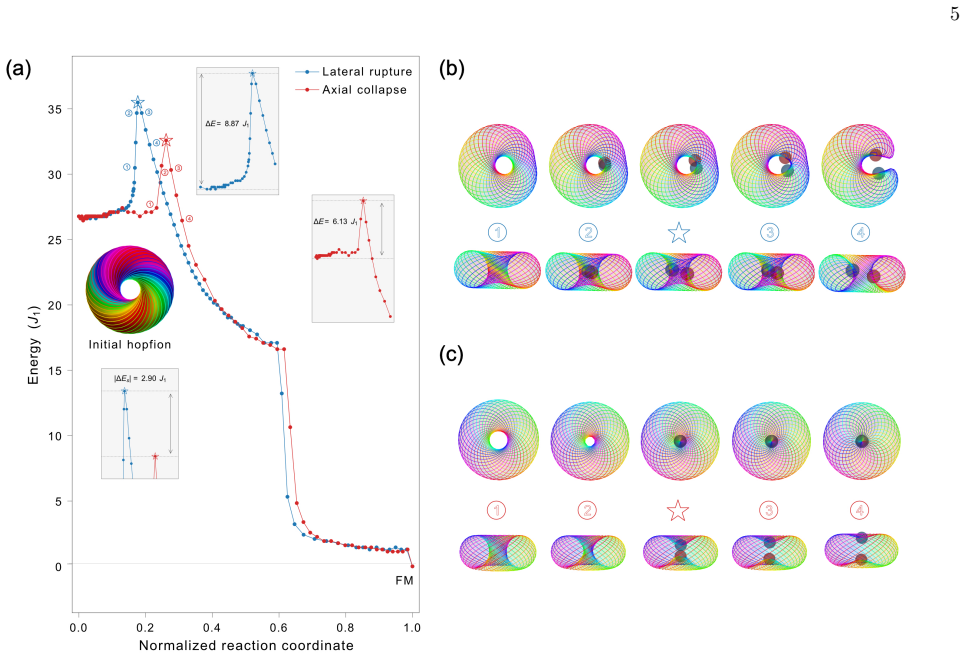
The central claim is that SpinX's unified Hamiltonian interface and sublattice-based multi-channel tensor convolutions make it possible to simulate exchange-stabilized magnetic hopfions on a million-spin atomistic lattice, uncovering two competing annihilation channels—an axial-collapse pathway previously reported and a distinct lateral-rupture pathway with different transition morphology and activation barrier—while supporting full workflows of dynamics, sampling, optimization, and transition-path calculations at billion-spin scale.
What carries the argument
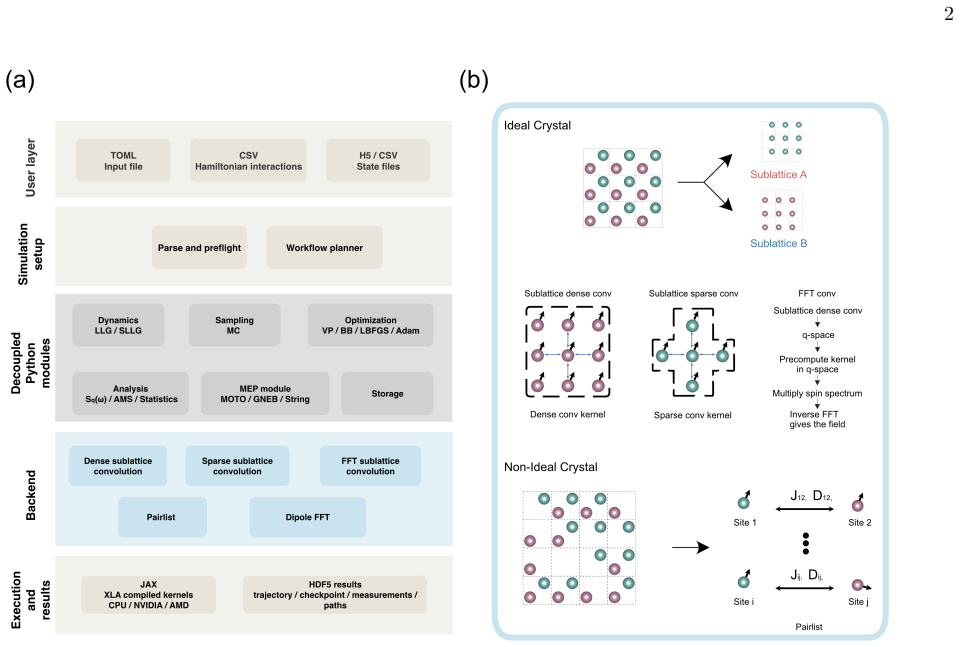
SpinX's core is a crystallographic sublattice decomposition that reformulates translationally invariant spin interactions as multi-channel tensor convolutions, enabling dense, sparse, and FFT-based backends.
If this is right
- Billion-spin atomistic simulations become feasible on single nodes for three-dimensional magnetic textures.
- Hopfion annihilation can proceed via either axial collapse or lateral rupture depending on the energy landscape.
- Transition-path methods like string and geodesic NEB can now resolve distinct morphologies and barriers at large scale.
- Mixed-precision field evaluation with full-precision propagation preserves accuracy while scaling throughput.
Where Pith is reading between the lines
- If the lateral-rupture channel dominates in real materials, hopfion-based devices may require different stabilization strategies than those based on axial stability alone.
- The convolution reformulation could extend to other long-range interactions or irregular geometries beyond the hopfion case.
- Single-node billion-spin capability opens the door to statistical sampling of rare events like hopfion creation or switching.
Load-bearing premise
The exchange-stabilized hopfion model parameters and the atomistic lattice representation accurately capture physical systems without artifacts from the mixed-precision convolution backends.
What would settle it
A direct observation or calculation on a physical material showing only the axial-collapse pathway with no evidence of the lateral-rupture channel at comparable energies would falsify the claim of two competing channels.
Figures
read the original abstract
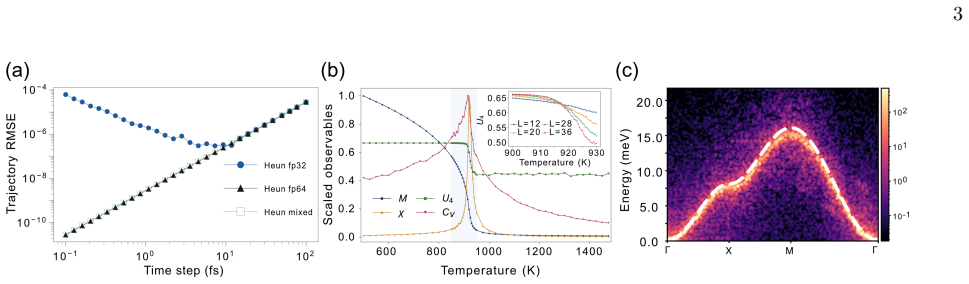
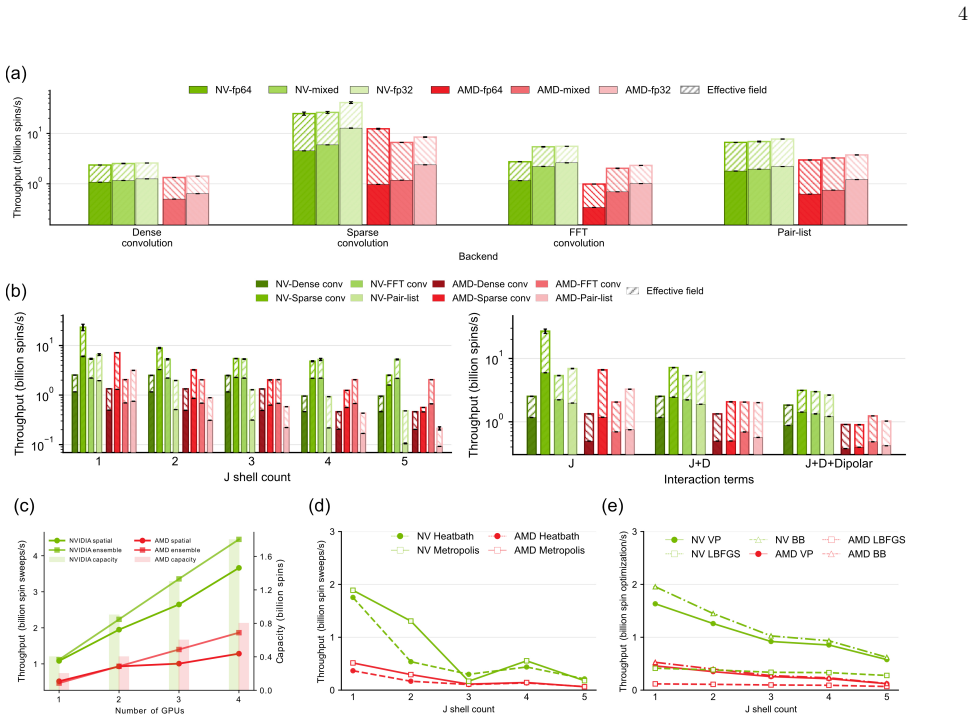
Modern atomistic spin simulations combine long stochastic trajectories, thermodynamic sampling, static optimization and multi-image transition-path workflows, all of which rely on repeated evaluation of spin Hamiltonians and become computationally prohibitive on the large lattices required for three-dimensional magnetic textures. We introduce SpinX, a GPU-native atomistic spin simulation framework built around a unified Hamiltonian interface and multiple user-selectable computational backends. Its core is a crystallographic sublattice decomposition that reformulates translationally invariant spin interactions as multi-channel tensor convolutions, enabling dense, sparse and FFT-based convolution backends, while irregular systems are handled by pair-list evaluation and long-range dipolar fields by reciprocal-space FFT. Implemented in JAX, SpinX supports deterministic and stochastic Landau-Lifshitz-Gilbert dynamics, Monte Carlo sampling, static optimization, dynamical spectroscopy and string and geodesic nudged elastic band transition-path calculations on heterogeneous accelerator platforms. A validated mixed-precision mode combines fp32 field evaluation with fp64 spin-state propagation. We validate SpinX against analytical single-spin dynamics, finite-size thermodynamics of bcc Fe and transverse dynamic structure factors. Performance benchmarks show peak throughput exceeding 10 billion spin-site operations per second on a single accelerator and aggregate single-node workloads of over 1 billion atomic spins. Applying this framework to an exchange-stabilized magnetic hopfion, we uncover two competing annihilation channels on a million-spin atomistic lattice: a previously reported axial-collapse pathway and a distinct lateral-rupture pathway with a different transition morphology and activation barrier.(Due to arXiv's limit, the abstract shown here is a shortened version)
Editorial analysis
A structured set of objections, weighed in public.
Referee Report
Summary. The manuscript introduces SpinX, a JAX-based GPU-native framework for atomistic spin simulations that reformulates interactions via crystallographic sublattice decomposition into multi-channel tensor convolutions (dense, sparse, FFT) with support for LLG dynamics, Monte Carlo, optimization, spectroscopy, and string/NEB transition-path methods. It includes a mixed-precision (fp32 field evaluation, fp64 propagation) mode, validates against single-spin dynamics, bcc Fe thermodynamics and transverse dynamic structure factors, demonstrates >10 billion spin-site ops/s and billion-spin workloads, and applies the framework to an exchange-stabilized hopfion on a million-spin lattice to identify two competing annihilation channels (axial collapse and lateral rupture) with distinct morphologies and barriers.
Significance. If the two annihilation channels prove robust, the result advances understanding of 3D topological spin textures by revealing a previously unreported lateral-rupture pathway alongside the axial-collapse mode, with implications for hopfion stability in spintronics. The framework's single-node billion-spin capability and unified Hamiltonian interface represent a technical advance for large-scale magnetic modeling; the open JAX implementation and performance benchmarks are strengths that support reproducibility.
major comments (2)
- [Validation section] Validation section (referenced in abstract): the reported validations cover single-spin dynamics, bcc Fe thermodynamics, and dynamic structure factors but provide no quantitative error metrics or tests on 3D topological textures such as hopfions; this is load-bearing for the central claim because the mixed-precision convolution backends are used for the NEB/string calculations that distinguish the axial-collapse and lateral-rupture pathways and their barriers.
- [Hopfion application] Hopfion application (final paragraph of abstract and corresponding results section): the identification of distinct activation barriers and morphologies for the two channels assumes that fp32 field evaluation introduces no artifacts that alter saddle-point connectivity on the finite exchange-stabilized lattice; the provided benchmarks do not include convergence tests with fp64-only mode or error estimates on hopfion energy landscapes, leaving open the possibility that the lateral-rupture channel is a numerical feature.
minor comments (2)
- [Abstract] Abstract: the shortened version omits key implementation details (e.g., exact sublattice decomposition equations) that would help readers assess the convolution reformulation.
- [Performance benchmarks] Performance claims: the >10 billion spin-site operations per second figure would benefit from explicit definition of the operation counted and the lattice size used for the single-node billion-spin benchmark.
Simulated Author's Rebuttal
We thank the referee for their thorough review and constructive comments on our manuscript. We address each major comment below and commit to revisions that strengthen the validation of the mixed-precision mode for the hopfion results.
read point-by-point responses
-
Referee: [Validation section] Validation section (referenced in abstract): the reported validations cover single-spin dynamics, bcc Fe thermodynamics, and dynamic structure factors but provide no quantitative error metrics or tests on 3D topological textures such as hopfions; this is load-bearing for the central claim because the mixed-precision convolution backends are used for the NEB/string calculations that distinguish the axial-collapse and lateral-rupture pathways and their barriers.
Authors: We agree that the validation section does not include quantitative error metrics or direct tests on 3D topological textures such as hopfions, and that this is relevant given the use of mixed-precision convolutions in the NEB calculations. The existing benchmarks validate the core components (single-spin LLG dynamics, thermodynamic sampling, and convolution accuracy via structure factors), but we acknowledge the gap for the specific application. In the revised manuscript we will add a new subsection reporting quantitative error metrics (energy and force differences) for a reference hopfion configuration computed in both mixed-precision and full fp64 modes. revision: yes
-
Referee: [Hopfion application] Hopfion application (final paragraph of abstract and corresponding results section): the identification of distinct activation barriers and morphologies for the two channels assumes that fp32 field evaluation introduces no artifacts that alter saddle-point connectivity on the finite exchange-stabilized lattice; the provided benchmarks do not include convergence tests with fp64-only mode or error estimates on hopfion energy landscapes, leaving open the possibility that the lateral-rupture channel is a numerical feature.
Authors: We acknowledge the concern that fp32 field evaluation could introduce artifacts affecting saddle-point identification in the hopfion NEB calculations. The current benchmarks do not contain fp64-only convergence tests or error estimates specific to the hopfion energy landscape. We will perform and report such tests in the revised manuscript, comparing the axial-collapse and lateral-rupture pathways, barriers, and morphologies between mixed-precision and full fp64 runs on the same million-spin lattice. If differences appear, we will revise the presentation of the results accordingly; if not, the additional data will support the robustness of both channels. revision: yes
Circularity Check
No significant circularity; framework and results are self-contained with external benchmarks
full rationale
The paper introduces SpinX as a new GPU-native framework reformulating spin interactions via crystallographic sublattice decomposition into multi-channel tensor convolutions, with multiple backends. It validates the implementation against independent external references: analytical single-spin dynamics, finite-size thermodynamics of bcc Fe, and transverse dynamic structure factors. The hopfion annihilation pathways are presented as an application result on a million-spin lattice, not as a fitted or self-referential prediction. No load-bearing steps reduce by construction to the paper's own inputs, self-citations, or ansatzes; the derivation chain relies on standard numerical methods and external checks rather than circular reduction.
Axiom & Free-Parameter Ledger
Reference graph
Works this paper leans on
-
[1]
V. P. Antropov, M. I. Katsnelson, M. van Schilfgaarde, and B. N. Harmon, Physical Review Letters75, 729 (1995)
1995
-
[2]
V. P. Antropov, M. I. Katsnelson, B. N. Harmon, M. van Schilfgaarde, and D. Kusnezov, Physical Review B54, 1019 (1996)
1996
-
[3]
Q. Xu, Z. Shen, A. Edstr¨ om, Z. Lu, A. Bergman, D. Thonig, W. Yin, O. Eriksson, and A. Delin, npj Com- putational Materials11, 56 (2025)
2025
-
[4]
Sallermann, H
M. Sallermann, H. J´ onsson, and S. Bl¨ ugel, Physical Re- view B107, 104404 (2023)
2023
-
[5]
I. S. Lobanov and V. M. Uzdin, Physical Review B107, 104405 (2023)
2023
-
[6]
Xu and A
Q. Xu and A. Delin, npj Computational Materials (2026)
2026
-
[7]
Q. Xu, I. P. Miranda, M. Pereiro, F. N. Rybakov, D. Thonig, E. Sj¨ oqvist, P. F. Bessarab, A. Bergman, O. Eriksson, P. Herman,et al., Physical Review Research 5, 043199 (2023)
2023
-
[8]
Q. Xu, Z. Shen, M. Pereiro, E. Sj¨ oqvist, P. Herman, O. Eriksson, and A. Delin, Communications Physics6, 239 (2023)
2023
-
[9]
V. M. Kuchkin, A. Haller, ˇS. Liˇ sˇ c´ ak, M. P. Adams, V. Rai, E. P. Sinaga, A. Michels, and T. L. Schmidt, Physical Review Research7, 013195 (2025)
2025
-
[10]
Y. Liu, R. K. Lake, and J. Zang, Physical Review B98, 174437 (2018)
2018
-
[11]
X. S. Wang, A. Qaiumzadeh, and A. Brataas, Physical Review Letters123, 147203 (2019)
2019
-
[12]
N. Kent, N. Reynolds, D. Raftrey, I. T. G. Campbell, S. Virasawmy, S. Dhuey, R. V. Chopdekar, A. Hierro- Rodriguez, A. Sorrentino, E. Pereiro, S. Ferrer, F. Hell- man, P. Sutcliffe, and P. Fischer, Nature Communica- tions12, 1562 (2021)
2021
-
[13]
Zheng, N
F. Zheng, N. S. Kiselev, F. N. Rybakov, L. Yang, W. Shi, S. Bl¨ ugel, and R. E. Dunin-Borkowski, Nature623, 718 (2023)
2023
-
[14]
Eriksson, A
O. Eriksson, A. Bergman, L. Bergqvist, and J. Hellsvik, Atomistic spin dynamics: foundations and applications (Oxford university press, 2017)
2017
- [15]
-
[16]
R. F. Evans, W. J. Fan, P. Chureemart, T. A. Ostler, M. O. Ellis, and R. W. Chantrell, Journal of Physics: Condensed Matter26, 103202 (2014)
2014
-
[17]
G. P. M¨ uller, M. Hoffmann, C. Dißelkamp, D. Sch¨ urhoff, S. Mavros, M. Sallermann, N. S. Kiselev, H. J´ onsson, and S. Bl¨ ugel, Physical Review B99, 224414 (2019)
2019
-
[18]
Xla : Compiling machine learning for peak performance,
A. Sabne, “Xla : Compiling machine learning for peak performance,” (2020)
2020
-
[19]
JAX: composable transformations of Python+NumPy programs,
J. Bradbury, R. Frostig, P. Hawkins, M. J. John- son, Y. Katariya, C. Leary, D. Maclaurin, G. Nec- ula, A. Paszke, J. VanderPlas, S. Wanderman-Milne, and Q. Zhang, “JAX: composable transformations of Python+NumPy programs,” (2018)
2018
-
[20]
Pajda, J
M. Pajda, J. Kudrnovsk´ y, I. Turek, V. Drchal, and P. Bruno, Physical Review B64, 174402 (2001)
2001
-
[21]
Heisenberg, Zeitschrift f¨ ur Physik49, 619 (1928)
W. Heisenberg, Zeitschrift f¨ ur Physik49, 619 (1928)
1928
-
[22]
J. W. Cooley and J. W. Tukey, Mathematics of Compu- tation19, 297 (1965)
1965
-
[23]
D. V. Berkov and N. L. Gorn, Journal of Magnetism and Magnetic Materials122, 204 (1993)
1993
-
[24]
C. J. Garc´ ıa-Cervera, Journal of Computational Physics 190, 1 (2003)
2003
-
[25]
L. D. Landau and E. M. Lifshitz, Physikalische Zeitschrift der Sowjetunion8, 153 (1935)
1935
-
[26]
T. L. Gilbert, IEEE Transactions on Magnetics40, 3443 (2004)
2004
-
[27]
W. F. Brown, Physical Review130, 1677 (1963)
1963
-
[28]
R. F. L. Evans, W. J. Fan, P. Chureemart, T. A. Ostler, M. O. A. Ellis, and R. W. Chantrell, Journal of Physics: Condensed Matter26, 103202 (2014)
2014
-
[29]
Metropolis, A
N. Metropolis, A. W. Rosenbluth, M. N. Rosenbluth, A. H. Teller, and E. Teller, The Journal of Chemical Physics21, 1087 (1953)
1953
-
[30]
Creutz, Physical Review D36, 515 (1987)
M. Creutz, Physical Review D36, 515 (1987)
1987
-
[31]
Absil, R
P.-A. Absil, R. Mahony, and R. Sepulchre,Optimization Algorithms on Matrix Manifolds(Princeton University Press, Princeton, 2008)
2008
-
[32]
Bitzek, P
E. Bitzek, P. Koskinen, F. G¨ ahler, M. Moseler, and P. Gumbsch, Physical Review Letters97, 170201 (2006)
2006
-
[33]
Barzilai and J
J. Barzilai and J. M. Borwein, IMA Journal of Numerical Analysis8, 141 (1988)
1988
-
[34]
D. C. Liu and J. Nocedal, Mathematical Programming 45, 503 (1989)
1989
-
[35]
Adam: A Method for Stochastic Optimization
D. P. Kingma and J. Ba, “Adam: A method for stochastic optimization,” (2015), arXiv:1412.6980 [cs.LG]
work page internal anchor Pith review Pith/arXiv arXiv 2015
-
[36]
W. E, W. Ren, and E. Vanden-Eijnden, Physical Review B66, 052301 (2002)
2002
-
[37]
Henkelman, B
G. Henkelman, B. P. Uberuaga, and H. J´ onsson, The Journal of Chemical Physics113, 9901 (2000)
2000
-
[38]
P. F. Bessarab, V. M. Uzdin, and H. J´ onsson, Computer Physics Communications196, 335 (2015)
2015
-
[39]
F. N. Rybakov, N. S. Kiselev, A. B. Borisov, L. D¨ oring, C. Melcher, and S. Bl¨ ugel, APL materials10(2022)
2022
-
[40]
Berg and M
B. Berg and M. L¨ uscher, Nuclear Physics B190, 412 (1981)
1981
discussion (0)
Sign in with ORCID, Apple, or X to comment. Anyone can read and Pith papers without signing in.