Multipole tomography of atomic nuclei with symmetry-conserved theories
Pith reviewed 2026-06-29 19:06 UTC · model grok-4.3
The pith
Two-body conditional probabilities define quadrupole deformations for angular-momentum conserving nuclear states.
A machine-rendered reading of the paper's core claim, the machinery that carries it, and where it could break.
Core claim
To define the intrinsic reference frame and multipole moments of angular-momentum-J-conserving many-body wave functions, we introduce two-body conditional probabilities of finding two nucleons at different positions in space. In this way, quadrupole deformations of states with J≤1/2, which are not accessible via spectroscopic one-body quadrupole moments, can be characterized. We illustrate the method with nuclear density functional theory calculations for J=0 states of 16O and 20Ne, the latter obtained by restoring rotational symmetry of prolate or oblate intrinsic configurations. We show that the two-body quadrupole shape characterizations differ from one-body moments obtained from broken-s
What carries the argument
Two-body conditional probabilities of finding two nucleons at different positions in space, used to define an intrinsic reference frame and multipole moments.
If this is right
- Quadrupole deformations become characterizable for all J=0 states within symmetry-conserving calculations.
- Shape information can be extracted without relying on auxiliary symmetry-broken mean-field solutions.
- Direct comparisons between theory and experiment become possible for even-even nuclei using only conserved-symmetry wave functions.
- The method extends the range of nuclei whose intrinsic shapes can be discussed in angular-momentum projected approaches.
Where Pith is reading between the lines
- The two-body approach could be applied to extract higher-order multipoles or to map full nuclear density distributions from symmetry-conserved states.
- It may provide a route to reconcile spectroscopic data with ab initio calculations that strictly conserve angular momentum.
- The conditional-probability construction might generalize to other fermionic systems where intrinsic frames are needed but total angular momentum is a good quantum number.
Load-bearing premise
Two-body conditional probabilities of nucleon positions suffice to define a unique intrinsic reference frame and multipole moments for J-conserving many-body wave functions.
What would settle it
A direct computation in which the two-body conditional probabilities fail to produce a stable, unique set of multipole moments that is independent of the choice of coordinate origin or that contradicts measured transition strengths in a J=0 state.
Figures
read the original abstract
To define the intrinsic reference frame and multipole moments of angular-momentum-$J$-conserving many-body wave functions, we introduce two-body conditional probabilities of finding two nucleons at different positions in space. In this way, quadrupole deformations of states with $J\leq1/2$, which are not accessible via spectroscopic one-body quadrupole moments, can be characterized. We illustrate the method with nuclear density functional theory calculations for $J=0$ states of $^{16}$O and $^{20}$Ne, the latter obtained by restoring rotational symmetry of prolate or oblate intrinsic configurations. We show that the two-body quadrupole shape characterizations differ from one-body moments obtained from broken-symmetry states.
Editorial analysis
A structured set of objections, weighed in public.
Referee Report
Summary. The manuscript introduces two-body conditional probabilities of nucleon positions to define intrinsic reference frames and multipole moments for angular-momentum J-conserving many-body wave functions. This enables characterization of quadrupole deformations for states with J ≤ 1/2 that are inaccessible via one-body spectroscopic quadrupole moments. The method is illustrated with nuclear density functional theory calculations for the J=0 ground states of 16O and 20Ne (the latter obtained via rotational symmetry restoration from prolate or oblate intrinsic configurations), showing that the resulting two-body quadrupole characterizations differ from one-body moments extracted from the corresponding broken-symmetry states.
Significance. If the construction is robust, the approach supplies a concrete route to extract intrinsic shape information directly from symmetry-conserved wave functions, a long-standing need in nuclear many-body theory where symmetry restoration is routinely employed. The explicit numerical comparison for 16O and 20Ne demonstrates that the two-body route can yield shape measures distinct from those of the underlying intrinsic states, potentially clarifying the interpretation of deformation in projected calculations.
major comments (1)
- [Abstract] Abstract (first sentence) and method section: the central claim that two-body conditional probabilities P(r1,r2) suffice to define a unique intrinsic reference frame for J-conserving states is not accompanied by an explicit demonstration of uniqueness or invariance under re-conditioning. For J=0 states the total wave function is rotationally invariant; without a proof that the conditional density fixes a unique principal-axis choice (or that any ambiguity does not affect the extracted quadrupole tensor), the reported difference from broken-symmetry one-body moments cannot be unambiguously attributed to intrinsic shape rather than frame convention.
minor comments (1)
- The explicit mathematical definition of the two-body conditional probability and the procedure for extracting the quadrupole tensor from it should be stated in an equation early in the method section for clarity.
Simulated Author's Rebuttal
We thank the referee for the careful reading and the constructive comment on the uniqueness of the intrinsic frame. We address the point below and will revise the manuscript accordingly.
read point-by-point responses
-
Referee: [Abstract] Abstract (first sentence) and method section: the central claim that two-body conditional probabilities P(r1,r2) suffice to define a unique intrinsic reference frame for J-conserving states is not accompanied by an explicit demonstration of uniqueness or invariance under re-conditioning. For J=0 states the total wave function is rotationally invariant; without a proof that the conditional density fixes a unique principal-axis choice (or that any ambiguity does not affect the extracted quadrupole tensor), the reported difference from broken-symmetry one-body moments cannot be unambiguously attributed to intrinsic shape rather than frame convention.
Authors: We agree that an explicit demonstration of uniqueness and invariance under re-conditioning is missing from the current text. In the revised manuscript we will insert a short subsection in the method section that (i) fixes one nucleon at a reference point along the z-axis by construction, (ii) shows that the resulting two-body quadrupole tensor is diagonal in the body-fixed frame defined by its eigenvectors, and (iii) proves that re-conditioning on any other nucleon yields a tensor that differs only by a global rotation, which is removed by the same diagonalization. Because the J=0 wave function is rotationally invariant, this procedure selects a unique principal-axis system (up to the discrete 180° ambiguities inherent to quadrupole shapes). The added argument will make clear that the reported difference with broken-symmetry one-body moments originates in the two-body correlations rather than in an arbitrary frame choice. revision: yes
Circularity Check
No significant circularity; new definition applied to independent calculations
full rationale
The paper defines the intrinsic frame via introduced two-body conditional probabilities and then applies this to DFT calculations on specific nuclei (16O, 20Ne) to exhibit differences from broken-symmetry one-body moments. No quoted equations, self-citations, or fitted parameters reduce the reported characterizations to tautological inputs by construction. The central illustration rests on explicit numerical results rather than renaming or self-referential fitting, rendering the derivation self-contained against external benchmarks.
Axiom & Free-Parameter Ledger
Forward citations
Cited by 1 Pith paper
-
Yoctosecond imaging of the ground state of $^{129}$Xe at the Large Hadron Collider
Bayesian global fit to Xe-Xe and Pb-Pb LHC data infers nearly maximal triaxiality for the 129Xe ground state and extracts two- and three-particle correlations.
Reference graph
Works this paper leans on
-
[1]
Even then, the two-body local density probabilities re- main invariant under rotations about the z-axis
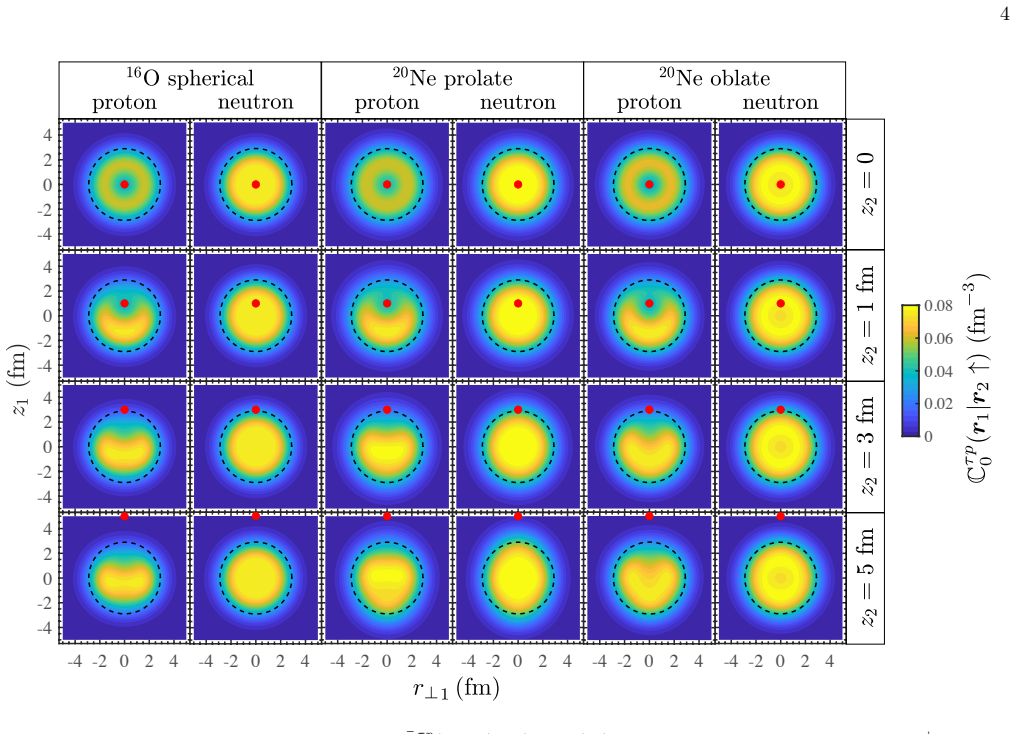
For further analysis, we therefore fix the position of 3 particle 2 on the z-axis at a distance z2 from the center of mass. Even then, the two-body local density probabilities re- main invariant under rotations about the z-axis. This allows us to, in addition, fix the azimuthal angle φ1 of particle 1’s position r1 at any value. In other words, rotationally ...
-
[2]
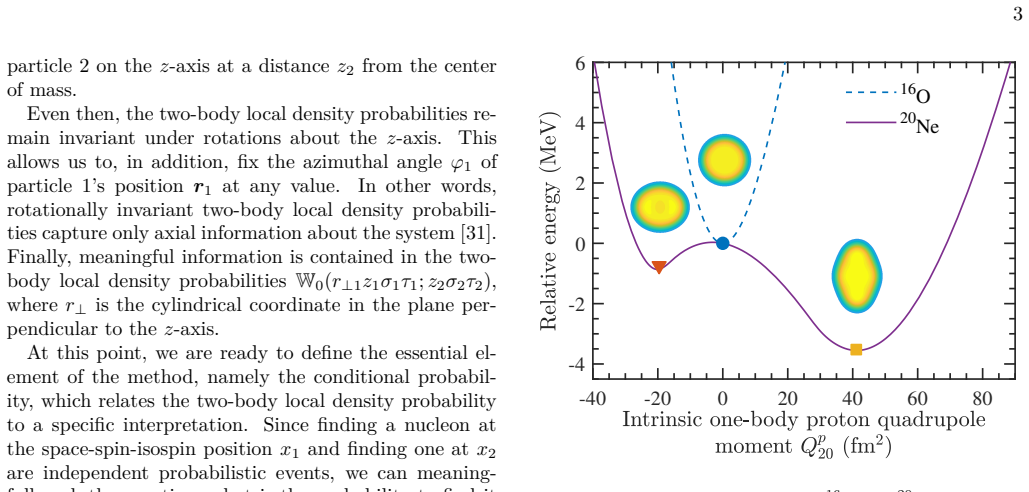
For the doubly magic nucleus 16O, the energy minimum occurs at spherical shape, Qp 20 = 0 . For the open-shell nucleus 20Ne, the global minimum is found at Qp 20 = +41 .1 fm2, corresponding to an elongated, prolate shape, and an ex- cited configuration is found at Qp 20 = −19.6 fm2, that is, at a flattened, oblate shape. In what follows, we present and comp...
-
[3]
Antoine de Saint-Exupéry, Le Petit Prince (Paris, Galli- mard, 1996)
1996
-
[4]
Reinhard and E
P.-G. Reinhard and E. W. Otten, Transition to deformed shapes as a nuclear Jahn-Teller effect, Nucl. Phys. A 420, 173 (1984)
1984
-
[5]
Nazarewicz, Microscopic origin of nuclear deforma- tions, Nucl
W. Nazarewicz, Microscopic origin of nuclear deforma- tions, Nucl. Phys. A 574, 27 (1994)
1994
-
[6]
P. W. Anderson, More is different. Broken symmetry and the nature of the hierarchical structure of science, Science 177, 393 (1972)
1972
-
[7]
J. A. Sheikh, J. Dobaczewski, P. Ring, L. M. Robledo, and C. Yannouleas, Symmetry restoration in mean-field approaches, J. Phys, G 48, 123001 (2021)
2021
-
[8]
Traditionally, the single-particle multipole moments, which in spherical coordinates {rθφ} are defined through the standard spherical harmonics as Qλµ(r) = 6 cλrλYλµ(θ, φ), include suitably chosen numerical prefac- tors cλ, such as c2 = √ 16π/5
-
[9]
N. J. Stone, Table of nuclear electric quadrupole mo- ments (2021), INDC International Nuclear Data Com- mittee, report INDC(NDS)-0833
2021
-
[10]
Dobaczewski, A
J. Dobaczewski, A. Gade, K. Godbey, R. V. F. Janssens, and W. Nazarewicz, Extraction of ground-state nuclear deformations from ultrarelativistic heavy-ion collisions: Nuclear structure physics context, Phys. Rev. Res. 7, 043159 (2025)
2025
-
[11]
Electromagnetic and Exotic Moments in Nuclear DFT
J. Dobaczewski, B. C. Backes, R. P. de Groote, A. Restrepo-Giraldo, X. Sun, and H. Wibowo, Electro- magnetic and exotic moments in nuclear DFT (2025), to appear in Annual Review of Nuclear and Particle Science, arXiv:2511.04632 [nucl-th]
work page internal anchor Pith review Pith/arXiv arXiv 2025
-
[12]
Lee, Lattice simulations for few- and many-body sys- tems, Prog
D. Lee, Lattice simulations for few- and many-body sys- tems, Prog. Part. Nucl. Phys. 63, 117 (2009)
2009
-
[13]
Elhatisari, E
S. Elhatisari, E. Epelbaum, H. Krebs, T. A. Lähde, D. Lee, N. Li, B.-n. Lu, U.-G. Meißner, and G. Rupak, Ab initio calculations of the isotopic dependence of nuclear clustering, Phys. Rev. Lett. 119, 222505 (2017)
2017
-
[14]
S. Shen, S. Elhatisari, T. A. Lähde, D. Lee, B.-N. Lu, and U.-G. Meißner, Emergent geometry and duality in the carbon nucleus, Nat. Comm. 14, 2777 (2023)
2023
-
[15]
Otsuka, T
T. Otsuka, T. Abe, T. Yoshida, Y. Tsunoda, N. Shimizu, N. Itagaki, Y. Utsuno, J. Vary, P. Maris, and H. Ueno, -clustering in atomic nuclei from first principles with statistical learning and the Hoyle state character, Nat. Comm. 13, 2234 (2022)
2022
-
[16]
R. Roth, T. Neff, H. Hergert, and H. Feldmeier, Nuclear structure based on correlated realistic nucleonnucleon po- tentials, Nucl. Phys. A 745, 333 (2004)
2004
-
[17]
Chernykh, H
M. Chernykh, H. Feldmeier, T. Neff, P. von Neumann- Cosel, and A. Richter, Structure of the Hoyle state in 12C, Phys. Rev. Lett. 98, 032501 (2007)
2007
-
[18]
D. D. Dao and F. Nowacki, Nuclear structure within a discrete nonorthogonal shell model approach: New fron- tiers, Phys. Rev. C 105, 054314 (2022)
2022
-
[19]
Bally, A
B. Bally, A. Sánchez-Fernández, and T. R. Rodríguez, Variational approximations to exact solutions in shell- model valence spaces: Calcium isotopes in the pf shell, Phys. Rev. C 100, 044308 (2019)
2019
-
[20]
A. V. Belitsky and A. V. Radyushkin, Unraveling hadron structure with generalized parton distributions, Phys. Rep. 418, 1 (2005)
2005
-
[21]
Frankfurt, M
L. Frankfurt, M. Strikman, and C. Weiss, Small-x physics: From HERA to LHC and beyond, Annu. Rev. Nucl. Part. Sci. 55, 403 (2005)
2005
-
[22]
Constantinou, A
M. Constantinou, A. Courtoy, M. A. Ebert, M. En- gelhardt, T. Giani, T. Hobbs, T.-J. Hou, A. Kusina, K. Kutak, J. Liang, H.-W. Lin, K.-F. Liu, S. Liuti, C. Mezrag, P. Nadolsky, E. R. Nocera, F. Olness, J.-W. Qiu, M. Radici, A. Radyushkin, A. Rajan, T. Rogers, J. Rojo, G. Schierholz, C.-P. Yuan, J.-H. Zhang, and R. Zhang, Parton distributions and lattice-Q...
2021
-
[23]
Quark and gluon tomography of the helium-4 nucleus
V. Martínez-Fernández, B. Pire, P. Sznajder, and J. Wag- ner, Quark and gluon tomography of the helium-4 nucleus (2026), arXiv:2605.18519 [hep-ph]
work page internal anchor Pith review Pith/arXiv arXiv 2026
-
[24]
Yannouleas and U
C. Yannouleas and U. Landman, Collective and independent-particle motion in two-electron artificial atoms, Phys. Rev. Lett. 85, 1726 (2000)
2000
-
[25]
Romanovsky, C
I. Romanovsky, C. Yannouleas, L. O. Baksmaty, and U. Landman, Bosonic molecules in rotating traps, Phys. Rev. Lett. 97, 090401 (2006)
2006
-
[26]
Y. Li, C. Yannouleas, and U. Landman, From a few to many electrons in quantum dots under strong magnetic fields: Properties of rotating electron molecules with mul- tiple rings, Phys. Rev. B 73, 075301 (2006)
2006
-
[27]
Yannouleas and U
C. Yannouleas and U. Landman, Quantum Wigner molecules in moiré materials, Phys. Rev. B 108, L121411 (2023)
2023
-
[28]
Giacalone, Many-body correlations for nuclear physics across scales: from nuclei to quark-gluon plasmas to hadron distributions, Eur
G. Giacalone, Many-body correlations for nuclear physics across scales: from nuclei to quark-gluon plasmas to hadron distributions, Eur. Phys. J. A 59, 297 (2023)
2023
-
[29]
W. Ke, From wave-function to fireball geometry: the role of a restored broken symmetry in ultrarelativistic colli- sions of deformed nuclei (2025), arXiv:2509.09549 [nucl- th]
-
[30]
Giacalone, B
G. Giacalone, B. Bally, G. Nijs, S. Shen, T. Duguet, J.- P. Ebran, S. Elhatisari, M. Frosini, T. A. Lähde, D. Lee, B.-N. Lu, Y.-Z. Ma, U.-G. Meißner, J. Noronha-Hostler, C. Plumberg, T. R. Rodríguez, R. Roth, W. van der Schee, and V. Somà, Exploiting 20Ne isotopes for pre- cision characterizations of collectivity in small systems, Phys. Rev. Lett. 135, 01...
2025
-
[31]
Blaizot and G
J.-P. Blaizot and G. Giacalone, Angular structure of many-body correlations in atomic nuclei, Eur. Phys. J. A 61, 220 (2025)
2025
-
[32]
Duguet, G
T. Duguet, G. Giacalone, S. Jeon, and A. Tichai, Re- vealing the harmonic structure of nuclear two-body cor- relations in high-energy heavy-ion collisions, Phys. Rev. Lett. 135, 182301 (2025)
2025
-
[33]
[ 8] and exploited in a subsequent publication [ 38], extracting information about triaxiality requires accounting for three-body probabilities
As specified in Ref. [ 8] and exploited in a subsequent publication [ 38], extracting information about triaxiality requires accounting for three-body probabilities
-
[34]
Schunck, Energy density functional methods for atomic nuclei , IOP Expanding Physics (IOP Publishing, Bristol, UK, 2019) oCLC: 1034572493
N. Schunck, Energy density functional methods for atomic nuclei , IOP Expanding Physics (IOP Publishing, Bristol, UK, 2019) oCLC: 1034572493
2019
-
[35]
Dobaczewski, P
J. Dobaczewski, P. B¸ aczyk, P. Becker, M. Ben- der, K. Bennaceur, J. Bonnard, Y. Gao, A. Idini, M. Konieczka, M. Kortelainen, L. Próchniak, A. M. Romero, W. Satuła, Y. Shi, L. F. Yu, and T. R. Werner, Solution of universal nonrelativistic nuclear DFT equa- tions in the Cartesian deformed harmonic-oscillator ba- sis. (IX) HFODD (v3.06h): a new version of ...
2021
-
[36]
Dobaczewski et al
J. Dobaczewski et al. , Code hfodd, version to be pub- lished (2026)
2026
-
[37]
Kortelainen, T
M. Kortelainen, T. Lesinski, J. Moré, W. Nazarewicz, J. Sarich, N. Schunck, M. V. Stoitsov, and S. Wild, Nuclear energy density optimization, Phys. Rev. C 82, 024313 (2010)
2010
-
[38]
We remark that because ρ0(r) is a rotational scalar, the volume integrals must vanish for λ > 0, that is,∫ d3r T τ τ′ λ0 (r) rn ρτ ′ 0 (r) = 0
-
[39]
Repository of raw data obtained in this work is available at this URL https://webfiles.york.ac.uk/ HFODD/Projects/Tomography
-
[40]
H. Mehrabpour, G. Giacalone, and M. W. Luzum, Tri- axial shapes and the angular structure of nuclear three- body correlations (2026), arXiv:2604.00619 [nucl-th]
-
[41]
Ring and P
P. Ring and P. Schuck, The Nuclear Many-Body Problem (Springer-Verlag, Berlin, 1980)
1980
-
[42]
Varshalovich, A
D. Varshalovich, A. Moskalev, and V. Khersonskii, Quan- 7 tum Theory of Angular Momentum (World Scientific, Singapore, 1988)
1988
-
[43]
Dobaczewski, A
J. Dobaczewski, A. E. Stuchbery, G. Danneaux, A. Nag- pal, P. L. Sassarini, and H. Wibowo, Electromagnetic moments of ground and excited states calculated in heavy odd-N open-shell nuclei, Phys. Rev. C 113, 024306 (2026), ibid C113 (2026) 044312 . 8 End Matter Two-body local density —The symmetry-conserving state obtained by restoring the angular-momentum...
2026
discussion (0)
Sign in with ORCID, Apple, or X to comment. Anyone can read and Pith papers without signing in.