Prism: A Plug-in Reproducible Infrastructure for Scalable Multimodal Continual Instruction Tuning
Pith reviewed 2026-06-29 23:08 UTC · model grok-4.3
The pith
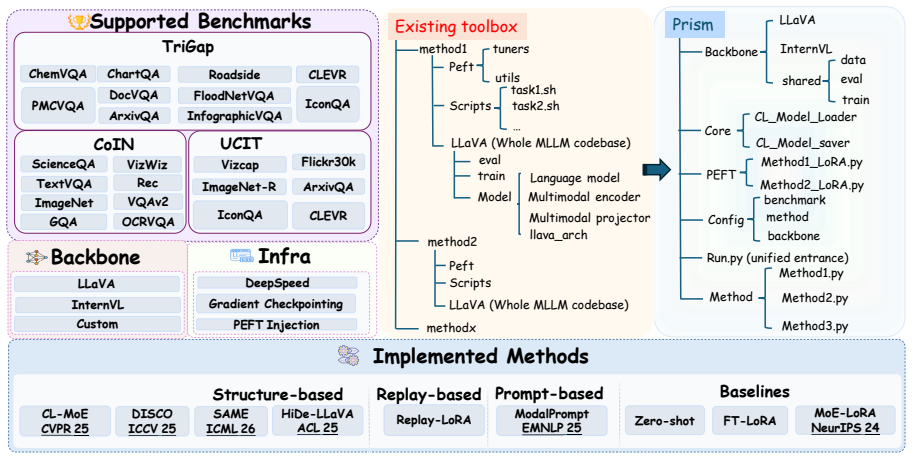
Prism uses a lightweight plugin registration system to let new multimodal continual instruction tuning methods integrate without modifying the base MLLM codebase.
A machine-rendered reading of the paper's core claim, the machinery that carries it, and where it could break.
Core claim
Prism separates algorithmic development from the backbone implementation via a lightweight plugin registration mechanism, enabling new strategies to be integrated as independent plugins without modifying the underlying MLLM codebase, thereby eliminating structural fragmentation and accelerating method development while natively supporting widely used large-scale training pipelines for reproducible MCIT experimentation.
What carries the argument
The lightweight plugin registration mechanism that registers new algorithmic strategies as independent components without altering the base MLLM codebase.
If this is right
- New MCIT strategies can be developed and shared as self-contained plugins that work with any supported backbone.
- Implementation overhead drops because researchers no longer rewrite core model code for each method.
- Direct comparisons between methods become possible inside the same reproducible training pipeline.
- Large-scale continual tuning experiments can run consistently across different algorithmic variants.
Where Pith is reading between the lines
- Adoption could standardize experimental setups across multimodal continual learning studies, making results easier to reproduce.
- Similar plug-in patterns might extend to other continual learning domains such as vision-only or language-only settings.
- Future benchmark suites could be built directly on this infrastructure to enforce consistent evaluation protocols.
Load-bearing premise
A lightweight plugin registration mechanism can handle the full range of MCIT algorithmic needs, including large-scale training, without hidden overhead or loss of functionality.
What would settle it
An MCIT method that requires direct edits to the MLLM source code to function and cannot be expressed through the plugin registration interface alone.
Figures
read the original abstract
Multimodal Large Language Models (MLLMs) achieve versatility by reformulating diverse tasks into a unified instruction-following framework via instruction tuning. However, real-world deployment requires continuous adaptation to emerging tasks, motivating Multimodal Continual Instruction Tuning (MCIT). Despite its growing importance, current MCIT research is hindered by severe engineering bottlenecks. Existing methods are typically implemented by directly modifying the base MLLM codebase, which imposes substantial implementation overhead and yields method-specific architectures that severely limit code reuse and fair comparison. To address this, we introduce Prism, a plug-in reproducible codebase specifically designed for scalable MCIT research. It separates algorithmic development from the backbone implementation via a lightweight plugin registration mechanism, enabling new strategies to be integrated as independent plugins without modifying the underlying MLLM codebase, thereby eliminating structural fragmentation and accelerating method development. Prism natively supports widely used large-scale training pipeline, thereby enabling reproducible and scalable MCIT experimentation. Code is available at https://github.com/LAMDA-CL/Prism.
Editorial analysis
A structured set of objections, weighed in public.
Referee Report
Summary. The paper introduces Prism, a plug-in reproducible infrastructure for scalable Multimodal Continual Instruction Tuning (MCIT). It claims that a lightweight plugin registration mechanism separates algorithmic development from the MLLM backbone implementation, allowing new strategies to be integrated as independent plugins without modifying the underlying codebase, while natively supporting large-scale training pipelines for reproducible experimentation.
Significance. If the described plugin mechanism holds, Prism could meaningfully reduce engineering overhead in MCIT research, improve reproducibility, and enable fairer method comparisons by providing a shared extensible framework rather than fragmented per-method codebases.
major comments (2)
- [Abstract] Abstract: the central claim that the lightweight plugin registration mechanism fully supports the range of MCIT requirements (including custom losses, dynamic components, and large-scale training) without hidden overhead or base-code edits is load-bearing but unsubstantiated, as the manuscript provides no description of the exposed hooks, registration API, or compatibility guarantees.
- [Abstract] Abstract: no implementation details, plugin examples, or verification of the registration mechanism are included, leaving the claim that it eliminates structural fragmentation without empirical or technical grounding.
minor comments (1)
- The GitHub link is provided but the manuscript contains no usage examples, API signatures, or installation instructions to allow readers to assess the plugin interface.
Simulated Author's Rebuttal
We thank the referee for highlighting the need for explicit technical grounding of Prism's plugin mechanism. We agree the current manuscript (including the abstract) does not sufficiently describe the registration API, hooks, or examples, and we will add this material in revision.
read point-by-point responses
-
Referee: [Abstract] Abstract: the central claim that the lightweight plugin registration mechanism fully supports the range of MCIT requirements (including custom losses, dynamic components, and large-scale training) without hidden overhead or base-code edits is load-bearing but unsubstantiated, as the manuscript provides no description of the exposed hooks, registration API, or compatibility guarantees.
Authors: We accept this assessment. The manuscript currently provides only a high-level description. In the revised version we will insert a new subsection (approximately 3.2) that enumerates the registration API, the precise hooks for custom losses and dynamic components, compatibility guarantees with the underlying MLLM, and any measured overhead. We will also add a table summarizing supported MCIT requirements and how each is satisfied without base-code modification. revision: yes
-
Referee: [Abstract] Abstract: no implementation details, plugin examples, or verification of the registration mechanism are included, leaving the claim that it eliminates structural fragmentation without empirical or technical grounding.
Authors: We agree. The revised manuscript will include (1) concrete plugin registration code examples for representative MCIT strategies, (2) a verification subsection showing that new plugins integrate without altering the backbone, and (3) a brief empirical note on engineering effort saved across three external methods. These additions will be placed in Section 3 and the experiments section. revision: yes
Circularity Check
No circularity: software infrastructure description with no derivations or fitted quantities
full rationale
The paper presents a software design for a plugin-based codebase (Prism) to support MCIT research. Its central claim is an engineering assertion about decoupling via registration mechanisms, supported by description of the system and a GitHub link. No equations, predictions, fitted parameters, or self-citation chains appear in the provided text. The contribution is a reusable infrastructure rather than a derived result, so the derivation chain is empty and self-contained by construction.
Axiom & Free-Parameter Ledger
Reference graph
Works this paper leans on
-
[1]
arXiv preprint arXiv:2508.07307 , year=
Ieee. Jiajun Deng, Zhengyuan Yang, Tianlang Chen, Wen- gang Zhou, and Houqiang Li. 2021. Transvg: End- to-end visual grounding with transformers. InPro- ceedings of the IEEE/CVF international conference on computer vision, pages 1769–1779. Yash Goyal, Tejas Khot, Douglas Summers-Stay, Dhruv Batra, and Devi Parikh. 2017. Making the v in vqa matter: Elevati...
-
[2]
The many faces of robustness: A critical anal- ysis of out-of-distribution generalization. InICCV, pages 8340–8349. Tianyu Huai, Jie Zhou, Xingjiao Wu, Qin Chen, Qingchun Bai, Ze Zhou, and Liang He. 2025. Cl- moe: Enhancing multimodal large language model with dual momentum mixture-of-experts for con- tinual visual question answering. InCVPR, pages 19608–...
-
[3]
arXiv preprint arXiv:2208.05358 , year =
Clevr-math: A dataset for compositional lan- guage, visual and mathematical reasoning.arXiv preprint arXiv:2208.05358. Haotian Liu, Chunyuan Li, Qingyang Wu, and Yong Jae Lee. 2023. Visual instruction tuning. InNeurIPS. Pan Lu, Swaroop Mishra, Tony Xia, Liang Qiu, Kai- Wei Chang, Song-Chun Zhu, Oyvind Tafjord, Peter Clark, and Ashwin Kalyan. 2022. Learn t...
-
[4]
SAME: Stabilized Mixture-of-Experts for Multimodal Continual Instruction Tuning
Towards vqa models that can read. InProceed- ings of the IEEE Conference on Computer Vision and Pattern Recognition, pages 8317–8326. Shengbang Tong, David Fan, Jiachen Li, Yunyang Xiong, Xinlei Chen, Koustuv Sinha, Michael Rabbat, Yann LeCun, Saining Xie, and Zhuang Liu. 2025. Metamorph: Multimodal understanding and genera- tion via instruction tuning. I...
work page internal anchor Pith review Pith/arXiv arXiv 2025
discussion (0)
Sign in with ORCID, Apple, or X to comment. Anyone can read and Pith papers without signing in.