REVIEW 2 minor 3 references
Squeezing Capacity from Multimodal Large Language Models for Subject-driven Generation
T0 review · 0 major / 2 minor · reviewed 2026-06-29 · grok-4.3
Pith's one-line read Jointly encoding text and reference images inside MLLMs lets diffusion models balance instruction following with subject identity preservation.
desk verdict The paper improves subject-driven generation by jointly encoding text and references in an MLLM, then balancing that with VAE identity via a new Dual Layer Aggregation module and multi-stage denoising. read the letter →
The pith
A machine-rendered reading of the paper's core claim, the machinery that carries it, and where it could break.
The reading
What carries the argument
The Dual Layer Aggregation (DLA) module, which aggregates multi-level features from the jointly encoded MLLM output to condition the diffusion model, paired with multi-stage denoising that shifts emphasis from MLLM semantics to VAE identity details.
What would settle it
Quantitative identity similarity scores or human preference ratings on a standard subject-driven benchmark where the method performs no better than, or worse than, baselines that encode text and images separately.
Extended reading notes
Core claim
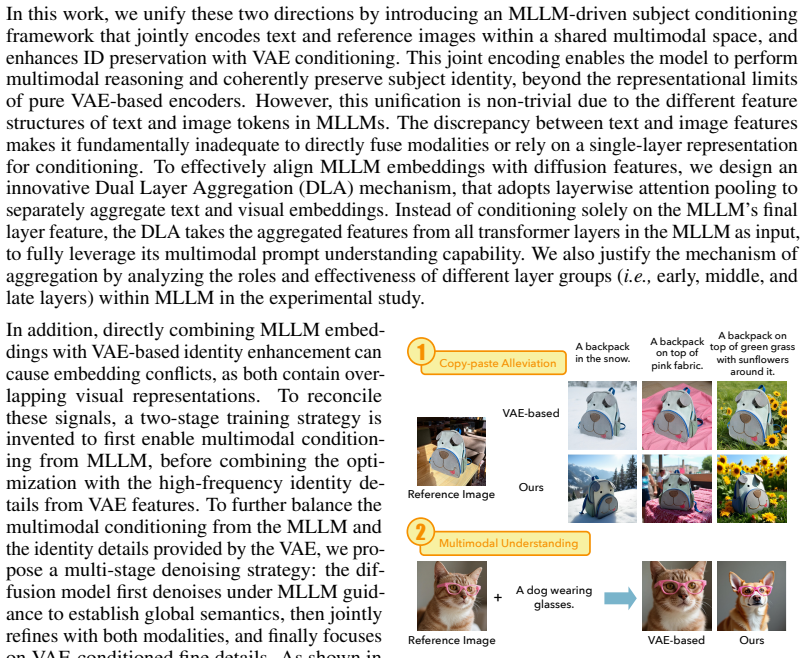
Conditioning diffusion models on Multimodal Large Language Models that jointly encode text and reference images, augmented with VAE-based identity conditioning, a Dual Layer Aggregation module to aggregate multi-level MLLM features, and a multi-stage denoising strategy that progressively balances semantic information from the MLLM with fine-detail identity from the VAE, harmonizes multimodal understanding with identity preservation, mitigates copy-paste issues, and achieves superior human preference on subject-driven image generation.
Load-bearing premise
Joint encoding of text and reference images inside an MLLM, when paired with the Dual Layer Aggregation module and multi-stage denoising, will balance semantic guidance and identity preservation without introducing new failure modes.
Editorial extensions
If this is right
- Joint MLLM encoding enables stronger cross-modal reasoning between instructions and reference subjects than separate encoders.
- The DLA module extracts usable conditioning signals from multiple layers of the MLLM without requiring architectural changes to the language model itself.
- Multi-stage denoising provides a controllable way to trade off instruction adherence against fine-grained identity fidelity during inference.
- The overall pipeline reduces reliance on post-hoc copy-paste mitigation techniques common in prior subject-driven methods.
- Human preference wins indicate the approach produces outputs that align better with user expectations for both content and likeness.
Reading between the lines
- The same joint-encoding principle could be tested on video or 3D subject-driven tasks where temporal or geometric consistency matters.
- If MLLMs already contain rich visual detail, further scaling or fine-tuning of the language model itself might reduce the need for an auxiliary VAE identity branch.
- The method implies that current separate-encoder pipelines waste capacity that joint multimodal models can reclaim without extra supervision.
Signed reviews
Editorial analysis
A structured set of objections, weighed in public.
Referee Report
Summary. The paper proposes conditioning diffusion models on Multimodal Large Language Models (MLLMs) that jointly encode text prompts and reference images for subject-driven generation. It augments this with VAE-based identity conditioning, introduces a Dual Layer Aggregation (DLA) module to aggregate multi-level MLLM features, and applies a multi-stage denoising strategy during inference to balance semantic information against fine-grained identity details. The central claim is that this harmonizes multimodal understanding with identity preservation, reduces copy-paste artifacts, and yields superior human preference scores relative to prior separate-encoding or MLLM-diffusion baselines.
Significance. If the quantitative comparisons and human studies hold, the work is significant for demonstrating a practical integration of MLLM joint encoding with diffusion pipelines that directly addresses the trade-off between instruction following and subject fidelity. Credit is due for supplying the full architectural description, training procedure, ablations on copy-paste versus semantic drift, and human preference evaluations that test the core balance assumption.
minor comments (2)
- The abstract states superior human preference but does not report the actual preference percentages or statistical significance; moving these numbers into the abstract would improve immediate readability without altering the manuscript scope.
- Notation for the DLA module (e.g., how the two layers are indexed and aggregated) is introduced in §3.2 but could be cross-referenced more explicitly in the multi-stage denoising schedule of §3.3 to aid readers tracing the conditioning path.
Simulated Author's Rebuttal
We thank the referee for the positive summary, recognition of the work's significance, and recommendation of minor revision. No specific major comments were provided in the report.
Circularity Check
No circularity in derivation chain
full rationale
The paper describes an engineering architecture that jointly encodes text and reference images in an MLLM, augments with VAE identity conditioning, introduces a Dual Layer Aggregation module, and applies multi-stage denoising. All load-bearing claims are presented as design choices validated directly by training procedure, ablations, and human preference experiments rather than any mathematical derivation, fitted parameter renamed as prediction, or self-citation chain. No equations or uniqueness theorems are invoked that reduce outputs to inputs by construction.
Assumptions & free parameters
assumptions (1)
- domain assumption Multimodal Large Language Models can jointly encode text and reference images in a manner suitable for diffusion conditioning
invented entities (2)
-
Dual Layer Aggregation (DLA) module
-
multi-stage denoising strategy
Cite this review
Pith. "Pith review of Squeezing Capacity from Multimodal Large Language Models for Subject-driven Generation." pith.science (2026). https://pith.science/paper/I6QE6DO6
@misc{pith2026260526111,
  author       = {Pith},
  title        = {Pith review of: Squeezing Capacity from Multimodal Large Language Models for Subject-driven Generation},
  year         = {2026},
  howpublished = {\url{https://pith.science/paper/I6QE6DO6}},
  note         = {Machine review of arXiv:2605.26111}
}
read the original abstract
Subject-driven image generation aims to synthesize new images that preserve the identity of the given subject while following textual instructions. Existing approaches often encode text and reference images separately. This limits cross-modal reasoning abilities and causes copy-paste artifacts. Recent frameworks that connect multimodal models and diffusion models improve instruction following, but largely overlook identity preservation. To address these limitations, we condition diffusion models on Multimodal Large Language Models (MLLMs) that jointly encode text and reference images, and augment it with VAE-based identity conditioning. A novel Dual Layer Aggregation (DLA) module is designed to aggregate multi-level MLLM features for optimal conditioning, and a multi-stage denoising strategy is applied to progressively balance the semantic information from MLLM and fine-detail identity from VAE during inference. Extensive experiments demonstrate that our approach harmonizes multimodal understanding with identity preservation, mitigates copy-paste issues, and achieves superior performance regarding human preference on subject-driven image generation. Our project website is available at https://zsh2000.github.io/squeeze-mllm-subject-gen/.
Figures


Figures from the paper (3 more)


Reference graph
Works this paper leans on
-
[1]
write newline
" write newline "" before.all 'output.state := FUNCTION n.dashify 't := "" t empty not t #1 #1 substring "-" = t #1 #2 substring "--" = not "--" * t #2 global.max substring 't := t #1 #1 substring "-" = "-" * t #2 global.max substring 't := while if t #1 #1 substring * t #2 global.max substring 't := if while FUNCTION format.date year duplicate empty "emp...
-
[2]
, " * write output.state after.block = add.period write
ENTRY address author booktitle chapter doi edition editor eid howpublished institution journal key month note number organization pages publisher school series title type url volume year label INTEGERS output.state before.all mid.sentence after.sentence after.block FUNCTION init.state.consts #0 'before.all := #1 'mid.sentence := #2 'after.sentence := #3 '...
-
[3]
write newline
" write newline "" before.all 'output.state := FUNCTION n.dashify 't := "" t empty not t #1 #1 substring "-" = t #1 #2 substring "--" = not "--" * t #2 global.max substring 't := t #1 #1 substring "-" = "-" * t #2 global.max substring 't := while if t #1 #1 substring * t #2 global.max substring 't := if while FUNCTION word.in bbl.in capitalize ":" * " " *...
Reviewed June 29, 2026 · model on record in the stance chip above.
Discussion (0). Continue with ORCID to comment.