Equatorial Circular Motion of Charged Test Particles in a Weakly Magnetized Taub--NUT Background
Pith reviewed 2026-06-29 20:08 UTC · model grok-4.3
The pith
A weak external magnetic field reduces the ISCO radius for charged test particles in a Taub-NUT spacetime, with the reduction depending on charge sign and motion direction.
A machine-rendered reading of the paper's core claim, the machinery that carries it, and where it could break.
Core claim
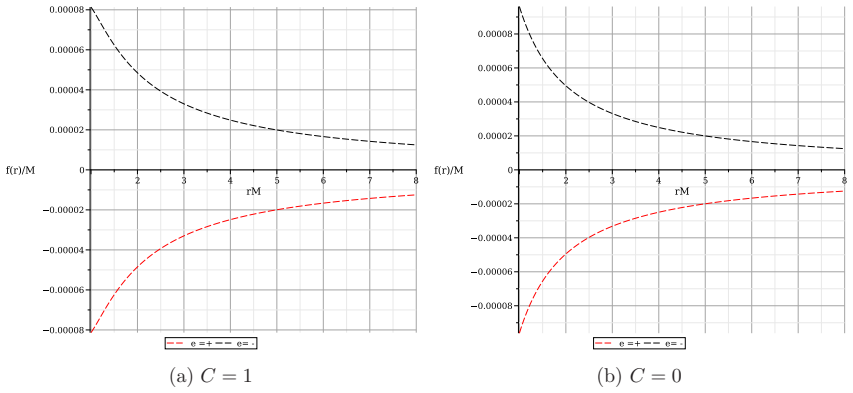
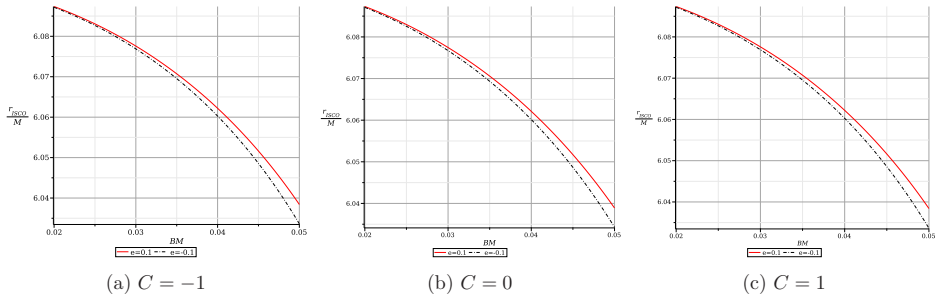
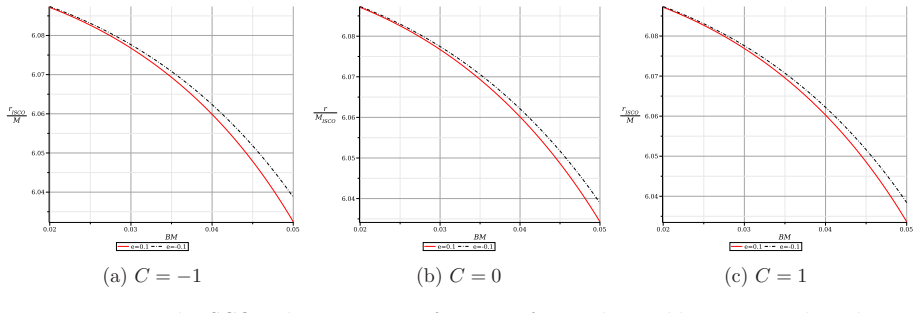
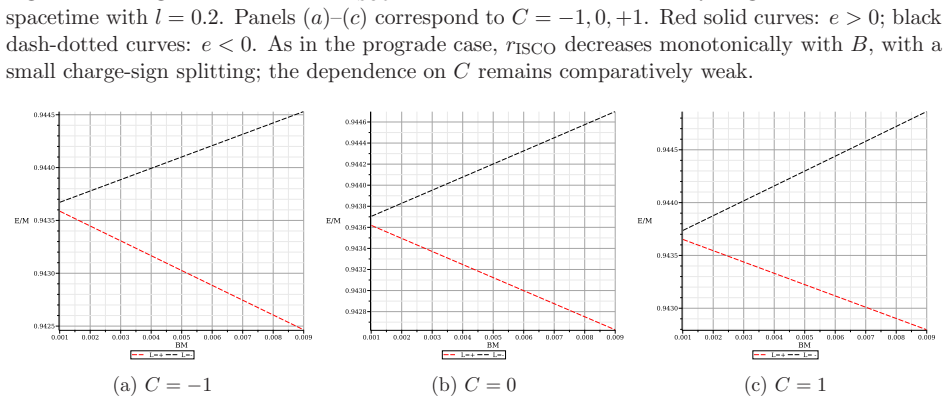
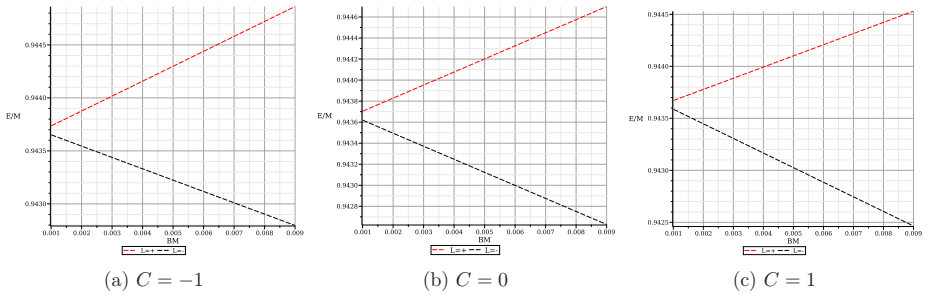
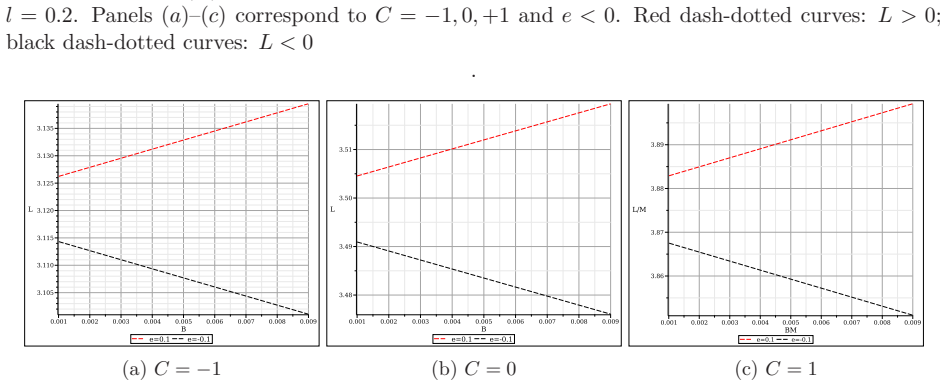
For constrained equatorial circular orbits of charged test particles in the weakly magnetized Taub-NUT background, increasing the magnetic field strength B decreases the ISCO radius monotonically. The sign of the particle charge splits the prograde and retrograde branches with the ordering of radii reversed between them, and the Manko-Ruiz parameter C contributes only subleading corrections to these radii.
What carries the argument
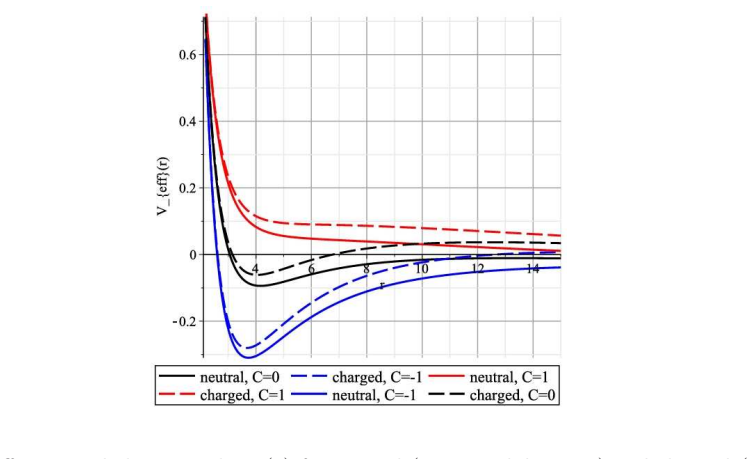
The effective potential for radial motion obtained after imposing the equatorial constraint x = ẋ = 0, from which the circularity condition (vanishing first derivative) and marginal-stability condition (vanishing second derivative) are extracted to locate the ISCO.
If this is right
- Stronger magnetic fields move the ISCO inward for both prograde and retrograde motion.
- Particle charge sign produces distinct ISCO radii for the two branches, with the relative ordering reversed when the direction of motion is switched.
- The Manko-Ruiz parameter C shifts the ISCO only by small corrections.
- The reported behavior applies to the constrained equatorial family rather than to the conical orbits permitted by the full metric.
Where Pith is reading between the lines
- The monotonic inward shift with B suggests that external fields could allow stable orbits at smaller radii in magnetized environments around twisted black holes.
- Direct comparison of the constrained ISCO locations with those obtained from fully three-dimensional numerical orbits would quantify the approximation error introduced by the equatorial constraint.
- Charge-dependent orbital radii could alter the structure of charged accretion flows or particle rings in models that include both magnetic fields and NUT-like twists.
Load-bearing premise
The stability properties extracted from orbits forced to the equator remain representative even though the metric lacks reflection symmetry when the NUT parameter is nonzero.
What would settle it
Numerical integration of the geodesic equations under the equatorial constraint that shows the ISCO radius increasing with magnetic field strength would contradict the reported monotonic decrease.
Figures
read the original abstract
We study circular motion of charged test particles on the equatorial slice of a Taub--NUT black hole with Manko--Ruiz parameter $C$, immersed in a weak external magnetic field introduced via Wald's prescription. Because the Taub--NUT metric is not reflection-symmetric about the equator once $l\neq 0$, generic charged orbits lie on cones $x=\cos\theta\neq 0$ rather than on the equatorial plane. We therefore analyse \emph{constrained} circular orbits obtained by imposing $x=\dot x=0$, and we exhibit in closed form the residual angular constraint that a fully self-consistent orbit would have to satisfy. Within this scope we derive the circularity and marginal-stability conditions and study how $B$ and $C$ shift the ISCO radius for prograde and retrograde branches. Increasing $B$ monotonically decreases $r_{\mathrm{ISCO}}$; the sign of the particle charge splits the two branches, with the ordering reversed between prograde and retrograde motion; and $C$ contributes only subleading corrections. The extension to self-consistent conical orbits is the natural direction for follow-up work.
Editorial analysis
A structured set of objections, weighed in public.
Referee Report
Summary. The manuscript analyzes constrained equatorial circular orbits (imposed via x = ẋ = 0) of charged test particles around a Taub-NUT black hole with Manko-Ruiz parameter C in a weak external magnetic field (Wald prescription). It derives closed-form circularity and marginal-stability conditions from the equations of motion including the Lorentz force, then reports that increasing B monotonically decreases r_ISCO, with particle charge sign q splitting the prograde/retrograde branches (order reversed between them) while C contributes only subleading corrections. The residual angular constraint for self-consistent orbits is exhibited explicitly, with extension to conical orbits noted as future work.
Significance. The closed-form derivations of the circularity and marginal-stability conditions constitute a clear strength, permitting direct analytic tracking of B, q, and C dependence without numerical fitting or self-referential quantities. If the constrained-orbit results hold under the stated scope, they supply explicit, falsifiable predictions for ISCO shifts that can be compared against geodesic-plus-Lorentz integrations in this spacetime. This analytic control is useful for exploring charged-particle dynamics in non-reflection-symmetric magnetized geometries.
major comments (1)
- [marginal-stability analysis] Marginal-stability analysis (section deriving ISCO conditions): the radial effective-potential marginal-stability condition is obtained under the x = ẋ = 0 constraint, but the manuscript does not report the sign of the second derivative of the effective potential with respect to x at the quoted r_ISCO values. Because the Taub-NUT metric lacks equatorial reflection symmetry for l eq 0, a negative value would imply that the reported orbits are already unstable to infinitesimal heta-perturbations, rendering the B- and q-dependent shifts unrepresentative even within the constrained framework. A concrete test is to evaluate ∂^{2}V_eff/∂x^{2} at each reported r_ISCO(B, q) and state its sign.
minor comments (1)
- [title and abstract] Abstract and introduction: the phrasing 'equatorial circular motion' in the title and opening paragraphs could be clarified to emphasize 'constrained' from the outset, to avoid any initial misreading before the symmetry caveat is stated.
Simulated Author's Rebuttal
We thank the referee for their careful reading of the manuscript and for the constructive comment on the marginal-stability analysis. We address the point below and will incorporate the requested check in the revised version.
read point-by-point responses
-
Referee: [marginal-stability analysis] Marginal-stability analysis (section deriving ISCO conditions): the radial effective-potential marginal-stability condition is obtained under the x = ẋ = 0 constraint, but the manuscript does not report the sign of the second derivative of the effective potential with respect to x at the quoted r_ISCO values. Because the Taub-NUT metric lacks equatorial reflection symmetry for l eq 0, a negative value would imply that the reported orbits are already unstable to infinitesimal θ-perturbations, rendering the B- and q-dependent shifts unrepresentative even within the constrained framework. A concrete test is to evaluate ∂²V_eff/∂x² at each reported r_ISCO(B, q) and state its sign.
Authors: We agree that, given the absence of equatorial reflection symmetry when l ≠ 0, it is necessary to verify the sign of ∂²V_eff/∂x² at the constrained r_ISCO loci to confirm that the orbits remain stable against infinitesimal vertical perturbations within the imposed x = ẋ = 0 framework. Although our analysis is explicitly restricted to radially marginal-stable constrained orbits (with the residual angular constraint exhibited in closed form), we acknowledge that a negative second derivative would limit the physical representativeness of the reported B- and q-dependent shifts. In the revised manuscript we will evaluate ∂²V_eff/∂x² at representative r_ISCO(B, q, C) values for both prograde and retrograde branches, state its sign explicitly, and discuss the implications for the domain of validity of the constrained-orbit results. revision: yes
Circularity Check
No circularity in derivation chain
full rationale
The paper derives circularity and marginal-stability conditions for constrained equatorial orbits by imposing the explicit constraint x=ẋ=0 on the standard charged-particle equations of motion obtained from the Taub-NUT metric plus Wald potential. The reported monotonic decrease of r_ISCO with B, charge-sign splitting, and subleading C corrections follow directly from solving those conditions; no parameter is fitted to the target ISCO shifts, no result is renamed as a prediction, and no load-bearing premise reduces to a self-citation or prior ansatz by the same authors. The paper explicitly flags the lack of equatorial symmetry and exhibits the residual angular constraint, confirming the derivation remains self-contained rather than self-referential.
Axiom & Free-Parameter Ledger
axioms (2)
- standard math Einstein-Maxwell equations govern the spacetime and electromagnetic field
- domain assumption Wald prescription correctly embeds a uniform magnetic field into the given curved background
Reference graph
Works this paper leans on
-
[1]
A. H. Taub, Annals Math. 53 (1951), 472–490
1951
-
[2]
Newman, L
E. Newman, L. Tamburino and T. Unti, J. Math. Phys. 4 (1963), 915–923
1963
-
[3]
C. W. Misner, J. Math. Phys. 4 (1963), 924–938
1963
-
[4]
W. B. Bonnor, Proc. Camb. Phil. Soc. 66 (1969), 145–151. 12
1969
-
[5]
Rehabilitating space-times with NUTs
G. Cl´ ement, D. Gal’tsov and M. Guenouche, Phys. Lett. B 750 (2015), 591–594, arXiv:1508.07622 [hep-th]
work page internal anchor Pith review Pith/arXiv arXiv 2015
- [6]
-
[7]
V. S. Manko and E. Ruiz, Class. Quant. Grav. 22 (2005), 3555–3560, arXiv:gr-qc/0505001
work page internal anchor Pith review Pith/arXiv arXiv 2005
-
[8]
Analytic treatment of complete and incomplete geodesics in Taub-NUT space-times
V. Kagramanova, J. Kunz, E. Hackmann and C. L¨ ammerzahl, Phys. Rev. D 81 (2010), 124044, arXiv:1002.4342 [gr-qc]
work page internal anchor Pith review Pith/arXiv arXiv 2010
-
[9]
Akiyamaet al.(Event Horizon Telescope), Astrophys
K. Akiyama et al. [Event Horizon Telescope Collaboration], Astrophys. J. Le tt. 910 (2021), L12, arXiv:2105.01169 [astro-ph.HE]
-
[10]
First M87 Event Horizon Telescope Results. VIII. Magnetic Field Structure near The Event Horizon,
K. Akiyama et al. [Event Horizon Telescope Collaboration], Astrophys. J. Le tt. 910 (2021), L13, arXiv:2105.01173 [astro-ph.HE]
-
[11]
R. P. Eatough et al. , Nature 501 (2013), 391–394, arXiv:1308.3147 [astro-ph.GA]
work page internal anchor Pith review Pith/arXiv arXiv 2013
-
[12]
R. M. Wald, Phys. Rev. D 10 (1974), 1680–1685
1974
-
[13]
A. N. Aliev and D. V. Gal’tsov, Sov. Phys. Usp. 32 (1989), 75–92
1989
-
[14]
V. P. Frolov and A. A. Shoom, Phys. Rev. D 82 (2010), 084034, arXiv:1008.2985 [gr-qc]
work page internal anchor Pith review Pith/arXiv arXiv 2010
-
[15]
M. Koloˇ s, Z. Stuchl ´ ık and A. Tursunov, Class. Quant. G rav. 32 (2015) no.16, 165009, arXiv:1506.06799 [gr-qc]
work page internal anchor Pith review Pith/arXiv arXiv 2015
-
[16]
New family of Maxwell like algebras
A. Tursunov, Z. Stuchl ´ ık and M. Koloˇ s, Phys. Rev. D93 (2016) no.8, 084012, arXiv:1601.06443 [gr-qc]
work page internal anchor Pith review Pith/arXiv arXiv 2016
-
[17]
Possible signature of magnetic fields related to quasi-periodic oscillation observed in microquasars
M. Koloˇ s, A. Tursunov and Z. Stuchl ´ ık, Eur. Phys. J. C77 (2017) no.12, 860, arXiv:1707.02224 [astro-ph.HE]
work page internal anchor Pith review Pith/arXiv arXiv 2017
-
[18]
A. A. Abdujabbarov, A. A. Tursunov, B. J. Ahmedov and A. K uvatov, Astrophys. Space Sci. 343 (2013), 179–185, arXiv:1209.2680 [gr-qc]
work page internal anchor Pith review Pith/arXiv arXiv 2013
-
[19]
S. Shaymatov, B. Narzilloev, A. Abdujabbarov and C. Bam bi, Phys. Rev. D 103 (2021) no.12, 124066, arXiv:2105.00342 [gr-qc]
-
[20]
H. M. Siahaan, Nucl. Phys. B 978 (2022), 115741
2022
-
[21]
H. M. Siahaan, B. J. Bansawang, T. Surungan and P. C. Tjia ng, Gen. Rel. Grav. 55 (2023) no.10, 113
2023
-
[22]
H. M. Siahaan, Eur. Phys. J. C 81 (2021) no.9, 838
2021
-
[23]
H. M. Siahaan, Phys. Lett. B 820 (2021), 136568
2021
-
[24]
Ghezelbash and H
M. Ghezelbash and H. M. Siahaan, Eur. Phys. J. C 81 (2021) no.7, 621
2021
-
[25]
H. M. Siahaan, Mod. Phys. Lett. A 39 (2024) no.21n22, 2450102. 13
2024
-
[26]
H. M. Siahaan, Phys. Lett. B 865 (2025), 139479
2025
-
[27]
Ghezelbash and H
M. Ghezelbash and H. M. Siahaan, Eur. Phys. J. C 83 (2023) no.5, 448
2023
-
[28]
J. B. Griffiths and J. Podolsk´ y, Exact Space-Times in Einstein ’s General Relativity, Cambridge University Press, Cambridge (2009)
2009
-
[29]
L. D. Landau and E. M. Lifshitz, The Classical Theory of Fields , 4th ed., Course of Theoretical Physics Vol. 2, Pergamon Press, Oxford (1975)
1975
-
[30]
Geodesic stability, Lyapunov exponents and quasinormal modes
V. Cardoso, A. S. Miranda, E. Berti, H. Witek and V. T. Zan chin, Phys. Rev. D 79 (2009), 064016, arXiv:0812.1806 [hep-th]. 14
work page internal anchor Pith review Pith/arXiv arXiv 2009
discussion (0)
Sign in with ORCID, Apple, or X to comment. Anyone can read and Pith papers without signing in.