Recursive Flow Matching
Pith reviewed 2026-06-29 19:18 UTC · model grok-4.3
The pith
Recursive Flow Matching enforces self-consistency across discretization scales to enable accurate one- and few-step generation of spatiotemporal dynamics.
A machine-rendered reading of the paper's core claim, the machinery that carries it, and where it could break.
Core claim
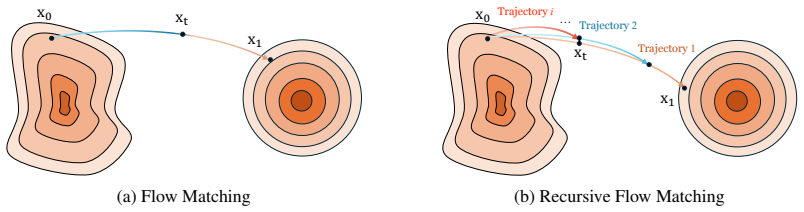
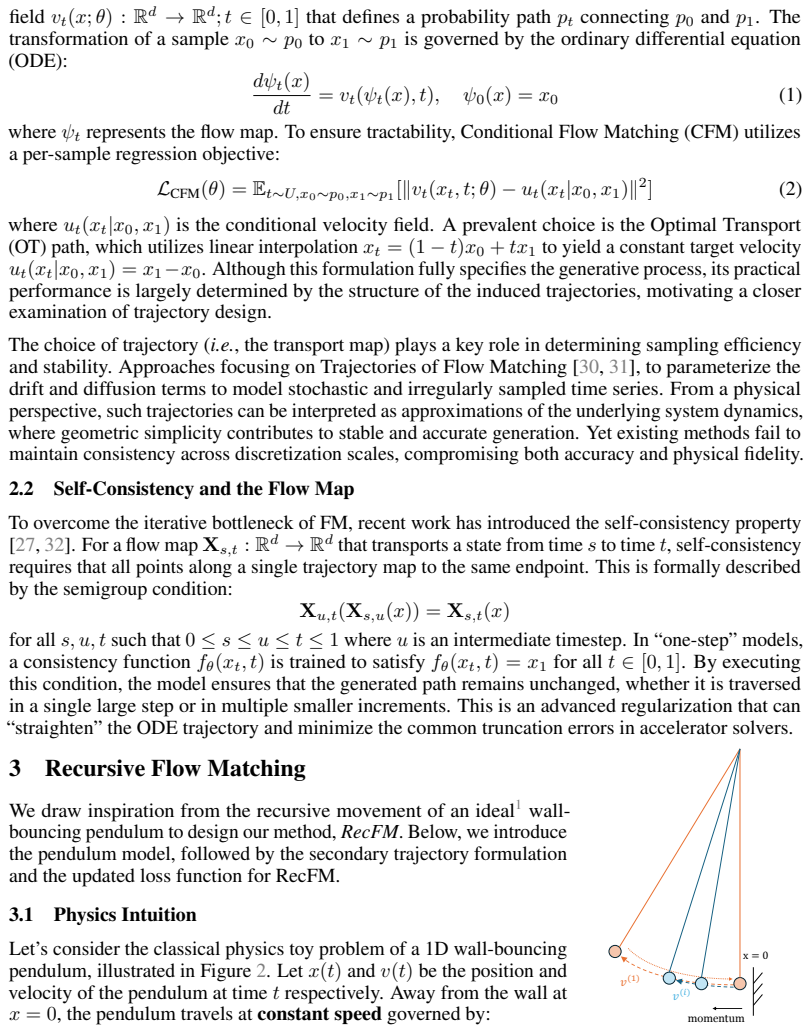
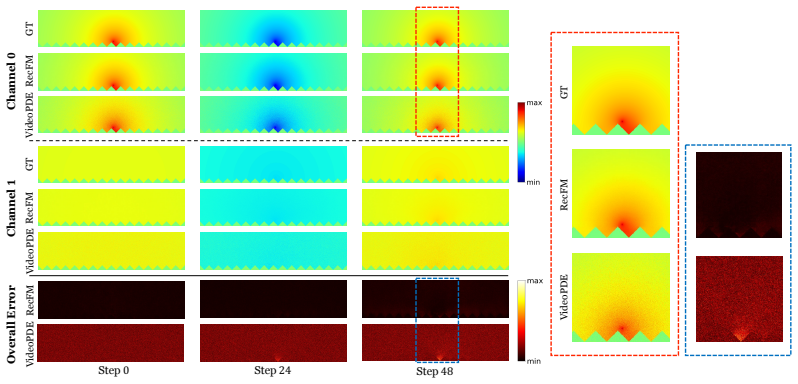
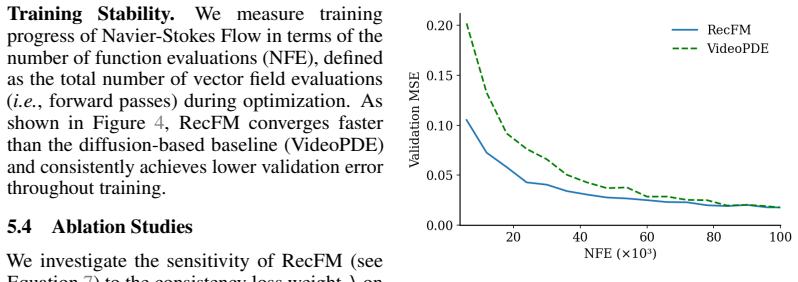
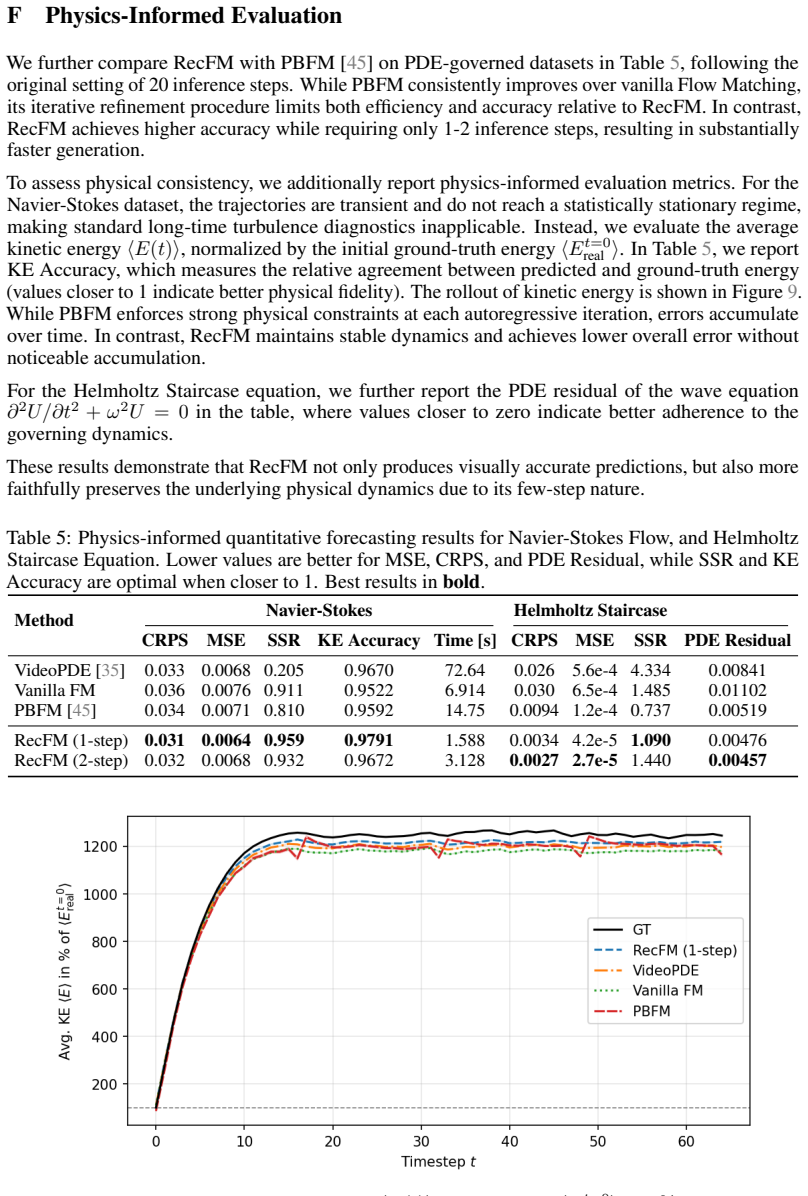
Recursive Flow Matching (RecFM) is a generative framework for forecasting complex spatiotemporal dynamics that enforces self-consistency to align trajectories across discretization scales. This alignment reduces discretization errors and improves performance across metrics for physics-based tasks. The method achieves high-fidelity one- and few-step (2-4 step) dynamic generation for scientific systems with performance comparable to state-of-the-art multi-step solvers, delivering up to a 20× speedup over leading diffusion-based emulators while improving predictive accuracy and reducing mean squared error by over 15% compared to vanilla flow matching.
What carries the argument
Recursive Flow Matching, the mechanism that enforces self-consistency to align trajectories across discretization scales in a flow-based generative model.
If this is right
- Enables high-fidelity one- and few-step (2-4 step) generation for scientific systems that matches multi-step solver performance.
- Delivers up to 20× speedup over diffusion-based emulators on challenging scientific benchmarks.
- Reduces mean squared error by more than 15% relative to vanilla flow matching.
- Offers a scalable path to real-time scientific emulation without sacrificing physical accuracy.
Where Pith is reading between the lines
- The self-consistency idea could be tested in other flow- or diffusion-based models for dynamics to see if similar error reductions occur.
- The method may extend to additional domains such as climate modeling or fluid dynamics where discretization errors are a known bottleneck.
- Further work could examine whether the same alignment principle improves performance at even coarser discretization levels.
Load-bearing premise
Enforcing self-consistency to align trajectories across discretization scales will reduce discretization errors enough to produce the reported accuracy and speed gains on representative scientific tasks.
What would settle it
A controlled test on one of the paper's scientific benchmarks in which RecFM one- or four-step outputs show higher error than a standard multi-step solver or fail to reach the claimed speedup over diffusion emulators.
Figures
read the original abstract
Generative models have emerged as a powerful paradigm for solving physics systems and modeling complex spatiotemporal dynamics. However, achieving high physical accuracy without incurring high computational cost remains a fundamental challenge, as existing approaches face a critical speed-fidelity trade-off. In this work, we introduce Recursive Flow Matching (RecFM), a generative framework for forecasting complex spatiotemporal dynamics. RecFM enforces self-consistency to align trajectories across discretization scales, reducing discretization errors and improving performance across metrics for physics-based tasks. To our knowledge, this is the first method to achieve high-fidelity one- and few-step (2-4 step) dynamic generation for scientific systems with performance comparable to state-of-the-art multi-step solvers. Across challenging scientific benchmarks, RecFM achieves up to a 20$\times$ speedup over leading diffusion-based emulators while improving predictive accuracy. Furthermore, RecFM reduces mean squared error by over 15% compared to vanilla flow matching, offering a scalable and efficient solution for real-time scientific emulation.
Editorial analysis
A structured set of objections, weighed in public.
Referee Report
Summary. The manuscript introduces Recursive Flow Matching (RecFM), a generative framework for forecasting complex spatiotemporal dynamics. It claims that enforcing self-consistency to align trajectories across discretization scales reduces discretization errors, enabling high-fidelity one- and few-step (2-4 step) dynamic generation for scientific systems with performance comparable to state-of-the-art multi-step solvers. Reported results include up to 20× speedup over leading diffusion-based emulators and over 15% MSE reduction versus vanilla flow matching on challenging scientific benchmarks.
Significance. If the self-consistency mechanism is well-defined, mathematically justified, and empirically shown to reduce discretization error without introducing new biases, the work could meaningfully advance real-time scientific emulation by improving the speed-fidelity trade-off in generative models. The claim of being the first method to achieve such few-step performance on scientific tasks would be noteworthy if supported by detailed derivations, algorithms, and controlled experiments. However, the provided abstract supplies no equations, training objectives, or implementation details, preventing assessment of whether the central mechanism is novel or effective.
major comments (2)
- Abstract: the central claim that self-consistency enforcement reduces discretization errors and delivers the reported accuracy/speed gains cannot be evaluated because no mathematical formulation, loss term, algorithm, or pseudocode is supplied for how alignment across discretization scales is achieved or enforced.
- Abstract: without access to the training objective, vector-field parameterization, or benchmark protocols, it is impossible to determine whether the claimed >15% MSE reduction and 20× speedup arise from the self-consistency mechanism, from unmentioned architecture changes, or from benchmark selection.
Simulated Author's Rebuttal
We thank the referee for their review of our manuscript on Recursive Flow Matching. We address the two major comments regarding the abstract below, clarifying that the full manuscript contains the requested mathematical details, algorithms, and experimental protocols.
read point-by-point responses
-
Referee: Abstract: the central claim that self-consistency enforcement reduces discretization errors and delivers the reported accuracy/speed gains cannot be evaluated because no mathematical formulation, loss term, algorithm, or pseudocode is supplied for how alignment across discretization scales is achieved or enforced.
Authors: Abstracts are conventionally kept equation-free for brevity and accessibility. The full manuscript defines the self-consistency mechanism in Section 2, presents the training objective (including the alignment loss across scales) in Section 3.1, and provides the recursive procedure with pseudocode in Algorithm 1. These sections directly support the central claim. revision: no
-
Referee: Abstract: without access to the training objective, vector-field parameterization, or benchmark protocols, it is impossible to determine whether the claimed >15% MSE reduction and 20× speedup arise from the self-consistency mechanism, from unmentioned architecture changes, or from benchmark selection.
Authors: Section 4 contains controlled experiments that isolate the self-consistency component via ablations against vanilla flow matching on identical architectures and benchmarks. The training objective appears in Equation (5), vector-field parameterization in Section 2.3, and full benchmark protocols (datasets, metrics, and evaluation) in Section 4.1. These establish that gains derive from the proposed mechanism. revision: no
Circularity Check
No circularity: claims rest on proposed self-consistency mechanism without reduction to inputs by construction
full rationale
The abstract and provided context introduce RecFM as a generative framework whose core innovation is enforcing self-consistency to align trajectories across discretization scales. No equations, parameter-fitting steps, self-citations, or uniqueness theorems are quoted that would make any performance claim (speedup, MSE reduction) equivalent to the inputs by definition. The derivation chain is therefore self-contained: the method is presented as a novel construction whose benefits are asserted to follow from the (unstated) consistency enforcement rather than from renaming or refitting existing quantities.
Axiom & Free-Parameter Ledger
Reference graph
Works this paper leans on
-
[1]
John Wiley & Sons, 2012
Gouri Dhatt, Emmanuel Lefrançois, and Gilbert Touzot.Finite element method. John Wiley & Sons, 2012
2012
-
[2]
Nektar++: An open-source spectral/hp element framework.Computer physics communications, 192:205–219, 2015
Chris D Cantwell, David Moxey, Andrew Comerford, Alessandro Bolis, Gabriele Rocco, Gianmarco Mengaldo, Daniele De Grazia, Sergey Yakovlev, J-E Lombard, Dirk Ekelschot, et al. Nektar++: An open-source spectral/hp element framework.Computer physics communications, 192:205–219, 2015
2015
-
[3]
Neural operator: Learning maps between function spaces with applications to pdes.Journal of Machine Learning Research, 24(89):1–97, 2023
Nikola Kovachki, Zongyi Li, Burigede Liu, Kamyar Azizzadenesheli, Kaushik Bhattacharya, Andrew Stuart, and Anima Anandkumar. Neural operator: Learning maps between function spaces with applications to pdes.Journal of Machine Learning Research, 24(89):1–97, 2023
2023
-
[4]
Fourier Neural Operator for Parametric Partial Differential Equations
Zongyi Li, Nikola Kovachki, Kamyar Azizzadenesheli, Burigede Liu, Kaushik Bhattacharya, Andrew Stuart, and Anima Anandkumar. Fourier neural operator for parametric partial differen- tial equations.arXiv preprint arXiv:2010.08895, 2020
work page internal anchor Pith review Pith/arXiv arXiv 2010
-
[5]
Learning nonlinear operators via deeponet based on the universal approximation theorem of operators
Lu Lu, Pengzhan Jin, Guofei Pang, Zhongqiang Zhang, and George Em Karniadakis. Learning nonlinear operators via deeponet based on the universal approximation theorem of operators. Nature machine intelligence, 3(3):218–229, 2021
2021
-
[6]
Maziar Raissi, Paris Perdikaris, and George E Karniadakis. Physics-informed neural networks: A deep learning framework for solving forward and inverse problems involving nonlinear partial differential equations.Journal of Computational physics, 378:686–707, 2019
2019
-
[7]
Multifidelity modeling for physics-informed neural networks (pinns).Journal of Computational Physics, 451:110844, 2022
Michael Penwarden, Shandian Zhe, Akil Narayan, and Robert M Kirby. Multifidelity modeling for physics-informed neural networks (pinns).Journal of Computational Physics, 451:110844, 2022
2022
-
[8]
Accurate structure prediction of biomolecular interactions with alphafold 3.Nature, 630(8016):493–500, 2024
Josh Abramson, Jonas Adler, Jack Dunger, Richard Evans, Tim Green, Alexander Pritzel, Olaf Ronneberger, Lindsay Willmore, Andrew J Ballard, Joshua Bambrick, et al. Accurate structure prediction of biomolecular interactions with alphafold 3.Nature, 630(8016):493–500, 2024
2024
-
[9]
Simul- taneous modeling of protein conformation and dynamics via autoregression
Yuning Shen, Lihao Wang, Huizhuo Yuan, Yan Wang, Bangji Yang, and Quanquan Gu. Simul- taneous modeling of protein conformation and dynamics via autoregression. InThe Thirty-ninth Annual Conference on Neural Information Processing Systems, 2025
2025
-
[10]
A generative model for inorganic materials design.Nature, 639(8055):624–632, 2025
Claudio Zeni, Robert Pinsler, Daniel Zügner, Andrew Fowler, Matthew Horton, Xiang Fu, Zilong Wang, Aliaksandra Shysheya, Jonathan Crabbé, Shoko Ueda, et al. A generative model for inorganic materials design.Nature, 639(8055):624–632, 2025
2025
-
[11]
James PC Duncan, Elynn Wu, Surya Dheeshjith, Adam Subel, Troy Arcomano, Spencer K Clark, Brian Henn, Anna Kwa, Jeremy McGibbon, W Andre Perkins, et al. Samudrace: Fast and accurate coupled climate modeling with 3d ocean and atmosphere emulators.arXiv preprint arXiv:2509.12490, 2025
-
[12]
Ace2: accurately learning sub- seasonal to decadal atmospheric variability and forced responses.npj Climate and Atmospheric Science, 8(1):205, 2025
Oliver Watt-Meyer, Brian Henn, Jeremy McGibbon, Spencer K Clark, Anna Kwa, W Andre Perkins, Elynn Wu, Lucas Harris, and Christopher S Bretherton. Ace2: accurately learning sub- seasonal to decadal atmospheric variability and forced responses.npj Climate and Atmospheric Science, 8(1):205, 2025
2025
-
[13]
Salva Rühling Cachay, Miika Aittala, Karsten Kreis, Noah Brenowitz, Arash Vahdat, Morteza Mardani, and Rose Yu. Elucidated rolling diffusion models for probabilistic forecasting of complex dynamics.arXiv preprint arXiv:2506.20024, 2025
-
[14]
Diffusionpde: Generative pde-solving under partial observation.Advances in Neural Information Processing Systems, 37:130291–130323, 2024
Jiahe Huang, Guandao Yang, Zichen Wang, and Jeong Joon Park. Diffusionpde: Generative pde-solving under partial observation.Advances in Neural Information Processing Systems, 37:130291–130323, 2024
2024
-
[15]
Dyffusion: A dynamics-informed diffusion model for spatiotemporal forecasting.Advances in neural information processing systems, 36:45259–45287, 2023
Salva Rühling Cachay, Bo Zhao, Hailey Joren, and Rose Yu. Dyffusion: A dynamics-informed diffusion model for spatiotemporal forecasting.Advances in neural information processing systems, 36:45259–45287, 2023. 10
2023
-
[16]
Yilin Zhuang, Sibo Cheng, and Karthik Duraisamy. Spatially-aware diffusion models with cross-attention for global field reconstruction with sparse observations.Computer Methods in Applied Mechanics and Engineering, 435:117623, 2025
2025
-
[17]
Denoising diffusion probabilistic models.Advances in neural information processing systems, 33:6840–6851, 2020
Jonathan Ho, Ajay Jain, and Pieter Abbeel. Denoising diffusion probabilistic models.Advances in neural information processing systems, 33:6840–6851, 2020
2020
-
[18]
Elucidating the design space of diffusion-based generative models.Advances in neural information processing systems, 35:26565–26577, 2022
Tero Karras, Miika Aittala, Timo Aila, and Samuli Laine. Elucidating the design space of diffusion-based generative models.Advances in neural information processing systems, 35:26565–26577, 2022
2022
-
[19]
Denoising Diffusion Implicit Models
Jiaming Song, Chenlin Meng, and Stefano Ermon. Denoising diffusion implicit models.arXiv preprint arXiv:2010.02502, 2020
work page internal anchor Pith review Pith/arXiv arXiv 2010
-
[20]
Improved denoising diffusion probabilistic models
Alexander Quinn Nichol and Prafulla Dhariwal. Improved denoising diffusion probabilistic models. InInternational conference on machine learning, pages 8162–8171. PMLR, 2021
2021
-
[21]
Riemannian continuous normalizing flows.Advances in neural information processing systems, 33:2503–2515, 2020
Emile Mathieu and Maximilian Nickel. Riemannian continuous normalizing flows.Advances in neural information processing systems, 33:2503–2515, 2020
2020
-
[22]
arXiv preprint arXiv:2302.03660 , year=
Ricky TQ Chen and Yaron Lipman. Flow matching on general geometries.arXiv preprint arXiv:2302.03660, 2023
-
[23]
Mean Flows for One-step Generative Modeling
Zhengyang Geng, Mingyang Deng, Xingjian Bai, J Zico Kolter, and Kaiming He. Mean flows for one-step generative modeling.arXiv preprint arXiv:2505.13447, 2025
work page internal anchor Pith review Pith/arXiv arXiv 2025
-
[24]
Flow Matching for Generative Modeling
Yaron Lipman, Ricky TQ Chen, Heli Ben-Hamu, Maximilian Nickel, and Matt Le. Flow matching for generative modeling.arXiv preprint arXiv:2210.02747, 2022
work page internal anchor Pith review Pith/arXiv arXiv 2022
-
[25]
Jan Tauberschmidt, Sophie Fellenz, Sebastian J V ollmer, and Andrew B Duncan. Physics- constrained fine-tuning of flow-matching models for generation and inverse problems.arXiv preprint arXiv:2508.09156, 2025
-
[26]
Cyclenet: Rethinking cycle consistency in text-guided diffusion for image manipulation.Advances in Neural Information Processing Systems, 36:10359–10384, 2023
Sihan Xu, Ziqiao Ma, Yidong Huang, Honglak Lee, and Joyce Chai. Cyclenet: Rethinking cycle consistency in text-guided diffusion for image manipulation.Advances in Neural Information Processing Systems, 36:10359–10384, 2023
2023
-
[27]
One Step Diffusion via Shortcut Models
Kevin Frans, Danijar Hafner, Sergey Levine, and Pieter Abbeel. One step diffusion via shortcut models.arXiv preprint arXiv:2410.12557, 2024
work page internal anchor Pith review Pith/arXiv arXiv 2024
-
[28]
Yanke Song, Jonathan Lorraine, Weili Nie, Karsten Kreis, and James Lucas. Multi-student diffusion distillation for better one-step generators.arXiv preprint arXiv:2410.23274, 2024
-
[29]
On understanding and overcoming spectral biases of deep neural network learning methods for solving pdes.Journal of Computational Physics, 530:113905, 2025
Zhi-Qin John Xu, Lulu Zhang, and Wei Cai. On understanding and overcoming spectral biases of deep neural network learning methods for solving pdes.Journal of Computational Physics, 530:113905, 2025
2025
-
[30]
Trajectory flow matching with applications to clinical time series modelling
Xi Zhang, Yuan Pu, Yuki Kawamura, Andrew Loza, Yoshua Bengio, Dennis L Shung, and Alexander Tong. Trajectory flow matching with applications to clinical time series modelling. Advances in Neural Information Processing Systems, 37:107198–107224, 2024
2024
-
[31]
arXiv preprint arXiv:2510.03569 , year=
Mohammad Mohaiminul Islam, Thijs P Kuipers, Sharvaree Vadgama, Coen de Vente, Afsana Khan, Clara I Sánchez, and Erik J Bekkers. Longitudinal flow matching for trajectory modeling. arXiv preprint arXiv:2510.03569, 2025
-
[32]
Inversion-free image editing with natural language.arXiv preprint arXiv:2312.04965, 2023
Sihan Xu, Yidong Huang, Jiayi Pan, Ziqiao Ma, and Joyce Chai. Inversion-free image editing with natural language.arXiv preprint arXiv:2312.04965, 2023
-
[33]
Space-time continuous pde forecasting using equivariant neural fields.Advances in Neural Information Processing Systems, 37:76553–76577, 2024
David M Knigge, David R Wessels, Riccardo Valperga, Samuele Papa, Jan-Jakob Sonke, Efstratios Gavves, and Erik J Bekkers. Space-time continuous pde forecasting using equivariant neural fields.Advances in Neural Information Processing Systems, 37:76553–76577, 2024
2024
-
[34]
Jiachen Yao, Abbas Mammadov, Julius Berner, Gavin Kerrigan, Jong Chul Ye, Kamyar Az- izzadenesheli, and Anima Anandkumar. Guided diffusion sampling on function spaces with applications to pdes.arXiv preprint arXiv:2505.17004, 2025. 11
-
[35]
Edward Li, Zichen Wang, Jiahe Huang, and Jeong Joon Park. Videopde: Unified generative pde solving via video inpainting diffusion models.arXiv preprint arXiv:2506.13754, 2025
-
[36]
Mcvd-masked conditional video dif- fusion for prediction, generation, and interpolation.Advances in neural information processing systems, 35:23371–23385, 2022
Vikram V oleti, Alexia Jolicoeur-Martineau, and Chris Pal. Mcvd-masked conditional video dif- fusion for prediction, generation, and interpolation.Advances in neural information processing systems, 35:23371–23385, 2022
2022
-
[37]
WIND: Weather Inverse Diffusion for Zero-Shot Atmospheric Modeling
Michael Aich, Andreas Fürst, Florian Sestak, Carlos Ruiz-Gonzalez, Niklas Boers, and Johannes Brandstetter. Wind: Weather inverse diffusion for zero-shot atmospheric modeling.arXiv preprint arXiv:2602.03924, 2026
work page internal anchor Pith review Pith/arXiv arXiv 2026
-
[38]
The well: a large-scale collection of diverse physics simulations for machine learning.Advances in Neural Information Processing Systems, 37:44989–45037, 2024
Ruben Ohana, Michael McCabe, Lucas Meyer, Rudy Morel, Fruzsina J Agocs, Miguel Beneitez, Marsha Berger, Blakesley Burkhart, Stuart B Dalziel, Drummond B Fielding, et al. The well: a large-scale collection of diverse physics simulations for machine learning.Advances in Neural Information Processing Systems, 37:44989–45037, 2024
2024
-
[39]
Rolling diffusion models.arXiv preprint arXiv:2402.09470, 2024
David Ruhe, Jonathan Heek, Tim Salimans, and Emiel Hoogeboom. Rolling diffusion models. arXiv preprint arXiv:2402.09470, 2024
-
[40]
Ar-diffusion: Auto-regressive diffusion model for text generation.Advances in Neural Information Processing Systems, 36:39957–39974, 2023
Tong Wu, Zhihao Fan, Xiao Liu, Hai-Tao Zheng, Yeyun Gong, Jian Jiao, Juntao Li, Jian Guo, Nan Duan, Weizhu Chen, et al. Ar-diffusion: Auto-regressive diffusion model for text generation.Advances in Neural Information Processing Systems, 36:39957–39974, 2023
2023
-
[41]
Sharvaree Vadgama, Mohammad Mohaiminul Islam, Domas Buracas, Christian Shewmake, Artem Moskalev, and Erik Bekkers. Probing equivariance and symmetry breaking in convolu- tional networks.arXiv preprint arXiv:2501.01999, 2025
-
[42]
Flow Straight and Fast: Learning to Generate and Transfer Data with Rectified Flow
Xingchao Liu, Chengyue Gong, and Qiang Liu. Flow straight and fast: Learning to generate and transfer data with rectified flow.arXiv preprint arXiv:2209.03003, 2022
work page internal anchor Pith review Pith/arXiv arXiv 2022
-
[43]
Generative Modeling via Drifting
Mingyang Deng, He Li, Tianhong Li, Yilun Du, and Kaiming He. Generative modeling via drifting.arXiv preprint arXiv:2602.04770, 2026
work page internal anchor Pith review Pith/arXiv arXiv 2026
-
[44]
Oscar Davis, Michael S Albergo, Nicholas M Boffi, Michael M Bronstein, and Avishek Joey Bose. Generalised flow maps for few-step generative modelling on riemannian manifolds.arXiv preprint arXiv:2510.21608, 2025
-
[45]
Physics vs distributions: Pareto optimal flow matching with physics constraints
Giacomo Baldan, Qiang Liu, Alberto Guardone, and Nils Thuerey. Physics vs distributions: Pareto optimal flow matching with physics constraints. InThe Fourteenth International Confer- ence on Learning Representations, 2026
2026
-
[46]
Improvements of the daily optimum interpolation sea surface temperature (doisst) version 2.1.Journal of Climate, 34(8):2923–2939, 2021
Boyin Huang, Chunying Liu, Viva Banzon, Eric Freeman, Garrett Graham, Bill Hankins, Tom Smith, and Huai-Min Zhang. Improvements of the daily optimum interpolation sea surface temperature (doisst) version 2.1.Journal of Climate, 34(8):2923–2939, 2021
2021
-
[47]
An extensible benchmark suite for learning to simulate physical systems
Karl Otness, Arvi Gjoka, Joan Bruna, Daniele Panozzo, Benjamin Peherstorfer, Teseo Schneider, and Denis Zorin. An extensible benchmark suite for learning to simulate physical systems. arXiv preprint arXiv:2108.07799, 2021
-
[48]
Scoring rules for continuous probability distributions
James E Matheson and Robert L Winkler. Scoring rules for continuous probability distributions. Management science, 22(10):1087–1096, 1976
1976
-
[49]
Error bounds for flow matching methods
Joe Benton, George Deligiannidis, and Arnaud Doucet. Error bounds for flow matching methods. Transactions on Machine Learning Research, 2024
2024
-
[50]
Imagenet: A large- scale hierarchical image database
Jia Deng, Wei Dong, Richard Socher, Li-Jia Li, Kai Li, and Li Fei-Fei. Imagenet: A large- scale hierarchical image database. In2009 IEEE conference on computer vision and pattern recognition, pages 248–255. Ieee, 2009
2009
-
[51]
Scalable diffusion models with transformers
William Peebles and Saining Xie. Scalable diffusion models with transformers. InProceedings of the IEEE/CVF international conference on computer vision, pages 4195–4205, 2023
2023
-
[52]
Sit: Exploring flow and diffusion-based generative models with scalable interpolant transformers
Nanye Ma, Mark Goldstein, Michael S Albergo, Nicholas M Boffi, Eric Vanden-Eijnden, and Saining Xie. Sit: Exploring flow and diffusion-based generative models with scalable interpolant transformers. InEuropean Conference on Computer Vision, pages 23–40. Springer, 2024. 12
2024
-
[53]
Diffusion models beat gans on image synthesis
Prafulla Dhariwal and Alexander Nichol. Diffusion models beat gans on image synthesis. Advances in neural information processing systems, 34:8780–8794, 2021
2021
-
[54]
High- resolution image synthesis with latent diffusion models
Robin Rombach, Andreas Blattmann, Dominik Lorenz, Patrick Esser, and Björn Ommer. High- resolution image synthesis with latent diffusion models. InProceedings of the IEEE/CVF conference on computer vision and pattern recognition, pages 10684–10695, 2022. 13 A Dataset Details In this section, we provide the formal governing equations and technical implemen...
discussion (0)
Sign in with ORCID, Apple, or X to comment. Anyone can read and Pith papers without signing in.