Near-Infrared-Triggered Photodynamic Antibacterial Therapy Using Rose Bengal-Coated Upconverting Nanoparticles
Pith reviewed 2026-06-29 17:26 UTC · model grok-4.3
The pith
Rose Bengal-coated upconverting nanoparticles convert near-infrared light into visible wavelengths to generate singlet oxygen and kill MRSA.
A machine-rendered reading of the paper's core claim, the machinery that carries it, and where it could break.
Core claim
LaF3:Er3+,Yb3+ upconverting nanoparticles coated with Rose Bengal produce singlet oxygen under near-infrared irradiation through efficient energy transfer, resulting in significant photo-bactericidal activity against MRSA.
What carries the argument
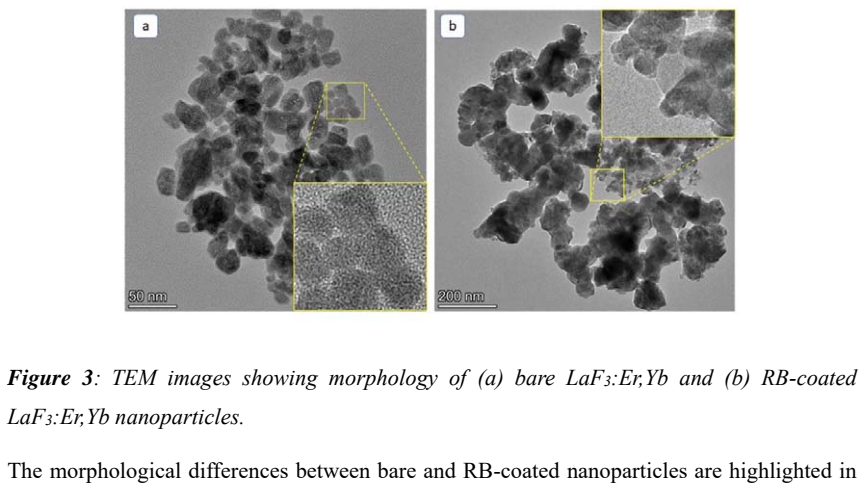
Rose Bengal-coated LaF3:Er3+,Yb3+ upconverting nanoparticles that convert NIR light to visible wavelengths for photosensitizer activation.
Load-bearing premise
The Rose Bengal coating maintains efficient upconversion and energy transfer without quenching or particle aggregation under biological conditions.
What would settle it
No measurable singlet oxygen production or no reduction in MRSA colony counts when the coated nanoparticles are exposed to NIR light in the reported in vitro setup.
Figures
read the original abstract
Antimicrobial photodynamic therapy (aPDT) is a promising modality for inactivation of antibiotic resistant bacteria, relying on the activation of a photosensitizer (PS) by light of a specific wavelength. This process results in the formation of reactive oxygen species, which ultimately induce cell death. However, aPDT in its conventional form, is limited by the shallow penetration of visible light, restricting its effectiveness for treatment of soft tissue and orthopaedic tissues. To overcome this limitation, near-infrared (NIR) absorbing PS can be used. However, poor stability in vivo after injection, ineffective microbial targeting due to hydrophilic nature and off-site tissue damage are the issues with use of NIR absorbing bare PSs. This issue can be mitigated by combining NIR light with a upconverting nanoparticles (UCNPs), which mediate in conversion of NIR into visible light for effective PS activation. In this study, LaF$_3$:Er$^{3+}$,Yb$^{3+}$ nanoparticles were synthesized using a hydrothermal method and coated with Rose Bengal (RB), a promising hydrophilic PS for aPDT, to evaluate the potential for NIR-triggered aPDT. Characterization of the synthesized UCNPs confirmed the crystalline structure, size distribution and successful RB functionalization. Photophysical studies demonstrated efficient energy transfer between UCNPs and RB, leading to singlet oxygen ($^1$O$_2$) generation in vitro. Antibacterial studies against Methicilin resistant Staphylococcus aureus (MRSA), a superbug of implicated soft tissue and orthopaedic infections, revealed significant photo-bactericidal efficacy upon NIR irradiation, indicating the potential of RB-coated UCNPs for aPDT applications.
Editorial analysis
A structured set of objections, weighed in public.
Referee Report
Summary. The manuscript describes the hydrothermal synthesis of LaF₃:Er³⁺,Yb³⁺ upconverting nanoparticles (UCNPs) functionalized with Rose Bengal (RB) for NIR-triggered antimicrobial photodynamic therapy (aPDT) against MRSA. It reports successful characterization of crystalline structure, size, and RB attachment, followed by claims of efficient UCNP-to-RB energy transfer, in vitro singlet oxygen generation, and significant photo-bactericidal activity upon 980 nm irradiation.
Significance. If the photophysical and antibacterial results are quantitatively validated with appropriate controls and stability data, the work would address a recognized limitation of conventional aPDT (shallow visible-light penetration) by enabling NIR activation via upconversion, with potential relevance to deep-tissue or orthopaedic infections caused by antibiotic-resistant pathogens. The approach of coating a hydrophilic PS onto UCNPs is a standard strategy, but the manuscript supplies no numerical yields, killing percentages, replicates, or error bars to allow assessment of effect size.
major comments (3)
- [Abstract / Photophysical studies] Abstract and Results (photophysical studies): the claim of 'efficient energy transfer between UCNPs and RB, leading to singlet oxygen (¹O₂) generation in vitro' is presented without any quantitative metrics (e.g., ¹O₂ quantum yield, luminescence quenching percentages, or comparison to free RB or bare UCNPs), controls for direct RB excitation, or statistical analysis, preventing evaluation of whether the observed effect supports the central aPDT claim.
- [Abstract / Antibacterial studies] Abstract and Results (antibacterial studies): 'significant photo-bactericidal efficacy upon NIR irradiation' is stated without colony-forming unit reduction values, dose-response data, dark controls, light-only controls, or replicate numbers, rendering the MRSA-killing result impossible to interpret as evidence for therapeutic potential.
- [Introduction / Results] Introduction and Results: the motivation emphasizes that bare NIR PSs suffer from 'poor stability in vivo' and that UCNP coating is intended to mitigate this, yet no data are provided on RB-UCNP stability in physiological media (zeta potential, hydrodynamic diameter in PBS/serum, luminescence retention after 24 h at 37 °C, or RB desorption), which directly undermines the applicability claim for soft-tissue and orthopaedic infections.
minor comments (2)
- [Abstract] Abstract: 'Methicilin' is misspelled; should be 'Methicillin'.
- [Abstract] Abstract: the phrase 'a superbug of implicated soft tissue and orthopaedic infections' is grammatically unclear; rephrase for precision.
Simulated Author's Rebuttal
We thank the referee for the constructive feedback aimed at improving the rigor of our manuscript. We address each major comment below and will revise the manuscript to incorporate quantitative data, controls, and stability assessments where feasible.
read point-by-point responses
-
Referee: [Abstract / Photophysical studies] Abstract and Results (photophysical studies): the claim of 'efficient energy transfer between UCNPs and RB, leading to singlet oxygen (¹O₂) generation in vitro' is presented without any quantitative metrics (e.g., ¹O₂ quantum yield, luminescence quenching percentages, or comparison to free RB or bare UCNPs), controls for direct RB excitation, or statistical analysis, preventing evaluation of whether the observed effect supports the central aPDT claim.
Authors: We agree that quantitative metrics are needed to substantiate the photophysical claims. In the revised manuscript we will add singlet oxygen quantum yield values, luminescence quenching percentages with comparisons to free RB and bare UCNPs, explicit controls for direct RB excitation at 980 nm, and statistical analysis of the data. revision: yes
-
Referee: [Abstract / Antibacterial studies] Abstract and Results (antibacterial studies): 'significant photo-bactericidal efficacy upon NIR irradiation' is stated without colony-forming unit reduction values, dose-response data, dark controls, light-only controls, or replicate numbers, rendering the MRSA-killing result impossible to interpret as evidence for therapeutic potential.
Authors: We acknowledge the absence of numerical effect sizes and controls in the current version. The revised manuscript will include specific CFU reduction percentages with error bars, dose-response information, descriptions of dark and light-only controls, and the number of biological replicates to allow proper evaluation of the antibacterial efficacy. revision: yes
-
Referee: [Introduction / Results] Introduction and Results: the motivation emphasizes that bare NIR PSs suffer from 'poor stability in vivo' and that UCNP coating is intended to mitigate this, yet no data are provided on RB-UCNP stability in physiological media (zeta potential, hydrodynamic diameter in PBS/serum, luminescence retention after 24 h at 37 °C, or RB desorption), which directly undermines the applicability claim for soft-tissue and orthopaedic infections.
Authors: The referee is correct that stability data are required to support the in vivo applicability claims. We will add measurements of zeta potential, hydrodynamic diameter in PBS and serum, and RB retention after 24 h incubation at 37 °C in the revised Results section. revision: yes
Circularity Check
No circularity: purely experimental observations with no derivations or fitted parameters
full rationale
The paper reports synthesis of LaF3:Er3+,Yb3+ UCNPs, RB coating, characterization (crystalline structure, size, functionalization), photophysical measurements of energy transfer and 1O2 generation, and antibacterial efficacy against MRSA under NIR. No equations, models, parameters fitted to data, or derivation chains appear. Claims rest on direct experimental results rather than any self-referential construction. No load-bearing self-citations or ansatzes are invoked. This is the normal case of an experimental materials paper with score 0.
Axiom & Free-Parameter Ledger
axioms (1)
- domain assumption Hydrothermal synthesis yields crystalline LaF3:Er3+,Yb3+ nanoparticles capable of upconversion
Reference graph
Works this paper leans on
-
[1]
X. Li, J.F. Lovell, J. Yoon, X. Chen, Clinical development and potenƟal of photothermal and photodynamic therapies for cancer, Nat Rev Clin Oncol 17 (2020) 657–674. hƩps://doi.org/10.1038/s41571-020-0410-2
-
[2]
N. Alvarez, A. Sevilla, Current Advances in Photodynamic Th erapy (PDT) and the Future PotenƟal of PDT-Combinatorial Cancer Therapies, Int J Mol Sci 25 (2024) 1023. hƩps://doi.org/10.3390/ijms25021023
-
[3]
J.H. Correia, J.A. Rodrigues, S. Pimenta, T. Dong, Z. Yang, Photodynamic Therapy Review: Principles, PhotosensiƟzers, ApplicaƟons, and Future DirecƟons, PharmaceuƟcs 13 (2021) 1332. hƩps://doi.org/10.3390/pharmaceuƟcs13091332
-
[4]
R.R. Allison, K. Moghissi, P hotodynamic Therapy (PDT): PDT Mechanisms, Clin Endosc 46 (2013) 24. hƩps://doi.org/10.5946/ce.2013.46.1.24
-
[5]
G. Gunaydin, M.E. Gedik, S. A yan, Photodynamic Therapy—Current LimitaƟons and Novel Approaches, Front Chem 9 (2021). hƩps://doi.org/10.3389/fchem.2021.691697
-
[6]
P . Dharmaratne, D.N. Sapugah awaƩe, B. Wang, C.L. Chan, K.-M. Lau, C.B. Lau, K.P . Fung, D.KP . Ng, M. IP , Contemporary approaches and future perspecƟves of anƟbacterial photodynamic therapy (aPDT) against methicillin-resistant Staphylococcus aureus (MRSA): A systemaƟc review, Eur J Med Chem 200 (2020) 112341. hƩps://doi.org/10.1016/j.ejmech.2020.112341
-
[7]
D.L. Sai, J. Lee, D.L. Nguyen, Y .-P . Kim, Tailoring photose nsiƟve ROS for advanced photodynamic therapy, Exp Mol Med 53 (2021) 495–504. hƩps://doi.org/10.1038/s12276-021-00599-7
-
[9]
C.A. del Valle, T. Hirsch, M .J. Marín, Recent advances in near infrared upconverƟng nanomaterials for targeted photodynamic therapy of cancer, Methods Appl Fluoresc 10 (2022) 034003. hƩps://doi.org/10.1088/2050-6120/ac6937
-
[10]
Y . Li, G. Chen, Upconversion NanoparƟcles for Cancer Therapy, Adv Nanobiomed Res 2 (2022). hƩps://doi.org/10.1002/anbr.202200092. 18 | Page
-
[11]
B. Meesaragandla, D. Sarkar, V. Mahalingam, Methylene Blue -Loaded UpconverƟng Hydrogel Nanocomposite: PotenƟal Material for Near-Infrared Light-Triggered Photodynamic Therapy ApplicaƟon, ACS Omega 4 (2019) 3169–3177. hƩps://doi.org/10.1021/acsomega.8b02416
-
[12]
S. Wen, J. Zhou, K. Zheng, A. Bednarkiewicz, X. Liu, D. Jin, Advances in highly doped upconversion nanoparƟcles, Nat Commun 9 (2018) 2415. hƩps://doi.org/10.1038/s41467-018-04813-5
-
[14]
A. Gulzar, J. Xu, P . Yang, F. He, L. Xu, Upconversion processes: versaƟle biological applicaƟons and biosafety, Nanoscale 9 (2017) 12248–12282. hƩps://doi.org/10.1039/C7NR01836C
-
[15]
Y . Yang, S. Jiang, S.G. Stanciu, H. Peng, A. Wu, F. Yang, Photodynamic therapy with NIR- II probes: review on state-of-the-art tools and strategies, Mater Horiz 11 (2024) 5815–
2024
-
[16]
hƩps://doi.org/10.1039/D4MH00819G
-
[17]
K. Malhotra, D. Hrovat, B. Kumar, G. Qu, J. Van Houten, R. Ahmed, P .A.E. Piunno, P .T. Gunning, U.J. Krull, Lanthanide-Doped Upconversion NanoparƟcles: Exploring A Treasure Trove of NIR-Mediated Emerging ApplicaƟons, ACS Appl Mater Interfaces 15 (2023) 2499–2528. hƩps://doi.org/10.1021/acsami.2c12370
-
[18]
Safdar, A
M. Safdar, A. Ghazy, M. Las tusaari, M. Karppinen, Lanthanide-based inorganic–organic hybrid materials for photon-upconversion, J Mater Chem C Mater 8 (2020) 6946–
2020
-
[19]
hƩps://doi.org/10.1039/D0TC01216E
-
[20]
H. Li, Y . Wang, L. Liao, Ne ar-Infrared Luminescent Materials IncorporaƟng Rare Earth/TransiƟon Metal Ions: From Materials to ApplicaƟons, Advanced Materials 36 (2024). hƩps://doi.org/10.1002/adma.202403076
-
[21]
T.M.D. Cao, T.T.G. Le, T.P .N. Nguyen, T.A.N. Dau, V.T. Nguyen, T.T. Van Tran, InvesƟgaƟng the effect of Yb3+ and Er3+ concentraƟon on red/green luminescent raƟo in β-NaYF4: Er, Yb nanocrystals using spectroscopic techniques, J Mol Struct 1210 (2020) 128014. hƩps://doi.org/10.1016/j.molstruc.2020.128014
-
[22]
L.M. Wiesholler, F. Frenzel, B. Grauel, C. Würth, U. Resch-Genger, T. Hirsch, Yb,Nd,Er- doped upconversion nanoparƟcles: 980 nm versus 808 nm excitaƟon, Nanoscale 11 (2019) 13440–13449. hƩps://doi.org/10.1039/C9NR03127H. 19 | Page
-
[23]
F.T. Rabouw, P .T. Prins, P . Villanueva-Delgado, M. Castelijns, R.G. Geitenbeek, A. Meijerink, Quenching Pathways in NaYF 4 :Er 3+ ,Yb 3+ Upconversion Nanocrystals, ACS Nano 12 (2018) 4812–4823. hƩps://doi.org/10.1021/acsnano.8b01545
-
[24]
P . Deshmukh, R.K. Deo, A. Ahlawat, A.A. Khan, R. Singh, A. K. Karnal, S. Satapathy, Spectroscopic invesƟgaƟon of upconversion and downshiŌing properƟes LaF3:Tb3+,Yb3+: A dual mode green emiƩer nanophosphor, J Alloys Compd 859 (2021) 157857. hƩps://doi.org/10.1016/j.jallcom.2020.157857
-
[25]
A. Zalkin, D.H. Templeton, Refinement of the trigonal crystal structure of lanthanum trifluoride with neutron diffracƟon data, Acta Crystallogr B 41 (1985) 91–93. hƩps://doi.org/10.1107/S0108768185001689
-
[26]
P .M. Carvalho, M.R. Felício, N.C. Santos, S. Gonçalves, M. M. Domingues, ApplicaƟon of Light ScaƩering Techniques to NanoparƟcle CharacterizaƟon and Development, Front Chem 6 (2018). hƩps://doi.org/10.3389/fchem.2018.00237
-
[27]
Y . Shi, Q. Chang, T. Zhang, G. Song, Y . Sun, G. Ding, A review on selecƟve dye adsorpƟon by different mechanisms, J Environ Chem Eng 10 (2022) 108639. hƩps://doi.org/10.1016/j.jece.2022.108639
-
[28]
W. Huang, S. Wang, D. Li, P olymers and Polymer Composites for AdsorpƟve Removal of Dyes in Water Treatment, in: Sustainable Polymer Composites and Nanocomposites, Springer InternaƟonal Publishing, Cham, 2019: pp. 519–556. hƩps://doi.org/10.1007/978-3-030-05399-4_19
-
[29]
A. Allabar, M. Nowak, High spaƟal resoluƟon analysis of H2O in silicate glass using aƩenuated total reflecƟon FTIR spectroscopy coupled with a focal plane array detector, Chem Geol 556 (2020) 119833. hƩps://doi.org/10.1016/j.chemgeo.2020.119833
-
[30]
F. HidayanƟ, K.R. Lestari, N. Sujani, J. Raharjo, A Physic al Chemistry Study of Black Powder Materials by SoluƟon CombusƟon Synthesis Method, Biology, Medicine, & Natural Product Chemistry 10 (2021) 93–103. hƩps://doi.org/10.14421/biomedich.2021.102.93-103
-
[31]
Deshmukh, B
P . Deshmukh, B. Sharma, K. Sahu, S. Satapathy, S.K. Majumd er, Exploring the potenƟal of Tb and Bi-doped LaF3 as a UV absorber, Journal of NanoparƟcle Research 26 (2024)
2024
-
[32]
hƩps://doi.org/10.1007/s11051-024-06186-x
-
[33]
W. Fang, Y . Wei, Y . Ye, T. Zhang, D. Xing, Oxyhemoglobin-monitoring photodynamic theranosƟcs with an 808 nm-excited upconversion opƟcal nanoagent, Chemical Engineering Journal 350 (2018) 108–119. hƩps://doi.org/10.1016/j.cej.2018.05.156. 20 | Page
-
[34]
M. Asha Jhonsi, A. Kathiravan, R. Renganathan, Photoinduce d interacƟon between xanthene dyes and colloidal CdS nanoparƟcles, J Mol Struct 921 (2009) 279–284. hƩps://doi.org/10.1016/j.molstruc.2009.01.006
- [35]
-
[36]
P . Soria-Lozano, Y . Gilaberte, M. Paz-Cristobal, L. Pérez-ArƟaga, V. Lampaya-Pérez, J. Aporta, V. Pérez-Laguna, I. García-Luque, M. Revillo, A. Rezusta, In vitro effect photodynamic therapy with differents photosensiƟzers on cariogenic microorganisms, BMC Microbiol 15 (2015) 187. hƩps://doi.org/10.1186/s12866-015-0524-3
-
[37]
G. Tessitore, A.-V. Mudring, K.W. Krämer, Upconversion lum inescence in sub-10 nm β- NaGdF 4 :Yb 3+ ,Er 3+ nanoparƟcles: an improved synthesis in anhydrous ionic liquids, RSC Adv 9 (2019) 34784–34792. hƩps://doi.org/10.1039/C9RA05950D
-
[38]
A.M. Kotulska, A. Pilch-Wróbel, S. LahƟnen, T. Soukka, A. Bednarkiewicz, Upconversion FRET quanƟtaƟon: the role of donor photoexcitaƟon mode and composiƟonal architecture on the decay and intensity based responses, Light Sci Appl 11 (2022) 256. hƩps://doi.org/10.1038/s41377-022-00946-x
-
[39]
J.C. Peterson, E. Arrieta, M. Ruggeri, J.D. Silgado, K.J. Mintz, E.H. Weisson, R.M. Leblanc, I. Kochevar, F. Manns, J.-M. Parel, DetecƟon of singlet oxygen luminescence for experimental corneal rose bengal photodynamic anƟmicrobial therapy, Biomed Opt Express 12 (2021) 272. hƩps://doi.org/10.1364/BOE.405601
-
[40]
A.U. Khan, M. Kasha, Direct spectroscopic observaƟon of si nglet oxygen emission at 1268 nm excited by sensiƟzing dyes of biological interest in liquid soluƟon, Proceedings of the NaƟonal Academy of Sciences 76 (1979) 6047–6049. hƩps://doi.org/10.1073/pnas.76.12.6047
-
[41]
S. Mondal, R.B. Jethwa, B. P ant, R. Hauschild, S.A. Freunberger, Singlet oxygen formaƟon in non-aqueous oxygen redox chemistry: direct spectroscopic evidence for formaƟon pathways and reliability of chemical probes, Faraday Discuss 248 (2024) 175–189. hƩps://doi.org/10.1039/D3FD00088E
-
[42]
Filer, Luminescence en hancement by deuterium, J Labelled Comp Radiopharm 66 (2023) 372–383
C.N. Filer, Luminescence en hancement by deuterium, J Labelled Comp Radiopharm 66 (2023) 372–383. hƩps://doi.org/10.1002/jlcr.4056
discussion (0)
Sign in with ORCID, Apple, or X to comment. Anyone can read and Pith papers without signing in.