Strongly Correlated Electrons · arXiv:2605.26887 v1 · submitted 26 May 2026 · 68 references
Self-Consistent Spectral Quadrature Approach to Many-Body Green Functions
The paper says
“We develop a self-consistent spectral quadrature (sc-SQ) framework for the calculation of many-body Green functions.”
more of the abstract
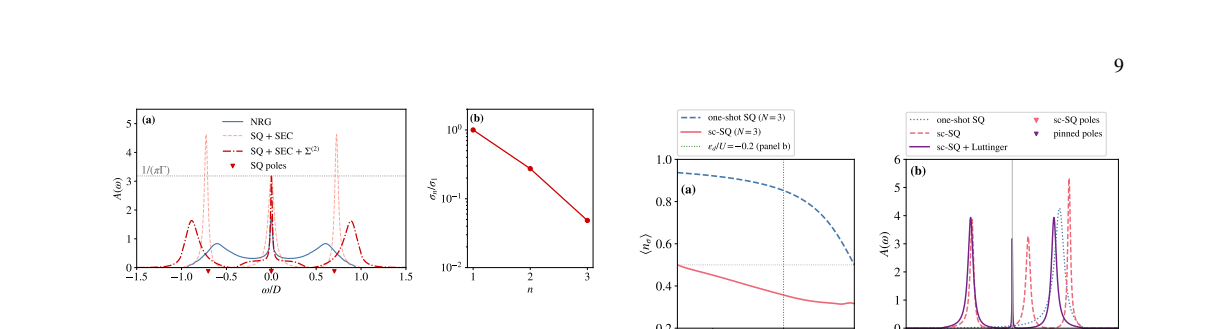
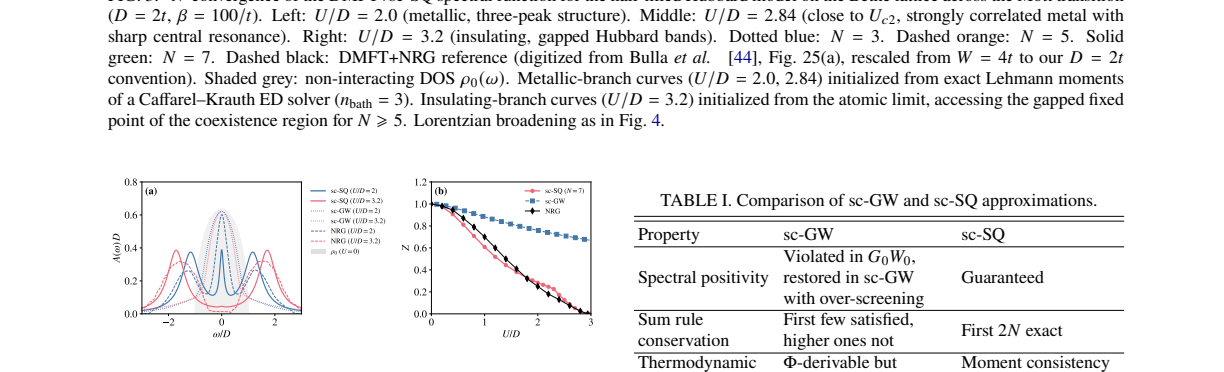
The method approximates the Källén–Lehmann spectral measure by Gauss–Christoffel (GC) quadrature, yielding a rational Green function representation with guaranteed spectral positivity that exactly reproduces the first 2N spectral moments at pole order N. A key component is an SVD-based rank-selection criterion on the Hankel matrix, which identifies the numerically resolvable pole rank N* from the singular-value gap and acts as a precision-guided diagnostic of correlation complexity. The scheme is made self-consistent by requiring that the spectral function used to evaluate expectation values coincides with the spectral function generated by the quadrature reconstruction. This defines a fixed-point hierarchy that connects systematically to established approximations, including Hartree–Fock and Hubbard-I, and incorporates non-perturbative features such as multi-peak spectral structure. We benchmark the approach for the Anderson impurity model against numerical renormalization group (NRG) results and apply it within dynamical mean-field theory for the Hubbard model on the Bethe lattice. The method captures the three-peak Anderson impurity spectrum and the suppression of quasiparticle weight in the half-filled Hubbard model on the Bethe lattice, including Mott-gap formation on the insulating branch for $N\geqslant 5$, in qualitative agreement with NRG references.
from the abstract
Pith says
Machine review · grok-4.3 · 29 Jun 2026 · what was read was not recorded · not checked by a person
It can be wrong. Challenge this review or reply to it.
No verdict was given on this paper.
3 major objections · 1 minor
How often objections from reviews like this one are right: not yet measured
Not checked: figures, code, what the 68 references say.
The paper says, at Abstract
The review did not quote this passage.
Pith says: Objection 1 of 3 · major
Abstract: the claim of capturing Mott-gap formation for N≥5 rests on stated qualitative agreement with NRG, yet no error bars, convergence plots, or explicit demonstration that the fixed-point iteration reaches a stable spectrum are supplied; without these the support for the self-consistent solution cannot be assessed.
The paper says, at Abstract
The review did not quote this passage.
Pith says: Objection 2 of 3 · major
Abstract (SVD rank-selection paragraph): the SVD gap on the Hankel matrix is asserted to identify a numerically resolvable N* that captures all physically relevant poles without truncation error inside the DMFT loop, but no test or argument is given that the gap remains stable or sufficient once the spectral function is updated self-consistently; this is load-bearing for the central claim that the retained poles produce an unbiased fixed point.
The paper says, at Abstract
The review did not quote this passage.
Pith says: Objection 3 of 3 · major
Abstract (self-consistency definition): while the fixed-point condition is clearly stated, the manuscript supplies no separate verification that the iteration converges to the reported spectra rather than to a solution biased by the automatic rank choice or moment truncation at each step.
1 minor objection
The paper says, at Place not named
Pith says: minor objection 1 of 1
Notation for the quadrature weights and poles should be introduced with an explicit equation number on first use to aid readability.
What would settle it
Re-run the half-filled Bethe-lattice DMFT loop at U=4 (metallic) and U=6 (insulating) with the SVD threshold tightened from the paper’s default to 10^{-10}; if the quasiparticle weight or Mott gap changes by >5 % or the selected N* jumps, the rank-selection step controls the reported physics.
from the skeptic's reading
How the review went
5 readings by grok-4.3 · 29 Jun 2026
- Reader no verdict given
- Skeptic agrees
- Editor wrote the review in brief
- Referee major revision: 3 major objections, 1 minor
- Strongest defence (simulated, not the authors)
Pith did not check this review's objections against the paper.
The review in full
The review in brief, machine-written
The paper's main contribution is a self-consistent spectral quadrature framework for many-body Green functions. It approximates the Källén-Lehmann spectral measure using Gauss-Christoffel quadrature to produce a rational Green function that exactly matches the first 2N moments at pole order N, with spectral positivity guaranteed. The SVD on the Hankel matrix selects the pole rank N* from the singular value gap, and self-consistency is enforced by equating the spectral function used in expectation values to the one from the quadrature.
This setup is presented as new, and it does link systematically to Hartree-Fock and Hubbard-I approximations while allowing for multi-peak structures. In the benchmarks, it reproduces the three-peak structure in the Anderson impurity model against NRG and shows Mott gap formation in the half-filled Hubbard model on the Bethe lattice for N at least 5, again in qualitative agreement with NRG.
The method appears to handle the positivity and moment matching cleanly by construction. That said, the evidence is limited to qualitative matches without error bars, convergence data for the fixed-point iteration, or explicit checks that the SVD rank remains appropriate as the spectrum updates inside the DMFT loop. The concern that the singular value gap might not reliably separate relevant poles from noise under iteration seems to have merit based on the description, as no counter-evidence is given in the abstract.
This work is aimed at researchers in condensed matter theory focused on dynamical mean-field theory and impurity models for strongly correlated electrons. Someone looking for new numerical techniques in Green function calculations might find the quadrature approach worth examining in detail.
I think it deserves peer review so that the full numerical validation and any handling of the rank selection stability can be assessed properly.
The strongest objection
The central claim requires that the quadrature at the automatically chosen N* exactly reproduces the first 2N moments while the self-consistency condition (spectral function used for expectation values equals the quadrature reconstruction) closes without systematic bias. The only mechanism that selects N* is the singular-value gap of the Hankel matrix. If that gap does not cleanly separate all physically relevant poles from numerical noise once the spectral function is updated inside the DMFT loop, the retained poles can miss weight that would shift the fixed-point solution, even though each individual quadrature is moment-exact up to its own N. The abstract presents this SVD step as a “precision-guided diagnostic,” but supplies no separate argument that the gap remains stable or sufficient under iteration.
The reader’s weakest_assumption isolates precisely the algorithmic component whose correctness is required for the self-consistent hierarchy and the N≥5 spectral features to be reliable rather than heuristic. No other internal inconsistency is visible from the abstract or the stated strongest claim.
The referee's report
If the fixed-point convergence and SVD rank stability can be rigorously verified, the framework would supply a controllable, positivity-preserving route to rational Green functions that systematically connects perturbative and non-perturbative regimes while exactly matching a prescribed number of moments; this could be valuable for impurity solvers in DMFT and related many-body calculations.
Pith's reading of the paper (a machine's summary, not the authors')
The paper develops a self-consistent spectral quadrature framework for many-body Green functions by approximating the Källén-Lehmann spectral measure with Gauss-Christoffel quadrature. This produces rational representations guaranteed to be positive that reproduce the first 2N moments exactly. An SVD criterion on the Hankel matrix selects the resolvable pole rank from the singular-value gap. Self-consistency is imposed by equating the spectral function used for expectation values with the quadrature output, creating a fixed-point hierarchy. The scheme is benchmarked on the Anderson impurity model against NRG and applied in DMFT to the Hubbard model on the Bethe lattice, where it reproduces the three-peak spectrum and Mott-gap formation for N at least 5.
What carries the argument. Gauss-Christoffel quadrature on the spectral measure together with SVD rank selection on the Hankel matrix to determine the self-consistent pole order N*.
Core claim. The sc-SQ framework approximates the Källén-Lehmann spectral measure by Gauss-Christoffel quadrature, yielding a rational Green function representation with guaranteed spectral positivity that exactly reproduces the first 2N spectral moments at pole order N. An SVD-based rank-selection criterion on the Hankel matrix identifies the numerically resolvable pole rank N* from the singular-value gap. Self-consistency is achieved by requiring that the spectral function used to evaluate expectation values coincides with the quadrature reconstruction, defining a fixed-point hierarchy that connects to Hartree-Fock and Hubbard-I approximations while capturing multi-peak spectral structure and Mott-gap
The premise it rests on. The SVD-based rank-selection criterion on the Hankel matrix reliably identifies the numerically resolvable pole rank such that the retained poles capture all physically relevant spectral features without systematic truncation error in the self-consistent solution.
Strongest defence (simulated, not the authors)
We thank the referee for the careful reading and the specific comments on the need for explicit verification of convergence, stability, and fixed-point properties. We address each point below and will incorporate additional supporting material in a revised manuscript.
-
Referee: [Abstract] Abstract: the claim of capturing Mott-gap formation for N≥5 rests on stated qualitative agreement with NRG, yet no error bars, convergence plots, or explicit demonstration that the fixed-point iteration reaches a stable spectrum are supplied; without these the support for the self-consistent solution cannot be assessed.
Simulated defence: We agree that the abstract's qualitative statement would be strengthened by quantitative diagnostics. The full manuscript shows the spectral functions for N≥5 in the Hubbard DMFT section with visual comparison to NRG, but does not include iteration residuals or error bars. In revision we will add convergence plots of the spectral-function residual versus iteration count and direct numerical comparison of the Mott-gap edges to NRG for the reported cases.
-
Referee: [Abstract] Abstract (SVD rank-selection paragraph): the SVD gap on the Hankel matrix is asserted to identify a numerically resolvable N* that captures all physically relevant poles without truncation error inside the DMFT loop, but no test or argument is given that the gap remains stable or sufficient once the spectral function is updated self-consistently; this is load-bearing for the central claim that the retained poles produce an unbiased fixed point.
Simulated defence: The SVD criterion is reapplied at every DMFT iteration using the current spectral function. While stability was observed in the Anderson benchmarks, the manuscript does not explicitly track the gap across Hubbard iterations. We will add a supplementary panel or table showing the singular-value spectra and chosen N* for successive iterations in the half-filled Hubbard case to confirm that the gap remains decisive and the selected rank is consistent.
-
Referee: [Abstract] Abstract (self-consistency definition): while the fixed-point condition is clearly stated, the manuscript supplies no separate verification that the iteration converges to the reported spectra rather than to a solution biased by the automatic rank choice or moment truncation at each step.
Simulated defence: The reported spectra are those obtained after the input and output spectral functions agree to within the chosen tolerance. The manuscript does not display the residual history or an explicit check against rank-induced bias. In revision we will include a plot of the L2 residual between successive iterates together with a statement that the final spectra reproduce the input moments to machine precision, thereby confirming that the fixed point is reached independently of the intermediate rank selections.
Check this review
Pith stored no record of this review's passes and took no fingerprint of it. Reviews made by code from 13 Nov 2026 on carry both.
How often reviews like this one are right
Reviews like this one: written by grok-4.3, where what was read was not recorded.
How often objections from reviews like this one are right: not yet measured
Reviews by people
This review was written by a machine. No person has reviewed this paper on Pith yet. A scientist listed on Pith can review it for a fee, and their review is published here whatever it concludes.
The paper
Abstract
We develop a self-consistent spectral quadrature (sc-SQ) framework for the calculation of many-body Green functions. The method approximates the Källén–Lehmann spectral measure by Gauss–Christoffel (GC) quadrature, yielding a rational Green function representation with guaranteed spectral positivity that exactly reproduces the first 2N spectral moments at pole order N. A key component is an SVD-based rank-selection criterion on the Hankel matrix, which identifies the numerically resolvable pole rank N* from the singular-value gap and acts as a precision-guided diagnostic of correlation complexity. The scheme is made self-consistent by requiring that the spectral function used to evaluate expectation values coincides with the spectral function generated by the quadrature reconstruction. This defines a fixed-point hierarchy that connects systematically to established approximations, including Hartree–Fock and Hubbard-I, and incorporates non-perturbative features such as multi-peak spectral structure. We benchmark the approach for the Anderson impurity model against numerical renormalization group (NRG) results and apply it within dynamical mean-field theory for the Hubbard model on the Bethe lattice. The method captures the three-peak Anderson impurity spectrum and the suppression of quasiparticle weight in the half-filled Hubbard model on the Bethe lattice, including Mott-gap formation on the insulating branch for $N\geqslant 5$, in qualitative agreement with NRG references.
The paper's own sentences, arranged, kept beside the review and separate from it. Each label is drawn from a closed vocabulary; the number beside it is the probability the classifier gave that label. No sentence in this record was written by a model.
abstract compiled · 2026-09-23
The authors' main claim, as the classifier picked it out 0.98
“The method captures the three-peak Anderson impurity spectrum and the suppression of quasiparticle weight in the half-filled Hubbard model on the Bethe lattice, including Mott-gap formation on the insulating branch for $N\geqslant 5$, in qualitative agreement with NRG references.”
How the main claim is stated: asserted 0.93
What the abstract itself states, as probabilities: claims first 0.04 · states limitation 0.22 · human participants 0.01 · controlled comparison 0.37 · randomized assignment 0.01 · states quantitative result 0.79 · compares with prior results 0.97 · mentions code or data availability 0.02
The abstract, sentence by sentence
This table labels the abstract only (arXiv listing abstract v1). The number is the probability the classifier gave the label.
| Sentence | Role | The authors' own work | States the main conclusion | Strength |
|---|---|---|---|---|
| We develop a self-consistent spectral quadrature (sc-SQ) framework for the calculation of many-body Green functions. | contribution 0.99 | 0.96 | 0.09 | asserted 1.00 |
| The method approximates the K\"all\'en--Lehmann spectral measure by Gauss--Christoffel (GC) quadrature, yielding a rational Green function representation with guaranteed spectral positivity that exactly reproduces the first $2N$ spectral moments at pole order $N$. | method 0.96 | 0.89 | 0.18 | asserted 1.00 |
| A key component is an SVD-based rank-selection criterion on the Hankel matrix, which identifies the numerically resolvable pole rank $N^*$ from the singular-value gap and acts as a precision-guided diagnostic of correlation complexity. | method 0.93 | 0.90 | 0.08 | asserted 1.00 |
| The scheme is made self-consistent by requiring that the spectral function used to evaluate expectation values coincides with the spectral function generated by the quadrature reconstruction. | method 0.97 | 0.88 | 0.07 | asserted 1.00 |
| This defines a fixed-point hierarchy that connects systematically to established approximations, including Hartree--Fock and Hubbard-I, and incorporates non-perturbative features such as multi-peak spectral structure. | method 0.58 | 0.78 | 0.10 | asserted 1.00 |
| We benchmark the approach for the Anderson impurity model against numerical renormalization group (NRG) results and apply it within dynamical mean-field theory for the Hubbard model on the Bethe lattice. | method 0.61 | 0.96 | 0.07 | asserted 0.98 |
| The method captures the three-peak Anderson impurity spectrum and the suppression of quasiparticle weight in the half-filled Hubbard model on the Bethe lattice, including Mott-gap formation on the insulating branch for $N\geqslant 5$, in qualitative agreement with NRG references. | result 0.99 | 0.95 | 0.56 | asserted 0.93 |
What kind of paper the classifier reports this is: method or tool 1.00 · evidence from simulation or computation 0.99
What was examined, and what was not
Sources read
- arXiv listing abstract v1
Not examined
- full text
- figures and tables
- references and citing sentences
- relations to other papers
Levels run
- P abstract
Not run
- S sections
- T body sentences
- C citations
- R cross-paper relations
How the labels were made
Compiled by classifier-1.13.0 via TypeSafe API, question bank abstract-p1-20260923, 2026-09-23: 1 request, 5,905 input tokens.
Every quoted sentence on this record is the authors'. Every label is from Pith's closed vocabulary, with the probability shown beside it. This record as JSON
Figures (4)
Showing 2 of the paper's 4 figures. Figures are the authors', reproduced from the paper.
References (68)
- [1] and equivalent to a Caldeira–Leggett model [21] whose arXiv:2605.26887v1 [cond-mat.str-el] 26 May 2026 2 bath frequencies and couplings are the Lanczos coefficients. Despite the completeness of this formal picture, these con- nections have not been assembled explicitly in the ... on PithPith's reviewarXiv
- [2] Evaluate all required expectation values via Eq. (16) on Pith
- [3] Recompute the input parameters of the quadrature rule from the updated expectation values via the initializa- tion route of Sec. II (power moments, direct Lanczos, or- thogonal polynomial expansion, or Green function sam- pling), and formL (ℓ+1) 𝑁 on Pith
- [4] Apply the SVD criterion (14) to the appropriate input matrix (Hankel, Gram, Cauchy, or Laplace, depending on the initialization route) to determine𝑁 ∗(ℓ+1) on Pith
- [5] DiagonalizeL (ℓ+1) 𝑁 ∗(ℓ+1) to obtain{𝜖 (ℓ+1) 𝑖 , 𝑤(ℓ+1) 𝑖 }. Convergence criterion.The computational process is con- sidered converged when max 𝑛 𝜇 (ℓ+1) 𝑛 −𝜇 (ℓ) 𝑛 𝜇 (ℓ) 𝑛 < 𝛿,(17) with𝛿=10 −8 in practice. The zeroth moment𝜇 0 =1 is exact by the anticom- mutation relations a... on Pith
- [6] Given the bath Green functionG 0 (𝑧), compute the hy- bridization functionΔ(𝜔)and the local moments𝜇 𝑛 of the impurity Green function from the equations of motion with the current bath on Pith
- [7] Run the sc-SQ iteration (Sec. IV B) to convergence, ob- taining the local Green function𝐺 (𝑁) loc (𝑧)and the self- energyΣ(𝑧)=G −1 0 (𝑧) −𝐺 −1 loc (𝑧) on Pith
- [8] Update the bath via the Bethe lattice self-consistency conditionG −1 0 (𝑧)=𝑧+𝜇−𝑡 2𝐺loc(𝑧)and return to step 1. For the benchmarks reported here we run the outer DMFT loop to a tolerance of 10−6 on the local Green function (typically 20– 50 iterations) with the inner sc-SQ loop... on Pith
- [9] G. D. Mahan,Many-Particle Physics, 3rd ed. (Kluwer Aca- demic/Plenum Publishers, 2000) on Pith
- [10] R. D. Mattuck,A Guide to Feynman Diagrams in the many-body problem(Dover, 1992) on Pith
- [11] F. Aryasetiawan and O. Gunnarsson, The𝐺𝑊method, Rep. Prog. Phys.61, 237 (1998) on Pith
- [12] M. Imada, A. Fujimori, and Y. Tokura, Metal-insulator transi- tions, Rev. Mod. Phys.70, 1039 (1998) on Pith
- [13] A. Georges, L. d. Medici, and J. Mravlje, Strong correlations from Hund’s coupling, Annual Review of Condensed Matter Physics4, 137 (2013) on Pith
- [14] G. A. Baker,Essentials of Pad ´e Approximants(Academic Press, 1975) on Pith
- [15] G. A. Baker and P. Graves-Morris,Pad ´e Approximants(Cam- bridge University Press, Cambridge, 1996) on Pith
- [16] H. J. Vidberg and J. W. Serene, Solving the Eliashberg equations by means of𝑁-point Pad ´e approximants, J. Low Temp. Phys. 29, 179–192 (1977) on Pith
- [17] K. S. D. Beach, R. J. Gooding, and F. Marsiglio, Reliable Pad ´e analytical continuation method based on a high-accuracy sym- bolic computation algorithm, Phys. Rev. B61, 5147 (2000) on Pith
- [18] J. Sch ¨ott, I. L. M. Locht, E. Lundin, O. Gr ˚an¨as, O. Eriksson, and I. Di Marco, Analytic continuation by averaging pad ´e ap- proximants, Phys. Rev. B93, 075104 (2016) on Pith
- [19] S. Nakajima, On quantum theory of transport phenomena, Prog. Theor. Phys.20, 948 (1958) on Pith
- [20] H. Mori, Transport, Collective Motion, and Brownian Motion, Prog. Theor. Phys.33, 423–455 (1965) on Pith
show 48 more
- [21] R. Zwanzig, Memory effects in irreversible thermodynamics, Phys. Rev.124, 983 (1961) on Pith
- [22] R. Haydock, V. Heine, and M. J. Kelly, Electronic structure based on the local atomic environment for tight-binding bands, J. Phys. C5, 2845–2858 (1972) on Pith
- [23] R. Haydock, The recursive solution of the schrodinger equation, inSolid State Physics(Elsevier, 1980) p. 215–294 on Pith
- [24] V. S. Viswanath and G. M¨ uller,The Recursion Method: Appli- cation to Many-Body Dynamics(Springer, Berlin, 1994) on Pith
- [25] W. B. Gragg, The Pad´e table and its relation to certain algorithms of numerical analysis, SIAM Rev.14, 1–62 (1972) on Pith
- [26] C. Brezinski,Pad ´e-Type Approximation and General Orthogo- nal Polynomials(Birkh ¨auser, 1980) on Pith
- [27] M. H. Lee, Orthogonalization process by recurrence relations, Phys. Rev. Lett.49, 1072 (1982) on Pith
- [28] H. Grabert, P. Schramm, and G.-L. Ingold, Quantum brownian motion: The functional integral approach, Phys. Rep.168, 115 (1988) on Pith
- [29] A. O. Caldeira and A. J. Leggett, Quantum tunnelling in a dis- sipative system, Ann. Phys.149, 374 (1983) on Pith
- [30] M. Froissart, Asymptotic behavior and subtractions in the man- delstam representation, Phys. Rev.123, 1053 (1961) on Pith
- [31] Y. Nakatsukasa, O. S `ete, and L. N. Trefethen, The AAA algo- rithm for rational approximation, SIAM Journal on Scientific Computing40, A1494 (2018) on Pith
- [32] L. Zhang, A. Erpenbeck, Y. Yu, and E. Gull, Minimal pole representation for spectral functions, arXiv:2504.01163 (2025), unpublished on PithPith's reviewarXiv
- [33] J. Fei, C.-N. Yeh, and E. Gull, Nevanlinna analytical continua- tion, Phys. Rev. Lett.126, 056402 (2021) on Pith
- [34] D. A. Leon, K. Berland, and C. Cardoso, Spectral properties from an efficient analytical representation of the𝐺𝑊self-energy within a multipole approximation, Phys. Rev. B111, 195147 (2025) on Pith
- [35] H. Takahashi, R. Sakurai, and H. Shinaoka, Compactness of quantics tensor train representations of local imaginary-time propagators, SciPost Phys.18, 007 (2025) on Pith
- [36] N. I. Akhiezer,The Classical Moment Problem and Some Re- lated Questions in Analysis(Oliver & Boyd, Edinburgh, 1965) on Pith
- [37] J. A. Shohat and J. D. Tamarkin,The Problem of Moments (American Mathematical Society, Providence, 1943) on Pith
- [38] W. Gautschi,Orthogonal Polynomials: Computation and Ap- proximation(Oxford University Press, Oxford, 2004) on Pith
- [39] A. Weiße, G. Wellein, A. Alvermann, and H. Fehske, The kernel polynomial method, Rev. Mod. Phys.78, 275 (2006) on Pith
- [40] L. Huang and L. Du, Barycentric rational function approxi- mation made simple: a fast analytic continuation method for Matsubara Green’s functions, Phys. Rev. B110, 235143 (2024) on Pith
- [41] L. Huang and S. Liang, Stochastic pole expansion method for analytic continuation of the Green’s function, Phys. Rev. B108, 235143 (2023) on Pith
- [42] A. W. Chin, ´A. Rivas, S. F. Huelga, and M. B. Plenio, Exact mapping between system-reservoir quantum models and semi- infinite discrete chains using orthogonal polynomials, J. Math. Phys.51, 092109 (2010) on Pith
- [43] I. de Vega and M.-C. Ba˜nuls, Thermofield-based chain-mapping approach for open quantum systems, Phys. Rev. A92, 052116 (2015) on Pith
- [44] H. LaBollita, J. Kaye, and A. Hampel, Stabilizing the calcu- lation of the self-energy in dynamical mean-field theory using constrained residual minimization, Phys. Rev. B111, 115155 (2025) on Pith
- [45] G. H. Golub and C. F. Van Loan,Matrix Computations, 4th ed. (Johns Hopkins University Press, Baltimore, 2013) on Pith
- [46] J.-P. Berrut and L. N. Trefethen, Barycentric Lagrange interpo- lation, SIAM Rev.46, 501 (2004) on Pith
- [47] H. Wang, D. Huybrechs, and S. Vandewalle, Explicit barycentric weights for polynomial interpolation in the roots or extrema of classical orthogonal polynomials, Math. Comp.83, 2893 (2014) on Pith
- [48] D. E. Parker, X. Cao, A. Avery, T. Scaffidi, and E. Altman, A universal operator growth hypothesis, Phys. Rev. X9, 041017 (2019). 15 on Pith
- [49] P. Nandy, A. S. Matsoukas-Roubeas, P. Mart ´ınez-Azcona, A. Dymarsky, and A. del Campo, Quantum dynamics in Krylov space: Methods and applications, Phys. Rep.1125, 1 (2025) on Pith
- [50] G. Baym, Self-consistent approximations in many-body sys- tems, Phys. Rev.127, 1391 (1962) on Pith
- [51] P. W. Anderson, Localized magnetic states in metals, Phys. Rev. 124, 41 (1961) on Pith
- [52] R. Bulla, T. A. Costi, and T. Pruschke, Numerical renormaliza- tion group method for quantum impurity systems, Rev. Mod. Phys.80, 395 (2008) on Pith
- [53] B. M. de Souza Melo, L. G. G. V. Dias da Silva, A. R. Rocha, and C. H. Lewenkopf, Quantitative comparison of Anderson impurity solvers applied to transport in quantum dots, J. Phys.: Condens. Matter32, 095602 (2020) on Pith
- [54] M. Potthoff, T. Wegner, and W. Nolting, Interpolating self- energy of the infinite-dimensional Hubbard model: Modifying the iterative perturbation theory, Phys. Rev. B55, 16132 (1997) on Pith
- [55] R. ˇZitko and T. Pruschke, Energy resolution and discretization artifacts in the numerical renormalization group, Phys. Rev. B 79, 085106 (2009) on Pith
- [56] W. Metzner and D. Vollhardt, Correlated lattice fermions in 𝑑=∞dimensions, Phys. Rev. Lett.62, 324 (1989) on Pith
- [57] A. Georges, G. Kotliar, W. Krauth, and M. J. Rozenberg, Dy- namical mean-field theory of strongly correlated fermion sys- tems and the limit of infinite dimensions, Rev. Mod. Phys.68, 13 (1996) on Pith
- [58] R. Bulla, Zero temperature metal-insulator transition in the infinite-dimensional Hubbard model, Phys. Rev. Lett.83, 136 (1999) on Pith
- [59] A. B. Harris and R. V. Lange, Single-particle excitations in narrow energy bands, Phys. Rev.157, 295 (1967) on Pith
- [60] A. G. Catalano, J. Nilsson Lill, J. Nilsson, and M. Granath, Equation of motion truncation scheme based on partial orthog- onalization, Eur. Phys. J. B93, 55 (2020) on Pith
- [61] G. R. Stewart, Heavy-fermion systems, Rev. Mod. Phys.56, 755 (1984) on Pith
- [62] E. Pavarini, S. Biermann, A. Poteryaev, A. I. Lichtenstein, A. Georges, and O. K. Andersen, Mott transition and suppres- sion of orbital fluctuations in orthorhombic 3𝑑 1 perovskites, Phys. Rev. Lett.92, 176403 (2004) on Pith
- [63] A. Kostin, P. O. Sprau, A. Kreisel, Y. X. Chong, A. E. B¨ohmer, P. C. Canfield, P. J. Hirschfeld, B. M. Andersen, and J. C. S. Davis, Imaging orbital-selective quasiparticles in the Hund’s metal state of FeSe, Nat. Mater.17, 869 (2018) on Pith
- [64] Y. Cao, P. Liu, P. Zhu, S. Jiang, J. Hu, S. Liu, and A. Georges, Strong enhancement of magnetic order from bulk to stretched monolayer FeSe as Hund’s metals, npj Comput. Mater.6, 138 (2020) on Pith
- [65] B. Cunningham, Many-body theory beyond𝐺𝑊: Towards a complete description of two-body correlated propagation, Phys. Rev. Research6, 043277 (2024) on Pith
- [66] G. Riva, M. Guerrini, and J. A. Berger, Multichannel Dyson equation: Coupling many-body Green’s functions, Phys. Rev. Lett.131, 216401 (2023) on Pith
- [67] K. H. Hughes, C. D. Christ, and I. Burghardt, Effective-mode representation of non-Markovian dynamics: a hierarchical ap- proximation of the spectral density. I. application to single sur- face dynamics, J. Chem. Phys.131, 024109 (2009) on Pith
- [68] K. H. Hughes, C. D. Christ, and I. Burghardt, Effective- mode representation of non-Markovian dynamics: a hierar- chical approximation of the spectral density. II. application to environment-induced nonadiabatic dynamics, J. Chem. Phys. 131, 124108 (2009) on Pith
Cited by 1 Pith paper
Reviewed papers on Pith that cite this one. The full citation record
How the literature uses it
What this paper does with the arXiv papers it cites
What it cites
Cites as background 1 paper
-
Complementary lines of work achieve compact rational representations of Green functions using complex poles optimized for a prescribed accuracy [ref] or compress imaginary-time propagators via quantics tensor trains [ref] .
Minimal pole representation for spectral functions · Introduction · 0.94
Challenges and discussion
Disagree with the review, or know something it missed? Leave a comment, or challenge this review formally: a challenge becomes a permanent entry in this paper's record, and its decision is published here.
Come back by email
A short list of the week's newly reviewed papers. Nothing is sent until you confirm from your inbox, and every email has a link that stops it. No account.
No comments yet.
Sign in to comment