Constraints on Dynamical Dark Energy from Multiple Probes in the Full Dark Energy Survey
Pith reviewed 2026-06-29 15:46 UTC · model grok-4.3
The pith
DES multi-probe analysis yields w0 = -0.84 and wa = -0.44 with 2.2 sigma deviation from a cosmological constant.
A machine-rendered reading of the paper's core claim, the machinery that carries it, and where it could break.
Core claim
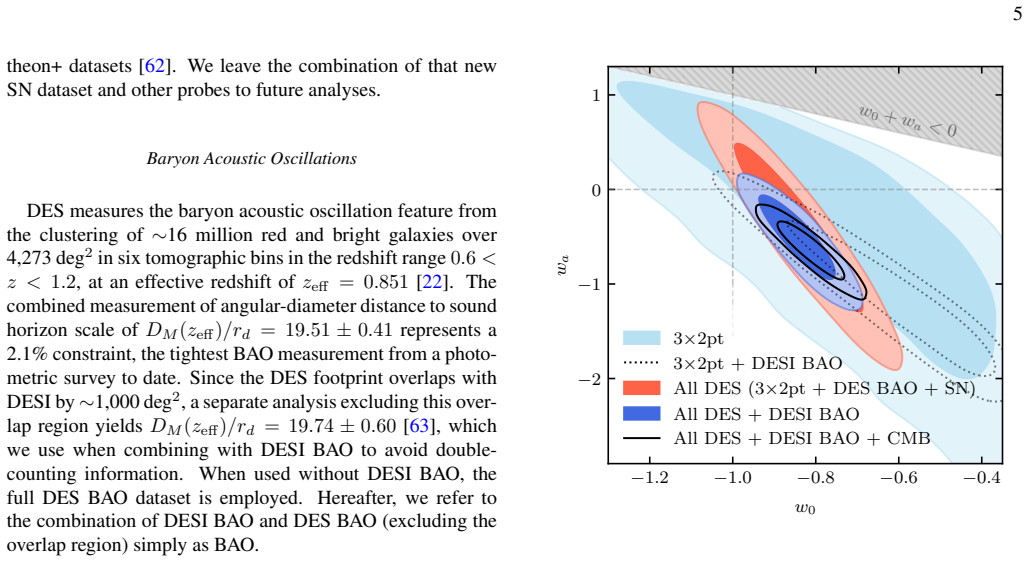
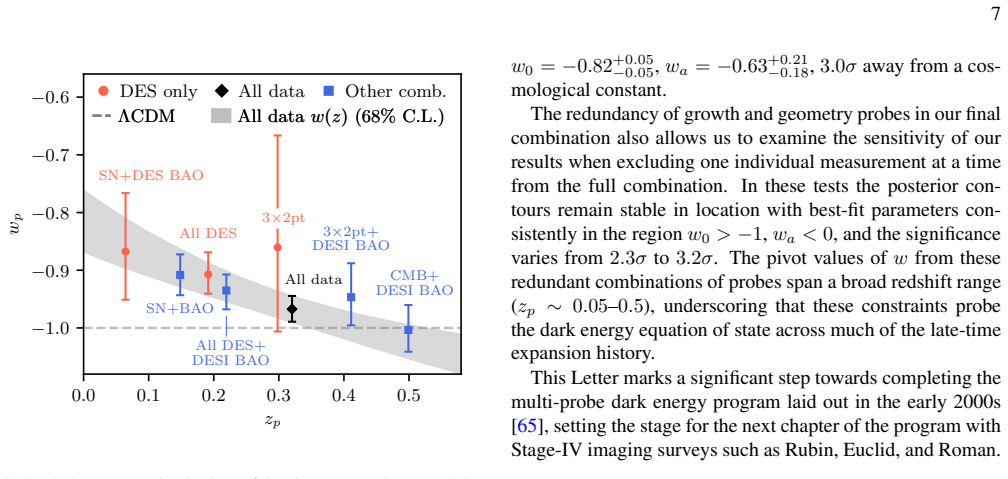
Using the full DES dataset, the joint analysis of SN Ia, BAO, and 3×2pt probes under the assumption w(a) = w0 + wa(1 − a) produces w0 = −0.84+0.10−0.10 and wa = −0.44+0.60−0.55. This combination deviates from a cosmological constant at 2.2σ. Inclusion of DESI DR2 BAO data tightens the errors and yields a 2.3σ deviation, while adding primary CMB data raises the tension to 3.0σ. The best-fit parameters stay consistently in the region w0 > −1 and wa < 0 across different probe combinations.
What carries the argument
The linear parametrization of the dark energy equation-of-state w(a) = w0 + wa(1-a) applied to the combined likelihood from supernovae, BAO, and 3x2pt measurements.
If this is right
- The deviation significance varies between 2.3σ and 3.2σ depending on which probes are included.
- Excluding the supernova sample still produces a 2.6σ departure from Lambda CDM.
- Adding the 3x2pt probe to SN+DESI+CMB improves the figure of merit by about 10 percent without altering the significance much.
- These results support the weak preference for dynamical dark energy seen in other recent cosmological analyses.
Where Pith is reading between the lines
- If correct, this would imply that dark energy density has decreased more slowly than in the Lambda CDM model at recent epochs.
- Independent cross-checks excluding supernovae suggest the signal is not driven by photometric calibration issues in the SN sample.
- Future analyses could test whether a different functional form for w(a) alters the apparent deviation.
- Consistency of the signal across growth and geometry probes reduces the likelihood that unmodeled systematics are responsible.
Load-bearing premise
That the assumed linear form w(a)=w0+wa(1-a) captures the true time variation of dark energy and that all systematic errors in the three probes are correctly accounted for without leaving residual biases that mimic the deviation.
What would settle it
Finding that the best-fit w0 and wa move closer to -1 and 0 respectively when using an independent dataset or a different dark energy parametrization, or identifying a specific unaccounted systematic that shifts the combined constraint by more than 2 sigma.
Figures
read the original abstract
We present results on dark energy evolution, assuming a time-dependent equation of state $w(a)=w_0+w_a(1-a)$, from growth and geometric probes using the full six-year Dark Energy Survey dataset: type Ia supernovae, baryon acoustic oscillations, and weak gravitational lensing and galaxy clustering (3$\times$2pt). The combination yields $w_0=-0.84^{+0.10}_{-0.10}$ and $w_a=-0.44^{+0.60}_{-0.55}$, the tightest constraints ever obtained from a single survey, with $2.2\sigma$ deviation from a cosmological constant. Adding the DESI DR2 BAO data yields $w_0=-0.84^{+0.06}_{-0.07}$ and $w_a=-0.53^{+0.33}_{-0.28}$, representing the most stringent low-redshift-only test of dynamical dark energy to date, with a $2.3\sigma$ deviation. In this combination, adding 3$\times$2pt doubles the constraining power. Finally, when combined with primary CMB information, we obtain $w_0=-0.82^{+0.05}_{-0.05}$, $w_a=-0.63^{+0.21}_{-0.18}$, with a $3.0\sigma$ deviation. We find that including 3$\times$2pt in the previously studied SN + DESI BAO + CMB combination leaves the significance essentially unchanged ($3.2 \sigma$ to $3.0\sigma$) while improving the figure of merit by $\sim$10\%. We systematically investigate the impact of leaving out each one of the probes and find that the significance of the deviation from a cosmological constant ranges from 2.3 to 3.2$\sigma$, with best-fit parameters consistently in the region $w_0 >-1$ and $w_a <0$. Excluding SN from the all data combination yields a $2.6\sigma$ departure from $\Lambda$CDM, providing a cross-check independent of supernova photometric calibration. These results support the weak preference for evolving dark energy reported by several recent cosmological analyses. By combining growth and geometric probes from a single survey, this work realizes the multi-probe dark energy program envisioned at the inception of DES.
Editorial analysis
A structured set of objections, weighed in public.
Referee Report
Summary. The manuscript reports constraints on dynamical dark energy in the CPL parametrization w(a)=w0+wa(1-a) from the full six-year DES dataset, combining SNIa, BAO, and 3×2pt probes. The DES-only combination yields w0=-0.84+0.10-0.10 and wa=-0.44+0.60-0.55 with a 2.2σ deviation from ΛCDM; adding DESI DR2 BAO tightens this to 2.3σ, and further inclusion of CMB data reaches 3.0σ. Leave-one-out tests show the deviation significance ranges from 2.3–3.2σ with best-fit values consistently in the w0>-1, wa<0 region. The work emphasizes the multi-probe combination from a single survey.
Significance. If the central results hold after addressing model assumptions and systematics, this would constitute the tightest single-survey constraints on dynamical dark energy to date and provide a valuable cross-check independent of supernova calibration when SN are excluded. The reported improvement in figure of merit when adding 3×2pt to SN+DESI+CMB is a concrete strength of the multi-probe approach.
major comments (2)
- [Abstract] Abstract and results section: The reported 2.2–3.0σ deviations from (w0,wa)=(-1,0) are obtained exclusively within the linear CPL model. The leave-one-out tests vary only the data combinations, not the functional basis for w(a). If the true dark-energy evolution is non-linear (e.g., a step function or different low-z slope), the best-fit point in the CPL plane can shift away from ΛCDM even when the underlying model is exactly ΛCDM. This directly affects the interpretation of the deviation significance and is load-bearing for the claim of support for evolving dark energy.
- [Methods] Methods and likelihood analysis (inferred from abstract description of probe combinations): The abstract states consistent best-fit values across combinations but provides no explicit details on the joint covariance matrix construction, treatment of cross-probe systematics, or validation of the likelihood. Without these, it is not possible to assess whether residual biases could produce the observed shift; this is required to substantiate the robustness claims.
minor comments (2)
- [Abstract] The abstract would benefit from a brief statement on the number of free parameters and any priors used in the fits.
- [Figures] Figure captions (assumed present) should explicitly state the data combinations shown in each panel to improve readability.
Simulated Author's Rebuttal
We thank the referee for their constructive and insightful comments, which help clarify the interpretation and robustness of our results. We address each major comment below and describe the planned revisions.
read point-by-point responses
-
Referee: [Abstract] Abstract and results section: The reported 2.2–3.0σ deviations from (w0,wa)=(-1,0) are obtained exclusively within the linear CPL model. The leave-one-out tests vary only the data combinations, not the functional basis for w(a). If the true dark-energy evolution is non-linear (e.g., a step function or different low-z slope), the best-fit point in the CPL plane can shift away from ΛCDM even when the underlying model is exactly ΛCDM. This directly affects the interpretation of the deviation significance and is load-bearing for the claim of support for evolving dark energy.
Authors: We agree that the reported deviation significance is conditional on the CPL parametrization and that a non-linear true w(a) could induce an apparent shift in the CPL plane even under exact ΛCDM. This is a substantive limitation of the model choice. In the revised manuscript we will add a dedicated paragraph in the Discussion section that (i) explicitly states the results are obtained within CPL, (ii) discusses the possibility of model-misspecification bias with references to alternative parametrizations (e.g., principal-component or step-function forms), and (iii) qualifies the claim of support for evolving dark energy as holding within the linear CPL framework. We will also note that CPL remains the community standard for such multi-probe analyses. revision: yes
-
Referee: [Methods] Methods and likelihood analysis (inferred from abstract description of probe combinations): The abstract states consistent best-fit values across combinations but provides no explicit details on the joint covariance matrix construction, treatment of cross-probe systematics, or validation of the likelihood. Without these, it is not possible to assess whether residual biases could produce the observed shift; this is required to substantiate the robustness claims.
Authors: The full manuscript contains a Methods section that describes the joint likelihood, covariance construction for the SN+BAO+3×2pt combination, cross-probe systematic marginalization, and validation via simulated catalogs and consistency tests. To make these elements immediately visible from the abstract and to directly address the concern, we will (i) expand the abstract with one sentence summarizing the joint-covariance and validation approach and (ii) add a short “Robustness and validation” subsection that explicitly references the covariance treatment and cross-probe checks. These additions will allow readers to assess residual-bias risks without altering the core results. revision: yes
Circularity Check
No circularity: direct multi-probe parameter fits to data
full rationale
The paper reports posterior constraints on w0 and wa obtained by fitting the CPL parametrization w(a)=w0+wa(1-a) to independent observational datasets (SN, BAO, 3x2pt) from DES. The quoted values, deviations (2.2–3.0σ), and leave-one-out tests are direct outputs of the likelihood analysis on the data; no step reduces a reported result to a previously fitted quantity or self-citation by construction. Self-citations to prior DES analyses exist but are not load-bearing for the central constraints, which remain externally falsifiable against the raw survey data.
Axiom & Free-Parameter Ledger
free parameters (2)
- w0 =
-0.84
- wa =
-0.44
axioms (2)
- standard math The universe follows the FLRW metric and standard general relativity.
- domain assumption The linear parametrization w(a)=w0 + wa(1-a) is sufficient to capture any dynamical dark energy behavior.
Forward citations
Cited by 6 Pith papers
-
Evolving Dark Energy Is Vacuum Energy After All
A QCD-vacuum-based model of dynamical dark energy fits Planck+ACT+SPT, DESI DR2, and supernova data while reproducing the late-time evolution favored by DESI.
-
Consistency of DES and DESI distances and the Standard Cosmological Model
DESI recovers the CMB-constrained parameter combination at sub-percent precision; high-redshift DES supernovae fit flat Lambda CDM while a 0.05 mag offset in the low-redshift anchor sample may be systematic, supportin...
-
Matter influence on large-scale scalar dynamics
Matter modeled as stochastic sources induces stochastic noise and new interactions in the large-scale EFT for light scalars, yielding corrections to the Klein-Gordon equation that can mimic dynamical dark energy or pr...
-
On the potential for inhomogeneities to mimic an evolving dark energy
Numerical simulations show that inhomogeneities in a LambdaCDM universe can lead some observers to infer evolving dark energy parameters consistent with DESI at 2-sigma.
-
The stability of voids in the Local Universe: The role of the cosmological constant
Cosmological constant repulsion stabilizes voids in the Local Universe by suppressing collapse modes through Landau damping and driving residual matter outward to void boundaries.
-
A short review on Quintom dark energy theory
Quintom dark energy models permit the equation of state to cross w=-1, supporting bouncing cosmologies and CMB-based tests of dark energy nature.
Reference graph
Works this paper leans on
-
[1]
DES Collaboration, Phys. Rev. D98, 043526 (2018), arXiv:1708.01530 [astro-ph.CO]
work page internal anchor Pith review Pith/arXiv arXiv 2018
-
[2]
DES Collaboration, Phys. Rev. D105, 023520 (2022), arXiv:2105.13549 [astro-ph.CO]
work page internal anchor Pith review Pith/arXiv arXiv 2022
- [3]
-
[4]
DES Collaboration, ApJ973, L14 (2024), arXiv:2401.02929 [astro-ph.CO]
work page internal anchor Pith review Pith/arXiv arXiv 2024
-
[5]
Popovicet al., arXiv e-prints , arXiv:2506.05471 (2025), arXiv:2506.05471 [astro-ph.CO]
B. Popovicet al., arXiv e-prints , arXiv:2506.05471 (2025), arXiv:2506.05471 [astro-ph.CO]
-
[6]
The Pantheon+ Analysis: Cosmological Constraints
D. Brout, D. Scolnic,et al., ApJ938, 110 (2022), arXiv:2202.04077 [astro-ph.CO]
work page internal anchor Pith review Pith/arXiv arXiv 2022
- [7]
-
[8]
Planck Collaboration, A&A641, A6 (2020), arXiv:1807.06209 [astro-ph.CO]
work page internal anchor Pith review Pith/arXiv arXiv 2020
-
[9]
The Atacama Cosmology Telescope: DR6 Power Spectra, Likelihoods and $\Lambda$CDM Parameters
T. Louiset al.(ACT), arXiv e-prints , arXiv:2503.14452 (2025), arXiv:2503.14452 [astro-ph.CO]
work page internal anchor Pith review Pith/arXiv arXiv 2025
-
[10]
E. Camphuiset al.(SPT-3G), arXiv e-prints , arXiv:2506.20707 (2025), arXiv:2506.20707 [astro-ph.CO]
work page internal anchor Pith review Pith/arXiv arXiv 2025
-
[11]
Weinberg, Rev
S. Weinberg, Rev. Mod. Phys.61, 1 (1989)
1989
-
[12]
J. Martin, Comptes Rendus Physique13, 566 (2012), arXiv:1205.3365 [astro-ph.CO]
work page internal anchor Pith review Pith/arXiv arXiv 2012
-
[13]
J. A. Frieman, C. T. Hill, A. Stebbins, and I. Waga, Phys. Rev. Lett.75, 2077 (1995), arXiv:astro-ph/9505060 [astro-ph]
work page internal anchor Pith review Pith/arXiv arXiv 2077
-
[14]
Ratra and P
B. Ratra and P. J. E. Peebles, Phys. Rev. D37, 3406 (1988)
1988
-
[15]
R. R. Caldwell, R. Dave, and P. J. Steinhardt, Phys. Rev. Lett. 80, 1582 (1998), arXiv:astro-ph/9708069 [astro-ph]
work page internal anchor Pith review Pith/arXiv arXiv 1998
-
[16]
Kinetically Driven Quintessence
T. Chiba, T. Okabe, and M. Yamaguchi, Phys. Rev. D62, 023511 (2000), arXiv:astro-ph/9912463 [astro-ph]
work page internal anchor Pith review Pith/arXiv arXiv 2000
- [17]
-
[18]
Accelerating Universes with Scaling Dark Matter
M. Chevallier and D. Polarski, International Journal of Modern Physics D10, 213 (2001), arXiv:gr-qc/0009008 [gr-qc]
work page internal anchor Pith review Pith/arXiv arXiv 2001
- [19]
-
[20]
B. Popovicet al.(DES), arXiv e-prints , arXiv:2511.07517 (2025), arXiv:2511.07517 [astro-ph.CO]
work page internal anchor Pith review Pith/arXiv arXiv 2025
-
[21]
A. G. Adameet al.(DESI), J. Cosmology Astropart. Phys. 2025, 021 (2025), arXiv:2404.03002 [astro-ph.CO]
work page internal anchor Pith review Pith/arXiv arXiv 2025
- [22]
-
[23]
DESI DR2 Results II: Measurements of Baryon Acoustic Oscillations and Cosmological Constraints
M. Abdul Karimet al.(DESI), Phys. Rev. D112, 083515 (2025), arXiv:2503.14738 [astro-ph.CO]
work page internal anchor Pith review Pith/arXiv arXiv 2025
-
[24]
Extended Dark Energy analysis using DESI DR2 BAO measurements
K. Lodhaet al.(DESI), Phys. Rev. D112, 083511 (2025), arXiv:2503.14743 [astro-ph.CO]
work page internal anchor Pith review Pith/arXiv arXiv 2025
- [25]
- [26]
-
[27]
Cosmological Evolution of a Quintom Model of Dark Energy
Z.-K. Guo, Y .-S. Piao, X.-M. Zhang, and Y .-Z. Zhang, Phys. Lett. B608, 177 (2005), arXiv:astro-ph/0410654
work page internal anchor Pith review Pith/arXiv arXiv 2005
-
[28]
J. Khoury, M.-X. Lin, and M. Trodden, Phys. Rev. Lett.135, 181001 (2025), arXiv:2503.16415 [astro-ph.CO]
-
[29]
Evolving Dark Sector and the Dark Dimension Scenario
A. Bedroya, G. Obied, C. Vafa, and D. H. Wu, (2025), arXiv:2507.03090 [astro-ph.CO]
work page internal anchor Pith review Pith/arXiv arXiv 2025
- [30]
-
[31]
Non-minimally coupled gravity constraints from DESI DR2 data
J. Pan and G. Ye, Phys. Rev. D113, L041304 (2026), arXiv:2503.19898 [astro-ph.CO]
work page internal anchor Pith review Pith/arXiv arXiv 2026
- [32]
-
[33]
W. J. Wolf, P. G. Ferreira, and C. Garc ´ıa-Garc´ıa, Phys. Rev. D 113, 023551 (2026), arXiv:2509.17586 [astro-ph.CO]
work page internal anchor Pith review Pith/arXiv arXiv 2026
-
[34]
S. Tsujikawa, Phys. Rev. D113, L041301 (2026), arXiv:2508.17231 [astro-ph.CO]
-
[35]
M. Cataneo and K. Koyama, (2025), arXiv:2512.13691 [astro- ph.CO]
-
[36]
DES Collaborationet al.(DES), MNRAS460, 1270 (2016), arXiv:1601.00329 [astro-ph.CO]
work page internal anchor Pith review Pith/arXiv arXiv 2016
- [37]
-
[38]
Bechtolet al.(DES), arXiv e-prints , arXiv:2501.05739 (2025), arXiv:2501.05739 [astro-ph.CO]
K. Bechtolet al.(DES), arXiv e-prints , arXiv:2501.05739 (2025), arXiv:2501.05739 [astro-ph.CO]
-
[39]
D. Anbajagane, M. Tabbutt,et al.(DES), The Open Journal of Astrophysics8, 65 (2025), arXiv:2501.05683 [astro-ph.CO]
-
[40]
Schuttet al.(DES), The Open Journal of Astrophysics8, 26 (2025), arXiv:2501.05781 [astro-ph.CO]
T. Schuttet al.(DES), The Open Journal of Astrophysics8, 26 (2025), arXiv:2501.05781 [astro-ph.CO]
-
[41]
N. Weaverdyck, M. Rodr ´ıguez-Monroy,et al.(DES), arXiv e-prints , arXiv:2601.14484 (2026), arXiv:2601.14484 [astro- ph.CO]
-
[42]
S. Mau, M. Becker,et al.(DES),in prep(2026)
2026
-
[43]
M. Yamamoto, M. R. Becker,et al.(DES), MNRAS543, 4156 (2025), arXiv:2501.05665 [astro-ph.CO]
-
[44]
M. Rodr ´ıguez-Monroy, N. Weaverdyck,et al.(DES), arXiv e-prints , arXiv:2509.07943 (2025), arXiv:2509.07943 [astro- ph.CO]
-
[45]
Dark Energy Survey Year 6 Results: Redshift Calibration of the Weak Lensing Source Galaxies
B. Yinet al.(DES), arXiv e-prints , arXiv:2510.23566 (2025), arXiv:2510.23566 [astro-ph.CO]
work page internal anchor Pith review Pith/arXiv arXiv 2025
-
[46]
G. Gianniniet al.(DES), Phys. Rev. D , arXiv:2509.07964 (2025), arXiv:2509.07964 [astro-ph.CO]
-
[47]
d’Assignieset al.(DES), arXiv e-prints , arXiv:2510.23565 (2025), arXiv:2510.23565 [astro-ph.CO]
W. d’Assignieset al.(DES), arXiv e-prints , arXiv:2510.23565 (2025), arXiv:2510.23565 [astro-ph.CO]
-
[48]
Dimensional reduction for sampled priors and application to photometric redshift distributions
G. Bernsteinet al.(DES), ApJ1002, 95 (2026), arXiv:2506.00758 [astro-ph.IM]. 10
work page internal anchor Pith review Pith/arXiv arXiv 2026
-
[49]
Legnaniet al.(DES), arXiv e-prints , arXiv:2601.14833 (2026), arXiv:2601.14833 [astro-ph.CO]
E. Legnaniet al.(DES), arXiv e-prints , arXiv:2601.14833 (2026), arXiv:2601.14833 [astro-ph.CO]
-
[50]
C.-H. Toet al.(DES), Phys. Rev. D112, 063537 (2025), arXiv:2503.13631 [astro-ph.CO]
-
[51]
G. Gianniniet al.(DES), Phys. Rev. D113, 103503 (2026), arXiv:2601.15175 [astro-ph.CO]
-
[52]
D. Sanchez-Cid, A. Fert ´e,et al.(DES), arXiv e-prints , arXiv:2601.14859 (2026), arXiv:2601.14859 [astro-ph.CO]
-
[53]
C. Doux, J. Muir,et al.(DES),in prep(2026)
2026
- [54]
-
[56]
DES Collaboration,in prep(2026)
2026
- [57]
-
[58]
CfA3: 185 Type Ia Supernova Light Curves from the CfA
M. Hickenet al., ApJ700, 331 (2009), arXiv:0901.4787 [astro- ph.CO]
work page internal anchor Pith review Pith/arXiv arXiv 2009
-
[59]
CfA4: Light Curves for 94 Type Ia Supernovae
M. Hickenet al., ApJS200, 12 (2012), arXiv:1205.4493 [astro- ph.CO]
work page internal anchor Pith review Pith/arXiv arXiv 2012
-
[60]
Optical and Infrared Photometry of SN 2005df
K. Krisciunas, N. B. Suntzeff, J. Espinoza, D. Gonzalez, A. Mi- randa, and P. Sanhueza, Research Notes of the American Astro- nomical Society1, 36 (2017), arXiv:1711.10345 [astro-ph.SR]
work page internal anchor Pith review Pith/arXiv arXiv 2017
-
[61]
R. J. Foleyet al., MNRAS475, 193 (2018), arXiv:1711.02474 [astro-ph.HE]
work page internal anchor Pith review Pith/arXiv arXiv 2018
-
[62]
Camilleriet al.(DES),in prep(2026)
R. Camilleriet al.(DES),in prep(2026)
2026
-
[63]
J. Mena-Fern ´andezet al.(DES), arXiv e-prints , arXiv:2601.14864 (2026), arXiv:2601.14864 [astro-ph.CO]
- [64]
-
[65]
Report of the Dark Energy Task Force
A. Albrecht and Others, arXiv e-prints , astro-ph/0609591 (2006), arXiv:astro-ph/0609591 [astro-ph]
work page internal anchor Pith review Pith/arXiv arXiv 2006
-
[66]
Figure of Merit for Dark Energy Constraints from Current Observational Data
Y . Wang, Phys. Rev. D77, 123525 (2008), arXiv:0803.4295 [astro-ph]
work page internal anchor Pith review Pith/arXiv arXiv 2008
- [67]
-
[68]
M. Ishak and L. Medina-Varela, arXiv e-prints , arXiv:2507.22856 (2025), arXiv:2507.22856 [astro-ph.CO]
-
[69]
Probing the dark energy: methods and strategies
D. Huterer and M. S. Turner, Phys. Rev. D64, 123527 (2001), astro-ph/0012510
work page internal anchor Pith review Pith/arXiv arXiv 2001
-
[70]
Ohio supercomputer center,
Ohio Supercomputer Center, “Ohio supercomputer center,” (1987)
1987
-
[71]
J. D. Hunter, Computing in Science & Engineering9, 90 (2007)
2007
-
[72]
Douxet al., MNRAS515, 1942 (2022), arXiv:2203.07128 [astro-ph.CO]
C. Douxet al., MNRAS515, 1942 (2022), arXiv:2203.07128 [astro-ph.CO]
- [73]
-
[74]
Asgariet al., A&A645, A104 (2021), arXiv:2007.15633 [astro-ph.CO]
M. Asgariet al., A&A645, A104 (2021), arXiv:2007.15633 [astro-ph.CO]
-
[75]
Liet al., A&A679, A133 (2023), arXiv:2306.11124 [astro-ph.CO]
S.-S. Liet al., A&A679, A133 (2023), arXiv:2306.11124 [astro-ph.CO]
-
[76]
Heymanset al., A&A646, A140 (2021), arXiv:2007.15632 [astro-ph.CO]
C. Heymanset al., A&A646, A140 (2021), arXiv:2007.15632 [astro-ph.CO]
-
[77]
A. H. Wrightet al., A&A703, A158 (2025), arXiv:2503.19441 [astro-ph.CO]
work page internal anchor Pith review Pith/arXiv arXiv 2025
-
[78]
X. Liet al., Phys. Rev. D108, 123518 (2023), arXiv:2304.00702 [astro-ph.CO]
-
[79]
R. Dalalet al., Phys. Rev. D108, 123519 (2023), arXiv:2304.00701 [astro-ph.CO]
-
[80]
S. Sugiyamaet al., Phys. Rev. D108, 123521 (2023), arXiv:2304.00705 [astro-ph.CO]
-
[81]
H. Miyatakeet al., Phys. Rev. D108, 123517 (2023), arXiv:2304.00704 [astro-ph.CO]
discussion (0)
Sign in with ORCID, Apple, or X to comment. Anyone can read and Pith papers without signing in.