Postselection-free ballistic-diffusive transition in monitored spin chains
Reviewed by Pith T0 review T1 audit T2 compute T3 formal T4 kernel 2026-06-29 17:15 UTCgrok-4.3pith:754WBLNIrecord.jsonopen to challenge →
The pith
In monitored XXZ spin chains a ballistic-to-diffusive transition in domain-wall spreading coincides with the entanglement phase transition and appears without postselection.
A machine-rendered reading of the paper's core claim, the machinery that carries it, and where it could break.
Core claim
The authors show that periodically monitored XXZ chains exhibit a measurement-induced entanglement phase transition together with a ballistic-to-diffusive transition in the transient spreading of a domain wall. Extensive numerics and theoretical arguments indicate that the two transitions are intimately interlinked, so that the postselection-free domain-wall dynamics serve as a direct probe of the entanglement criticality.
What carries the argument
The initial domain-wall state |↑↑↑…↓↓↓…⟩ whose spreading velocity changes from ballistic to diffusive at the critical monitoring rate that also marks the entanglement transition.
If this is right
- The entanglement transition can be detected through spin-density or magnetization profiles without postselection.
- Periodic monitoring provides a tunable knob between ballistic and diffusive transport in monitored spin chains.
- The many-body Zeno effect appears directly in the slowing of domain melting as monitoring increases.
- Similar postselection-free signatures may exist in other monitored many-body systems.
Where Pith is reading between the lines
- Monitoring strength could be used to control the speed of information or excitation propagation in quantum simulators.
- Classical-like transport measurements might serve as a proxy for entanglement criticality in larger systems.
- The coincidence of the two transitions could be tested by varying the monitoring protocol or initial-state preparation.
Load-bearing premise
The transient domain-wall dynamics in the unconditioned evolution reflect the same critical monitoring rate as the postselected steady-state entanglement transition.
What would settle it
A numerical or experimental measurement showing that the monitoring rate at which domain-wall spreading becomes diffusive differs from the rate at which the steady-state entanglement entropy changes its scaling.
Figures




read the original abstract
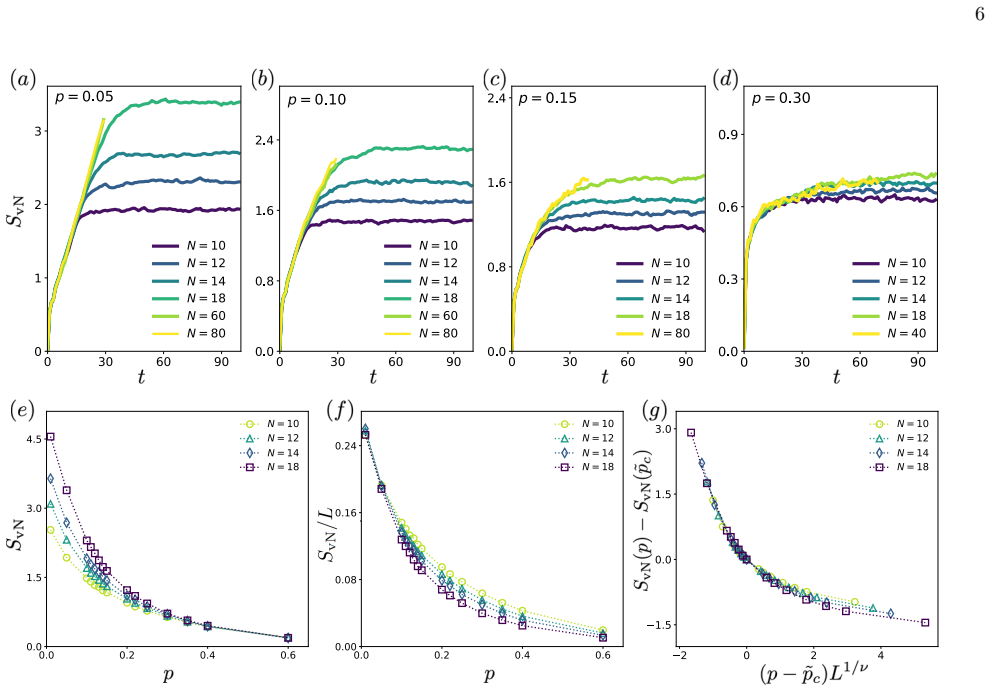
We study spin and entanglement dynamics in spin-1/2 XXZ chains under periodic monitoring and show that this system exhibits two measurement-induced phase transitions: a steady-state entanglement phase transition similar to those in monitored quantum circuits and a ballistic-to-diffusive transition in transient dynamics. Specifically, we discover that at low monitoring rate, an initial configuration containing a domain wall $|\uparrow\uparrow\uparrow\ldots \downarrow\downarrow\downarrow\ldots\rangle$ spreads ballistically while, at large monitoring rates, the domain melting is diffusive. Extensive numerical simulations, supported by theoretical arguments, indicate that the ballistic-diffusive transition is intimately interlinked with the entanglement phase transition. In contrast to the entanglement phase transitions, which require exponentially complex postselection, the ballistic-diffusive transition can be observed without postselection and constitutes an experimentally accessible manifestation of the many-body Zeno effect.
Editorial analysis
A structured set of objections, weighed in public.
Referee Report
Summary. The manuscript examines periodically monitored spin-1/2 XXZ chains and reports two measurement-induced transitions: a steady-state entanglement phase transition (requiring postselection) and a ballistic-to-diffusive transition in the transient spreading of a domain-wall initial state. Extensive numerics and theoretical arguments are presented to show that the ballistic-diffusive transition occurs at the same critical monitoring rate as the entanglement transition and can be observed in the unconditioned Lindblad evolution without postselection, serving as an experimentally accessible manifestation of the many-body Zeno effect.
Significance. If the reported coincidence of critical monitoring rates is confirmed, the result provides a postselection-free dynamical probe of measurement-induced criticality. This is significant because postselection on rare trajectories is experimentally prohibitive, while domain-wall spreading in the average dynamics is directly measurable in quantum simulators. The approach links transient transport to steady-state entanglement scaling in a concrete spin-chain model.
major comments (1)
- [Numerical results and discussion of critical rates] The central claim of an 'intimate interlink' between the ballistic-diffusive and entanglement transitions requires explicit demonstration that the critical monitoring rate extracted from domain-wall spreading in the unconditioned (Lindblad) dynamics coincides with the critical rate from postselected entanglement entropy. The manuscript should report the two critical values (with uncertainty estimates from finite-size scaling or fitting) side-by-side, e.g., in a dedicated table or figure panel, because the Lindblad master equation for the averaged state differs from the conditioned trajectory ensemble and nothing a priori guarantees exact equality.
minor comments (2)
- [Model definition] Clarify the precise form of the periodic monitoring operators and the XXZ anisotropy parameter used in the simulations.
- [Figures] Ensure that all plots of domain-wall width or velocity versus monitoring rate include the extracted critical point with error bars for direct visual comparison with the entanglement data.
Simulated Author's Rebuttal
We thank the referee for their positive assessment of our work and for the constructive suggestion to strengthen the presentation of our central claim. We address the major comment below.
read point-by-point responses
-
Referee: [Numerical results and discussion of critical rates] The central claim of an 'intimate interlink' between the ballistic-diffusive and entanglement transitions requires explicit demonstration that the critical monitoring rate extracted from domain-wall spreading in the unconditioned (Lindblad) dynamics coincides with the critical rate from postselected entanglement entropy. The manuscript should report the two critical values (with uncertainty estimates from finite-size scaling or fitting) side-by-side, e.g., in a dedicated table or figure panel, because the Lindblad master equation for the averaged state differs from the conditioned trajectory ensemble and nothing a priori guarantees exact equality.
Authors: We agree that an explicit side-by-side comparison of the two critical monitoring rates, including uncertainty estimates, would make the claimed interlink more transparent. Although our extensive numerics and theoretical arguments already indicate coincidence of the transitions, we will revise the manuscript to include a dedicated table or figure panel reporting the critical value from domain-wall spreading in the Lindblad dynamics next to the value from postselected entanglement entropy, each with uncertainties from finite-size scaling. This will directly address the formal distinction between the averaged and conditioned ensembles while highlighting the numerical agreement we observe. revision: yes
Circularity Check
No circularity: transitions reported from independent simulations
full rationale
The paper derives the ballistic-diffusive transition from direct numerical simulation of the unconditioned Lindblad dynamics on the domain-wall initial state and the entanglement transition from postselected trajectories. The claim of interlinkage is presented as an observation from these separate computations plus theoretical arguments, not as a definitional equivalence, a fitted parameter renamed as prediction, or a result forced by self-citation. No load-bearing step reduces to its own inputs by construction.
Axiom & Free-Parameter Ledger
Reference graph
Works this paper leans on
-
[1]
Unmonitored limit: pure Hamiltonian dynamics In the unmonitored limitp=0, as established by gener- alized hydrodynamics, in the interacting, gapless regime (∣∆∣<1), the XXZ model supports ballistic transport. Although the model is integrable and the exact magne- tization profile can, in principle, be derived via the ther- modynamic Bethe ansatz, its expli...
-
[2]
Under weak monitoring, the ballis- tic scaling structure is largely robust, and the domain wall continues to melt linearly in time
Strong monitoring limit The framework established above can be extended at least in a qualitative manner to encompass the effects of local measurements. Under weak monitoring, the ballis- tic scaling structure is largely robust, and the domain wall continues to melt linearly in time. However, for sufficiently strong monitoring rates, the dynamics must und...
-
[3]
Misra and E
B. Misra and E. G. Sudarshan, The zeno’s paradox in quantum theory, Journal of Mathematical Physics18, 756 (1977)
1977
-
[4]
W. M. Itano, D. J. Heinzen, J. J. Bollinger, and D. J. Wineland, Quantum zeno effect, Phys. Rev. A41, 2295 (1990)
1990
-
[5]
Skinner, J
B. Skinner, J. Ruhman, and A. Nahum, Measurement- Induced Phase Transitions in the Dynamics of Entangle- ment, Phys. Rev. X9, 031009 (2019)
2019
-
[6]
Y. Li, X. Chen, and M. P. A. Fisher, Quantum Zeno effect and the many-body entanglement transition, Phys. Rev. B98, 205136 (2018)
2018
-
[7]
Y. Li, X. Chen, and M. P. A. Fisher, Measurement- driven entanglement transition in hybrid quantum cir- cuits, Phys. Rev. B100, 134306 (2019)
2019
-
[8]
M. P. Fisher, V. Khemani, A. Nahum, and S. Vijay, Random quantum circuits, Annu. Rev. Condens. Matter Phys.14, 335 (2023)
2023
-
[9]
R. Vasseur, Les houches lectures on random quan- tum circuits and monitored quantum dynamics, arXiv:2602.17258 10.48550/arXiv.2602.17258 (2026)
-
[10]
A. C. Potter and R. Vasseur, Entanglement dynamics in hybrid quantum circuits, inEntanglement in Spin Chains: From Theory to Quantum Technology Applica- tions, edited by A. Bayat, S. Bose, and H. Johannes- son (Springer International Publishing, Cham, 2022) pp. 211–249
2022
-
[11]
C. Noel, P. Niroula, D. Zhu, A. Risinger, L. Egan, D. Biswas, M. Cetina, A. V. Gorshkov, M. J. Gullans, D. A. Huse, and C. Monroe, Measurement-induced quan- tum phases realized in a trapped-ion quantum computer, Nat. Phys.18, 760 (2022)
2022
-
[12]
Jian, Y.-Z
C.-M. Jian, Y.-Z. You, R. Vasseur, and A. W. W. Ludwig, Measurement-induced criticality in random quantum cir- cuits, Phys. Rev. B101, 104302 (2020)
2020
-
[13]
Y. Bao, S. Choi, and E. Altman, Theory of the phase transition in random unitary circuits with measurements, Phys. Rev. B101, 104301 (2020)
2020
-
[14]
Zabalo, M
A. Zabalo, M. J. Gullans, J. H. Wilson, S. Gopalakrish- nan, D. A. Huse, and J. H. Pixley, Critical properties of the measurement-induced transition in random quantum circuits, Phys. Rev. B101, 060301 (2020)
2020
-
[15]
Lavasani, Y
A. Lavasani, Y. Alavirad, and M. Barkeshli, Measurement-induced topological entanglement transi- tions in symmetric random quantum circuits, Nat. Phys. 17, 342 (2021)
2021
-
[16]
S. J. Garratt, Z. Weinstein, and E. Altman, Measure- ments conspire nonlocally to restructure critical quantum states, Phys. Rev. X13, 021026 (2023)
2023
-
[17]
Turkeshi, R
X. Turkeshi, R. Fazio, and M. Dalmonte, Measurement- 11 induced criticality in$(2+1)$-dimensional hybrid quan- tum circuits, Phys. Rev. B102, 014315 (2020)
2020
-
[18]
Poboiko, P
I. Poboiko, P. P¨ opperl, I. V. Gornyi, and A. D. Mirlin, Theory of free fermions under random projective mea- surements, Phys. Rev. X13, 041046 (2023)
2023
-
[19]
Chahine and M
K. Chahine and M. Buchhold, Entanglement phases, lo- calization, and multifractality of monitored free fermions in two dimensions, Phys. Rev. B110, 054313 (2024)
2024
-
[20]
J. C. Hokeet al.,(Google Quantum AI and Collabora- tors), Measurement-induced entanglement and telepor- tation on a noisy quantum processor, Nature622, 481 (2023)
2023
-
[21]
J. M. Koh, S.-N. Sun, M. Motta, and A. J. Minnich, Measurement-induced entanglement phase transition on a superconducting quantum processor with mid-circuit readout, Nat. Phys.19, 1314 (2023)
2023
-
[22]
Kamakari, J
H. Kamakari, J. Sun, Y. Li, J. J. Thio, T. P. Gujarati, M. P. A. Fisher, M. Motta, and A. J. Minnich, Exper- imental demonstration of scalable cross-entropy bench- marking to detect measurement-induced phase transi- tions on a superconducting quantum processor, Phys. Rev. Lett.134, 120401 (2025)
2025
-
[23]
M. J. Gullans and D. A. Huse, Dynamical Purification Phase Transition Induced by Quantum Measurements, Phys. Rev. X10, 041020 (2020)
2020
-
[24]
Agrawal, A
U. Agrawal, A. Zabalo, K. Chen, J. H. Wilson, A. C. Potter, J. Pixley, S. Gopalakrishnan, and R. Vasseur, En- tanglement and Charge-Sharpening Transitions in U(1) Symmetric Monitored Quantum Circuits, Phys. Rev. X 12(2022)
2022
-
[25]
Majidy, U
S. Majidy, U. Agrawal, S. Gopalakrishnan, A. C. Pot- ter, R. Vasseur, and N. Y. Halpern, Critical phase and spin sharpening in su(2)-symmetric monitored quantum circuits, Phys. Rev. B108, 054307 (2023)
2023
-
[26]
Niroula, C
P. Niroula, C. D. White, Q. Wang, S. Johri, D. Zhu, C. Monroe, C. Noel, and M. J. Gullans, Phase transition in magic with random quantum circuits, Nature physics 20, 1786 (2024)
2024
-
[27]
Sticlet, B
D. Sticlet, B. D´ ora, D. Szombathy, G. Zar´ and, and C. P. Moca, Nonstabilizerness in open XXZ spin chains: Uni- versal scaling and dynamics, Phys. Rev. Res.7, 043130 (2025)
2025
-
[28]
S. Choi, Y. Bao, X.-L. Qi, and E. Altman, Quan- tum Error Correction in Scrambling Dynamics and Measurement-Induced Phase Transition, Phys. Rev. Lett.125, 030505 (2020)
2020
-
[29]
Yamamoto and R
K. Yamamoto and R. Hamazaki, Localization properties in disordered quantum many-body dynamics under con- tinuous measurement, Phys. Rev. B107, L220201 (2023)
2023
-
[30]
B. Zeng, X. Chen, D.-L. Zhou, X.-G. Wen,et al.,Quan- tum information meets quantum matter(Springer, 2019)
2019
-
[31]
Augusiak, F
R. Augusiak, F. M. Cucchietti, and M. Lewenstein, Many-body physics from a quantum information per- spective, inModern Theories of Many-Particle Systems in Condensed Matter Physics, edited by D. C. Cabra, A. Honecker, and P. Pujol (Springer Berlin Heidelberg, Berlin, Heidelberg, 2012) pp. 245–294
2012
-
[32]
Amico, R
L. Amico, R. Fazio, A. Osterloh, and V. Vedral, Entan- glement in many-body systems, Rev. Mod. Phys.80, 517 (2008)
2008
-
[33]
W. W. Ho and D. A. Abanin, Entanglement dynamics in quantum many-body systems, Phys. Rev. B95, 094302 (2017)
2017
-
[34]
Subrahmanyam, Entanglement dynamics and quantum-state transport in spin chains, Phys
V. Subrahmanyam, Entanglement dynamics and quantum-state transport in spin chains, Phys. Rev. A 69, 034304 (2004)
2004
-
[35]
Amico, A
L. Amico, A. Osterloh, F. Plastina, R. Fazio, and G. Massimo Palma, Dynamics of entanglement in one- dimensional spin systems, Phys. Rev. A69, 022304 (2004)
2004
-
[36]
A. Bayat, S. Bose, and H. Johannesson, Entanglement in spin chains, Quantum Science and Technology (Springer Cham) 10.1007/978-3-031-03998-0 (2022)
-
[37]
Gopalakrishnan and R
S. Gopalakrishnan and R. Vasseur, Kinetic theory of spin diffusion and superdiffusion inxxzspin chains, Phys. Rev. Lett.122, 127202 (2019)
2019
-
[38]
Ippoliti and V
M. Ippoliti and V. Khemani, Postselection-free entangle- ment dynamics via spacetime duality, Phys. Rev. Lett. 126, 060501 (2021)
2021
-
[39]
McGinley, Postselection-free learning of measurement-induced quantum dynamics, PRX Quan- tum5, 020347 (2024)
M. McGinley, Postselection-free learning of measurement-induced quantum dynamics, PRX Quan- tum5, 020347 (2024)
2024
-
[40]
Measurement-Induced Crossover of Quantum Jump Statistics in Postselection-Free Many-Body Dynamics
K. Yamamoto and R. Hamazaki, Measurement-induced crossover of quantum jump statistics in postselection-free many-body dynamics, arXiv:2503.02418 (2025)
work page internal anchor Pith review Pith/arXiv arXiv 2025
-
[41]
Passarelli, X
G. Passarelli, X. Turkeshi, A. Russomanno, P. Lucig- nano, M. Schir` o, and R. Fazio, Many-body dynamics in monitored atomic gases without postselection barrier, Phys. Rev. Lett.132, 163401 (2024)
2024
-
[42]
H. Yu, J. Hu, and S.-X. Zhang, Post-selection-free decod- ing of measurement-induced area-law phases via neural networks, arXiv:2604.03550 (2026)
work page internal anchor Pith review Pith/arXiv arXiv 2026
-
[43]
Hauschild and F
J. Hauschild and F. Pollmann, Efficient numerical sim- ulations with Tensor Networks: Tensor Network Python (TeNPy), SciPost Phys. Lect. Notes , 5 (2018)
2018
-
[44]
Or´ us, A practical introduction to tensor networks: Matrix product states and projected entangled pair states, Annals of physics349, 117 (2014)
R. Or´ us, A practical introduction to tensor networks: Matrix product states and projected entangled pair states, Annals of physics349, 117 (2014)
2014
-
[45]
Fishman, S
M. Fishman, S. R. White, and E. M. Stoudenmire, The ITensor Software Library for Tensor Network Calcula- tions, SciPost Phys. Codebases , 4 (2022)
2022
-
[46]
Fishman, S
M. Fishman, S. R. White, and E. M. Stoudenmire, Code- base release 0.3 for ITensor, SciPost Phys. Codebases , 4 (2022)
2022
-
[47]
Chakraborty, K
A. Chakraborty, K. Chen, A. Zabalo, J. H. Wilson, and J. H. Pixley, Charge and entanglement criticality in a U(1)-symmetric hybrid circuit of qubits, Phys. Rev. B 110, 045135 (2024)
2024
-
[48]
A. G. Moghaddam, K. P¨ oyh¨ onen, and T. Ojanen, Expo- nential shortcut to measurement-induced entanglement phase transitions, Phys. Rev. Lett.131, 020401 (2023)
2023
-
[49]
Oshima and Y
H. Oshima and Y. Fuji, Charge fluctuation and charge- resolved entanglement in a monitored quantum circuit withu(1)symmetry, Phys. Rev. B107, 014308 (2023)
2023
-
[50]
Kardar, G
M. Kardar, G. Parisi, and Y.-C. Zhang, Dynamic scaling of growing interfaces, Phys. Rev. Lett.56, 889 (1986)
1986
-
[51]
Barab´ asi and H
A.-L. Barab´ asi and H. E. Stanley,Fractal concepts in surface growth(Cambridge university press, 1995)
1995
-
[52]
Ljubotina, M
M. Ljubotina, M. ˇZnidariˇ c, and T. c. v. Prosen, Kardar- parisi-zhang physics in the quantum heisenberg magnet, Phys. Rev. Lett.122, 210602 (2019)
2019
-
[53]
B. Ye, F. Machado, J. Kemp, R. B. Hutson, and N. Y. Yao, Universal kardar-parisi-zhang dynamics in inte- grable quantum systems, Phys. Rev. Lett.129, 230602 (2022)
2022
-
[54]
Gopalakrishnan, D
S. Gopalakrishnan, D. A. Huse, V. Khemani, and R. Vasseur, Hydrodynamics of operator spreading and quasiparticle diffusion in interacting integrable systems, 12 Phys. Rev. B98, 220303(R) (2018)
2018
-
[55]
Doyon, S
B. Doyon, S. Gopalakrishnan, F. Møller, J. Schmied- mayer, and R. Vasseur, Generalized hydrodynamics: A perspective, Phys. Rev. X15, 010501 (2025)
2025
-
[56]
K. P¨ oyh¨ onen, A. G. Moghaddam, M. N. Ivaki, and T. Ojanen, Scalable approach to monitored quan- tum dynamics and entanglement phase transitions, arXiv:2406.19052 (2024)
discussion (0)
Sign in with ORCID, Apple, or X to comment. Anyone can read and Pith papers without signing in.