REVIEW 2 major objections 15 references
Quantum Machine Learning-based 6G edge Network: Enabling Adaptive Communication and Model Aggregation
T0 review · 2 major / 0 minor · reviewed 2026-06-30 · grok-4.3
Pith's one-line read A quantum-enhanced framework with four modules targets efficient V2X communication and model aggregation in 6G networks.
desk verdict This is a high-level framework sketch for quantum ML in 6G V2X with four modules but no equations, simulations, or results to support the claims. read the letter →
The pith
A machine-rendered reading of the paper's core claim, the machinery that carries it, and where it could break.
The reading
What carries the argument
The quantum-enhanced framework composed of four modules that apply quantum convolutional neural networks, quantum attention, quantum reinforcement learning, and quantum tensor decomposition to communication and aggregation tasks.
What would settle it
A direct comparison in simulated or field V2X trials where the proposed quantum modules show no reduction in communication overhead, no faster convergence, and no privacy advantage over classical baselines would falsify the central claim.
Extended reading notes
Core claim
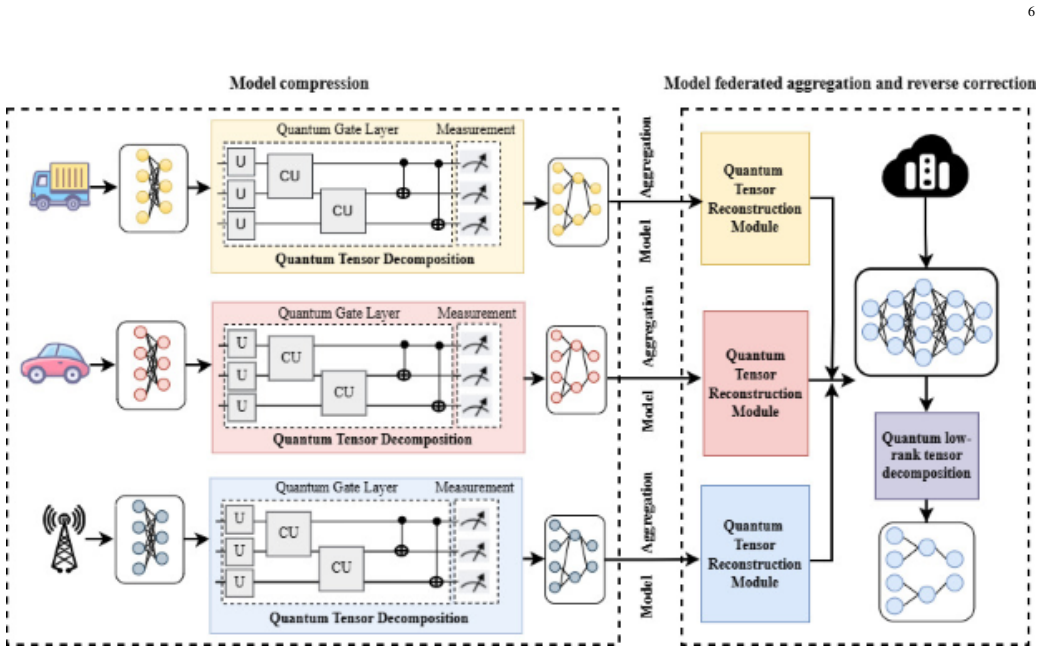
The authors claim that a quantum-enhanced framework for V2X communication and model aggregation in 6G, built from a channel-adaptive semantic communication module using quantum CNNs and distortion metrics, a multimodal fusion module using quantum attention and entanglement, a model transfer module using quantum reinforcement learning, and a federated aggregation module using quantum tensor decomposition with backpropagation corrections, overcomes the limitations of classical machine learning in high-dimensional spaces, slow convergence, and poor generalization under heterogeneous conditions.
Load-bearing premise
Quantum machine learning methods will produce measurable gains in efficiency, generalization, and privacy when deployed in real heterogeneous V2X environments.
Editorial extensions
If this is right
- Quantum CNNs and distortion metrics enable efficient transmission with strong generalization across diverse channel conditions.
- Quantum attention and entanglement compress features while associating semantics across heterogeneous multimodal data.
- Quantum reinforcement learning models decision-making to improve adaptability in dynamic environments.
- Quantum tensor decomposition combined with backpropagation corrections delivers privacy preservation at low overhead while strengthening global model robustness.
Reading between the lines
- If the modules prove effective, similar quantum structures could be tested in other edge networks that face heterogeneous data and rapid state changes.
- Practical deployment would require quantum hardware or simulators capable of handling the described operations at scale.
- The framework's emphasis on semantic compression suggests potential reductions in spectrum usage that could be measured against current 6G targets.
- Integration of the four modules into a single pipeline might reveal interactions between privacy mechanisms and communication efficiency not addressed in separate classical designs.
Editorial analysis
A structured set of objections, weighed in public.
Referee Report
Summary. The manuscript proposes a quantum-enhanced framework for V2X communication and model aggregation in 6G networks. It consists of four modules: a channel-adaptive semantic communication module using quantum CNNs and quantum distortion metrics; a multimodal fusion module using quantum attention and entanglement; a model transfer module using quantum reinforcement learning; and a federated aggregation module using quantum tensor decomposition combined with backpropagation-based corrections. The central claim is that these modules will deliver improved communication efficiency, generalization, robustness, and privacy preservation compared to classical machine learning under heterogeneous nodes, rapidly varying channels, and multimodal data.
Significance. If the proposed quantum modules were shown to deliver the claimed performance gains, the work could outline a potentially useful paradigm for applying quantum machine learning to edge intelligence in 6G intelligent transportation systems. The high-level architecture addresses relevant challenges in V2X such as high-dimensional state spaces and privacy. However, the manuscript supplies no derivations, complexity bounds, convergence arguments, or empirical results, so the significance remains entirely prospective.
major comments (2)
- [Abstract] Abstract: The assertions that the channel-adaptive module 'enables efficient transmission and strong generalization,' the fusion module 'compress[es] features and associate[s] semantics,' the transfer module 'improve[s] adaptability,' and the aggregation module provides 'privacy preservation with low overhead' are presented without any equations, circuit descriptions, complexity analysis, or baseline comparisons. These performance claims are therefore unsupported.
- [Abstract] Abstract and throughout: No simulation setup, channel model, dataset description, or convergence argument is given for any module. Without these elements it is impossible to assess whether the quantum CNN, quantum attention, quantum RL, or quantum tensor decomposition components address the stated limitations of classical ML in heterogeneous V2X environments.
Simulated Author's Rebuttal
We thank the referee for the detailed comments. The manuscript is a high-level conceptual outline of a quantum-enhanced framework for 6G V2X, not a fully implemented or evaluated system. We address the points below and note that several elements identified as missing are outside the current scope of this proposal paper.
read point-by-point responses
-
Referee: [Abstract] Abstract: The assertions that the channel-adaptive module 'enables efficient transmission and strong generalization,' the fusion module 'compress[es] features and associate[s] semantics,' the transfer module 'improve[s] adaptability,' and the aggregation module provides 'privacy preservation with low overhead' are presented without any equations, circuit descriptions, complexity analysis, or baseline comparisons. These performance claims are therefore unsupported.
Authors: We agree that the abstract states intended benefits without supporting technical details. The claims are prospective, based on established properties of quantum machine learning (e.g., quantum CNNs for feature extraction in high-dimensional spaces and quantum RL for policy optimization). The manuscript does not derive or simulate these modules. We will revise the abstract to replace definitive language with 'aims to enable' and 'is expected to provide' to reflect the conceptual nature. revision: yes
-
Referee: [Abstract] Abstract and throughout: No simulation setup, channel model, dataset description, or convergence argument is given for any module. Without these elements it is impossible to assess whether the quantum CNN, quantum attention, quantum RL, or quantum tensor decomposition components address the stated limitations of classical ML in heterogeneous V2X environments.
Authors: The work is positioned as an architectural proposal to motivate quantum approaches for V2X challenges such as multimodal data and dynamic channels. No channel models, datasets, or convergence proofs are provided because the paper does not implement or evaluate the modules. We cannot supply these elements in a revision without fundamentally changing the paper from an outline to a technical derivation, which exceeds the current contribution. revision: no
- Empirical validation, complexity analysis, or convergence arguments for the proposed quantum modules, as none exist in the manuscript.
Circularity Check
No circularity: conceptual proposal with no derivations or fitted quantities
full rationale
The paper is a high-level conceptual outline of four quantum modules for V2X communication and model aggregation. It supplies module descriptions but contains no equations, parameter fits, predictions, uniqueness theorems, or derivation chains of any kind. Consequently none of the enumerated circularity patterns (self-definitional, fitted-input-called-prediction, self-citation load-bearing, etc.) can be instantiated; the document is self-contained as an unsubstantiated proposal rather than a derivation that reduces to its own inputs.
Assumptions & free parameters
assumptions (1)
- domain assumption Quantum machine learning methods can be practically applied to communication and federated learning tasks in edge networks
invented entities (4)
-
channel-adaptive semantic communication module using quantum CNN and quantum distortion metrics
-
multimodal fusion module using quantum attention and entanglement
-
model transfer module employing quantum reinforcement learning
-
federated aggregation module integrating quantum tensor decomposition with backpropagation-based corrections
Cite this review
Pith. "Pith review of Quantum Machine Learning-based 6G edge Network: Enabling Adaptive Communication and Model Aggregation." pith.science (2026). https://pith.science/paper/V25N4WD4
@misc{pith2026260527417,
  author       = {Pith},
  title        = {Pith review of: Quantum Machine Learning-based 6G edge Network: Enabling Adaptive Communication and Model Aggregation},
  year         = {2026},
  howpublished = {\url{https://pith.science/paper/V25N4WD4}},
  note         = {Machine review of arXiv:2605.27417}
}
read the original abstract
With the advent of sixth-generation (6G) mobile communication technology, vehicle-to-everything (V2X) communication faces unprecedented challenges in communication efficiency, system generalization capabilities, and model collaboration. Conventional machine learning struggles with high-dimensional state spaces, slow convergence, and poor generalization under heterogeneous V2X nodes, rapidly varying channels, and multimodal sensing data in V2X systems. To address these issues, we propose a quantum-enhanced framework for V2X communication and model aggregation that targets efficient, robust, and intelligent transportation in 6G, which includes four modules: the channel-adaptive semantic communication module, the multimodal fusion module, the model transfer module, and the federated aggregation module. Specifically, the channel-adaptive semantic communication module leverages quantum convolutional neural networks (CNN) and quantum distortion metrics to enable efficient transmission and strong generalization across diverse conditions. The multimodal fusion module exploits quantum attention and entanglement to compress features and associate semantics across heterogeneous data. The model transfer module employs quantum reinforcement learning to model decision-making and improve adaptability in dynamic environments. The federated aggregation module integrates quantum tensor decomposition with backpropagation-based corrections to provide privacy preservation with low overhead and to strengthen global model robustness. This work outlines a new paradigm for communication and model collaboration in future 6G intelligent transportation.
Figures


Figures from the paper (2 more)

Reference graph
Works this paper leans on
-
[1]
Jiayi Lu, Wanting Yang, Zehui Xiong, Chengwen Xing, Rahim Tafa- zolli, Tony Q.S. Quek, and M ´erouane Debbah. Generative artificial intelligence-enhanced multimodal semantic communication in internet of vehicles: System design and methodologies.IEEE Vehicular Tech- nology Magazine, 20(2):71–82, 2025
work page 2025
-
[2]
Quantum machine learning.Nature, 549(7671):195–202, 2017
Jacob Biamonte, Peter Wittek, Nicola Pancotti, Patrick Rebentrost, Nathan Wiebe, and Seth Lloyd. Quantum machine learning.Nature, 549(7671):195–202, 2017
work page 2017
-
[3]
Victoria Kostina, Yury Polyanskiy, and Sergio Verd. Joint source-channel coding with feedback.IEEE Transactions on Information Theory, 63(6):3502–3515, 2017
work page 2017
-
[4]
Eirina Bourtsoulatze, David Burth Kurka, and Deniz G ¨und¨uz. Deep joint source-channel coding for wireless image transmission.IEEE Transactions on Cognitive Communications and Networking, 5(3):567– 579, 2019
work page 2019
-
[5]
Witt: A wireless image transmission transformer for semantic communications
Ke Yang, Sixian Wang, Jincheng Dai, Kailin Tan, Kai Niu, and Ping Zhang. Witt: A wireless image transmission transformer for semantic communications. InICASSP 2023 - 2023 IEEE International Conference on Acoustics, Speech and Signal Processing (ICASSP), pages 1–5, 2023
work page 2023
-
[6]
Unitr: A unified and efficient multi-modal transformer for bird’s-eye-view representation
Haiyang Wang, Hao Tang, Shaoshuai Shi, Aoxue Li, Zhenguo Li, Bernt Schiele, and Liwei Wang. Unitr: A unified and efficient multi-modal transformer for bird’s-eye-view representation. In2023 IEEE/CVF International Conference on Computer Vision (ICCV), pages 6769–6779, 2023
work page 2023
- [7]
-
[8]
Nafis Irtija, Iraklis Anagnostopoulos, Georgios Zervakis, Eirini Eleni Tsiropoulou, Hussam Amrouch, and J ¨org Henkel. Energy efficient edge computing enabled by satisfaction games and approximate com- puting.IEEE Transactions on Green Communications and Networking, 6(1):281–294, 2022. 9
work page 2022
Show all 15 references
-
[9]
Computation offloading in multi-access edge computing: A multi- task learning approach.IEEE Transactions on Mobile Computing, 20(9):2745–2762, 2021
Bo Yang, Xuelin Cao, Joshua Bassey, Xiangfang Li, and Lijun Qian. Computation offloading in multi-access edge computing: A multi- task learning approach.IEEE Transactions on Mobile Computing, 20(9):2745–2762, 2021
2021
-
[10]
Zilong Cao, Pan Zhou, Ruixuan Li, Siqi Huang, and Dapeng Wu. Multiagent deep reinforcement learning for joint multichannel access and task offloading of mobile-edge computing in industry 4.0.IEEE Internet of Things Journal, 7(7):6201–6213, 2020
2020
-
[11]
Federated learning-assisted vehicular edge computing: Architecture and research directions.IEEE Vehicular Technology Mag- azine, 18(4):75–84, 2023
Xinran Zhang, Jingyuan Liu, Tao Hu, Zheng Chang, Yanru Zhang, and Geyong Min. Federated learning-assisted vehicular edge computing: Architecture and research directions.IEEE Vehicular Technology Mag- azine, 18(4):75–84, 2023
2023
-
[12]
On compressing deep models by low rank and sparse decomposition
Xiyu Yu, Tongliang Liu, Xinchao Wang, and Dacheng Tao. On compressing deep models by low rank and sparse decomposition. In 2017 IEEE Conference on Computer Vision and Pattern Recognition (CVPR), pages 67–76, 2017
2017
-
[13]
Automated multi-stage compression of neural networks
Julia Gusak, Maksym Kholiavchenko, Evgeny Ponomarev, Larisa Mar- keeva, Philip Blagoveschensky, Andrzej Cichocki, and Ivan Oseledets. Automated multi-stage compression of neural networks. In2019 IEEE/CVF International Conference on Computer Vision Workshop (ICCVW), pages 2501–...
2019
-
[14]
Layerwise quantum deep reinforcement learning for joint optimization of uav trajectory and resource allocation.IEEE Internet of Things Journal, 11(1):430–443, 2024
Silvirianti, Bhaskara Narottama, and Soo Young Shin. Layerwise quantum deep reinforcement learning for joint optimization of uav trajectory and resource allocation.IEEE Internet of Things Journal, 11(1):430–443, 2024
2024
-
[15]
Duong, Octavia A
Uman Khalid, Muhammad Shohibul Ulum, Ahmad Farooq, Trung Q. Duong, Octavia A. Dobre, and Hyundong Shin. Quantum semantic communications for metaverse: Principles and challenges.IEEE Wireless Communications, 30(4):26–36, 2023
2023
Reviewed June 30, 2026 · model on record in the stance chip above.
Discussion (0). Continue with ORCID to comment.