Reconstructing the Globular Cluster Initial Mass Function from Present-Day Globular Cluster Systems
Pith reviewed 2026-06-29 16:46 UTC · model grok-4.3
The pith
Reversing dynamical mass loss shows globular cluster initial mass functions follow power laws whose slopes steepen with host halo mass.
A machine-rendered reading of the paper's core claim, the machinery that carries it, and where it could break.
Core claim
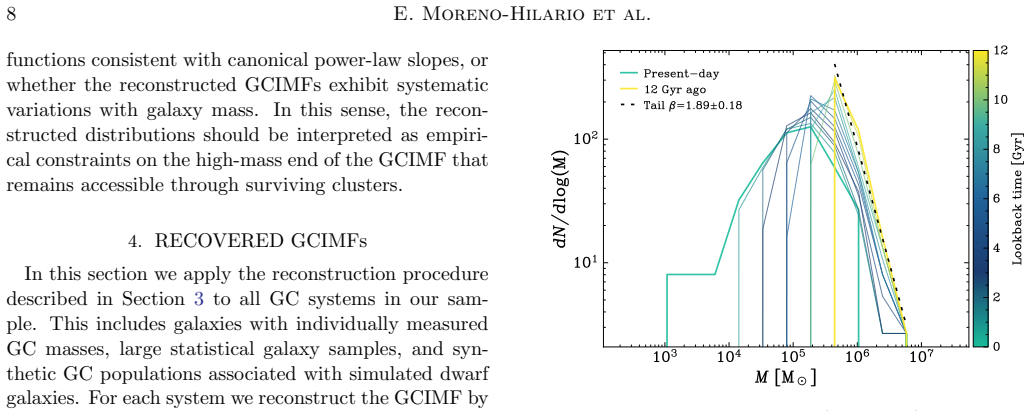
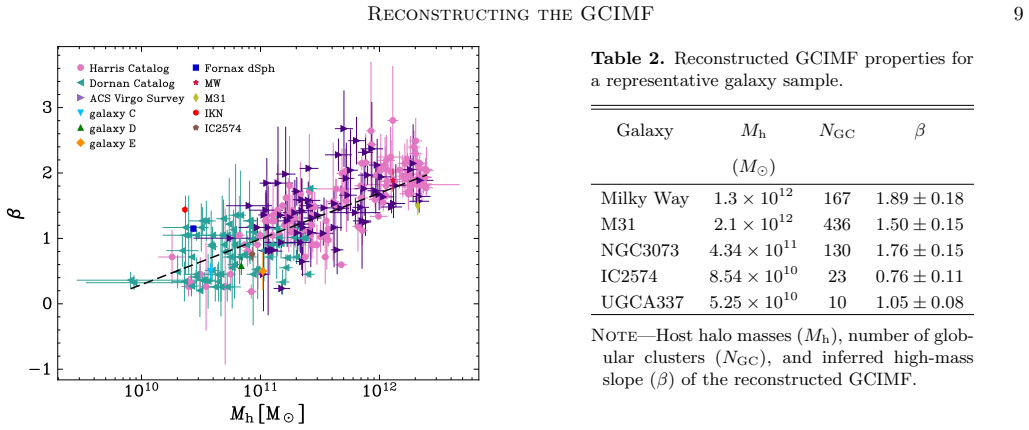
The recovered GCIMFs are systematically shifted towards higher masses and exhibit a power-law behavior at the high-mass end. The inferred slopes vary across galaxies and show a strong correlation with host halo mass, with more massive galaxies exhibiting steeper high-mass slopes. Our results suggest that the slope of the GCIMF depends on the galactic properties and provides a direct empirical link between present-day globular cluster systems and their high-redshift progenitors.
What carries the argument
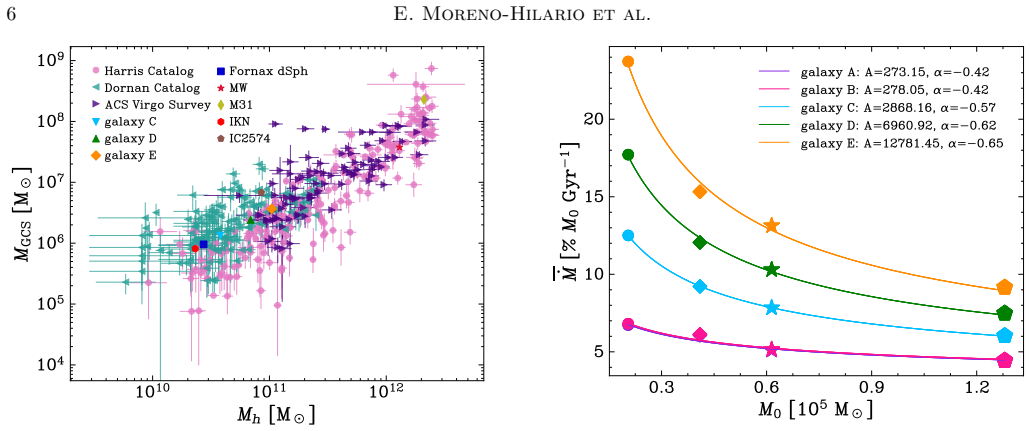
An environment-dependent mass-loss model calibrated by direct N-body simulations in time-dependent tidal fields, which maps observed present-day cluster masses back to progenitor masses without assuming any functional form for the GCIMF.
If this is right
- The high-mass end of the GCIMF is a power law whose slope correlates with host halo mass.
- More massive galaxies host GCIMFs with steeper high-mass power-law slopes.
- The near-universal turnover mass observed today in globular cluster systems arises from dynamical evolution acting on these initial power-law distributions.
- The method supplies an empirical bridge between present-day cluster populations and the conditions under which clusters formed at high redshift.
Where Pith is reading between the lines
- If the slope-halo mass relation holds, hydrodynamic simulations of galaxy formation at early times should produce cluster populations whose initial mass functions also vary systematically with halo mass.
- The reconstruction technique can be applied to statistical samples of galaxies where only global cluster properties are measured, expanding the set of systems for which progenitor masses can be estimated.
- The dependence on galactic properties implies that the physics setting the upper end of the cluster mass spectrum is not universal but responds to the depth of the galactic potential or the ambient density at formation.
Load-bearing premise
The mass-loss rates given by the N-body calibrated model in varying tidal fields correctly describe the actual dynamical evolution that globular clusters experience inside real galaxies.
What would settle it
Repeating the reconstruction on an independent sample of galaxies with directly measured cluster masses and finding no correlation between the recovered high-mass slope and halo mass would falsify the central claim.
Figures
read the original abstract
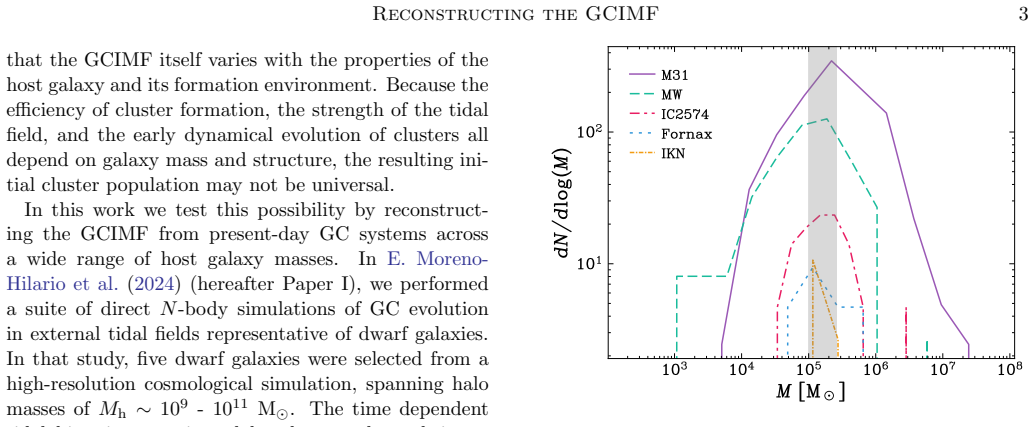
The near-universal turnover mass of the present-day globular cluster mass function (GCMF), $M_{\rm TO} \sim 2 \times 10^5\ {\rm M_\odot}$, is a well established observational feature across galaxies of different types and masses, providing an important empirical benchmark for understanding the globular cluster initial mass function (GCIMF). Competing explanations of this property invoke either dynamical evolution from an initial power-law distribution or an imprint of cluster formation physics. We address this problem by reconstructing the high-mass regime of the GCIMF by inverting the mass loss due to dynamical evolution of present-day globular cluster systems across a wide range of host galaxy masses. Our method is based on an environment-dependent mass-loss model calibrated by direct $N$-body simulations in time-dependent tidal fields, enabling a mapping between observed cluster masses and their progenitor values without assuming a priori a functional form for the GCIMF. We apply our method to galaxies spanning halo masses of $\sim10^{9}$ - $10^{12}\ {\rm M_\odot}$, combining systems with individually measured globular cluster masses as well as large statistical samples constructed from observed global properties. The recovered GCIMFs are systematically shifted towards higher masses and exhibit a power-law behavior at the high-mass end. The inferred slopes vary across galaxies and show a strong correlation with host halo mass, with more massive galaxies exhibiting steeper high-mass slopes. Our results suggest that the slope of the GCIMF depends on the galactic properties and provides a direct empirical link between present-day globular cluster systems and their high-redshift progenitors.
Editorial analysis
A structured set of objections, weighed in public.
Referee Report
Summary. The paper claims to reconstruct the high-mass regime of the globular cluster initial mass function (GCIMF) by inverting dynamical mass loss from observed present-day globular cluster systems. The inversion employs an environment-dependent mass-loss model calibrated directly on N-body simulations in time-dependent tidal fields, without assuming a functional form for the GCIMF a priori. Applied to galaxies spanning halo masses ~10^9–10^12 M_⊙ (using both individually measured clusters and statistical samples from global properties), the recovered GCIMFs are shifted to higher masses, exhibit power-law behavior at the high-mass end, and display slopes that correlate strongly with host halo mass (steeper in more massive galaxies). The results are presented as providing an empirical link between present-day systems and high-redshift progenitors.
Significance. If the mapping is robust, the work offers a direct empirical constraint on the GCIMF across a wide galaxy mass range and suggests environment-dependent formation physics. A notable strength is the avoidance of an assumed GCIMF functional form, relying instead on N-body calibrated mass-loss rates. The combination of resolved and statistical samples broadens applicability. However, the central correlation result requires explicit validation against model-induced artifacts to be considered definitive.
major comments (1)
- [Abstract/method description] Abstract/method description: The environment-dependent mass-loss model (calibrated on N-body simulations in time-dependent tidal fields) is applied on a per-galaxy basis. Tidal strength scales with host galaxy properties that correlate with halo mass over 10^9–10^12 M_⊙. This differential mapping can induce steeper recovered high-mass power-law slopes in more massive halos even if the true GCIMF is identical across systems. No test isolating the model’s environment dependence from the data is described, which is load-bearing for the reported slope-halo mass correlation.
minor comments (1)
- [Abstract] Abstract: No error bars, validation tests against known clusters, or data exclusion criteria are provided for the mass-loss inversion, limiting assessment of robustness.
Simulated Author's Rebuttal
We thank the referee for their thorough review and valuable comments on our manuscript. We address the major comment below.
read point-by-point responses
-
Referee: The environment-dependent mass-loss model (calibrated on N-body simulations in time-dependent tidal fields) is applied on a per-galaxy basis. Tidal strength scales with host galaxy properties that correlate with halo mass over 10^9–10^12 M_⊙. This differential mapping can induce steeper recovered high-mass power-law slopes in more massive halos even if the true GCIMF is identical across systems. No test isolating the model’s environment dependence from the data is described, which is load-bearing for the reported slope-halo mass correlation.
Authors: We agree this is an important point requiring explicit validation. The mass-loss model is physically calibrated from N-body simulations in time-dependent tides, and the observed present-day GCMFs are near-universal across the halo mass range studied. Applying stronger mass loss in more massive halos to match the same present-day masses therefore requires higher initial masses, with the mass-dependent mapping affecting the recovered high-mass slope. To isolate the model’s environment dependence, we will add a forward-modeling test in the revised manuscript: we assume a universal GCIMF, apply the environment-dependent mass-loss rates for different halo masses, and compare the predicted present-day distributions against the observed (near-universal) GCMFs. This will demonstrate that a single GCIMF cannot reproduce the data and that the recovered slope variation is required by the observations under the calibrated model. revision: yes
Circularity Check
No significant circularity; mass-loss model calibrated externally via N-body simulations
full rationale
The paper's core derivation inverts present-day GCMF to GCIMF using an environment-dependent mass-loss model calibrated exclusively by direct N-body simulations in time-dependent tidal fields. This calibration is independent of the target observational sample and does not assume a functional form for the GCIMF. The reported power-law slopes and their correlation with host halo mass emerge as outputs when the mapping is applied across galaxies spanning 10^9–10^12 M_⊙. No equations reduce by construction to fitted inputs, no self-citations are load-bearing for the uniqueness of the method, and no ansatz is smuggled via prior work. The derivation remains self-contained against the external simulation benchmark.
Axiom & Free-Parameter Ledger
Reference graph
Works this paper leans on
-
[1]
Adamo, A., Bradley, L. D., Vanzella, E., et al. 2024, Nature, 632, 513, doi: 10.1038/s41586-024-07703-7
-
[2]
P., Mac Low, M.-M., Agertz, O., Renaud, F., & Li, H
Andersson, E. P., Mac Low, M.-M., Agertz, O., Renaud, F., & Li, H. 2024, A&A, 681, A28, doi: 10.1051/0004-6361/202347792
-
[3]
2018, MNRAS, 478, 1520, doi: 10.1093/mnras/sty1057
Baumgardt, H., & Hilker, M. 2018, MNRAS, 478, 1520, doi: 10.1093/mnras/sty1057
-
[4]
2023, The Galactic Globular Cluster Database,, https: //people.smp.uq.edu.au/HolgerBaumgardt/globular/
Baumgardt, H., Sollima, A., Hilker, M., & et al. 2023, The Galactic Globular Cluster Database,, https: //people.smp.uq.edu.au/HolgerBaumgardt/globular/
2023
-
[5]
Behroozi, P., Wechsler, R. H., Hearin, A. P., & Conroy, C. 2019, MNRAS, 488, 3143, doi: 10.1093/mnras/stz1182
-
[6]
Bell, E. F., McIntosh, D. H., Katz, N., & Weinberg, M. D. 2003, ApJS, 149, 289, doi: 10.1086/378847
work page internal anchor Pith review doi:10.1086/378847 2003
-
[7]
Brodie, J. P., & Strader, J. 2006, ARA&A, 44, 193, doi: 10.1146/annurev.astro.44.051905.092441
-
[8]
Caldwell, N., & Romanowsky, A. J. 2016, ApJ, 824, 42, doi: 10.3847/0004-637X/824/1/42
-
[9]
Chen, Y., & Gnedin, O. Y. 2023, MNRAS, 522, 5638, doi: 10.1093/mnras/stad1328
-
[10]
2026, arXiv e-prints, arXiv:2601.16281, doi: 10.48550/arXiv.2601.16281 de Boer, T
Claeyssens, A., Adamo, A., Kokorev, V., et al. 2026, arXiv e-prints, arXiv:2601.16281, doi: 10.48550/arXiv.2601.16281 de Boer, T. J. L., & Fraser, M. 2016, A&A, 590, A35, doi: 10.1051/0004-6361/201527580
-
[11]
Dornan, V., & Harris, W. E. 2026, ApJ, 998, 41, doi: 10.3847/1538-4357/ae2742
-
[12]
Fall, S. M., & Zhang, Q. 2001, ApJ, 561, 751, doi: 10.1086/323358
-
[13]
Fardal, M. A., Weinberg, M. D., Babul, A., et al. 2013, MNRAS, 434, 2779, doi: 10.1093/mnras/stt1121
-
[14]
Forbes, D. A., Read, J. I., Gieles, M., & Collins, M. L. M. 2018, MNRAS, 481, 5592, doi: 10.1093/mnras/sty2584
-
[15]
Garcia, F. A. B., Ricotti, M., Sugimura, K., & Park, J. 2023, MNRAS, 522, 2495, doi: 10.1093/mnras/stad1092
-
[16]
Gieles, M., & Gnedin, O. Y. 2023, MNRAS, 522, 5340, doi: 10.1093/mnras/stad1287
-
[17]
Gnedin, O. Y., & Ostriker, J. P. 1997, ApJ, 474, 223, doi: 10.1086/303441
-
[18]
Harris, W. E., Harris, G. L., & Hudson, M. J. 2015, ApJ, 806, 36, doi: 10.1088/0004-637X/806/1/36
-
[19]
Harris, W. E., Harris, G. L. H., & Alessi, M. 2013, ApJ, 772, 82, doi: 10.1088/0004-637X/772/2/82
-
[20]
Hunter, J. D. 2007, Computing in Science and Engineering, 9, 90, doi: 10.1109/MCSE.2007.55 Jord´ an, A., McLaughlin, D. E., Cˆ ot´ e, P., et al. 2007, ApJS, 171, 101, doi: 10.1086/516840 Jord´ an, A., Peng, E. W., Blakeslee, J. P., et al. 2009, ApJS, 180, 54, doi: 10.1088/0067-0049/180/1/54
-
[21]
Karim, N., Collins, M. L. M., Forbes, D. A., & Read, J. I. 2024, MNRAS, 530, 4936, doi: 10.1093/mnras/stae611
-
[22]
Kimm, T., Cen, R., Rosdahl, J., & Yi, S. K. 2016, ApJ, 823, 52, doi: 10.3847/0004-637X/823/1/52
-
[23]
Kruijssen, J. M. D. 2015, MNRAS, 454, 1658, doi: 10.1093/mnras/stv2026
-
[24]
Li, H., & Gnedin, O. Y. 2019, MNRAS, 486, 4030, doi: 10.1093/mnras/stz1114
-
[25]
McCrady, N., & Graham, J. R. 2007, ApJ, 663, 844, doi: 10.1086/518357
-
[26]
McLaughlin, D. E. 1994, PASP, 106, 47, doi: 10.1086/133340
-
[27]
McLaughlin, D. E., & Pudritz, R. E. 1996, ApJ, 457, 578, doi: 10.1086/176754
-
[28]
Moreno-Hilario, E., Martinez-Medina, L. A., Li, H., Souza, S. O., & P´ erez-Villegas, A. 2024, MNRAS, 527, 2765, doi: 10.1093/mnras/stad3306
-
[29]
Mowla, L., Iyer, K. G., Desprez, G., et al. 2022, ApJL, 937, L35, doi: 10.3847/2041-8213/ac90ca
-
[30]
Pace, A. B. 2024, arXiv e-prints, arXiv:2411.07424, doi: 10.48550/arXiv.2411.07424
-
[31]
2007, MNRAS, 378, 910, doi: 10.1111/j.1365-2966.2007.11817.x 2, 17, 21
Parmentier, G., & Gilmore, G. 2007, MNRAS, 377, 352, doi: 10.1111/j.1365-2966.2007.11611.x
-
[32]
W., Jord´ an, A., Cˆ ot´ e, P., et al
Peng, E. W., Jord´ an, A., Cˆ ot´ e, P., et al. 2008, ApJ, 681, 197, doi: 10.1086/587951
-
[33]
Pfeffer, J., Kruijssen, J. M. D., Crain, R. A., & Bastian, N. 2018, MNRAS, 475, 4309, doi: 10.1093/mnras/stx3124
-
[34]
2019, A&A, 621, A56, doi: 10.1051/0004-6361/201833355
Posti, L., & Helmi, A. 2019, A&A, 621, A56, doi: 10.1051/0004-6361/201833355
-
[35]
2012, Ap&SS, 341, 195, doi: 10.1007/s10509-012-0986-9
Rejkuba, M. 2012, Ap&SS, 341, 195, doi: 10.1007/s10509-012-0986-9
-
[36]
Rieder, S., Dobbs, C., Bending, T., Liow, K. Y., & Wurster, J. 2022, MNRAS, 509, 6155, doi: 10.1093/mnras/stab3425
-
[37]
Rodriguez, C. L., Hafen, Z., Grudi´ c, M. Y., et al. 2023, MNRAS, 521, 124, doi: 10.1093/mnras/stad578 The pandas development Team. 2025, pandas-dev/pandas: Pandas, v2.3.1 Zenodo, doi: 10.5281/zenodo.3509134
-
[38]
Tudorica, A., Georgiev, I. Y., & Chies-Santos, A. L. 2015, A&A, 581, A84, doi: 10.1051/0004-6361/201525615 van der Walt, S., Colbert, S. C., & Varoquaux, G. 2011, Computing in Science and Engineering, 13, 22, doi: 10.1109/MCSE.2011.37
-
[39]
2023, ApJ, 945, 53, doi: 10.3847/1538-4357/acb59a
Vanzella, E., Claeyssens, A., Welch, B., et al. 2023, ApJ, 945, 53, doi: 10.3847/1538-4357/acb59a
-
[40]
2026, A&A, 705, A171, doi: 10.1051/0004-6361/202556570
Vanzella, E., Messa, M., Adamo, A., et al. 2026, A&A, 705, A171, doi: 10.1051/0004-6361/202556570
-
[41]
2001, MNRAS, 322, 247, doi: 10.1046/j.1365-8711.2001.04072.x 14E
Vesperini, E. 2001, MNRAS, 322, 247, doi: 10.1046/j.1365-8711.2001.04072.x 14E. Moreno-Hilario et al
-
[42]
Virtanen, P., Gommers, R., Oliphant, T. E., et al. 2020, Nature Methods, 17, 261, doi: 10.1038/s41592-019-0686-2 Wes McKinney. 2010, in Proceedings of the 9th Python in Science Conference, ed. St´ efan van der Walt & Jarrod Millman, 56 – 61, doi: 10.25080/Majora-92bf1922-00a
-
[43]
Zhang, Q., & Fall, S. M. 1999, ApJL, 527, L81, doi: 10.1086/312412
discussion (0)
Sign in with ORCID, Apple, or X to comment. Anyone can read and Pith papers without signing in.