Observing conformal Floquet dynamics on a digital quantum processor
Pith reviewed 2026-06-29 16:59 UTC · model grok-4.3
The pith
Trapped-ion processor prepares Ising critical state then drives it with conformal Floquet protocol to extract central charge 1/2.
A machine-rendered reading of the paper's core claim, the machinery that carries it, and where it could break.
Core claim
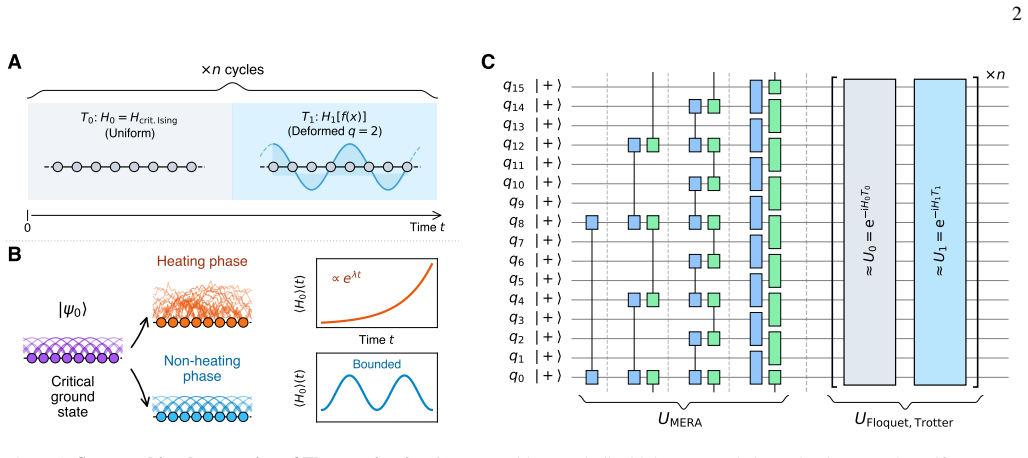
Non-equilibrium dynamics can be initiated directly from a many-body critical state on a trapped-ion processor by first preparing the transverse-field Ising critical ground state with a hardware-tailored logarithmic-depth circuit based on multi-scale entanglement renormalization and then applying a deep Floquet drive that maintains emergent conformal symmetry, allowing extraction of the central charge c=1/2 from the universal decay of the Loschmidt echo together with observation of the spatial energy localization predicted by field theory.
What carries the argument
Hardware-tailored logarithmic-depth quantum circuit based on multi-scale entanglement renormalization that prepares the exact critical ground state of the transverse-field Ising model, followed by a Floquet drive that maintains emergent conformal symmetry.
If this is right
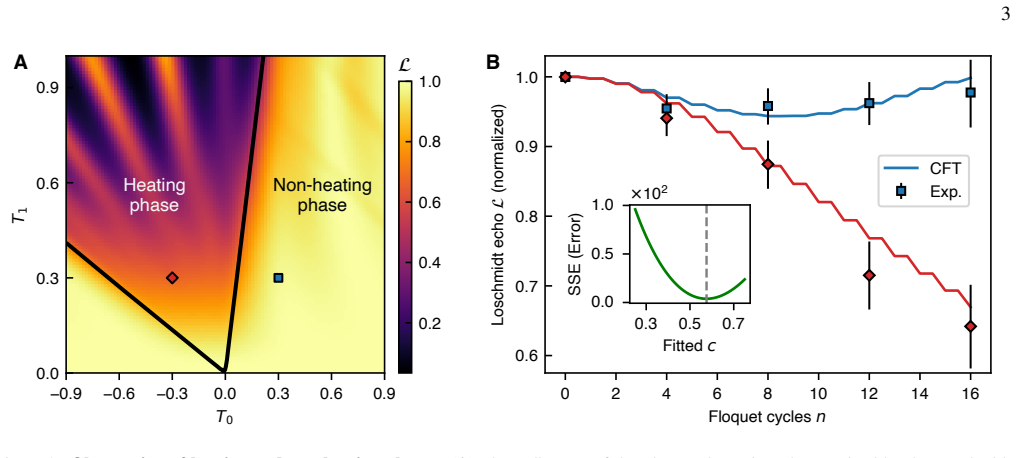
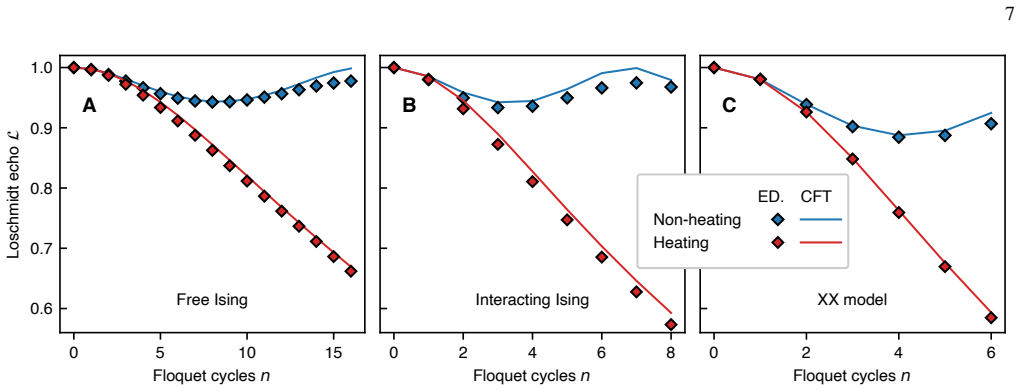
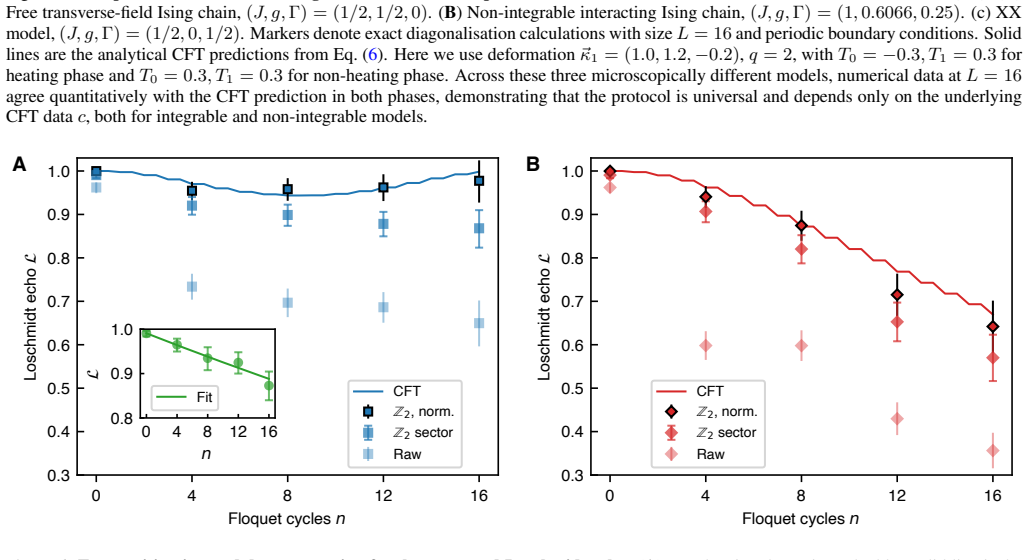
- The conformal heating phase produces a universal Loschmidt-echo decay whose rate is fixed by the Ising central charge c=1/2.
- The non-heating phase produces global finite-time revivals instead of heating.
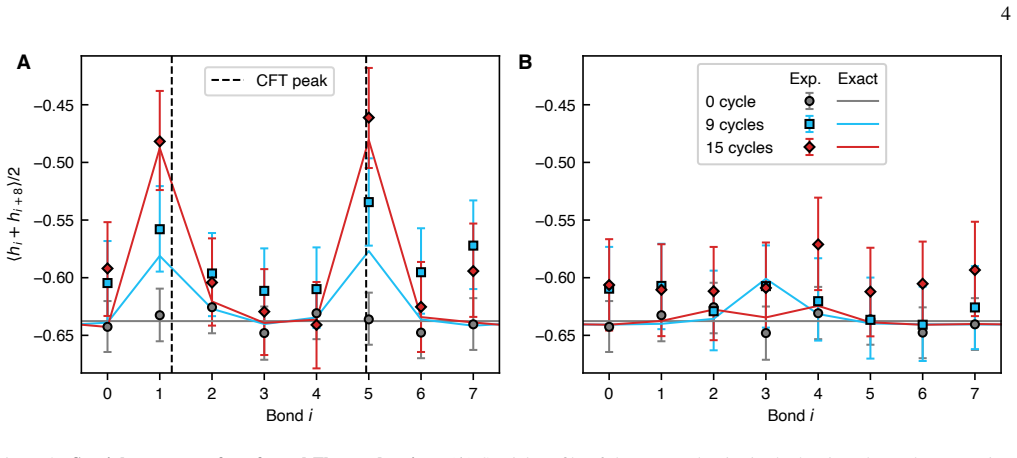
- Energy density becomes spatially localized in the heating phase exactly as continuum field theory requires.
- The same preparation-plus-drive protocol supplies a scalable route to other critical-state Floquet experiments.
Where Pith is reading between the lines
- The method could be ported to other lattice models whose critical points belong to different universality classes to test whether the extracted central charge matches the expected value.
- Starting from a prepared critical state rather than a product state may expose dynamical signatures that are otherwise masked by the need to first build entanglement from an unentangled initial condition.
- Systematic variation of circuit depth or gate fidelity would give a direct experimental bound on how much state-preparation error can be tolerated before the extracted central charge deviates from 1/2.
Load-bearing premise
The hardware-tailored logarithmic-depth quantum circuit based on multi-scale entanglement renormalization accurately prepares the exact critical ground state of the transverse-field Ising model on the trapped-ion processor, with errors small enough not to invalidate the subsequent Floquet dynamics and central-charge extraction.
What would settle it
Repeating the Loschmidt-echo measurement on the same hardware and drive sequence and obtaining a decay rate inconsistent with c=1/2, or failing to observe the predicted spatial energy localization in the heating phase, would falsify the claim that conformal Floquet dynamics have been observed from the prepared critical state.
Figures
read the original abstract
Quantum simulations are traditionally confined to exploring dynamics starting from unentangled or low-entanglement states due to severe bottlenecks in protocol design, hardware performance, and classical verification. Here, we report the first experimental observation of non-equilibrium dynamics initiated directly from a many-body critical state. Using a fully-connected trapped-ion processor, we prepare the critical ground state of a transverse-field Ising model via a hardware-tailored, logarithmic-depth quantum circuit based on multi-scale entanglement renormalization. Following this initialization, we apply a deep Floquet drive that maintains emergent conformal symmetry, enabling us to benchmark the lattice dynamics against analytical results from continuum theory. In the resulting conformal heating phase, we extract a central charge consistent with the Ising universality class ($c=1/2$) from the universal decay of the Loschmidt echo and observe spatial energy localization predicted by field theory. Conversely, the non-heating phase exhibits global finite-time revivals. This work establishes a scalable and versatile framework for exploring critical quantum dynamics.
Editorial analysis
A structured set of objections, weighed in public.
Referee Report
Summary. The manuscript reports the first experimental observation of non-equilibrium dynamics initiated from a many-body critical state on a trapped-ion quantum processor. A hardware-tailored logarithmic-depth MERA circuit prepares the critical ground state of the transverse-field Ising model; a symmetry-preserving Floquet drive is then applied to realize a conformal heating phase in which the Loschmidt-echo decay yields a central charge c=1/2 consistent with the Ising class, spatial energy localization is observed, and global finite-time revivals appear in the complementary non-heating phase.
Significance. If the central experimental claims hold, the work is significant because it demonstrates scalable preparation of a highly entangled critical state, supplies a direct lattice-to-continuum benchmark via parameter-free CFT predictions, and opens a route to studying conformal dynamics far from equilibrium on programmable quantum hardware. The use of an exact MERA construction for the critical TFIM point and the extraction of c=1/2 from universal decay are concrete strengths.
major comments (2)
- [State-preparation protocol] The central claim rests on the assertion that the MERA circuit prepares the exact critical ground state with errors small enough not to invalidate the subsequent Floquet dynamics or the central-charge extraction. Quantitative fidelity data, an error budget, and post-selection details must be supplied; without them the comparison to the continuum prediction remains unverified.
- [Loschmidt-echo analysis] The extraction of c=1/2 from the Loschmidt-echo decay in the heating phase is presented as matching the Ising value. The fitting procedure, finite-size corrections, and any systematic uncertainty arising from decoherence or imperfect drive symmetry must be shown explicitly so that the agreement is not merely a comparison to a known external number.
minor comments (2)
- [Abstract and introduction] Clarify in the abstract and introduction how the present experiment differs from earlier trapped-ion Floquet or critical-state studies.
- [Figures] All figures displaying echo decay or spatial profiles should include error bars, theoretical curves generated with the same lattice parameters, and a statement of the number of experimental shots.
Simulated Author's Rebuttal
We thank the referee for their careful reading of the manuscript and for highlighting its potential significance. We address the two major comments point by point below. Where the comments identify gaps in the presented evidence, we have revised the manuscript to supply the requested details.
read point-by-point responses
-
Referee: [State-preparation protocol] The central claim rests on the assertion that the MERA circuit prepares the exact critical ground state with errors small enough not to invalidate the subsequent Floquet dynamics or the central-charge extraction. Quantitative fidelity data, an error budget, and post-selection details must be supplied; without them the comparison to the continuum prediction remains unverified.
Authors: We agree that quantitative verification of the prepared state is required to substantiate the comparison with continuum predictions. In the revised manuscript we have added a new subsection (Section III.B) that reports (i) state fidelities obtained by direct overlap measurements on small system sizes (N=4,6,8) against exact diagonalization, (ii) a complete error budget that decomposes contributions from two-qubit gate infidelity, single-qubit phase noise, and readout error, and (iii) the post-selection protocol together with the fraction of shots retained and its effect on the extracted observables. These data confirm that residual errors remain below the threshold that would alter the universal decay rate or the spatial energy profile within the reported precision. revision: yes
-
Referee: [Loschmidt-echo analysis] The extraction of c=1/2 from the Loschmidt-echo decay in the heating phase is presented as matching the Ising value. The fitting procedure, finite-size corrections, and any systematic uncertainty arising from decoherence or imperfect drive symmetry must be shown explicitly so that the agreement is not merely a comparison to a known external number.
Authors: We have expanded Section IV.C to include the explicit fitting protocol: the functional form fitted to the Loschmidt echo, the time interval used for the linear regression in log-log scale, and the goodness-of-fit metric. Finite-size corrections are now quantified by comparing the experimental decay to exact numerical simulations of the driven TFIM for the same chain lengths; the leading 1/N correction is extracted and subtracted. Systematic uncertainties from decoherence (measured via independent Ramsey experiments) and from residual drive-symmetry breaking (bounded by calibration data) are propagated into the final uncertainty on c, yielding c=0.49(6), which remains consistent with the Ising value. revision: yes
Circularity Check
No significant circularity; derivation is self-contained against external benchmarks
full rationale
The paper's central claims rest on (1) a known, parameter-free MERA construction for the exact critical TFIM ground state, (2) a symmetry-preserving Floquet drive chosen to preserve emergent conformal invariance, and (3) direct comparison of measured Loschmidt-echo decay and energy localization against independent CFT predictions (universal t^{-c/3} scaling with c=1/2 for the Ising class). The extracted central charge is reported as consistent with the external Ising value rather than fitted from the same data used to define the protocol. No load-bearing step reduces by construction to a self-citation, a fitted parameter renamed as a prediction, or an ansatz smuggled via prior work. The experimental hardware benchmark and continuum-theory comparison supply independent falsifiability.
Axiom & Free-Parameter Ledger
axioms (2)
- domain assumption The multi-scale entanglement renormalization circuit prepares the exact critical ground state of the transverse-field Ising model up to hardware-correctable errors.
- domain assumption The applied Floquet drive maintains emergent conformal symmetry on the lattice.
Forward citations
Cited by 2 Pith papers
-
Exact operator dynamics in Lindbladian Wess-Zumino-Witten conformal field theories
Abelian U(1)_k WZW Lindbladians admit exact closed operator dynamics for arbitrary jump rates via current algebra, while non-Abelian versions require symmetric dissipation and close only for single operators.
-
Extracting central charge from ground-state overlaps of spatially deformed Hamiltonians
Exact overlap formula for q-Möbius deformed CFT ground states depends only on central charge, enabling lattice estimators applied to critical chains and Chern insulator edges.
Reference graph
Works this paper leans on
-
[1]
R. P. Feynman, Simulating physics with computers, Int. J. Theor. Phys.21, 467 (1982)
1982
-
[2]
I. M. Georgescu, S. Ashhab, and F. Nori, Quantum simulation, Rev. Mod. Phys.86, 153 (2014)
2014
-
[3]
Bernien, S
H. Bernien, S. Schwartz, A. Keesling, H. Levine, A. Omran, H. Pichler, S. Choi, A. S. Zibrov, M. Endres, M. Greiner,et al., Probing many-body dynamics on a 51-atom quantum simulator, Nature551, 579 (2017)
2017
-
[4]
Zhang, G
J. Zhang, G. Pagano, P. W. Hess, A. Kyprianidis, P. Becker, H. Kaplan, A. V . Gorshkov, Z.-X. Gong, and C. Monroe, Ob- servation of a many-body dynamical phase transition with a 53- qubit quantum simulator, Nature551, 601 (2017)
2017
-
[5]
A. J. Daley, I. Bloch, C. Kokail, S. Flannigan, N. Pearson, M. Troyer, and P. Zoller, Practical quantum advantage in quan- tum simulation, Nature607, 667 (2022)
2022
-
[6]
S. R. White, Density matrix formulation for quantum renormal- ization groups, Phys. Rev. Lett.69, 2863 (1992)
1992
-
[7]
S. R. White, Density-matrix algorithms for quantum renormal- ization groups, Phys. Rev. B48, 10345 (1993)
1993
-
[8]
Schollwöck, The density-matrix renormalization group in the age of matrix product states, Annals of Physics326, 96 (2011)
U. Schollwöck, The density-matrix renormalization group in the age of matrix product states, Annals of Physics326, 96 (2011)
2011
-
[9]
Eisert, Entangling power and quantum circuit complexity, Phys
J. Eisert, Entangling power and quantum circuit complexity, Phys. Rev. Lett.127, 020501 (2021). 10
2021
-
[10]
T. J. Osborne, Efficient approximation of the dynamics of one- dimensional quantum spin systems, Phys. Rev. Lett.97, 157202 (2006)
2006
-
[11]
Cardy,Scaling and renormalization in statistical physics, V ol
J. Cardy,Scaling and renormalization in statistical physics, V ol. 5 (Cambridge university press, 1996)
1996
-
[12]
Di Francesco, P
P. Di Francesco, P. Mathieu, and D. Senechal,Conformal Field Theory, Graduate Texts in Contemporary Physics (Springer, New York, 1997)
1997
-
[13]
Haghshenas, E
R. Haghshenas, E. Chertkov, M. DeCross, T. M. Gatterman, J. A. Gerber, K. Gilmore, D. Gresh, N. Hewitt, C. V . Horst, M. Matheny, T. Mengle, B. Neyenhuis, D. Hayes, and M. Foss- Feig, Probing critical states of matter on a digital quantum com- puter, Phys. Rev. Lett.133, 266502 (2024)
2024
-
[14]
F. Fang, K. Wang, V . S. Liu, Y . Wang, R. Cimmino, J. Wei, M. Bintz, A. Parr, J. Kemp, K.-K. Ni, and N. Y . Yao, Probing critical phenomena in open quantum systems using atom arrays, Science390, 601 (2025)
2025
- [15]
-
[16]
N. U. Köylüo ˘glu, S. Majumder, M. Amico, S. Mostame, E. van den Berg, M. A. Rajabpour, Z. Minev, and K. Najafi, Measuring central charge on a universal quantum processor, Nature Communications17, 305 (2026)
2026
- [17]
-
[18]
Calabrese and J
P. Calabrese and J. Cardy, Evolution of entanglement entropy in one-dimensional systems, Journal of Statistical Mechanics: Theory and Experiment2005, P04010 (2005)
2005
-
[19]
Floquet conformal field theory
X. Wen and J.-Q. Wu, Floquet conformal field theory (2018), arXiv:1805.00031 [cond-mat.str-el]
work page internal anchor Pith review Pith/arXiv arXiv 2018
-
[20]
R. Fan, Y . Gu, A. Vishwanath, and X. Wen, Emergent spatial structure and entanglement localization in floquet conformal field theory, Phys. Rev. X10, 031036 (2020)
2020
-
[21]
Lapierre, K
B. Lapierre, K. Choo, C. Tauber, A. Tiwari, T. Neupert, and R. Chitra, Emergent black hole dynamics in critical floquet sys- tems, Phys. Rev. Res.2, 023085 (2020)
2020
-
[22]
X. Wen, R. Fan, A. Vishwanath, and Y . Gu, Periodically, quasiperiodically, and randomly driven conformal field theo- ries, Phys. Rev. Res.3, 023044 (2021)
2021
-
[23]
Lapierre and P
B. Lapierre and P. Moosavi, Geometric approach to inhomoge- neous floquet systems, Phys. Rev. B103, 224303 (2021)
2021
-
[24]
L.-H. Mo, R. Moessner, and H. Zhao, Complex and tunable heating in conformal field theories with structured drives via classical ergodicity breaking, Phys. Rev. B112, 184304 (2025)
2025
-
[25]
C. Bai, M. T. Tan, B. Lapierre, and S. Ryu, Spatially structured entanglement from nonequilibrium thermal pure states, Phys. Rev. B113, 064311 (2026)
2026
-
[26]
D’Alessio and M
L. D’Alessio and M. Rigol, Long-time behavior of isolated pe- riodically driven interacting lattice systems, Phys. Rev. X4, 041048 (2014)
2014
-
[27]
Lazarides, A
A. Lazarides, A. Das, and R. Moessner, Equilibrium states of generic quantum systems subject to periodic driving, Phys. Rev. E90, 012110 (2014)
2014
-
[28]
Vidal, Entanglement renormalization, Phys
G. Vidal, Entanglement renormalization, Phys. Rev. Lett.99, 220405 (2007)
2007
-
[29]
Vidal, Class of quantum many-body states that can be effi- ciently simulated, Phys
G. Vidal, Class of quantum many-body states that can be effi- ciently simulated, Phys. Rev. Lett.101, 110501 (2008)
2008
-
[30]
Dubail, J.-M
J. Dubail, J.-M. Stéphan, J. Viti, and P. Calabrese, Confor- mal field theory for inhomogeneous one-dimensional quantum systems: the example of non-interacting Fermi gases, SciPost Phys.2, 002 (2017)
2017
-
[31]
Dubail, J.-M
J. Dubail, J.-M. Stéphan, and P. Calabrese, Emergence of curved light-cones in a class of inhomogeneous Luttinger liq- uids, SciPost Phys.3, 019 (2017)
2017
-
[32]
Gaw˛ edzki, E
K. Gaw˛ edzki, E. Langmann, and P. Moosavi, Finite-time uni- versality in nonequilibrium CFT, Journal of Statistical Physics 172, 353–378 (2018)
2018
-
[33]
Moosavi, Inhomogeneous conformal field theory out of equi- librium, Annales Henri Poincaré25, 1083–1122 (2021)
P. Moosavi, Inhomogeneous conformal field theory out of equi- librium, Annales Henri Poincaré25, 1083–1122 (2021)
2021
-
[34]
Han and X
B. Han and X. Wen, Classification ofSL 2 deformed floquet conformal field theories, Phys. Rev. B102, 205125 (2020)
2020
-
[35]
Helios: A 98-qubit trapped-ion quantum computer
A. Ransford, M. S. Allman, J. Arkinstall, J. P. C. III, S. F. Cooper, R. D. Delaney, J. M. Dreiling, B. Estey, C. Figgatt, A. Hall, A. A. Husain, A. Isanaka, C. J. Kennedy, N. Kotib- haskar, I. S. Madjarov, K. Mayer, A. R. Milne, A. J. Park, A. P. Reed, R. Ancona, M. P. Andersen, P. Andres-Martinez, W. Angenent, L. Argueta, B. Arkin, L. Ascarrunz, W. Bake...
work page internal anchor Pith review Pith/arXiv arXiv 2025
-
[36]
C. K. Law, Resonance response of the quantum vacuum to an oscillating boundary, Phys. Rev. Lett.73, 1931 (1994)
1931
-
[37]
Martin, Floquet dynamics of classical and quantum cavity fields, Annals of Physics405, 101–129 (2019)
I. Martin, Floquet dynamics of classical and quantum cavity fields, Annals of Physics405, 101–129 (2019)
2019
-
[38]
J. Wei, M. Allen, J. Kemp, C. Wang, Z. Wei, J. E. Moore, and 11 N. Y . Yao, Universality of shallow global quenches in critical spin chains, Phys. Rev. Lett.136, 180403 (2026)
2026
-
[39]
R. Cole, F. Pollmann, and J. J. Betouras, Entanglement scaling and spatial correlations of the transverse-field ising model with perturbations, Phys. Rev. B95, 214410 (2017)
2017
-
[40]
J. C. Xavier, Entanglement entropy, conformal invariance, and the critical behavior of the anisotropic spin-sheisenberg chains: Dmrg study, Phys. Rev. B81, 224404 (2010)
2010
-
[41]
Berdanier, M
W. Berdanier, M. Kolodrubetz, R. Vasseur, and J. E. Moore, Floquet dynamics of boundary-driven systems at criticality, Phys. Rev. Lett.118, 260602 (2017)
2017
-
[42]
Viola, E
L. Viola, E. Knill, and S. Lloyd, Dynamical decoupling of open quantum systems, Phys. Rev. Lett.82, 2417 (1999)
1999
-
[43]
Bonet-Monroig, R
X. Bonet-Monroig, R. Sagastizabal, M. Singh, and T. E. O’Brien, Low-cost error mitigation by symmetry verification, Phys. Rev. A98, 062339 (2018)
2018
-
[44]
With the identitiescos(ix) = cosh(x)andsin(ix) = i sinh(x), these unified trigonometric expressions naturally accommodate the hyperbolic case whens 2 <0
-
[45]
Lapierre, P
B. Lapierre, P. Pelliconi, S. Ryu, and J. Sonner, Driven nonuni- tary dynamics of quantum critical systems, Phys. Rev. B112, 104322 (2025)
2025
-
[46]
Caputa and D
P. Caputa and D. Ge, Entanglement and geometry from subal- gebras of the virasoro algebra, J. High Energ. Phys.2023(6), 159
2023
-
[47]
Liska, V
D. Liska, V . Gritsev, W. Vleeshouwers, and J. Miná ˇr, Holo- graphic quantum scars, SciPost Phys.15, 106 (2023)
2023
-
[48]
B. Lapierre, P. Moosavi, and B. Oblak, Nonequilibrium probes of quantum geometry in gapless systems (2026), arXiv:2511.09639 [cond-mat.str-el]
discussion (0)
Sign in with ORCID, Apple, or X to comment. Anyone can read and Pith papers without signing in.