Extracting central charge from ground-state overlaps of spatially deformed Hamiltonians
Pith reviewed 2026-06-28 20:40 UTC · model grok-4.3
The pith
The central charge of a (1+1)D CFT is encoded in the overlap between undeformed and q-Möbius deformed ground states.
A machine-rendered reading of the paper's core claim, the machinery that carries it, and where it could break.
Core claim
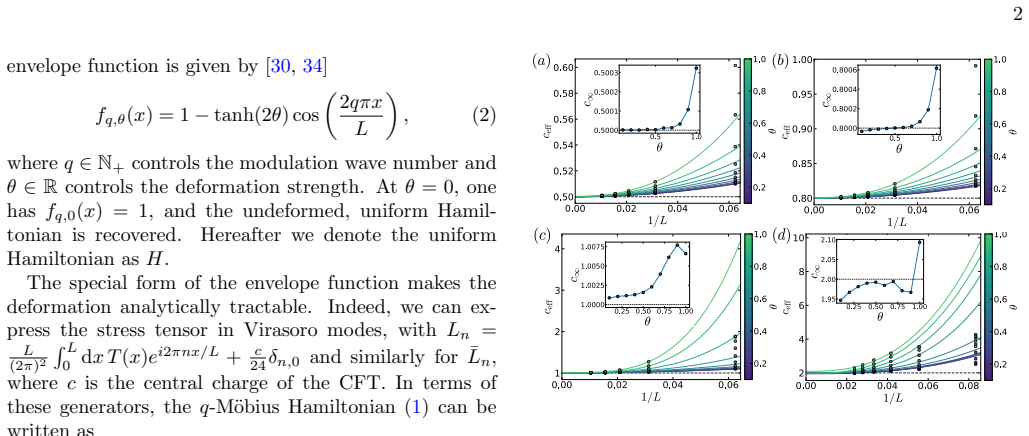
We show that the conformal anomaly of a (1+1)-dimensional conformal field theory can be extracted directly from a ground-state wave-function overlap associated with a spatial conformal deformation. Focusing on the q-Möbius deformation, we derive an exact overlap formula between the deformed and undeformed ground states, whose exponent depends only on the central charge. Motivated by this result, we construct a lattice estimator based solely on ground-state overlaps and apply it to representative critical quantum chains and the gapless edge modes of a two-dimensional Chern insulator.
What carries the argument
The q-Möbius deformation, a one-parameter family of spatial conformal maps on the circle that produces a deformed Hamiltonian whose ground-state overlap with the original state has an exponent fixed solely by the central charge.
If this is right
- Central charge can be obtained from ground-state wavefunctions alone without computing energies or correlation functions.
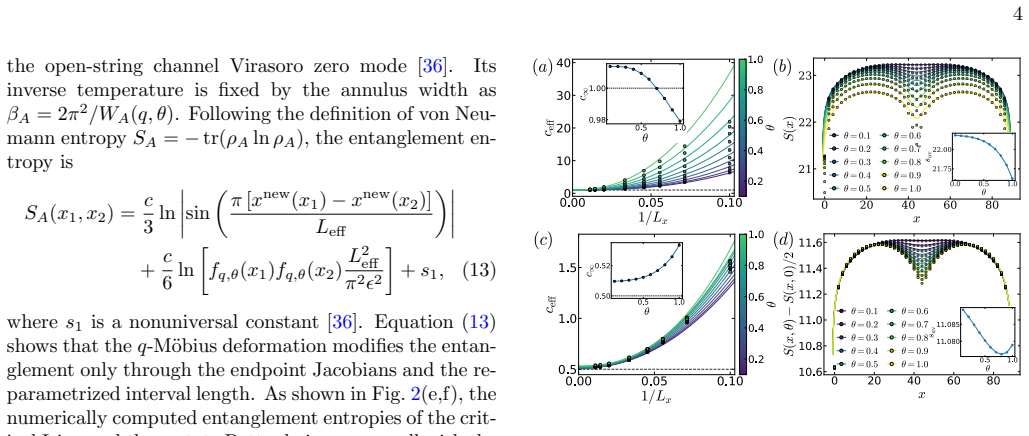
- The same overlap construction applies to gapless edge modes of two-dimensional topological insulators.
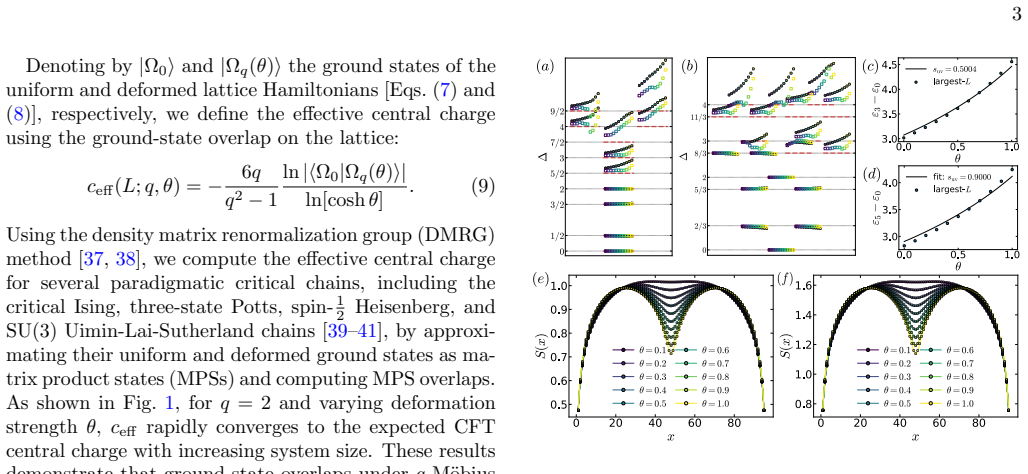
- Deformed ground states retain universal geometric structures in their entanglement spectra and entanglement entropies.
- The lattice estimator is simple to implement and numerically robust for a range of critical spin chains.
Where Pith is reading between the lines
- The method may allow extraction of central charge in models whose continuum limit is not known in advance.
- Other families of conformal deformations could be examined to see whether they also isolate the central charge in an overlap formula.
- The preservation of universal entanglement features under deformation hints that wavefunction overlaps may capture additional CFT data beyond the central charge.
Load-bearing premise
The physical system must be described by a continuum (1+1)D conformal field theory whose lattice regularization preserves the conformal properties needed for the exact overlap formula to hold.
What would settle it
For the critical transverse-field Ising chain (known c=1/2), compute the overlap for a chosen q-Möbius deformation and check whether the exponent of the overlap matches the value predicted by the formula; a statistically significant mismatch would falsify the claim.
Figures
read the original abstract
We show that the conformal anomaly of a $(1+1)$-dimensional conformal field theory can be extracted directly from a ground-state wave-function overlap associated with a spatial conformal deformation. Focusing on the $q$-M\"obius deformation, we derive an exact overlap formula between the deformed and undeformed ground states, whose exponent depends only on the central charge. Motivated by this result, we construct a lattice estimator based solely on ground-state overlaps and apply it to representative critical quantum chains and the gapless edge modes of a two-dimensional Chern insulator. Numerical results demonstrate that the resulting overlaps provide a simple and robust probe of the central charge in microscopic models. We further demonstrate that the deformed ground states retain universal geometric structures in their entanglement spectra and entanglement entropies. These results provide a simple wave-function-based route to probing conformal data in critical systems and topological edge modes.
Editorial analysis
A structured set of objections, weighed in public.
Referee Report
Summary. The manuscript claims that the conformal anomaly (central charge c) of (1+1)D CFTs can be extracted from ground-state wave-function overlaps under a q-Möbius spatial deformation. An exact overlap formula is derived in the continuum whose exponent depends only on c; a lattice estimator is then constructed from this relation and applied to critical quantum chains and the gapless edge modes of a 2D Chern insulator. Numerical results are presented to demonstrate robustness, and the deformed states are shown to retain universal geometric features in their entanglement spectra and entropies.
Significance. If the continuum derivation is rigorous and lattice corrections are demonstrably controlled, the approach supplies a direct wave-function probe of c that requires only ground-state overlaps. This would be useful for tensor-network or DMRG studies of critical chains and topological edge modes, where overlaps are often accessible. The numerical tests on representative models provide practical evidence of utility.
major comments (2)
- [Derivation of the overlap formula (continuum CFT section)] The abstract and introduction assert an exact overlap formula whose logarithm is strictly proportional to c after a CFT derivation, yet the provided text contains no derivation steps, intermediate Ward-identity manipulations, or explicit verification that no other CFT data (e.g., operator dimensions) enter the exponent. This is load-bearing for the central claim that the estimator depends only on c.
- [Lattice estimator and numerical results] The lattice implementation of the q-Möbius deformation on finite chains and edge modes is presented without quantitative bounds on corrections from irrelevant operators or broken conformal Ward identities at finite spacing. The numerical success on representative models does not yet rule out non-universal contributions to the extracted exponent; an explicit finite-size or continuum-limit analysis is required to confirm the claimed parameter-free dependence on c.
minor comments (1)
- The abstract refers to 'representative critical quantum chains' without naming the specific Hamiltonians, system sizes, or bond dimensions used; these details are needed for reproducibility even if the central claim holds.
Simulated Author's Rebuttal
We thank the referee for their thoughtful review and for highlighting two key areas where the manuscript can be strengthened. We agree that both the continuum derivation and the lattice analysis require additional explicit detail to fully support the central claims. Below we respond point by point and outline the revisions we will make.
read point-by-point responses
-
Referee: The abstract and introduction assert an exact overlap formula whose logarithm is strictly proportional to c after a CFT derivation, yet the provided text contains no derivation steps, intermediate Ward-identity manipulations, or explicit verification that no other CFT data (e.g., operator dimensions) enter the exponent. This is load-bearing for the central claim that the estimator depends only on c.
Authors: We acknowledge that the submitted manuscript presents the final overlap formula without the intermediate steps of the derivation. In the revised version we will expand the continuum CFT section to include the full derivation: starting from the q-Möbius transformation, applying the appropriate Ward identities for the stress-tensor insertions, and explicitly showing that all contributions involving operator dimensions cancel, leaving an exponent that depends only on the central charge c. This will make the load-bearing step transparent and verifiable. revision: yes
-
Referee: The lattice implementation of the q-Möbius deformation on finite chains and edge modes is presented without quantitative bounds on corrections from irrelevant operators or broken conformal Ward identities at finite spacing. The numerical success on representative models does not yet rule out non-universal contributions to the extracted exponent; an explicit finite-size or continuum-limit analysis is required to confirm the claimed parameter-free dependence on c.
Authors: We agree that the current numerical section lacks a systematic finite-size or continuum-limit study. In the revision we will add (i) data for multiple system sizes with explicit extrapolation of the extracted exponent to the thermodynamic limit, (ii) a quantitative estimate of the leading irrelevant-operator corrections based on the known scaling dimensions of the models studied, and (iii) a direct comparison of the lattice overlaps against the continuum formula at the largest accessible sizes. These additions will provide the requested bounds and confirm that non-universal contributions are under control. revision: yes
Circularity Check
No circularity: CFT derivation supplies independent input; lattice tests are external validation
full rationale
The central result is an exact overlap formula derived from continuum (1+1)D CFT under the q-Möbius deformation, with the exponent fixed solely by the conformal anomaly (standard Ward identities). This supplies the functional dependence on c as an external theoretical input rather than a fit to the lattice data. The subsequent lattice estimator applies this pre-derived relation to numerical ground-state overlaps on concrete models (critical chains, Chern edge modes); the numerical agreement tests the applicability of the continuum formula but does not redefine or force the exponent. No self-citation chain, self-definitional loop, or fitted-input-renamed-as-prediction appears in the derivation. The continuum-to-lattice step is an assumption about irrelevant-operator corrections, not a circular reduction.
Axiom & Free-Parameter Ledger
axioms (1)
- domain assumption The system is described by a (1+1)D conformal field theory in the continuum limit
Reference graph
Works this paper leans on
-
[1]
(2) to the local Hamiltonian terms eHq(θ) = X X fq,θ(X)h X .(8) For fixedqand finiteθ̸= 0, the deformation profile varies smoothly on the lattice scale in the large-Llimit
We define the latticeq-M¨ obius deformation by applying the same envelope function in Eq. (2) to the local Hamiltonian terms eHq(θ) = X X fq,θ(X)h X .(8) For fixedqand finiteθ̸= 0, the deformation profile varies smoothly on the lattice scale in the large-Llimit. This construction follows the same spirit as the Koo–Saleur approach [14, 15]. 3 Denoting by|Ω...
-
[2]
A. A. Belavin, A. M. Polyakov, and A. B. Zamolodchikov, Infinite Conformal Symmetry in Two-Dimensional Quan- tum Field Theory, Nucl. Phys. B241, 333 (1984)
1984
-
[3]
P. D. Francesco, P. Mathieu, and D. S´ en´ echal,Conformal Field Theory(Springer-Verlag, New York, 1997)
1997
-
[4]
H. W. J. Bl¨ ote, J. L. Cardy, and M. P. Nightingale, Con- formal invariance, the central charge, and universal finite- size amplitudes at criticality, Phys. Rev. Lett.56, 742 (1986)
1986
-
[5]
Affleck, Universal term in the free energy at a critical point and the conformal anomaly, Phys
I. Affleck, Universal term in the free energy at a critical point and the conformal anomaly, Phys. Rev. Lett.56, 746 (1986)
1986
-
[6]
Holzhey, F
C. Holzhey, F. Larsen, and F. Wilczek, Geometric and renormalized entropy in conformal field theory, Nucl. Phys. B424, 443 (1994)
1994
-
[7]
Vidal, J
G. Vidal, J. I. Latorre, E. Rico, and A. Kitaev, Entan- glement in quantum critical phenomena, Phys. Rev. Lett. 90, 227902 (2003)
2003
-
[8]
Calabrese and J
P. Calabrese and J. L. Cardy, Entanglement entropy and quantum field theory, J. Stat. Mech.0406, P06002 (2004)
2004
-
[9]
irreversibility
A. B. Zamolodchikov, “irreversibility” of the flux of the renormalization group in a 2d field theory, JETP Lett. 43, 730 (1986)
1986
-
[10]
J. L. Cardy, Conformal invariance and universality in finite-size scaling, J. Phys. A17, L385 (1984)
1984
-
[11]
Cardy, Thermalization and revivals after a quantum quench in conformal field theory, Phys
J. Cardy, Thermalization and revivals after a quantum quench in conformal field theory, Phys. Rev. Lett.112, 220401 (2014)
2014
-
[12]
Lapierre, P
B. Lapierre, P. Pelliconi, S. Ryu, and J. Sonner, Driven nonunitary dynamics of quantum critical systems, Phys. Rev. B112, 104322 (2025)
2025
-
[13]
B. Lapierre, P. Moosavi, and B. Oblak, Nonequilib- rium Probes of Quantum Geometry in Gapless Systems, (2025), arXiv:2511.09639
-
[14]
L.-H. Mo, B. Lapierre, and Q. Miao, Observing conformal floquet dynamics on a digital quantum processor, (2026), arXiv:2605.27530
work page internal anchor Pith review Pith/arXiv arXiv 2026
-
[15]
W. M. Koo and H. Saleur, Representations of the Vira- soro algebra from lattice models, Nucl. Phys. B426, 459 (1994)
1994
-
[16]
Milsted and G
A. Milsted and G. Vidal, Extraction of conformal data in critical quantum spin chains using the koo-saleur for- mula, Phys. Rev. B96, 245105 (2017)
2017
-
[17]
Zou, Universal information of critical quantum spin chains from wavefunction overlap, Phys
Y. Zou, Universal information of critical quantum spin chains from wavefunction overlap, Phys. Rev. B105, 165420 (2022)
2022
-
[18]
Y. Liu, Y. Zou, and S. Ryu, Operator fusion from wave- function overlap: Universal finite-size corrections and application to the haagerup model, Phys. Rev. B107, 155124 (2023)
2023
-
[19]
H.-H. Tu, Y. Zhang, and X.-L. Qi, Momentum polariza- tion: An entanglement measure of topological spin and chiral central charge, Phys. Rev. B88, 195412 (2013)
2013
-
[20]
M. P. Zaletel, R. S. K. Mong, and F. Pollmann, Topolog- 6 ical characterization of fractional quantum hall ground states from microscopic hamiltonians, Phys. Rev. Lett. 110, 236801 (2013)
2013
-
[21]
Kobayashi, T
R. Kobayashi, T. Wang, T. Soejima, R. S. K. Mong, and S. Ryu, Extracting higher central charge from a single wave function, Phys. Rev. Lett.132, 016602 (2024)
2024
-
[22]
I. H. Kim, B. Shi, K. Kato, and V. V. Albert, Chiral central charge from a single bulk wave function, Phys. Rev. Lett.128, 176402 (2022)
2022
-
[23]
I. H. Kim, B. Shi, K. Kato, and V. V. Albert, Modu- lar commutator in gapped quantum many-body systems, Phys. Rev. B106, 075147 (2022)
2022
-
[24]
Y. Zou, B. Shi, J. Sorce, I. T. Lim, and I. H. Kim, Mod- ular commutators in conformal field theory, Phys. Rev. Lett.129, 260402 (2022)
2022
-
[25]
Fan, From entanglement generated dynamics to the gravitational anomaly and chiral central charge, Phys
R. Fan, From entanglement generated dynamics to the gravitational anomaly and chiral central charge, Phys. Rev. Lett.129, 260403 (2022)
2022
-
[26]
Hikihara and T
T. Hikihara and T. Nishino, Connecting distant ends of one-dimensional critical systems by a sine-square defor- mation, Phys. Rev. B83, 060414(R) (2011)
2011
-
[27]
Katsura, Exact ground state of the sine-square de- formed xy spin chain, J
H. Katsura, Exact ground state of the sine-square de- formed xy spin chain, J. Phys. A44, 252001 (2011)
2011
-
[28]
Maruyama, H
I. Maruyama, H. Katsura, and T. Hikihara, Sine-square deformation of free fermion systems in one and higher dimensions, Phys. Rev. B84, 165132 (2011)
2011
-
[29]
Katsura, Sine-square deformation of solvable spin chains and conformal field theories, J
H. Katsura, Sine-square deformation of solvable spin chains and conformal field theories, J. Phys. A45, 115003 (2012)
2012
-
[30]
Tada, Sine-square deformation and its relevance to string theory, Mod
T. Tada, Sine-square deformation and its relevance to string theory, Mod. Phys. Lett. A30, 1550092 (2015)
2015
-
[31]
Okunishi, Sine-square deformation and M¨ obius quan- tization of 2D conformal field theory, Prog
K. Okunishi, Sine-square deformation and M¨ obius quan- tization of 2D conformal field theory, Prog. Theor. Exp. Phys.2016, 063A02 (2016)
2016
-
[32]
Tamura and H
S. Tamura and H. Katsura, Zero-energy states in con- formal field theory with sine-square deformation, Prog. Theor. Exp. Phys.2017, 113A01 (2017)
2017
-
[33]
Miyata, M
A. Miyata, M. Nozaki, K. Tamaoka, and M. Watanabe, Hawking-Page and entanglement phase transition in 2d CFT on curved backgrounds, J. High Energy Phys.08, 190
-
[34]
C. Bai, A. Miyata, and M. Nozaki, Entanglement dy- namics in 2d hcfts on the curved background: the case of q-m¨ obius hamiltonian, J. High Energy Phys.12, 208
-
[35]
R. Fan, Y. Gu, A. Vishwanath, and X. Wen, Emergent spatial structure and entanglement localization in floquet conformal field theory, Phys. Rev. X10, 031036 (2020)
2020
-
[36]
Han and X
B. Han and X. Wen, Classification ofsL 2 deformed flo- quet conformal field theories, Phys. Rev. B102, 205125 (2020)
2020
-
[37]
See Supplemental Material for derivations of the q- M¨ obius-deformed ground state, the exact overlap for- mula, the entanglement spectrum and entropy, and ad- ditional numerical results
-
[38]
S. R. White, Density matrix formulation for quantum renormalization groups, Phys. Rev. Lett.69, 2863 (1992)
1992
-
[39]
Schollw¨ ock, The density-matrix renormalization group in the age of matrix product states, Ann
U. Schollw¨ ock, The density-matrix renormalization group in the age of matrix product states, Ann. Phys.326, 96 (2011)
2011
-
[40]
G. V. Uimin, One-dimensional problem for s = 1 with modified antiferromagnetic hamiltonian, JEPT Lett.12, 332 (1970)
1970
-
[41]
C. K. Lai, Lattice gas with nearest-neighbor interaction in one dimension with arbitrary statistics, J. Math. Phys. 15, 1675 (1974)
1974
-
[42]
Sutherland, Model for a multicomponent quantum system, Phys
B. Sutherland, Model for a multicomponent quantum system, Phys. Rev. B12, 3795 (1975)
1975
-
[43]
A. M. L¨ auchli, Operator content of real-space entan- glement spectra at conformal critical points, (2013), arXiv:1303.0741
work page internal anchor Pith review Pith/arXiv arXiv 2013
-
[44]
Li and F
H. Li and F. D. M. Haldane, Entanglement spectrum as a generalization of entanglement entropy: Identification of topological order in non-abelian fractional quantum hall effect states, Phys. Rev. Lett.101, 010504 (2008)
2008
-
[45]
The spectral gaps are fitted using the analytical expres- sion with a non-universal UV constant, which reflects the dependence on the UV cutoffϵinW A(q, θ)
-
[46]
The entanglement entropy for different deformation strengthsθis fitted using a common UV constant, sug- gesting that this UV contribution is invariant under the deformation
-
[47]
Qi, Y.-S
X.-L. Qi, Y.-S. Wu, and S.-C. Zhang, Topological quan- tization of the spin hall effect in two-dimensional param- agnetic semiconductors, Phys. Rev. B74, 085308 (2006)
2006
-
[48]
For two Slater-determinant states|ψ 1⟩= QM m=1 d† m|0⟩ and|ψ 2⟩= QM m=1 f † m|0⟩, withd † m = P i c† i(V1)i,m and f † m = P i c† i(V2)i,m, the overlap is given by⟨ψ 1|ψ2⟩= det(V † 1 V2)
-
[49]
Peschel, Calculation of reduced density matrices from correlation functions, J
I. Peschel, Calculation of reduced density matrices from correlation functions, J. Phys. A36, L205 (2003)
2003
-
[50]
A. J. Daley, I. Bloch, C. Kokail, S. Flannigan, N. Pearson, M. Troyer, and P. Zoller, Practical quantum advantage in quantum simulation, Nature607, 667 (2022)
2022
-
[51]
A. K. Ekert, C. M. Alves, D. K. L. Oi, M. Horodecki, P. Horodecki, and L. C. Kwek, Direct estimations of lin- ear and nonlinear functionals of a quantum state, Phys. Rev. Lett.88, 217901 (2002)
2002
-
[52]
Brydges, A
T. Brydges, A. Elben, P. Jurcevic, B. Vermersch, C. Maier, B. P. Lanyon, P. Zoller, R. Blatt, and C. F. Roos, Probing r´ enyi entanglement entropy via random- ized measurements, Science364, 260 (2019)
2019
-
[53]
Elben, S
A. Elben, S. T. Flammia, H.-Y. Huang, R. Kueng, J. Preskill, B. Vermersch, and P. Zoller, The randomized measurement toolbox, Nat. Rev. Phys.5, 9 (2023)
2023
-
[54]
Hauschild, J
J. Hauschild, J. Unfried, S. Anand, B. Andrews, M. Bintz, U. Borla, S. Divic, M. Drescher, J. Geiger, M. Hefel, K. H´ emery, W. Kadow, J. Kemp, N. Kirchner, V. S. Liu, G. M¨ oller, D. Parker, M. Rader, A. Romen, S. Scalet, L. Schoonderwoerd, M. Schulz, T. Soejima, P. Thoma, Y. Wu, P. Zechmann, L. Zweng, R. S. K. Mong, M. P. Zaletel, and F. Pollmann, Tenso...
2024
-
[55]
ground-state degeneracy
I. Affleck and A. W. W. Ludwig, Universal noninteger “ground-state degeneracy” in critical quantum systems, Phys. Rev. Lett.67, 161 (1991)
1991
-
[56]
Blume, Theory of the first-order magnetic phase change in uo2, Phys
M. Blume, Theory of the first-order magnetic phase change in uo2, Phys. Rev.141, 517 (1966)
1966
-
[57]
Capel, On the possibility of first-order phase transi- tions in ising systems of triplet ions with zero-field split- ting, Physica32, 966 (1966)
H. Capel, On the possibility of first-order phase transi- tions in ising systems of triplet ions with zero-field split- ting, Physica32, 966 (1966)
1966
-
[58]
J. C. Xavier and F. C. Alcaraz, Finite-size corrections of the entanglement entropy of critical quantum chains, Phys. Rev. B85, 024418 (2012)
2012
-
[59]
Albertini, S
G. Albertini, S. Dasmahapatra, and B. M. McCoy, Spec- trum doubling and the extended brillouin zone in the ex- citations of the three state potts spin chain, Phys. Lett. 7 A170, 397 (1992)
1992
-
[60]
Gomez, G
C. Gomez, G. Sierra, and M. Ruiz-Altaba,Quantum groups in two-dimensional physics(Cambridge Univer- sity Press, 2011)
2011
-
[61]
Dotsenko and V
V. Dotsenko and V. Fateev, Conformal algebra and mul- tipoint correlation functions in 2d statistical models, Nucl. Phys. B240, 312 (1984)
1984
-
[62]
Kedem and B
R. Kedem and B. M. McCoy, Construction of modular branching functions from bethe’s equations in the 3-state potts chain, J. Stat. Phys.71, 865 (1993)
1993
-
[63]
W. Li, S. Yang, H.-H. Tu, and M. Cheng, Criticality in translation-invariant parafermion chains, Phys. Rev. B 91, 115133 (2015)
2015
-
[64]
Affleck, Critical behaviour of su(n) quantum chains and topological non-linearσ-models, Nucl
I. Affleck, Critical behaviour of su(n) quantum chains and topological non-linearσ-models, Nucl. Phys. B305, 582 (1988)
1988
-
[65]
F¨ uhringer, S
M. F¨ uhringer, S. Rachel, R. Thomale, M. Greiter, and P. Schmitteckert, Dmrg studies of critical su (n) spin chains, Ann. Phys. (Berlin)520, 922 (2008)
2008
-
[66]
Extracting central charge from ground-state overlaps of spatially deformed Hamiltonians
M. Aguado, M. Asorey, E. Ercolessi, F. Ortolani, and S. Pasini, Density-matrix renormalization-group simula- tion of theSU(3) antiferromagnetic heisenberg model, Phys. Rev. B79, 012408 (2009). 8 Supplemental Material for “Extracting central charge from ground-state overlaps of spatially deformed Hamiltonians” This Supplemental Material provides technical ...
2009
discussion (0)
Sign in with ORCID, Apple, or X to comment. Anyone can read and Pith papers without signing in.