REVIEW 2 major objections 115 references
Synthetic information can inherit hidden traits via steganography that persist through edits and reveal its parent source on query.
Reviewed by Pith at T0; open to challenge. T0 means a machine referee read the full paper against a public rubric. the ladder, T0–T4 →
Proposes steganographic inheritance to embed and extract lineage traits for tracing the origins of synthetic information produced by AI models.
T0 review reviewed 2026-06-29 challenge →
load-bearing objection The paper sketches a steganography mechanism to embed traceable lineage traits in synthetic content but the abstract supplies no derivations, data, or results to check whether it works. the 2 major comments →
On the Origin of Synthetic Information by Means of Steganographic Inheritance
The pith
A machine-rendered reading of the paper's core claim, the machinery that carries it, and where it could break.
The reading
Core claim
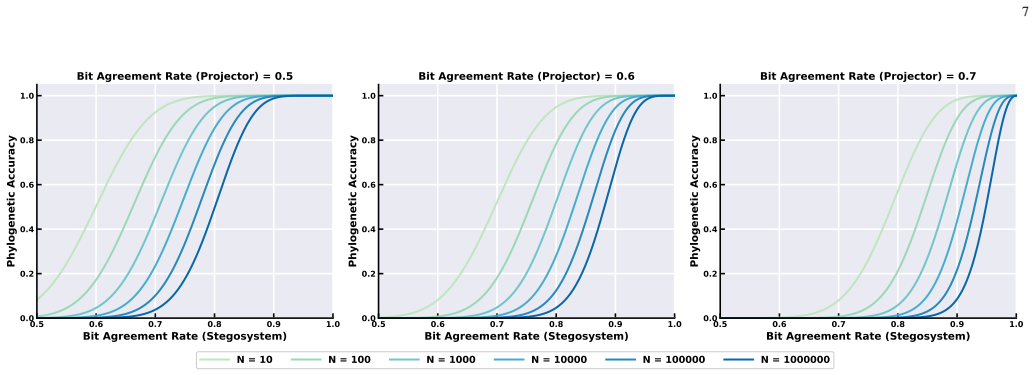
At the instant an offspring is generated, a projector extracts a trait from the parent and a steganographic encoder conceals that trait inside the offspring. The trait survives the offspring's subsequent life cycle. When parentage is later queried, a decoder recovers the trait and compares it against traits stored for candidate parents, nominating the closest match. Phylogenetic accuracy is characterized as a function of projector and stegosystem parameters, and empirical tests confirm the method operates under a wide range of processing operations and semantic modifications.
What carries the argument
The steganographic inheritance pipeline: a projector that derives a trait from the parent, an encoder that invisibly embeds it in the offspring, and a decoder that later extracts and matches the trait to a reference pool of candidate parents.
Load-bearing premise
The embedded steganographic traits survive the full life cycle of the offspring content and can still be extracted and correctly matched after processing operations and semantic modifications.
What would settle it
A sequence of common editing operations and semantic alterations applied to generated content such that the decoder either fails to extract any trait or extracts one that does not match the true parent in the reference pool.
If this is right
- Lineage tracing becomes possible for synthetic content even when structural or signal-level resemblance to the parent has been lost.
- A reference pool of parent traits allows nomination of the most likely source for any queried offspring.
- Accuracy of the tracing depends on the choice of projector and the robustness properties of the stegosystem employed.
- The method remains viable across a broad spectrum of processing operations and semantic modifications.
Where Pith is reading between the lines
- Such traits could support accountability mechanisms that distinguish synthetic from human-authored content at scale.
- Widespread adoption would require ecosystems to maintain and query large reference pools of parent traits.
- The approach could be combined with existing content-authentication standards to create layered provenance records.
Editorial analysis
A structured set of objections, weighed in public.
Referee Report
Summary. The manuscript proposes a steganographic inheritance mechanism for tracing the lineage of synthetic information, drawing an analogy to genetic heredity. A projector derives a trait from the parent at reproduction, which a steganographic encoder hides invisibly in the offspring; the trait persists through the offspring's life cycle and can be extracted by a decoder to match against a reference pool of candidate parents. The abstract claims a theoretical analysis that characterizes phylogenetic accuracy as a function of projector and stegosystem properties, together with empirical evaluations across multiple projectors and stegosystems that demonstrate viability under processing operations and semantic modifications.
Significance. If the claimed theoretical characterization and empirical results hold, the method could provide a practical means of attributing parentage to synthetic (including AI-generated) content despite modifications, addressing attribution and trust issues in information ecosystems. The abstract indicates an absence of free parameters and ad-hoc axioms, which would be a notable strength if the derivations are parameter-free and the empirical setups are reproducible; however, no such derivations, equations, data, or results are present in the manuscript.
major comments (2)
- [Abstract] Abstract: the central claims of a 'theoretical analysis [that] characterises phylogenetic accuracy as a function of projector and stegosystem properties' and 'empirical evaluations across multiple projectors and stegosystems [that] demonstrate the viability' are unsupported, as the manuscript text contains neither the derivations, equations, projector definitions, stegosystem parameters, phylogenetic accuracy formulas, nor any data, tables, or results from the claimed evaluations.
- [Abstract] Abstract: the assertion that 'steganographic traits persist throughout the offspring's life cycle in a cyber ecosystem and can be accurately extracted and matched despite processing operations and semantic modifications' is presented as a load-bearing assumption for the methodology, yet no analysis, bounds, or experimental controls addressing extraction accuracy under those conditions are provided.
Simulated Author's Rebuttal
We thank the referee for their review. The submitted manuscript consists only of the abstract, which outlines a conceptual proposal and states claims about theoretical analysis and empirical evaluations that are not present in the text. We respond to the major comments below.
read point-by-point responses
-
Referee: [Abstract] Abstract: the central claims of a 'theoretical analysis [that] characterises phylogenetic accuracy as a function of projector and stegosystem properties' and 'empirical evaluations across multiple projectors and stegosystems [that] demonstrate the viability' are unsupported, as the manuscript text contains neither the derivations, equations, projector definitions, stegosystem parameters, phylogenetic accuracy formulas, nor any data, tables, or results from the claimed evaluations.
Authors: The referee correctly observes that the manuscript contains none of the claimed derivations, equations, definitions, formulas, data, or results. The abstract summarizes intended contributions of a fuller work, but those elements are absent from the submitted text. We will revise by either expanding the manuscript to include the analysis and evaluations or by removing the unsubstantiated claims from the abstract. revision: yes
-
Referee: [Abstract] Abstract: the assertion that 'steganographic traits persist throughout the offspring's life cycle in a cyber ecosystem and can be accurately extracted and matched despite processing operations and semantic modifications' is presented as a load-bearing assumption for the methodology, yet no analysis, bounds, or experimental controls addressing extraction accuracy under those conditions are provided.
Authors: We agree that the manuscript provides no analysis, bounds, or experimental controls for trait persistence or extraction accuracy under processing operations and semantic modifications. The claim appears in the abstract without supporting material. We will revise the abstract to qualify or remove this assertion. revision: yes
Circularity Check
No significant circularity
full rationale
The paper proposes a steganographic inheritance mechanism for tracing synthetic information lineages, drawing an analogy to genetics. It outlines a theoretical analysis of phylogenetic accuracy in terms of projector and stegosystem properties plus empirical evaluations across processing operations. The provided text (abstract plus description) contains no equations, fitted parameters presented as predictions, self-citations, or ansatzes that reduce any claimed result to its own inputs by construction. The derivation chain is a forward proposal relying on established steganography techniques applied to a new domain, with no load-bearing self-referential steps.
Axiom & Free-Parameter Ledger
Cite this review
Pith. "Pith review of On the Origin of Synthetic Information by Means of Steganographic Inheritance." pith.science (2026). https://pith.science/paper/4Z7M74HG
@misc{pith2026260527551,
  author       = {Pith},
  title        = {Pith review of: On the Origin of Synthetic Information by Means of Steganographic Inheritance},
  year         = {2026},
  howpublished = {\url{https://pith.science/paper/4Z7M74HG}},
  note         = {Machine review of arXiv:2605.27551}
}
read the original abstract
The origin of species has been the mystery of mysteries in natural science. By analogy, the origin of synthetic information, we suggest, is the mystery of mysteries in information science. The question carries a moral weight that a technical account can neither fully resolve nor responsibly ignore, as its impact on truth, trust, and human intellect extends deep into the broader economy and society. The very power of artificial intelligence makes the evolutionary lineage of synthetic information grow ever harder to trace, for a sufficiently capable model may generate offspring that bear little resemblance, at either the structural or signal level, to the parent source from which they were derived. As in genetics, two individuals may share the same phenotype mirroring each other in outward appearance, yet differ fundamentally in their genotype. We propose, by means of steganography, a mechanism analogous to heredity. At the moment an offspring is reproduced, a projector derives a trait from the parent, and a steganographic encoder invisibly hides it within the offspring. This trait persists throughout the offspring's life cycle in a cyber ecosystem. When parentage is queried, a steganographic decoder extracts the trait from the offspring and compares it against the traits of candidate parents in a reference pool, thereby nominating the most likely one. A theoretical analysis characterises phylogenetic accuracy as a function of projector and stegosystem properties, whilst empirical evaluations across multiple projectors and stegosystems demonstrate the viability of the proposed methodology under a broad spectrum of processing operations and semantic modifications. We envision a cyber ecosystem in which synthetic information, endowed with hidden yet traceable lineage traits, branches from a simple beginning into endless forms that have been, and are being, evolved.
Figures




Reference graph
Works this paper leans on
-
[1]
Darwin,On the Origin of Species by Means of Natural Selection, or the Preservation of Favoured Races in the Struggle for Life
C. Darwin,On the Origin of Species by Means of Natural Selection, or the Preservation of Favoured Races in the Struggle for Life. London, UK: John Murray, 1859
-
[2]
Computing machinery and intelligence,
A. M. Turing, “Computing machinery and intelligence,”Mind, vol. 59, no. 236, pp. 433–460, 1950
1950
-
[3]
Learning repre- sentations by back-propagating errors,
D. E. Rumelhart, G. E. Hinton, and R. J. Williams, “Learning repre- sentations by back-propagating errors,”Nature, vol. 323, no. 6088, pp. 533–536, 1986
1986
-
[4]
Deep learning,
Y . LeCun, Y . Bengio, and G. E. Hinton, “Deep learning,”Nature, vol. 521, no. 7553, pp. 436–444, 2015
2015
-
[5]
The science of fake news,
D. M. J. Lazeret al., “The science of fake news,”Science, vol. 359, no. 6380, pp. 1094–1096, 2018
2018
-
[6]
Artificial intelligence, deepfakes and a future of ectypes,
L. Floridi, “Artificial intelligence, deepfakes and a future of ectypes,” Philos. Technol., vol. 31, no. 3, pp. 317–321, 2018
2018
-
[7]
The spread of true and false news online,
S. V osoughi, D. Roy, and S. Aral, “The spread of true and false news online,”Science, vol. 359, no. 6380, pp. 1146–1151, 2018
2018
-
[8]
AI content detection in the emerging information ecosystem: New obligations for media and tech companies,
A. Knottet al., “AI content detection in the emerging information ecosystem: New obligations for media and tech companies,”Ethics Inf. Technol., vol. 26, no. 4, pp. 1–14, 2024
2024
-
[9]
Auto-encoding variational Bayes,
D. P. Kingma and M. Welling, “Auto-encoding variational Bayes,” in Proc. Int. Conf. Learn. Represent. (ICLR), Banff, AB, Canada, 2014, pp. 1–14
2014
-
[10]
Generative adversarial nets,
I. Goodfellowet al., “Generative adversarial nets,” inProc. Int. Conf. Neural Inf. Process. Syst. (NeurIPS), vol. 27, Montréal, QC, Canada, 2014, pp. 2672–2680
2014
-
[11]
Denoising diffusion probabilistic models,
J. Ho, A. Jain, and P. Abbeel, “Denoising diffusion probabilistic models,” inProc. Int. Conf. Neural Inf. Process. Syst. (NeurIPS), vol. 33, Virtual Event, 2020, pp. 6840–6851
2020
-
[12]
Language models are few-shot learners,
T. Brownet al., “Language models are few-shot learners,” inProc. Int. Conf. Neural Inf. Process. Syst. (NeurIPS), vol. 33, Virtual Event, 2020, pp. 1877–1901
2020
-
[13]
The malicious use of artificial intelligence: Fore- casting, prevention, and mitigation,
M. Brundageet al., “The malicious use of artificial intelligence: Fore- casting, prevention, and mitigation,” Apollo – University of Cambridge Repository, Tech. Rep., 2018
2018
-
[14]
Deep fakes: A looming challenge for privacy, democracy, and national security,
B. Chesney and D. Citron, “Deep fakes: A looming challenge for privacy, democracy, and national security,”Calif. Law Rev., vol. 107, no. 6, pp. 1753–1820, 2019
2019
-
[15]
Deepfakes and disinformation: Explor- ing the impact of synthetic political video on deception, uncertainty, and trust in news,
C. Vaccari and A. Chadwick, “Deepfakes and disinformation: Explor- ing the impact of synthetic political video on deception, uncertainty, and trust in news,”Soc. Media + Soc., vol. 6, no. 1, pp. 1–13, 2020
2020
-
[16]
Believe in artificial intelligence? A user study on the ChatGPT’s fake information impact,
I. Amaro, P. Barra, A. D. Greca, R. Francese, and C. Tucci, “Believe in artificial intelligence? A user study on the ChatGPT’s fake information impact,”IEEE Trans. Comput. Soc. Syst., vol. 11, no. 4, pp. 5168–5177, 2024
2024
-
[17]
Large-scale image phylogeny: Tracing image ancestral relationships,
Z. Dias, S. Goldenstein, and A. Rocha, “Large-scale image phylogeny: Tracing image ancestral relationships,”IEEE Multimed., vol. 20, no. 3, pp. 58–70, 2013
2013
-
[18]
Schrödinger,What Is Life? The Physical Aspect of the Living Cell
E. Schrödinger,What Is Life? The Physical Aspect of the Living Cell. Cambridge, UK: Cambridge University Press, 1944
1944
-
[19]
Vision of the unseen: Current trends and challenges in digital image and video forensics,
A. Rocha, W. Scheirer, T. Boult, and S. Goldenstein, “Vision of the unseen: Current trends and challenges in digital image and video forensics,”ACM Comput. Surv., vol. 43, no. 4, pp. 1–42, 2011
2011
-
[20]
Gradient-based learning applied to document recognition,
Y . LeCun, L. Bottou, Y . Bengio, and P. Haffner, “Gradient-based learning applied to document recognition,”Proc. IEEE, vol. 86, no. 11, pp. 2278–2324, 1998
1998
-
[21]
Every picture tells a story: Generating sentences from images,
A. Farhadiet al., “Every picture tells a story: Generating sentences from images,” inProc. Eur. Conf. Comput. Vis. (ECCV), Heraklion, Greece, 2010, pp. 15–29
2010
-
[22]
I2T: Image parsing to text description,
B. Z. Yao, X. Yang, L. Lin, M. W. Lee, and S.-C. Zhu, “I2T: Image parsing to text description,”Proc. IEEE, vol. 98, no. 8, pp. 1485–1508, 2010
2010
-
[23]
One-shot learning of object categories,
L. Fei-Fei, R. Fergus, and P. Perona, “One-shot learning of object categories,”IEEE Trans. Pattern Anal. Mach. Intell., vol. 28, no. 4, pp. 594–611, 2006
2006
-
[24]
Grounded compositional semantics for finding and describing images with sentences,
R. Socher, A. Karpathy, Q. V . Le, C. D. Manning, and A. Y . Ng, “Grounded compositional semantics for finding and describing images with sentences,”Trans. Assoc. Comput. Linguist., vol. 2, pp. 207–218, 2014
2014
-
[25]
Show and tell: A neural image caption generator,
O. Vinyals, A. Toshev, S. Bengio, and D. Erhan, “Show and tell: A neural image caption generator,” inProc. IEEE Conf. Comput. Vis. Pattern Recognit. (CVPR), Boston, MA, USA, 2015, pp. 3156–3164
2015
-
[26]
Video Google: A text retrieval approach to object matching in videos,
J. Sivic and A. Zisserman, “Video Google: A text retrieval approach to object matching in videos,” inProc. IEEE Int. Conf. Comput. Vis. (ICCV), Nice, France, 2003, pp. 1470–1477
2003
-
[27]
Object retrieval with large vocabularies and fast spatial matching,
J. Philbin, O. Chum, M. Isard, J. Sivic, and A. Zisserman, “Object retrieval with large vocabularies and fast spatial matching,” inProc. IEEE Conf. Comput. Vis. Pattern Recognit. (CVPR), Minneapolis, MN, USA, 2007, pp. 1–8
2007
-
[28]
Large-scale discovery of spatially related images,
O. Chum and J. Matas, “Large-scale discovery of spatially related images,”IEEE Trans. Pattern Anal. Mach. Intell., vol. 32, no. 2, pp. 371–377, 2010
2010
-
[29]
Neural codes for image retrieval,
A. Babenko, A. Slesarev, A. Chigorin, and V . Lempitsky, “Neural codes for image retrieval,” inProc. Eur. Conf. Comput. Vis. (ECCV), Zurich, Switzerland, 2014, pp. 584–599
2014
-
[30]
Deep image retrieval: Learning global representations for image search,
A. Gordo, J. Almazán, J. Revaud, and D. Larlus, “Deep image retrieval: Learning global representations for image search,” inProc. Eur. Conf. Comput. Vis. (ECCV), Amsterdam, Netherlands, 2016, pp. 241–257
2016
-
[31]
Images with self-correcting capabilities,
J. Fridrich and M. Goljan, “Images with self-correcting capabilities,” inProc. IEEE Int. Conf. Image Process. (ICIP), vol. 3, Kobe, Japan, 1999, pp. 792–796
1999
-
[32]
Efficient method for content reconstruction with self-embedding,
P. Korus and A. Dziech, “Efficient method for content reconstruction with self-embedding,”IEEE Trans. Image Process., vol. 22, no. 3, pp. 1134–1147, 2013
2013
-
[33]
Cyber vaccine for deepfake immunity,
C.-C. Chang, H. H. Nguyen, J. Yamagishi, and I. Echizen, “Cyber vaccine for deepfake immunity,”IEEE Access, vol. 11, pp. 105 027– 105 039, 2023
2023
-
[34]
Image forgery detection,
H. Farid, “Image forgery detection,”IEEE Signal Process. Mag., vol. 26, no. 2, pp. 16–25, 2009
2009
-
[35]
Spoofing and countermeasures for speaker verification: A survey,
Z. Wu, N. Evans, T. Kinnunen, J. Yamagishi, F. Alegre, and H. Li, “Spoofing and countermeasures for speaker verification: A survey,” Speech Commun., vol. 66, pp. 130–153, 2015
2015
-
[36]
FaceForensics++: Learning to detect manipulated facial images,
A. Rössler, D. Cozzolino, L. Verdoliva, C. Riess, J. Thies, and M. Niessner, “FaceForensics++: Learning to detect manipulated facial images,” inProc. IEEE/CVF Int. Conf. Comput. Vis. (ICCV), Seoul, Korea, 2019, pp. 1–11
2019
-
[37]
Media forensics and DeepFakes: An overview,
L. Verdoliva, “Media forensics and DeepFakes: An overview,”IEEE J. Sel. Top. Signal Process., vol. 14, no. 5, pp. 910–932, 2020
2020
-
[38]
The creation and detection of deepfakes: A survey,
Y . Mirsky and W. Lee, “The creation and detection of deepfakes: A survey,”ACM Comput. Surv., vol. 54, no. 1, pp. 1–41, 2021
2021
-
[39]
A survey on LLM-generated text detection: Necessity, methods, and future directions,
J. Wu, S. Yang, R. Zhan, Y . Yuan, L. S. Chao, and D. F. Wong, “A survey on LLM-generated text detection: Necessity, methods, and future directions,”Comput. Linguist., vol. 51, no. 1, pp. 275–338, 2025
2025
-
[40]
How realistic is photorealistic?
S. Lyu and H. Farid, “How realistic is photorealistic?”IEEE Trans. Signal Process., vol. 53, no. 2, pp. 845–850, 2005
2005
-
[41]
CNN- generated images are surprisingly easy to spot. . . for now,
S.-Y . Wang, O. Wang, R. Zhang, A. Owens, and A. A. Efros, “CNN- generated images are surprisingly easy to spot. . . for now,” inProc. IEEE/CVF Conf. Comput. Vis. Pattern Recognit. (CVPR), Seattle, W A, USA, 2020, pp. 8692–8701
2020
-
[42]
On the detection of synthetic images generated by diffusion models,
R. Corvi, D. Cozzolino, G. Zingarini, G. Poggi, K. Nagano, and L. Verdoliva, “On the detection of synthetic images generated by diffusion models,” inProc. IEEE Int. Conf. Acoust. Speech Signal Process. (ICASSP), Rhodes Island, Greece, 2023, pp. 1–5
2023
-
[43]
Image watermarking for tamper detection,
J. Fridrich, “Image watermarking for tamper detection,” inProc. IEEE Int. Conf. Image Process. (ICIP), vol. 2, Chicago, IL, USA, 1998, pp. 404–408
1998
-
[44]
Exposing digital forgeries by detecting traces of resampling,
A. Popescu and H. Farid, “Exposing digital forgeries by detecting traces of resampling,”IEEE Trans. Signal Process., vol. 53, no. 2, pp. 758– 767, 2005
2005
-
[45]
Learning rich features for image manipulation detection,
P. Zhou, X. Han, V . I. Morariu, and L. S. Davis, “Learning rich features for image manipulation detection,” inProc. IEEE/CVF Conf. Comput. Vis. Pattern Recognit. (CVPR), Salt Lake City, UT, USA, 2018, pp. 1053–1061
2018
-
[46]
Face X-ray for more general face forgery detection,
L. Liet al., “Face X-ray for more general face forgery detection,” in Proc. IEEE/CVF Conf. Comput. Vis. Pattern Recognit. (CVPR), Seattle, W A, USA, 2020, pp. 5000–5009
2020
-
[47]
Reversible linguistic steganography with Bayesian masked language modeling,
C.-C. Chang, “Reversible linguistic steganography with Bayesian masked language modeling,”IEEE Trans. Comput. Soc. Syst., vol. 10, no. 2, pp. 714–723, 2023. 16
2023
-
[48]
A method for obtaining dig- ital signatures and public-key cryptosystems,
R. L. Rivest, A. Shamir, and L. Adleman, “A method for obtaining dig- ital signatures and public-key cryptosystems,”Commun. ACM, vol. 21, no. 2, pp. 120–126, 1978
1978
-
[49]
How to time-stamp a digital document,
S. Haber and W. S. Stornetta, “How to time-stamp a digital document,” J. Cryptol., vol. 3, no. 2, pp. 99–111, 1991
1991
-
[50]
The trustworthy digital camera: Restoring credibility to the photographic image,
G. Friedman, “The trustworthy digital camera: Restoring credibility to the photographic image,”IEEE Trans. Consum. Electron., vol. 39, no. 4, pp. 905–910, 1993
1993
-
[51]
Digital image authentication from JPEG headers,
E. Kee, M. K. Johnson, and H. Farid, “Digital image authentication from JPEG headers,”IEEE Trans. Inf. Forensics Secur., vol. 6, no. 3, pp. 1066–1075, 2011
2011
-
[52]
Geolocating static cameras,
N. Jacobs, S. Satkin, N. Roman, R. Speyer, and R. Pless, “Geolocating static cameras,” inProc. IEEE Int. Conf. Comput. Vis. (ICCV), Rio de Janeiro, Brazil, 2007, pp. 1–6
2007
-
[53]
IM2GPS: Estimating geographic information from a single image,
J. Hays and A. A. Efros, “IM2GPS: Estimating geographic information from a single image,” inProc. IEEE Conf. Comput. Vis. Pattern Recognit. (CVPR), Anchorage, AK, USA, 2008, pp. 1–8
2008
-
[54]
Mapping the world’s photos,
D. J. Crandall, L. Backstrom, D. Huttenlocher, and J. Kleinberg, “Mapping the world’s photos,” inProc. Int. Conf. World Wide Web (WWW), Madrid, Spain, 2009, pp. 761–770
2009
-
[55]
What do the sun and the sky tell us about the camera?
J.-F. Lalonde, S. G. Narasimhan, and A. A. Efros, “What do the sun and the sky tell us about the camera?”Int. J. Comput. Vis., vol. 88, no. 1, pp. 24–51, 2010
2010
-
[56]
Are you lying: Validating the time-location of outdoor images,
X. Li, W. Xu, S. Wang, and X. Qu, “Are you lying: Validating the time-location of outdoor images,” inProc. Int. Conf. Appl. Cryptogr. Netw. Secur. (ACNS), Kanazawa, Japan, 2017, pp. 103–123
2017
-
[57]
Digital watermarking for telltale tamper proofing and authentication,
D. Kundur and D. Hatzinakos, “Digital watermarking for telltale tamper proofing and authentication,”Proc. IEEE, vol. 87, no. 7, pp. 1167– 1180, 1999
1999
-
[58]
Blind inverse gamma correction,
H. Farid, “Blind inverse gamma correction,”IEEE Trans. Image Process., vol. 10, no. 10, pp. 1428–1433, 2001
2001
-
[59]
Forensic detection of image manipulation using statistical intrinsic fingerprints,
M. C. Stamm and K. R. Liu, “Forensic detection of image manipulation using statistical intrinsic fingerprints,”IEEE Trans. Inf. Forensics Secur., vol. 5, no. 3, pp. 492–506, 2010
2010
-
[60]
Deep learning for detecting processing history of images,
M. Boroumand and J. Fridrich, “Deep learning for detecting processing history of images,” inProc. IS&T Int. Symp. Electron. Imaging (EI), Burlingame, CA, USA, 2018, pp. 1–9
2018
-
[61]
Tell-tale watermarks for explanatory reasoning in synthetic media forensics,
C.-C. Chang and I. Echizen, “Tell-tale watermarks for explanatory reasoning in synthetic media forensics,”IEEE Access, vol. 14, pp. 18 206–18 221, 2026
2026
-
[62]
Language model inversion,
J. X. Morris, W. Zhao, J. T. Chiu, V . Shmatikov, and A. M. Rush, “Language model inversion,” inProc. Int. Conf. Learn. Represent. (ICLR), Vienna, Austria, 2024, pp. 1–21
2024
-
[63]
Prompt stealing attacks against text-to-image generation models,
X. Shen, Y . Qu, M. Backes, and Y . Zhang, “Prompt stealing attacks against text-to-image generation models,” inProc. USENIX Secur. Symp. (SEC), Philadelphia, PA, USA, 2024, pp. 1–18
2024
-
[64]
Prompting hard or hardly prompting: Prompt inversion for text-to-image diffusion models,
S. Mahajan, T. Rahman, K. M. Yi, and L. Sigal, “Prompting hard or hardly prompting: Prompt inversion for text-to-image diffusion models,” inProc. IEEE/CVF Conf. Comput. Vis. Pattern Recognit. (CVPR), Seattle, W A, USA, 2024, pp. 6808–6817
2024
-
[65]
The intentional fallacy,
W. K. Wimsatt and M. C. Beardsley, “The intentional fallacy,”Sewanee Rev., vol. 54, no. 3, pp. 468–488, 1946
1946
-
[66]
The original understanding of original intent,
H. J. Powell, “The original understanding of original intent,”Harvard Law Rev., vol. 98, no. 5, pp. 885–948, 1985
1985
-
[67]
Telling more than we can know: Verbal reports on mental processes,
R. E. Nisbett and T. D. Wilson, “Telling more than we can know: Verbal reports on mental processes,”Psychol. Rev., vol. 84, no. 3, pp. 231–259, 1977
1977
-
[68]
Blind source camera iden- tification,
M. Kharrazi, H. Sencar, and N. Memon, “Blind source camera iden- tification,” inProc. IEEE Int. Conf. Image Process. (ICIP), vol. 1, Singapore, 2004, pp. 709–712
2004
-
[69]
Digital camera identification from sensor pattern noise,
J. Lukas, J. Fridrich, and M. Goljan, “Digital camera identification from sensor pattern noise,”IEEE Trans. Inf. Forensics Secur., vol. 1, no. 2, pp. 205–214, 2006
2006
-
[70]
Source camera identification using enhanced sensor pattern noise,
C.-T. Li, “Source camera identification using enhanced sensor pattern noise,”IEEE Trans. Inf. Forensics Secur., vol. 5, no. 2, pp. 280–287, 2010
2010
-
[71]
Noiseprint: A CNN-based camera model fingerprint,
D. Cozzolino and L. Verdoliva, “Noiseprint: A CNN-based camera model fingerprint,”IEEE Trans. Inf. Forensics Secur., vol. 15, pp. 144– 159, 2020
2020
-
[72]
Do GANs leave artificial fingerprints?
F. Marra, D. Gragnaniello, L. Verdoliva, and G. Poggi, “Do GANs leave artificial fingerprints?” inProc. IEEE Conf. Multimedia Inf. Process. Retr. (MIPR), San Jose, CA, USA, 2019, pp. 506–511
2019
-
[73]
Authorship attribution for neural text generation,
A. Uchendu, T. Le, K. Shu, and D. Lee, “Authorship attribution for neural text generation,” inProc. Conf. Empir. Methods Nat. Lang. Process. (EMNLP), Virtual Event, 2020, pp. 8384–8395
2020
-
[74]
TURINGBENCH: A benchmark environment for Turing test in the age of neural text gen- eration,
A. Uchendu, Z. Ma, T. Le, R. Zhang, and D. Lee, “TURINGBENCH: A benchmark environment for Turing test in the age of neural text gen- eration,” inProc. Conf. Empir. Methods Nat. Lang. Process. (EMNLP), Punta Cana, Dominican Republic, 2021, pp. 2001–2016
2021
-
[75]
A watermark for large language models,
J. Kirchenbauer, J. Geiping, Y . Wen, J. Katz, I. Miers, and T. Goldstein, “A watermark for large language models,” inProc. Int. Conf. Mach. Learn. (ICML), vol. 202, Honolulu, HI, USA, 2023, pp. 17 061–17 084
2023
-
[76]
Secure spread spectrum watermarking for multimedia,
I. J. Cox, J. Kilian, F. T. Leighton, and T. Shamoon, “Secure spread spectrum watermarking for multimedia,”IEEE Trans. Image Process., vol. 6, no. 12, pp. 1673–1687, 1997
1997
-
[77]
Multimedia data- embedding and watermarking technologies,
M. D. Swanson, M. Kobayashi, and A. H. Tewfik, “Multimedia data- embedding and watermarking technologies,”Proc. IEEE, vol. 86, no. 6, pp. 1064–1087, 1998
1998
-
[78]
Multimedia watermarking techniques,
F. Hartung and M. Kutter, “Multimedia watermarking techniques,” Proc. IEEE, vol. 87, no. 7, pp. 1079–1107, 1999
1999
-
[79]
The use of watermarks in the protection of digital multimedia products,
G. V oyatzis and I. Pitas, “The use of watermarks in the protection of digital multimedia products,”Proc. IEEE, vol. 87, no. 7, pp. 1197– 1207, 1999
1999
-
[80]
Tracing traitors,
B. Chor, A. Fiat, M. Naor, and B. Pinkas, “Tracing traitors,”IEEE Trans. Inf. Theory, vol. 46, no. 3, pp. 893–910, 2000
2000
This paper was first reviewed by grok-4.3 on June 29, 2026.
discussion (0)
Sign in with ORCID, Apple, or X to comment. Anyone can read and Pith papers without signing in.