Explanations as Dialogues: Toward Human-Centered Conversational Explainable AI
Pith reviewed 2026-06-29 15:23 UTC · model grok-4.3
The pith
The conversational layer around an AI explanation is a critical part of its effectiveness, not an optional extra.
A machine-rendered reading of the paper's core claim, the machinery that carries it, and where it could break.
Core claim
Explanations are experienced as interactive exchanges whose effectiveness depends on timing, tone, persona, and conversational history, so the conversational layer must be treated as a core constituent rather than an incidental wrapper around static content.
What carries the argument
The conversational layer, consisting of timing, tone, persona, and history that shape an explanation during interactive exchanges.
If this is right
- XAI systems must be built to handle and adapt to multiple turns of user input rather than delivering a single response.
- Evaluation of explanations needs to include measures of how well the exchange flows over time.
- Research focus should move from producing correct facts to modeling full conversational sequences.
- Domains that rely on user trust, such as medical or financial decisions, would require explanations that respond to follow-up questions in context.
Where Pith is reading between the lines
- The same emphasis on dialogue could apply to other AI outputs like recommendations, where back-and-forth might improve acceptance.
- Testing whether static-only explanations reduce user satisfaction in real deployments would provide a direct check on the claim.
- Linking this view with existing conversational AI tools could produce more natural ongoing collaboration between humans and systems.
Load-bearing premise
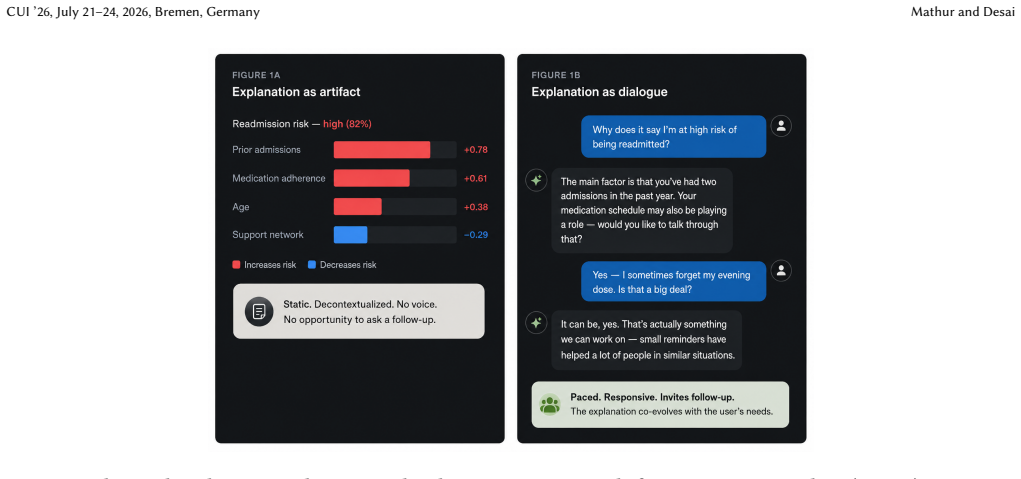
The gap between studying explanations as static items and experiencing them as dialogue means the conversational features are essential to success, shown mainly through example cases rather than measured results.
What would settle it
A study that gives users the same information once as a static explanation and once through a multi-turn dialogue, then measures no difference in understanding, trust, or decision quality.
Figures
read the original abstract
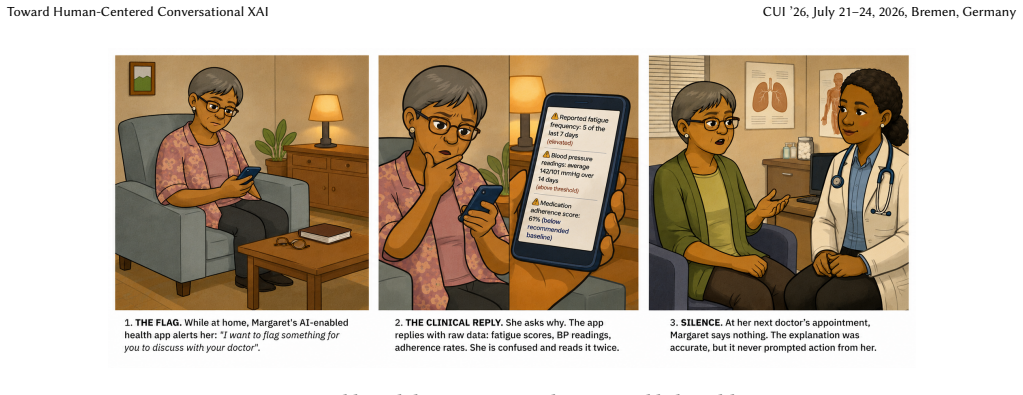
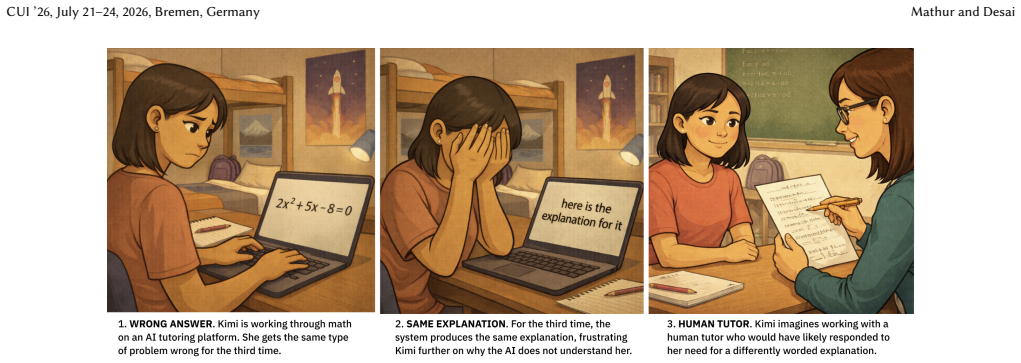
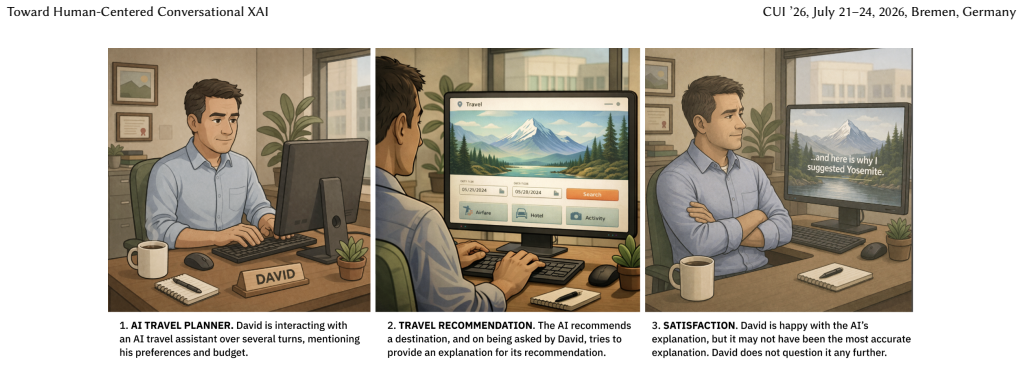
As AI systems become increasingly conversational, a gap emerges wherein explanations are studied as static artifacts, yet in practice, are experienced as dialogue. In this provocation, we argue that the conversational layer around an explanation is not incidental to its effectiveness, but a critical constituent. Drawing on three illustrative scenarios, we invite the CUI community to study explanations as interactive, conversational exchanges shaped by timing, tone, persona and conversational history, and introduce our vision for Human-Centered Conversational XAI (HC2XAI).
Editorial analysis
A structured set of objections, weighed in public.
Referee Report
Summary. The manuscript is a provocation arguing that explanations in AI are studied as static artifacts yet experienced as dialogues in conversational systems. It claims that the conversational layer around an explanation is not incidental but a critical constituent of effectiveness. The argument is advanced through three illustrative scenarios and culminates in a call for the CUI community to treat explanations as interactive exchanges shaped by timing, tone, persona, and conversational history, while introducing the vision of Human-Centered Conversational Explainable AI (HC2XAI).
Significance. If adopted, the perspective could usefully redirect XAI research toward dynamic, dialogue-based explanations that better match how users actually interact with conversational AI. The paper's value lies in its explicit framing as an invitation to new work rather than an empirical demonstration; its acknowledgment of the illustrative basis is a strength that keeps the contribution proportionate to the evidence supplied.
minor comments (2)
- [Abstract] Abstract: the phrase 'critical constituent' is used without a short operational gloss; adding one sentence on what would count as evidence that conversation is load-bearing (versus merely present) would help readers evaluate the provocation.
- [Introduction] The three illustrative scenarios are referenced but not summarized; a one-sentence capsule of each in the introduction would make the central claim easier to assess without requiring the reader to reach later sections.
Simulated Author's Rebuttal
We thank the referee for their positive and accurate summary of our provocation paper, which correctly identifies its core argument that explanations in conversational AI must be studied as interactive dialogues rather than static artifacts, along with the illustrative scenarios and the vision for HC2XAI. We appreciate the recognition that the paper's value lies in its framing as an invitation to new work and that its illustrative basis is proportionate to the contribution. The recommendation for minor revision is noted, though no specific major comments were provided in the report.
Circularity Check
No significant circularity
full rationale
The paper is framed as a provocation advancing a vision for HC2XAI, supported only by three illustrative scenarios rather than any derivation, model, equations, or fitted parameters. No load-bearing steps reduce claims to self-citations, self-definitions, or renamed inputs; the central position is explicitly presented as exploratory rather than derived from prior results by the same authors. The argument remains self-contained against external benchmarks with no internal reduction.
Axiom & Free-Parameter Ledger
axioms (1)
- domain assumption Explanations are experienced as dialogue in practice while studied as static artifacts
Reference graph
Works this paper leans on
-
[1]
Alafate Abulimiti, Paola R. Peña, Fatemeh Alizadeh, Shashank Ahire, Heloisa Candello, Smit Desai, Justin Edwards, Yuan He, Darragh Higgins, Alberto Jo- vane, Matthias Kraus, Guy Laban, Rachel McDonnell, Jairo Pérez-Osorio, Tanja Schneeberger, Jaisie Sin, Tobias Thejll-Madsen, Nima Zargham, and Benjamin R. Cowan. 2025. DEBP-PVA: Designing and Evaluating Be...
-
[2]
Malihe Alikhani and Matthew Stone. 2020. Achieving common ground in multi- modal dialogue. InProceedings of the 58th Annual Meeting of the Association for Computational Linguistics: Tutorial Abstracts. 10–15
2020
-
[3]
Theo Araujo and Nadine Bol. 2024. From speaking like a person to being personal: The effects of personalized, regular interactions with conversational agents. Computers in Human Behavior: Artificial Humans2, 1 (2024), 100030
2024
-
[4]
Shoshana Blum-Kulka, Michal Hamo, and Talia Habib. 2010. Explanations in naturally occurring peer talk: Conversational emergence and function, thematic scope, and contribution to the development of discursive skills.First language 30, 3-4 (2010), 440–460
2010
-
[5]
Suman Chahar, Kuldeep Singh Kaswan, Meenakshi Sharma, and Jagjit Singh Dhatterwal. 2025. Research Exploration of Artificial Intelligence: The Black Box. In2025 International Conference on Intelligent and Secure Engineering Solutions (CISES). IEEE, 282–286
2025
-
[6]
Harmon Lee Bruce Chia. 2023. The emergence and need for explainable AI. Advances in Engineering Innovation3 (2023), 1–4
2023
-
[7]
Herbert H Clark and Edward F Schaefer. 1989. Contributing to discourse.Cogni- tive science13, 2 (1989), 259–294
1989
-
[8]
Benjamin R. Cowan, Nadia Pantidi, David Coyle, Kellie Morrissey, Peter Clarke, Sara Al-Shehri, David Earley, and Natasha Bandeira. 2017. “What can i help you with?”: infrequent users’ experiences of intelligent personal assistants. In Proceedings of the 19th International Conference on Human-Computer Interaction with Mobile Devices and Services (MobileHCI...
- [9]
-
[10]
Samuel Rhys Cox, Joel Wester, and Niels van Berkel. 2026. Polite But Bor- ing? Trade-offs Between Engagement and Psychological Reactance to Chatbot Feedback Styles. arXiv:2601.20683 (Jan. 2026). doi:10.48550/arXiv.2601.20683 arXiv:2601.20683 [cs]
work page internal anchor Pith review Pith/arXiv arXiv doi:10.48550/arxiv.2601.20683 2026
-
[11]
Smit Desai, Jessie Chin, Dakuo Wang, Benjamin Cowan, and Michael Twidale
-
[12]
Toward Metaphor-Fluid Conversation Design for Voice User Interfaces. arXiv:2502.11554 (Feb. 2025). doi:10.48550/arXiv.2502.11554 arXiv:2502.11554 [cs]
-
[13]
Smit Desai, Mateusz Dubiel, and Luis A Leiva. 2024. Examining humanness as a metaphor to design voice user interfaces. InProceedings of the 6th ACM Conference on Conversational User Interfaces. 1–15
2024
-
[14]
Smit Desai, Mateusz Dubiel, Nima Zargham, Thomas Mildner, and Laura Spillner
-
[15]
InProceedings of the 7th ACM Conference on Conversational User Interfaces
Personas evolved: Designing ethical LLM-based conversational agent personalities. InProceedings of the 7th ACM Conference on Conversational User Interfaces. 1–4
-
[16]
Smit Desai and Michael Twidale. 2023. Metaphors in voice user interfaces: a slippery fish.ACM Transactions on Computer-Human Interaction30, 6 (2023), 1–37
2023
-
[17]
Philip R Doyle, Leigh Clark, and Benjamin R. Cowan. 2021. What Do We See in Them? Identifying Dimensions of Partner Models for Speech Interfaces Using a Psycholexical Approach. InProceedings of the 2021 CHI Conference on Human Factors in Computing Systems (CHI ’21). Association for Computing Machinery, New York, NY, USA, 1–14. doi:10.1145/3411764.3445206
-
[18]
Mateusz Dubiel, Sylvain Daronnat, and Luis A. Leiva. 2022. Conversational Agents Trust Calibration: A User-Centred Perspective to Design. InProceedings of the 4th Conference on Conversational User Interfaces (CUI ’22). Association for Computing Machinery, New York, NY, USA, 1–6. doi:10.1145/3543829.3544518
-
[19]
Upol Ehsan, Brent Harrison, Larry Chan, and Mark O Riedl. 2018. Rationalization: A neural machine translation approach to generating natural language explana- tions. InProceedings of the 2018 AAAI/ACM Conference on AI, Ethics, and Society. 81–87
2018
-
[20]
Upol Ehsan, Q Vera Liao, Michael Muller, Mark O Riedl, and Justin D Weisz
-
[21]
In Proceedings of the 2021 CHI conference on human factors in computing systems
Expanding explainability: Towards social transparency in ai systems. In Proceedings of the 2021 CHI conference on human factors in computing systems. 1–19
2021
-
[22]
Upol Ehsan, Samir Passi, Q Vera Liao, Larry Chan, I-Hsiang Lee, Michael Muller, and Mark O Riedl. 2024. The who in XAI: how AI background shapes perceptions of AI explanations. InProceedings of the 2024 CHI Conference on Human Factors in Computing Systems. 1–32
2024
-
[23]
Upol Ehsan, Pradyumna Tambwekar, Larry Chan, Brent Harrison, and Mark O Riedl. 2019. Automated rationale generation: a technique for explainable AI and its effects on human perceptions. InProceedings of the 24th international conference on intelligent user interfaces. 263–274
2019
-
[24]
Sharon Ferguson, Paula Akemi Aoyagui, Rimsha Rizvi, Young-Ho Kim, and Anastasia Kuzminykh. 2024. The explanation that hits home: the characteristics of verbal explanations that affect human perception in subjective decision-making. Proceedings of the ACM on Human-Computer Interaction8, CSCW2 (2024), 1–37
2024
-
[25]
Raymond Fok and Daniel S Weld. 2024. In search of verifiability: Explanations rarely enable complementary performance in AI-advised decision making.AI Magazine45, 3 (2024), 317–332
2024
-
[26]
Anna Viktorovna Gavrilova and Carlo Galli. 2026. Conversing with machines: How AI is changing the way scientists think.Quantitative Biology14, 2 (2026)
2026
-
[27]
Julie Gerlings, Millie Søndergaard Jensen, and Arisa Shollo. 2021. Explainable AI, but explainable to whom? An exploratory case study of xAI in healthcare. In Handbook of Artificial Intelligence in Healthcare: Vol 2: Practicalities and Prospects. Springer, 169–198
2021
-
[28]
Martin Gjoreski, Matias Laporte, Marc Langheinrich, and Tim Miller. 2024. How to Validate XAI in Longitudinal Studies?. InCompanion of the 2024 on ACM international joint conference on pervasive and ubiquitous computing. 866–869
2024
-
[29]
Shirley Gregor and Izak Benbasat. 1999. Explanations From Intelligent Systems: Theoretical Foundations and Implications for Practice1.MIS quarterly23, 4 (1999), 497–530
1999
-
[30]
David Gunning and David Aha. 2019. DARPA’s explainable artificial intelligence (XAI) program.AI magazine40, 2 (2019), 44–58
2019
-
[31]
Jyoti Gupta and KR Seeja. 2024. A comparative study and systematic analysis of XAI models and their applications in healthcare.Archives of Computational Methods in Engineering31, 7 (2024), 3977–4002
2024
-
[32]
Gaole He, Nilay Aishwarya, and Ujwal Gadiraju. 2025. Is conversational XAI all you need? Human-AI decision making with a conversational XAI assistant. InProceedings of the 30th international conference on intelligent user interfaces. 907–924
2025
-
[33]
Sophie F Jentzsch, Sviatlana Höhn, and Nico Hochgeschwender. 2019. Conversa- tional interfaces for explainable AI: a human-centred approach. InInternational workshop on explainable, transparent autonomous agents and multi-agent systems. Springer, 77–92
2019
-
[34]
M Kedar. 2024. Exploring the Effectiveness of SHAP over other Explainable AI Methods.Int. J. Sci. Res. Eng. Manag8 (2024)
2024
-
[35]
help me help the ai
Sunnie SY Kim, Elizabeth Anne Watkins, Olga Russakovsky, Ruth Fong, and Andrés Monroy-Hernández. 2023. " help me help the ai": Understanding how explainability can support human-ai interaction. Inproceedings of the 2023 CHI conference on human factors in computing systems. 1–17
2023
-
[36]
Patrick Knab, Sascha Marton, Udo Schlegel, and Christian Bartelt. 2025. Which lime should i trust? concepts, challenges, and solutions. InWorld Conference on Explainable Artificial Intelligence. Springer, 28–52
2025
-
[37]
Todd Kulesza, Simone Stumpf, Margaret Burnett, Sherry Yang, Irwin Kwan, and Weng-Keen Wong. 2013. Too much, too little, or just right? Ways explanations impact end users’ mental models. In2013 IEEE Symposium on visual languages and human centric computing. IEEE, 3–10
2013
-
[38]
Jiachen Li, Bingrui Zong, Tingyu Cheng, Yunzhi Li, Elizabeth D Mynatt, and Ashutosh Dhekne. 2023. Privacy vs. awareness: Relieving the tension between older adults and adult children when sharing in-home activity data.Proceedings of the ACM on Human-Computer Interaction7, CSCW2 (2023), 1–30
2023
-
[39]
Q Vera Liao, Daniel Gruen, and Sarah Miller. 2020. Questioning the AI: informing design practices for explainable AI user experiences. InProceedings of the 2020 CHI conference on human factors in computing systems. 1–15. Toward Human-Centered Conversational XAI CUI ’26, July 21–24, 2026, Bremen, Germany
2020
-
[40]
Duri Long, Jessica Roberts, Brian Magerko, Kenneth Holstein, Daniella DiPaola, and Fred Martin. 2023. AI literacy: Finding common threads between education, design, policy, and explainability. InExtended Abstracts of the 2023 CHI Conference on Human Factors in Computing Systems. 1–6
2023
-
[41]
Tao Long, Sitong Wang, Émilie Fabre, Tony Wang, Anup Sathya, Jason Wu, Savvas Dimitrios Petridis, Ding Li, Tuhin Chakrabarty, Yue Jiang, et al . 2025. Facilitating Longitudinal Interaction Studies of AI Systems. InAdjunct Proceedings of the 38th Annual ACM Symposium on User Interface Software and Technology. 1–5
2025
-
[42]
Ewa Luger and Abigail Sellen. 2016. “Like Having a Really Bad PA”: The Gulf Between User Expectation and Experience of Conversational Agents. InProceed- ings of the 2016 CHI Conference on Human Factors in Computing Systems (CHI ’16). ACM, New York, NY, USA, 5286–5297. doi:10.1145/2858036.2858288 event-place: San Jose, California, USA
-
[43]
Niharika Mathur, Hasibur Rahman, and Smit Desai. 2026. " Who wants to be nagged by AI?": Investigating the Effects of Agreeableness on Older Adults’ Perception of LLM-Based Voice Assistants’ Explanations.arXiv preprint arXiv:2603.09012(2026)
-
[44]
Sometimes You Need Facts, and Sometimes a Hug
Niharika Mathur, Tamara Zubatiy, Agata Rozga, Jodi Forlizzi, and Elizabeth Mynatt. 2025. " Sometimes You Need Facts, and Sometimes a Hug": Understanding Older Adults’ Preferences for Explanations in LLM-Based Conversational AI Systems.arXiv preprint arXiv:2510.06697(2025)
-
[45]
Why Did You Say That?
Niharika Mathur, Tamara Zubatiy, Agata Rozga, and Elizabeth Mynatt. 2023. “Why Did You Say That?”: Understanding Explainability in Conversational AI Systems for Older Adults with Mild Cognitive Impairment (MCI). InInternational Conference on Ubiquitous Computing and Ambient Intelligence. Springer, 208–214
2023
-
[46]
Tim Miller. 2019. Explanation in artificial intelligence: Insights from the social sciences.Artificial intelligence267 (2019), 1–38
2019
-
[47]
Tim Miller. 2023. Explainable ai is dead, long live explainable ai! hypothesis- driven decision support using evaluative ai. InProceedings of the 2023 ACM conference on fairness, accountability, and transparency. 333–342
2023
-
[48]
Mohammad Namvarpour and Afsaneh Razi. 2025. The Art of Talking Machines: A Comprehensive Literature Review of Conversational User Interfaces. InPro- ceedings of the 7th ACM Conference on Conversational User Interfaces. 1–18
2025
-
[49]
Animesh Nighojkar, Bekhzodbek Moydinboyev, My Duong, and John Licato
- [50]
-
[51]
Hasibur Rahman and Smit Desai. 2025. Vibe Check: Understanding the Effects of LLM-Based Conversational Agents’ Personality and Alignment on User Percep- tions in Goal-Oriented Tasks. arXiv:2509.09870 (Sept. 2025). doi:10.48550/arXiv. 2509.09870 arXiv:2509.09870 [cs]
work page internal anchor Pith review Pith/arXiv arXiv doi:10.48550/arxiv 2025
-
[52]
Minjin Rheu, Ji Youn Shin, Wei Peng, and Jina Huh-Yoo. 2021. Systematic re- view: Trust-building factors and implications for conversational agent design. International Journal of Human–Computer Interaction37, 1 (2021), 81–96
2021
-
[53]
Yao Rong, Tobias Leemann, Thai-Trang Nguyen, Lisa Fiedler, Peizhu Qian, Vaib- hav Unhelkar, Tina Seidel, Gjergji Kasneci, and Enkelejda Kasneci. 2023. Towards human-centered explainable ai: A survey of user studies for model explana- tions.IEEE transactions on pattern analysis and machine intelligence46, 4 (2023), 2104–2122
2023
-
[54]
Rikard Rosenbacke, Åsa Melhus, Martin McKee, and David Stuckler. 2024. How explainable artificial intelligence can increase or decrease clinicians’ trust in AI applications in health care: systematic review.Jmir Ai3 (2024), e53207
2024
-
[55]
Jae-Eun Russell, Anna Marie Smith, Salim George, Jonah Pratt, Brian Fodale, Cassandra Monk, and Adam Brummett. 2025. Unlocking Insights: Investigating Student AI Tutor Interactions in a Large Introductory STEM Course. InPro- ceedings of the 15th International Learning Analytics and Knowledge Conference (LAK ’25). Association for Computing Machinery, New Y...
-
[56]
Ute Schmid and Britta Wrede. 2022. What is missing in XAI so far? An interdis- ciplinary perspective.KI-Künstliche Intelligenz36, 3 (2022), 303–315
2022
-
[57]
Hua Shen, Chieh-Yang Huang, Tongshuang Wu, and Ting-Hao Kenneth Huang
-
[58]
InCompanion publication of the 2023 conference on computer supported cooperative work and social computing
ConvXAI: Delivering heterogeneous AI explanations via conversations to support human-AI scientific writing. InCompanion publication of the 2023 conference on computer supported cooperative work and social computing. 384–387
2023
-
[59]
Eleanor Palo Stoller. 1993. Interpretations of symptoms by older people: A health diary study of illness behavior.Journal of Aging and Health5, 1 (1993), 58–81
1993
-
[60]
Nipuna Thalpage. 2023. Unlocking the black box: Explainable artificial intelli- gence (XAI) for trust and transparency in ai systems.J. Digit. Art Humanit4, 1 (2023), 31–36
2023
-
[61]
Qiaosi Wang, Koustuv Saha, Eric Gregori, David Joyner, and Ashok Goel. 2021. Towards Mutual Theory of Mind in Human-AI Interaction: How Language Reflects What Students Perceive About a Virtual Teaching Assistant. InPro- ceedings of the 2021 CHI Conference on Human Factors in Computing Systems (CHI ’21). Association for Computing Machinery, New York, NY, U...
-
[62]
Christina Ziying Wei, Young-Ho Kim, and Anastasia Kuzminykh. 2023. The Bot on Speaking Terms: The Effects of Conversation Architecture on Perceptions of Conversational Agents. InProceedings of the 5th International Conference on Conversational User Interfaces (CUI ’23). Association for Computing Machinery, New York, NY, USA, 1–16. doi:10.1145/3571884.3597139
-
[63]
Miaoxiang Yi. 2024. Revolutionizing interaction: the role of artificial intelligent conversation agents in human-computer interaction. InFourth International Con- ference on Signal Processing and Machine Learning (CONF-SPML 2024), Vol. 13077. SPIE, 192–201
2024
-
[64]
Setareh Zafari, Jesse de Pagter, Guglielmo Papagni, Alischa Rosenstein, Michael Filzmoser, and Sabine T Koeszegi. 2024. Trust development and explainability: A longitudinal study with a personalized assistive system.Multimodal Technologies and Interaction8, 3 (2024), 20
2024
-
[65]
Nima Zargham, Leon Reicherts, Michael Bonfert, Sarah Theres Voelkel, Johannes Schoening, Rainer Malaka, and Yvonne Rogers. 2022. Understanding Circum- stances for Desirable Proactive Behaviour of Voice Assistants: The Proactivity Dilemma. InProceedings of the 4th Conference on Conversational User Interfaces (CUI ’22). Association for Computing Machinery, ...
-
[66]
John Zerilli. 2022. Explaining machine learning decisions.Philosophy of Science 89, 1 (2022), 1–19
2022
-
[67]
Tong Zhang, Mengao Zhang, Wei Yan Low, X Jessie Yang, and Boyang Albert Li. 2025. Conversational explanations: discussing explainable AI with non-AI experts. InProceedings of the 30th international conference on intelligent user interfaces. 409–424
2025
discussion (0)
Sign in with ORCID, Apple, or X to comment. Anyone can read and Pith papers without signing in.