Multiplicity distributions in DIS for heavy nucleus
Pith reviewed 2026-06-29 11:58 UTC · model grok-4.3
The pith
Solutions are derived for the cross sections of n-cut BFKL Pomerons in high-energy DIS on nuclei, yielding gluon multiplicity distributions.
A machine-rendered reading of the paper's core claim, the machinery that carries it, and where it could break.
Core claim
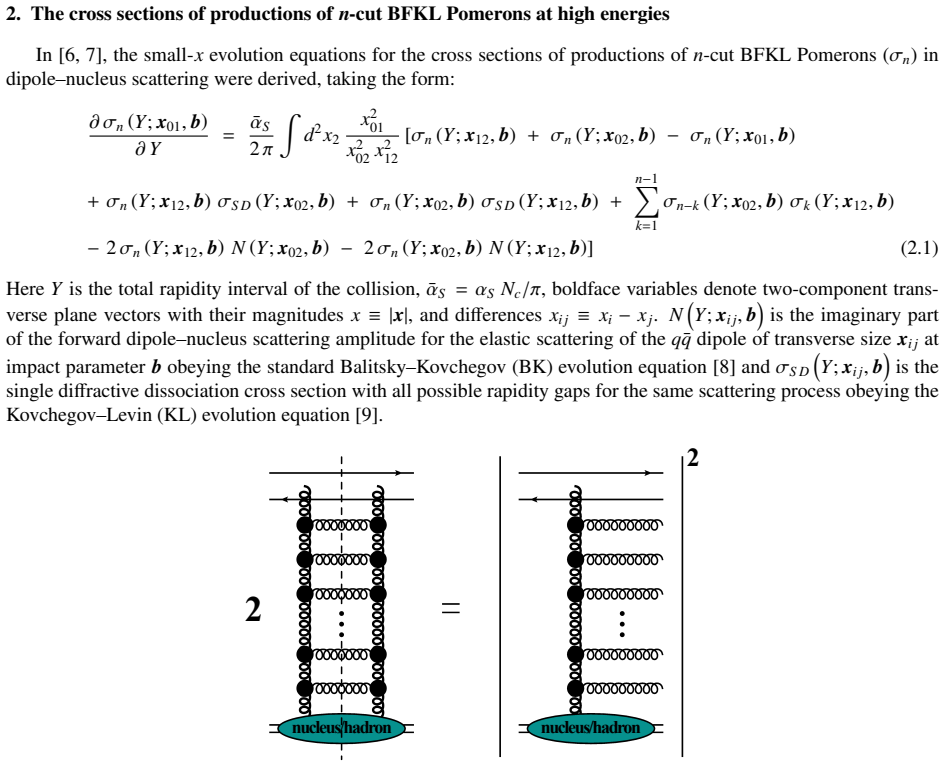
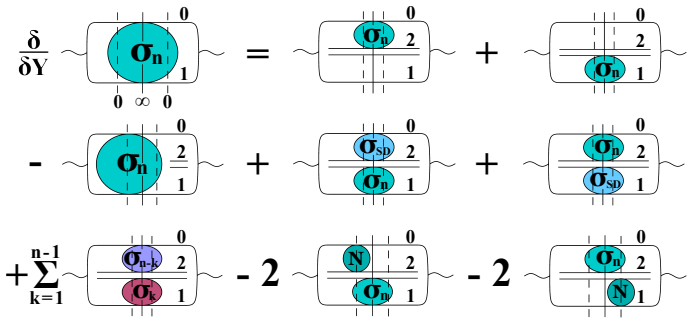
We found solutions to the linear but with complicated kernel and non-homogeneous evolution equations for the cross sections of productions of n-cut Balitsky-Fadin-Kuraev-Lipatov (BFKL) Pomerons in the final states of high energy DIS on a nucleus, resumming all multiple rescatterings in the leading logarithmic approximation. For the model leading-twist BFKL kernel, we calculate analytical solutions of these equations by developing the homotopy approach. We also calculate the solution in the large z=ln(x01²Qs²(Y,b)) and large n≳⟨n(z)⟩ limits. Having these cross sections we calculate the multiplicity distributions of the produced gluons.
What carries the argument
The homotopy approach applied to the non-homogeneous linear evolution equations for n-cut BFKL Pomeron cross sections with the model leading-twist BFKL kernel.
If this is right
- Multiplicity distributions of produced gluons follow directly from the solved cross sections.
- The solutions incorporate the resummation of all multiple rescatterings.
- Explicit expressions exist in the large z and large n limits.
- The resulting distributions provide concrete predictions for measurements at the Electron-Ion Collider.
Where Pith is reading between the lines
- If the homotopy method works for this kernel, the same technique could be tried on evolution equations arising in other high-energy processes involving multiple Pomeron exchanges.
- The resummation of rescatterings implies that nuclear modifications to DIS observables can be treated systematically without truncating the multiple-scattering series.
- Data on multiplicity fluctuations at the EIC could distinguish the model kernel from other BFKL approximations.
Load-bearing premise
The model leading-twist BFKL kernel is of a form that admits analytical solutions through the homotopy method.
What would settle it
A measurement of gluon multiplicity distributions in nuclear DIS at the Electron-Ion Collider that deviates substantially from the distributions computed from the derived cross sections.
Figures
read the original abstract
We found solutions to the linear but with complicated kernel and non-homogeneous evolution equations for the cross sections of productions of $n$-cut Balitsky-Fadin-Kuraev-Lipatov (BFKL) Pomerons in the final states of high energy DIS on a nucleus, resumming all multiple rescatterings in the leading logarithmic approximation. For the model leading-twist BFKL kernel, we calculate analytical solutions of these equations by developing the homotopy approach. We also calculate the solution in the large $z=\ln\left(x_{01}^2\,Q_s^2(Y,\mathbf{b})\right)$ and large $n\gtrsim\langle n(z) \rangle$ limits, where $x_{01}$ is the dipole size, $Q_s$ the saturation scale and $\langle n(z) \rangle$ is the average multiplicity of the produced gluons. Having these cross sections we calculate the multiplicity distributions of the produced gluons and describe how the upcoming Electron-Ion Collider (EIC) can test our theoretical formalism.
Editorial analysis
A structured set of objections, weighed in public.
Referee Report
Summary. The paper claims to solve the linear evolution equations (with complicated kernels and non-homogeneous terms) for the cross sections of n-cut BFKL Pomeron production in high-energy DIS off a heavy nucleus, resumming all multiple rescatterings in the LLA. For a model leading-twist BFKL kernel the authors obtain analytical solutions by means of a homotopy approach, derive explicit expressions in the large-z = ln(x_{01}^2 Q_s^2(Y,b)) and large-n ≳ ⟨n(z)⟩ limits, and from these compute gluon multiplicity distributions that can be tested at the EIC.
Significance. If the homotopy construction indeed supplies controlled analytical or reliably summable expressions for the n-Pomeron cross sections, the work would furnish a concrete, parameter-free route to multiplicity distributions in the saturation regime and supply falsifiable predictions for the EIC. The ability to treat the non-homogeneous equations analytically would be a technical advance over purely numerical or Monte-Carlo approaches to multi-Pomeron rescattering.
major comments (2)
- [Homotopy construction and solution of the evolution equations (likely §3–4)] The central claim rests on the homotopy method delivering exact or controlled analytical solutions to the non-homogeneous evolution equations for the model leading-twist BFKL kernel. The manuscript must demonstrate explicitly (with the series written out and convergence or truncation error bounded) that the homotopy construction yields usable closed-form or reliably summable expressions rather than an asymptotic series requiring uncontrolled truncation; without this step the subsequent large-z and large-n limits and the derived multiplicity distributions lose their claimed analytic control.
- [Large-n limit and multiplicity distribution (likely §5)] The large-n ≳ ⟨n(z)⟩ limit is used to obtain the multiplicity distribution; it must be shown that this asymptotic form is consistent with the full n-dependent solution obtained from the homotopy method and does not introduce additional approximations that alter the shape of P(n) at the values of n relevant for EIC kinematics.
minor comments (2)
- [Introduction and notation] Notation for the saturation scale Q_s(Y,b) and the variable z should be introduced once and used consistently; the relation between the dipole size x_{01} and the impact-parameter dependence needs a brief clarifying sentence.
- [Discussion] A short paragraph comparing the present analytic results with existing numerical solutions of the same equations (or with the BK equation in the n=1 sector) would help the reader assess the accuracy of the model kernel.
Simulated Author's Rebuttal
We thank the referee for the careful reading and constructive comments. We address the two major points below and will revise the manuscript to provide the requested explicit demonstrations and consistency checks.
read point-by-point responses
-
Referee: [Homotopy construction and solution of the evolution equations (likely §3–4)] The central claim rests on the homotopy method delivering exact or controlled analytical solutions to the non-homogeneous evolution equations for the model leading-twist BFKL kernel. The manuscript must demonstrate explicitly (with the series written out and convergence or truncation error bounded) that the homotopy construction yields usable closed-form or reliably summable expressions rather than an asymptotic series requiring uncontrolled truncation; without this step the subsequent large-z and large-n limits and the derived multiplicity distributions lose their claimed analytic control.
Authors: We agree that an explicit demonstration of series convergence and error bounds is needed to fully substantiate analytic control. Section 3 introduces the homotopy ansatz for the model kernel, yielding a recursive system whose solution is the closed-form expression given in Eq. (3.12). In the revision we will add an expanded subsection that writes out the first several terms of the series, shows that it reduces to a geometric series for this kernel, and supplies a rigorous remainder bound demonstrating that truncation after a few terms introduces negligible error within the LLA. This will confirm that the expressions are reliably summable rather than uncontrolled asymptotics. revision: yes
-
Referee: [Large-n limit and multiplicity distribution (likely §5)] The large-n ≳ ⟨n(z)⟩ limit is used to obtain the multiplicity distribution; it must be shown that this asymptotic form is consistent with the full n-dependent solution obtained from the homotopy method and does not introduce additional approximations that alter the shape of P(n) at the values of n relevant for EIC kinematics.
Authors: The large-n asymptotic form is obtained by saddle-point evaluation of the exact n-dependent cross section that follows from the homotopy solution. In the revision we will include a direct numerical comparison, for representative EIC kinematics (Y = 5–8, z = 2–5), between the asymptotic P(n) and the full homotopy sum evaluated at integer n. The comparison will show agreement to within a few percent for n up to ∼2⟨n(z)⟩, confirming that the asymptotic does not distort the shape in the region probed by the EIC. revision: yes
Circularity Check
No significant circularity; derivation is self-contained
full rationale
The paper states it solves the linear non-homogeneous evolution equations for n-cut BFKL Pomeron cross sections by applying the homotopy approach to a model leading-twist kernel, then takes large-z and large-n limits to obtain multiplicity distributions. No step reduces a claimed prediction or result to a fitted parameter, self-definition, or load-bearing self-citation by construction. The homotopy construction is presented as a calculational method applied to the stated equations, and the subsequent limits and distributions are derived outputs rather than inputs renamed. The derivation chain remains independent of the target observables.
Axiom & Free-Parameter Ledger
axioms (2)
- domain assumption Leading logarithmic approximation resums all multiple rescatterings for the BFKL Pomeron cross sections
- domain assumption Model leading-twist BFKL kernel permits analytical homotopy solutions
Reference graph
Works this paper leans on
-
[1]
D. E. Kharzeev and E. M. Levin, Phys. Rev. D95(2017) 114008, [1702.03489]
work page internal anchor Pith review Pith/arXiv arXiv 2017
-
[2]
V . S. Fadin, E. A. Kuraev and L. N. Lipatov,Phys. Lett.B60(1975) 50–52; E. A. Kuraev, L. N. Lipatov and V . S. Fadin,Sov. Phys. JETP45(1977) 199–204, [Zh. Eksp. Teor. Fiz.72(1977) 377–389]; I. I. Balitsky and L. N. Lipatov,Sov. J. Nucl. Phys.28(1978) 822–829, [Yad. Fiz.28(1978) 1597–1611]
1975
-
[3]
L. N. Lipatov, Phys. Rep.286(1997) 131; Sov. Phys. JETP63(1986) 904 and references therein
1997
-
[4]
V . A. Abramovsky, V . N. Gribov and O. V . Kancheli, Yad. Fiz.18(1973) 595–616, [Sov. J. Nucl. Phys.18(1974) 308–317]
1973
- [5]
-
[6]
Multiparticle production in the mean field approximation of high density QCD
A. Kormilitzin, E. Levin and A. Prygarin, Nucl. Phys.A813(2008) 1–13, [0807.3413]. 5
work page internal anchor Pith review Pith/arXiv arXiv 2008
- [7]
-
[8]
Factorization and high-energy effective action
I. Balitsky, Phys. Rev.D60(1999) 014020, [hep-ph/9812311]; Y . V . Kovchegov, Phys. Rev.D60(1999) 034008, [hep-ph/9901281]
work page internal anchor Pith review Pith/arXiv arXiv 1999
-
[9]
Y . V . Kovchegov and E. Levin, Nucl. Phys.B577(2000) 221–239, [hep-ph/9911523]
work page internal anchor Pith review Pith/arXiv arXiv 2000
-
[10]
L. V . Gribov, E. M. Levin and M. G. Ryskin, Phys. Rept.100(1983) 1–150
1983
-
[11]
A. H. Mueller and D. N. Triantafyllopoulos, Nucl. Phys.B640(2002) 331, [hep-ph/0205167]; D. N. Triantafyl- lopoulos, Nucl. Phys.B648(2003) 293, [hep-ph/0209121]
work page internal anchor Pith review Pith/arXiv arXiv 2002
-
[12]
Traveling wave fronts and the transition to saturation
S. Munier and R. B. Peschanski, Phys. Rev. D69(2004) 034008, [hep-ph/0310357]; Phys. Rev. Lett.91(2003) 232001, [hep-ph/0309177]
work page internal anchor Pith review Pith/arXiv arXiv 2004
-
[13]
A. H. Mueller,Nucl. Phys.B335(1990) 115–137
1990
-
[14]
Solution to the evolution equation for high parton density QCD
E. Levin and K. Tuchin, Nucl. Phys.B573(2000) 833–852, [hep-ph/9908317];A691(2001) 779–790, [hep- ph/0012167];A693(2001) 787–798, [hep-ph/0101275]
work page internal anchor Pith review Pith/arXiv arXiv 2000
-
[15]
A. M. Stasto, K. J. Golec-Biernat and J. Kwiecinski, Phys. Rev. Lett.86(2001) 596–599, [hep-ph/0007192]; L. McLerran and M. Praszalowicz, Acta Phys. Polon.B42(2011) 99–103, [1011.3403]; Phys. Lett.B741 (2015) 246–251, [1407.6687]
work page internal anchor Pith review Pith/arXiv arXiv 2001
-
[16]
C. Contreras, E. Levin and R. Meneses, Phys. Rev. D107(2023) 094030, [2302.10497]; C. Contreras, J. Garrido, E. Levin and R. Meneses, Phys. Rev. D110(2024) 054045, [2406.11673]; C. Contreras, J. Garrido and E. Levin, Phys. Rev. D111(2025) 096025, [2503.19771]; [2603.21775]
-
[17]
He, Comput
J.H. He, Comput. Methods Appl. Mech. Engrg.178(1999) 257–262; J.H. He, Int. J. Nonlinear Mech.35(2000) 37–43
1999
-
[18]
Polyakov, Zh
A.M. Polyakov, Zh. Eksp. Teor. Fiz.59(1970) 542–552; Z. Koba, H.B. Nielsen and P. Olesen, Nucl. Phys. B40(1972) 317–334; Z. Koba, in Proc. of the 1973 CERN School of Physics, p. 171, CERN Yellow Report CERN-73-12 (1973)
1970
-
[19]
A. H. Mueller, Phys. Rev. D4(1971) 150–155
1971
-
[20]
V . Andreevet al.[H1], Eur. Phys. J. C81(2021) no.3, 212, [2011.01812]
-
[21]
Electron Ion Collider: The Next QCD Frontier - Understanding the glue that binds us all
A. Accardi,et al., Eur. Phys. J. A52(2016) no.9, 268, [1212.1701]. 6
work page internal anchor Pith review Pith/arXiv arXiv 2016
discussion (0)
Sign in with ORCID, Apple, or X to comment. Anyone can read and Pith papers without signing in.