On the Learnability of Test-Time Adaptation: A Recovery Complexity Perspective
Pith reviewed 2026-06-29 13:40 UTC · model grok-4.3
The pith
Test-time adaptation faces fundamental limits measured by recovery complexity under non-stationary streams.
A machine-rendered reading of the paper's core claim, the machinery that carries it, and where it could break.
Core claim
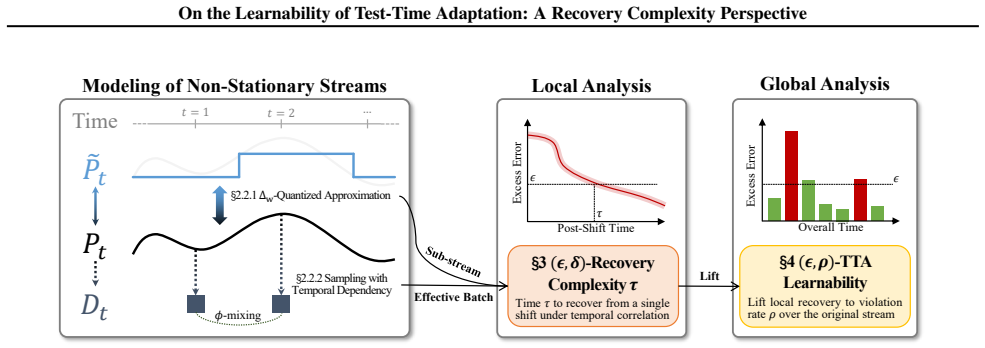
The authors introduce (ε,δ)-Recovery Complexity to quantify the post-shift time required to keep excess risk below a target with high probability, extended to (ε,ρ)-TTA Learnability for long-term reliability. Using a novel discrete surrogate for non-stationary streams, they obtain order-wise matching lower and upper bounds on recovery complexity for gradual and abrupt shifts, which demonstrate fundamental limits of TTA and an intrinsic adaptivity-information trade-off, yielding unified learnability guarantees.
What carries the argument
(ε,δ)-Recovery Complexity, which quantifies the time needed after a distribution shift to maintain low excess risk with high probability, and its extension to TTA learnability.
Load-bearing premise
The discrete surrogate model for non-stationary test streams preserves the essential dynamics of real distribution shifts.
What would settle it
Empirical recovery times in TTA experiments on streams with known shift types that fall outside the order of the derived upper and lower bounds.
Figures
read the original abstract
Test-time adaptation (TTA) aims to adapt models to maintain reliable performance on non-stationary test streams without requiring labeled data. Despite its empirical success, the learnability of TTA under non-stationary streams remains unexplored. A key challenge is the lack of a principled theoretical framework that simultaneously aligns with the TTA objective and captures both continuously evolving distribution shifts and intrinsic information constraints. To address this gap, we propose the first theoretical framework for studying the learnability of TTA and introduce $(\epsilon,\delta)$-Recovery Complexity and $(\epsilon,\rho)$-TTA Learnability. Recovery complexity measures the post-shift time needed to maintain excess risk below a target level with high probability, and is further extended to TTA learnability, which measures the long-term reliability of TTA. Within this framework, we introduce a novel discrete surrogate for non-stationary test streams, enabling a unified and tractable analysis of both gradual and abrupt shifts. We derive order-wise matching lower and upper bounds on recovery complexity, revealing fundamental limits of TTA and an intrinsic adaptivity-information trade-off. These results provide unified learnability guarantees for TTA that complement regret-based analyses.
Editorial analysis
A structured set of objections, weighed in public.
Referee Report
Summary. The paper introduces the first theoretical framework for the learnability of test-time adaptation (TTA) under non-stationary streams. It defines (ε,δ)-Recovery Complexity as the post-shift time to keep excess risk below a target with high probability, extends it to (ε,ρ)-TTA Learnability for long-term reliability, proposes a novel discrete surrogate for non-stationary test streams to unify analysis of gradual and abrupt shifts, and derives order-wise matching lower and upper bounds on recovery complexity that reveal an adaptivity-information trade-off and provide unified learnability guarantees complementing regret-based analyses.
Significance. If the matching bounds hold under a surrogate that faithfully captures information constraints and shift rates, the work would be significant as the first principled learnability theory for TTA, identifying fundamental limits and trade-offs not addressed by regret analyses. The order-wise matching bounds, if rigorously derived with complete proofs, represent a clear strength in providing tight characterizations.
major comments (2)
- [Abstract and surrogate definition section] Abstract and the section defining the discrete surrogate: the order-wise matching bounds and adaptivity-information trade-off are derived inside this novel surrogate. The abstract claims it enables unified tractable analysis of gradual and abrupt shifts, but the central claim requires that discretization preserves the essential information constraints and shift rates of real non-stationary processes; without a theorem or explicit argument showing that discretization artifacts do not alter recovery-time scaling, the bounds do not necessarily transfer to practical TTA.
- [Bounds derivation section] The section deriving the lower and upper bounds: the claim of order-wise matching bounds is load-bearing for the fundamental limits and unified guarantees. The abstract states these are derived, but without the full proofs, explicit assumptions on the surrogate, or the definition of the (ε,δ)-Recovery Complexity in the main text, it is not possible to verify whether the math supports the claims or whether modeling choices affect the result.
minor comments (2)
- [Introduction or definitions section] Clarify the relationship between (ε,δ)-Recovery Complexity and (ε,ρ)-TTA Learnability with an explicit statement or diagram early in the paper.
- [Preliminaries] Ensure all assumptions on the non-stationary streams (e.g., shift rates, information per step) are listed explicitly before the surrogate is introduced.
Simulated Author's Rebuttal
We thank the referee for the constructive feedback. We address each major comment below.
read point-by-point responses
-
Referee: Abstract and the section defining the discrete surrogate: the order-wise matching bounds and adaptivity-information trade-off are derived inside this novel surrogate. The abstract claims it enables unified tractable analysis of gradual and abrupt shifts, but without a theorem or explicit argument showing that discretization artifacts do not alter recovery-time scaling, the bounds do not necessarily transfer to practical TTA.
Authors: The surrogate in Section 3 is constructed to preserve the governing parameters of shift rate and per-step information availability that control recovery scaling. The order-wise bounds are derived directly for this model, which unifies gradual and abrupt cases by design. We will add a proposition in revision that bounds the discretization error on recovery time under standard Lipschitz assumptions on the underlying shift process, confirming that the scaling is unaffected. revision: yes
-
Referee: The section deriving the lower and upper bounds: the claim of order-wise matching bounds is load-bearing for the fundamental limits and unified guarantees. The abstract states these are derived, but without the full proofs, explicit assumptions on the surrogate, or the definition of the (ε,δ)-Recovery Complexity in the main text, it is not possible to verify whether the math supports the claims or whether modeling choices affect the result.
Authors: Definition 2.1 in the main text introduces (ε,δ)-Recovery Complexity. Section 3.1 lists the surrogate assumptions. Theorems 4.1 and 4.2 state the matching bounds, with complete proofs in the appendix. We will expand the main-text presentation of the definition and key assumptions for clarity, while retaining the appendix proofs. revision: partial
Circularity Check
No circularity: bounds derived from newly introduced definitions and surrogate
full rationale
The paper defines new quantities ((ε,δ)-Recovery Complexity and (ε,ρ)-TTA Learnability) and a novel discrete surrogate for non-stationary streams, then derives matching lower/upper bounds inside that framework. No step reduces a claimed prediction to a fitted parameter by construction, no self-citation is load-bearing for the central result, and the surrogate is presented as an enabling modeling choice rather than a hidden tautology. The derivation chain is self-contained and does not collapse to its inputs.
Axiom & Free-Parameter Ledger
axioms (1)
- domain assumption A novel discrete surrogate accurately captures both gradual and abrupt distribution shifts for the purpose of bounding recovery complexity.
invented entities (1)
-
(ε,δ)-Recovery Complexity
no independent evidence
Reference graph
Works this paper leans on
-
[1]
Xiao, Z. and Snoek, C. G. M. Beyond model adaptation at test time: A survey.CoRR, abs/2411.03687,
-
[2]
By the greedy rule, right before the shift at time ti, the current anchor equals ti−1, and the shift is triggered because W1(Pti ,P t(i−1))>∆ W /2.(23) On the other hand, by the triangle inequality along the original path, W1(Pt(i−1) ,P ti)≤ ti−1X t=t(i−1) W1(Pt,P t+1).(24) Combining (23) and (24) yields, for eachi∈[m], ti−1X t=ti−1 W1(Pt,P t+1)>∆ W /2.(2...
1986
-
[3]
on X ×Y with U∼ν and mi ∈ {0,∆} (the label is constant so the loss reduces to a function ofx alone). The translation coupling ((U, y0),(∆ +U, y 0)) in product metric yields W1(P(0),P (1))≤E U−(∆ +U) = ∆ = 2ρ sat ≤∆ W (33) by the theorem’s shift-budget hypothesis, so the hard instance lies in the assumed stream class. With per-sample supervised loss ℓ(θ;x)...
2012
-
[4]
Our analysis reveals the proxy-task alignment α of Assump- tion 2.1 as the key quantity governing recovery
on the corruption benchmarks CIFAR-10-C, CIFAR-100- C, and ImageNet-C (Hendrycks & Dietterich, 2019). Our analysis reveals the proxy-task alignment α of Assump- tion 2.1 as the key quantity governing recovery. In the following experiments, we measure its empirical counterpart ˜α=⟨∇ℓ ent,∇ℓ ce⟩/∥∇ℓce∥2 in practice, which is the observed alignment between t...
2019
discussion (0)
Sign in with ORCID, Apple, or X to comment. Anyone can read and Pith papers without signing in.