Conformal Symmetry and Non-Singular Scalar field Collapse
Pith reviewed 2026-06-29 10:58 UTC · model grok-4.3
The pith
Conformally flat scalar field collapse keeps proper radius finite and avoids shell-focusing singularities.
A machine-rendered reading of the paper's core claim, the machinery that carries it, and where it could break.
Core claim
We investigate the gravitational collapse of a massive scalar field in a conformally flat, spherically symmetric spacetime within general relativity. The collapsing matter distribution is modeled using a minimally coupled homogeneous scalar field together with both perfect fluid and dissipative matter sectors. Imposing conformal flatness through the vanishing of the Weyl tensor considerably constrains the geometry and enables the construction of exact analytical solutions. For both classes of solutions, the proper radius remains finite throughout the evolution, preventing the formation of shell-focusing singularities within the considered domain.
What carries the argument
The condition that the Weyl tensor vanishes identically, which enforces conformal flatness and permits a separable conformal factor that yields exact interior solutions.
If this is right
- The non-dissipative solutions collapse asymptotically and remain regular when smoothly matched to an exterior Schwarzschild geometry.
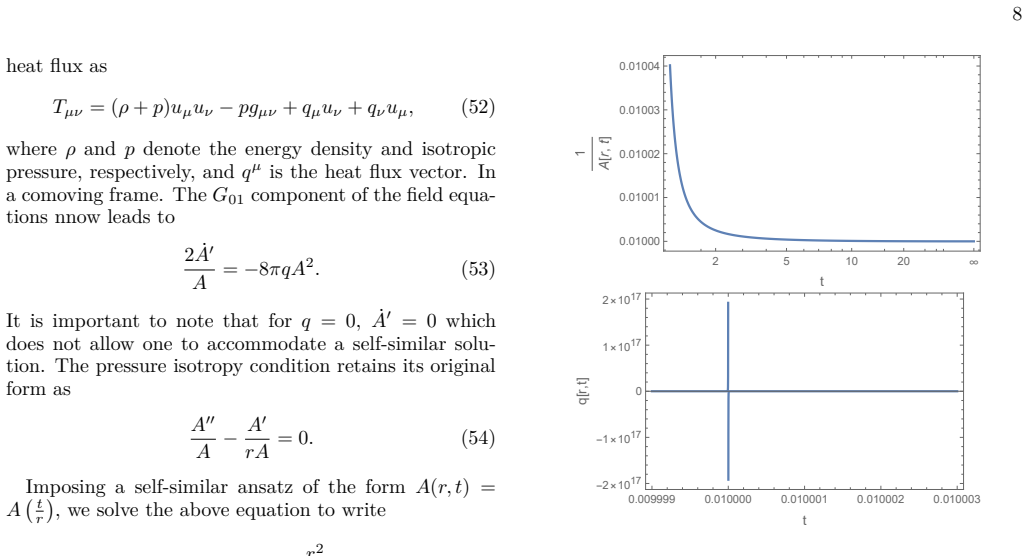
- Self-similar evolution is incompatible with perfect fluid alone but becomes consistent once radial heat flux is included, requiring matching to an exterior Vaidya spacetime.
- The Misner-Sharp mass decreases monotonically because of outward energy transport carried by the heat flux.
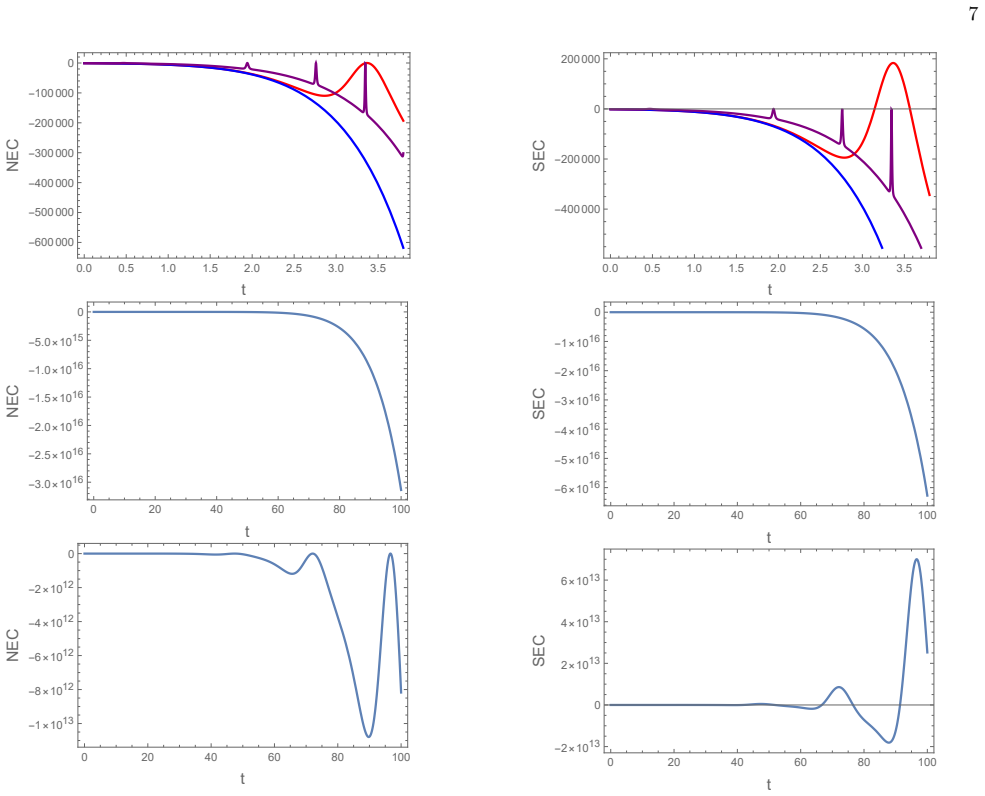
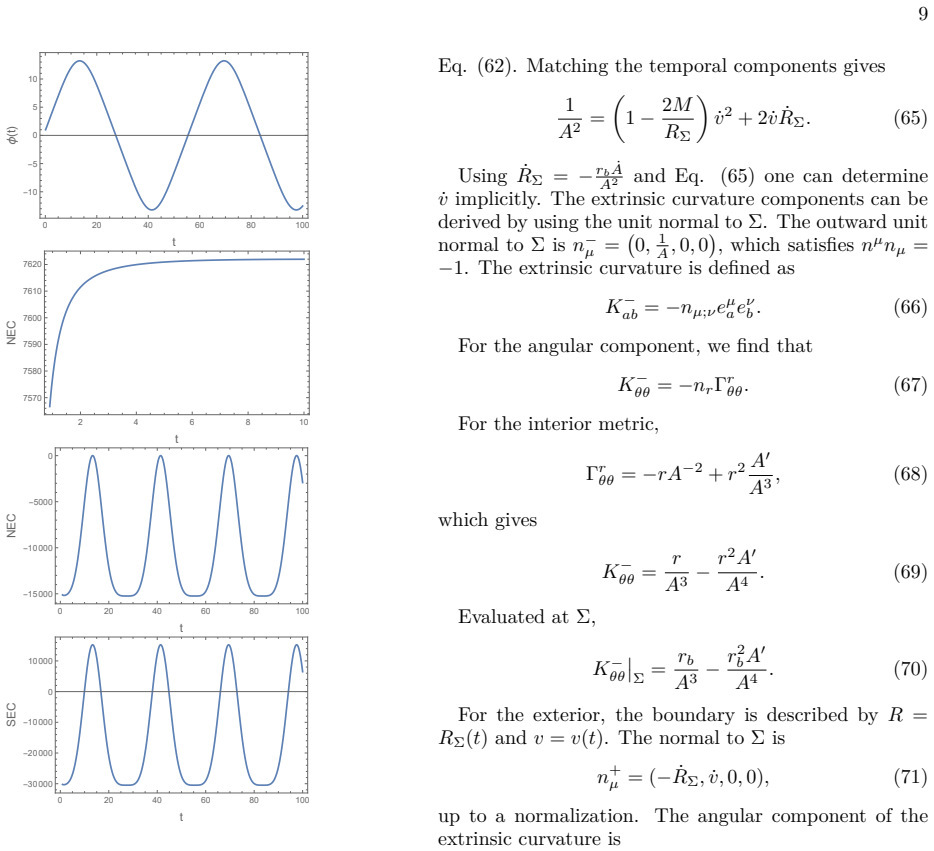
- The scalar field obeys the null energy condition for the potentials considered, while the effective fluid sector violates the null and strong energy conditions.
Where Pith is reading between the lines
- The finite-radius result may survive in nearby models that relax exact conformal flatness but keep the Weyl tensor small.
- The effective exotic-matter behavior of the fluid sector could be checked by embedding the same matter content into numerical codes that allow small Weyl curvature.
- Whether the avoidance of shell-focusing singularities persists for inhomogeneous scalar-field profiles remains open within the same conformal-flat framework.
Load-bearing premise
The spacetime is assumed to be conformally flat from the outset so that the Weyl tensor is identically zero.
What would settle it
An explicit solution in which the areal radius of the collapsing sphere reaches zero at a finite value of proper time while the Weyl tensor remains zero throughout the interior would falsify the claim.
Figures
read the original abstract
We investigate the gravitational collapse of a massive scalar field in a conformally flat, spherically symmetric spacetime within general relativity. The collapsing matter distribution is modeled using a minimally coupled homogeneous scalar field together with both perfect fluid and dissipative matter sectors. Imposing conformal flatness through the vanishing of the Weyl tensor considerably constrains the geometry and enables the construction of exact analytical solutions. In the non-dissipative case, the field equations admit a separable conformal factor leading to a continuously collapsing configuration smoothly matched to an exterior Schwarzschild spacetime. The collapse proceeds asymptotically and does not develop a shell-focusing singularity within finite proper time. We further examine the possibility of self-similar evolution associated with homothetic symmetry. It is shown that self-similar solutions are incompatible with a perfect-fluid configuration alone, but become consistent when dissipative effects in the form of a radial heat flux are included. The resulting self-similar collapse must be matched to an exterior Vaidya spacetime and exhibits a monotonically decreasing Misner-Sharp mass due to outward energy transport. For both classes of solutions, the proper radius remains finite throughout the evolution, preventing the formation of shell-focusing singularities within the considered domain. The scalar field sector satisfies the null energy condition for the potentials studied, while the effective fluid sector exhibits violations of the null and strong energy conditions, indicating the emergence of effective exotic matter behavior.
Editorial analysis
A structured set of objections, weighed in public.
Referee Report
Summary. The paper constructs exact analytical solutions for the collapse of a homogeneous minimally coupled scalar field in a conformally flat, spherically symmetric spacetime, considering both a perfect-fluid sector and a dissipative sector with radial heat flux. Under the imposed vanishing of the Weyl tensor, the non-dissipative solutions admit a separable conformal factor, evolve asymptotically, and match to an exterior Schwarzschild spacetime without forming a shell-focusing singularity in finite proper time. Self-similar solutions require the dissipative sector, match to Vaidya, exhibit decreasing Misner-Sharp mass, and likewise keep the proper radius finite. The scalar-field sector obeys the null energy condition while the effective fluid violates the null and strong energy conditions.
Significance. If the derivations hold, the work supplies concrete, analytically tractable examples in which conformal flatness together with homothetic symmetry prevents shell-focusing singularities for scalar-field collapse. The explicit matching conditions and the demonstration that self-similarity is incompatible with a perfect fluid alone but viable once dissipation is included constitute the main technical contribution.
major comments (2)
- [Abstract and the sections deriving the metric ansatz] The central non-singularity claim (finite proper radius for all finite proper time) rests on the separable conformal factor that exists only because the Weyl tensor is set to zero at the outset. No perturbation analysis or independent argument is supplied showing that the finite-radius property persists when the Weyl tensor is allowed to be non-zero, which is load-bearing for any broader interpretation beyond the conformally flat sector.
- [Sections presenting the exact solutions and matching] The manuscript states that the field equations admit the quoted solutions and that the proper radius remains finite, yet the explicit expressions for the conformal factor, the metric functions, and the verification that they satisfy the Einstein equations with the given matter content are not reproduced in sufficient detail to permit independent checking of the boundary conditions and the absence of singularities.
minor comments (2)
- [Abstract] The abstract refers to 'the potentials studied' without naming them; a brief statement of the specific scalar potentials would improve clarity.
- Notation for the Misner-Sharp mass and the areal radius should be introduced once and used consistently; occasional shifts between R(r,t) and other symbols hinder readability.
Simulated Author's Rebuttal
We thank the referee for the careful reading and constructive comments. We address each major comment below.
read point-by-point responses
-
Referee: [Abstract and the sections deriving the metric ansatz] The central non-singularity claim (finite proper radius for all finite proper time) rests on the separable conformal factor that exists only because the Weyl tensor is set to zero at the outset. No perturbation analysis or independent argument is supplied showing that the finite-radius property persists when the Weyl tensor is allowed to be non-zero, which is load-bearing for any broader interpretation beyond the conformally flat sector.
Authors: The manuscript is devoted exclusively to the conformally flat sector, as stated in the title, abstract, and the explicit imposition of vanishing Weyl tensor. The non-singularity result is derived and claimed only under this assumption, which enables the separable conformal factor and exact solutions; we advance no broader claim about non-conformally flat geometries. A perturbation analysis lies outside the paper's scope. To prevent misinterpretation we will add one clarifying sentence in the introduction stating that all results are restricted to the conformally flat case. revision: partial
-
Referee: [Sections presenting the exact solutions and matching] The manuscript states that the field equations admit the quoted solutions and that the proper radius remains finite, yet the explicit expressions for the conformal factor, the metric functions, and the verification that they satisfy the Einstein equations with the given matter content are not reproduced in sufficient detail to permit independent checking of the boundary conditions and the absence of singularities.
Authors: We agree that the explicit expressions and verifications can be presented more fully. In the revised version we will add an appendix that reproduces the full functional forms of the conformal factor and metric functions, together with the step-by-step substitution into the Einstein equations for both the perfect-fluid and dissipative sectors and the explicit matching conditions to the exterior Schwarzschild and Vaidya spacetimes. revision: yes
Circularity Check
No significant circularity detected
full rationale
The paper imposes conformal flatness (Weyl tensor vanishes) and homogeneity of the scalar field as initial assumptions, then solves the Einstein equations to obtain exact solutions with a separable conformal factor. The finite proper radius and absence of shell-focusing singularities are direct consequences of these solutions within the stated domain, not reductions of the result to the inputs by definition or self-citation. No load-bearing self-citations, fitted parameters renamed as predictions, or ansatzes smuggled via prior work appear in the derivation chain. The non-singularity result is therefore self-contained under the model's geometric constraints.
Axiom & Free-Parameter Ledger
axioms (2)
- domain assumption Spacetime is conformally flat (Weyl tensor vanishes)
- domain assumption Scalar field is minimally coupled and homogeneous
Reference graph
Works this paper leans on
-
[1]
explored the necessary conditions for singularity formation for collapsing massive scalar fields, while Goncalves [39] investigated scalar field collapse in an asymptotically Einstein-de Sitter background. Goswami and Joshi [40] constructed models leading to naked singularities; Ganguly and Banerjee [41] demonstrated that collapse may proceed even with vi...
-
[2]
Conformal Symmetry and Non-Singular Scalar field Collapse
and dark energy [46, 47]. Despite extensive studies, the clustering properties of scalar field dark energy remain unclear. Massive scalar feld collapse models can provide insights into this issue. Moreover, scalar fields with suitable potentials can effectively mimic various realistic forms of matter; for example, quadratic and arXiv:2605.28246v1 [gr-qc] ...
work page internal anchor Pith review Pith/arXiv arXiv 2026
-
[3]
J. R. Oppenheimer and H. Snyder, Phys. Rev.56. 455 (1939)
1939
-
[4]
Penrose, Phys
R. Penrose, Phys. Rev. Lett.14, 57 (1965) ; Nuovo Ci- mento Rivista Serie1(1969)
1965
-
[5]
Yodzis, H
P. Yodzis, H. J. Seifert, and H. Muller zum Hagen, Com- mun. Math. Phys.34, 135 (1973)
1973
-
[6]
Yodzis, H
P. Yodzis, H. J. Seifert, and H. Muller zum Hagen, Com- mun. Math. Phys.37, 29 (1974)
1974
-
[7]
D. M. Eardley and L. Smarr, Phys. Rev. D.19, 2239 (1979)
1979
-
[8]
Christodoulou, Commun
D. Christodoulou, Commun. Math. Phys.93, 171 (1984)
1984
-
[9]
R. P. A. C. Newman, Class. Quant. Grav.3, 527 (1986)
1986
-
[10]
P. S. Joshi and I. H. Dwivedi, Commun. Math. Phys. 146, 333 (1992)
1992
-
[11]
P. S. Joshi, I. H. Dwivedi, Phys. Rev. D.47(1993) 5357
1993
-
[12]
P. S. Joshi and I. H. Dwivedi, Lett. Math. Phys.27, 235 (1993)
1993
-
[14]
P. S. Joshi, Pramana55, 529 (2000)
2000
-
[15]
P. S. Joshi,Global aspects in Gravitation and Cosmology; Clarendon Press, Oxford (1993)
1993
-
[16]
P. S. Joshi, arXiv: 1305.1005
work page internal anchor Pith review Pith/arXiv arXiv
-
[17]
Celerier and P
M. Celerier and P. Szekeres, Phys. Rev. D.65(2002) 123516
2002
-
[18]
Giambo, F
R. Giambo, F. Giannoni, G. Magli, P. Piccione, Com- mun. Math. Phys.235(2003) 545
2003
-
[19]
Harada, H
T. Harada, H. Iguchi, and K. Nakao, Prog. Theor. Phys. 107(2002) 449
2002
-
[20]
R.Goswami, P.S.Joshi, D.Malafarina, arXiv: 1202.6218 [gr-qc] (2012)
work page internal anchor Pith review Pith/arXiv arXiv 2012
-
[21]
P. S. Joshi, N. Dadhich, R. Maartens, Phys. Rev. D.65 (2002) 101501
2002
-
[22]
Goswami, A
R. Goswami, A. M. Nzioki, S. D. Maharaj, S. G. Ghosh, Phys. Rev. D.90, 084011 (2014)
2014
-
[23]
Chakrabarti, N
S. Chakrabarti, N. Banerjee, Gen. Relativ. Grav.48: 57 (2016)
2016
-
[24]
Chakrabarti, N
S. Chakrabarti, N. Banerjee, Eur. Phys. J. Plus,131:
-
[25]
J. A. R. Cembranos, A. de la Cruz-Dombriz and B. Montes Nunez, JCAP,1204, 021 (2012)
2012
-
[26]
Hwang, B
D. Hwang, B. H. Lee and D. Yeom, JCAP1112, 006 (2011)
2011
-
[27]
S. G. Ghosh and S. D. Maharaj, Phys. Rev. D85, 124064 (2012)
2012
-
[28]
La and P
D. La and P. J. Steinhardt, Phys. Rev. Lett.,62: 376 (1989) ; D. Grumiller, W. Kummer, and D. V. Vassile- vich, Physics Reports,369(4) : 327 (2002) ; L. Vecchi, Phys. Rev. D,82: 076009 (2010) ; K. Kojima and Y. Okubo, Phys. Rev. D,106: 063540 (2022) ; Adam G. et. al. Riess. The Astrophysical Journal,560(1) : 49, (2001) ; I. Maor, R. Brustein and P. J. Ste...
1989
-
[29]
Christodoulou, Commun
D. Christodoulou, Commun. Math. Phys.,109, 591 (1987)
1987
-
[30]
Christodoulou, Commun
D. Christodoulou, Commun. Math. Phys.,109, 609 (1987)
1987
-
[31]
Christodoulou, Ann
D. Christodoulou, Ann. Math.,140, 607 (1994)
1994
-
[32]
E. Condron, B. C. Nolan, arXiv:1305.4866v4 [gr-qc] (2013)
work page internal anchor Pith review Pith/arXiv arXiv 2013
-
[33]
K.Ganguly, N.Banerjee, Gen.Rel.Grav.432141(2011)
2011
-
[34]
Naked Singularity formation in scalar field collapse
R. Goswami and P. S. Joshi, Phys. Rev. D;65, 027502 (2004) [arxiv:gr-qc/0410144]
work page internal anchor Pith review Pith/arXiv arXiv 2004
-
[35]
Giambo, Class
R. Giambo, Class. Quant. Grav;22, 2295 (2005)
2005
-
[36]
Goldwirth and T
D. Goldwirth and T. Piran, Phys. Rev. D;36, 3575 (1987)
1987
-
[37]
M. W. Choptuik, Phys. Rev. Lett.;70, 9 (1993)
1993
-
[38]
P. R. Brady, Class.Quant.Grav.;11, 1255 (1995)
1995
-
[39]
Gundlach, Phys
C. Gundlach, Phys. Rev. Lett.;75, 3214 (1995)
1995
-
[40]
Critical phenomena in Gravitational Col- lapse: Living Reviews
C. Gundlach, “Critical phenomena in Gravitational Col- lapse: Living Reviews”; Living. Rev. Rel.2:4 (1999)
1999
-
[41]
Goncalves, Phys
S. Goncalves, Phys. Rev. D;62, 124006 (2000)
2000
-
[42]
Goswami and P
R. Goswami and P. S. Joshi, Mod. Phys. Lett. A;22, 65 (2007)
2007
-
[43]
Ganguly and N
K. Ganguly and N. Banerjee, Pramana,80, 439, (2013)
2013
-
[44]
Baier, H
R. Baier, H. Nishimura and S. A. Stricker, Class. Quan- tum. Grav.,32, 135021 (2015)
2015
-
[45]
Chakrabarti and N
S. Chakrabarti and N. Banerjee, [In Communication]
-
[46]
Chakrabarti and N
S. Chakrabarti and N. Banerjee, to appear in PRD
-
[47]
Padmanabhan, Phys
T. Padmanabhan, Phys. Rep.;380, 235 (2003); B. A. Bassett, S. Tsujikawa, and D. Wands, Rev. Mod. Phys. 78, 537 (2006); L. Amendola, Phys. Rev. D62, 043511 (2000); B. Gumjudpai, T. Naskar, M. Sami, and S. Tsu- jikawa, JCAP0506, 007 (2005); A. Y. Kamenshchik, U. Moschella, and V. Pasquier, Phys. Lett. B511, 265 (2001); M. C. Bento, O. Bertolami, and A. A. S...
2003
-
[48]
Sahni and A
V. Sahni and A. A. Starobinsky, Int. J. Mod. Phys. D9, 373 (2000)
2000
-
[49]
E. J. Copeland, M. Sami and S. Tsujikawa, Int. J. Mod. Phys. D15, 1753 (2006)
2006
-
[50]
Goncalves and I
S. Goncalves and I. Moss, Class. Quant. Grav.;14, 2607 (1997)
1997
-
[51]
Sami, Models of dark energy (Springer Berlin Heidel- berg, Berlin, Heidelberg,219(2007)
M. Sami, Models of dark energy (Springer Berlin Heidel- berg, Berlin, Heidelberg,219(2007)
2007
-
[52]
J. J. Halliwell, Phys. Lett. B.185(1987) 341
1987
-
[53]
Whitt, Phys
B. Whitt, Phys. Lett.145B, 176 (1984); J. D. Bar- row and S. Cotsakis, Phys. Lett.214B, 515 (1988); D. Wands, Class. Quantum Grav.11, 269 (1994)
1984
-
[54]
M. B. Green, J. H. Schwarz and E. Witten, Superstring Theory, Cambridge University Press (1987)
1987
-
[55]
J. D. Barrow, Phys. Lett. B187, 12 (1987); A. B. Burd and J. D. Barrow, Nucl. Phys. B308, 929 (1988); L. P. Chimento, Class. Quant. Grav.15, 965 (1998); J. G. Russo, Phys. Lett. B600, 185 (2004); C. Rubano, P. Scudellaro, E. Piedipalumbo, S. Capozziello, and M. Capone, Phys. Rev. D69, 103510 (2004); A. Andrianov, F. Cannata, and A. Yu. Kamenshchik, JCAP10...
1987
-
[56]
M.M.SomandN.O.Santos, Phys.Lett.A87, 89(1981)
1981
-
[57]
S. R. Maiti, Phys. Rev. D25, 2518 (1982)
1982
-
[58]
Modak, J
B. Modak, J. Astrophys. Astron.5, 317 (1984)
1984
-
[59]
Banerjee, S
A. Banerjee, S. Choudhury and B. Bhui, Phy. Rev. D40, 670 (1989)
1989
-
[60]
L. K. Patel and R. Tikekar, Mathematics TodayIX, 19 (1991). 12
1991
-
[61]
Schafer and H
D. Schafer and H. F. Goenner, Gen. Relativ. Grav.42, 2119 (2000)
2000
-
[62]
B. V. Ivanov, Gen. Relativ. Grav.44, 1835 (2012)
2012
-
[63]
Herrera, G
L. Herrera, G. Le Denmat, N. O. Santos and A. Wang, Int. J. Mod. Phys. D13, 583 (2004)
2004
-
[64]
Sharma, S
R. Sharma, S. Das and R.Tikekar, Gen. Relativ. Grav. 47(2015) 3, 25
2015
-
[65]
D. S. Salopek and J. R. Bond, Phys. Rev. D42, 3936 (1990)
1990
-
[66]
Yodzis, H
P. Yodzis, H. J. Seifert, and H. Muller zum Hagen, Com- mun. Math. Phys.;34, 135 (1973)
1973
-
[67]
Waugh and K
B. Waugh and K. Lake, Phys. Rev. D.;34, 2978 (1986)
1986
-
[68]
C. W. Misner, D. Sharp: Phys. Rev.136(1964) B571
1964
-
[69]
N. O. Santos, Mon. Not. R. Astron. Soc.216, 403 (1985)
1985
-
[70]
Chan, Mon
R. Chan, Mon. Not. R. Astron. Soc.316, 588 (2000)
2000
-
[71]
C. A. Kolassis, N. O. Santos, D. Tsoubelis. Astrophysical Journal,327, 755, (1988)
1988
-
[72]
S. D. Maharaj, M. Govender, Int. J. Mod. Phys. D14 667 (2005)
2005
-
[73]
P. S. Joshi, R. Goswami and N. Dadhich, Phys. Rev. D, 70, 087502 (2004)
2004
-
[74]
C. A. Kolassis, N. O. Santos, and D. Tsoubelis, Classical Quant. Grav5, 1329 (1988)
1988
-
[75]
Chan, Int
R. Chan, Int. J. Mod. Phys. D12, 1131 (2003)
2003
-
[76]
P. S. Joshi, R. Goswami, Phys. Rev. D69064027 (2004)
2004
-
[77]
O. M. Pimentel, F. D. Lora-Clavijo, and G. A. Gonzalez, Gen. Relativ. Gravit.48, 124 (2016)
2016
-
[78]
Bandyopadhyay and S
T. Bandyopadhyay and S. Chakraborty, gr-qc/0605.068
-
[79]
S. W. Hawking and G. F. R. Ellis, The large scale struc- ture of spacetime (University of Chicago Press, 1973)
1973
-
[80]
R. J. Nemiroff, R. Joshi, B. R. Patla, JCAP;1506, 006 (2015)
2015
-
[81]
Graham and K
N. Graham and K. D. Olum, Phys. Rev. D67, 085014 (2003)
2003
discussion (0)
Sign in with ORCID, Apple, or X to comment. Anyone can read and Pith papers without signing in.