Machine Learning methods for event classification and vertex reconstruction of the 12C + 12C reaction with the MATE-TPC
Pith reviewed 2026-06-29 14:16 UTC · model grok-4.3
The pith
Machine learning models classify elastic scattering and fusion events in 12C+12C reactions from TPC data at 97 percent accuracy on simulations and 90 percent on experiments.
A machine-rendered reading of the paper's core claim, the machinery that carries it, and where it could break.
Core claim
Residual Neural Network models (ResNet-50, ResNet-34, ResNet-18) and the VGG-19 network classify elastic scattering versus fusion events with accuracies of approximately 97 percent on simulated data and 90 percent on experimental data. The same architectures classify events among different fusion reaction channels at approximately 95 percent accuracy on simulated data. A convolutional neural network reconstructs the reaction vertex position, supplying an alternative to conventional vertex-finding algorithms.
What carries the argument
Residual Neural Network and Visual Geometry Group image classifiers applied to two-dimensional projections of TPC ionization tracks, together with a convolutional network for vertex coordinate regression.
If this is right
- The networks recover some events that traditional selection cuts misclassify.
- Vertex reconstruction by the convolutional network offers a direct alternative to existing geometric algorithms.
- The approach extends to classification among multiple fusion exit channels once labeled simulation samples are available.
- The reported performance holds across both simulated and real detector data collected with the same apparatus.
Where Pith is reading between the lines
- The method could be retrained on data from other active-target TPCs without redesign of the network architecture.
- If simulation fidelity improves, the gap between simulated and experimental accuracy may narrow further.
- The same image-based classifiers could be tested on reactions involving heavier beams where track patterns become more intricate.
Load-bearing premise
The event labels supplied for training and testing, whether produced by simulation or by existing analysis routines, match the true physical categories present in the TPC recordings.
What would settle it
A set of experimental events whose true categories have been determined by an independent detector or by exhaustive manual review; the machine-learning accuracy on that set would have to fall significantly below the reported 90 percent for the claim to be overturned.
Figures
read the original abstract
In modern nuclear physics experiments, identifying events of interest is challenging for nuclear reaction studies with the active target Time Projection Chamber (TPC). In this work, machine learning techniques are employed to analyze the complex data of the 12C + 12C fusion reaction from a TPC named MATE (multi-purpose active-target time projection chamber for nuclear experiments). Specifically, we successfully applied Residual Neural Network (ResNet-50, ResNet-34 and ResNet-18) and Visual Geometry Group (VGG-19) to classify elastic scattering and fusion reaction events from the 12C + 12C reaction. The classification results of the four models are nearly identical, with accuracies of approximately 97% for the simulated data and 90% for the experimental data. Moreover, these approaches successfully identify some events that are misclassified by traditional methods. These models are also applied to classify events from different fusion reaction channels, with classification accuracies of approximately 95% on simulated data. In addition, a Convolutional Neural Network (CNN) model is developed to reconstruct the reaction vertex, providing an alternative strategy for vertex reconstruction. These results indicate that machine learning techniques can effectively classify reaction events from different channels and reconstruct the reaction vertex, thereby paving the way for future analyses of complex nuclear reaction data.
Editorial analysis
A structured set of objections, weighed in public.
Referee Report
Summary. The manuscript applies deep convolutional networks (ResNet-18/34/50, VGG-19, and a custom CNN) to classify elastic-scattering versus fusion events and different fusion channels in 12C+12C data recorded with the MATE-TPC, and to reconstruct the reaction vertex. It reports classification accuracies of approximately 97 % on simulated data and 90 % on experimental data, states that the networks identify some events misclassified by traditional reconstruction, and presents the CNN vertex reconstruction as an alternative strategy.
Significance. If the experimental performance claims are independently validated, the work would illustrate a practical route for applying established image-classification architectures to active-target TPC data, potentially reducing reliance on hand-crafted reconstruction algorithms in nuclear-reaction experiments.
major comments (2)
- [Abstract / Results] Abstract and results section: the 90 % accuracy quoted for experimental data is computed against event labels produced by traditional reconstruction methods. The manuscript provides no independent ground-truth source (auxiliary detector information, kinematic closure, or blinded expert review) to adjudicate disagreements between the ML and traditional labels. Consequently the claim that the networks “identify some events that are misclassified by traditional methods” remains unverified.
- [Methods / Results] Methods / Results: the abstract and main text give no information on training-set sizes, train/validation/test splits, cross-validation procedure, or statistical uncertainties on the reported accuracies. These omissions prevent assessment of whether the quoted figures are robust or over-fit.
minor comments (2)
- [Results] The four ResNet/VGG models are stated to give “nearly identical” results; a table or figure quantifying the per-model accuracies and confusion matrices would strengthen the presentation.
- [Methods] No description is given of the image preprocessing steps (e.g., hit-map generation, normalization, or padding) applied to the TPC data before network input.
Simulated Author's Rebuttal
We thank the referee for the constructive comments. We address each major comment below.
read point-by-point responses
-
Referee: [Abstract / Results] Abstract and results section: the 90 % accuracy quoted for experimental data is computed against event labels produced by traditional reconstruction methods. The manuscript provides no independent ground-truth source (auxiliary detector information, kinematic closure, or blinded expert review) to adjudicate disagreements between the ML and traditional labels. Consequently the claim that the networks “identify some events that are misclassified by traditional methods” remains unverified.
Authors: We agree that the 90% accuracy on experimental data is computed relative to labels from traditional reconstruction and that no independent ground truth is available. The statement that the networks identify misclassified events rests only on discrepancies with the traditional method. We will revise the abstract and results to clarify the label source and remove or qualify the unverified claim about misclassified events. revision: yes
-
Referee: [Methods / Results] Methods / Results: the abstract and main text give no information on training-set sizes, train/validation/test splits, cross-validation procedure, or statistical uncertainties on the reported accuracies. These omissions prevent assessment of whether the quoted figures are robust or over-fit.
Authors: We agree these details are missing. In the revised manuscript we will add the training-set sizes, train/validation/test splits, cross-validation procedure, and statistical uncertainties on the accuracies. revision: yes
Circularity Check
No circularity in ML classification and reconstruction pipeline
full rationale
The paper reports standard supervised learning results (ResNet/VGG accuracies on held-out simulated and experimental test sets, plus a separate CNN for vertex reconstruction) using labels generated either by Monte Carlo or by conventional reconstruction algorithms. No equations, fitted parameters, or self-citations are invoked to derive the reported performance numbers; the metrics are computed directly against the supplied labels. This is ordinary empirical evaluation with no reduction of outputs to inputs by construction, satisfying the self-contained benchmark criterion.
Axiom & Free-Parameter Ledger
axioms (2)
- domain assumption The 2D projections or images from the TPC contain sufficient information to distinguish event types via convolutional filters
- domain assumption Simulated data distributions match experimental data sufficiently for transfer learning or direct application
Reference graph
Works this paper leans on
-
[1]
MA TE-TPC was installed at a scattering angle of 30◦, and separated from the vacuum target chamber through a Mylar window with a thickness of 10 µm
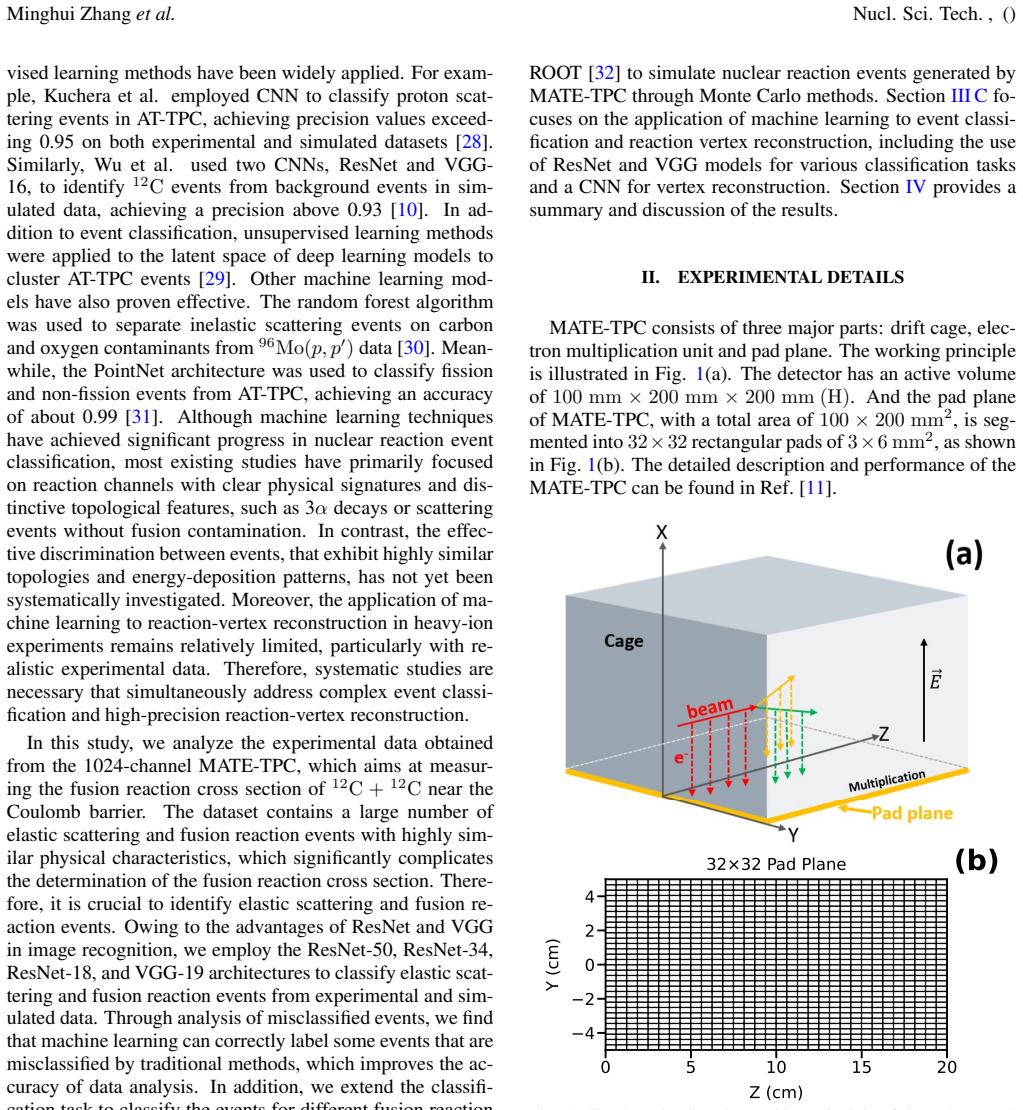
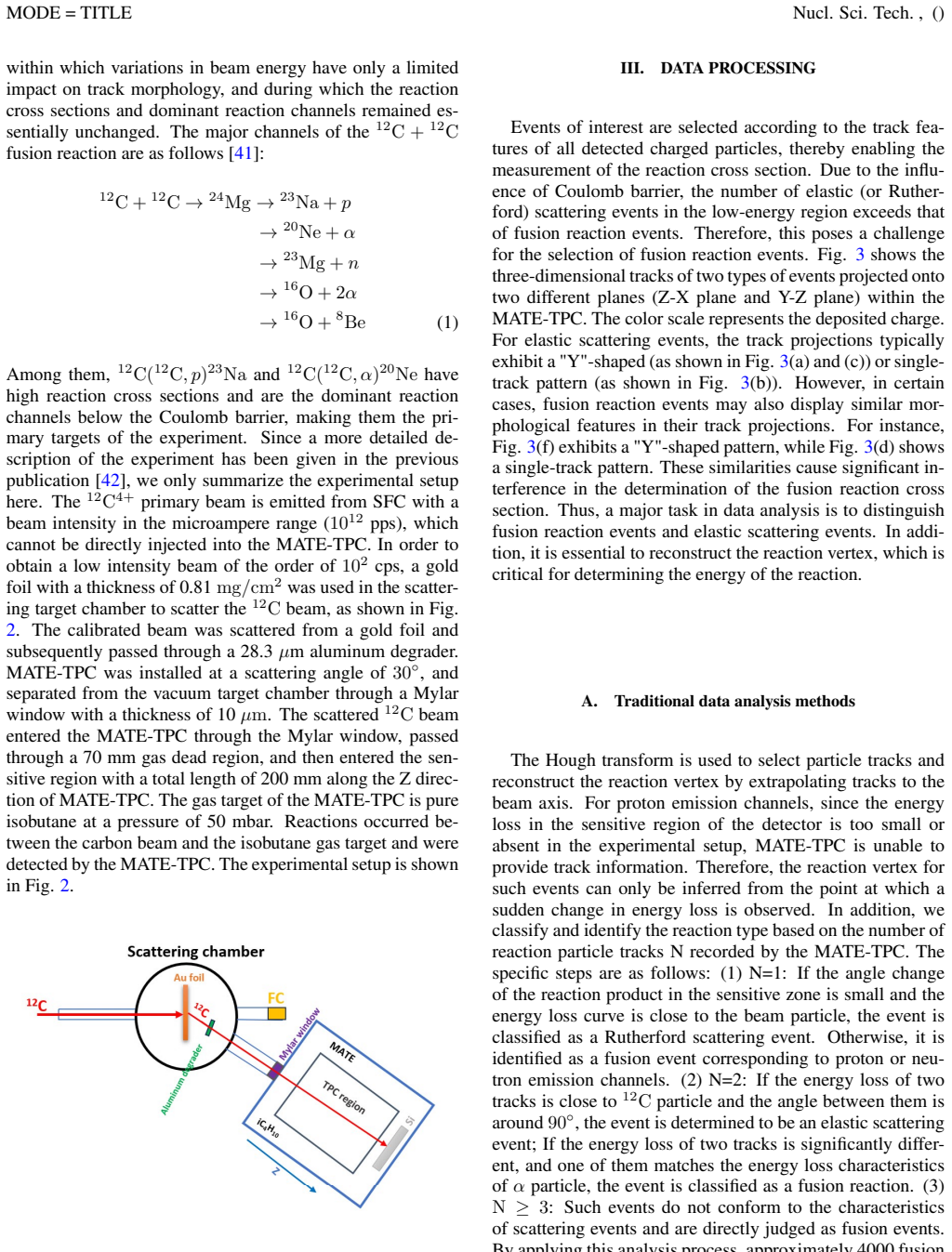
The calibrated beam was scattered from a gold foil and subsequently passed through a 28.3 µm aluminum degrader. MA TE-TPC was installed at a scattering angle of 30◦, and separated from the vacuum target chamber through a Mylar window with a thickness of 10 µm. The scattered 12C beam entered the MA TE-TPC through the Mylar window, passed through a 70 mm ga...
2000
-
[2]
First, we train these models on simulated data for the classification of elastic scattering and fusion reaction events
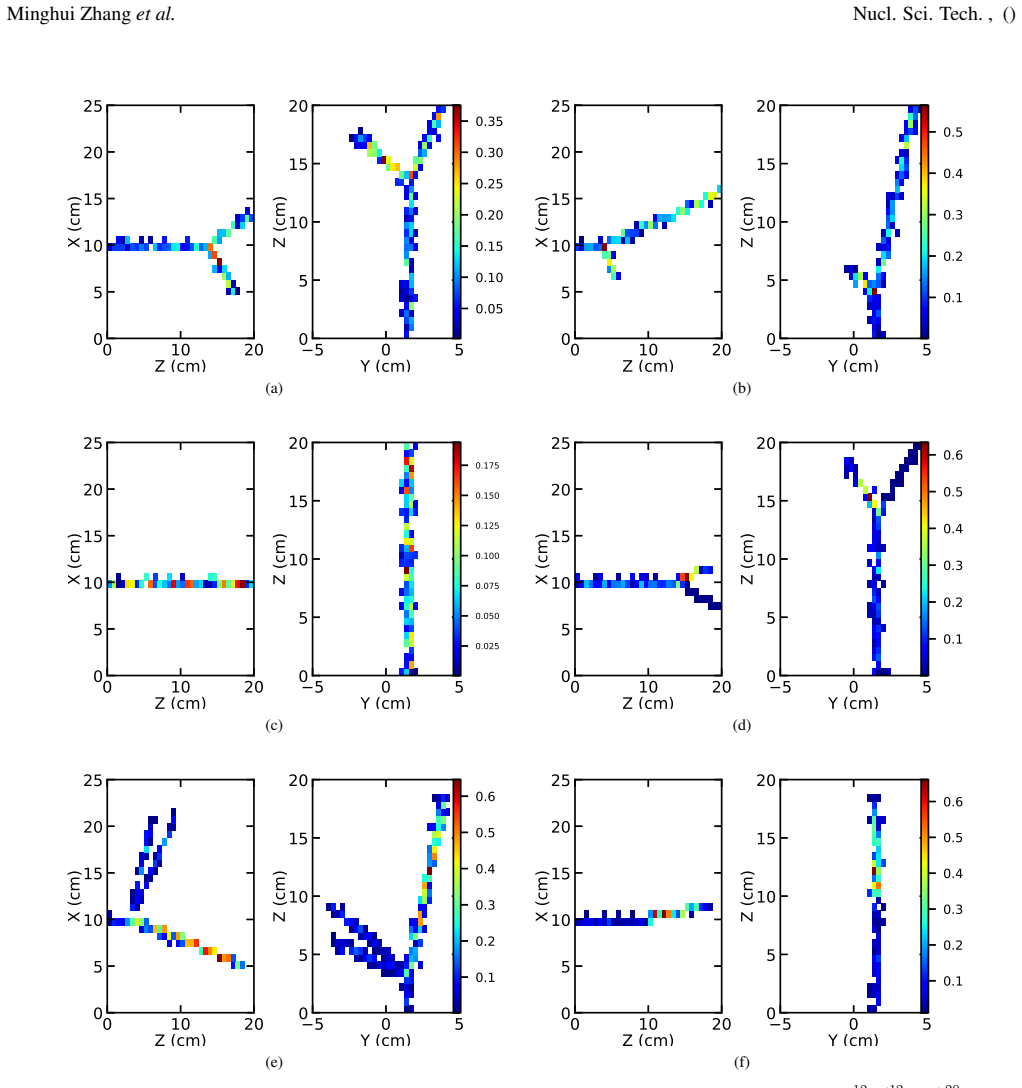
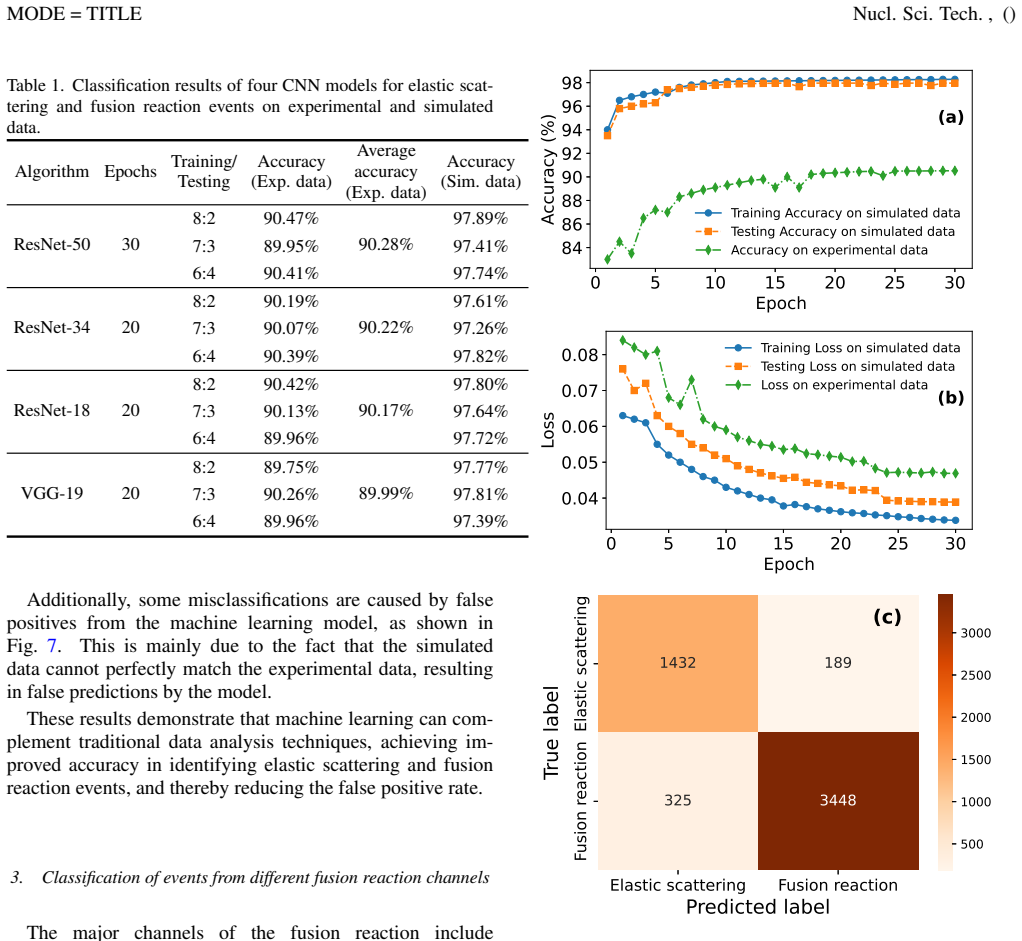
Classification of elastic scattering and fusion reaction events The classification of elastic scattering and fusion reaction events is performed using ResNet-50, ResNet-34, ResNet-18, and VGG-19. First, we train these models on simulated data for the classification of elastic scattering and fusion reaction events. The Cross Entropy Loss function is used to m...
-
[3]
The performance of the models trained on simulated data is evaluated with experimental data
To address uncertainties, the models are trained multi- ple times on simulated data using different training-to-testing split ratios (8:2, 7:3, and 6:4). The performance of the models trained on simulated data is evaluated with experimental data. The experimental data consist of 3773 fusion reaction events and 1621 elastic scattering events. The labels of...
-
[4]
For these discrepant events, a further event-by-event manual inspection combined with track visualization is performed
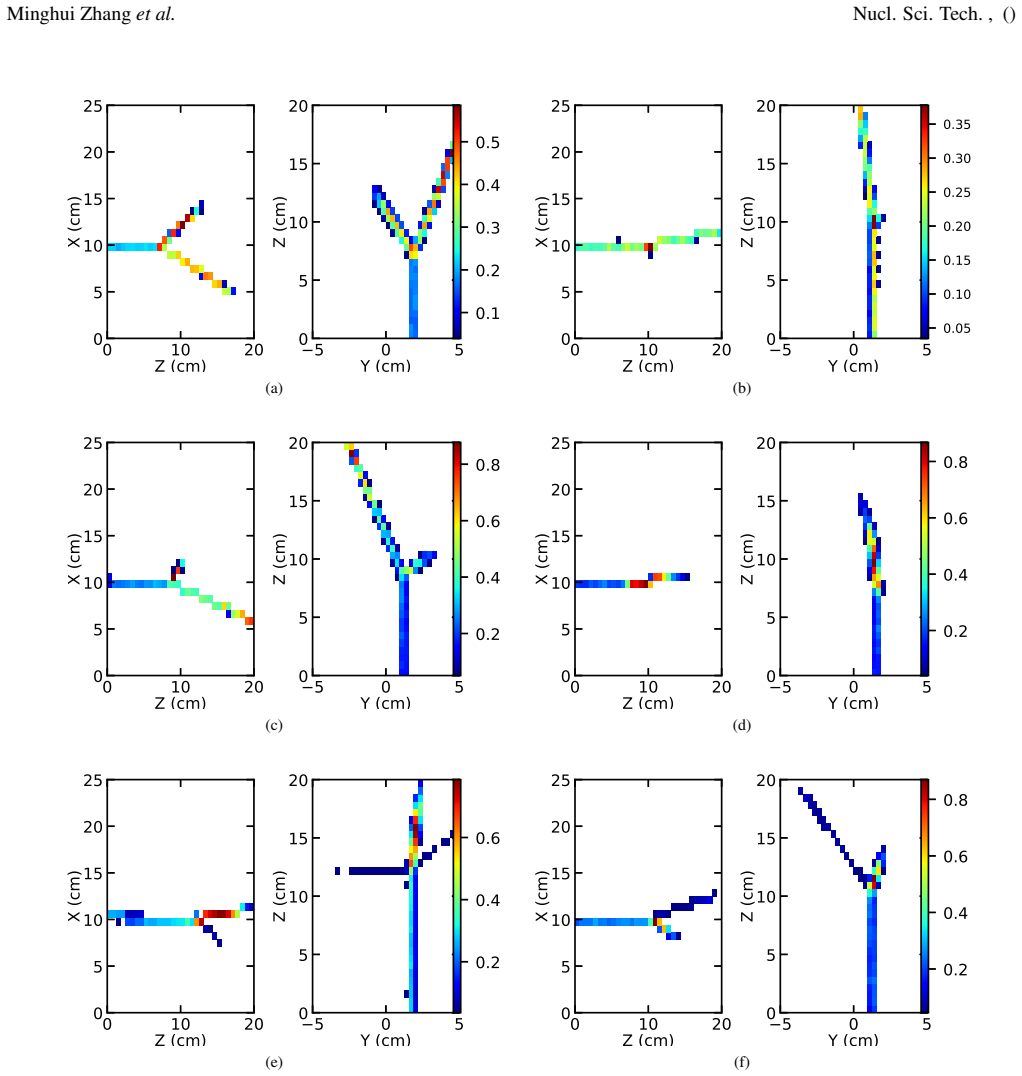
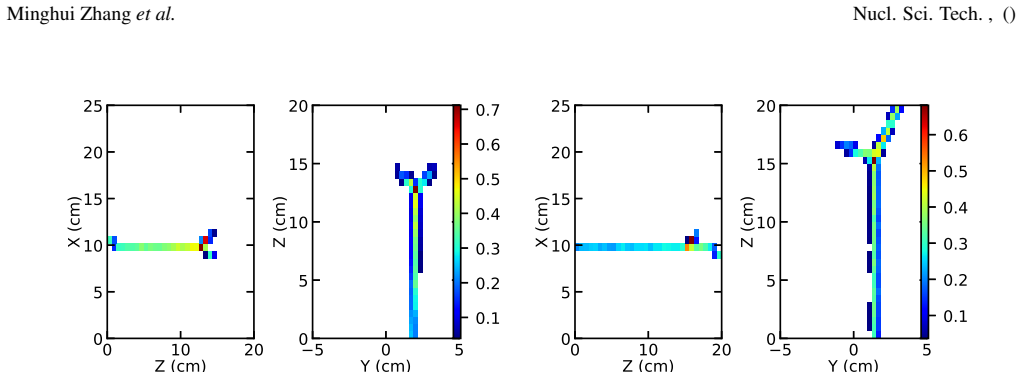
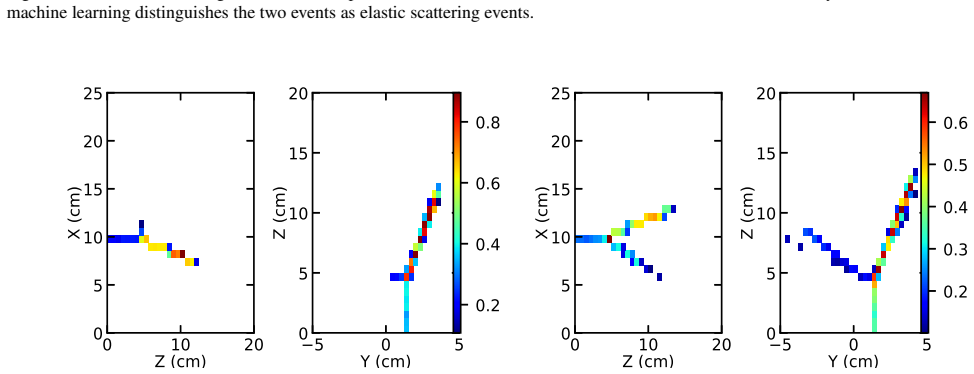
Analysis of the mislabeled events We analyze the experimental data that are misclassified by the ResNet-50 model and find that some of these cases are in fact mislabeled by traditional methods. For these discrepant events, a further event-by-event manual inspection combined with track visualization is performed. About 1.5% of the ex- perimental data are mis...
-
[5]
For the proton and neutron reaction chan- nels, they cannot be distinguished experimentally because the proton cannot be detected
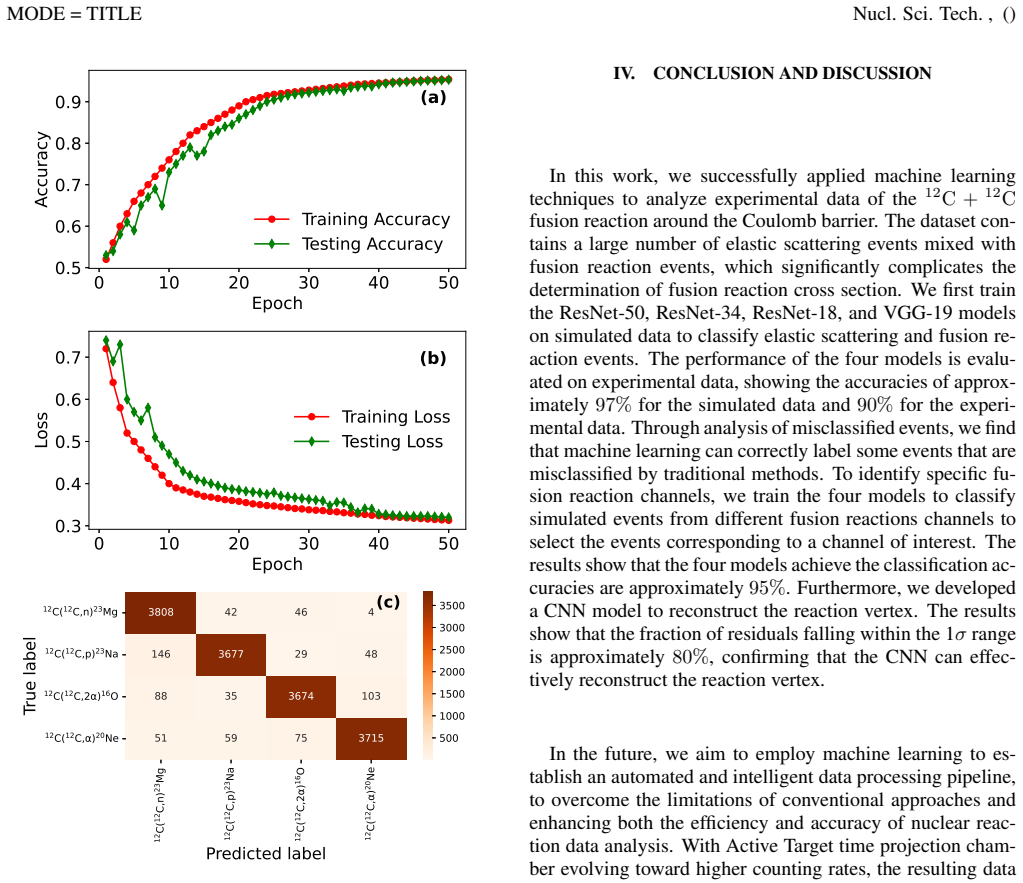
Classification of events from different fusion reaction channels The major channels of the fusion reaction include 12C(12C, p)23Na, 12C(12C, α)20Ne, 12C(12C, n)23Mg and 12C(12C, 2α)16O. For the proton and neutron reaction chan- nels, they cannot be distinguished experimentally because the proton cannot be detected. However, in the simulated data, the proto...
2000
-
[6]
However, due to the problem of overfitting, effective reconstruction of the reac- tion vertex cannot be achieved
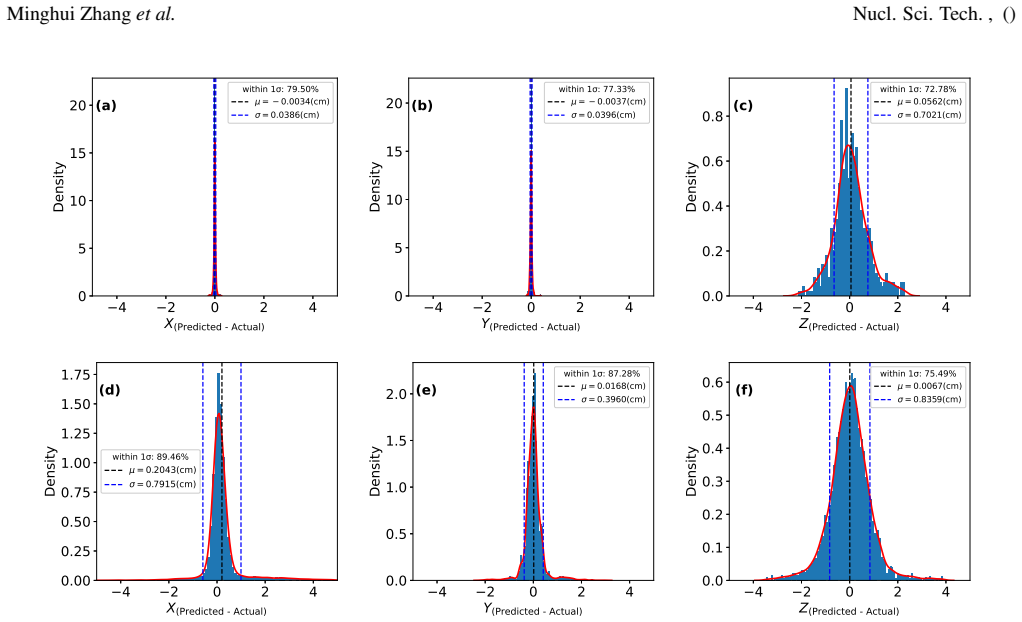
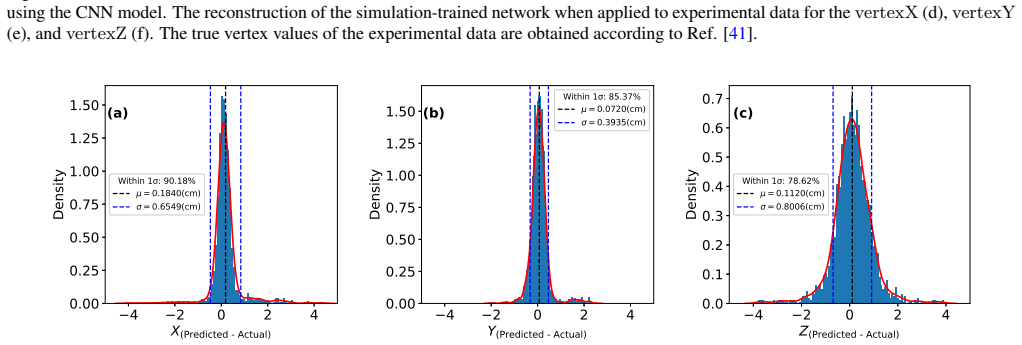
Reconstruction of reaction vertex using CNN Initially, we try to use the ResNet and VGG architectures for the reconstruction of reaction vertex. However, due to the problem of overfitting, effective reconstruction of the reac- tion vertex cannot be achieved. Therefore, in this study, we designed a CNN model to reconstruct the reaction vertex of the events....
2000
-
[7]
Y . Blumenfeld, T. Nilsson, P . V an Duppen, Facilities and meth- ods for radioactive ion beam production. Phys. Scr. T152, 014023 (2013). doi:10.1088/0031-8949/2013/T152/014023 -9 Minghui Zhang et al. Nucl. Sci. Tech. , () −4 −2 0 2 4 X (Predicted - Actual) 0 5 10 15 20 Density (a) within 1 σ: 79.50% /uni03BC= − 0.0034(cm) μ = 0.0386(cm) −4 −2 0 2 4 Y (P...
-
[8]
Stracener, Status of radioactive ion beams at the HRIBF
D.W. Stracener, Status of radioactive ion beams at the HRIBF. Nucl. Instrum. Meth. B 204, 42–47 (2003). doi:10.1016/S0168-583X(02)01888-8
-
[9]
P .G. Bricault, M. Dombsky, P .W. Schmor et al., Radioactive ion beams facility at TRIUMF. Nucl. Instrum. Meth. B 126, 231–235 (1997). doi:10.1016/S0168-583X(96)01037-3
-
[10]
D. Bazin, T. Ahn, Y . Ayyad et al., Low energy nu- clear physics with active targets and time projection chambers. Prog. Part. Nucl. Phys. 114, 103790 (2020). doi:10.1016/j.ppnp.2020.103790
-
[11]
Y . Ayyad, D. Bazin, S. Beceiro-Novo et al., Physics and tech- nology of time projection chambers as active targets. Eur. Phys. J. A 54, 181 (2018). doi:10.1140/epja/i2018-12557-7
-
[12]
W. Mittig, S. Beceiro-Novo, A. Fritsch et al., Active Tar- get detectors for studies with exotic beams: Present and next future. Nucl. Instrum. Meth. A 784, 494–498 (2015). doi:10.1016/j.nima.2014.10.048
-
[13]
J. Giovinazzo, J. Pancin, J. Pibernat et al., ACTAR TPC per- formance with GET electronics. Nucl. Instrum. Meth. A 953, 163184 (2020). doi:10.1016/j.nima.2019.163184
-
[14]
E. Koshchiy, G.V . Rogachev, E. Pollacco et al., Texas Ac- tive Target (TexA T) detector for experiments with rare iso- tope beams. Nucl. Instrum. Meth. A 957, 163398 (2020). doi:10.1016/j.nima.2020.163398
-
[15]
E. Oberla, H.J. Frisch, The design and performance of a prototype water Cherenkov optical time-projection chamber. Nucl. Instrum. Meth. A 814, 19–32 (2016). doi:10.1016/j.nima.2016.01.030 -10 MODE = TITLE Nucl. Sci. Tech. , ()
-
[16]
H.K. Wu, Y .J. Wang, Y .M. Wang et al., Machine learning method for 12C event classification and reconstruction in the active target time-projection chamber. Nucl. Instrum. Meth. A 1055, 168528 (2023). doi:10.1016/j.nima.2023.168528
-
[17]
Z.C. Zhang, X.Y . Wang, T.L. Pu et al., Studying the heavy- ion fusion reactions at stellar energies using Time Projec- tion Chamber. Nucl. Instrum. Meth. A 1016, 165740 (2021). doi:10.1016/j.nima.2021.165740
-
[18]
X.B. Li, L.H. Ru, Z.C. Zhang et al., Construction and perfor- mance test of charged particle detector array for MA TE. Nucl. Sci. Tech. 35, 131 (2024). doi:10.1007/s41365-024-01500-7
-
[19]
Y . Li, Y . Han, Y .K. Sun et al., Performance study of the Multi-purpose Time Projection Chamber (MTPC) using a four- component alpha source. Nucl. Instrum. Meth. A 1060, 169045 (2024). doi:10.1016/j.nima.2023.169045
-
[20]
J. Chen, Y . Ayyad, D. Bazin et al., Near-Threshold Dipole Strength in 10Be with Isoscalar Character. Phys. Rev. Lett.134, 012502 (2025). doi:10.1103/PhysRevLett.134.012502
-
[21]
J. Chen, J.R. Ma, Inelastic scattering reaction as a probe for monopole, dipole and quadrupole excitations. EPJ Web Conf. 311, 00008 (2024). doi:10.1051/epjconf/202431100008
-
[22]
S. Zhang, G. Li, W. Jiang et al., Measurement of the 159Tb(n,γ) cross section at the CSNS Back-n facility. Phys. Rev. C 107, 045809 (2023). doi:10.1103/PhysRevC.107.045809
-
[23]
A. Boehnlein, M. Diefenthaler, N. Sato et al., Colloquium: Ma- chine learning in nuclear physics. Rev. Mod. Phys. 94, 031003 (2022). doi:10.1103/RevModPhys.94.031003
-
[24]
W.B. He, Y .G. Ma, L.G. Pang et al., High-energy nuclear physics meets machine learning. Nucl. Sci. Tech. 34, 88 (2023). doi:10.1007/s41365-023-01233-z
-
[25]
Z.P . Gao, Y .J. Wang, H.L. Lü et al., Machine learn- ing the nuclear mass. Nucl. Sci. Tech. 32, 109 (2021). doi:10.1007/s41365-021-00956-1
-
[26]
Z.Y . Y uan, D. Bai, Z. Wang et al., Reliable calculations of nuclear binding energies by the Gaussian process of machine learning. Nucl. Sci. Tech. 35, 105 (2024). doi:10.1007/s41365- 024-01463-9
-
[27]
T.S. Shang, J. Li, Z.M. Niu et al., Prediction of nuclear charge density distribution with feedback neural network. Nucl. Sci. Tech. 33, 153 (2022). doi:10.1007/s41365-022-01140-9
-
[28]
J. He, W.B. He, Y .G. Ma et al., Machine-learning-based identification for initial clustering structure in relativistic heavy-ion collisions. Phys. Rev. C 104, 044902 (2021). doi:10.1103/PhysRevC.104.044902
-
[29]
C.H. Kim, S. Ahn, K.Y . Chae et al., Noise signal identi- fication in time projection chamber data using deep learn- ing model. Nucl. Instrum. Meth. A 1048, 168025 (2023). doi:10.1016/j.nima.2023.168025
-
[30]
Z. Qian, V . Belavin, V . Bokov et al., V ertex and energy reconstruction in JUNO with machine learning methods. Nucl. Instrum. Meth. A 1010, 165527 (2021). doi:10.1016/j.nima.2021.165527
-
[31]
J. Mayer, K. Boretzky, C. Douma et al., Classical and machine learning methods for event reconstruction in Neu- LAND. Nucl. Instrum. Meth. A 1013, 165666 (2021). doi:10.1016/j.nima.2021.165666
-
[32]
Z.Y . Li, Z. Qian, J.H. He et al., Improvement of machine learning-based vertex reconstruction for large liquid scintilla- tor detectors with multiple types of PMTs. Nucl. Sci. Tech. 33, 93 (2022). doi:10.1007/s41365-022-01078-y
-
[33]
Delaquis, M.J
S. Delaquis, M.J. Jewell, I. Ostrovskiy et al., Deep neu- ral networks for energy and position reconstruction in EXO-
-
[34]
J. Instrum. 13, P08023 (2018). doi:10.1088/1748- 0221/13/08/P08023
-
[35]
M.P . Kuchera, R. Ramanujan, J.Z. Taylor et al., Ma- chine learning methods for track classification in the A T-TPC. Nucl. Instrum. Meth. A 940, 156–167 (2019). doi:10.1016/j.nima.2019.05.097
-
[36]
R. Solli, D. Bazin, M. Hjorth-Jensen et al., Unsuper- vised learning for identifying events in active target ex- periments. Nucl. Instrum. Meth. A 1010, 165461 (2021). doi:10.1016/j.nima.2021.165461
-
[37]
R. Ghimire, A. Ratkiewicz, S.D. Pain et al., Background subtraction in inelastic scattering measurements using ma- chine learning. Nucl. Instrum. Meth. B 561, 165649 (2025). doi:10.1016/j.nimb.2025.165649
-
[38]
P . Dey, A.K. Anthony, C. Hunt et al., Point-cloud based machine learning for classifying rare events in the Active- Target Time Projection Chamber. Nucl. Instrum. Meth. A1072, 170002 (2025). doi:10.1016/j.nima.2024.170002
-
[39]
L. Li, Z.C. Zhang, N.T. Zhang et al., MA TEROOT: A Sim- ulation and Analysis Tool for Experiments with MA TE. Chi- naXiv:202605.00027. doi:10.12074/202605.00027
work page internal anchor Pith review Pith/arXiv arXiv doi:10.12074/202605.00027
-
[40]
J.W. Xia, W.L. Zhan, B.W. Wei et al., The heavy ion cooler-storage-ring project (HIRFL-CSR) at Lanzhou. Nucl. Instrum. Meth. A 488, 11–25 (2002). doi:10.1016/S0168- 9002(02)00475-8
-
[41]
W.K. Nan, Y .B. Wang, Y .D. Sheng et al., Novel thick- target inverse kinematics method for the astrophysical 12C + 12C fusion reaction. Nucl. Sci. Tech. 35, 208 (2024). doi:10.1007/s41365-024-01573-4
-
[42]
X.D. Tang, L.H. Ru, The 12C+12C fusion reaction at stellar energies. EPJ Web Conf. 260, 01002 (2022). doi:10.1051/epjconf/202226001002
-
[43]
B.B. Back, H. Esbensen, C.L. Jiang et al., Recent developments in heavy-ion fusion reactions. Rev. Mod. Phys. 86, 317–360 (2014). doi:10.1103/RevModPhys.86.317
-
[44]
L.R. Gasques, E.F. Brown, A. Chieffi et al., Implica- tions of low-energy fusion hindrance on stellar burning and nucleosynthesis. Phys. Rev. C 76, 035802 (2007). doi:10.1103/PhysRevC.76.035802
-
[45]
S. Wang, Y .Z. Li, L.H. Ru et al., 12C+12C fusion reaction at astrophysical energies using HOPG target. Nucl. Sci. Tech. 36, 143 (2025). doi:10.1007/s41365-025-01714-3
-
[46]
X.D. Tang, S.B. Ma, X. Fang et al., An efficient method for mapping the 12C+12C molecular resonances at low ener- gies. Nucl. Sci. Tech. 30, 126 (2019). doi:10.1007/s41365-019- 0652-9
-
[47]
W.P . Liu, B. Guo, Z. An et al., Recent progress in nuclear astro- physics research and its astrophysical implications at the China Institute of Atomic Energy. Nucl. Sci. Tech. 35, 217 (2024). doi:10.1007/s41365-024-01590-3
-
[48]
Zhang, Development and Applications of the Time Pro- jection Chamber for the Cross-section Measurements of the Important Fusion Reactions in Astrophysics, Ph.D
Z.C. Zhang, Development and Applications of the Time Pro- jection Chamber for the Cross-section Measurements of the Important Fusion Reactions in Astrophysics, Ph.D. thesis, Uni- versity of Chinese Academy of Sciences (Institute of Modern Physics, CAS), 2021
2021
-
[49]
X.Y . Wang, N.T. Zhang, Z.C. Zhang et al., Studies of the 2α and 3α channels of the 12C+12C reaction in the range of Ec.m. = 8.9 to 21 MeV using the active target Time Projection Chamber. Chin. Phys. C 46, 104001 (2022). doi:10.1088/1674- 1137/ac7a1d
-
[50]
Koonce, ResNet-50 Convolutional Neural Networks with Swift for TensorFlow: Image Recognition and Dataset Cate- gorization
B. Koonce, ResNet-50 Convolutional Neural Networks with Swift for TensorFlow: Image Recognition and Dataset Cate- gorization. pp. 63–72 (2021)
2021
-
[51]
Liang, Image classification based on RESNET
J.H. Liang, Image classification based on RESNET. J. -11 Minghui Zhang et al. Nucl. Sci. Tech. , () Phys.: Conf. Ser. 1634, 012110 (2020). doi:10.1088/1742- 6596/1634/1/012110
-
[52]
B.Q. Li, Y .Y . He, An improved ResNet based on the ad- justable shortcut connections. IEEE Access 6, 18967 (2018). doi:10.1109/ACCESS.2018.2814605
-
[53]
A. Sengupta, Y . Y e, R. Wang et al., Going Deeper in Spik- ing Neural Networks: VGG and Residual Architectures. Front. Neurosci. 13, 95 (2019). doi:10.3389/fnins.2019.00095
-
[54]
S. Tammina, Transfer learning using VGG-16 with deep convo- lutional neural network for classifying images. Int. J. Sci. Res. Publ. 9, 143 (2019). doi:10.29322/IJSRP .9.10.2019.p9420 -12
discussion (0)
Sign in with ORCID, Apple, or X to comment. Anyone can read and Pith papers without signing in.