Engineering Molecular Rectification: Mechanisms, Modulation Strategies, and Device Integration
Pith reviewed 2026-06-29 11:14 UTC · model grok-4.3
The pith
Molecular rectifiers reach practical use by linking transport mechanisms to molecular design and device fabrication.
A machine-rendered reading of the paper's core claim, the machinery that carries it, and where it could break.
Core claim
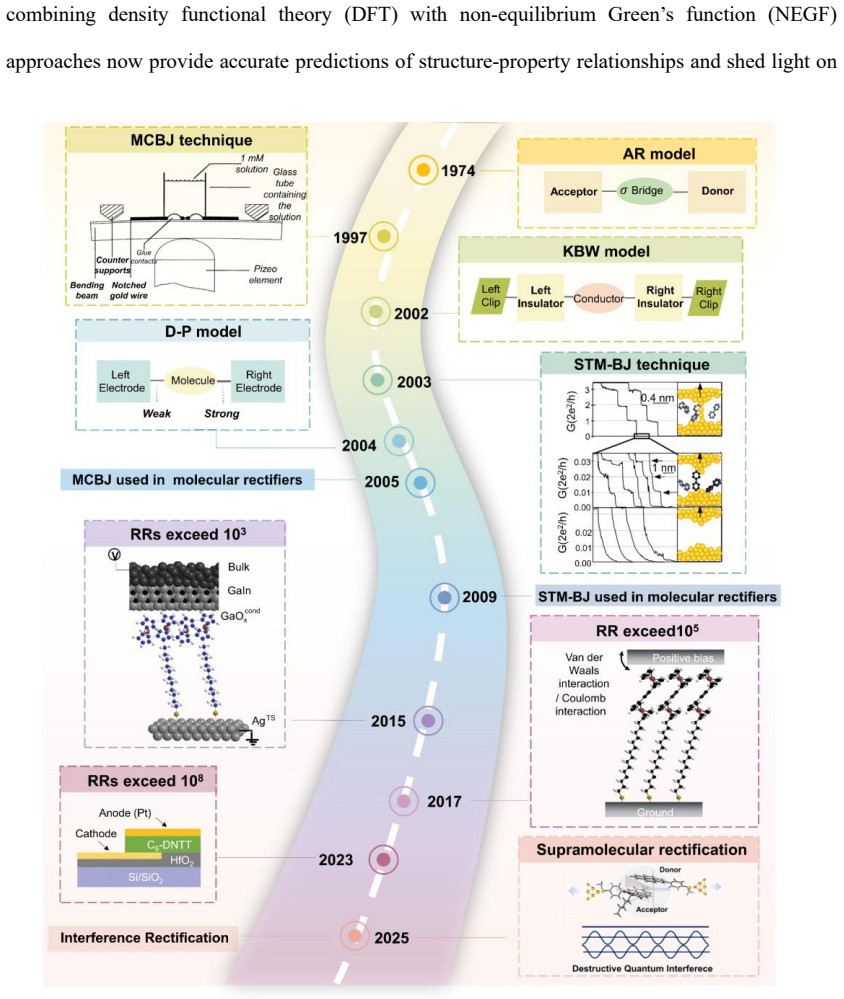
By holistically considering the transport mechanisms, modulation strategies, fabrication, characterization techniques, and theoretical simulations, this review provides a comprehensive overview of molecular rectifiers. Representative examples of conceptually significant and high-performance molecular rectifier systems are highlighted to illustrate the relationships between rectification mechanisms, molecular design strategies, and device realization. Building on these discussions, an outlook for current bottlenecks and future directions is presented to guide the development of molecular rectifiers.
What carries the argument
Holistic integration of transport mechanisms, modulation strategies, fabrication, characterization, and simulations to connect molecular design to device performance
If this is right
- Molecular rectifiers become competitive with silicon-based devices through improved design principles from mechanistic and experimental perspectives.
- Practical deployment advances by addressing limited rectification ratios, insufficient robustness, and poor reproducibility.
- A conceptual framework and technical reference supports researchers working at the intersection of molecular electronics and nanoscale device engineering.
- Development in the post-CMOS era follows the identified future directions and bottleneck solutions.
Where Pith is reading between the lines
- The same holistic mapping of mechanisms to design could apply to other molecular electronic elements such as switches or sensors.
- Standardized testing protocols across labs might further reduce the reproducibility issues noted in the review.
- New materials or fabrication approaches could be evaluated against the modulation strategies summarized here to test the framework's generality.
Load-bearing premise
The highlighted representative examples sufficiently capture the key relationships between rectification mechanisms, molecular design strategies, and device realization without bias in selection or coverage.
What would settle it
Discovery of a major molecular rectifier system or mechanism omitted from the review that alters the presented relationships or outlook on bottlenecks.
Figures
read the original abstract
Molecular rectifiers, as prototypical components of molecular electronics, present unique opportunities for pushing device miniaturization to its ultimate limits. Nevertheless, challenges including limited rectification ratios (RR), insufficient robustness, and poor reproducibility impede their practical deployment. To make molecular rectifiers competitive with silicon-based devices, it is important to fully understand the design principles and fabrication methods from both mechanistic and experimental perspectives. By holistically considering the transport mechanisms, modulation strategies, fabrication, characterization techniques, and theoretical simulations, this review provides a comprehensive overview of molecular rectifiers. Representative examples of conceptually significant and high-performance molecular rectifier systems are highlighted to illustrate the relationships between rectification mechanisms, molecular design strategies, and device realization. Building on these discussions, we present an outlook for current bottlenecks and future directions to guide the development of molecular rectifiers. This review aims to serve as both a conceptual framework and a technical reference for researchers working at the intersection of molecular electronics and nanoscale device engineering in the post-CMOS era.
Editorial analysis
A structured set of objections, weighed in public.
Referee Report
Summary. The manuscript is a review article surveying molecular rectifiers as components for molecular electronics. It covers transport mechanisms, modulation strategies for improving rectification ratios, fabrication and characterization methods, theoretical simulations, highlights representative high-performance examples to link mechanisms with design and device realization, and provides an outlook on bottlenecks such as limited RR, robustness, and reproducibility along with future directions.
Significance. If the literature selection proves balanced and the highlighted examples accurately capture key relationships, the review would function as a useful conceptual framework and technical reference for advancing molecular rectifiers toward practical post-CMOS applications.
minor comments (3)
- [Abstract] Abstract: the claim of a 'holistic' overview would be strengthened by explicitly stating the time window or number of papers surveyed to allow readers to assess coverage.
- [Representative Examples] The manuscript should include a dedicated subsection or table comparing rectification ratios, stability metrics, and fabrication yields across the representative examples to make cross-system trends more transparent.
- [Throughout] Ensure consistent use of abbreviations (e.g., RR) on first use in each major section and verify that all figure captions are self-contained.
Simulated Author's Rebuttal
We thank the referee for the positive assessment of our review, the accurate summary of its scope, and the recommendation for minor revision. The referee's evaluation aligns with our intent to provide a conceptual framework and technical reference for molecular rectifiers.
Circularity Check
Review paper: no derivations, predictions or self-referential reductions
full rationale
This is an explicit review article whose central claim is a literature summary of transport mechanisms, modulation strategies, fabrication methods and representative examples. No original equations, fitted parameters, predictions or uniqueness theorems are advanced. The selection of examples is presented as illustrative rather than as a derived result, and no step reduces by construction to prior inputs within the paper itself. The reader's assessment of zero circularity is therefore confirmed.
Axiom & Free-Parameter Ledger
Reference graph
Works this paper leans on
-
[1]
Moore, G. E. Cramming More Components Onto Integrated Circuits. Proceedings of the IEEE 1998, 86, 82-85
1998
-
[2]
& Datta, S
Salahuddin, S.,Ni, K. & Datta, S. The era of hyper-scaling in electronics. Nature Electronics 2018, 1, 442-450
2018
-
[3]
Waldrop, M. M. The chips are down for Moore’s law. Nature 2016, 530, 144-147
2016
-
[4]
ITRS: The International Technology Roadmap for Semiconductors
Hoefflinger, B. ITRS: The International Technology Roadmap for Semiconductors. Chips 2020: A Guide to the Future of Nanoelectronics 2012, 161-174
2020
-
[5]
Khanna, V . K. Short-Channel Effects in MOSFETs. Integrated Nanoelectronics: Nanoscale CMOS, Post-CMOS and Allied Nanotechnologies 2016, 73-93
2016
-
[6]
& Liu, Y .-R
Zhang, M.,Yao, R.-H. & Liu, Y .-R. A channel thermal noise model of nanoscaled metal-oxide-semiconductor field-effect transistor. Acta Physica Sinica 2020, 69, 057101
2020
-
[7]
Jia, X. et al. Analysis of Channel Current Noise in Small Nanoscale Metal Oxide Semiconductor Field Effect Transistors. Small 2024, 20, 2403659
2024
-
[8]
Chen, Z. et al. Quantum interference enhances the performance of single-molecule transistors. Nature Nanotechnology 2024, 19, 986-992
2024
-
[9]
& Ghibaudo, G
Cristoloveanu, S. & Ghibaudo, G. Intrinsic Mechanism of Mobility Collapse in Short MOSFETs. IEEE Transactions on Electron Devices 2021, 68, 5090-5094
2021
-
[10]
& Zou, J
Tang, L. & Zou, J. p -Type Two-Dimensional Semiconductors: From Materials Preparation to Electronic Applications. Nano-Micro Letters 2023, 15, 230
2023
-
[11]
Luo, S. et al. Massively Parallel Arrays of Size-Controlled Metallic Nanogaps with Gap-Widths Down to the Sub-3-nm Level. Advanced Materials 2021, 33, 2100491
2021
-
[12]
& Ratner, M
Aviram, A. & Ratner, M. A. Molecular rectifiers. Chemical Physics Letters 1974, 29, 277-283
1974
-
[13]
Metzger, R. M. Unimolecular Electronics. Chemical Reviews 2015, 115, 5056-5115
2015
-
[14]
Su, T. A. et al. Chemical principles of single-molecule electronics. Nature Reviews Materials 2016, 1, 16002
2016
-
[15]
Wang, B. & Lu, Y . Collective Molecular Machines: Multidimensionality and Reconfigurability. Nano-Micro Letters 2024, 16, 155
2024
-
[16]
& Baranger, H
Ke, S.-H.,Yang, W. & Baranger, H. U. Quantum-Interference-Controlled Molecular Electronics. Nano Letters 2008, 8, 3257-3261
2008
-
[17]
Lambert, C. J. Basic concepts of quantum interference and electron transport in single -molecule electronics. Chemical 66 Society Reviews 2015, 44, 875-888
2015
-
[18]
Bai, J. et al. Anti-resonance features of destructive quantum interference in single-molecule thiophene junctions achieved by electrochemical gating. Nature Materials 2019, 18, 364-369
2019
-
[19]
L.,Burzurí, E
Perrin, M. L.,Burzurí, E. & van der Zant, H. S. J. Single-molecule transistors. Chemical Society Reviews 2015, 44, 902- 919
2015
-
[20]
Intra-molecular switching for memory and logic
Natelson, D. Intra-molecular switching for memory and logic. Nature Materials 2022, 21, 839-840
2022
-
[21]
Li, J. et al. Room -temperature logic-in-memory operations in si ngle-metallofullerene devices. Nature Materials 2022, 21, 917-923
2022
-
[22]
& Leiderer, P
Scheer, E. & Leiderer, P . Detecting interference of lattice vibrations. Nature Materials 2025, 24, 1164-1165
2025
-
[23]
van der Poel, S. et al. Mechanoelectric sensitivity reveals destructive quantum interference in single-molecule junctions. Nature Communications 2024, 15, 10097
2024
-
[24]
Chen, X. et al. Molecular diodes with rectification ratios exceeding 105 driven by electrostatic interactions. Nature Nanotechnology 2017, 12, 797-803
2017
-
[25]
G uo, C. et al. Molecular rectifier composed of DNA with high rectification ratio enabled by intercalation. Nature Chemistry 2016, 8, 484-490
2016
-
[26]
Li, Y . et al. Monolayer Organic Crystals for Ultrahigh Performance Molecular Diodes. Advanced Science 2024, 11, 2305100
2024
-
[27]
Wang, Z. et al. Electrochemically controlled rectification in symmetric single -molecule junctions. Proceedings of the National Academy of Sciences of the United States of America 2022, 119, e2122183119
2022
-
[28]
Xin, N. et al. Tunable Symmetry -Breaking-Induced Dual Functions in Stable and Photoswitched Single -Molecule Junctions. Journal of the American Chemical Society 2021, 143, 20811-20817
2021
-
[29]
Wang, H. et al. Gating the Rectifying Direction of Tunneling Current through Single-Molecule Junctions. Journal of the American Chemical Society 2024, 146, 35347-35355
2024
-
[30]
Boyen, H.-G. et al. Local density of states effects at the metal-molecule interfaces in a molecular device. Nature Materials 2006, 5, 394-399
2006
-
[31]
Gobbi, M. et al. Determination of energy level alignment at metal/molecule interfaces by in-device electrical spectroscopy. Nature Communications 2014, 5, 4161
2014
-
[32]
Nakayama, M. et al. Probing Energy-Level Alignment in Molecular Multilayers by Frequency-Modulation Electrostatic Force Microscopy under Tapping -Mode-Combined Fowler –Nordheim Tunneling Spectroscopy. ACS Applied Materials & Interfaces 2023, 15, 47704-47714
2023
-
[33]
Song, X.,Yu, X. & Hu, W. Model Study on the Ideal Current–V oltage Characteristics and Rectification Performance of a Molecular Rectifier under Single-Level-Based Tunneling and Hopping Transport. The Journal of Physical Chemistry C 2020, 124, 24408-24419
2020
-
[34]
D.,Kim, M.,Cho, S
Kong, G. D.,Kim, M.,Cho, S. J. & Yoon, H. J. Gradients of Rectification: Tu ning Molecular Electronic Devices by the Controlled Use of Different -Sized Diluents in Heterogeneous Self -Assembled Monolayers. Angewandte Chemie International Edition 2016, 55, 10307-10311. 67
2016
-
[35]
Khalid, H. et al. Modulated Structure and Rectification Prop erties of a Molecular Junction by a Mixed Self -Assembled Monolayer. Langmuir 2022, 38, 10893-10901
2022
-
[36]
& Cornil, J
Van Dyck, C.,Geskin, V . & Cornil, J. Fermi Level Pinning and Orbital Polarization Effects in Molecular Junctions: The Role of Metal Induced Gap States. Advanced Functional Materials 2014, 24, 6154-6165
2014
-
[37]
Gu, M.-W. et al. Increased Surface Density of States at the Fermi Level for Electron Transport Across Single-Molecule Junctions. Angewandte Chemie International Edition 2023, 62, e202214963
2023
-
[38]
Louie, S. G. & Cohen, M. L. Electronic structure of a metal-semiconductor interface. Physical Review B 1976, 13, 2461- 2469
1976
-
[39]
& van Ruitenbeek, J
Evers, F.,Korytár, R.,Tewari, S. & van Ruitenbeek, J. M. Advances and challenges in single-molecule electron transport. Reviews of Modern Physics 2020, 92, 035001
2020
-
[40]
Zou, D.-Q. et al. Large rectification ratio induced by nitrogen (boron) doping in graphene nanoribbon electrodes for OPE junctions. Physics Letters A 2015, 379, 1842-1846
2015
-
[41]
L.,Doelman, M.,Eelkema, R
Perrin, M. L.,Doelman, M.,Eelkema, R. & van der Zant, H. S. J. Design of an efficient coherent multi-site single-molecule rectifier. Physical Chemistry Chemical Physics 2017, 19, 29187-29194
2017
-
[42]
Kaur, R. et al. Mechanism of rectification and negative differential resistance in single -molecule junctions with asymmetric anchoring groups: a DFT study. Journal of Molecular Modeling 2023, 29, 340
2023
-
[43]
M.,Low, P
Dief, E. M.,Low, P. J.,Díez -Pérez, I. & Darwish, N. Advances in single -molecule junctions as tools for chemical and biochemical analysis. Nature Chemistry 2023, 15, 600-614
2023
-
[44]
Bei, Z. et al. Photo-induced carbocation-enhanced charge transport in single-molecule junctions. Chemical Science 2020, 11, 6026-6030
2020
-
[45]
Sun, X.,Liu, R.,Kandapal, S. & Xu, B. Development and mechanisms of photo -induced molecule junction device. Nanophotonics 2024, 13, 1535-1560
2024
-
[46]
Sergi Lopes, C. et al. Rectification rat io and direction controlled by temperature in copper phthalocyanine ensemble molecular diodes. Nanoscale 2020, 12, 10001-10009
2020
-
[47]
Li, J. et al. Unveiling Quantum Coherence Effects in Modulating Electron Transfer in Platinum (II) Donor -Acceptor- Donor Systems. Chemistry–A European Journal 2025, 31, e202404512
2025
-
[48]
Guo, Y . et al. A Robust Single-Molecule Diode with High Rectification Ratio and Integrability. Journal of the American Chemical Society 2025, 147, 16972-16981
2025
-
[49]
Xu, W. et al. Supramolecular Diodes with Donor–Acceptor Interactions. Journal of the American Chemical Society 2025, 147, 5879-5886
2025
-
[50]
& Yang, J
Huang, C. & Yang, J. Nano-Molecular Junctions on STM Tips. Nano-Micro Letters 2011, 3, 1-5
2011
-
[51]
Reed, M. A. et al. Conductance of a Molecular Junction. Science 1997, 278, 252-254
1997
-
[52]
Stone, I. et al. A single-molecule blueprint for synthesis. Nature Reviews Chemistry 2021, 5, 695-710
2021
-
[53]
& Chiechi, R
Liu, Y .,Qiu, X.,Soni, S. & Chiechi, R. C. Charge transport through molecular ensembles: Recent progress in molecular electronics. Chemical Physics Reviews 2021, 2, 021303. 68
2021
-
[54]
Liu, H. et al. Single-molecule photoelectron tunnelling spectroscopy. Nature Materials 2023, 22, 1007-1012
2023
-
[55]
& Fraser Stoddart, J
Chen, H. & Fraser Stoddart, J. From molecular to supramolecular electronics . Nature Reviews Materials 2021, 6, 804- 828
2021
-
[56]
Zou, Y .-L. et al. Boron-Doped Single-Molecule van der Waals Diode. Angewandte Chemie 2025, 64, e202415940
2025
-
[57]
Li, X. et al. Characterization and Application of Supramolecular Junctions. Angewandte Chemie International Edition 2022, 62, e202216819
2022
-
[58]
Gupta, R. et al. Nanoscale molecular rectifiers. Nature Reviews Chemistry 2023, 7, 106-122
2023
-
[59]
& Guo, X
Yang, C.,Hu, W. & Guo, X. Precise Detection, Control and Synthesis of Chiral Compounds at Single-Molecule Resolution. Nano-Micro Letters 2023, 15, 211
2023
-
[60]
& Ratner, M
Nitzan, A. & Ratner, M. A. Electron Transport in Molecular Wire Junctions. Science 2003, 300, 1384-1389
2003
-
[61]
Electronic transport in mesoscopic systems; Cambridge university press, 1997
Datta, S. Electronic transport in mesoscopic systems; Cambridge university press, 1997
1997
-
[62]
& Ostlund, N
Szabo, A. & Ostlund, N. S. Modern quantum chemistry: introduction to advanced electronic structure theory. Courier Corporation 1996, 39
1996
-
[63]
How Chemistry and Physics Meet in the Solid State
Hoffmann, R. How Chemistry and Physics Meet in the Solid State. Angewandte Chemie International Edition in English 1987, 26, 846-878
1987
-
[64]
Heath, J. R. Molecular Electronics. Annual Review of Materials Research 2009, 39, 1-23
2009
-
[65]
Simmons, J. G. Generalized Fo rmula for the Electric Tunnel Effect between Similar Electrodes Separated by a Thin Insulating Film. Journal of Applied Physics 1963, 34, 1793-1803
1963
-
[66]
L.,Yan, H
McCreery, R. L.,Yan, H. & Bergren, A. J. A critical perspective on molecular electronic junctions: there is plenty of room in the middle. Physical Chemistry Chemical Physics 2013, 15, 1065-1081
2013
-
[67]
& Guo, X
Jia, C. & Guo, X. Molecule –electrode interfaces in molecular electronic devices. Chemical Society Reviews 2013, 42, 5642-5660
2013
-
[68]
& Bjørnho lm, T
Moth -Poulsen, K. & Bjørnho lm, T. Molecular electronics with single molecules in solid -state devices. Nature Nanotechnology 2009, 4, 551-556
2009
-
[69]
Spatial Variation of Currents and Fields Due to Localized Scatterers in Metallic Conduction
Landauer, R. Spatial Variation of Currents and Fields Due to Localized Scatterers in Metallic Conduction. IBM Journal of Research and Development 1957, 1, 223-231
1957
-
[70]
& Pinhas, S
Büttiker, M.,Imry, Y .,Landauer, R. & Pinhas, S. Generalized many-channel conductance formula with application to small rings. Physical Review B 1985, 31, 6207-6215
1985
-
[71]
Marcus, R. A. Electron Transfer Reactions in Chemistry: Theory and Experiment (Nobel Lecture). Garland Science 1993, 32, 1111-1121
1993
-
[72]
Sowa, J. K. & Marcus, R. A. On the theory of charge transport and entropic effects in solvated molecular junctions. The Journal of Chemical Physics 2021, 154, 034110
2021
-
[73]
Keldysh, L. V . Diagram technique for nonequilibrium processes. Selected Papers of Leonid V Keldysh 2024, 47-55
2024
-
[74]
Kim, Y . et al. Benzenedithiol: A Broad-Range Single-Channel Molecular Conductor. Nano Letters 2011, 11, 3734-3738. 69
2011
-
[75]
Kim, Y . et al. Charge Transport Characteristics of Diarylethene Photoswitching Single-Molecule Junctions. Nano Letters 2012, 12, 3736-3742
2012
-
[76]
Yelin, T. et al. Conductance saturation in a series of highly transmitting molecular junctions. Nature Materials 2016, 15, 444-449
2016
-
[77]
E.,Bratkovsky, A
Kornilovitch, P. E.,Bratkovsky, A. M. & Stanley Williams, R. Current rectification by molecules with asymmetric tunneling barriers. Physical Review B 2002, 66, 165436
2002
-
[78]
Zahid, F. et al. Charging-induced asymmetry in molecular conductors. Physical Review B 2004, 70, 245317
2004
-
[79]
Lörtscher, E. et al. Transport Properties of a Single-Molecule Diode. ACS Nano 2012, 6, 4931-4939
2012
-
[80]
Metzger, R. M. Unimolecular Electrical Rectifiers. Chemical Reviews 2003, 103, 3803-3834
2003
discussion (0)
Sign in with ORCID, Apple, or X to comment. Anyone can read and Pith papers without signing in.