REVIEW 4 major objections 3 minor
Cultural Binding Heads in Language Models
T0 review · 4 major / 3 minor · reviewed 2026-07-12 · grok-4.5
Pith's one-line read A few mid-layer attention heads causally bind cultural items to identities in LLMs; amplifying them raises differentiation accuracy without wrecking neutral reasoning.
desk verdict Abstract-only: coherent mech-interp localization of cultural binding heads with modest effects, but the causal isolation claim is still unsecured. read the letter →
The pith
A machine-rendered reading of the paper's core claim, the machinery that carries it, and where it could break.
The reading
What carries the argument
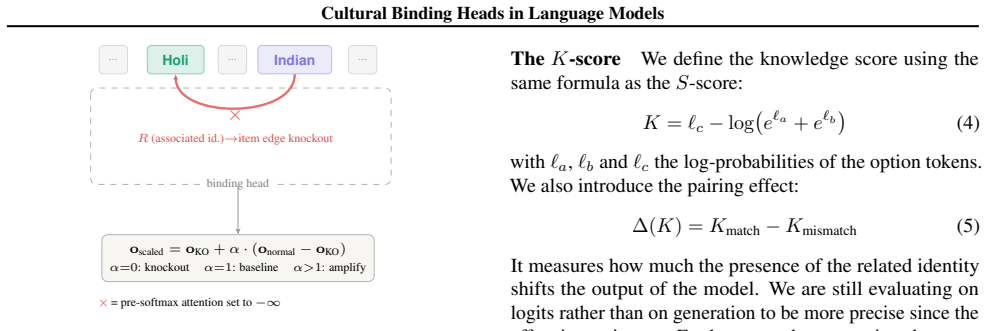
Identity-to-item edge knockout and α-scaling of a small set of mid-layer attention heads, evaluated with a binding-strength metric on the N4 cultural-appropriation benchmark. These interventions isolate the causal contribution of the heads to cultural binding and show a graded dose-response at generation time.
What would settle it
Knock out the same number of non-cultural (or randomly chosen) mid-layer edges and check whether binding strength and cultural differentiation accuracy drop by a comparable 9–23% and 1–3 pp; if they do, the cultural-binding interpretation fails.
Extended reading notes
Core claim
Across eight models spanning four architectures and both base and instruct variants, 2–3 mid-layer attention heads contribute causally to cultural binding—the association of cultural items with the appropriate identity. Knockout of identity-to-item edges on those heads lowers binding strength by 9–23%; the heads transfer from instruct to base models; and moderate α-amplification (α=2–3) raises cultural differentiation accuracy by 1–3 pp while mostly preserving neutral reasoning. Models know far more than they act upon, so the bottleneck is routing.
Load-bearing premise
That the N4 cultural-appropriation benchmark and the authors' binding-strength metric cleanly isolate cultural binding rather than general attention disruption or benchmark-specific artefacts.
Signed reviews
Editorial analysis
A structured set of objections, weighed in public.
Referee Report
Summary. The manuscript claims that, across eight models spanning four architectures (base and instruct), 2–3 mid-layer attention heads causally implement cultural binding—the association of cultural items with appropriate identities. Using mechanistic interpretability and a factorial design on the N4 cultural-appropriation benchmark (Wang et al., 2025), the authors report that knockout of identity-to-item edges on these heads lowers binding strength by 9–23%; that the heads transfer from instruct to base models, suggesting a pre-training origin; that moderate α-amplification (α=2–3) raises cultural differentiation accuracy by 1–3 pp while leaving neutral reasoning largely intact; and that a knowledge probe shows models know 3–5× more than they act on, locating the bottleneck in routing rather than knowledge.
Significance. If the causal identification is clean, the work would give a concrete mechanistic account of difference-awareness failures in LLMs and a practical steering handle for cultural differentiation. Multi-model, multi-architecture coverage and the instruct→base transfer design would make the result more than a single-model curiosity. Edge knockout, graded α-scaling, and an explicit knowledge-vs-action probe are falsifiable and useful contributions for mechanistic interpretability and culturally aware AI. Significance is conditional on the intervention isolating cultural binding rather than generic mid-layer disruption or N4-specific artifacts.
major comments (4)
- [Abstract] Abstract (knockout result, 9–23% drop): The central causal claim rests on identity-to-item edge knockout on the selected heads lowering binding strength on N4. The abstract does not report controls that would establish cleanliness of this intervention—e.g., non-cultural edge knockouts on the same heads, random mid-layer heads of matched magnitude, or alternative binding-strength definitions independent of N4 surface statistics. Without those, the drop is consistent with generic attention disruption; transfer and α-steering would inherit the same ambiguity. This is load-bearing for the claim that the heads implement cultural binding.
- [Abstract] Abstract (instruct→base transfer): The inference that transfer of the identified heads from instruct to base implies cultural binding is created at pre-training is not entailed by transfer alone. Shared architectural regularities, residual fine-tuning effects, or selection on a common evaluation metric could produce transfer without pre-training origin. A load-bearing claim of this form needs either pre-training-checkpoint evidence or a stronger negative control (e.g., heads selected on instruct that fail to transfer).
- [Abstract] Abstract (knowledge probe, 3–5× claim): The claim that models know 3–5 times more cultural associations than they act upon, and thus that the bottleneck is routing not knowledge, requires the probe to be independent of the N4 binding metric and of the head-selection procedure. The abstract does not specify probe construction, scoring, or independence checks; without them the knowledge-vs-action gap cannot be verified and cannot secure the routing-bottleneck interpretation.
- [Abstract] Abstract (α-scaling / head selection): Free parameters include the α amplification factor and the head-selection threshold/count (2–3 heads). The reported 1–3 pp gain at α=2–3 and the 9–23% knockout range are only interpretable if sensitivity to selection criteria and to α outside that band is shown, and if neutral-reasoning controls are matched in difficulty and length to the cultural items. Absent that, dose-response and steering claims remain under-constrained.
minor comments (3)
- [Abstract] Abstract: “Cultural binding” and “binding strength” are introduced as named quantities but not formally defined in the abstract (e.g., whether binding strength is a probability ratio, logit difference, or edge attribution score). A one-line operational definition would reduce ambiguity for readers.
- [Abstract] Abstract: The phrase “leaving neutral reasoning mostly intact” should be backed by a named control suite and effect sizes, not only a qualitative claim, once full methods are available.
- [Abstract] Abstract: Citation of Wang et al. (2025) for N4 is appropriate; when full text is available, a brief statement of how N4 items map to identity-to-item edges would help non-specialist readers.
Circularity Check
No significant circularity in the abstract; causal claims are empirical results on an external benchmark, not definitional reductions.
full rationale
Only the abstract is available. It reports identification of 2–3 mid-layer heads via mechanistic interpretability on the external N4 cultural-appropriation benchmark (Wang et al., 2025), with identity-to-item edge knockout lowering binding strength 9–23%, transfer from instruct to base, graded α-scaling (dose-response and 1–3 pp accuracy gain), and a knowledge probe (3–5× more knowledge than action). These are empirical measurements against an external benchmark and independent probes; the abstract contains no self-citations, no uniqueness theorems imported from the authors, no fitted parameters renamed as predictions, and no ansatz smuggled via prior author work. Mild residual risk that heads are selected by the same knockout metric later reported as causal effect is the ordinary structure of circuit discovery and is not exhibited in the abstract as a definitional tautology (selection procedure is not fully specified). Correctness concerns about whether the intervention cleanly isolates cultural binding (vs. generic disruption) are validity/assumption issues, not circularity. With no quotable reduction of a claimed prediction to its own inputs, score is 0 and steps are empty.
Assumptions & free parameters
free parameters (2)
- α amplification factor =
2–3 (reported operating range)
- head selection threshold / count =
2–3 heads per model
assumptions (4)
- domain assumption N4 cultural appropriation benchmark validly measures cultural binding / difference awareness
- domain assumption Identity-to-item attention edge knockout isolates cultural binding rather than general mid-layer disruption
- ad hoc to paper Instruct→base head transfer implies cultural binding is created at pre-training
- standard math Standard transformer attention and residual stream mechanics
invented entities (1)
-
cultural binding heads (as a named functional class)
Cite this review
Pith. "Pith review of Cultural Binding Heads in Language Models." pith.science (2026). https://pith.science/paper/WIZQ3W4V
@misc{pith2026260528543,
  author       = {Pith},
  title        = {Pith review of: Cultural Binding Heads in Language Models},
  year         = {2026},
  howpublished = {\url{https://pith.science/paper/WIZQ3W4V}},
  note         = {Machine review of arXiv:2605.28543}
}
abstract
LLMs often default to equal treatment across cultural groups, even though context warrants differentiation: this is a lack of difference awareness. Using mechanistic interpretability and a factorial design on the N4 cultural appropriation benchmark from Wang et al. (2025), we identify 2-3 mid-layer attention heads per model that contribute causally to cultural binding across eight models (four architectures, base and instruct). Cultural binding is the process of associating cultural items with the appropriate identity. Knockout of the identity-to-item edges on these heads lowers the binding strength by 9-23%. The identified heads transfer from instruct to base models, suggesting that cultural binding is created at pre-training. An $\alpha$-scaling shows a graded dose-response and moderate amplification steering at generation ($\alpha = 2-3$) increases cultural differentiation accuracy by 1-3 pp while leaving neutral reasoning mostly intact. A knowledge probing task shows that models know 3-5 times more than they act upon it, indicating that the bottleneck lies in routing and not knowledge.
Figures


Figures from the paper (1 more)

Reviewed July 12, 2026 · model on record in the stance chip above.
Discussion (0). Continue with ORCID to comment.