Generation as Compositeness: A Subconstituent Interpretation of the B-Lattice Flavor Hierarchy
Pith reviewed 2026-06-29 11:35 UTC · model grok-4.3
The pith
The Z9 lattice treats lighter fermion generations as chains of subconstituents, reproducing CKM and PMNS parameters plus specific neutrino and axion masses from only two inputs.
A machine-rendered reading of the paper's core claim, the machinery that carries it, and where it could break.
Core claim
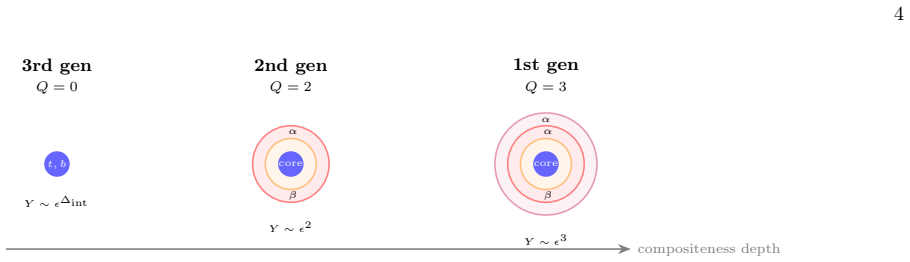
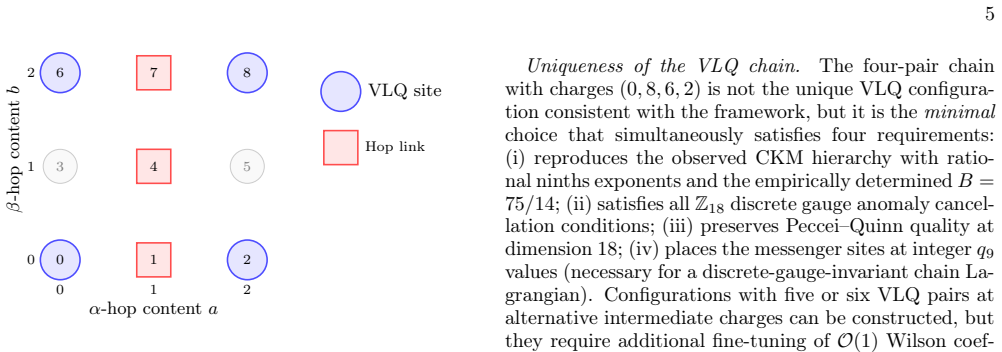
The B-lattice flavor framework is reinterpreted as a compositeness hierarchy: all three fermion generations remain elementary chiral fields, but third-generation Yukawa couplings are undressed while lighter generations acquire theirs through chains of spin-0 subconstituents whose depth is counted by the Z9 discrete gauge symmetry. The charge admits a two-index decomposition q9 ↦ (a,b) that identifies two hop species (α, β) and places all scales on the ninths ladder Λ × ε^{n/9} with ε = 14/75 supplied as input. This lattice directly produces the CKM and PMNS mixing parameterizations (mixing exponents expressed as charge differences ΔQ dressed by a universal Fritzsch–Xing phase shift of ±1/9),
What carries the argument
The two-index decomposition q9 ↦ (a,b) of the Z9 discrete gauge symmetry, which defines two hop species (α, β) and organizes all scales on the ninths ladder Λ × ε^{n/9}.
If this is right
- All CKM and PMNS mixing exponents are charge differences ΔQ dressed by a universal ±1/9 Fritzsch–Xing phase shift.
- The neutrino sector follows a seesaw with benchmark mass m3 ≃ 51 meV.
- The axion mass lies in the window 7–12 μeV and the axion-photon coupling is restored to C_aγ ≃ 0.6–1.0 by generation-dependent Peccei–Quinn charges.
- The ratio tanβ is fixed in the range 10–16 by the chain internal factor together with the DFSZ-II Higgs structure.
Where Pith is reading between the lines
- If the hop chains are realized by hypercolor-confined scalars communicated through a gauge-invariant messenger, collider searches could directly probe the compositeness scale.
- The specific numerical choice ε = 14/75 may itself be fixed by an underlying dynamics or symmetry not constructed in the paper.
- The shared lattice structure implies correlated predictions between the neutrino mass scale and the axion mass that could be tested once both sectors are measured more precisely.
Load-bearing premise
The Z9 discrete gauge symmetry admits a two-index decomposition that identifies two hop species and places every scale on the ninths ladder with the supplied numerical value ε = 14/75.
What would settle it
A precision measurement showing the lightest neutrino mass significantly different from 51 meV, or an axion mass outside the 7–12 μeV window, while the observed CKM and PMNS angles remain consistent with the charge-difference parameterization.
Figures
read the original abstract
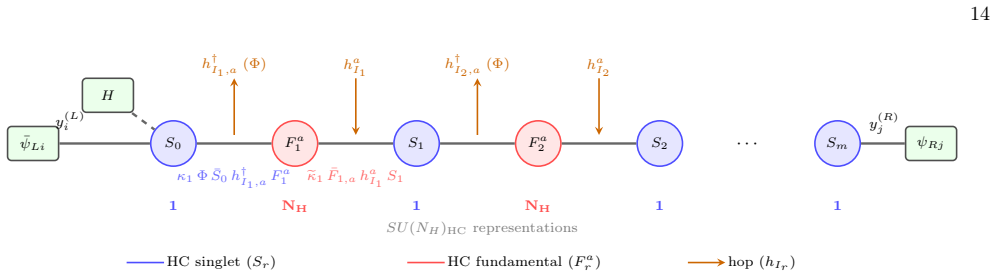
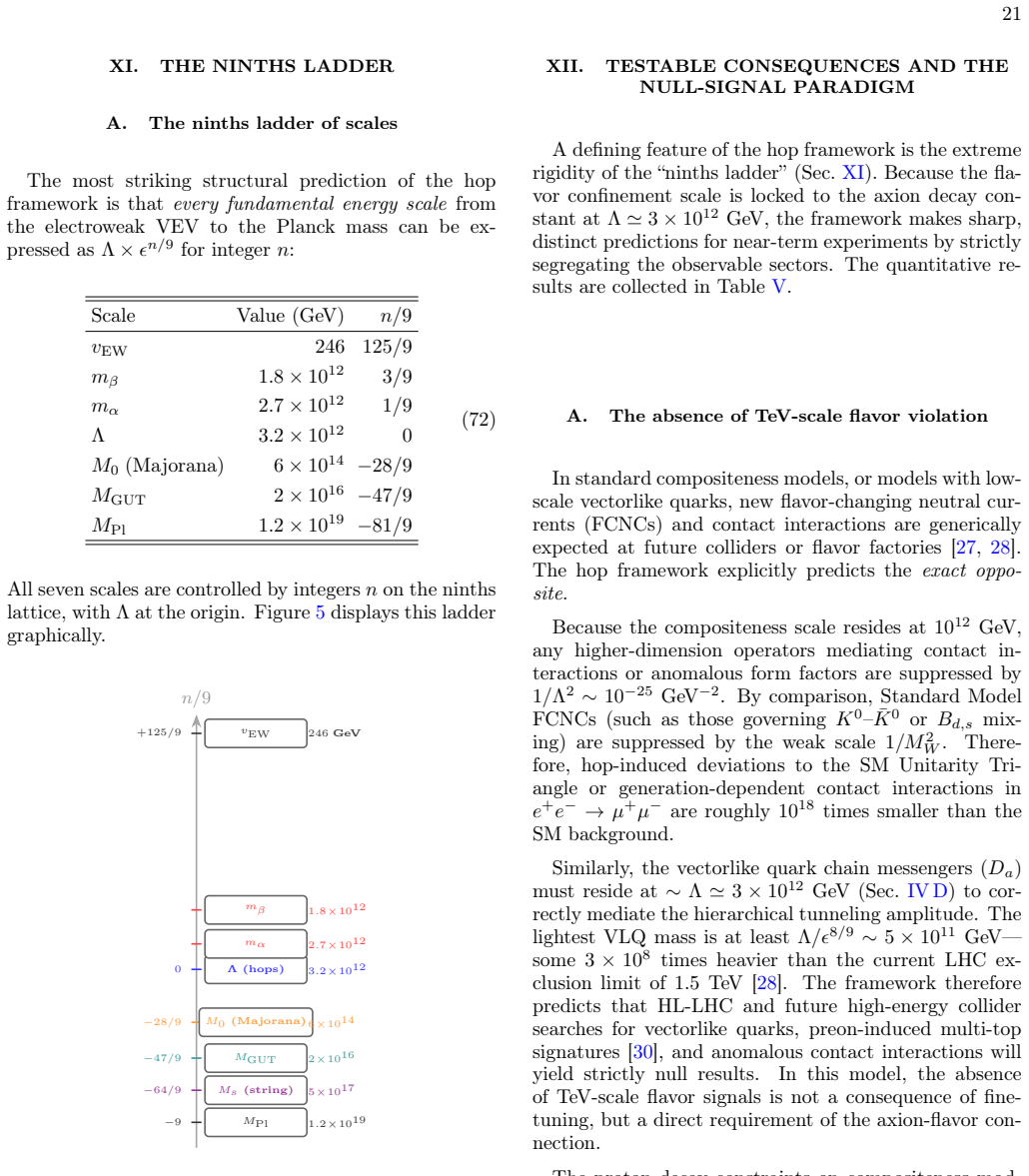
We interpret the $B$-lattice flavor framework as a compositeness hierarchy: all three fermion generations are elementary chiral fields, but third-generation Yukawa couplings are undressed ($Q=0$), while lighter generations acquire their Yukawa couplings through chains of spin-$0$ subconstituents (``hops'') whose depth is counted by the $\mathbb{Z}_9$ discrete gauge symmetry. The $\mathbb{Z}_9$ charge admits a two-index decomposition $q_9\mapsto(a,b)$ that identifies two hop species ($\alpha$, $\beta$) and organizes all fundamental scales from $v_{\rm EW}$ to $M_{\rm Pl}$ on a ``ninths ladder'' $\Lambda\times\epsilon^{n/9}$. The lattice structure yields the CKM and PMNS mixing parameterizations (with all mixing exponents expressible as charge differences $\Delta Q$ dressed by a universal Fritzsch--Xing phase shift of $\pm 1/9$), a seesaw benchmark $m_3\simeq 51$~meV, the axion mass window $m_a\sim 7$--$12\;\mu$eV, and the prediction $\tan\beta\simeq 10$--$16$ (from the chain internal factor combined with the DFSZ-II two-Higgs-doublet structure), all from two parameters ($\Lambda$ and $\epsilon = 14/75$). Generation-dependent Peccei--Quinn charges restore the axion--photon coupling ($C_{a\gamma}\simeq 0.6$--$1.0$) from ``back to invisible'' suppression. An illustrative UV realization in terms of hypercolor-confined scalars communicated to the SM by a gauge-invariant messenger chain is presented as an existence proof.
Editorial analysis
A structured set of objections, weighed in public.
Referee Report
Summary. The manuscript interprets the B-lattice flavor framework as compositeness: all fermions are elementary chiral fields, but lighter-generation Yukawas arise via chains of spin-0 subconstituents ('hops') whose depth is counted by a Z9 discrete gauge symmetry. The Z9 charge admits a two-index decomposition q9↦(a,b) identifying two hop species (α, β) that organizes all scales from vEW to MPl on the ninths ladder Λ×ε^{n/9}. This structure is claimed to produce the CKM/PMNS mixing parameterizations (exponents as ΔQ dressed by universal ±1/9 Fritzsch–Xing phase), a seesaw benchmark m3≃51 meV, axion mass window ma∼7–12 μeV, and tanβ≃10–16, all from only two parameters (Λ and ε=14/75), with generation-dependent PQ charges restoring Caγ≃0.6–1.0 and an illustrative hypercolor-confined scalar UV completion via gauge-invariant messenger chain.
Significance. If the construction is made internally consistent, particularly by deriving ε from the Z9 symmetry or the UV messenger chain rather than supplying it as input, the work would link flavor hierarchies, neutrino masses, and axion phenomenology through a single discrete symmetry and compositeness mechanism, yielding multiple concrete numerical predictions from minimal parameters. The existence-proof UV realization is a positive feature.
major comments (2)
- [Abstract] Abstract: the assertion that the listed numerical results (m3≃51 meV, ma window, tanβ range) follow from two parameters is not supported, because ε=14/75 is introduced as an external input chosen to reproduce the observed B-lattice hierarchies rather than derived from Z9 or the hypercolor messenger chain; the outputs are therefore dependent on this choice.
- [Abstract] Abstract: the two-index decomposition q9↦(a,b) that identifies the hop species α and β is stated without a uniqueness argument showing why this partition (rather than other decompositions of the Z9 charge) is required or preferred for organizing the ninths ladder.
minor comments (1)
- The manuscript would benefit from explicit step-by-step derivations, error estimates, and tabulated intermediate values showing how the quoted numerical outputs are obtained from the model equations.
Simulated Author's Rebuttal
We thank the referee for the careful reading and constructive feedback. We respond to the major comments point by point below, agreeing that the abstract requires revision to clarify the status of ε and providing additional motivation for the charge decomposition.
read point-by-point responses
-
Referee: [Abstract] Abstract: the assertion that the listed numerical results (m3≃51 meV, ma window, tanβ range) follow from two parameters is not supported, because ε=14/75 is introduced as an external input chosen to reproduce the observed B-lattice hierarchies rather than derived from Z9 or the hypercolor messenger chain; the outputs are therefore dependent on this choice.
Authors: We agree with the referee that ε=14/75 is chosen to reproduce the B-lattice hierarchies and is not derived from the Z9 symmetry or the hypercolor messenger chain in the current work. The numerical results are therefore obtained from the two parameters Λ and this fitted ε. We will revise the abstract to state explicitly that the predictions follow from Λ and ε=14/75, with ε determined by fitting to the observed hierarchies. This makes the dependence on the choice of ε transparent. Deriving ε from the underlying symmetry or UV completion is left for future work. revision: yes
-
Referee: [Abstract] Abstract: the two-index decomposition q9↦(a,b) that identifies the hop species α and β is stated without a uniqueness argument showing why this partition (rather than other decompositions of the Z9 charge) is required or preferred for organizing the ninths ladder.
Authors: The decomposition q9 ↦ (a,b) is selected because it defines two distinct hop species (α, β) that permit the compositeness chains to reproduce the specific ninths-ladder structure and mixing patterns of the B-lattice. Other partitions of the Z9 charge do not yield an equivalent organization of scales or consistent assignment of Yukawa suppressions. While we do not provide a formal uniqueness proof, this choice is preferred on phenomenological grounds as it enables both the flavor hierarchy and the illustrative UV messenger chain. We will add a paragraph motivating the decomposition in the manuscript. revision: partial
Circularity Check
ε=14/75 introduced as input to reproduce B-lattice hierarchies; numerical outputs (m3, ma, tanβ) computed from this choice
specific steps
-
fitted input called prediction
[Abstract]
"The lattice structure yields the CKM and PMNS mixing parameterizations (with all mixing exponents expressible as charge differences ΔQ dressed by a universal Fritzsch–Xing phase shift of ±1/9), a seesaw benchmark m3≃51 meV, the axion mass window ma∼7–12 μeV, and the prediction tanβ≃10–16 (from the chain internal factor combined with the DFSZ-II two-Higgs-doublet structure), all from two parameters (Λ and ε = 14/75)."
ε = 14/75 is chosen to reproduce the B-lattice flavor hierarchies; the quoted numerical benchmarks are then obtained by direct substitution of this fitted value into the ninths ladder Λ×ε^{n/9} and the associated chain factors, rendering the listed predictions outputs of the hierarchy fit rather than independent derivations from Z9 or the UV messenger chain.
full rationale
The manuscript states that the Z9 two-index decomposition and ninths ladder organize scales from vEW to MPl, yielding CKM/PMNS forms via ΔQ plus a universal phase shift, plus the listed numerical benchmarks, all from Λ and ε=14/75. The value ε=14/75 is supplied to match the observed hierarchies rather than derived from the discrete symmetry or the illustrative hypercolor chain. Consequently the specific numbers for m3≃51 meV, ma∼7–12 μeV and tanβ≃10–16 are direct substitutions of the fitted ε into the ladder and internal factors. This matches the fitted-input-called-prediction pattern for the quantitative claims while the structural parameterization of the mixing matrices remains independent of the numerical fit. No self-citation chains, uniqueness theorems, or ansatz smuggling are present in the supplied text.
Axiom & Free-Parameter Ledger
free parameters (2)
- epsilon =
14/75
- Lambda
axioms (2)
- domain assumption Z9 discrete gauge symmetry with two-index decomposition q9 ↦ (a,b) identifying hop species α and β
- ad hoc to paper Universal Fritzsch–Xing phase shift of ±1/9
invented entities (2)
-
spin-0 subconstituents (α and β hops)
no independent evidence
-
hypercolor-confined scalars and gauge-invariant messenger chain
no independent evidence
Reference graph
Works this paper leans on
-
[1]
The top mass is therefore mMS t (MZ) =c t Yt v√ 2 ≃169GeV,(45) withc t ≃0.97absorbing the small departure ofY t from unity (the pole massm pole t ≃173GeV corresponds to ctYt ≃0.99)
= 0, givingp u 33 = 0andY t =O(1). The top mass is therefore mMS t (MZ) =c t Yt v√ 2 ≃169GeV,(45) withc t ≃0.97absorbing the small departure ofY t from unity (the pole massm pole t ≃173GeV corresponds to ctYt ≃0.99). Either way, this fixes the Higgs vacuum expectation value (VEV)v= 246GeV as theunsup- pressed Yukawa scale—the energy at which an elemen- ta...
-
[2]
vanishing FN charges onbothsides of the Yukawa bilinear and a trivial up-type chain internal factor∆u int = 0(withsinβ≃1at tanβ≃16contributing no additional suppression)
= 0, i.e. vanishing FN charges onbothsides of the Yukawa bilinear and a trivial up-type chain internal factor∆u int = 0(withsinβ≃1at tanβ≃16contributing no additional suppression). This is the converse of top-condensation models [45], where the Higgs boson is a¯ttbound state and the top Yukawa is dynamically generated; in the hop framework, both the Higgs...
-
[3]
un- does
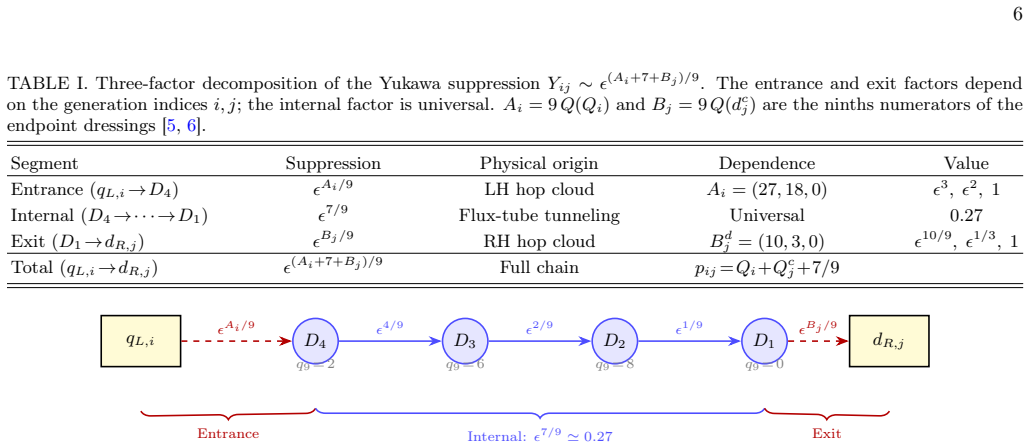
= 0, so the endpoint dressings vanish, theabsolutebottom Yukawa is Yb =c d 33 ϵ∆d int =c d 33 ϵ7/9 ≃0.27,(48) withc d 33 =O(1). In the SM with a single Higgs dou- blet,m b/mt =Y b/Yt ≃ϵ 7/9 ≃0.27; the measured ratio mb(MZ)/mt ≃0.017[28, 29] is smaller by a factor∼16, indicating that additional structure is required. Precisely this structure is already pre...
-
[4]
= 23/6 and the left-handed chargeQ(L 1) = 1; the exponent 5/3 = 7/6 + 1/2sumsQ(e c
-
[5]
elementary
= 7/6andQ(L 2) = 1/2. These lie on the1/6sublattice (not1/9), reflecting the half-integer lepton-doublet charges that require theZ18 embedding. This contrasts sharply with the neutrino spectrum, where the seesaw cancels the right-handed charges and produces equally spaced integer exponents17,18,19. The cleanest mass ratio is mµ(MZ) mτ(MZ) =c µ ϵ5/3 =c µ (...
-
[6]
ninths ladder
Form 3 ≃50meV, this requiresy ν ≃2.9×10 −13, corresponding to a total FN charge sumQ(L 3) +Q(N R)≃17. Strikingly, this isthe same total FN depthas the high-scale Majorana case (wherem 3 ∝v ϵ 17), illustrating that the hop frame- work’s ninths-lattice predictionm3 ∼ 1 2 v ϵ17 is a robust feature of compositeness depth17rather than a feature specific to the...
-
[7]
The third involves the full charge gap∆Q(Q) 13 = 3aug- mented by the right-handed strange chargeQ(dc
= 3 + 1 3 = 10 3 ,(78) p(Jq) =p us +p cb +p ub = 55 9 .(79) The first two share a common structure: the left-handed charge gap minus oneα-hop quantum (−1/9), which is the universal Fritzsch–Xing phase correction [3, 54]. The third involves the full charge gap∆Q(Q) 13 = 3aug- mented by the right-handed strange chargeQ(dc
-
[8]
two large, one small
= 1/3, which enters through the two-step productθd 12 ×θ d 23 in the Fritzsch–Xing diagonalization. The Jarlskog invari- ant is the product of all three rotation amplitudes, so its exponent is the sum. Cabibbo-angle master identity.Since|V us| ∼ϵ 8/9, the expansion parameter can be expressed as a power of the Cabibbo angle: ϵ=|V us|9/8,(80) giving |Vcb|=|...
-
[9]
= 10/9—theβ- hop quantum number (Sec. V). In the hop picture, the re- actor angle is suppressed by exactly oneβ-hop unit. Sim- ilarly, the solar exponent1/3equals the strange-quark right-handed chargeQ(d c
-
[10]
TheB-lattice thus unifies quark masses, CKM angles, and PMNS angles through a single set of rational exponents in ninths and sixths
= 1/3. TheB-lattice thus unifies quark masses, CKM angles, and PMNS angles through a single set of rational exponents in ninths and sixths. TABLE IV. Four-magnitude parameterization of the CKM and PMNS mixing matrices. Four equivalent representations are shown: the expansion parameterϵ= 14/75≃0.187,β (β≡ϵ 3/2 ≃0.081, withB= (1/β) 2/3;m β/Λ =β 2/9), the α-...
-
[11]
= 10/3yield the Cabibbo master identityϵ=|V us|9/8 and theB-lattice refine- ment of the Wolfenstein hierarchy:|V cb|=|V us|17/8, |Vub|=|V us|15/4. In the lepton sector, the three PMNS mixing anglessinθ 23 ∼ϵ 1/6 ≃0.756,sinθ 12 ∼ϵ 1/3 ≃ 0.572, andsinθ 13 ∼ϵ 10/9 ≃0.155(Table IV) decom- pose asp 23 = ∆Q(L) 23/3,p 12 = 2∆Q(L) 12/3, and p13 = ∆Q(L)13 +1/9, wi...
-
[12]
HereT(R C)is the Dynkin index of the colorrepresentation(1/2for3,0for1),d(R C)andd(R L) are the dimensions of the color andSU(2)L representa- tions, andQ f is the electric charge
Definitions The axion couplings to photons and electrons are pa- rameterized by gaγγ = α 2πfa Caγ, C aγ = E N −2.0 ,(A1) gaee = Cae me fa ,(A2) whereNandEare the anomaly coefficients N= X f Xf T(R C f )d(R L f ),(A3) E= X f Xf Q2 f ×d(R C f )d(R L f ),(A4) summed over all left-handed Weyl fermionsfcarrying PQ chargeX f. HereT(R C)is the Dynkin index of th...
-
[13]
Standard DFSZ-II We use the PQ-invariance conditions on the Yukawa couplings to eliminate individual fermion PQ charges in favor ofHand the Yukawa exponentsp ij. For a given quark generationi, the color anomaly contribution is 2XQi +X uc i +X dc i = (XQi +X uc i ) + (XQi +X dc i ) = (−XHu −p u ii) + (−XHd −p d ii) =−H−p u ii −p d ii.(A6) Summing over thre...
-
[14]
MSSM DFSZ-II with higgsinos In the MSSM, the Higgsino doublets˜Hu (Qem = +1,0) and ˜Hd (Qem = 0,−1) are additional PQ-charged chiral fermions. Their contribution to the anomaly coefficients is ∆Nhigg = 0 (color singlets),(A12) ∆Ehigg =X Hu ·(12+02)·1 +X Hd ·(02+12)·1 =H.(A13) 31 The total electromagnetic anomaly including higgsinos becomes EMSSM =E quarks...
-
[15]
Vectorlike quark chain The four VLQ pairs (Da + ¯Da,a= 1, . . . ,4) acquire PQ-invariant bare massesMa ¯Da Da, which require XDa +X ¯Da = 0∀a.(A16) Their total contribution to both anomaly coefficients is ∆NVLQ = 1 2 X a (XDa +X ¯Da) = 0,(A17) ∆EVLQ = 1 3 X a (XDa +X ¯Da) = 0.(A18) The chain couplings¯Da(Φ/Λ)ha Da+1 fix therelativePQ charges between adjac...
-
[16]
IV): pf ii(PQ) =Q(ψ (i) L ) +Q(ψ (i) R ) + ∆f int,(A19) with∆ u int = 0for the up sector and∆ d,ℓ int = 7/9for the down and lepton sectors (the latter in Scenario A)
Hop framework evaluation Using theB-lattice charge assignments [2, 5], the PQ exponentsS f entering the anomaly coefficients are the diagonal Yukawaoperatorexponents—the total number of flavon insertions in the(i, i)entry of the Yukawa ma- trix, including the sector-specific chain internal factor ∆f int (Sec. IV): pf ii(PQ) =Q(ψ (i) L ) +Q(ψ (i) R ) + ∆f ...
-
[17]
One-flavon flavor: A single hierarchical pa- rameterBorganizes quarks and leptons atM Z,
V. Barger, “One-flavon flavor: A single hierarchical pa- rameterBorganizes quarks and leptons atM Z,” Phys. Rev. D113, 013002 (2026), arXiv:2512.13630 [hep-ph]
-
[18]
Two-over-two lattice flavor from a single flavon with three messenger chains,
V. Barger, “Two-over-two lattice flavor from a single flavon with three messenger chains,” Phys. Rev. D113, 053003 (2026), arXiv:2602.18393 [hep-ph]
-
[19]
Quark Mixing from a Lattice Flavon Model: A Four-Magnitude Parameterization
V. Barger, “Quark mixing from a lattice flavon model: A four-magnitude parameterization,” arXiv:2603.00810 [hep-ph] (2026)
work page internal anchor Pith review Pith/arXiv arXiv 2026
-
[20]
Lepton mixing from a lattice flavon model: A two-branch octant–δprediction,
V. Barger, “Lepton mixing from a lattice flavon model: A two-branch octant–δprediction,” arXiv:2603.06934 [hep- ph] (2026)
-
[21]
Flavor in ninths and a discrete gauge origin of the QCD axion,
V. Barger, “Flavor in ninths and a discrete gauge origin of the QCD axion,” arXiv:2603.03631 [hep-ph] (2026)
-
[22]
V. Barger, “Unified flavor: Lattice quantization, chain locality, and a dynamical origin of hierarchical Yukawas,” arXiv:2603.11341 [hep-ph] (2026)
-
[23]
Unitary symmetry and leptonic decays,
N. Cabibbo, “Unitary symmetry and leptonic decays,” Phys. Rev. Lett.10, 531 (1963)
1963
-
[24]
CP-violation in the renormalizable theory of weak interaction,
M. Kobayashi and T. Maskawa, “CP-violation in the renormalizable theory of weak interaction,” Prog. Theor. Phys.49, 652 (1973)
1973
-
[25]
Remarks on the unified model of elementary particles,
Z. Maki, M. Nakagawa, and S. Sakata, “Remarks on the unified model of elementary particles,” Prog. Theor. Phys.28, 870 (1962)
1962
-
[26]
Neutrino experiments and the problem of conservation of leptonic charge,
B. Pontecorvo, “Neutrino experiments and the problem of conservation of leptonic charge,” Sov. Phys. JETP26, 984 (1968) [Zh. Eksp. Teor. Fiz.53, 1717 (1967)]
1968
-
[27]
Hierarchy of quark masses, Cabibbo angles and CP violation,
C. D. Froggatt and H. B. Nielsen, “Hierarchy of quark masses, Cabibbo angles and CP violation,” Nucl. Phys. B147, 277 (1979)
1979
-
[28]
Statistical analysis of quarkandleptonmasses,
C. D. Froggatt and H. B. Nielsen, “Statistical analysis of quarkandleptonmasses,” Nucl.Phys.B164, 114(1980)
1980
-
[29]
CP conservation in the presence of pseudoparticles,
R. D. Peccei and H. R. Quinn, “CP conservation in the presence of pseudoparticles,” Phys. Rev. Lett.38, 1440 (1977)
1977
-
[30]
Constraints imposed by CP conservation in the presence of pseudoparticles,
R. D. Peccei and H. R. Quinn, “Constraints imposed by CP conservation in the presence of pseudoparticles,” Phys. Rev. D16, 1791 (1977)
1977
-
[31]
Stabilizing the Axion by Discrete Gauge Symmetries
K. S. Babu, I. Gogoladze, and K. Wang, “Stabilizing the axion by discrete gauge symmetries,” Phys. Lett. B560, 214 (2003), arXiv:hep-ph/0212339
work page internal anchor Pith review Pith/arXiv arXiv 2003
-
[32]
High-quality axions in solutions to theµproblem,
P. N. Bhattiprolu and S. P. Martin, “High-quality axions in solutions to theµproblem,” Phys. Rev. D104, 055014 (2021), arXiv:2106.14964 [hep-ph]
-
[33]
Lepton number as the fourth ’color’,
J. C. Pati and A. Salam, “Lepton number as the fourth ’color’,” Phys. Rev. D10, 275 (1974)
1974
-
[34]
A schematic model of quarks and leptons,
H. Harari, “A schematic model of quarks and leptons,” Phys. Lett. B86, 83 (1979)
1979
-
[35]
A composite model of leptons and quarks,
M. A. Shupe, “A composite model of leptons and quarks,” Phys. Lett. B86, 87 (1979)
1979
-
[36]
A dynamical theory for the rishon model,
H. Harari and N. Seiberg, “A dynamical theory for the rishon model,” Phys. Lett. B98, 269 (1981)
1981
-
[37]
The rishon model,
H. Harari and N. Seiberg, “The rishon model,” Nucl. Phys. B204, 141 (1982)
1982
-
[38]
Generationlabelsincomposite models for quarks and leptons,
H.HarariandN.Seiberg, “Generationlabelsincomposite models for quarks and leptons,” Phys. Lett. B102, 263 (1981)
1981
-
[39]
Massless composite fermions and discrete chiral symmetries,
H. Harari and N. Seiberg, “Massless composite fermions and discrete chiral symmetries,” Phys. Lett. B115, 450 (1982)
1982
-
[40]
Weak interactions as manifestations of the substructure of leptons and quarks,
H. Fritzsch and G. Mandelbaum, “Weak interactions as manifestations of the substructure of leptons and quarks,” Phys. Lett. B102, 319 (1981)
1981
-
[41]
Uni- fied model of the Nambu–Jona-Lasinio type for all elementary-particle forces,
H. Terazawa, Y. Chikashige, and K. Akama, “Uni- fied model of the Nambu–Jona-Lasinio type for all elementary-particle forces,” Phys. Rev. D15, 480 (1977)
1977
-
[42]
Are the weak interactions strong?
L. F. Abbott and E. Farhi, “Are the weak interactions strong?” Phys. Lett. B101, 69 (1981)
1981
-
[43]
New tests for quark and lepton substructure,
E. Eichten, K. Lane, and M. Peskin, “New tests for quark and lepton substructure,” Phys. Rev. Lett.50, 811 (1983)
1983
-
[44]
Review of particle physics,
S. Navaset al.[Particle Data Group], “Review of particle physics,” Phys. Rev. D110, 030001 (2024)
2024
-
[45]
Precise values of running quark and lepton masses in the standard model,
G.-Y. Huang and S. Zhou, “Precise values of running quark and lepton masses in the standard model,” Phys. Rev. D103, 016010 (2021), arXiv:2009.04851 [hep-ph]
-
[46]
Multi-top signals of vectorlike quarks at the LHC,
E. Bernreuther and B. A. Dobrescu, “Multi-top signals of vectorlike quarks at the LHC,” JHEP12, 047 (2025), arXiv:2508.14960 [hep-ph]
-
[47]
Quark Singlets: Implications and Constraints
V. Barger, M. S. Berger, and R. J. N. Phillips, “Quark singlets: Implications and constraints,” Phys. Rev. D52, 1663 (1995), arXiv:hep-ph/9503204
work page internal anchor Pith review Pith/arXiv arXiv 1995
-
[48]
Generating the fermion mass hierarchy at the TeV scale,
N. Arkani-Hamed, C. Figueiredo, L. J. Hall, and C. A. Manzari, “Generating the fermion mass hierarchy at the TeV scale,” arXiv:2602.17754 [hep-ph] (2026)
-
[49]
Proton de- cays and neutron oscillations in the rishon model,
H. Harari, R. N. Mohapatra, and N. Seiberg, “Proton de- cays and neutron oscillations in the rishon model,” Nucl. Phys. B209, 174 (1982)
1982
-
[50]
Quark and lepton compositeness: A renormalizable model,
B. A. Dobrescu, “Quark and lepton compositeness: A renormalizable model,” Phys. Rev. Lett.128, 241804 (2022), arXiv:2112.15132 [hep-ph]
-
[51]
A new lepton–quark mass relationinaunifiedtheory,
H. Georgi and C. Jarlskog, “A new lepton–quark mass relationinaunifiedtheory,” Phys.Lett.B86, 297(1979)
1979
-
[52]
Cosmology of the invisible axion,
J. Preskill, M. B. Wise, and F. Wilczek, “Cosmology of the invisible axion,” Phys. Lett. B120, 127 (1983)
1983
-
[53]
A cosmological bound on the invisible axion,
L. F. Abbott and P. Sikivie, “A cosmological bound on the invisible axion,” Phys. Lett. B120, 133 (1983)
1983
-
[54]
The not-so-harmless axion,
M. Dine and W. Fischler, “The not-so-harmless axion,” Phys. Lett. B120, 137 (1983)
1983
-
[55]
All axion dark matter from supersymmetric models,
H. Baer, V. Barger, D. Sengupta, and K. Zhang, “All axion dark matter from supersymmetric models,” Phys. Rev. D111, L111702 (2025), arXiv:2502.06955 [hep-ph]
-
[56]
Naturalness, chiral symmetry, and spon- taneous chiral symmetry breaking,
G. ’t Hooft, “Naturalness, chiral symmetry, and spon- taneous chiral symmetry breaking,” inRecent Develop- ments in Gauge Theories, edited by G. ’t Hooftet al. (Plenum Press, New York, 1980), p. 135
1980
-
[57]
Discrete gauge symmetry in continuum theories,
L. M. Krauss and F. Wilczek, “Discrete gauge symmetry in continuum theories,” Phys. Rev. Lett.62, 1221 (1989)
1989
-
[58]
Note on discrete gauge anomalies,
T. Banks and M. Dine, “Note on discrete gauge anomalies,” Phys. Rev. D45, 1424 (1992), arXiv:hep- th/9109045
-
[59]
Discrete gauge symmetries and the origin of baryon and lepton number conservation in supersymmetric versions of the standard model,
L. E. Ibáñez and G. G. Ross, “Discrete gauge symmetries and the origin of baryon and lepton number conservation in supersymmetric versions of the standard model,” Nucl. Phys. B368, 3 (1992)
1992
-
[60]
Anomaly cancellations in supersymmetricD= 10gauge theory and superstring theory,
M. B. Green and J. H. Schwarz, “Anomaly cancellations in supersymmetricD= 10gauge theory and superstring theory,” Phys. Lett. B149, 117 (1984)
1984
-
[61]
Natural top quark condensation (a redux),
C. T. Hill, “Natural top quark condensation (a redux),” Nucl. Phys. B1018, 116987 (2025), arXiv:2503.21518 [hep-ph]. 35
-
[62]
µ→eγat a rate of one out of109 muon decays?,
P. Minkowski, “µ→eγat a rate of one out of109 muon decays?,” Phys. Lett. B67, 421 (1977)
1977
-
[63]
Horizontal symmetry and masses of neu- trinos,
T. Yanagida, “Horizontal symmetry and masses of neu- trinos,” inProceedings of the Workshop on Unified The- ory and Baryon Number in the Universe, edited by O. Sawada and A. Sugamoto (KEK, Tsukuba, 1979), p. 95
1979
-
[64]
The fam- ily group in grand unified theories,
M. Gell-Mann, P. Ramond, and R. Slansky, “The fam- ily group in grand unified theories,” Sanibel Symposium, February 1979, CALT-68-700, reprinted as arXiv:hep- ph/9809459; and “Complex spinors and unified theories,” Print-80-0576, inSupergravity, edited by P. van Nieuwen- huizen and D. Z. Freedman (North-Holland, Amsterdam, 1979), p. 315, arXiv:1306.4669 [hep-th]
-
[65]
Neutrino mass and spontaneous parity nonconservation,
R. N. Mohapatra and G. Senjanović, “Neutrino mass and spontaneous parity nonconservation,” Phys. Rev. Lett. 44, 912 (1980)
1980
-
[66]
Constraints on Neutrino Physics from DESI DR2 BAO and DR1 Full Shape
W. Elberset al.[DESI Collaboration], “Constraints on neutrino physics from DESI DR2 BAO and DR1 full shape,” Phys. Rev. D112, 083513 (2025), arXiv:2503.14744 [astro-ph.CO]
work page internal anchor Pith review Pith/arXiv arXiv 2025
-
[67]
Neutrino masses, mixing and leptogenesis in TeV scale B-L extension of the standard model
M. Abbas and S. Khalil, “Neutrino masses, mixing and leptogenesis in TeV scaleB−Lextension of the Standard Model,” JHEP04, 056 (2008), arXiv:0707.0841 [hep-ph]
work page internal anchor Pith review Pith/arXiv arXiv 2008
-
[68]
The Search for Heavy Majorana Neutrinos
A. Atre, T. Han, S. Pascoli, and B. Zhang, “The search for heavy Majorana neutrinos,” JHEP05, 030 (2009), arXiv:0901.3589 [hep-ph]
work page internal anchor Pith review Pith/arXiv arXiv 2009
-
[69]
LightZ′ and Dirac fermion dark matter in theB−L model,
N. Nath, N. Okada, S. Okada, D. Raut, and Q. Shafi, “LightZ′ and Dirac fermion dark matter in theB−L model,” Eur. Phys. J. C82, 864 (2022), arXiv:2112.08960 [hep-ph]
-
[70]
Mass and Flavor Mixing Schemes of Quarks and Leptons
H. Fritzsch and Z.-Z. Xing, “Mass and flavor mixing schemes of quarks and leptons,” Prog. Part. Nucl. Phys. 45, 1 (2000), arXiv:hep-ph/9912358
work page internal anchor Pith review Pith/arXiv arXiv 2000
-
[71]
Proton decay from quark and lepton compositeness,
B. Assi and B. A. Dobrescu, “Proton decay from quark and lepton compositeness,” JHEP12, 116 (2022), arXiv:2211.02211 [hep-ph]
-
[72]
Theprocessesµ→eγ,µ→e¯ee,ν ′ →νγin the Weinberg–Salam model with neutrino mixing,
S.T.Petcov, “Theprocessesµ→eγ,µ→e¯ee,ν ′ →νγin the Weinberg–Salam model with neutrino mixing,” Sov. J. Nucl. Phys.25, 340 (1977) [Erratum: ibid.25, 698 (1977)] [Yad. Fiz.25, 641 (1977)]
1977
-
[73]
µ→eγin theories with Dirac and Majorana neutrino mass terms,
T. P. Cheng and L.-F. Li, “µ→eγin theories with Dirac and Majorana neutrino mass terms,” Phys. Rev. Lett. 45, 1908 (1980)
1908
-
[74]
Searchforaxion dark matter from 1.1 to 1.3 GHz with ADMX,
ADMXCollaboration(G.Carosiet al.), “Searchforaxion dark matter from 1.1 to 1.3 GHz with ADMX,” Phys. Rev. Lett.135, 191001 (2025), arXiv:2504.07279 [hep- ex]
-
[75]
A simple solu- tion to the strong CP problem with a harmless axion,
M. Dine, W. Fischler, and M. Srednicki, “A simple solu- tion to the strong CP problem with a harmless axion,” Phys. Lett. B104, 199 (1981)
1981
-
[76]
On possible suppression of the axion hadron interactions,
A. R. Zhitnitsky, “On possible suppression of the axion hadron interactions,” Sov. J. Nucl. Phys.31, 260 (1980) [Yad. Fiz.31, 497 (1980)]
1980
-
[77]
K. J. Bae, H. Baer, and H. Serce, “Prospects for ax- ion detection in natural SUSY with mixed axion-higgsino dark matter: back to invisible?” JCAP06, 024 (2017), arXiv:1705.01134 [hep-ph]
work page internal anchor Pith review Pith/arXiv arXiv 2017
-
[78]
Weak-interaction singlet and strong CP in- variance,
J. E. Kim, “Weak-interaction singlet and strong CP in- variance,” Phys. Rev. Lett.43, 103 (1979)
1979
-
[79]
Can confinement ensure natural CP invariance of strong interactions?,
M. A. Shifman, A. I. Vainshtein, and V. I. Zakharov, “Can confinement ensure natural CP invariance of strong interactions?,” Nucl. Phys. B166, 493 (1980)
1980
-
[80]
Baryon- and lepton-nonconserving pro- cesses,
S. Weinberg, “Baryon- and lepton-nonconserving pro- cesses,” Phys. Rev. Lett.43, 1566 (1979)
1979
discussion (0)
Sign in with ORCID, Apple, or X to comment. Anyone can read and Pith papers without signing in.