Quantum effects in the quadrupole rotor picture of ultra-relativistic ion-ion collisions
Pith reviewed 2026-06-29 09:14 UTC · model grok-4.3
The pith
Quantum fermionic effects explain nearly all effective quadrupole deformation in light nuclei but drop below 10 percent in well-deformed heavy nuclei.
A machine-rendered reading of the paper's core claim, the machinery that carries it, and where it could break.
Core claim
By systematically comparing the quantum quadrupole rotor with its classical rigid-rotor limit across the nuclear chart, the authors show that quantum contributions associated with the fermionic nature of the nucleons are largely independent of shell effects and hence of the intrinsic deformation. These contributions account for nearly all of the quantum rotor effective quadrupole deformation in light and/or spherical nuclei, while they drop below 10 percent in intrinsically well deformed heavy nuclei. The letter demonstrates that a quantitative interpretation of nuclear-structure effects in final-state observables requires going beyond the classical rigid-rotor paradigm.
What carries the argument
The direct numerical comparison of the quantum quadrupole rotor model to its classical rigid-rotor limit, used to isolate and quantify the fermionic quantum contributions to effective quadrupole deformation.
If this is right
- Quantitative use of azimuthal hadronic flow to extract nuclear deformation requires inclusion of collective vibrations and non-collective nucleonic motion in addition to the rotor picture.
- Classical rigid-rotor models remain a reasonable approximation only for intrinsically well-deformed heavy nuclei.
- Light and spherical nuclei demand explicit accounting for fermionic quantum effects when modeling collision observables.
- The reported independence from shell effects implies that the quantum corrections can be estimated once and applied across a range of nuclei without repeated shell-by-shell recalculations.
Where Pith is reading between the lines
- Models of ultra-relativistic collisions that rely on classical deformation parameters will systematically mis-estimate flow signals for light colliding systems.
- The same separation technique could be applied to other multipole deformations to test whether fermionic quantum effects remain small in heavy nuclei for those cases as well.
- Direct comparison of predicted flow harmonics between light and heavy colliding pairs at the same beam energy would provide an experimental test of the size difference reported here.
Load-bearing premise
The quadrupole rotor framework in both quantum and classical forms is the right starting point for isolating fermionic quantum effects before adding collective vibrations or non-collective nucleonic motion.
What would settle it
A calculation or measurement in which the size of fermionic quantum contributions to effective quadrupole deformation varies strongly with shell filling or intrinsic deformation, contrary to the reported independence, would falsify the central separation.
Figures
read the original abstract
The azimuthal hadronic flow observed in ultra-relativistic ion-ion collisions provides a sensitive probe of many-body ground-state correlations in the colliding nuclei. In particular, collective correlations associated with nuclear "intrinsic deformation" are expected to leave pronounced fingerprints on specific final-state observables. However, such effects are commonly interpreted within a classical rigid-rotor picture, despite the intrinsically quantum nature of nuclei. In this Letter, the validity of this interpretation is assessed systematically across the nuclear chart by comparing the quantum quadrupole rotor with its classical rigid-rotor limit. Quantum contributions associated with the fermionic nature of the nucleons are shown to be largely independent of shell effects, and hence of the intrinsic deformation. While they account for nearly all of the quantum rotor effective quadrupole deformation in light and/or spherical nuclei, they drop below 10% in intrinsically well deformed heavy nuclei. The present letter demonstrates that a quantitative interpretation of nuclear-structure effects in final-state observables requires going beyond the classical rigid-rotor paradigm. Beyond the quantum contributions quantified presently, correlations associated with collective vibrations and with the non-collective nucleonic motion must be further included and characterized.
Editorial analysis
A structured set of objections, weighed in public.
Referee Report
Summary. The manuscript systematically compares the quantum quadrupole rotor to its classical rigid-rotor limit across the nuclear chart to isolate fermionic quantum contributions to the effective quadrupole deformation relevant for azimuthal flow in ultra-relativistic ion-ion collisions. It reports that these quantum effects are largely independent of shell structure (and thus intrinsic deformation), accounting for nearly all of the quantum rotor deformation in light and/or spherical nuclei but dropping below 10% in intrinsically well-deformed heavy nuclei. The work concludes that quantitative interpretation of nuclear-structure effects in final-state observables requires going beyond the classical rigid-rotor paradigm, while explicitly placing collective vibrations and non-collective nucleonic motion outside the present scope.
Significance. If the calculations hold, the result supplies a concrete, chart-wide benchmark for when the classical rigid-rotor approximation remains adequate inside the quadrupole-rotor framework. This directly informs the nuclear-structure inputs used in hydrodynamic and transport models of heavy-ion collisions and quantifies the regime in which purely fermionic quantum corrections must be retained.
minor comments (2)
- The abstract states that quantum contributions 'drop below 10%' in well-deformed heavy nuclei and are 'largely independent of shell effects'; the main text should include an explicit table or figure (with nuclei labeled by A, Z, and deformation parameter) that lists the numerical values of the quantum-to-total ratio for at least the representative cases used to support these statements.
- The final sentence of the abstract correctly delimits the scope, but the introduction or methods section should briefly state the precise definition of the 'effective quadrupole deformation' extracted from both the quantum and classical rotors (e.g., via the expectation value of the quadrupole operator or the moment of inertia) so that the comparison is reproducible.
Simulated Author's Rebuttal
We thank the referee for the positive assessment of our manuscript, the accurate summary of its scope and conclusions, and the recommendation for minor revision. No major comments were raised in the report.
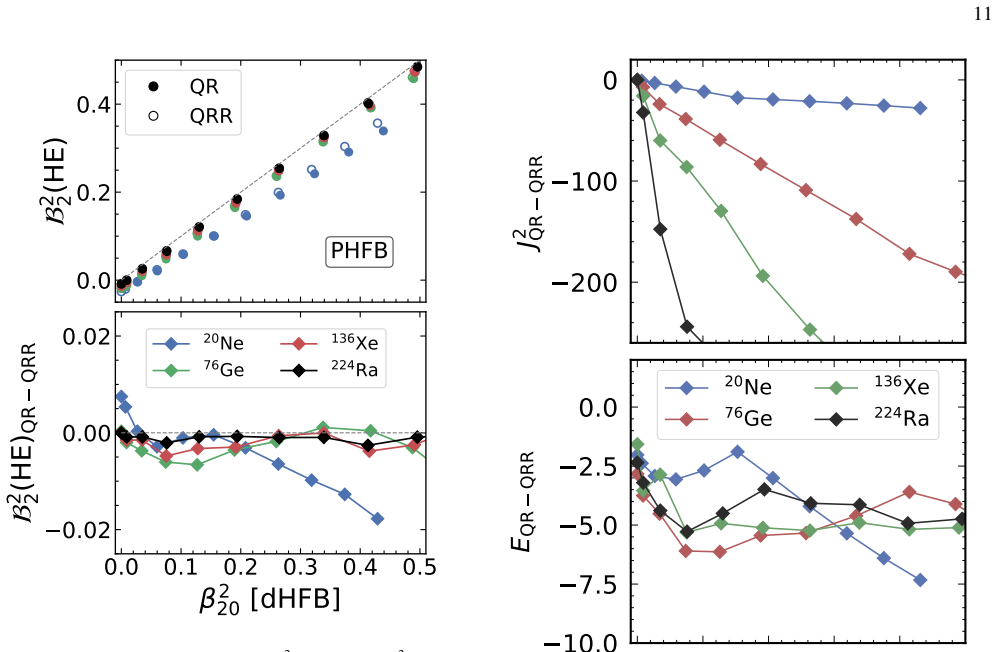
Circularity Check
No significant circularity detected
full rationale
The paper's central claim is obtained by direct numerical comparison of the quantum quadrupole rotor model against its classical rigid-rotor limit across the nuclear chart. The reported percentages, independence from shell effects, and the <10% figure in heavy deformed nuclei are presented as outputs of that comparison inside the explicitly delimited rotor framework (abstract final sentence). No load-bearing step reduces by construction to a fitted input, self-citation chain, or renamed ansatz; the derivation remains self-contained against the stated premises.
Axiom & Free-Parameter Ledger
axioms (1)
- domain assumption The quadrupole rotor model (quantum and classical) is a sufficient framework for isolating fermionic quantum contributions to effective deformation across the nuclear chart.
Forward citations
Cited by 2 Pith papers
-
Quantum Symmetry Restoration and Emergent Effective Deformation in Relativistic Heavy-Ion Collisions
Rotational symmetry restoration in even-even nuclei generates an effective collision geometry that acts as a low-pass filter exponentially suppressing deformation modes, recovering the classical rigid-rotor limit only...
-
Yoctosecond imaging of the ground state of $^{129}$Xe at the Large Hadron Collider
Bayesian global fit to Xe-Xe and Pb-Pb LHC data infers nearly maximal triaxiality for the 129Xe ground state and extracts two- and three-particle correlations.
Reference graph
Works this paper leans on
-
[1]
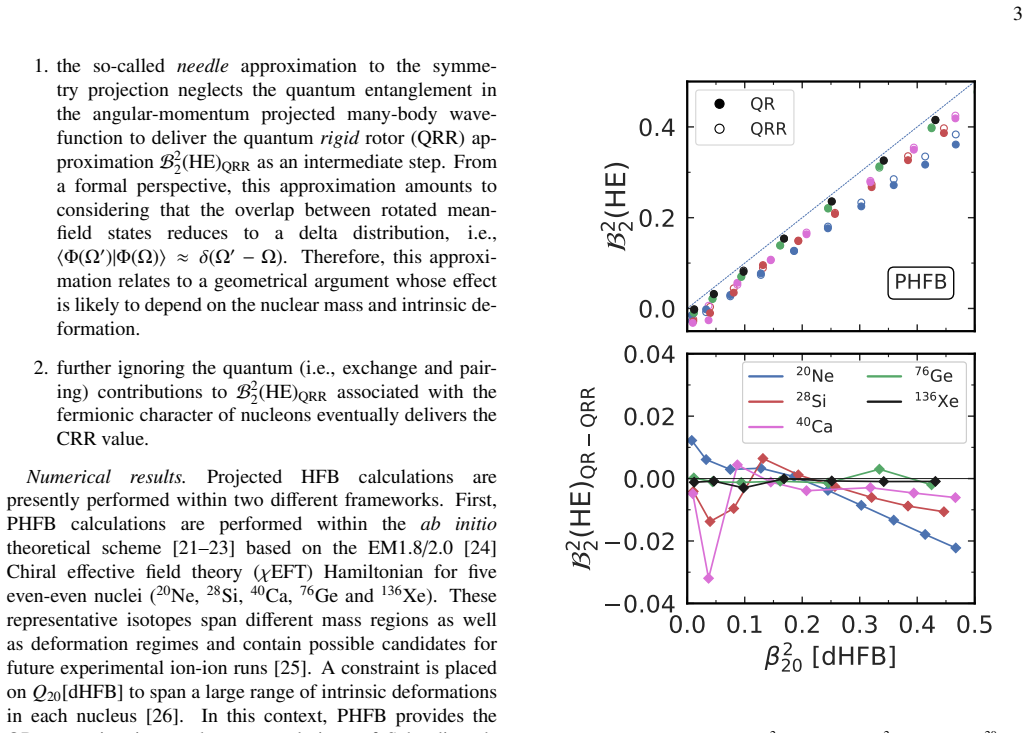
the so-calledneedleapproximation to the symme- try projection neglects the quantum entanglement in the angular-momentum projected many-body wave- function to deliver the quantumrigidrotor (QRR) ap- proximationB 2 2(HE)QRR as an intermediate step. From a formal perspective, this approximation amounts to considering that the overlap between rotated mean- fi...
-
[2]
traditional
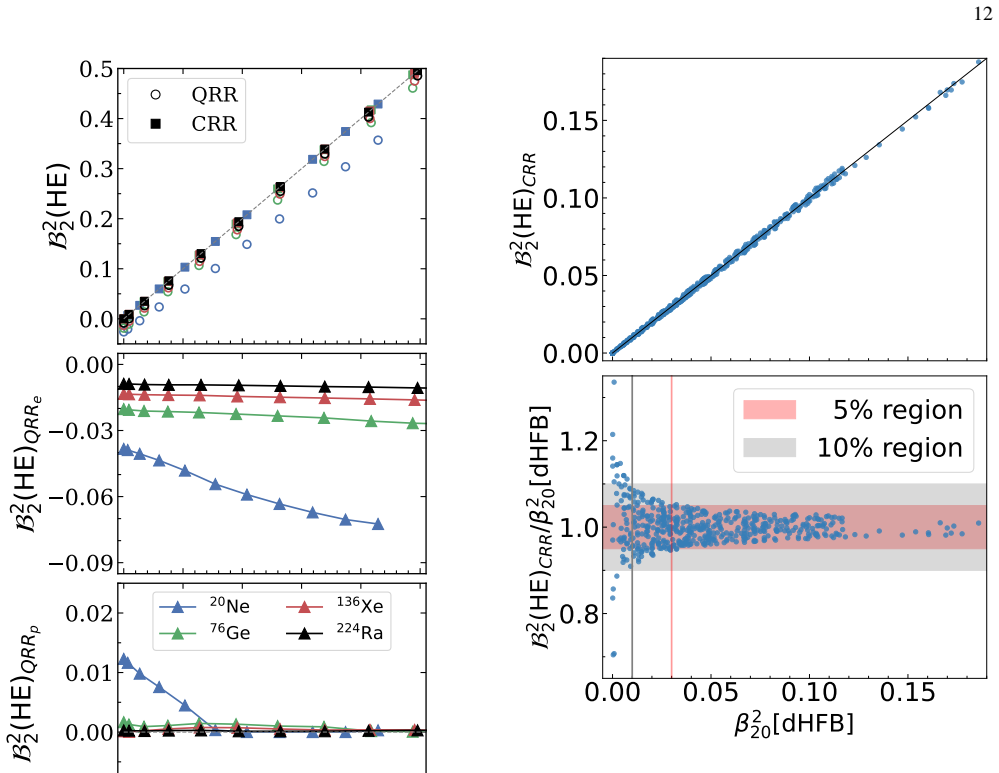
further ignoring the quantum (i.e., exchange and pair- ing) contributions toB 2 2(HE)QRR associated with the fermionic character of nucleons eventually delivers the CRR value. Numerical results.Projected HFB calculations are presently performed within two different frameworks. First, PHFB calculations are performed within theab initio theoretical scheme [...
-
[3]
Intersection of nuclear structure and high-energy nuclear collisions 2026
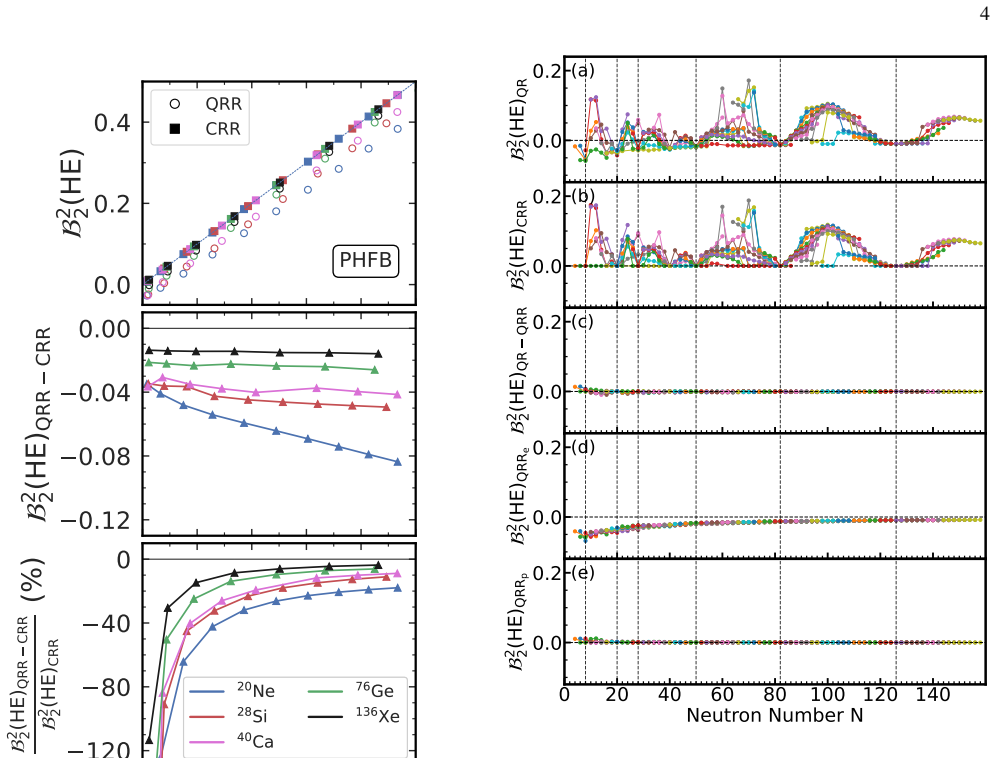
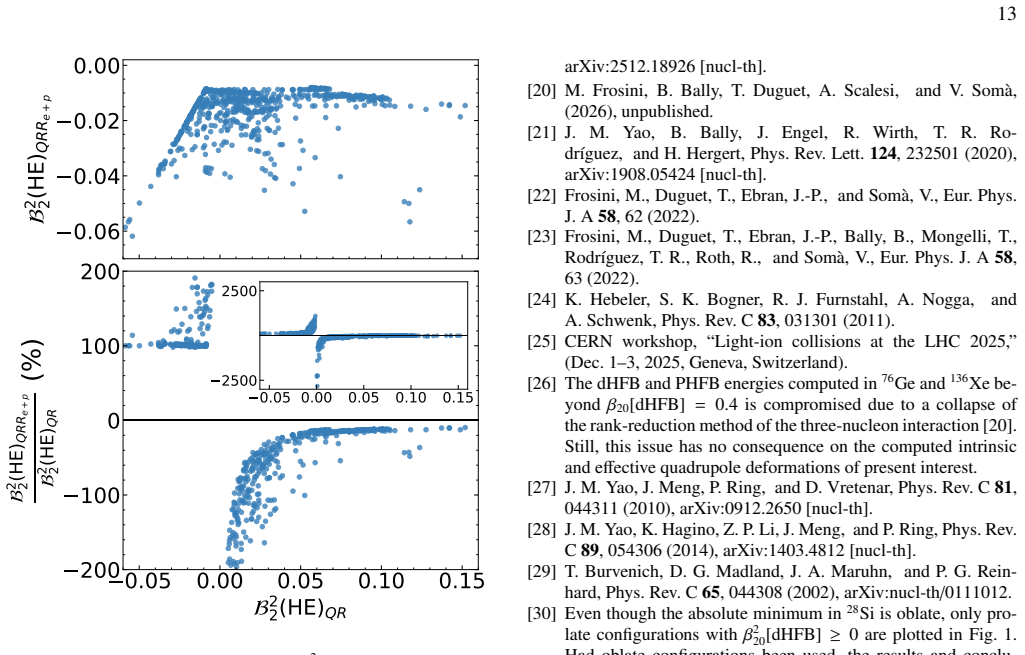
The middle panel of Fig. 2 singles out the subtracted contributions, showing that their sum is negative, grows linearly but mildly withβ2 20[dHFB] and decreases monotonically withA. The lower panel of Fig. 2 shows that the quantum contributions dominate the QRR ef- fective quadrupole deformation in light nuclei and/or nuclei displaying a small or moderate...
2026
-
[4]
Giacalone, J
G. Giacalone, J. Noronha-Hostler, M. Luzum, and J.-Y . Olli- trault, Phys. Rev. C97, 034904 (2018)
2018
-
[5]
Giacalone, J
G. Giacalone, J. Jia, and V . Somà, Phys. Rev. C104, L041903 (2021)
2021
-
[6]
Summerfield, B.-N
N. Summerfield, B.-N. Lu, C. Plumberg, D. Lee, J. Noronha- Hostler, and A. Timmins, Phys. Rev. C104, L041901 (2021)
2021
-
[7]
Bally, M
B. Bally, M. Bender, G. Giacalone, and V . Somà, Phys. Rev. Lett.128, 082301 (2022)
2022
-
[8]
Zhang and J
C. Zhang and J. Jia, Phys. Rev. Lett.128, 022301 (2022)
2022
-
[9]
Ryssens, G
W. Ryssens, G. Giacalone, B. Schenke, and C. Shen, Phys. Rev. Lett.130, 212302 (2023)
2023
-
[10]
S. T. A. R. Collaboration, Nature635, 67 (2024)
2024
-
[11]
Giacalone, B
G. Giacalone, B. Bally, G. Nijs, S. Shen, T. Duguet, J.-P. Ebran, S. Elhatisari, M. Frosini, T. A. Lähde, D. Lee, B.-N. Lu, Y .- Z. Ma, U.-G. Meißner, J. Noronha-Hostler, C. Plumberg, T. R. Rodríguez, R. Roth, W. van der Schee, and V . Somà, Phys. Rev. Lett.135, 012302 (2025). 13 0.06 0.04 0.02 0.00 2 2(HE)QRRe + p 0.05 0.00 0.05 0.10 0.15 2 2(HE)QR 200 1...
2025
-
[12]
Giacalone, W
G. Giacalone, W. Zhao, B. Bally, S. Shen, T. Duguet, J.-P. Ebran, S. Elhatisari, M. Frosini, T. A. Lähde, D. Lee, B.-N. Lu, Y .-Z. Ma, U.-G. Meißner, G. Nijs, J. Noronha-Hostler, C. Plumberg, T. R. Rodríguez, R. Roth, W. van der Schee, B. Schenke, C. Shen, and V . Somà, Phys. Rev. Lett.134, 082301 (2025)
2025
-
[13]
Niemi, K
H. Niemi, K. J. Eskola, and R. Paatelainen, Phys. Rev. C93, 024907 (2016)
2016
-
[14]
J.-P. Blaizot and G. Giacalone, Eur. Phys. J. A61, 220 (2025), arXiv:2504.15421 [nucl-th]
-
[15]
Duguet, G
T. Duguet, G. Giacalone, S. Jeon, and A. Tichai, Phys. Rev. Lett.135, 182301 (2025)
2025
- [16]
-
[17]
[18, 19] but still demands a dedicated analysis
The impact of many-body correlations beyond the quantum ro- tor has been touched upon in Refs. [18, 19] but still demands a dedicated analysis
-
[18]
J. Dobaczewski, A. Gade, K. Godbey, R. V . F. Janssens, and W. Nazarewicz, Phys. Rev. Res.7, 043159 (2025), arXiv:2507.05208 [nucl-th]
-
[19]
Ke, (2025), arXiv:2509.09549 [nucl-th]
W. Ke, (2025), arXiv:2509.09549 [nucl-th]
-
[20]
Sousa, J
J. Sousa, J. Noronha, and M. Luzum, Phys. Rev. C110, 044909 (2024)
2024
-
[21]
Imaging two-body correlations in atomic nuclei via low- and high-energy processes
S. Bofos, B. Bally, T. Duguet, and M. Frosini, (2026), arXiv:2602.09890 [nucl-th]
work page internal anchor Pith review Pith/arXiv arXiv 2026
-
[22]
J.-P. Blaizot, G. Giacalone, and A. Lovato, (2025), arXiv:2512.18926 [nucl-th]
-
[23]
Frosini, B
M. Frosini, B. Bally, T. Duguet, A. Scalesi, and V . Somà, (2026), unpublished
2026
- [24]
-
[25]
Frosini, M., Duguet, T., Ebran, J.-P., and Somà, V ., Eur. Phys. J. A58, 62 (2022)
2022
-
[26]
R., Roth, R., and Somà, V ., Eur
Frosini, M., Duguet, T., Ebran, J.-P., Bally, B., Mongelli, T., Rodríguez, T. R., Roth, R., and Somà, V ., Eur. Phys. J. A58, 63 (2022)
2022
-
[27]
Hebeler, S
K. Hebeler, S. K. Bogner, R. J. Furnstahl, A. Nogga, and A. Schwenk, Phys. Rev. C83, 031301 (2011)
2011
-
[28]
Light-ion collisions at the LHC 2025,
CERN workshop, “Light-ion collisions at the LHC 2025,” (Dec. 1–3, 2025, Geneva, Switzerland)
2025
-
[29]
Still, this issue has no consequence on the computed intrinsic and effective quadrupole deformations of present interest
The dHFB and PHFB energies computed in 76Ge and 136Xe be- yondβ 20[dHFB]=0.4 is compromised due to a collapse of the rank-reduction method of the three-nucleon interaction [20]. Still, this issue has no consequence on the computed intrinsic and effective quadrupole deformations of present interest
-
[30]
J. M. Yao, J. Meng, P. Ring, and D. Vretenar, Phys. Rev. C81, 044311 (2010), arXiv:0912.2650 [nucl-th]
work page internal anchor Pith review Pith/arXiv arXiv 2010
-
[31]
J. M. Yao, K. Hagino, Z. P. Li, J. Meng, and P. Ring, Phys. Rev. C89, 054306 (2014), arXiv:1403.4812 [nucl-th]
work page internal anchor Pith review Pith/arXiv arXiv 2014
-
[32]
Nuclear Ground State Observables and QCD Scaling in a Refined Relativistic Point Coupling Model
T. Burvenich, D. G. Madland, J. A. Maruhn, and P. G. Rein- hard, Phys. Rev. C65, 044308 (2002), arXiv:nucl-th/0111012
work page internal anchor Pith review Pith/arXiv arXiv 2002
-
[33]
Even though the absolute minimum in 28Si is oblate, only pro- late configurations withβ 2 20[dHFB]≥0 are plotted in Fig. 1. Had oblate configurations been used, the results and conclu- sions would have remained the same
-
[34]
When constraining over such a large span ofβ 2 20[dHFB] val- ues, the needle approximation toB 2 2(HE)QR is seen to become abruptly unsafe for nuclei withA≤16
-
[35]
This is illustrated in the SM by comparing the impact of the needle approximation onB 2 2(HE), the total energyEand the total angular momentumJ 2
The impact of the needle approximation, and so its behavior as a function of bothβ 2 20[dHFB] andA, cannot be anticipated and depends on the system and observable under consideration. This is illustrated in the SM by comparing the impact of the needle approximation onB 2 2(HE), the total energyEand the total angular momentumJ 2
-
[36]
The amplitude of the spike is seen to decrease with bothAand isospin asymmetry
This trend of the error with respect toβ 2 20[dHFB] is common to all doubly-magic nuclei withA>16. The amplitude of the spike is seen to decrease with bothAand isospin asymmetry
-
[37]
Two isotopic chains (Z=14 and 16) do not display minima at N=28, indicating the disappearance of such a neutron magic number in proton deficient isotones
-
[38]
The exchange term converges to zero in theA→ ∞limit, thus showing that the QR becomes fully classical in this limit
-
[39]
The even-even nuclear ground state|Ψ 0+ ⟩is taken to be normal- ized
-
[40]
H. Mehrabpour, G. Giacalone, and M. W. Luzum, (2026), arXiv:2604.00619 [nucl-th]
-
[41]
[12] and [37], re- spectively
The present discussion can be easily extended to octupole de- formation and/or triaxial shapes; see Refs. [12] and [37], re- spectively
-
[42]
Balian and E
R. Balian and E. Brezin, Nuovo Cim. B64, 37 (1969)
1969
-
[43]
Starting from Eq. (45), it is clear that the (un- normalized) two-body part of the mean-square eccen- tricity is now approximated as⟨Θ 0+ PHFB|E(2)(2b) ℓ |Θ0+ PHFB⟩d =Z r1,2 [E(2)(2b) ℓ ]00(r1,r 2)ρ (1) 00 (r1)ρ(1) 00 (r2),which is nothing but the direct part of the symmetry-breaking HFB contribution
-
[44]
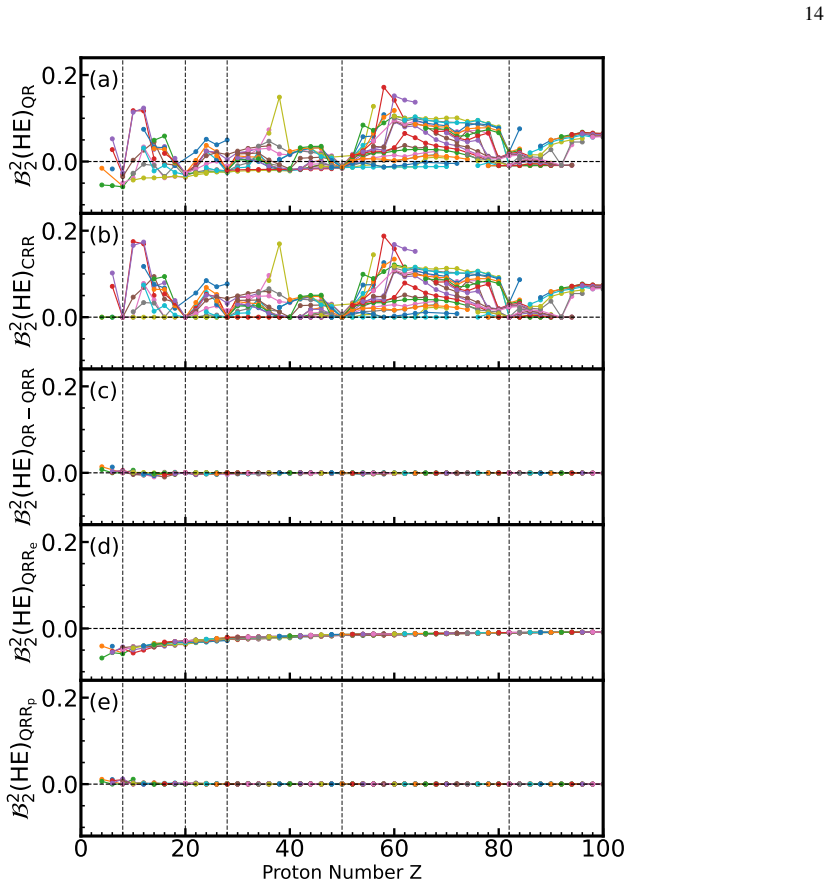
Frosini, M., Duguet, T., Bally, B., Beaujeault-Taudière, Y ., Ebran, J.-P., and Somà, V ., Eur. Phys. J. A57, 151 (2021). 14 0.0 0.2 2 2(HE)QR (a) 0.0 0.2 2 2(HE)CRR (b) 0.0 0.2 2 2(HE)QR QRR (c) 0.0 0.2 2 2(HE)QRRe (d) 0 20 40 60 80 100 Proton Number Z 0.0 0.2 2 2(HE)QRRp (e) FIG. 11. Systematic of MR-EDF effective deformation along many isotonic chains ...
2021
discussion (0)
Sign in with ORCID, Apple, or X to comment. Anyone can read and Pith papers without signing in.