Towards a Foundation Model for the Martian Atmosphere
Pith reviewed 2026-06-30 18:59 UTC · model grok-4.3
The pith
Sparse and fragmented observations of the Martian atmosphere, combined with the high computational cost of detailed simulations, motivate the development of a data-driven foundation model.
A machine-rendered reading of the paper's core claim, the machinery that carries it, and where it could break.
Core claim
The development of a data-driven foundation model for the Martian atmosphere is motivated by the need to address dynamical phenomena like dust storms and orographic clouds in a data- and compute-efficient way, requiring a clear understanding of the interplay between data availability, physical processes, and AI techniques to determine what applications a single model can sensibly address.
What carries the argument
The design landscape for the foundation model, shaped by the interplay between available data (atmospheric retrievals and reanalysis), physical models (general circulation models), candidate downstream applications, and AI developments (models for atmospheric physics, data-driven data assimilation, and limited-data methods).
If this is right
- The model could simulate mesoscale features without the computational burden of traditional high-resolution GCMs.
- It would enable better handling of sparse and fragmented observation records for forecasting.
- A single model could cover a wide range of phenomena from planet-encircling dust storms to nocturnal low-level jets.
- Relevant AI techniques could be leveraged to work effectively even with limited Martian data.
Where Pith is reading between the lines
- Extending this approach might allow foundation models for other planetary atmospheres with similar data constraints.
- Integration with existing reanalysis datasets could enhance the model's accuracy for assimilation tasks.
- The emphasis on limited-data AI methods could lead to more robust models that generalize across different observation instruments.
Load-bearing premise
That elucidating the interplay between available data, underlying physics, and AI developments can meaningfully guide the design of one foundation model to address multiple use cases efficiently.
What would settle it
Demonstrating that no single model architecture can efficiently handle both large-scale dust storm simulation and mesoscale cloud forecasting without significant performance loss or increased data requirements would falsify the motivation.
Figures
read the original abstract
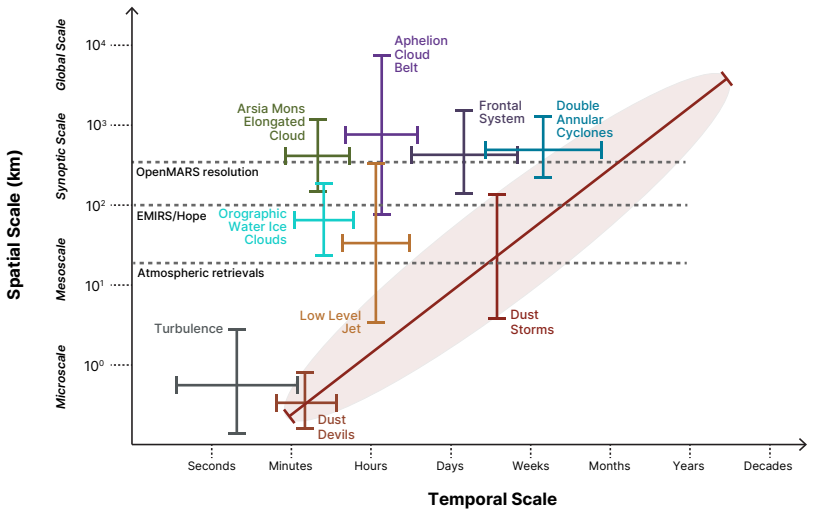
The martian atmosphere hosts dynamical phenomena ranging from planet-encircling dust storms to mesoscale orographic clouds and nocturnal low-level jets. General circulation model show capability to simulate these phenomena, but is computationally expensive at resolution needed to resolve mesoscale features. While assimilation of satellite remote sensing observation enable forecasting capabilities using such models, observation record is often sparse, short and fragmented across instrument generators. These constraints motivate the development of a data-driven foundation model for the Martian atmosphere. Foundation models live in a complex design landscape. There is an interplay between the available data, the physics of the underlying processes and corresponding developments in AI. Even though the idea of a foundation model is to address multiple use cases in a data- and compute-efficient manner, it is important to have a clear picture what applications can sensibly addressed by a single model. The purpose of this paper is to elucidate this design landscape. We discuss available data ranging from atmospheric retrievals to reanalysis datasets as well as existing physical models. Moreover, we identify a wide range of candidate downstream applications. Finally, we consider relevant recent developments in artificial intelligence (AI) that can be leveraged in this context. Here, we put a particular emphasis on AI models for atmospheric physics, data-driven approaches to data assimilation as well as methods to work in a limited data setting.
Editorial analysis
A structured set of objections, weighed in public.
Referee Report
Summary. The manuscript is a position/discussion paper arguing that computational expense of high-resolution GCMs and sparsity/fragmentation of observational records for the Martian atmosphere motivate development of a data-driven foundation model. It surveys data sources (retrievals and reanalysis), physical models, downstream applications, and AI techniques (data assimilation, limited-data methods) to elucidate the design landscape, emphasizing the interplay between data, physics, and AI for multi-use-case efficiency.
Significance. If the motivation holds, the paper provides a useful high-level synthesis of Martian atmospheric data, modeling constraints, and relevant AI methods that could guide community efforts toward efficient foundation models in data-sparse planetary settings. The explicit framing of application compatibility within a single model is a constructive contribution to the design discussion.
minor comments (3)
- [Abstract] Abstract: 'General circulation model show capability' contains a subject-verb agreement error and should read 'models show'.
- [Abstract] Abstract: 'observation record is often sparse, short and fragmented across instrument generators' is unclear; 'instrument generators' appears to be a possible typo for 'instruments' or 'generations of instruments'.
- The discussion of downstream applications and AI techniques remains at a high level without concrete criteria for determining which use cases can be jointly addressed by one foundation model, which would help readers assess the practicality of the proposed approach.
Simulated Author's Rebuttal
We thank the referee for their positive assessment of the manuscript as a useful high-level synthesis and for recommending minor revision. The paper is intended as a discussion piece to map the design landscape for a foundation model of the Martian atmosphere, and we are glad this framing is viewed constructively.
Circularity Check
No significant circularity
full rationale
The paper is a position and survey piece whose purpose is to motivate and map the design space for a potential foundation model. It contains no derivations, equations, fitted parameters, predictions, or load-bearing self-citations that reduce any claim to its own inputs. The central statements are observational (data sparsity, computational cost of GCMs) and motivational; they do not assert a specific architecture, performance result, or uniqueness theorem. All referenced AI techniques and data sources are external to the paper and are discussed at a high level without internal reduction. This is the normal, non-circular case for a discussion manuscript.
Axiom & Free-Parameter Ledger
axioms (2)
- domain assumption General circulation models are computationally expensive at resolutions needed to resolve mesoscale features.
- domain assumption Observational records for the Martian atmosphere are sparse, short, and fragmented.
Reference graph
Works this paper leans on
-
[1]
On the possibility of liquid water on present-day mars.Journal of Geophysical Research: Planets, 106(E10):23317–23326, 2001
Robert M Haberle, Christopher P McKay, James Schaeffer, Nathalie A Cabrol, Edmon A Grin, Aaron P Zent, and Richard Quinn. On the possibility of liquid water on present-day mars.Journal of Geophysical Research: Planets, 106(E10):23317–23326, 2001
2001
-
[2]
Abundance and isotopic composition of gases in the martian atmosphere from the curiosity rover.Science, 341(6143):263–266, 2013
Paul R Mahaffy, Christopher R Webster, Sushil K Atreya, Heather Franz, Michael Wong, Pamela G Conrad, Dan Harpold, John J Jones, Laurie A Leshin, Heidi Manning, et al. Abundance and isotopic composition of gases in the martian atmosphere from the curiosity rover.Science, 341(6143):263–266, 2013
2013
-
[3]
A. Sánchez-Lavega, T. del Río-Gaztelurrutia, A. Spiga, J. Hernández-Bernal, E. Larsen, D. Tirsch, A. Cardesin-Moinelo, and P. Machado. Dynamical phenomena in the Martian atmosphere through Mars Express imaging.Space Science Reviews, 220(16), 2024. doi: 10.1007/s11214-024-01047-4
-
[6]
N. J. Kelly, W. V. Boynton, K. Kerry, D. Hamara, D. Janes, R. C. Reedy, K. J. Kim, and R. M. Haberle. Seasonal polar carbon dioxide frost on Mars: CO2 mass and columnar thickness distribution.Journal of Geophysical Research: Planets, 111(E3), 2006. doi: 10. 1029/2006JE002678
2006
-
[7]
Robert B Leighton and Bruce C Murray. Behavior of carbon dioxide and other volatiles on mars: A thermal model of the martian surface suggests that mars’s polar caps are solid carbon dioxide.Science, 153(3732):136–144, 1966
1966
-
[8]
Timothy n
TIMOTHY I MICHAELS and THOMAS H PRETTYMAN. Timothy n. titus, shane byrne, anthony colaprete, françois forget.The Atmosphere and Climate of Mars, page 374, 2017
2017
-
[9]
A topographically forced asymmetry in the martian circulation and climate.Nature, 416(6878):298–301, 2002
Mark I Richardson and R John Wilson. A topographically forced asymmetry in the martian circulation and climate.Nature, 416(6878):298–301, 2002
2002
-
[10]
A comparison of co2 seasonal activity in mars’ northern and southern hemispheres.Icarus, 419:115801, 2024
Candice J Hansen, Shane Byrne, Wendy M Calvin, Serina Diniega, Colin M Dundas, Paul O Hayne, Alfred S McEwen, Lauren E McKeown, Sylvain Piqueux, Ganna Portyankina, et al. A comparison of co2 seasonal activity in mars’ northern and southern hemispheres.Icarus, 419:115801, 2024
2024
-
[13]
H. Wang and M. I. Richardson. The origin, evolution, and trajectory of large dust storms on Mars during Mars years 24–30 (1999–2011).Icarus, 251:112–127, 2015. doi: 10.1016/j.icarus. 2013.10.033
-
[14]
H. Wang, M. Saidel, M. I. Richardson, A. D. Toigo, and J. M. Battalio. Martian dust storm distribution and annual cycle from Mars daily global map observations.Icarus, 394:115416,
-
[16]
Modeling the martian dust cycle and surface dust reservoirs with the nasa ames general circulation model.Journal of Geophysical Research: Planets, 111(E6), 2006
Melinda A Kahre, James R Murphy, and Robert M Haberle. Modeling the martian dust cycle and surface dust reservoirs with the nasa ames general circulation model.Journal of Geophysical Research: Planets, 111(E6), 2006
2006
-
[17]
Interannual variability in tes atmospheric observations of mars during 1999–2003.Icarus, 167(1):148–165, 2004
Michael D Smith. Interannual variability in tes atmospheric observations of mars during 1999–2003.Icarus, 167(1):148–165, 2004
1999
-
[18]
Mars climate sounder observation of mars’ 2018 global dust storm.Geophysical Research Letters, 47(23):e2019GL083931, 2020
DM Kass, JT Schofield, A Kleinböhl, DJ McCleese, NG Heavens, JH Shirley, and LJ Steele. Mars climate sounder observation of mars’ 2018 global dust storm.Geophysical Research Letters, 47(23):e2019GL083931, 2020
2018
-
[19]
Martian dust storms: 1999 mars orbiter camera observations.Journal of Geophysical Research: Planets, 106(E10):23653–23687, 2001
Bruce A Cantor, Philip B James, Michael Caplinger, and Michael J Wolff. Martian dust storms: 1999 mars orbiter camera observations.Journal of Geophysical Research: Planets, 106(E10):23653–23687, 2001
1999
-
[20]
Bruce A Cantor, Katharine M Kanak, and Kenneth S Edgett. Mars orbiter camera observa- tions of martian dust devils and their tracks (september 1997 to january 2006) and evaluation of theoretical vortex models.Journal of Geophysical Research: Planets, 111(E12), 2006
1997
-
[21]
Richardson
Huiqun Wang and Mark I. Richardson. The origin, evolution, and trajectory of large dust storms on mars during mars years 24–30 (1999–2011).Icarus, 251:112–127, 2015. ISSN 0019-
1999
-
[22]
doi: https://doi.org/10.1016/j.icarus.2013.10.033. URLhttps://www.sciencedirect. com/science/article/pii/S0019103513004624. Dynamic Mars
-
[23]
C. L. Campbell, A. M. Kling, S. D. Guzewich, C. L. Smith, J. L. Kloos, M. T. Lemmon, C. A. Moore, B. A. Cooper, R. M. Haberle, and J. E. Moores. Estimating the altitudes of Martian water-ice clouds above the Mars Science Laboratory rover landing site.Planetary and Space Science, 182:104785, 2020. doi: 10.1016/j.pss.2019.104785
-
[24]
J. Hernández-Bernal, A. Sánchez-Lavega, T. del Río-Gaztelurrutia, E. Ravanis, A. Cardesín- Moinelo, K.Connour, et al. An extremely elongated cloud over Arsia Mons volcano on Mars: I. Life cycle.Journal of Geophysical Research: Planets, 126, 2021. doi: 10.1029/2020JE006517. e2020JE006517
-
[25]
R. T. Clancy, A. W. Grossman, M. J. Wolff, P. B. James, D. J. Rudy, Y. N. Billawala, B. J. Sandor, S. W. Lee, and D. O. Muhleman. Water vapor saturation at low altitudes around Mars aphelion: A key to Mars climate?Icarus, 122(1):36–62, 1996. doi: 10.1006/icar.1996.0108
-
[26]
Mid latitude elongated clouds on mars
E Larsen, A Sanchez-Lavega, T del Rio-Gaztelurrutia, and J Hernandez-Bernal. Mid latitude elongated clouds on mars. InProceedings of the VIII Iberian Congress on Planetary Sciences and Solar System Exploration, page 115, 2025
2025
-
[27]
F. Montmessin, F. Forget, P. Rannou, M. Cabane, and R. M. Haberle. Origin and role of water ice clouds in the martian water cycle as inferred from a general circulation model.Journal of 48 Geophysical Research: Planets, 109(E10), 2004. doi: https://doi.org/10.1029/2004JE002284. URLhttps://agupubs.onlinelibrary.wiley.com/doi/abs/10.1029/2004JE002284
-
[28]
R. M. Haberle, M. A. Kahre, J. L. Hollingsworth, F. Montmessin, R. J. Wilson, R. A. Urata, A.S.Brecht, M.J.Wolff, A.M.Kling, andJ.R.Schaeffer. DocumentationoftheNASA/Ames legacy Mars global climate model: Simulations of the present seasonal water cycle.Icarus, 333:130–164, 2019. doi: 10.1016/j.icarus.2019.03.026
-
[29]
Harris, X
L. Harris, X. Chen, W. Putman, L. Zhou, and J.-H. Chen. A scientific description of the GFDL finite-volume cubed-sphere dynamical core. Technical report, NOAA Technical Memorandum OAR GFDL ; 2021-001, 2021
2021
-
[30]
M. I. Richardson, A. D. Toigo, and C. E. Newman. PlanetWRF: A general purpose, lo- cal to global numerical model for planetary atmospheric and climate dynamics.Journal of Geophysical Research: Planets, 112(E9), 2007
2007
-
[31]
Atime-splitnonhydrostaticatmosphericmodelforweather research and forecasting applications.Journal of Computational Physics, 227(7):3465–3485, 2008
W.C.SkamarockandJ.B.Klemp. Atime-splitnonhydrostaticatmosphericmodelforweather research and forecasting applications.Journal of Computational Physics, 227(7):3465–3485, 2008
2008
-
[32]
J. A. Holmes, S. R. Lewis, M. R. Patel, and F. Lefèvre. A reanalysis of ozone on Mars from assimilation of SPICAM observations.Icarus, 302:308–318, 2018. doi: 10.1016/j.icarus.2017. 11.026
-
[33]
Holmes, Stephen R
James A. Holmes, Stephen R. Lewis, and Manish R. Patel. Openmars: A global record of mar- tian weather from 1999 to 2015.Planetary and Space Science, 188:104962, 2020. ISSN 0032-
1999
-
[37]
DJ McCleese, JT Schofield, FW Taylor, SB Calcutt, MC Foote, DM Kass, CB Leovy, DA Paige, PL Read, and RW Zurek. Mars climate sounder: An investigation of thermal and water vapor structure, dust and condensate distributions in the atmosphere, and energy balance of the polar regions.Journal of Geophysical Research: Planets, 112(E5), 2007
2007
-
[38]
Korablev, F
O. Korablev, F. Montmessin, A. Trokhimovskiy, A. A. Fedorova, A. V. Shakun, A. V. Grigoriev, et al. The Atmospheric Chemistry Suite (ACS) of three spectrometers for the ExoMars 2016 Trace Gas Orbiter.Space Science Reviews, 214(7), 2018. doi: 10.1007/ s11214-017-0437-6
2016
-
[39]
A. C. Vandaele, J.-J. Lopez-Moreno, M. R. Patel, G. Bellucci, F. Daerden, B. Ristic, et al. NOMAD, an integrated suite of three spectrometers for the ExoMars Trace Gas Mission: technical description, science objectives and expected performance.Space Science Reviews, 214(80), 2018. doi: 10.1007/s11214-018-0517-2. 49
-
[40]
S. J. Greybush, E. Kalnay, R. J. Wilson, R. N. Hoffman, T. Nehrkorn, M. Leidner, J. Eluszkiewicz, H. E. Gillespie, M. Wespetal, Y. Zhao, et al. The Ensemble Mars Atmo- sphere Reanalysis System (EMARS) version 1.0.Geoscience Data Journal, 6(2):137–150, 2019
2019
-
[41]
J. Pathak, S. Subramanian, P. Harrington, S. Raja, A. Chattopadhyay, M. Mardani, T. Kurth, D. Hall, Z. Li, K. Azizzadenesheli, et al. FourCastNet: A global data-driven high-resolution weather model using adaptive Fourier neural operators.arXiv preprint arXiv:2202.11214, 2022
work page internal anchor Pith review Pith/arXiv arXiv 2022
-
[42]
Forecasting global weather with graph neural net- works,
Ryan Keisler. Forecasting global weather with graph neural networks.arXiv preprint arXiv:2202.07575, 2022
- [45]
-
[46]
Fuxi: A cascade machine learning forecasting system for 15-day global weather forecast.npj climate and atmospheric science, 6(1):190, 2023
Lei Chen, Xiaohui Zhong, Feng Zhang, Yuan Cheng, Yinghui Xu, Yuan Qi, and Hao Li. Fuxi: A cascade machine learning forecasting system for 15-day global weather forecast.npj climate and atmospheric science, 6(1):190, 2023
2023
-
[47]
Spherical fourier neural operators: Learning stable dynamics on the sphere
Boris Bonev, Thorsten Kurth, Christian Hundt, Jaideep Pathak, Maximilian Baust, Karthik Kashinath, and Anima Anandkumar. Spherical fourier neural operators: Learning stable dynamics on the sphere. InInternational conference on machine learning, pages 2806–2823. PMLR, 2023
2023
-
[48]
AIFS – ECMWF’s data-driven forecast- ing system,
Simon Lang, Mihai Alexe, Matthew Chantry, Jesper Dramsch, Florian Pinault, Baudouin Raoult, Mariana CA Clare, Christian Lessig, Michael Maier-Gerber, Linus Magnusson, et al. Aifs–ecmwf’s data-driven forecasting system.arXiv preprint arXiv:2406.01465, 2024
-
[49]
Aifs- crps: ensemble forecasting using a model trained with a loss function based on the continuous ranked probability score.npj Artificial Intelligence, 2(1):18, 2026
Simon Lang, Mihai Alexe, Mariana CA Clare, Christopher Roberts, Rilwan Adewoyin, Zied BenBouallègue, MatthewChantry, JesperDramsch, PeterDDueben, SaraHahner, etal. Aifs- crps: ensemble forecasting using a model trained with a loss function based on the continuous ranked probability score.npj Artificial Intelligence, 2(1):18, 2026
2026
-
[50]
Climax: A foundation model for weather and climate,
Tung Nguyen, Johannes Brandstetter, Ashish Kapoor, Jayesh K Gupta, and Aditya Grover. Climax: A foundation model for weather and climate.arXiv preprint arXiv:2301.10343, 2023
- [51]
-
[53]
A foundation model for the earth system.Nature, 641(8065):1180–1187, 2025
Cristian Bodnar, Wessel P Bruinsma, Ana Lucic, Megan Stanley, Anna Allen, Johannes Brandstetter, Patrick Garvan, Maik Riechert, Jonathan A Weyn, Haiyu Dong, et al. A foundation model for the earth system.Nature, 641(8065):1180–1187, 2025
2025
-
[54]
The challenge of atmospheric data assimilation on mars.Earth and Space Science, 4(12):690–722, 2017
T Navarro, F Forget, E Millour, SJ Greybush, E Kalnay, and T Miyoshi. The challenge of atmospheric data assimilation on mars.Earth and Space Science, 4(12):690–722, 2017
2017
-
[55]
The ensemble mars atmosphere reanalysis system (emars) version 1.0.Geoscience data journal, 6(2):137–150, 2019
Steven J Greybush, Eugenia Kalnay, R John Wilson, Ross N Hoffman, Thomas Nehrkorn, Mark Leidner, Janusz Eluszkiewicz, Hartzel E Gillespie, Matthew Wespetal, Yongjing Zhao, et al. The ensemble mars atmosphere reanalysis system (emars) version 1.0.Geoscience data journal, 6(2):137–150, 2019
2019
-
[56]
Holmes, Stephen R
James A. Holmes, Stephen R. Lewis, Manish R. Patel, and Franck Lefèvre. A reanalysis of ozoneonmarsfromassimilationofspicamobservations.Icarus, 302:308–318, 2018. ISSN0019-
2018
-
[57]
doi: https://doi.org/10.1016/j.icarus.2017.11.026. URLhttps://www.sciencedirect. com/science/article/pii/S0019103517302889
-
[58]
The meteorological office analysis correction data assimilation scheme.Quarterly Journal of the Royal Meteorological Society, 117(497):59–89, 1991
AC Lorenc, RS Bell, and B Macpherson. The meteorological office analysis correction data assimilation scheme.Quarterly Journal of the Royal Meteorological Society, 117(497):59–89, 1991
1991
-
[59]
Philip R. Christensen, Donald L. Anderson, Stillman C. Chase, Roger N. Clark, Hugh H. Kieffer, Michael C. Malin, John C. Pearl, James Carpenter, Nuno Bandiera, F. Gerald Brown, and Steven Silverman. Thermal emission spectrometer experiment: Mars observer mission. Journal of Geophysical Research: Planets, 97(E5):7719–7734, 1992. doi: https://doi.org/ 10.10...
-
[60]
P. R. Christensen, J. L. Bandfield, V. E. Hamilton, S. W. Ruff, H. H. Kieffer, T. N. Titus, M. C. Malin, R. V. Morris, M. D. Lane, R. L. Clark, B. M. Jakosky, M. T. Mellon, J. C. Pearl, B. J. Conrath, M. D. Smith, R. T. Clancy, R. O. Kuzmin, T. Roush, G. L. Mehall, N. Gorelick, K. Bender, K. Murray, S. Dason, E. Greene, S. Silverman, and M. Greenfield. Ma...
-
[61]
URLhttps://agupubs.onlinelibrary
doi: https://doi.org/10.1029/2000JE001370. URLhttps://agupubs.onlinelibrary. wiley.com/doi/abs/10.1029/2000JE001370
-
[62]
Mars climate sounder limb profile retrieval of atmospheric temperature, pressure, and dust and water ice opacity.Journal of Geophysical Research: Planets, 114(E10), 2009
Armin Kleinböhl, John T Schofield, David M Kass, Wedad A Abdou, Charles R Backus, Bhaswar Sen, James H Shirley, W Gregory Lawson, Mark I Richardson, Fredric W Taylor, et al. Mars climate sounder limb profile retrieval of atmospheric temperature, pressure, and dust and water ice opacity.Journal of Geophysical Research: Planets, 114(E10), 2009
2009
-
[63]
The emirates mars mission (emm) emirates mars infrared spectrometer (emirs) instrument.Space Science Reviews, 217(7):77, 2021
Christopher S Edwards, Philip R Christensen, Greg L Mehall, Saadat Anwar, Eman Al Tu- naiji, Khalid Badri, Heather Bowles, Stillman Chase, Zoltan Farkas, Tara Fisher, et al. The emirates mars mission (emm) emirates mars infrared spectrometer (emirs) instrument.Space Science Reviews, 217(7):77, 2021. 51
2021
-
[64]
Scot C. R. Rafkin, Robert M. Haberle, and Timothy I. Michaels. The Mars Regional Atmo- spheric Modeling System: Model description and selected simulations.Icarus, 151(2):228–256,
-
[65]
doi: 10.1006/icar.2001.6605
-
[66]
Toigo, Christopher Lee, Claire E
Anthony D. Toigo, Christopher Lee, Claire E. Newman, and Mark I. Richardson. The impact of resolution on the dynamics of the Martian global atmosphere: Varying resolution studies with the MarsWRF GCM.Icarus, 221(1):276–288, 2012. doi: 10.1016/j.icarus.2012.07.020
-
[67]
Newman, Javier Gómez-Elvira, M
Claire E. Newman, Javier Gómez-Elvira, M. Marin, S. Navarro, J. Torres, Mark I. Richardson, J. M. Battalio, Scott D. Guzewich, R. Sullivan, M. de la Torre Juárez, Ashwin R. Vasavada, and Nathan T. Bridges. Winds measured by the Rover Environmental Monitoring Station (REMS) during the Mars Science Laboratory (MSL) rover’s Bagnold Dunes campaign and compari...
2017
-
[68]
Richardson, Xi Zhang, Jun Cui, Nicholas G
Zhaopeng Wu, Mark I. Richardson, Xi Zhang, Jun Cui, Nicholas G. Heavens, Christopher Lee, Tao Li, Yuan Lian, Claire E. Newman, Alejandro Soto, Anthony D. Toigo, Marcin L. Witek, and Jun Yang. Large eddy simulations of the dusty Martian convective boundary layer with MarsWRF.Journal of Geophysical Research: Planets, 126(9):e2020JE006752, 2021. doi: 10.1029...
-
[69]
Senel, Stefano Porchetta, Domingo Muñoz-Esparza, Michael A
Orkun Temel, Cem M. Senel, Stefano Porchetta, Domingo Muñoz-Esparza, Michael A. Mis- chna, Tim Van Hoolst, Jeroen van Beeck, and Özgür Karatekin. Large eddy simulations of the Martian convective boundary layer: Towards developing a new planetary boundary layer scheme.Atmospheric Research, 250:105381, 2021. doi: 10.1016/j.atmosres.2020.105381
-
[70]
MichaelA.Mischna, ChristopherLee, andMarkI.Richardson. Developmentofafast, accurate radiative transfer model for the Martian atmosphere, past and present.Journal of Geophysical Research: Planets, 117(E10):E10009, 2012. doi: 10.1029/2012JE004110
-
[71]
ChristopherLee, W.GregoryLawson, MarkI.Richardson, JeffreyL.Anderson, NancyCollins, Tim Hoar, and Michael A. Mischna. Demonstration of ensemble data assimilation for Mars using DART, MarsWRF, and radiance observations from MGS TES.Journal of Geophysical Research: Planets, 116(E11):E11011, 2011. doi: 10.1029/2011JE003815
-
[72]
Co2 polar mass on mars determined from insight pressure data
Victor Corchete. Co2 polar mass on mars determined from insight pressure data. Frontiers in Astronomy and Space Sciences, Volume 11 - 2024, 2025. ISSN 2296- 987X. doi: 10.3389/fspas.2024.1532334. URLhttps://www.frontiersin.org/journals/ astronomy-and-space-sciences/articles/10.3389/fspas.2024.1532334
-
[73]
María Ruíz, Eduardo Sebastián-Martínez, Jose Antonio Rodríguez-Manfredi, Jorge Pla- García, Manuel de la Torre-Juarez, and Scot C. R. Rafkin. Meteorological changes across cu- riosity rover’s traverse using rems measurements and comparisons between measurements and mrams model results.Remote Sensing, 17(3), 2025. ISSN 2072-4292. doi: 10.3390/rs17030368. U...
-
[74]
Jasper F. Kok and Nilton O. Renno. Enhancement of the emission of mineral dust aerosols by electric forces.Geophysical Research Letters, 33(19), 2006. doi: https://doi. org/10.1029/2006GL026284. URLhttps://agupubs.onlinelibrary.wiley.com/doi/abs/ 10.1029/2006GL026284. 52
-
[75]
J.J Berthelier, R Grard, H Laakso, and M Parrot. Ares, atmospheric relaxation and electric field sensor, the electric field experiment on netlander.Planetary and Space Science, 48 (12):1193–1200, 2000. ISSN 0032-0633. doi: https://doi.org/10.1016/S0032-0633(00)00103-3. URLhttps://www.sciencedirect.com/science/article/pii/S0032063300001033. Mars Exploratio...
-
[76]
W. Fernández. Martian dust storms: A review.Earth, Moon, and Planets, 77:19–46, 1997. doi: https://doi.org/10.1023/A:1006134805153
-
[77]
Laura Kulowski, Huiqun Wang, and Anthony D. Toigo. The seasonal and spatial distribu- tion of textured dust storms observed by mars global surveyor mars orbiter camera.Ad- vances in Space Research, 59(2):715–721, 2017. ISSN 0273-1177. doi: https://doi.org/ 10.1016/j.asr.2016.10.028. URLhttps://www.sciencedirect.com/science/article/pii/ S0273117716306226
-
[78]
Martian dust storm distribution and annual cycle from mars daily global map observations
HuiqunWang, MorganSaidel, MarkI.Richardson, AnthonyD.Toigo, andJ.MichaelBattalio. Martian dust storm distribution and annual cycle from mars daily global map observations. Icarus, 394:115416, 2023. ISSN 0019-1035. doi: https://doi.org/10.1016/j.icarus.2022.115416. URLhttps://www.sciencedirect.com/science/article/pii/S0019103522005085
-
[79]
H. Wang and J. A. Fisher. North polar frontal clouds and dust storms on Mars during spring and summer.Icarus, 204(1):103–113, 2009. doi: 10.1016/j.icarus.2009.05.028
-
[80]
D. P. Hinson and H. Wang. Further observations of regional dust storms and baroclinic eddies in the northern hemisphere of Mars.Icarus, 206:290–305, 2010. doi: 10.1016/j.icarus.2009.08. 019
-
[81]
Ingersoll
Huiqun Wang and Andrew P. Ingersoll. Martian clouds observed by mars global sur- veyor mars orbiter camera.Journal of Geophysical Research: Planets, 107(E10):8–1–8–16,
-
[82]
URLhttps://agupubs.onlinelibrary
doi: https://doi.org/10.1029/2001JE001815. URLhttps://agupubs.onlinelibrary. wiley.com/doi/abs/10.1029/2001JE001815
-
[83]
Martian extratropical cyclones.Nature, 278:531–532, 1979
James PB Hunt GE. Martian extratropical cyclones.Nature, 278:531–532, 1979. doi: https: //doi.org/10.1038/278531a0
-
[84]
Traveling waves in the martian atmosphere from mgs tes nadir data.Icarus, 170(2):365–403, 2004
D Banfield, BJ Conrath, PJ Gierasch, R John Wilson, and MD Smith. Traveling waves in the martian atmosphere from mgs tes nadir data.Icarus, 170(2):365–403, 2004
2004
-
[85]
Huiqun Wang, Richard W Zurek, and Mark I Richardson. Relationship between frontal dust storms and transient eddy activity in the northern hemisphere of mars as observed by mars global surveyor.Journal of Geophysical Research: Planets, 110(E7), 2005
2005
-
[86]
D. P. Hinson. Radio occultation measurements of transient eddies in the northern hemisphere of mars.Journal of Geophysical Research, 111(E05002), 2006. doi: 10.1029/2005JE002612
-
[87]
J. L. Hollingsworth and M. A. Kahre. Extratropical cyclones, frontal waves, and Mars dust: Modeling and considerations.Geophysical Research Letters, 37(L22202), 2010. doi: 10.1029/ 2010GL044262
2010
-
[88]
Sánchez-Lavega, A
A. Sánchez-Lavega, A. Garro, T. del Río-Gaztelurrutia, R. Hueso, I. Ordoñez-Etxeberria, H. Chen Chen, et al. A seasonally recurrent annular cyclone in Mars northern latitudes and observations of a companion vortex.Journal of Geophysical Research: Planets, 123:3020–3034,
-
[89]
doi: 10.1029/2018JE005740. 53
-
[90]
Marli: Mars Lidar for Measuring Global Wind and Aerosol Profiles from Orbit.Bulletin of the AAS, 55(8), oct 23 2023
James Abshire, Daniel Cremons, Xiaoli Sun, Scott Guzewich, Michael Smith, and Floyd Hovis. Marli: Mars Lidar for Measuring Global Wind and Aerosol Profiles from Orbit.Bulletin of the AAS, 55(8), oct 23 2023. URLhttps://baas.aas.org/pub/2023n8i317p04
2023
-
[91]
T. I. Michaels, A. Colaprete, and S. C. R. Rafkin. Significant vertical water transport by mountain-induced circulations on mars.Geophysical Research Letters, 33(16), 2006. doi: https://doi.org/10.1029/2006GL026562
discussion (0)
Sign in with ORCID, Apple, or X to comment. Anyone can read and Pith papers without signing in.