Testing loop quantum gravity through EHT observations of M87* and Sgr A* using rotating holonomy-corrected black holes
Pith reviewed 2026-06-30 12:57 UTC · model grok-4.3
The pith
EHT observations of M87* and Sgr A* permit nonzero holonomy correction values in rotating black hole metrics.
A machine-rendered reading of the paper's core claim, the machinery that carries it, and where it could break.
Core claim
Rotating holonomy-corrected black holes produce larger shadows as the holonomy correction b grows, with prograde photon orbits shifting outward, and the EHT angular diameter constraints at 17 degrees for M87* and 50 degrees for Sgr A* allow nonzero b values up to 0.1319M at zero spin for M87* and up to 0.7482M at spin 0.6253 for Sgr A*, making the model consistent with observations as a viable alternative to Kerr geometry.
What carries the argument
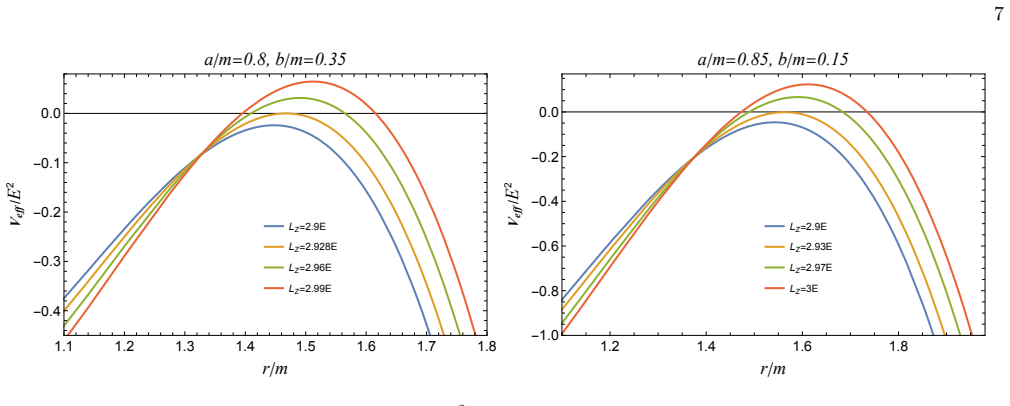
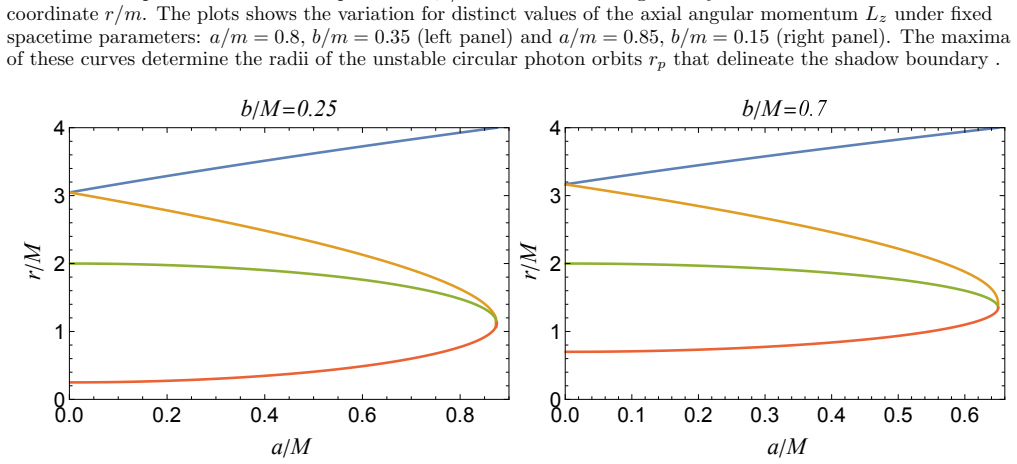
The rotating holonomy-corrected black hole metric with spin a and holonomy correction b, whose unstable circular photon orbits determine the shadow area A and oblateness D observables used to constrain the parameters.
If this is right
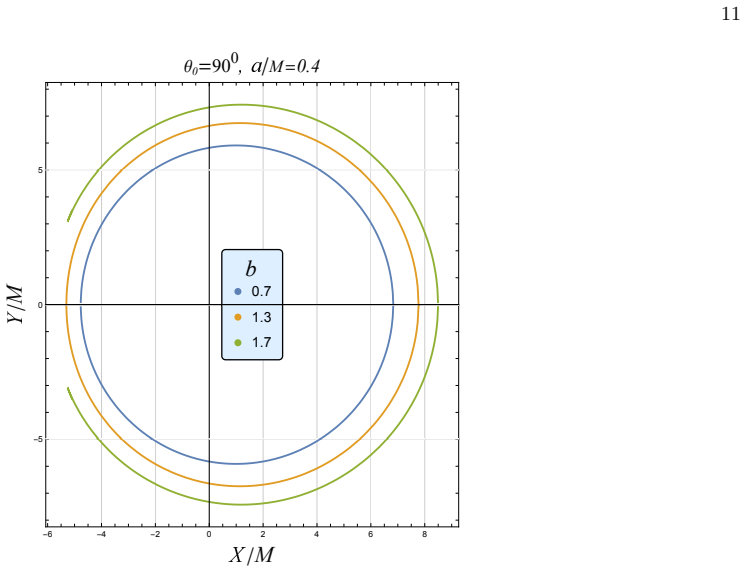
- The shadow size increases with increasing b compared to the Kerr case.
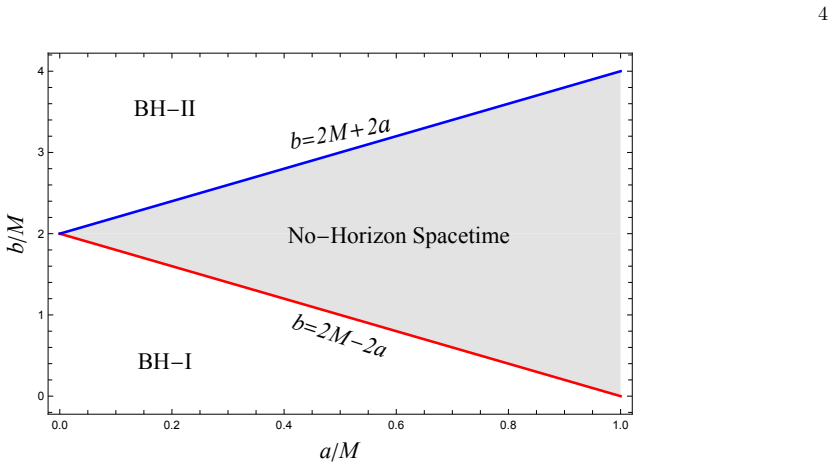
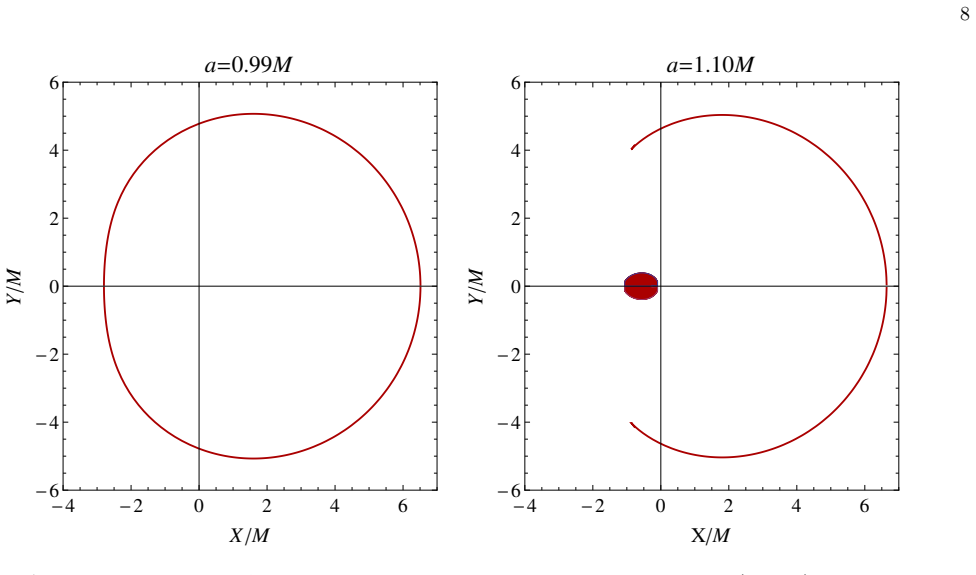
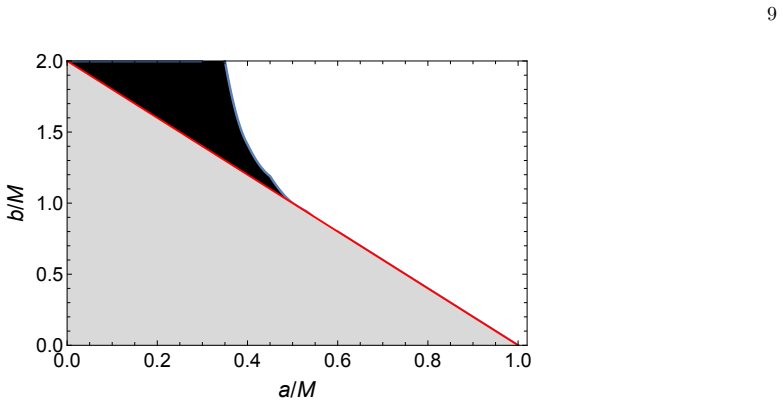
- Closed shadow rings form for b in the interval between the extremal and photon-orbit values even without an event horizon.
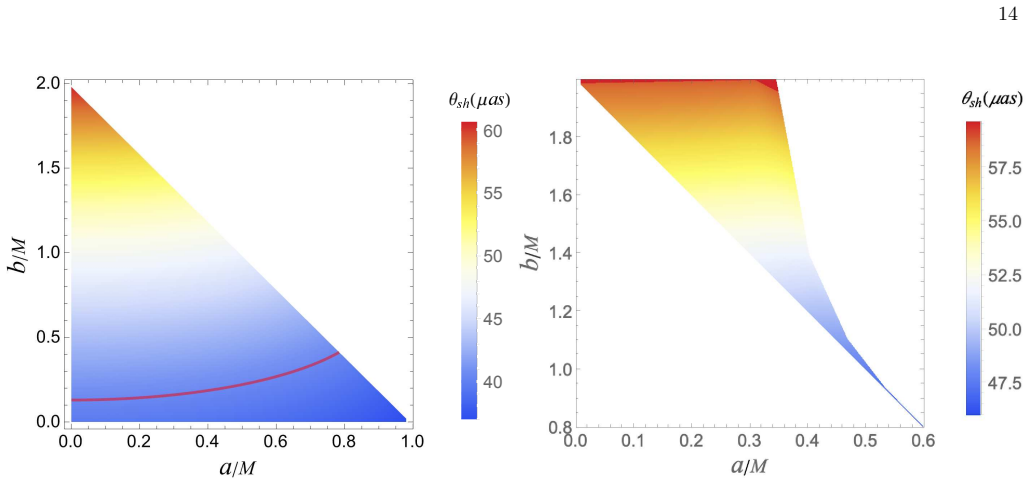
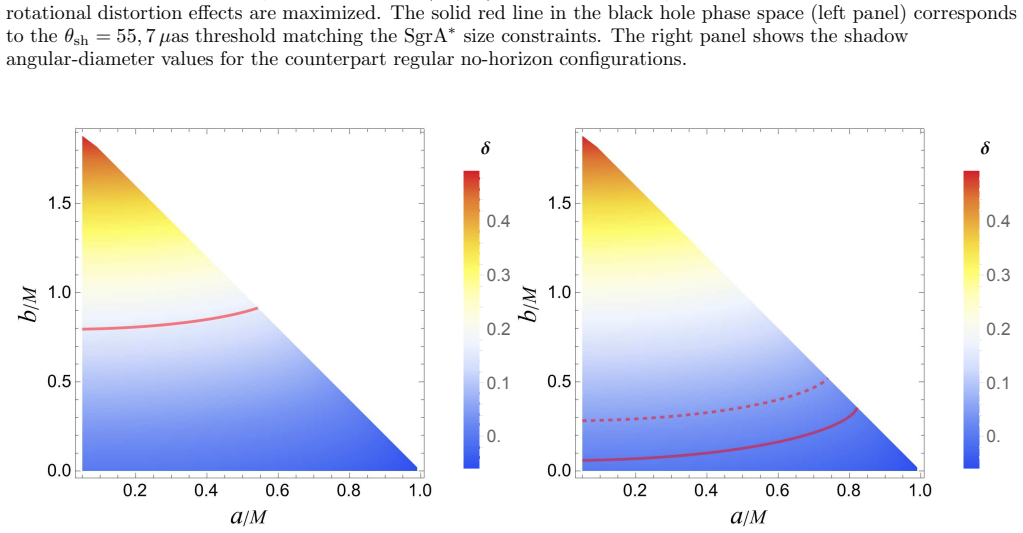
- Photon rings exist throughout the parameter range b_E ≤ b ≤ b_p.
- Upper bounds on b are obtained separately for each source at its observed inclination angle.
Where Pith is reading between the lines
- Tighter future EHT angular resolution could shrink the allowed range for b and begin to exclude parts of the parameter space.
- The A-D method could be applied to other effective metrics that modify photon orbits near black holes.
- Including detailed accretion flow models might shift the extracted bounds on b if those flows contribute substantially to the observed shadow.
- The persistence of closed shadows without horizons raises the possibility that the same metric could describe certain horizonless compact objects.
Load-bearing premise
The rotating holonomy-corrected metric is a faithful effective description of loop quantum gravity near the horizon and the shadow observables depend only on a and b without dominant effects from accretion or other matter.
What would settle it
A measured shadow diameter or oblateness for either M87* or Sgr A* that lies outside the range of A and D values allowed by any combination of a and b in the model would show the consistency claim is false.
Figures
read the original abstract
The Event Horizon Telescope (EHT) has provided a new tool for testing the strong-field regime of gravity by imaging the shadows of M87* and Sgr A*. These observations provide the first real opportunity to test whether quantum gravity--specifically loop quantum gravity--leaves observable imprints on spacetime. We use the EHT observations of M87* and Sgr A* to examine the observational signs of rotating holonomy-corrected black holes (RHCBHs). We discover that, in comparison to the typical Kerr black hole, the quantum correction parameter $b$ increases the size of the black hole shadow. As the deviation parameter $b$ increases in RHCBH, the prograde photon orbits shift outward, indicating a weaker effective gravitational field near the central region. Unlike Kerr naked singularities, which produce open arc-like shadows, the RHCBH spacetime can still produce closed shadow rings even in the absence of an event horizon. We find that photon rings continue to exist in the parameter range $b_E \leq b \leq b_p$, due to the presence of unstable circular photon orbits.We apply the Kumar--Ghosh method based on the shadow observables: the shadow area $A$ and the oblateness $D$ that together allow a unique determination of the spin parameter $a$ and the quantum correction parameter $b$. At $\theta_o=17$\textdegree~, the angular diameter bound of M87$^{*}$ yields $b \leq 0.1319\,M$ at $a = 0\,$ and $b \leq 0.421\,M$ at $a = 0.784\,M$, while at $\theta_o=50$\textdegree~, the angular diameter bound of Sgr A$^{*}$ yields $b \leq 0.5764\,M$ at $a = 0\,$ and $b \leq 0.7482\,M$ at $a = 0.6253\,M$ the Sgr~A$^{*}$. Our results show that nonzero values of the holonomy correction parameter are consistent with current EHT data, indicating that RHCBHs provide viable alternatives to the classical Kerr geometry in the strong-gravity regime and are strong astrophysical black hole candidates.
Editorial analysis
A structured set of objections, weighed in public.
Referee Report
Summary. The manuscript claims that nonzero values of the holonomy correction parameter b in rotating holonomy-corrected black holes (RHCBHs) remain consistent with EHT angular-diameter data for M87* and Sgr A*, obtained by applying the Kumar-Ghosh method to shadow area A and oblateness D; it concludes that RHCBHs are viable alternatives to Kerr black holes in the strong-gravity regime.
Significance. If the mapping from A and D to (a, b) holds after accounting for astrophysical effects, the work would supply concrete observational bounds on loop quantum gravity corrections near black hole horizons and demonstrate a direct link between EHT shadow observables and quantum-gravity parameters.
major comments (3)
- [Application of Kumar-Ghosh method (results on M87* and Sgr A* bounds)] The central consistency claim rests on the assumption that A and D are determined solely by a and b. The manuscript applies the Kumar-Ghosh method directly to the EHT angular-diameter bounds at fixed θ_o (abstract and results section) without marginalizing over accretion-flow or plasma contributions that can shift the effective shadow boundary by amounts comparable to or larger than the reported EHT uncertainties.
- [Results section reporting numerical bounds] No error propagation or sensitivity analysis is presented for the quoted bounds (b ≤ 0.1319 M at a=0 for M87*, b ≤ 0.5764 M at a=0 for Sgr A*). The abstract states the bounds but supplies neither the explicit mapping equations nor validation that A and D uniquely fix a and b once realistic accretion uncertainties are included.
- [Metric and photon-orbit discussion] The rotating holonomy-corrected metric itself is used without a visible derivation or reference to an explicit line element in the provided text; the claim that photon rings persist for b_E ≤ b ≤ b_p therefore rests on an unexamined effective description whose domain of validity near the horizon is not quantified.
minor comments (1)
- [Abstract] The abstract introduces b_E and b_p without defining them or relating them to the metric parameters; a brief clarification would improve readability.
Simulated Author's Rebuttal
We thank the referee for the thorough and constructive review. The comments highlight important aspects of our analysis that we will address to strengthen the manuscript. We respond point-by-point below.
read point-by-point responses
-
Referee: [Application of Kumar-Ghosh method (results on M87* and Sgr A* bounds)] The central consistency claim rests on the assumption that A and D are determined solely by a and b. The manuscript applies the Kumar-Ghosh method directly to the EHT angular-diameter bounds at fixed θ_o (abstract and results section) without marginalizing over accretion-flow or plasma contributions that can shift the effective shadow boundary by amounts comparable to or larger than the reported EHT uncertainties.
Authors: We agree that the Kumar-Ghosh method as applied assumes the shadow observables are determined by the spacetime geometry. While this geometric approach is standard for constraining spacetime parameters from shadow data, we acknowledge that accretion and plasma effects are not marginalized over and could influence the effective boundary. In the revised manuscript we will add a paragraph in the discussion section explicitly noting this limitation, stating that the reported bounds apply to the idealized vacuum case, and suggesting that future analyses incorporate these astrophysical uncertainties. This is a partial revision. revision: partial
-
Referee: [Results section reporting numerical bounds] No error propagation or sensitivity analysis is presented for the quoted bounds (b ≤ 0.1319 M at a=0 for M87*, b ≤ 0.5764 M at a=0 for Sgr A*). The abstract states the bounds but supplies neither the explicit mapping equations nor validation that A and D uniquely fix a and b once realistic accretion uncertainties are included.
Authors: We will revise the results section to include error propagation and a sensitivity analysis for the quoted bounds. The explicit mapping equations relating the shadow area A and oblateness D to the parameters (a, b) will be stated in the main text (or an appendix). We will also clarify the conditions under which A and D uniquely determine a and b within the Kumar-Ghosh framework. This addresses the referee's concern directly and will be incorporated as a full revision. revision: yes
-
Referee: [Metric and photon-orbit discussion] The rotating holonomy-corrected metric itself is used without a visible derivation or reference to an explicit line element in the provided text; the claim that photon rings persist for b_E ≤ b ≤ b_p therefore rests on an unexamined effective description whose domain of validity near the horizon is not quantified.
Authors: The metric is an extension of the holonomy-corrected line element from the non-rotating case in the loop quantum gravity literature. In the revised manuscript we will include the explicit rotating metric line element in Section 2, together with a reference to its derivation and a short discussion of its domain of validity near the horizon. We will also expand the photon-orbit analysis to quantify the persistence of photon rings in the stated parameter range. This will be added as a full revision. revision: yes
Circularity Check
No significant circularity; constraints are direct observational bounds
full rationale
The paper computes shadow observables A and D from the RHCBH metric and uses EHT angular-diameter data to place upper bounds on the correction parameter b for given spin a. The conclusion that nonzero b remains consistent is simply the statement that the data-permitted interval includes b > 0; it does not reduce to a fitted input renamed as a prediction, nor does any step equate to its own definition by construction. The Kumar–Ghosh mapping is an explicit geometric inversion of the metric’s photon orbits and is not invoked as an unverified uniqueness theorem that forces the result. No self-citation chain, ansatz smuggling, or renaming of known patterns is required for the central claim. The derivation chain is therefore self-contained against the supplied EHT angular-diameter bounds.
Axiom & Free-Parameter Ledger
free parameters (1)
- b
axioms (1)
- domain assumption The rotating holonomy-corrected black hole metric accurately encodes loop quantum gravity effects for rotating spacetimes
invented entities (1)
-
rotating holonomy-corrected black hole (RHCBH)
no independent evidence
Reference graph
Works this paper leans on
-
[1]
( 19) yields the critical impact parameters, [3, 95] ξc = (a2 + r2)∆ ′(r) − 4r∆( r) a∆ ′(r) ηc = r2 ( 8∆( r) ( 2a2 + r∆ ′(r) ) − r2∆ ′(r)2 − 16∆( r)2) a2∆ ′(r)2 , (23)
for Eq. ( 19) yields the critical impact parameters, [3, 95] ξc = (a2 + r2)∆ ′(r) − 4r∆( r) a∆ ′(r) ηc = r2 ( 8∆( r) ( 2a2 + r∆ ′(r) ) − r2∆ ′(r)2 − 16∆( r)2) a2∆ ′(r)2 , (23) . These critical impact parameters separate the photon traject ories that fall into the black hole from those that escape to infinity. Hence, they are important for determining the b...
-
[2]
In contrast, in the absence of photon spheres, the naked singularity images are markedly different from t hose of black holes [ 123]
spacetimes, naked singularities admit closed photon spheres for s ome ranges of their parameter values and consequently cast shadows closely resembling those of Schwarzsc hild black holes. In contrast, in the absence of photon spheres, the naked singularity images are markedly different from t hose of black holes [ 123]. This demonstrates the fact that, ra...
2005
-
[3]
Another related approach was developed by Tsukamoto et al
extended this method and derived analytical expressions for par ameter estimation. Another related approach was developed by Tsukamoto et al. [135] to distinguish Kerr black hole shadows from those arising in modified theories of gravity. These methods mainly assume that the shadow boundary is nearly circular and possesses certain symmetries. Such assumpti...
-
[4]
introduced a new set of observables that can describe more gene ral and distorted shadow shapes. Since Kumar - Ghosh method does not depend on circular symmetry, it is better su ited for studying rotating non-Kerr black holes, modified gravity spacetimes, and quantum-corrected geometries where the shadow may significantly deviate from a circular shape [ 99,...
2019
-
[5]
Using the EHT-inferred values for the sha dow diameters of M87* and Sgr A* constrains the parameter Lq to 0 < L q < 0
of the semiclassical spherically symmetric solution [ 108], and LIRBH-2, derived using MNJA [ 46, 140] from the quantum–extended Schwarzschild metric [ 42] acting as a seed metric. Using the EHT-inferred values for the sha dow diameters of M87* and Sgr A* constrains the parameter Lq to 0 < L q < 0. 0643 and 0 < L q < 0. 0423 for LIRBH-1 and 0 < L q < 0. 1...
-
[6]
61116M for a = 0
155M < g ≤ 0. 61116M for a = 0. 2M [97] from SgrA*. f. Hayward black holes Hayward ( 2006) presented this spacetime with an additional length–scale paramet er ℓ, governing the region concentrating the central energy density in a way that modifications to the metric become significant when the curvature scale approaches ℓ− 2. This model provides an exact sol...
2006
-
[7]
7M [99], while the SgrA* observation within 46
73627M for a = 0 . 7M [99], while the SgrA* observation within 46 . 9 µ as ≤ θsh ≤ 50 µ as yields g ≥ 0. 4881M for a = 0. 2M [97]. g. Bardeen black holes The rotating Bardeen spacetime [ 31, 69, 95, 97, 99] can be defined by metric ( 3) with the mass function [ 33] as: M (r) = M ( r2 r2 + g2 ) 3/ 2 , (43) where the magnetic monopole charge, g, [ 26] g is t...
-
[8]
The analytically derived critical impact parameters– ξc and ηc, determine whether a photon gets captured, scattered, or mov es in an unstable orbit
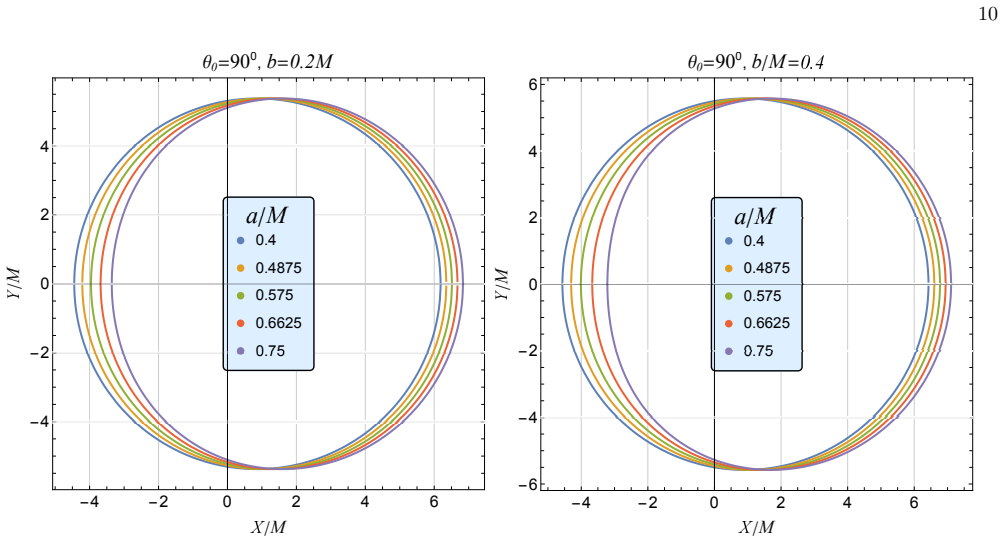
We used the Hamilton-Jacobi formalism to understand the motion of photons in this spacetime. The analytically derived critical impact parameters– ξc and ηc, determine whether a photon gets captured, scattered, or mov es in an unstable orbit. The retrograde and prograde orbits shift out ward relative to their Kerr counterparts upon incorporation of the hol...
-
[9]
An increase in the parameter b at a fixed spin results in an enlarged shadow and an increase in the spin at a fixed b results in the horizontal shift of the shadow centroid, flattening t he prograde edge, consistent with the frame-dragging effect
-
[10]
When b becomes large enough so that the event horizon of black holes disap pears, the spacetime still remains regular—no singularity forms. However, unlike ordinary Kerr naked singularities, which give open arc-like shadows, these horizonless RHCBHs can still produce complete, clo sed shadow rings as long as b is not too large (cf. Fig. 5) within the rang...
-
[11]
The intersection of constant A and D contours in the ( a, b ) plane at unique points allows the determination of both parameters simultaneously
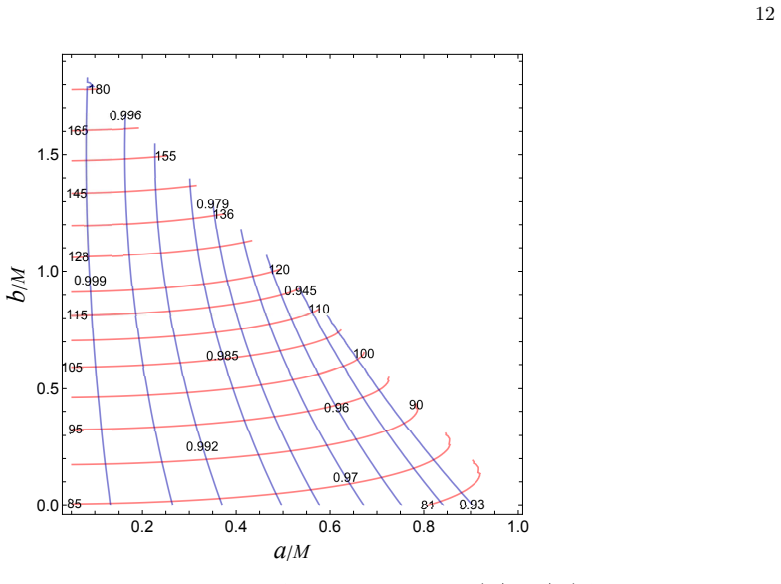
We adopted the Kumar–Ghosh method to estimate the paramete rs using the shadow area A and oblateness D as the two primary observables. The intersection of constant A and D contours in the ( a, b ) plane at unique points allows the determination of both parameters simultaneously. The results summarized in Table II imply that the observables A and D, when t...
-
[12]
1319M − 1) at a = 0, b ∈ (0, 0
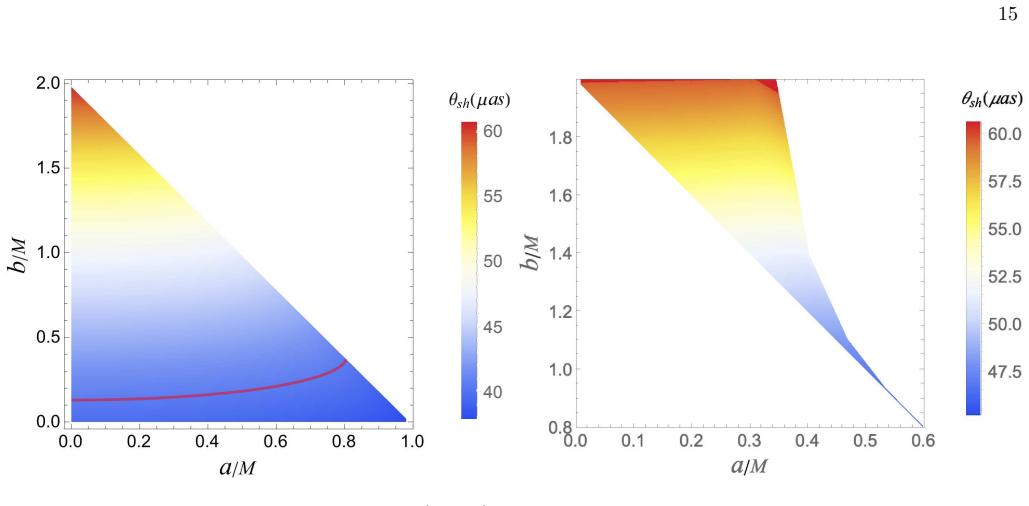
For M87 ∗ , the angular diameter bound θsh constrains b ∈ (0, 0. 1319M − 1) at a = 0, b ∈ (0, 0. 421M − 1) at a = 0 . 784M , for θo = 17 ° (cf. Fig. 9) (left) and b ∈ (0, 0. 1316M − 1) at a = 0 , b ∈ (0, 0. 3685M − 1) at a = 0 . 803M for θo = 90 ° (cf. Fig. 10) (left), while the Schwarzschild deviation δM87∗ = − 0. 01 ± 0. 17 allows comparatively wider ra...
-
[13]
5141 M at a = 0
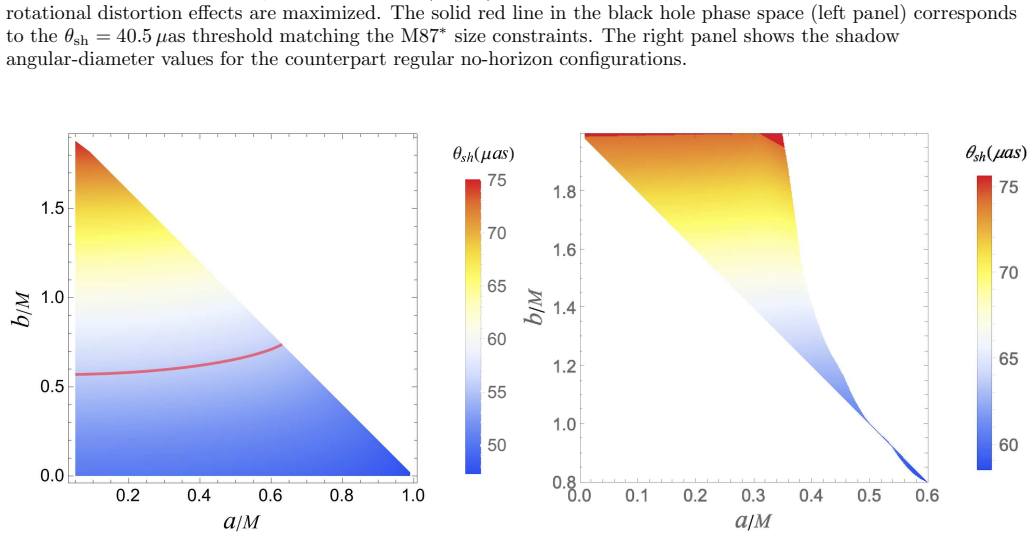
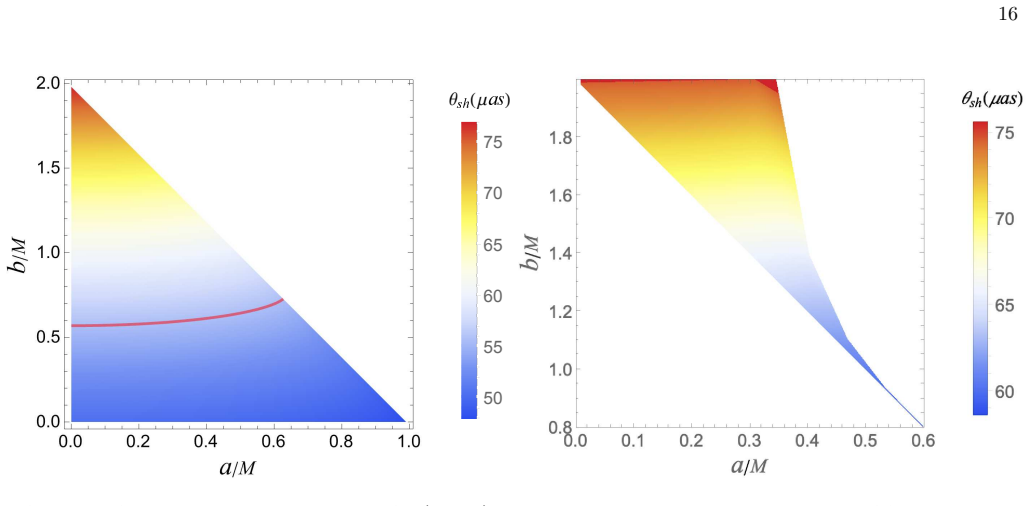
The Keck and VLTI Schwarzschild deviation priors yield individual co nstraints at b ≲ 0. 5141 M at a = 0. 7348 M and b ≲ 0. 358 M at a = 0 . 8176 M , respectively with the VLTI prior providing the tightest constraint on b among all observables considered. This agreement of the RHCBH ge ometry with both EHT datasets across a substantial region of parameter...
-
[14]
All of them remain consistent with curr ent EHT data
We compared RHCBHs with several other modified gravity and reg ular black hole models—quantum-corrected black holes, LQG-inspired models, Bumblebee gravity, hairy black hole s, and regular ones like Bardeen, Hayward, Ghosh, and Simpson-Visser. All of them remain consistent with curr ent EHT data. The way ∆( r) depends on b in our model is different (linear)...
-
[15]
B. P. Abbott et al. Observation of Gravitational Waves fr om a Binary Black Hole Merger. Phys. Rev. Lett. , 116(6): 061102, 2016. doi:10.1103/PhysRevLett.116.061102
-
[16]
A. A. Abdujabbarov, L. Rezzolla, and B. J. Ahmedov. A coor dinate-independent characterization of a black hole shado w. Mon. Not. Roy. Astron. Soc. , 454(3):2423–2435, 2015. doi:10.1093/mnras/stv2079
-
[17]
Ahmadjon Abdujabbarov, Muhammed Amir, Bobomurat Ahmed ov, and Sushant G. Ghosh. Shadow of rotating regular black holes. Phys. Rev. , D93(10):104004, 2016. doi:10.1103/PhysRevD.93.104004
-
[18]
Misba Afrin, Rahul Kumar, and Sushant G. Ghosh. Paramete r estimation of hairy Kerr black holes from its shadow and constraints from M87*. Mon. Not. Roy. Astron. Soc. , 504:5927–5940, 2021. doi:10.1093/mnras/stab1260
-
[19]
Misba Afrin, Sunny Vagnozzi, and Sushant G. Ghosh. Tests of Loop Quantum Gravity from the Event Horizon Telescope Results of Sgr A*. Astrophys. J. , 944(2):149, 2023. doi:10.3847/1538-4357/acb334
-
[20]
Misba Afrin, Sushant G. Ghosh, and Anzhong Wang. Testing EGB gravity coupled to bumblebee field and black hole parameter estimation with EHT observations. Phys. Dark Univ. , 46:101642, 2024. doi:10.1016/j.dark.2024.101642
-
[21]
Fazlay Ahmed, Shafqat Ul Islam, and Sushant G. Ghosh. Sha dows of rotating hairy black holes surrounded with quintessence and constraints from EHT observations. JHEAp, 46:100350, 2025. doi:10.1016/j.jheap.2025.100350
-
[22]
Kazunori Akiyama et al. First M87 Event Horizon Telescop e Results. I. The Shadow of the Supermassive Black Hole. Astrophys. J. Lett. , 875:L1, 2019. doi:10.3847/2041-8213/ab0ec7
-
[23]
First M87 Event Horizon Telescop e Results
Kazunori Akiyama et al. First M87 Event Horizon Telescop e Results. VI. The Shadow and Mass of the Central Black Hole. Astrophys. J. Lett. , 875(1):L6, 2019. doi:10.3847/2041-8213/ab1141
-
[24]
First M87 Event Horizon Telesco pe Results
Kazunori Akiyama et al. First M87 Event Horizon Telesco pe Results. IV. Imaging the Central Supermassive Black Hole . Astrophys. J. Lett. , 875(1):L4, 2019. doi:10.3847/2041-8213/ab0e85
-
[25]
First Sagittarius A* Event Hori zon Telescope Results
Kazunori Akiyama et al. First Sagittarius A* Event Hori zon Telescope Results. II. EHT and Multiwavelength Observa - tions, Data Processing, and Calibration. Astrophys. J. Lett. , 930(2):L13, 2022. doi:10.3847/2041-8213/ac6675
-
[26]
First Sagittarius A* Event Hori zon Telescope Results
Kazunori Akiyama et al. First Sagittarius A* Event Hori zon Telescope Results. IV. Variability, Morphology, and Bl ack Hole Mass. Astrophys. J. Lett. , 930(2):L15, 2022. doi:10.3847/2041-8213/ac6736
-
[27]
First Sagittarius A* Event Hori zon Telescope Results
Kazunori Akiyama et al. First Sagittarius A* Event Hori zon Telescope Results. V. Testing Astrophysical Models of t he Galactic Center Black Hole. Astrophys. J. Lett. , 930(2):L16, 2022. doi:10.3847/2041-8213/ac6672
-
[28]
Kazunori Akiyama et al. First Sagittarius A* Event Hori zon Telescope Results. I. The Shadow of the Supermassive Bla ck Hole in the Center of the Milky Way. Astrophys. J. Lett. , 930(2):L12, 2022. doi:10.3847/2041-8213/ac6674
-
[29]
First Sagittarius A* Event Hori zon Telescope Results
Kazunori Akiyama et al. First Sagittarius A* Event Hori zon Telescope Results. III. Imaging of the Galactic Center Supermassive Black Hole. Astrophys. J. Lett. , 930(2):L14, 2022. doi:10.3847/2041-8213/ac6429
-
[30]
First Sagittarius A* Event Horizon Telescope Results
Kazunori Akiyama et al. First Sagittarius A* Event Hori zon Telescope Results. VI. Testing the Black Hole Metric. Astrophys. J. Lett. , 930(2):L17, 2022. doi:10.3847/2041-8213/ac6756
-
[31]
Heena Ali, Shafqat Ul Islam, and Sushant G. Ghosh. Shado ws and parameter estimation of rotating quantum cor- rected black holes and constraints from EHT observation of M 87* and Sgr A*. JHEAp, 47:100367, 2025. doi: 10.1016/j.jheap.2025.100367
-
[32]
Charged black holes i n effective loop quantum gravity
Alberto Alonso-Bardaji and et al. Charged black holes i n effective loop quantum gravity. Physical Review D , 107(8): 084042, 2023
2023
-
[33]
Formation of nonsingular spher ical black holes with holonomy corrections
Asier Alonso-Bardaji. Formation of nonsingular spher ical black holes with holonomy corrections. Phys. Rev. D , 111(8): 084023, 2025. doi:10.1103/PhysRevD.111.084023
-
[34]
An effective model for the quantum Schwarzschild black hole
Asier Alonso-Bardaji, David Brizuela, and Ra¨ ul Vera. An effective model for the quantum Schwarzschild black hole. Phys. Lett. B , 829:137075, 2022. doi:10.1016/j.physletb.2022.137075
-
[35]
Nonsingular spherically symmetric black-hole model with h olonomy corrections
Asier Alonso-Bardaji, David Brizuela, and Ra¨ ul Vera. Nonsingular spherically symmetric black-hole model with h olonomy corrections. Phys. Rev. D , 106(2):024035, 2022. doi:10.1103/PhysRevD.106.024035
-
[36]
Muhammed Amir and Sushant G. Ghosh. Shapes of rotating n onsingular black hole shadows. Phys. Rev., D94(2):024054,
-
[37]
doi:10.1103/PhysRevD.94.024054. 23
-
[38]
Quantum geometry a nd the Schwarzschild singularity
Abhay Ashtekar and Martin Bojowald. Quantum geometry a nd the Schwarzschild singularity. Class. Quant. Grav. , 23: 391–411, 2006. doi:10.1088/0264-9381/23/2/008
-
[39]
Background inde pendent quantum gravity: A status report
Abhay Ashtekar and Jerzy Lewandowski. Background inde pendent quantum gravity: A status report. Classical and Quantum Gravity, 21(15):R53, 2004
2004
-
[40]
Quantum nature of the big bang
Abhay Ashtekar, Tomasz Pawlowski, and Parampreet Sing h. Quantum nature of the big bang. Physical Review Letters , 96(14):141301, 2006
2006
-
[41]
The Bardeen model a s a nonlinear magnetic monopole
Eloy Ayon-Beato and Alberto Garcia. The Bardeen model a s a nonlinear magnetic monopole. Phys. Lett., B493:149–152,
-
[42]
doi:10.1016/S0370-2693(00)01125-4
-
[43]
D. Ayzenberg et al. Fundamental physics opportunities with future ground-based mm/sub-mm VLBI arrays. Living Rev. Rel., 28(1):4, 2025. doi:10.1007/s41114-025-00057-0. [Errat um: Living Rev.Rel. 28, 7 (2025)]
-
[44]
Mustapha Azreg-A ¨ ınou. From static to rotating to conf ormal static solutions: Rotating imperfect fluid wormholes with(out) electric or magnetic field. Eur. Phys. J. C , 74(5):2865, 2014. doi:10.1140/epjc/s10052-014-2865-8
-
[45]
Regular and conformal regular c ores for static and rotating solutions
Mustapha Azreg-Ainou. Regular and conformal regular c ores for static and rotating solutions. Phys. Lett. B , 730:95–98,
-
[46]
doi:10.1016/j.physletb.2014.01.041
-
[47]
Generating rotating regular black hole solutions without complexification
Mustapha Azreg-A ¨ ınou. Generating rotating regular black hole solutions without complexification. Phys. Rev. D , 90(6): 064041, 2014. doi:10.1103/PhysRevD.90.064041
-
[48]
Cosimo Bambi and Leonardo Modesto. Rotating regular bl ack holes. Phys. Lett. , B721:329–334, 2013. doi: 10.1016/j.physletb.2013.03.025
-
[49]
Cosimo Bambi, Katherine Freese, Sunny Vagnozzi, and Lu ca Visinelli. Testing the rotational nature of the su- permassive object M87* from the circularity and size of its fi rst image. Phys. Rev. , D100(4):044057, 2019. doi: 10.1103/PhysRevD.100.044057
-
[50]
J. M. Bardeen. Circular geodesic of Bardeen and Ayon–Be ato–Garcia regular black-hole and no-horizon spacetimes. in Conference Proceedings of GR5 , page 174, 1968. doi:10.1142/S0218271815500200
-
[51]
J. M. Bardeen. Timelike and null geodesics in the Kerr me tric. Proceedings, Ecole d’Et´ e de Physique Th´ eorique: Les Astres Occlus : Les Houches, France, August, 1972, 215-240 , pages 215–240, 1973
1972
-
[52]
James M. Bardeen. Kerr Metric Black Holes. Nature, 226:64–65, 1970. doi:10.1038/226064a0
-
[53]
James M. Bardeen. Properties of black holes relevant to their observation. Symposium - International Astronomical Union, 64:132–144, 1974. doi:10.1017/S0074180900236218
-
[54]
James M. Bardeen, William H. Press, and Saul A Teukolsky . Rotating black holes: Locally nonrotating frames, energy extraction, and scalar synchrotron radiation. Astrophys. J. , 178:347, 1972. doi:10.1086/151796
-
[55]
The Four laws of black hole me- chanics,
James M. Bardeen, B. Carter, and S. W. Hawking. The Four l aws of black hole mechanics. Commun. Math. Phys. , 31: 161–170, 1973. doi:10.1007/BF01645742
-
[56]
Black holes, edited by c
JM Bardeen. Black holes, edited by c. dewitt and bs dewit t, 1973
1973
-
[57]
Idrus Husin Belfaqih, Martin Bojowald, Suddhasattwa B rahma, and Erick I. Duque. Black holes in effective loop quant um gravity: Covariant holonomy modifications. Phys. Rev. D , 112(4):046022, 2025. doi:10.1103/1tyh-87sr
-
[58]
Robert Bluhm and V. Alan Kostelecky. Spontaneous Loren tz violation, Nambu-Goldstone modes, and gravity. Phys. Rev. D , 71:065008, 2005. doi:10.1103/PhysRevD.71.065008
-
[59]
Norbert Bodendorfer, Fabio M. Mele, and Johannes M¨ unc h. (b,v)-type variables for black to white hole transitions in effective loop quantum gravity. Phys. Lett. B , 819:136390, 2021. doi:10.1016/j.physletb.2021.136390
-
[60]
Christian G. Boehmer and Kevin Vandersloot. Loop Quant um Dynamics of the Schwarzschild Interior. Phys. Rev. D , 76:104030, 2007. doi:10.1103/PhysRevD.76.104030
-
[62]
S. V. Bolokhov and et al. Echoes from quantum black holes . Physical Review D , 108(12):124032, 2023
2023
-
[63]
T esting Loop Quantum Gravity from Obser- vational Consequences of Nonsingular Rotating Black Holes
Suddhasattwa Brahma, Che-Yu Chen, and Dong-han Yeom. T esting Loop Quantum Gravity from Obser- vational Consequences of Nonsingular Rotating Black Holes . Phys. Rev. Lett. , 126(18):181301, 2021. doi: 10.1103/PhysRevLett.126.181301
-
[64]
Francesco Caravelli and Leonardo Modesto. Spinning Lo op Black Holes. Class. Quant. Grav. , 27:245022, 2010. doi: 10.1088/0264-9381/27/24/245022
-
[65]
Global structure of the Kerr family of g ravitational fields
Brandon Carter. Global structure of the Kerr family of g ravitational fields. Phys. Rev. , 174:1559–1571, 1968. doi: 10.1103/PhysRev.174.1559
-
[66]
Johnson, and Alexandru Lupsas ca
Andrew Chael, Michael D. Johnson, and Alexandru Lupsas ca. Observing the Inner Shadow of a Black Hole: A Direct View of the Event Horizon. Astrophys. J. , 918(1):6, 2021. doi:10.3847/1538-4357/ac09ee
-
[67]
The mathematical theory of black holes
S Chandrasekhar. The mathematical theory of black holes . Oxford Univ. Press, Oxford, 1985
1985
-
[68]
Spherical photon orbits in the field of Kerr naked singularities
Daniel Charbul´ ak and Zdenˇ ek Stuchl ´ ık. Spherical photon orbits in the field of Kerr naked singularities. Eur. Phys. J. C , 78(11):879, 2018. doi:10.1140/epjc/s10052-018-6336-5
-
[69]
Clarissa-Marie Claudel, K. S. Virbhadra, and G. F. R. El lis. The Geometry of photon surfaces. J. Math. Phys. , 42: 818–838, 2001. doi:10.1063/1.1308507
-
[70]
, year = 2018, month = mar, volume = 855, pages =
R. Craig Walker, Phillip E. Hardee, Frederick B. Davies , Chun Ly, and William Junor. The Structure and Dynamics of the Subparsec Jet in M87 Based on 50 VLBA Observations over 17 Years at 43 GHz. Astrophys. J. , 855(2):128, 2018. doi:10.3847/1538-4357/aaafcc
-
[71]
On a regular charged black hole with a non linear electric source
Hristu Culetu. On a regular charged black hole with a non linear electric source. Int. J. Theor. Phys. , 54(8):2855–2863,
-
[72]
doi:10.1007/s10773-015-2521-6. 24
-
[73]
Pedro V. P. Cunha and Carlos A. R. Herdeiro. Shadows and s trong gravitational lensing: a brief review. Gen. Rel. Grav. , 50(4):42, 2018. doi:10.1007/s10714-018-2361-9
-
[74]
Pedro V. P. Cunha, Carlos A. R. Herdeiro, Eugen Radu, and Helgi F. Runarsson. Shadows of Kerr black holes with scalar hair. Phys. Rev. Lett. , 115(21):211102, 2015. doi:10.1103/PhysRevLett.115.21 1102
-
[75]
Pedro V. P. Cunha, Carlos A. R. Herdeiro, and Maria J. Rod riguez. Does the black hole shadow probe the event horizon geometry? Phys. Rev. D , 97(8):084020, 2018. doi:10.1103/PhysRevD.97.084020
-
[76]
Pedro V. P. Cunha, Carlos A. R. Herdeiro, and Eugen Radu. Spontaneously Scalarized Kerr Black Holes in Extended Scalar-Tensor–Gauss-Bonnet Gravity. Phys. Rev. Lett. , 123(1):011101, 2019. doi:10.1103/PhysRevLett.123.011 101
-
[77]
C. T. Cunningham and J. M. Bardeen. The Optical Appearan ce of a Star Orbiting an Extreme Kerr Black Hole. Astrophysical Journal, 173:L137, May 1972. doi:10.1086/180933
-
[78]
Polarization images of solitonic boson stars.Eur
Vittorio De Falco, Emmanuele Battista, Salvatore Capo zziello, and Mariafelicia De Laurentis. Reconstructing wo rmhole solutions in curvature based Extended Theories of Gravity. Eur. Phys. J. C , 81(2):157, 2021. doi:10.1140/epjc/s10052- 021-08958-4
-
[79]
Relativistic redshift of the star S0-2 orb iting the Galactic center supermassive black hole
Tuan Do et al. Relativistic redshift of the star S0-2 orb iting the Galactic center supermassive black hole. Science, 365 (6454):664–668, 2019. doi:10.1126/science.aav8137
-
[80]
P redictive power of grand unification from quantum gravity
Astrid Eichhorn, Aaron Held, and Christof Wetterich. P redictive power of grand unification from quantum gravity. JHEP, 08:111, 2020. doi:10.1007/JHEP08(2020)111
-
[81]
Die Feldgleichungen der Gravitation
Albert Einstein. Die Feldgleichungen der Gravitation . Sitzungsberichte der Königlich Preussischen Akadem ie der Wissenschaften, pages 844–847, January 1915
1915
discussion (0)
Sign in with ORCID, Apple, or X to comment. Anyone can read and Pith papers without signing in.