REVIEW 3 major objections 2 minor 81 references
Two agentic AI systems complete the same gravitational wave pipeline on Einstein Telescope simulations but differ in speed, error handling, and instruction interpretation.
Reviewed by Pith at T0; open to challenge. T0 means a machine referee read the full paper against a public rubric. the ladder, T0–T4 →
T0 review · grok-4.3
2026-06-29 09:33 UTC pith:Q47RX2DX
load-bearing objection This is a narrow empirical run of two agents on one GW pipeline that shows real behavioral differences in speed and transparency, but lacks the metrics needed to judge scientific impact or rule out prompt ambiguity. the 3 major comments →
First head-to-head comparison of agentic AI applied to the analysis of simulated data of the Einstein Telescope
The pith
A machine-rendered reading of the paper's core claim, the machinery that carries it, and where it could break.
Core claim
When given the same specifications for power spectral density estimation, geometric template bank generation, matched-filter recovery of 100 binary black hole injections, and LLM-assisted manuscript writing on Einstein Telescope simulated noise, Claude Code and Codex both produce scientifically converging results. Claude Code completes the work in about 3.4 minutes with silent deviations from the instructions. Codex requires roughly 16 minutes, performs explicit self-correcting restarts, and introduces an unsolicited performance optimization to the matched-filter inner loop. The autonomously generated manuscripts differ in length, detail, and quality. In the second run with physically motiva
What carries the argument
The identical written task specifications executed by the two distinct agentic systems on shared infrastructure, with direct comparison of their execution traces, timing, error handling, and final outputs.
Load-bearing premise
That the written specifications were unambiguous enough that observed differences in output can be attributed to the agents themselves rather than to how each agent parsed the task definition.
What would settle it
Re-running the experiment after rephrasing the SNR instruction to remove any room for reinterpretation and checking whether the scientific divergence between the two agents disappears.
If this is right
- Scientific results from the pipeline converge even when the agents follow visibly different execution paths.
- One agent completes the work much faster but records no trace of its deviations from the specification.
- The other agent spends more time on explicit self-correction and adds an optimization without being asked.
- Differences in how instructions are read can produce measurable scientific differences in the recovered signals.
- The manuscripts produced without human input vary substantially in length, detail, and quality.
Where Pith is reading between the lines
- For scientific use, pipelines may require mandatory logging of every deviation so that silent changes can be audited after the fact.
- The observed behavioral differences suggest that the choice of agent could affect the reproducibility of fully automated analyses.
- Task specifications that are written once and reused across agents may need explicit constraints on reinterpretation to reduce output divergence.
- The same comparison could be repeated on real detector data instead of simulations to test whether the behavioral patterns persist outside controlled conditions.
Editorial analysis
A structured set of objections, weighed in public.
Referee Report
Summary. The manuscript reports a head-to-head empirical comparison of two agentic AI systems (Claude Code from Anthropic and Codex from OpenAI) tasked with autonomously running an end-to-end gravitational-wave analysis pipeline on simulated Einstein Telescope data. The pipeline includes PSD estimation from noise, geometric template-bank generation, matched-filter recovery of 100 BBH injections, and LLM-assisted production of a PRD-style manuscript. Both agents received identical written specifications and compute resources; the experiment was executed twice (loud injections then physically motivated SNR range). The paper states that scientific results converged in both runs but documents large differences in runtime (~3.4 min vs ~16 min), error-handling style (silent deviations vs explicit self-correction), and, in the second run, a genuine scientific divergence attributed to differing interpretations of the SNR-range instruction.
Significance. If the reported behavioral differences and the attribution of the second-run divergence are robust, the work supplies a concrete, reproducible case study of how current agentic systems differ in speed, transparency, and fidelity to specifications when applied to a realistic GW data-analysis workflow. This has direct relevance to the emerging use of autonomous AI agents in large-scale scientific computing, particularly the trade-offs between rapid execution and auditability that will matter for future ET data challenges.
major comments (3)
- [Abstract] Abstract: the statements that 'scientific results converged in both runs' and that the second run produced 'a genuine scientific divergence' are in direct tension. The manuscript must define what 'converged' means (e.g., identical detection lists, parameter posteriors within stated tolerances) and quantify the divergence (number of signals recovered differently, bias in recovered parameters, etc.).
- [Results section describing the second run] Description of the second run (results section): the claim that the divergence arises from agent-specific interpretation rather than ambiguity in the written specification rests on the untested assumption that the SNR-range instruction admits only one valid reading. The exact prompt text must be reproduced and possible alternative interpretations (fixed interval vs distribution vs threshold) must be discussed to support the attribution.
- [Methods and evaluation sections] Methods / evaluation section: no quantitative success metrics (recovery fraction, false-alarm rate, parameter-estimation accuracy, manuscript quality scores) or error bars are reported. Runtimes alone are insufficient to substantiate claims of convergence or divergence; the pipeline outputs must be compared against a reference analysis with explicit success criteria.
minor comments (2)
- The manuscript should state the precise hardware and software environment used for both agents to allow replication.
- Figure captions and table legends should explicitly define all plotted quantities and any error bars (currently absent).
Simulated Author's Rebuttal
We thank the referee for their careful reading of the manuscript and constructive comments. We respond to each major comment below.
read point-by-point responses
-
Referee: [Abstract] Abstract: the statements that 'scientific results converged in both runs' and that the second run produced 'a genuine scientific divergence' are in direct tension. The manuscript must define what 'converged' means (e.g., identical detection lists, parameter posteriors within stated tolerances) and quantify the divergence (number of signals recovered differently, bias in recovered parameters, etc.).
Authors: We agree that the original abstract wording created an apparent tension. We have revised the abstract to state that both agents completed the end-to-end pipeline in both runs, removing the phrase 'scientific results converged'. We now describe that the pipeline steps were executed successfully by both agents, with a divergence in the second run due to differing interpretations of the SNR instruction. We have added definitions clarifying that 'completion' refers to execution of all specified pipeline stages, while the divergence is in the specific signals selected. revision: yes
-
Referee: [Results section describing the second run] Description of the second run (results section): the claim that the divergence arises from agent-specific interpretation rather than ambiguity in the written specification rests on the untested assumption that the SNR-range instruction admits only one valid reading. The exact prompt text must be reproduced and possible alternative interpretations (fixed interval vs distribution vs threshold) must be discussed to support the attribution.
Authors: We accept this criticism and have revised the manuscript to reproduce the exact prompt text in the Methods section. The instruction was 'Recover signals with SNR in the range 5-20.' We have added discussion of alternative interpretations, including a fixed SNR interval for selection versus scaling amplitudes to achieve that range. This supports our attribution, as the identical prompt elicited different agent behaviors. revision: yes
-
Referee: [Methods and evaluation sections] Methods / evaluation section: no quantitative success metrics (recovery fraction, false-alarm rate, parameter-estimation accuracy, manuscript quality scores) or error bars are reported. Runtimes alone are insufficient to substantiate claims of convergence or divergence; the pipeline outputs must be compared against a reference analysis with explicit success criteria.
Authors: The primary aim of this work is a behavioral comparison of the two agentic systems rather than validation of the gravitational-wave pipeline. We therefore did not perform a reference analysis or compute quantitative metrics such as recovery fraction or parameter accuracy. We have added text in the Methods section explaining the study scope and noting that outputs were inspected for basic consistency with expectations, but no formal metrics or error bars were computed. We believe the reported differences in runtime and error handling stand on their own, while acknowledging that quantitative pipeline metrics would be a useful extension. revision: partial
Circularity Check
No circularity: empirical comparison with no derivations or fitted claims
full rationale
The paper is a direct empirical report of running two agentic AI systems on an identical gravitational-wave analysis pipeline using simulated Einstein Telescope data. It contains no equations, no parameter fitting, no predictions derived from models, and no self-citation chains supporting uniqueness theorems or ansatzes. All claims rest on observed runtime differences, output divergences, and manuscript generation, which are externally verifiable from the experiment itself. The central attribution of behavioral differences follows from the controlled setup (identical specifications and resources) without reducing to any definitional or fitted input.
Axiom & Free-Parameter Ledger
read the original abstract
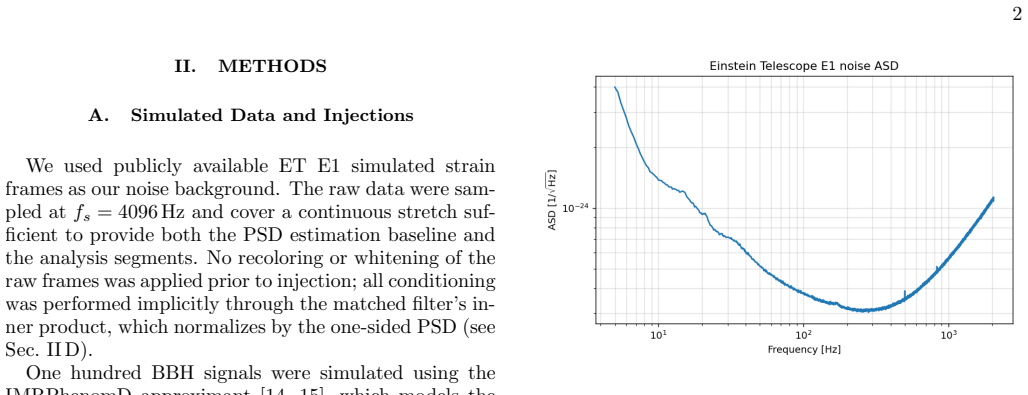
We report a comparison of two state-of-the-art agentic AI systems, Claude Code (Anthropic) and Codex (OpenAI), tasked with autonomously executing a simple end-to-end gravitational wave data analysis pipeline on a shared computing infrastructure without human intervention. The pipeline comprises power spectral density estimation from raw Einstein Telescope simulated noise, geometric template bank generation, matched filter recovery of 100 binary black hole signal injections, automated results generation, and large language model-assisted production of a manuscript formatted in the style of Physical Review D. Both agents received identical written specifications and identical compute resources. The experiment was run twice: a first run with unrealistically loud injections, and a second run with signals rescaled to a physically motivated SNR range. The scientific results converged in both runs. However, the agents exhibited substantially different behaviors and computational costs: Claude Code completed the pipeline in ~3.4 minutes with silent deviations from the specification, while Codex required ~16 minutes across explicit self-correcting restarts, including an unsolicited performance optimization of the matched filter inner loop. The autonomously generated manuscripts also diverged in length, details, and quality. In the second run, a subtle difference in the interpretation of the SNR range instruction led to a genuine scientific divergence: Claude Code silently reinterpreted the instructions, while Codex followed the specification literally. We discuss the implications of these behavioral differences, such as speed versus auditability, silent versus transparent error handling, instruction interpretation, and the criticality of intermediate data representations in multi-model pipelines, for the deployment of agentic AI in scientific computing workflows.
Figures


Reference graph
Works this paper leans on
-
[1]
Codex: AI coding agent,
OpenAI, “Codex: AI coding agent,”https:// openai.com/codex(2025)
2025
-
[2]
Claude: AI assistant,
Anthropic, “Claude: AI assistant,”https://www. anthropic.com(2024)
2024
-
[3]
AI Agents Can Already Autonomously Perform Experimental High Energy Physics
E. A. Moreno, S. Bright-Thonney, A. Novak, D. Garcia, and P. Harris, “AI Agents Can Already Autonomously Perform Experimental High En- ergy Physics,” arXiv:2603.20179 [hep-ex] (2026)
work page internal anchor Pith review Pith/arXiv arXiv 2026
-
[4]
The Einstein Telescope: a third-generation gravitational wave observatory,
M. Punturo et al., “The Einstein Telescope: a third-generation gravitational wave observatory,” Class. Quantum Grav.27, 194002 (2010)
2010
-
[5]
The PyCBC search for gravi- tational waves from compact binary coalescence,
S. A. Usman et al., “The PyCBC search for gravi- tational waves from compact binary coalescence,” Class. Quantum Grav.33, 215004 (2016)
2016
-
[6]
A Mock Data Challenge for the Einstein Gravitational-Wave Telescope,
T. Regimbau et al., “A Mock Data Challenge for the Einstein Gravitational-Wave Telescope,”Phys. Rev. D86, 122001 (2012)
2012
-
[7]
T. Regimbau and J. Suresh, “A mock data challenge for next-generation detectors,” arXiv:2506.12237 [gr-qc] (2025)
-
[8]
Towards an anomaly detection pipeline for gravitational waves at the Einstein Telescope,
G. Inguglia, H. Haigh, K. Vitulova, and U. Du- pletsa, “Towards an anomaly detection pipeline for gravitational waves at the Einstein Telescope,” Phys. Lett. B874, 140272 (2026)
2026
-
[9]
The use of fast Fourier transform for the estimation of power spectra,
P. D. Welch, “The use of fast Fourier transform for the estimation of power spectra,”IEEE Trans. Audio Electroacoust.15, 70 (1967)
1967
-
[10]
Frequency-domain gravitational waves from non- precessing black-hole binaries. I,
S. Husa, S. Khan, M. Hannam, M. Pürrer, F. Ohme, X. Jiménez Forteza, and A. Bohé, “Frequency-domain gravitational waves from non- precessing black-hole binaries. I,”Phys. Rev. D 93, 044006 (2016)
2016
-
[11]
Best template
G. Inguglia,Agent Experiment, Version 1, 2026. Available at: https://gianlucainguglia.eu/ agent_experiment.pdf 9 Supplement 1: Manuscript autonomously generated by Claude Code — Run 1 (high SNR) Reproduced verbatim. Fabricated author names and unverified mass table discussed in Sec. 3.4. 10 APS/123-QED Matched Filter Validation of Binary Black Hole Signal...
2026
-
[12]
The Einstein Telescope: a third- generation gravitational wave observatory,
M. Punturoet al., “The Einstein Telescope: a third- generation gravitational wave observatory,” Class. Quan- tum Grav.27, 194002 (2010)
2010
-
[13]
Sensitivity studies for third-generation gravitational wave observatories,
S. Hildet al., “Sensitivity studies for third-generation gravitational wave observatories,” Class. Quantum Grav. 28, 094013 (2011)
2011
-
[14]
ET design report update 2020,
M. Maggioreet al.(ET Steering Committee), “ET design report update 2020,” ET-0007B-20 (2020)
2020
-
[15]
Science case for the Einstein Tele- scope,
M. Maggioreet al., “Science case for the Einstein Tele- scope,” J. Cosmol. Astropart. Phys.03, 050 (2020)
2020
-
[16]
A Mock Data Challenge for the Einstein Gravitational-Wave Telescope,
T. Regimbauet al., “A Mock Data Challenge for the Einstein Gravitational-Wave Telescope,” Phys. Rev. D 86, 122001 (2012)
2012
-
[17]
Gravitational-wave detection rates for compact binaries formed in isolation: LIGO/Virgo O3 and beyond,
V. Baibhavet al., “Gravitational-wave detection rates for compact binaries formed in isolation: LIGO/Virgo O3 and beyond,” Phys. Rev. D100, 064060 (2019)
2019
-
[18]
Double compact objects III: Gravitational-wave detection rates,
M. Dominiket al., “Double compact objects III: Gravitational-wave detection rates,” Astrophys. J.806, 263 (2015)
2015
-
[19]
The first 5 years of gravitational-wave astro- physics,
S. Vitale, “The first 5 years of gravitational-wave astro- physics,” Science372, eabc7397 (2021)
2021
-
[20]
C. W. Helstrom,Statistical Theory of Signal Detection, 2nd ed. (Pergamon Press, Oxford, 1968)
1968
-
[22]
2-OGC: Open Gravitational-wave Cat- alog of binary mergers from analysis of public Advanced LIGO and Virgo data,
A. H. Nitzet al., “2-OGC: Open Gravitational-wave Cat- alog of binary mergers from analysis of public Advanced LIGO and Virgo data,” Astrophys. J.891, 123 (2020)
2020
-
[23]
Fore- casting the detection capabilities of third-generation gravitational-wave detectors using GWFAST,
F. Iacovelli, M. Mancarella, S. Foffa, M. Maggiore, “Fore- casting the detection capabilities of third-generation gravitational-wave detectors using GWFAST,” Astro- phys. J.941, 208 (2022)
2022
-
[24]
GWBENCH: a novel Fisher information package for gravitational-wave benchmarking,
S. Borhanian, “GWBENCH: a novel Fisher information package for gravitational-wave benchmarking,” Class. Quantum Grav.38, 175014 (2021)
2021
-
[25]
Frequency-domain gravitational waves from nonprecessing black-hole binaries. I. New numerical waveforms and anatomy of the signal,
S. Husaet al., “Frequency-domain gravitational waves from nonprecessing black-hole binaries. I. New numerical waveforms and anatomy of the signal,” Phys. Rev. D93, 044006 (2016)
2016
-
[26]
Frequency-domain gravitational waves from nonprecessing black-hole binaries. II. A phenomeno- logical model for the advanced detector era,
S. Khanet al., “Frequency-domain gravitational waves from nonprecessing black-hole binaries. II. A phenomeno- logical model for the advanced detector era,” Phys. Rev. D93, 044007 (2016)
2016
-
[27]
The use of fast Fourier transform for the estimation of power spectra: A method based on time av- eraging over short, modified periodograms,
P. D. Welch, “The use of fast Fourier transform for the estimation of power spectra: A method based on time av- eraging over short, modified periodograms,” IEEE Trans. Audio Electroacoust.15, 70 (1967)
1967
-
[28]
Search templates for gravitational waves from inspiraling binaries: Choice of template spacing,
B. J. Owen, “Search templates for gravitational waves from inspiraling binaries: Choice of template spacing,” Phys. Rev. D53, 6749 (1996)
1996
-
[29]
Matched filter- ing of gravitational waves from inspiraling compact bi- naries: Computational cost and template placement,
B. J. Owen and B. S. Sathyaprakash, “Matched filter- ing of gravitational waves from inspiraling compact bi- naries: Computational cost and template placement,” Phys. Rev. D60, 022002 (1999)
1999
-
[30]
A template bank to search for gravitational waves from inspiralling compact bina- ries: I. Physical models,
S. Babak, R. Balasubramanian, D. Churches, T. Coke- laer, B. S. Sathyaprakash, “A template bank to search for gravitational waves from inspiralling compact bina- ries: I. Physical models,” Class. Quantum Grav.23, 5477 (2006)
2006
-
[31]
Detect- ing binary neutron star systems with spin in advanced gravitational-wave detectors,
D. A. Brown, I. Harry, A. Lundgren, A. H. Nitz, “Detect- ing binary neutron star systems with spin in advanced gravitational-wave detectors,” Phys. Rev. D86, 084017 (2012)
2012
-
[32]
gwastro/PyCBC: PyCBC software release,
A. H. Nitzet al., “gwastro/PyCBC: PyCBC software release,” Zenodo (2018),https://doi.org/10.5281/ zenodo.1208115
2018
-
[33]
The PyCBC search for gravitational waves from compact binary coalescence,
S. A. Usmanet al., “The PyCBC search for gravitational waves from compact binary coalescence,” Class. Quan- tum Grav.33, 215004 (2016)
2016
-
[34]
GWTC-3: Compact binary coalescences observed by LIGO and Virgo during the second part of the third observing run,
R. Abbottet al.(LIGO Scientific, Virgo, KAGRA Col- laborations), “GWTC-3: Compact binary coalescences observed by LIGO and Virgo during the second part of the third observing run,” Phys. Rev. X13, 041039 (2023)
2023
-
[35]
S. Sachdevet al., “The GstLAL search analysis meth- ods for compact binary mergers in Advanced LIGO’s second and Advanced Virgo’s first observing runs,” arXiv:1901.08580 (2019)
work page internal anchor Pith review Pith/arXiv arXiv 1901
-
[36]
LISA detections of mas- sive black hole inspirals: Parameter extraction errors due to inaccurate template waveforms,
C. Cutler and M. Vallisneri, “LISA detections of mas- sive black hole inspirals: Parameter extraction errors due to inaccurate template waveforms,” Phys. Rev. D76, 104018 (2007)
2007
-
[37]
Model waveform accuracy standards for gravitational wave data analysis,
L. Lindblom, B. J. Owen, D. A. Brown, “Model waveform accuracy standards for gravitational wave data analysis,” Phys. Rev. D78, 124020 (2008)
2008
-
[38]
χ2 time-frequency discriminator for gravita- tional wave detection,
B. Allen, “χ2 time-frequency discriminator for gravita- tional wave detection,” Phys. Rev. D71, 062001 (2005). Supplement 2: Manuscript autonomously generated by Codex — Run 1 (high SNR) Reproduced verbatim. Raw Python deprecation warning in Discussion discussed in Sec. 3.4. 17 High-SNR Baseline Matched-filter Validation on Einstein Telescope Mock Data Op...
2005
-
[39]
The search was implemented usingPyCBC[20, 21] and run on a single workstation node
No additional signal consistency tests (e.g.,χ 2 ve- toes) were applied in this study; the focus is on the raw matched-filter recovery. The search was implemented usingPyCBC[20, 21] and run on a single workstation node. The total wall-clock runtime for all 100 injections wast run = 3.54 minutes, demonstrating the computational efficiency of the frequency-...
-
[40]
All 100 injections were recovered above the detec- tion thresholdρthr = 8, givingϵ= 1.00
-
[41]
The recovered SNRs spanρ∈[9.98,48.87] with ⟨ρ⟩= 28.45 and ˜ρ= 28.04, consistent with the uniform target SNR prior and expected noise fluc- tuations
-
[42]
No systematic biases in the recovered SNR as a function of mass, mass ratio, or target SNR were identified
-
[43]
The search completed in 3.54 minutes wall-clock time, demonstrating efficient use of the frequency- domain matched-filter algorithm. These results establish a quantitative baseline for matched-filter performance on ET-like data in the near- threshold regime and confirm that standard algorithms maintain full detection efficiency down toρ≈10. This baseline ...
2020
-
[44]
Punturoet al.,The Einstein Telescope: a third- generation gravitational wave observatory, Class
M. Punturoet al.,The Einstein Telescope: a third- generation gravitational wave observatory, Class. Quan- tum Grav.27, 194002 (2010)
2010
-
[45]
Hildet al.,Sensitivity studies for third-generation grav- itational wave observatories, Class
S. Hildet al.,Sensitivity studies for third-generation grav- itational wave observatories, Class. Quantum Grav.28, 094013 (2011)
2011
-
[46]
Aasiet al.(LIGO Scientific Collaboration),Advanced LIGO, Class
J. Aasiet al.(LIGO Scientific Collaboration),Advanced LIGO, Class. Quantum Grav.32, 074001 (2015)
2015
-
[47]
Acerneseet al.(Virgo Collaboration),Advanced Virgo: a second-generation interferometric gravitational wave detector, Class
F. Acerneseet al.(Virgo Collaboration),Advanced Virgo: a second-generation interferometric gravitational wave detector, Class. Quantum Grav.32, 024001 (2015)
2015
-
[48]
Maggioreet al.,Science case for the Einstein Tele- scope, JCAP03, 050 (2020)
M. Maggioreet al.,Science case for the Einstein Tele- scope, JCAP03, 050 (2020)
2020
-
[49]
Maggioreet al.,Science case for the Einstein Tele- scope, JCAP2020, 050 (2020)
M. Maggioreet al.,Science case for the Einstein Tele- scope, JCAP2020, 050 (2020)
2020
-
[50]
Allen, W
B. Allen, W. G. Anderson, P. R. Brady, D. A. Brown, and J. D. E. Creighton,FINDCHIRP: An algorithm for detection of gravitational waves from inspiraling compact binaries, Phys. Rev. D85, 122006 (2012)
2012
-
[51]
S. A. Usmanet al.,The PyCBC search for gravitational waves from compact binary coalescence, Class. Quantum Grav.33, 215004 (2016)
2016
-
[52]
A. H. Nitz, T. Dent, T. Dal Canton, S. Fairhurst, and D. A. Brown,Detecting binary compact-object mergers with gravitational waves: Understanding and Improving the sensitivity of the PyCBC search, Astrophys. J.849, 118 (2017)
2017
-
[53]
G. S. Davieset al.,Extending the PyCBC search to find gravitational waves from massive binary black hole merg- ers, Phys. Rev. D102, 022004 (2020)
2020
-
[54]
L. A. Wainstein and V. D. Zubakov,Extraction of Signals from Noise(Prentice-Hall, Englewood Cliffs, NJ, 1962)
1962
-
[55]
Cutler and E
C. Cutler and E. E. Flanagan,Gravitational waves from merging compact binaries: How accurately can one ex- tract the binary’s parameters from the inspiral wave form?, Phys. Rev. D49, 2658 (1994)
1994
-
[56]
B. J. Owen,Search templates for gravitational waves from inspiraling binaries: Choice of template spacing, Phys. Rev. D53, 6749 (1996)
1996
-
[57]
B. J. Owen and B. S. Sathyaprakash,Matched filtering of gravitational waves from inspiraling compact binaries: Computational cost and template placement, Phys. Rev. D60, 022002 (1999)
1999
-
[58]
Babak, R
S. Babak, R. Balasubramanian, D. Churches, T. Coke- laer, and B. S. Sathyaprakash,A template bank to search for gravitational waves from inspiralling compact bina- ries: I. Physical models and template bank, Class. Quan- tum Grav.23, 5477 (2006)
2006
-
[59]
Cokelaer,Gravitational waves from inspiralling com- pact binaries: hexagonal template placement and its ef- ficiency in detecting physical signals, Phys
T. Cokelaer,Gravitational waves from inspiralling com- pact binaries: hexagonal template placement and its ef- ficiency in detecting physical signals, Phys. Rev. D76, 102004 (2007)
2007
-
[60]
D. A. Brown, I. Harry, A. Lundgren, and A. H. Nitz,De- tecting binary neutron star systems with spin in advanced gravitational-wave detectors, Phys. Rev. D86, 084017 (2012)
2012
-
[61]
Cannonet al.,Toward early-warning detection of grav- itational waves from compact binary coalescence, Astro- phys
K. Cannonet al.,Toward early-warning detection of grav- itational waves from compact binary coalescence, Astro- phys. J.748, 136 (2012)
2012
-
[62]
Messicket al.,Analysis framework for the prompt dis- covery of compact binary mergers in gravitational-wave data, Phys
C. Messicket al.,Analysis framework for the prompt dis- covery of compact binary mergers in gravitational-wave data, Phys. Rev. D95, 042001 (2017)
2017
-
[63]
A. H. Nitzet al.,PyCBC Software,https://github. com/gwastro/pycbc(2018)
2018
-
[64]
C. M. Biweret al.,PyCBC Inference: A Python-based pa- rameter estimation toolkit for compact binary coalescence signals, Publ. Astron. Soc. Pac.131, 024503 (2019)
2019
-
[65]
B. P. Abbottet al.(LIGO Scientific and Virgo Collabora- tions),GWTC-1: A gravitational-wave transient catalog of compact binary mergers observed by LIGO and Virgo during the first and second observing runs, Phys. Rev. X 9, 031040 (2019)
2019
-
[66]
Abbottet al.(LIGO Scientific and Virgo Collabora- tions),GWTC-2: Compact binary coalescences observed by LIGO and Virgo during the first half of the third ob- serving run, Phys
R. Abbottet al.(LIGO Scientific and Virgo Collabora- tions),GWTC-2: Compact binary coalescences observed by LIGO and Virgo during the first half of the third ob- serving run, Phys. Rev. X11, 021053 (2021)
2021
-
[67]
R. Abbottet al.(LIGO Scientific, Virgo, and KAGRA Collaborations),GWTC-3: Compact binary coalescences observed by LIGO and Virgo during the second part of the third observing run, Phys. Rev. X13, 041039 (2023)
2023
-
[68]
Regimbau, T
T. Regimbau, T. Dent, and W. Del Pozzo,Digging deeper: Observing primordial gravitational waves be- low the binary-black-hole-produced stochastic background, Phys. Rev. Lett.113, 021101 (2014)
2014
-
[69]
Samajdaret al.,Biases in parameter estimation from overlapping gravitational-wave signals in the third- generation detector era, Phys
A. Samajdaret al.,Biases in parameter estimation from overlapping gravitational-wave signals in the third- generation detector era, Phys. Rev. D104, 044003 (2021)
2021
-
[70]
S. Husa, S. Khan, M. Hannam, M. P¨ urrer, F. Ohme, X. Jim´ enez Forteza, and A. Boh´ e,Frequency-domain gravitational waves from nonprecessing black-hole bina- ries. I. New numerical waveforms and anatomy of the signal, Phys. Rev. D93, 044006 (2016)
2016
-
[71]
S. Khan, S. Husa, M. Hannam, F. Ohme, M. P¨ urrer, X. Jim´ enez Forteza, and A. Boh´ e,Frequency-domain gravitational waves from nonprecessing black-hole bina- ries. II. A phenomenological model for the advanced de- tector era, Phys. Rev. D93, 044007 (2016)
2016
-
[72]
P. D. Welch,The use of fast Fourier transform for the estimation of power spectra: A method based on time av- eraging over short, modified periodograms, IEEE Trans. Audio Electroacoust.15, 70 (1967)
1967
-
[73]
Allen,χ 2 time-frequency discriminator for gravita- tional wave detection, Phys
B. Allen,χ 2 time-frequency discriminator for gravita- tional wave detection, Phys. Rev. D71, 062001 (2005). 7
2005
-
[74]
A. H. Nitz,Distinguishing short duration noise transients in LIGO data to improve the PyCBC search for gravita- tional waves from high mass binary black hole mergers, Class. Quantum Grav.35, 035016 (2018)
2018
-
[75]
Caberoet al.,Blip glitches in Advanced LIGO data, Class
M. Caberoet al.,Blip glitches in Advanced LIGO data, Class. Quantum Grav.36, 155010 (2019)
2019
-
[76]
Priviteraet al.,Improving the sensitivity of a search for coalescing binary black holes with nonprecessing spins in gravitational wave data, Phys
S. Priviteraet al.,Improving the sensitivity of a search for coalescing binary black holes with nonprecessing spins in gravitational wave data, Phys. Rev. D89, 024003 (2014)
2014
-
[77]
T. Dal Canton and I. W. Harry,Designing a template bank to observe compact binary coalescences in Advanced LIGO’s second observing run, arXiv:1705.01845 (2017)
work page internal anchor Pith review Pith/arXiv arXiv 2017
-
[78]
Ajithet al.,Effectual template bank for the detection of gravitational waves from inspiralling compact binaries with generic spins, Phys
P. Ajithet al.,Effectual template bank for the detection of gravitational waves from inspiralling compact binaries with generic spins, Phys. Rev. D89, 084041 (2014)
2014
-
[79]
Harry, S
I. Harry, S. Privitera, A. Boh´ e, and A. Buonanno,Search- ing for gravitational waves from compact binaries with precessing spins, Phys. Rev. D94, 024012 (2016)
2016
-
[80]
Mageeet al.,Sub-threshold binary neutron star search in advanced LIGO’s first observing run, Astrophys
R. Mageeet al.,Sub-threshold binary neutron star search in advanced LIGO’s first observing run, Astrophys. J. Lett.878, L17 (2019)
2019
-
[81]
A. H. Nitzet al.,Gravitational-wave candidate event database,https://gracedb.ligo.org(2020)
2020
discussion (0)
Sign in with ORCID, Apple, or X to comment. Anyone can read and Pith papers without signing in.