Greybody Factors, Absorption Cross Sections and Hawking Radiation of Holonomy-Corrected Schwarzschild Black Holes
Pith reviewed 2026-06-29 10:30 UTC · model grok-4.3
The pith
Holonomy corrections to Schwarzschild black holes suppress overall Hawking radiation despite making scalar modes more transparent.
A machine-rendered reading of the paper's core claim, the machinery that carries it, and where it could break.
Core claim
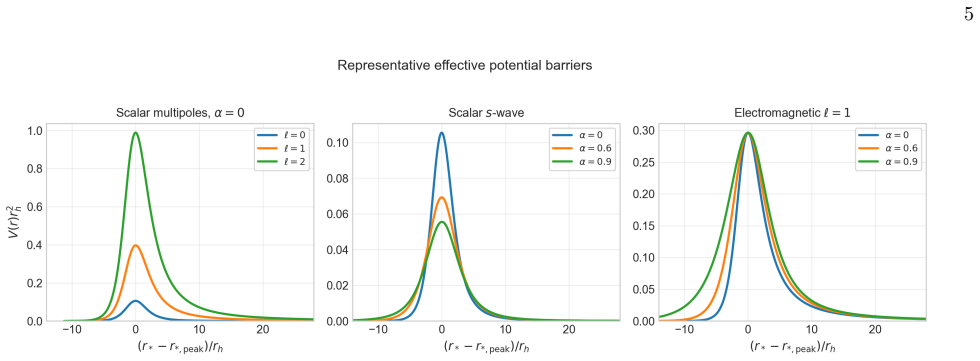
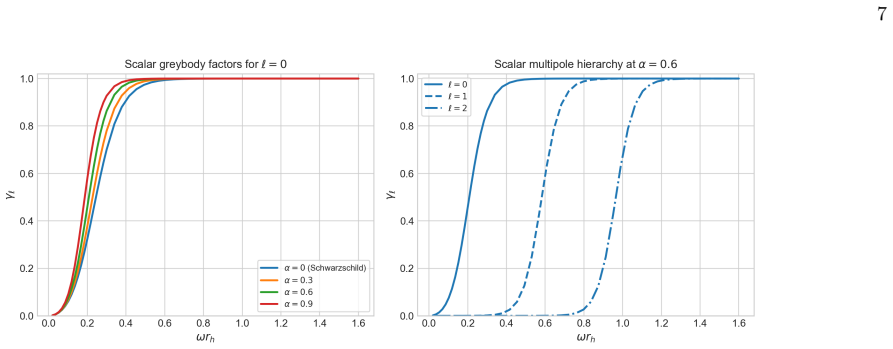
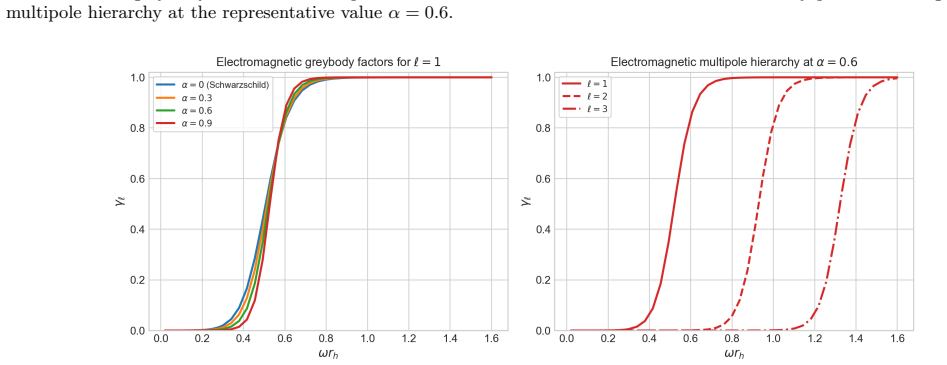
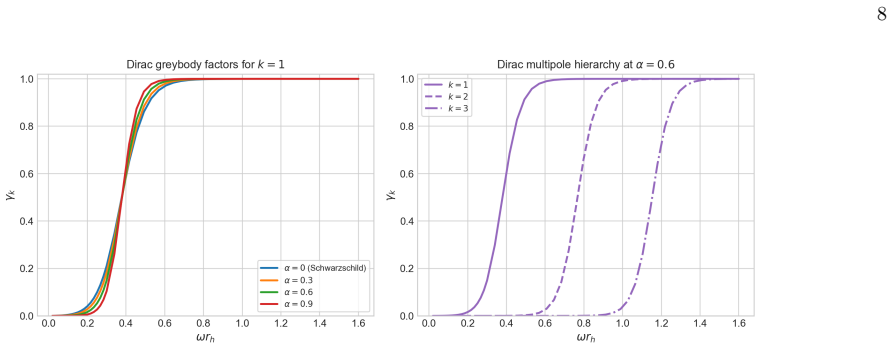
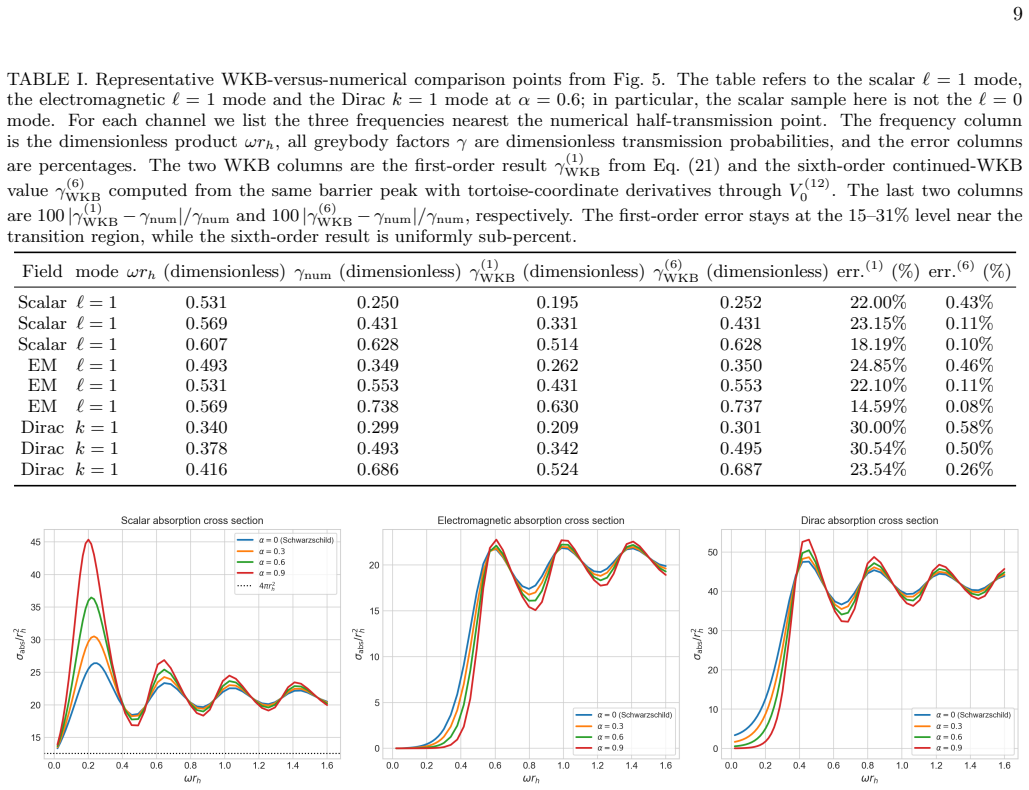
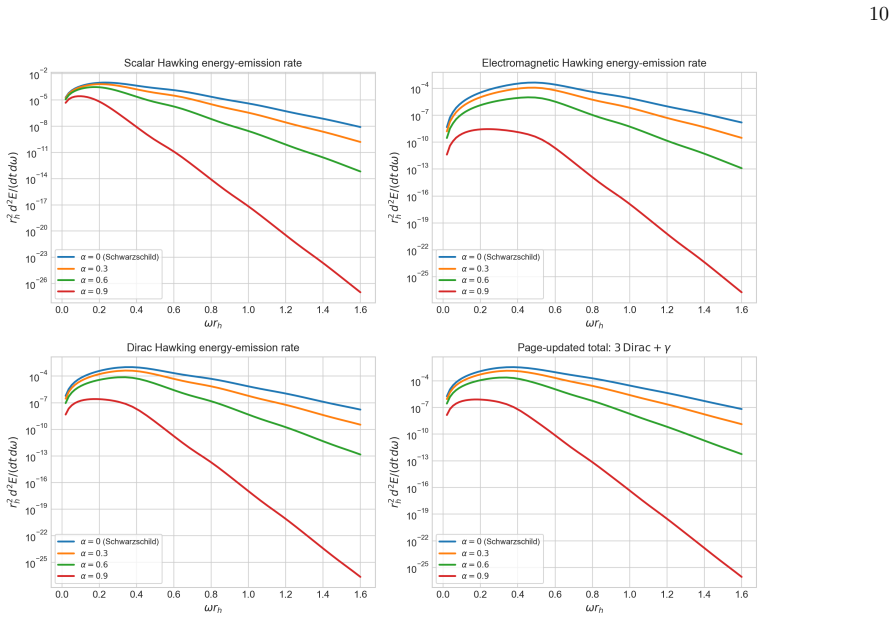
On the holonomy-corrected Schwarzschild geometry the scalar absorption cross section keeps its universal low-frequency limit while the electromagnetic cross section varies mainly in the infrared and the Dirac cross section acquires a strongly suppressed low-frequency tail; thermal suppression from the lowered temperature nevertheless dominates, so that the holonomy correction enhances low-lying scalar transmission but reduces total Hawking radiation, most strongly in the electromagnetic sector.
What carries the argument
The dimensionless holonomy parameter that deforms the Schwarzschild metric, together with direct numerical integration of the radial wave equations checked by first- and sixth-order WKB approximations.
If this is right
- The dominant scalar mode transmits more readily at low frequencies.
- The electromagnetic absorption cross section is altered chiefly in the infrared regime.
- The Dirac absorption cross section develops a strongly suppressed low-frequency tail.
- The electromagnetic sector experiences the strongest quenching while the fermionic sector becomes dominant once the holonomy parameter is appreciable.
Where Pith is reading between the lines
- Black-hole evaporation could proceed more slowly under such corrections, lengthening lifetimes compared with the classical case.
- The relative abundance of emitted particle species would shift, potentially altering the expected spectrum of Hawking radiation.
- The same numerical approach could be applied to rotating or charged holonomy-corrected metrics to test whether the differential quenching pattern persists.
Load-bearing premise
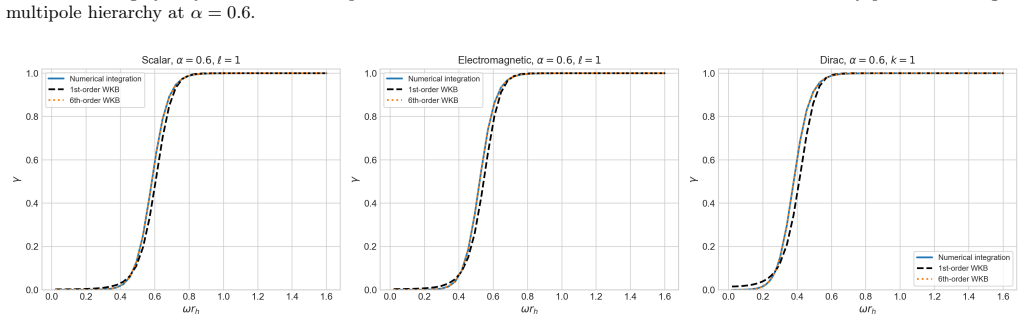
The chosen numerical scheme and WKB orders accurately capture the physical transmission coefficients without significant truncation or discretization error across the frequencies and holonomy values examined.
What would settle it
An explicit computation of the total Hawking emission rate for a fixed nonzero holonomy parameter that yields a higher rather than lower output than the classical Schwarzschild case would falsify the claim that thermal suppression dominates.
Figures
read the original abstract
We study greybody factors, absorption cross sections and Hawking energy-emission rates for minimally coupled massless scalar, electromagnetic and massless Dirac test fields on the loop-quantum-gravity-inspired holonomy-corrected Schwarzschild black hole. The geometry is controlled by a dimensionless holonomy parameter, and the radial wave equations are solved by direct numerical integration with first- and sixth-order WKB estimates as complementary checks. The scalar, electromagnetic and Dirac channels respond differently: the dominant scalar mode becomes more transparent, the electromagnetic threshold shifts slightly upward, and the dominant Dirac mode is only mildly modified. The scalar absorption cross section retains the universal low-frequency limit, the electromagnetic cross section changes mainly in the infrared, and the Dirac cross section develops a strongly suppressed low-frequency tail. Since the Hawking temperature falls monotonically, thermal suppression dominates the radiative output. Thus the holonomy correction enhances low-lying scalar transmission but suppresses Hawking radiation overall, with the electromagnetic sector most strongly quenched and the fermionic sector dominant once $\alpha$ is appreciable.
Editorial analysis
A structured set of objections, weighed in public.
Referee Report
Summary. The manuscript examines greybody factors, absorption cross sections, and Hawking radiation for massless scalar, electromagnetic, and Dirac fields on a holonomy-corrected Schwarzschild black hole controlled by a dimensionless parameter α. Radial wave equations are solved by direct numerical integration supplemented by first- and sixth-order WKB approximations. The holonomy correction is reported to enhance low-frequency scalar transmission, shift the electromagnetic threshold slightly upward, and mildly modify the dominant Dirac mode; overall Hawking radiation is suppressed due to the monotonic drop in temperature, with the electromagnetic sector most strongly quenched and the fermionic sector becoming dominant at appreciable α.
Significance. If the numerical results hold, the work supplies a concrete illustration of spin-dependent effects arising from loop-quantum-gravity-inspired metric corrections on black-hole emission spectra. The complementary use of direct integration and WKB estimates is a methodological strength that allows cross-validation of transmission coefficients. The finding that thermal suppression dominates transmission changes, together with the retention of the universal low-frequency scalar absorption limit, provides falsifiable predictions for how quantum-geometry parameters alter observable radiation.
major comments (2)
- [Abstract] Abstract (computational method paragraph): the central claims of scalar-mode enhancement, electromagnetic quenching, and fermionic dominance rest on numerical integration and WKB results, yet no convergence tests, error bars, frequency ranges, or quantitative validation of the integration scheme and WKB orders are supplied. This absence directly undermines in the reported suppression and channel-dominance statements.
- [Abstract] Abstract and methods description: the weakest assumption—that the chosen numerical scheme and WKB orders capture the physical transmission coefficients without significant truncation or discretization error—is load-bearing for all quantitative conclusions on α-dependent behavior, but remains untested in the supplied information.
Simulated Author's Rebuttal
We thank the referee for the careful reading and for highlighting the need for explicit validation of our numerical methods. The comments are well taken and point to a genuine gap in the presentation. We will revise the manuscript to include the requested details on convergence, error estimates, and frequency ranges.
read point-by-point responses
-
Referee: [Abstract] Abstract (computational method paragraph): the central claims of scalar-mode enhancement, electromagnetic quenching, and fermionic dominance rest on numerical integration and WKB results, yet no convergence tests, error bars, frequency ranges, or quantitative validation of the integration scheme and WKB orders are supplied. This absence directly undermines in the reported suppression and channel-dominance statements.
Authors: We agree that the absence of explicit convergence tests and error quantification weakens the presentation. In the revised manuscript we will add a new subsection (Methods, Numerical validation) that reports: (i) convergence of the direct integrator with respect to radial grid spacing and outer boundary location, (ii) comparison of transmission coefficients obtained with first- and sixth-order WKB against the numerical results, including relative differences as a function of frequency, and (iii) the precise frequency intervals over which each channel was integrated. These additions will be referenced from the abstract and results sections. revision: yes
-
Referee: [Abstract] Abstract and methods description: the weakest assumption—that the chosen numerical scheme and WKB orders capture the physical transmission coefficients without significant truncation or discretization error—is load-bearing for all quantitative conclusions on α-dependent behavior, but remains untested in the supplied information.
Authors: We accept that the current text does not demonstrate the magnitude of truncation or discretization errors. The revision will supply quantitative error measures (maximum relative discrepancy between numerical and WKB results, and between successive grid refinements) for representative values of α and for each spin. Where the two methods agree to within a stated tolerance, this will be stated explicitly; where they differ, the more conservative result will be adopted. This directly addresses the load-bearing assumption for the α-dependent claims. revision: yes
Circularity Check
No significant circularity in derivation chain
full rationale
The paper takes the holonomy-corrected Schwarzschild metric with dimensionless parameter α as an external input motivated by loop quantum gravity. It then directly integrates the radial wave equations for minimally coupled massless scalar, electromagnetic, and Dirac fields on this fixed background, supplementing with first- and sixth-order WKB checks, to obtain greybody factors, absorption cross sections, and Hawking emission rates. All reported quantities (transmission coefficients, cross sections, and thermal spectra) are computed outputs from these standard methods applied to the given metric; no parameters are fitted to the results themselves, no self-definitional relations appear, and no load-bearing steps rely on self-citations or uniqueness theorems from the authors' prior work. The derivation is therefore self-contained against external benchmarks.
Axiom & Free-Parameter Ledger
free parameters (1)
- holonomy parameter α
axioms (1)
- domain assumption The loop-quantum-gravity-inspired holonomy-corrected Schwarzschild metric provides a valid background geometry for test-field propagation.
Reference graph
Works this paper leans on
-
[1]
S. W. Hawking, Communications in Mathematical Physics43, 199 (1975)
1975
-
[2]
D. N. Page, Physical Review D13, 198 (1976). 11
1976
-
[3]
W. G. Unruh, Physical Review D14, 3251 (1976)
1976
-
[4]
S. R. Das, G. W. Gibbons, and S. D. Mathur, Physical Review Letters78, 417 (1997)
1997
-
[5]
Kanti, International Journal of Modern Physics A19, 4899 (2004)
P. Kanti, International Journal of Modern Physics A19, 4899 (2004)
2004
-
[6]
Kanti and E
P. Kanti and E. Winstanley, inQuantum Aspects of Black Holes, Fundamental Theories of Physics, Vol. 178, edited by X. Calmet (Springer, Cham, 2015) pp. 229–265
2015
-
[7]
R. A. Konoplya and A. Zhidenko, JCAP09, 068 (2024), arXiv:2406.11694 [gr-qc]
work page internal anchor Pith review Pith/arXiv arXiv 2024
- [8]
-
[9]
A. Alonso-Bardaji and D. Brizuela, European Physical Journal C81, 283 (2021), 2010.14437
-
[10]
Alonso-Bardaji and D
A. Alonso-Bardaji and D. Brizuela, Physical Review D 104, 084064 (2021)
2021
-
[11]
Alonso-Bardaji, D
A. Alonso-Bardaji, D. Brizuela, and R. Vera, Physics Letters B829, 137075 (2022)
2022
-
[12]
Alonso-Bardaji, D
A. Alonso-Bardaji, D. Brizuela, and R. Vera, Physical Review D106, 024035 (2022)
2022
-
[13]
Z. S. Moreira, H. C. D. Lima Junior, L. C. B. Crispino, and C. A. R. Herdeiro, Physical Review D107, 104016 (2023)
2023
-
[14]
S. V. Bolokhov, Phys. Rev. D110, 024010 (2024)
2024
-
[15]
Rinc´ on, A.¨Ovg¨ un, and R
´A. Rinc´ on, A.¨Ovg¨ un, and R. C. Pantig, Physics of the Dark Universe46, 101623 (2024)
2024
- [16]
- [17]
-
[18]
R. A. Konoplya and A. Zhidenko, Phys. Rev. D82, 084003 (2010), arXiv:1004.3772 [hep-th]
work page internal anchor Pith review Pith/arXiv arXiv 2010
- [19]
- [20]
-
[21]
Karmakar and U
R. Karmakar and U. D. Goswami, Phys. Scripta99, 055003 (2024)
2024
-
[22]
Skvortsova, Eur
M. Skvortsova, Eur. Phys. J. C85, 854 (2025)
2025
-
[23]
B. C. L¨ utf¨ uo˘ glu, J. Rayimbaev, S. Murodov, J. Kur- banov, and M. Matyoqubov, Annals Phys.491, 170514 (2026)
2026
- [24]
-
[25]
Z. Malik, Int. J. Grav. Theor. Phys.1, 6 (2025), arXiv:2509.15995 [gr-qc]
-
[26]
B. C. L¨ utf¨ uo˘ glu, Eur. Phys. J. C86, 39 (2026)
2026
-
[27]
Carter, Commun
B. Carter, Commun. Math. Phys.10, 280 (1968)
1968
-
[28]
R. A. Konoplya, Z. Stuchl´ ık, and A. Zhidenko, Phys. Rev. D97, 084044 (2018), arXiv:1801.07195 [gr-qc]
work page internal anchor Pith review Pith/arXiv arXiv 2018
-
[29]
D. R. Brill and J. A. Wheeler, Rev. Mod. Phys.29, 465 (1957)
1957
-
[30]
H. T. Cho, Phys. Rev. D68, 024003 (2003)
2003
-
[31]
Kanti, R
P. Kanti, R. A. Konoplya, and A. Zhidenko, Phys. Rev. D74, 064008 (2006)
2006
-
[32]
Jing, Phys
J.-l. Jing, Phys. Rev. D69, 084009 (2004)
2004
-
[33]
J. Tan, (2026), arXiv:2605.09756 [gr-qc]
work page internal anchor Pith review Pith/arXiv arXiv 2026
-
[34]
B. F. Schutz and C. M. Will, The Astrophysical Journal Letters291, L33 (1985)
1985
-
[35]
Iyer and C
S. Iyer and C. M. Will, Physical Review D35, 3621 (1987)
1987
-
[36]
R. A. Konoplya, A. Zhidenko, and A. F. Zinhailo, Class. Quant. Grav.36, 155002 (2019), arXiv:1904.10333
work page internal anchor Pith review Pith/arXiv arXiv 2019
- [37]
-
[38]
S. V. Bolokhov, Phys. Lett. B856, 138879 (2024)
2024
-
[39]
S. V. Bolokhov, (2026), arXiv:2605.21533 [gr-qc]
work page internal anchor Pith review Pith/arXiv arXiv 2026
- [40]
- [41]
-
[42]
B. C. L¨ utf¨ uo˘ glu, Eur. Phys. J. C85, 630 (2025)
2025
-
[43]
S. V. Bolokhov, Eur. Phys. J. C84, 634 (2024)
2024
-
[44]
Bolokhov, Eur
S. Bolokhov, Eur. Phys. J. C85, 1166 (2025)
2025
-
[45]
R. A. Konoplya and E. Abdalla, Phys. Rev. D71, 084015 (2005), arXiv:hep-th/0503029
work page internal anchor Pith review Pith/arXiv arXiv 2005
-
[46]
J. P. Arbelaez, JCAP05, 043 (2026)
2026
-
[47]
Scalar field evolution in Gauss-Bonnet black holes
E. Abdalla, R. A. Konoplya, and C. Molina, Phys. Rev. D72, 084006 (2005), arXiv:hep-th/0507100
work page internal anchor Pith review Pith/arXiv arXiv 2005
-
[48]
R. A. Konoplya and A. Zhidenko, Phys. Lett. B648, 236 (2007), arXiv:hep-th/0611226
work page internal anchor Pith review Pith/arXiv arXiv 2007
-
[49]
Fernando, Gen
S. Fernando, Gen. Rel. Grav.48, 24 (2016)
2016
-
[50]
Wongjun, C.-H
P. Wongjun, C.-H. Chen, and R. Nakarachinda, Phys. Rev. D101, 124033 (2020)
2020
-
[51]
Malik, Int
Z. Malik, Int. J. Theor. Phys.63, 128 (2024)
2024
-
[52]
Malik, Grav
Z. Malik, Grav. Cosmol.32, 122 (2026)
2026
- [53]
-
[54]
B. C. L¨ utf¨ uo˘ glu, J. Rayimbaev, S. Murodov, J. Kur- banov, and M. Matyoqubov, (2026), arXiv:2605.11364 [gr-qc]
work page internal anchor Pith review Pith/arXiv arXiv 2026
- [55]
- [56]
- [57]
-
[58]
S. V. Bolokhov, (2026), arXiv:2605.11013 [gr-qc]
work page internal anchor Pith review Pith/arXiv arXiv 2026
- [59]
-
[60]
M. Skvortsova, (2026), arXiv:2605.12113 [gr-qc]
work page internal anchor Pith review Pith/arXiv arXiv 2026
-
[61]
M. Skvortsova, (2026), arXiv:2604.25471 [gr-qc]
work page internal anchor Pith review Pith/arXiv arXiv 2026
-
[62]
M. Skvortsova, Fortsch. Phys.72, 2400036 (2024), arXiv:2311.11650 [gr-qc]
-
[63]
D. S. Eniceicu and M. Reece, Phys. Rev. D102, 044015 (2020)
2020
-
[64]
Z. Stuchl´ ık and A. Zhidenko, arXiv e-prints (2025), arXiv:2506.09829 [gr-qc]
-
[65]
K. D. Kokkotas, R. A. Konoplya, and A. Zhidenko, Phys. Rev. D83, 024031 (2011), arXiv:1011.1843 [gr-qc]
work page internal anchor Pith review Pith/arXiv arXiv 2011
-
[66]
Evolution of perturbations of squashed Kaluza-Klein black holes: escape from instability
H. Ishihara, M. Kimura, R. A. Konoplya, K. Murata, J. Soda, and A. Zhidenko, Phys. Rev. D77, 084019 (2008), arXiv:0802.0655 [hep-th]
work page internal anchor Pith review Pith/arXiv arXiv 2008
- [67]
-
[68]
R. A. Konoplya and A. Zhidenko, Phys. Lett. B686, 199 (2010), arXiv:0909.2138 [hep-th]
work page internal anchor Pith review Pith/arXiv arXiv 2010
-
[69]
Matyjasek and M
J. Matyjasek and M. Opala, Phys. Rev. D96, 024011 (2017)
2017
-
[70]
Matyjasek and M
J. Matyjasek and M. Telecka, Phys. Rev. D100, 124006 (2019)
2019
-
[71]
J. Matyjasek, R. A. Konoplya, and A. Zhidenko, Int. J. Grav. Theor. Phys.2, 5 (2026), arXiv:2603.12466 [gr-qc]. 12
- [72]
-
[73]
R. A. Konoplya and A. Zhidenko, Phys. Rev. D95, 104005 (2017), arXiv:1701.01652 [hep-th]
work page internal anchor Pith review Pith/arXiv arXiv 2017
-
[74]
M. A. Cuyubamba, R. A. Konoplya, and A. Zhidenko, Phys. Rev. D93, 104053 (2016), arXiv:1604.03604
work page internal anchor Pith review Pith/arXiv arXiv 2016
-
[75]
Takahashi and J
T. Takahashi and J. Soda, Prog. Theor. Phys.124, 711 (2010)
2010
-
[76]
Dotti and R
G. Dotti and R. J. Gleiser, Class. Quant. Grav.22, L1 (2005)
2005
-
[77]
L. C. B. Crispino, E. S. Oliveira, A. Higuchi, and G. E. A. Matsas, Physical Review D75, 104012 (2007)
2007
-
[78]
S. V. Bolokhov, Phys. Rev. D109, 064017 (2024)
2024
-
[79]
Skvortsova, EPL149, 59001 (2025)
M. Skvortsova, EPL149, 59001 (2025)
2025
-
[80]
Skvortsova, Fortsch
M. Skvortsova, Fortsch. Phys.72, 2400132 (2024)
2024
discussion (0)
Sign in with ORCID, Apple, or X to comment. Anyone can read and Pith papers without signing in.