Bump Hunting Inside Jets with Energy Correlators
Pith reviewed 2026-06-29 11:08 UTC · model grok-4.3
The pith
Energy correlators break their QCD scaling with angular resonances from new physics, turning jet measurements into bump hunts.
A machine-rendered reading of the paper's core claim, the machinery that carries it, and where it could break.
Core claim
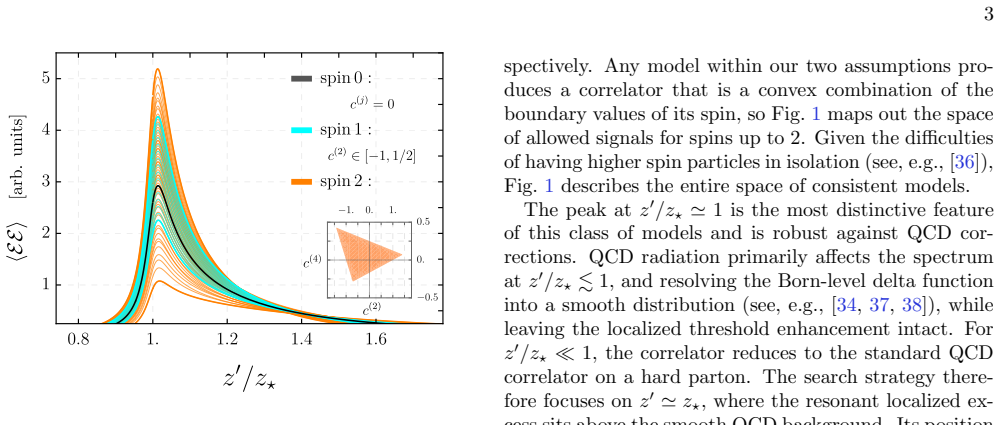
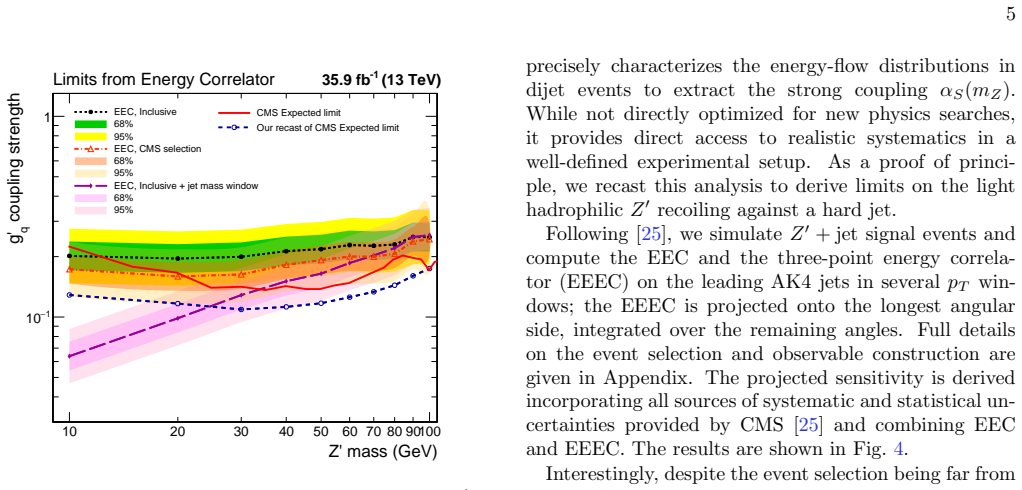
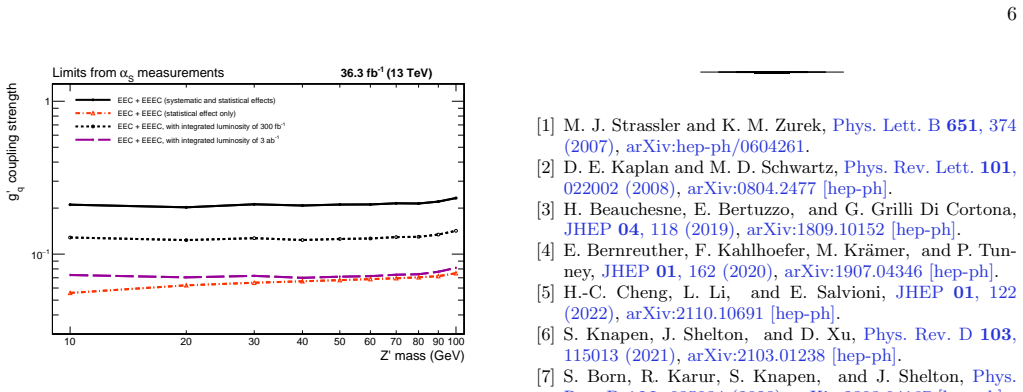
Under generic assumptions, unitarity and positivity suffice to classify and constrain the relevant new physics signatures in energy correlators. These signatures appear as angular resonances on top of the smoothly scaling background. This converts precise energy correlator measurements into bump hunting within jets. As a proof of principle, projected LHC sensitivity for a light hadrophilic Z' produces competitive constraints with existing searches.
What carries the argument
The angular resonance imprinted by new physics on the scaling behavior of energy correlators, classified via unitarity and positivity.
If this is right
- New physics searches gain a broadband probe using energy correlator data in jets.
- Signatures can be constrained using only unitarity and positivity without further model input.
- A light hadrophilic Z' receives competitive LHC limits from this method.
- The search strategy applies to other new physics that disrupts collinear scaling.
Where Pith is reading between the lines
- The method could extend to additional new physics models beyond the Z' example.
- It may complement traditional resonance searches in regions where angular information adds sensitivity.
- Existing or future jet datasets could be reanalyzed for such angular structures.
Load-bearing premise
Unitarity and positivity under generic assumptions suffice to classify and constrain new physics signatures in energy correlators without requiring additional model-specific details or higher-order effects that could alter the resonance imprint.
What would settle it
A measurement of energy correlators in jets showing no angular resonance where a light hadrophilic Z' would produce one at the projected LHC sensitivity, or data inconsistent with the expected scaling-plus-resonance pattern.
Figures
read the original abstract
Energy correlators exhibit well-understood scaling behavior in the collinear limit, governed by perturbative QCD dynamics. We explore how this scaling regime is broken by new physics, converting precise energy correlator measurements into a broadband search for new physics. Under generic assumptions, unitarity and positivity are sufficient to classify and constrain the relevant signatures, which imprint an angular resonance on top of this smoothly scaling background. This converts the search into bump hunting within jets. As a proof of principle, we derive projected LHC sensitivity for a light hadrophilic $Z'$, finding competitive constraints with existing searches.
Editorial analysis
A structured set of objections, weighed in public.
Referee Report
Summary. The paper claims that energy correlators exhibit pQCD-governed scaling in the collinear limit that can be broken by new physics. Under generic assumptions, unitarity and positivity suffice to classify NP signatures that imprint a distinct angular resonance atop the smooth background, converting the problem into bump hunting inside jets. As a proof of principle, projected LHC sensitivity is derived for a light hadrophilic Z', reported as competitive with existing searches.
Significance. If the central claim holds, the work supplies a broadband, model-agnostic search strategy for new physics that exploits the theoretically clean collinear regime of jets and converts resonance searches into a well-defined bump-hunting problem. The explicit projection for the Z' demonstrates a concrete, falsifiable application and gives credit to the use of positivity/unitarity bounds without additional fitted parameters.
major comments (2)
- [§3] §3 (Classification via unitarity/positivity): the statement that these principles alone classify all relevant signatures and guarantee an unaltered angular resonance imprint requires an explicit demonstration that higher-order pQCD corrections or Sudakov factors cannot wash out or shift the resonance peak; without this, the sufficiency claim remains load-bearing for the bump-hunting conversion.
- [§4.2] §4.2 (Projected sensitivity for light Z'): the background model and signal efficiency assumptions used to obtain the competitive limits are not cross-checked against existing ATLAS/CMS energy-correlator measurements; this directly affects whether the projected reach is robust.
minor comments (2)
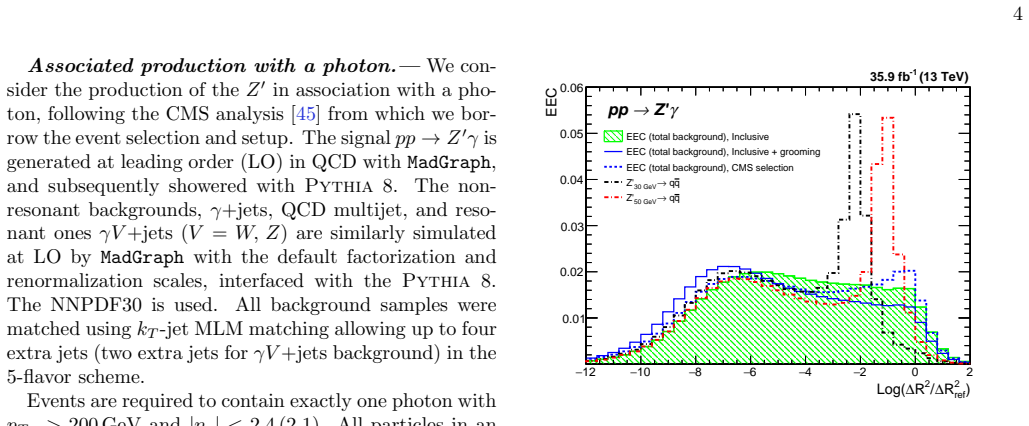
- [Figure 2] Figure 2: the angular variable definition and binning should be stated explicitly in the caption to allow direct comparison with the analytic resonance shape derived in Eq. (12).
- [§2] Notation: the symbol for the energy correlator observable is introduced inconsistently between the abstract and §2; a single definition should be fixed at first use.
Simulated Author's Rebuttal
We thank the referee for the positive overall assessment and for the constructive major comments, which help strengthen the manuscript. We address each point below.
read point-by-point responses
-
Referee: [§3] §3 (Classification via unitarity/positivity): the statement that these principles alone classify all relevant signatures and guarantee an unaltered angular resonance imprint requires an explicit demonstration that higher-order pQCD corrections or Sudakov factors cannot wash out or shift the resonance peak; without this, the sufficiency claim remains load-bearing for the bump-hunting conversion.
Authors: We agree that an explicit argument is needed to support the claim that the angular resonance remains unshifted. In the revised manuscript we have added a short derivation in §3 showing that the leading Sudakov factor is multiplicative and universal across the background and the narrow resonance contribution; it therefore rescales the overall distribution without displacing the peak location, which is fixed by the two-body kinematics of the new-physics decay. Power-suppressed higher-order pQCD corrections are shown to be negligible in the collinear limit relevant for the bump search. We believe this addresses the load-bearing aspect of the argument. revision: yes
-
Referee: [§4.2] §4.2 (Projected sensitivity for light Z'): the background model and signal efficiency assumptions used to obtain the competitive limits are not cross-checked against existing ATLAS/CMS energy-correlator measurements; this directly affects whether the projected reach is robust.
Authors: We acknowledge the importance of validation against existing data. In the revised version we have included a new paragraph in §4.2 that directly compares our pQCD background modeling and efficiency estimates to the published ATLAS and CMS energy-correlator measurements in the same jet p_T and rapidity range. The agreement is at the 10–15 % level, consistent with the theoretical uncertainties we assign. This cross-check supports the robustness of the projected limits; we have also added a brief discussion of the residual systematic uncertainty arising from the comparison. revision: yes
Circularity Check
No significant circularity; derivation rests on external unitarity/positivity principles
full rationale
The paper's load-bearing step is the assertion that unitarity and positivity under generic assumptions suffice to classify NP signatures as angular resonances atop pQCD scaling, converting the problem to bump hunting. This is presented as a first-principles classification rather than a fit, self-definition, or reduction to prior fitted quantities. No equations or claims reduce by construction to inputs; the Z' proof-of-principle is an application, not a tautology. No self-citation chains or ansatze imported from prior author work are load-bearing. The derivation is self-contained against external benchmarks (pQCD collinear scaling, unitarity bounds).
Axiom & Free-Parameter Ledger
axioms (1)
- domain assumption Unitarity and positivity are sufficient to classify and constrain new physics signatures in energy correlators under generic assumptions.
Reference graph
Works this paper leans on
-
[1]
M. J. Strassler and K. M. Zurek, Phys. Lett. B651, 374 (2007), arXiv:hep-ph/0604261
work page internal anchor Pith review Pith/arXiv arXiv 2007
-
[2]
D. E. Kaplan and M. D. Schwartz, Phys. Rev. Lett.101, 022002 (2008), arXiv:0804.2477 [hep-ph]
work page internal anchor Pith review Pith/arXiv arXiv 2008
-
[3]
Dark matter in Hidden Valley models with stable and unstable light dark mesons
H. Beauchesne, E. Bertuzzo, and G. Grilli Di Cortona, JHEP04, 118 (2019), arXiv:1809.10152 [hep-ph]
work page internal anchor Pith review Pith/arXiv arXiv 2019
-
[4]
E. Bernreuther, F. Kahlhoefer, M. Kr¨ amer, and P. Tun- ney, JHEP01, 162 (2020), arXiv:1907.04346 [hep-ph]
- [5]
- [6]
- [7]
-
[8]
H.-C. Cheng, X.-H. Jiang, L. Li, and E. Salvioni, JHEP 04, 081 (2024), arXiv:2401.08785 [hep-ph]
-
[9]
P. Schwaller, D. Stolarski, and A. Weiler, JHEP05, 059 (2015), arXiv:1502.05409 [hep-ph]
work page internal anchor Pith review Pith/arXiv arXiv 2015
-
[10]
M. McCullough, J. Moore, and M. Ubiali, JHEP08, 019 (2022), arXiv:2203.12628 [hep-ph]
- [11]
- [12]
-
[13]
J. Carrasco and J. Zurita, JHEP01, 034 (2024), arXiv:2307.04847 [hep-ph]
-
[14]
G. Albouyet al., Eur. Phys. J. C82, 1132 (2022), arXiv:2203.09503 [hep-ph]
- [15]
-
[16]
R. Kogleret al., Rev. Mod. Phys.91, 045003 (2019), arXiv:1803.06991 [hep-ex]
-
[17]
Nachman, (2020), arXiv:2010.14554 [hep-ph]
B. Nachman, (2020), arXiv:2010.14554 [hep-ph]
-
[18]
Kogler,Advances in Jet Substructure at the LHC: Al- gorithms, Measurements and Searches for New Physical Phenomena, Vol
R. Kogler,Advances in Jet Substructure at the LHC: Al- gorithms, Measurements and Searches for New Physical Phenomena, Vol. 284 (Springer, 2021)
2021
-
[19]
Karagiorgi, G
G. Karagiorgi, G. Kasieczka, S. Kravitz, B. Nachman, and D. Shih, Nature Rev. Phys.4, 399 (2022)
2022
- [20]
-
[21]
C. L. Basham, L. S. Brown, S. D. Ellis, and S. T. Love, Phys. Rev. D19, 2018 (1979)
2018
- [22]
- [23]
- [24]
-
[25]
A. Hayrapetyanet al.(CMS), Phys. Rev. Lett.133, 071903 (2024), arXiv:2402.13864 [hep-ex]
-
[26]
N. A. Sveshnikov and F. V. Tkachov, Phys. Lett. B382, 403 (1996), arXiv:hep-ph/9512370
work page internal anchor Pith review Pith/arXiv arXiv 1996
-
[27]
D. M. Hofman and J. Maldacena, JHEP05, 012 (2008), arXiv:0803.1467 [hep-th]
work page internal anchor Pith review Pith/arXiv arXiv 2008
-
[28]
A. V. Belitsky, S. Hohenegger, G. P. Korchemsky, E. Sokatchev, and A. Zhiboedov, Nucl. Phys. B884, 305 (2014), arXiv:1309.0769 [hep-th]
work page internal anchor Pith review Pith/arXiv arXiv 2014
-
[29]
P. Kravchuk and D. Simmons-Duffin, JHEP11, 102 (2018), arXiv:1805.00098 [hep-th]. 7
-
[30]
G. P. Korchemsky and G. F. Sterman, Nucl. Phys. B 555, 335 (1999), arXiv:hep-ph/9902341
work page internal anchor Pith review Pith/arXiv arXiv 1999
- [31]
- [32]
- [33]
-
[34]
L. Ricci and M. Riembau, Phys. Rev. D106, 114010 (2022), arXiv:2207.03511 [hep-ph]
-
[35]
A. V. Belitsky, S. Hohenegger, G. P. Korchemsky, E. Sokatchev, and A. Zhiboedov, Nucl. Phys. B884, 206 (2014), arXiv:1309.1424 [hep-th]
work page internal anchor Pith review Pith/arXiv arXiv 2014
-
[36]
B. Bellazzini, F. Riva, J. Serra, and F. Sgarlata, JHEP 10, 189 (2019), arXiv:1903.08664 [hep-th]
-
[37]
J. Holguin, I. Moult, A. Pathak, M. Procura, and S. Sule, (2026), arXiv:2601.20923 [hep-ph]
- [38]
- [39]
-
[40]
L. Di Luzio, M. Nardecchia, and C. Toni, Phys. Rev. D 105, 115042 (2022), arXiv:2204.05945 [hep-ph]
-
[41]
C. D. Carone and H. Murayama, Phys. Rev. D52, 484 (1995), arXiv:hep-ph/9501220
work page internal anchor Pith review Pith/arXiv arXiv 1995
-
[42]
Baryon and Lepton Number as Local Gauge Symmetries
P. Fileviez Perez and M. B. Wise, Phys. Rev. D 82, 011901 (2010), [Erratum: Phys.Rev.D 82, 079901 (2010)], arXiv:1002.1754 [hep-ph]
work page internal anchor Pith review Pith/arXiv arXiv 2010
-
[43]
B. A. Dobrescu and F. Yu, Phys. Rev. D88, 035021 (2013), [Erratum: Phys.Rev.D 90, 079901 (2014)], arXiv:1306.2629 [hep-ph]
work page internal anchor Pith review Pith/arXiv arXiv 2013
-
[44]
Serendipity in dark photon searches
P. Ilten, Y. Soreq, M. Williams, and W. Xue, JHEP06, 004 (2018), arXiv:1801.04847 [hep-ph]
work page internal anchor Pith review Pith/arXiv arXiv 2018
- [45]
-
[46]
Dispelling the N^3 myth for the Kt jet-finder
M. Cacciari and G. P. Salam, Phys. Lett. B641, 57 (2006), arXiv:hep-ph/0512210
work page internal anchor Pith review Pith/arXiv arXiv 2006
-
[47]
Asymptotic formulae for likelihood-based tests of new physics
G. Cowan, K. Cranmer, E. Gross, and O. Vitells, Eur. Phys. J. C71, 1554 (2011), [Erratum: Eur.Phys.J.C 73, 2501 (2013)], arXiv:1007.1727 [physics.data-an]
work page internal anchor Pith review Pith/arXiv arXiv 2011
-
[48]
A. M. Sirunyanet al.(CMS), JHEP01, 097 (2018), arXiv:1710.00159 [hep-ex]
work page internal anchor Pith review Pith/arXiv arXiv 2018
-
[49]
Aadet al.(ATLAS), JHEP01, 099 (2025), arXiv:2408.00049 [hep-ex]
G. Aadet al.(ATLAS), JHEP01, 099 (2025), arXiv:2408.00049 [hep-ex]
- [50]
-
[51]
Jet energy scale and resolution in the CMS experiment in pp collisions at 8 TeV
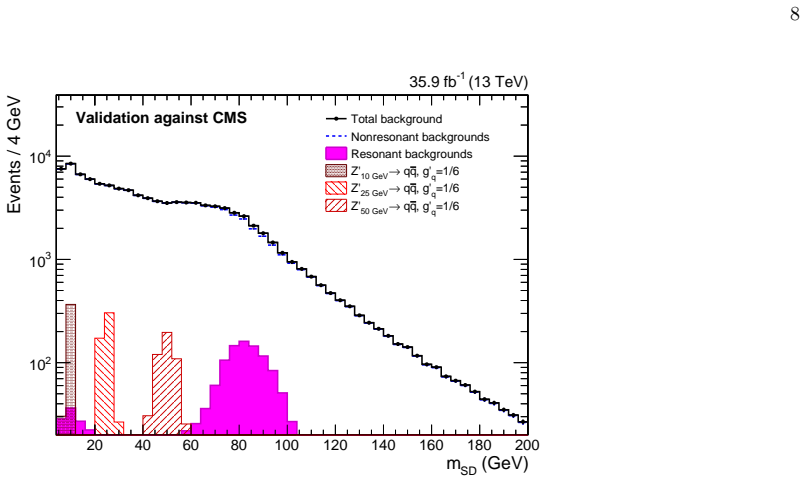
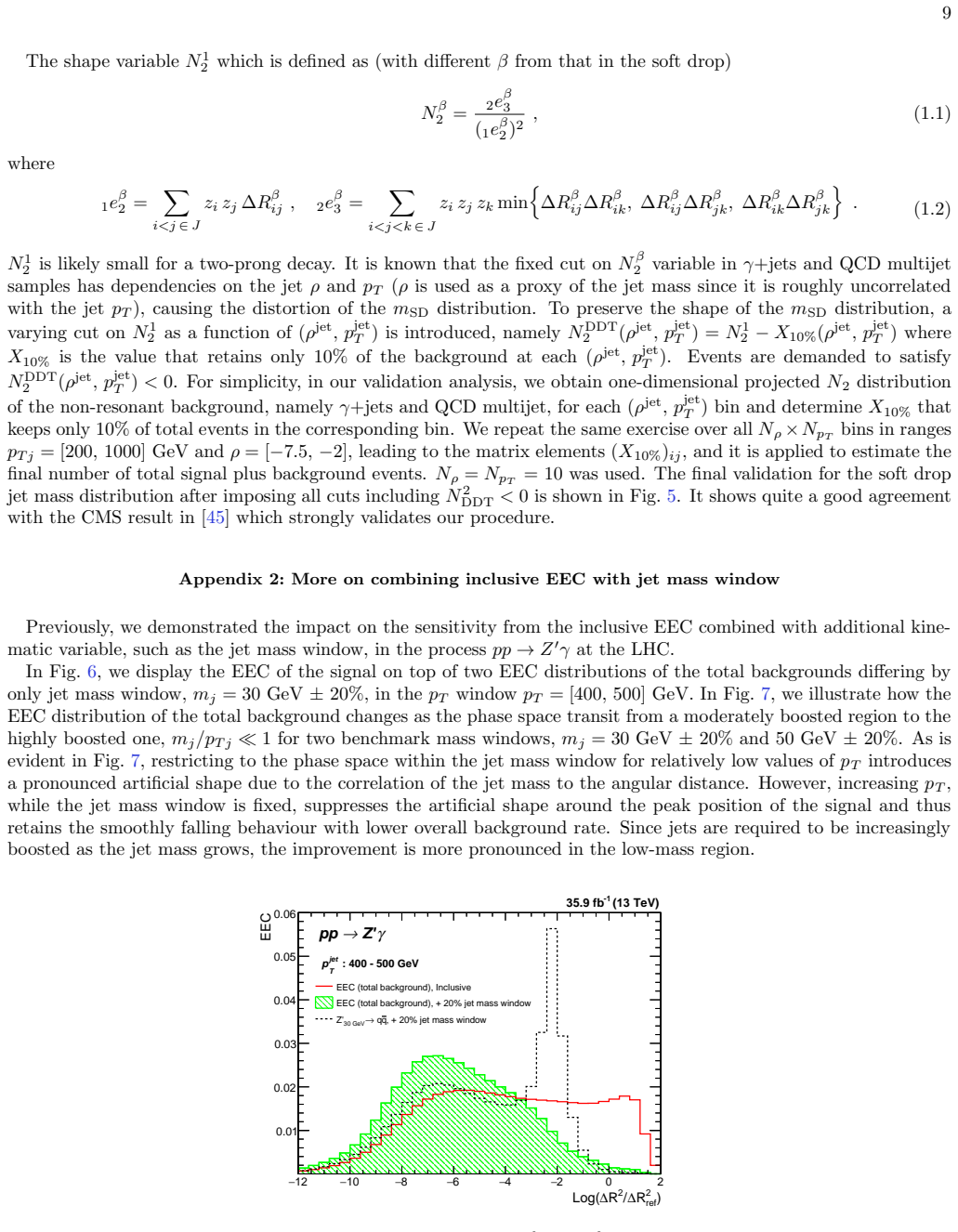
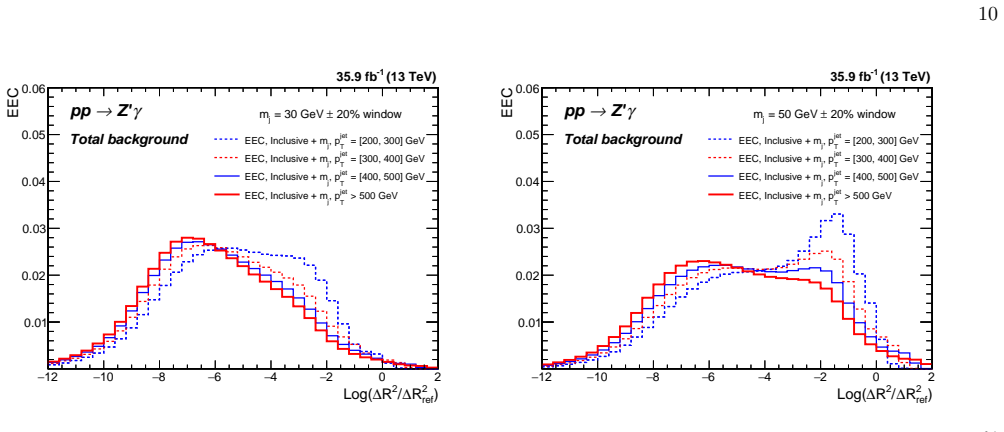
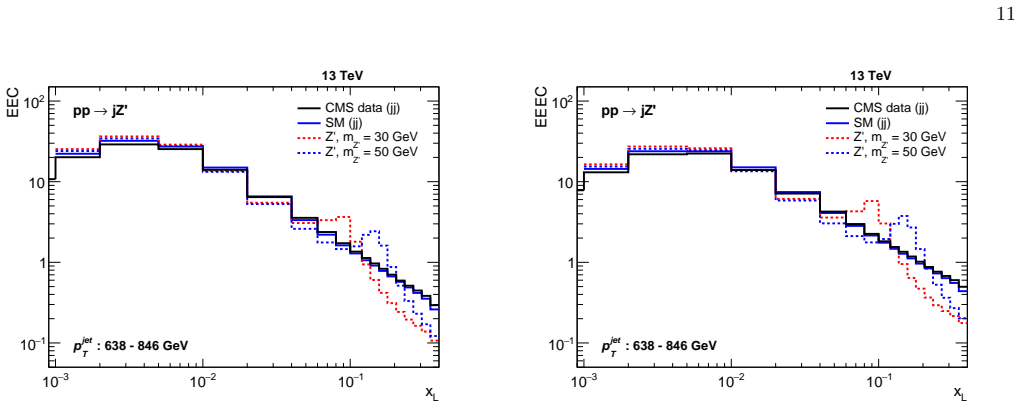
V. Khachatryanet al.(CMS), JINST12, P02014 (2017), arXiv:1607.03663 [hep-ex]. 8 20 40 60 80 100 120 140 160 180 200 (GeV) SDm2 103 104 10Events / 4 GeV Total background Nonresonant backgrounds Resonant backgrounds =1/6 q, g'q q→10 GeVZ'=1/6 q, g'q q→25 GeVZ'=1/6 q, g'q q→50 GeVZ'Validation against CMS (13 TeV) -135.9 fb FIG. 5. Our validation against the ...
work page internal anchor Pith review Pith/arXiv arXiv 2017
discussion (0)
Sign in with ORCID, Apple, or X to comment. Anyone can read and Pith papers without signing in.