Bootstrapping the Four-Point NMHV Stress-Tensor Form Factor
Pith reviewed 2026-06-29 10:29 UTC · model grok-4.3
The pith
The three-loop symbol of the four-point NMHV stress-tensor form factor is uniquely fixed by an 88-letter alphabet plus physical constraints.
A machine-rendered reading of the paper's core claim, the machinery that carries it, and where it could break.
Core claim
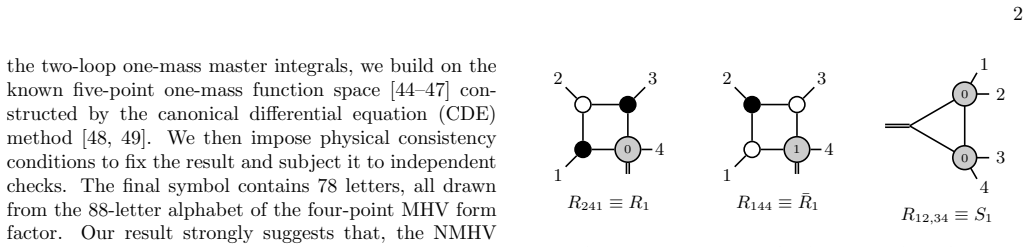
We bootstrap the four-point NMHV form factor through three loops at the symbol level. At two loops the ansatz built from NMHV leading singularities and the relevant five-point one-mass integral function space is fixed uniquely by physical constraints, producing a ratio-function symbol that contains 78 letters all drawn from the 88-letter alphabet identified in the MHV sector. At three loops the same 88-letter alphabet is used as input; imposing extended Steinmann relations satisfied by the minimally-subtracted hard function together with other physical constraints determines the three-loop symbol uniquely. Both results pass soft, double-soft and DDCI checks and support the universality of th
What carries the argument
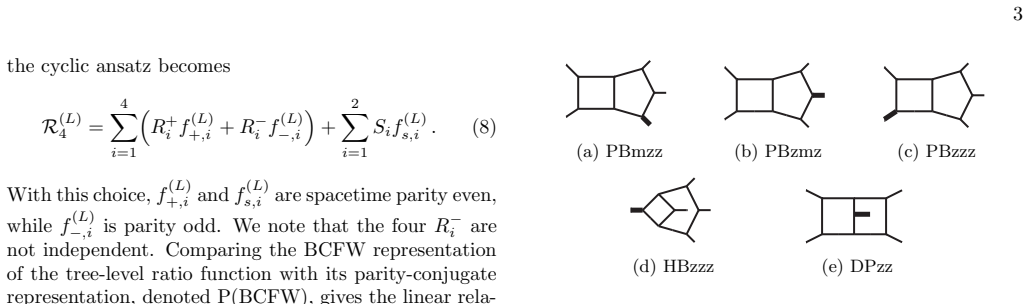
The 88-letter alphabet from the MHV sector, together with an ansatz from NMHV leading singularities and five-point one-mass integrals, fixed by extended Steinmann relations and soft/DDCI constraints.
If this is right
- The NMHV ratio function is now known at symbol level through three loops.
- The 88-letter alphabet governs both MHV and NMHV four-point form factors.
- Extended Steinmann relations plus soft and DDCI constraints suffice to fix the three-loop symbol.
- This supplies the first concrete multi-loop non-MHV form-factor data for further checks.
Where Pith is reading between the lines
- If the alphabet remains universal at higher loops, all four-point form factors may be determined by the same finite set of letters without new transcendental structures.
- The bootstrap procedure could be applied to five-point form factors once an analogous alphabet is identified.
- Comparing the symbol against a four-loop integrand computation would test whether the constraints remain sufficient.
Load-bearing premise
The chosen ansatz space plus the listed constraints are assumed to be complete, with no independent terms left unfixed.
What would settle it
An independent calculation that produces a three-loop symbol coefficient outside the space fixed by the bootstrap, or a mismatch with a direct integrand construction at the same order, would show the determination is not unique.
Figures
read the original abstract
We bootstrap the four-point next-to-maximally helicity-violating (NMHV) form factor of the chiral stress-tensor supermultiplet in planar maximally supersymmetric Yang-Mills theory through three loops at the symbol level. At two loops, an ansatz built from NMHV leading singularities and the relevant five-point one-mass integral function space is fixed uniquely by physical constraints; the resulting ratio function symbol contains 78 letters, all drawn from the 88-letter alphabet previously identified in the four-point MHV sector. At three loops, using this 88-letter alphabet as input and imposing extended Steinmann relations satisfied by the minimally-subtracted hard function, together with other physical constraints, we determine the three-loop symbol uniquely. Both results pass soft, double-soft and directional dual conformal invariance (DDCI) checks, provide the first multi-loop non-MHV form-factor data, and support the universality of the 88-letter alphabet for four-point form factors beyond the MHV sector.
Editorial analysis
A structured set of objections, weighed in public.
Referee Report
Summary. The paper bootstraps the four-point NMHV stress-tensor form factor in planar N=4 SYM through three loops at the symbol level. At two loops an ansatz constructed from NMHV leading singularities and the five-point one-mass integral space is fixed uniquely by physical constraints, producing a 78-letter symbol drawn from the 88-letter MHV alphabet. At three loops the same 88-letter alphabet is used as input; imposing extended Steinmann relations on the minimally-subtracted hard function together with soft, double-soft and DDCI constraints determines the symbol uniquely. Both results pass the listed physical checks and are presented as the first multi-loop non-MHV form-factor data.
Significance. If the uniqueness claims hold, the work supplies the first three-loop NMHV form-factor symbol and furnishes concrete evidence that the 88-letter alphabet identified in the MHV sector extends to the NMHV sector. The systematic use of extended Steinmann relations, DDCI and soft limits as constraining data is a methodological strength that aligns with successful bootstrap programs in the field.
major comments (2)
- [Abstract] Abstract (three-loop determination paragraph): the assertion that the symbol is fixed uniquely rests on the twin assumptions that (i) the ansatz built from NMHV leading singularities and the five-point one-mass integral function space spans the full relevant space and (ii) the extended Steinmann relations plus soft/DDCI constraints are complete enough to reduce the coefficient space to a single solution. No a-priori dimension count of the unconstrained ansatz or explicit demonstration that no other 88-letter symbols satisfy the same relations is supplied, rendering the uniqueness claim dependent on unverified completeness.
- [Abstract] Abstract (two-loop ansatz paragraph): the two-loop symbol is stated to be fixed uniquely, yet the manuscript provides neither the initial dimension of the ansatz space nor the explicit reduction steps under the physical constraints, making it impossible to verify that the constraints are sufficient rather than merely consistent with a particular solution.
minor comments (2)
- A table listing the dimension of the ansatz space before and after each class of constraints (Steinmann, soft, DDCI) at both two and three loops would make the uniqueness argument transparent and should be added.
- [Abstract] The precise definition of the 'minimally-subtracted hard function' on which the extended Steinmann relations are imposed is referenced but not restated; a short reminder in the main text would improve readability.
Simulated Author's Rebuttal
We thank the referee for their careful reading and constructive feedback on our manuscript. We address the two major comments on the uniqueness claims below. We agree that additional explicit details on ansatz dimensions and reduction steps will improve verifiability and will incorporate them in the revised version.
read point-by-point responses
-
Referee: [Abstract] Abstract (three-loop determination paragraph): the assertion that the symbol is fixed uniquely rests on the twin assumptions that (i) the ansatz built from NMHV leading singularities and the five-point one-mass integral function space spans the full relevant space and (ii) the extended Steinmann relations plus soft/DDCI constraints are complete enough to reduce the coefficient space to a single solution. No a-priori dimension count of the unconstrained ansatz or explicit demonstration that no other 88-letter symbols satisfy the same relations is supplied, rendering the uniqueness claim dependent on unverified completeness.
Authors: The three-loop ansatz is assembled from the full set of NMHV leading singularities together with the five-point one-mass integral basis, which by construction spans the space of functions with the appropriate analytic properties at this loop order. The extended Steinmann relations on the minimally-subtracted hard function, combined with soft, double-soft and DDCI constraints, are then imposed; the resulting linear system reduces to a unique solution. We acknowledge that the abstract does not quote the initial dimension of this ansatz or the step-by-step reduction. In the revised manuscript we will state the dimension of the unconstrained three-loop ansatz and outline the successive reductions under each class of constraints. revision: yes
-
Referee: [Abstract] Abstract (two-loop ansatz paragraph): the two-loop symbol is stated to be fixed uniquely, yet the manuscript provides neither the initial dimension of the ansatz space nor the explicit reduction steps under the physical constraints, making it impossible to verify that the constraints are sufficient rather than merely consistent with a particular solution.
Authors: The two-loop ansatz is likewise built from the complete NMHV leading-singularity basis and the five-point one-mass integrals. Physical constraints (Steinmann relations, soft limits and DDCI) fix the coefficients uniquely. The manuscript text describes the construction and the final result but does not tabulate the starting dimension or the reduction sequence. We will add these explicit counts and reduction steps to the revised manuscript so that readers can directly verify that the constraints are sufficient. revision: yes
Circularity Check
No significant circularity; derivation uses independent constraints on external alphabet
full rationale
The paper builds a two-loop ansatz from NMHV leading singularities and five-point one-mass integrals, then fixes coefficients via physical constraints (extended Steinmann relations on the minimally-subtracted hard function, soft/double-soft limits, DDCI). The three-loop step takes the 88-letter alphabet (identified in prior MHV work) as input and applies the same independent constraints to obtain a unique symbol. No equation or step reduces the output to the input by definition, fitted parameter, or self-citation chain; the constraints are external physical requirements, not tautological with the result. Completeness of the ansatz space is an assumption but does not trigger any enumerated circularity pattern.
Axiom & Free-Parameter Ledger
axioms (3)
- domain assumption Extended Steinmann relations satisfied by the minimally-subtracted hard function
- domain assumption The 88-letter alphabet identified in the four-point MHV sector applies to NMHV
- domain assumption NMHV leading singularities and five-point one-mass integral function space span the relevant ansatz space
Reference graph
Works this paper leans on
-
[1]
Bootstrapping the Four-Point NMHV Stress-Tensor Form Factor
for the two-loop four-point case. Similar to scattering amplitudes inN= 4 sYM, half- BPS form factors have been found to exhibit a variety of simplifications, hidden symmetries and structures. At tree level and one loop, they have been shown to possess a dual conformal invariance structure [33]. At higher per- turbative orders, the three-point MHV form fa...
work page internal anchor Pith review Pith/arXiv arXiv 2026
-
[2]
Since the non-planar roots Σ 1,Σ 2 do not appear in the leading singularities, the final answer must be even under their sign flips
Galois and parity symmetry We first impose the Galois-symmetry constraints associated with the alge- braic roots, together with ordinary spacetime parity act- ing through tr5. Since the non-planar roots Σ 1,Σ 2 do not appear in the leading singularities, the final answer must be even under their sign flips. By contrast,S 1 ∝1/r 2 requiresf s,1 to be odd u...
-
[3]
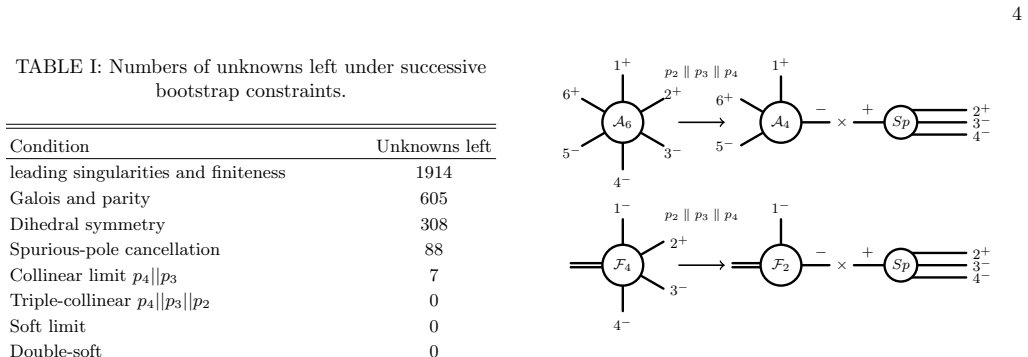
Dihedral symmetry We then impose the dihedral symmetry of the ansatz, which translates into symmetry properties of the coefficient functions inherited from the 4 TABLE I: Numbers of unknowns left under successive bootstrap constraints. Condition Unknowns left leading singularities and finiteness 1914 Galois and parity 605 Dihedral symmetry 308 Spurious-po...
1914
-
[4]
Spurious-pole cancellation We next impose spurious-pole cancellation. Up to dihedral symmetry, the form factorR-invariants have a single type of spurious pole,⟨3,4,1 +,3 +⟩ →0, written in the periodic momentum-twistor notation reviewed in the Supplemen- tal Material. On this locus the unphysical pole in the prefactors must cancel in the full ratio functio...
-
[5]
In this limit only the prefactors ¯R2, ¯R3, andS 1 survive, and they all reduce to the three-point NMHV tree prefactor; all other prefactors vanish
Collinear limit We then impose the collinear limit p4||p3. In this limit only the prefactors ¯R2, ¯R3, andS 1 survive, and they all reduce to the three-point NMHV tree prefactor; all other prefactors vanish. Since the three-point NMHV ratio function vanishes at any loop order, the accompanying functions must obey ¯f2 + ¯f3 +f s,1 p4||p3 →0.(15) This reduc...
-
[6]
Triple-collinear limit Finally, we impose a triple- collinear consistency condition [62–64] by taking p4||p3||p2. In the triple-collinear limit, the four-point NMHV form factor factorizes into a product of a two-point MHV form factor and theN= 4 triple-collinear splitting function of Grassmann degree four. After normalizing by the cor- responding MHV sect...
-
[7]
Wilczek, Phys
F. Wilczek, Phys. Rev. Lett.39, 1304 (1977)
1977
-
[8]
M. A. Shifman, A. I. Vainshtein, and V. I. Zakharov, Phys. Lett. B78, 443 (1978)
1978
-
[9]
W. L. van Neerven, Z. Phys. C30, 595 (1986)
1986
-
[10]
N. Arkani-Hamed, L. J. Dixon, A. J. McLeod, M. Spradlin, J. Trnka, and A. Volovich, Snowmass 2021 (2022), arXiv:2207.10636 [hep-th]
-
[11]
Form factors at strong coupling via a Y-system
J. Maldacena and A. Zhiboedov, JHEP11, 104, arXiv:1009.1139 [hep-th]
work page internal anchor Pith review Pith/arXiv arXiv
-
[12]
L. F. Alday and J. Maldacena, JHEP11, 068, arXiv:0710.1060 [hep-th]
work page internal anchor Pith review Pith/arXiv arXiv
-
[13]
Form Factors in N=4 Super Yang-Mills and Periodic Wilson Loops
A. Brandhuber, B. Spence, G. Travaglini, and G. Yang, JHEP01, 134, arXiv:1011.1899 [hep-th]
work page internal anchor Pith review Pith/arXiv arXiv
-
[14]
A. Brandhuber, O. Gurdogan, R. Mooney, G. Travaglini, and G. Yang, JHEP10, 046, arXiv:1107.5067 [hep-th]
work page internal anchor Pith review Pith/arXiv arXiv
-
[15]
Y-system for form factors at strong coupling in AdS5 and with multi-operator insertions in AdS3
Z. Gao and G. Yang, JHEP06, 105, arXiv:1303.2668 [hep-th]
work page internal anchor Pith review Pith/arXiv arXiv
-
[16]
Li, JHEP05, 209, arXiv:2412.17974 [hep-th]
Z. Li, JHEP05, 209, arXiv:2412.17974 [hep-th]
-
[17]
Form factor recursion relations at loop level
L. Bianchi, A. Brandhuber, R. Panerai, and G. Travaglini, JHEP02, 182, arXiv:1812.09001 [hep-th]
work page internal anchor Pith review Pith/arXiv arXiv
-
[18]
On-shell Diagrams, Gra{\ss}mannians and Integrability for Form Factors
R. Frassek, D. Meidinger, D. Nandan, and M. Wilhelm, JHEP01, 182, arXiv:1506.08192 [hep-th]
work page internal anchor Pith review Pith/arXiv arXiv
-
[19]
L. V. Bork and A. I. Onishchenko, JHEP12, 076, arXiv:1607.00503 [hep-th]
work page internal anchor Pith review Pith/arXiv arXiv
-
[20]
L. V. Bork and A. I. Onishchenko, JHEP04, 019, arXiv:1607.02320 [hep-th]. 6
work page internal anchor Pith review Pith/arXiv arXiv
-
[21]
R. H. Boels, B. A. Kniehl, O. V. Tarasov, and G. Yang, JHEP02, 063, arXiv:1211.7028 [hep-th]
work page internal anchor Pith review Pith/arXiv arXiv
-
[22]
G. Yang, Phys. Rev. Lett.117, 271602 (2016), arXiv:1610.02394 [hep-th]
work page internal anchor Pith review Pith/arXiv arXiv 2016
- [23]
- [24]
- [25]
- [26]
- [27]
- [28]
-
[29]
S. Caron-Huot, L. J. Dixon, J. M. Drummond, F. Dulat, J. Foster, ¨O. G¨ urdo˘ gan, M. von Hippel, A. J. McLeod, and G. Papathanasiou, PoSCORFU2019, 003 (2020), arXiv:2005.06735 [hep-th]
- [30]
- [31]
- [32]
- [33]
- [34]
-
[35]
Dixon and Z
L. Dixon and Z. Li, To appear
- [36]
- [37]
- [38]
-
[39]
L. Bianchi, A. Brandhuber, R. Panerai, and G. Travaglini, JHEP02, 134, arXiv:1812.10468 [hep-th]
- [40]
- [41]
-
[42]
Analytic two-loop form factors in N=4 SYM
A. Brandhuber, G. Travaglini, and G. Yang, JHEP05, 082, arXiv:1201.4170 [hep-th]
work page internal anchor Pith review Pith/arXiv arXiv
-
[43]
Hopf algebras, coproducts and symbols: an application to Higgs boson amplitudes
C. Duhr, JHEP08, 043, arXiv:1203.0454 [hep-ph]
work page internal anchor Pith review Pith/arXiv arXiv
- [44]
-
[45]
A. V. Kotikov and L. N. Lipatov, Nucl. Phys. B661, 19 (2003), [Erratum: Nucl.Phys.B 685, 405–407 (2004)], arXiv:hep-ph/0208220
work page internal anchor Pith review Pith/arXiv arXiv 2003
- [46]
-
[47]
L. J. Dixon, JHEP01, 075, arXiv:1712.07274 [hep-th]
work page internal anchor Pith review Pith/arXiv arXiv
-
[48]
A. B. Goncharov, M. Spradlin, C. Vergu, and A. Volovich, Phys. Rev. Lett.105, 151605 (2010), arXiv:1006.5703 [hep-th]
work page internal anchor Pith review Pith/arXiv arXiv 2010
-
[49]
C. Duhr, H. Gangl, and J. R. Rhodes, JHEP10, 075, arXiv:1110.0458 [math-ph]
work page internal anchor Pith review Pith/arXiv arXiv
- [50]
-
[51]
D. Chicherin, V. Sotnikov, and S. Zoia, JHEP01, 096, arXiv:2110.10111 [hep-ph]
- [52]
- [53]
-
[54]
J. M. Henn, Phys. Rev. Lett.110, 251601 (2013), arXiv:1304.1806 [hep-th]
work page internal anchor Pith review Pith/arXiv arXiv 2013
-
[55]
J. M. Henn, J. Phys. A48, 153001 (2015), arXiv:1412.2296 [hep-ph]
work page internal anchor Pith review Pith/arXiv arXiv 2015
-
[56]
L. V. Bork, JHEP01, 049, arXiv:1203.2596 [hep-th]
work page internal anchor Pith review Pith/arXiv arXiv
-
[57]
L. V. Bork, D. I. Kazakov, and G. S. Vartanov, JHEP 10, 133, arXiv:1107.5551 [hep-th]
work page internal anchor Pith review Pith/arXiv arXiv
-
[58]
J. M. Drummond, J. Henn, G. P. Korchemsky, and E. Sokatchev, Nucl. Phys. B828, 317 (2010), arXiv:0807.1095 [hep-th]
work page internal anchor Pith review Pith/arXiv arXiv 2010
-
[59]
Sharpening The Leading Singularity
F. Cachazo, (2008), arXiv:0803.1988 [hep-th]
work page internal anchor Pith review Pith/arXiv arXiv 2008
-
[60]
Twistor-Strings, Grassmannians and Leading Singularities
M. Bullimore, L. J. Mason, and D. Skinner, JHEP03, 070, arXiv:0912.0539 [hep-th]
work page internal anchor Pith review Pith/arXiv arXiv
-
[61]
Scattering Amplitudes and the Positive Grassmannian
N. Arkani-Hamed, J. L. Bourjaily, F. Cachazo, A. B. Goncharov, A. Postnikov, and J. Trnka,Grassmannian Geometry of Scattering Amplitudes(Cambridge Univer- sity Press, 2016) arXiv:1212.5605 [hep-th]
work page internal anchor Pith review Pith/arXiv arXiv 2016
-
[62]
Similar to the case of scattering amplitudes, these operations do not introduce additional R-invariants beyond one-loop lead- ing singularities
We note that the leading singularities of the form fac- tor at all-loop orders, along with their corresponding on- shell diagrams, can always be obtained from the one-loop leading singularity through gluing operations, including BCFW bridges and inverse-soft factors [55]. Similar to the case of scattering amplitudes, these operations do not introduce addi...
-
[63]
L. V. Bork, JHEP12, 111, arXiv:1407.5568 [hep-th]
work page internal anchor Pith review Pith/arXiv arXiv
- [64]
-
[65]
S. Carrˆ olo, D. Chicherin, J. Henn, Q. Yang, and Y. Zhang, JHEP07, 214, arXiv:2505.01245 [hep-th]
-
[66]
S. Carrˆ olo, D. Chicherin, J. Henn, Q. Yang, and Y. Zhang, Phys. Rev. Lett.136, 181602 (2026), arXiv:2510.20565 [hep-th]
-
[67]
QCD Scattering Amplitudes and Prescriptive Unitarity
S. Carrˆ olo, D. Chicherin, J. Henn, Q. Yang, and Y. Zhang, (2026), arXiv:2602.02783 [hep-th]
work page internal anchor Pith review Pith/arXiv arXiv 2026
-
[68]
Collinear Factorization and Splitting Functions for Next-to-next-to-leading Order QCD Calculations
S. Catani and M. Grazzini, Phys. Lett. B446, 143 (1999), arXiv:hep-ph/9810389
work page internal anchor Pith review Pith/arXiv arXiv 1999
-
[69]
The triple collinear limit of one-loop QCD amplitudes
S. Catani, D. de Florian, and G. Rodrigo, Phys. Lett. B 586, 323 (2004), arXiv:hep-ph/0312067
work page internal anchor Pith review Pith/arXiv arXiv 2004
-
[70]
One-loop triple collinear splitting amplitudes in QCD
S. Badger, F. Buciuni, and T. Peraro, JHEP09, 188, arXiv:1507.05070 [hep-ph]
work page internal anchor Pith review Pith/arXiv arXiv
-
[71]
D. A. Kosower, R. Roiban, and C. Vergu, Phys. Rev. D 83, 065018 (2011), arXiv:1009.1376 [hep-th]
work page internal anchor Pith review Pith/arXiv arXiv 2011
-
[72]
L. J. Dixon, J. M. Drummond, and J. M. Henn, JHEP 01, 024, arXiv:1111.1704 [hep-th]
work page internal anchor Pith review Pith/arXiv arXiv
- [73]
- [74]
-
[75]
Two-loop leading-color QCD corrections for Higgs plus two-jet production in the heavy-top limit
G. De Laurentis, H. Ita, V. Kuschke, M. Ruf, and V. Sot- nikov, (2026), arXiv:2605.04009 [hep-ph]
work page internal anchor Pith review Pith/arXiv arXiv 2026
-
[76]
V. Del Duca and L. J. Dixon, J. Phys. A55, 443016 (2022), arXiv:2203.13026 [hep-th]. 7
-
[77]
L. J. Dixon and M. von Hippel, JHEP10, 065, arXiv:1408.1505 [hep-th]
work page internal anchor Pith review Pith/arXiv arXiv
-
[78]
L. J. Dixon and I. Esterlis, JHEP07, 116, [Erratum: JHEP 08, 131 (2016)], arXiv:1602.02107 [hep-th]
work page internal anchor Pith review Pith/arXiv arXiv 2016
-
[79]
Eliminating spurious poles from gauge-theoretic amplitudes
A. Hodges, JHEP05, 135, arXiv:0905.1473 [hep-th]
work page internal anchor Pith review Pith/arXiv arXiv
-
[80]
Local Integrals for Planar Scattering Amplitudes
N. Arkani-Hamed, J. L. Bourjaily, F. Cachazo, and J. Trnka, JHEP06, 125, arXiv:1012.6032 [hep-th]
work page internal anchor Pith review Pith/arXiv arXiv
discussion (0)
Sign in with ORCID, Apple, or X to comment. Anyone can read and Pith papers without signing in.