First steps towards gauge-independent vortex identification through machine learning
Pith reviewed 2026-06-29 08:51 UTC · model grok-4.3
The pith
A machine learning model trained on distorted lattices identifies the locations of center vortices in two-dimensional SU(2) gauge theory.
A machine-rendered reading of the paper's core claim, the machinery that carries it, and where it could break.
Core claim
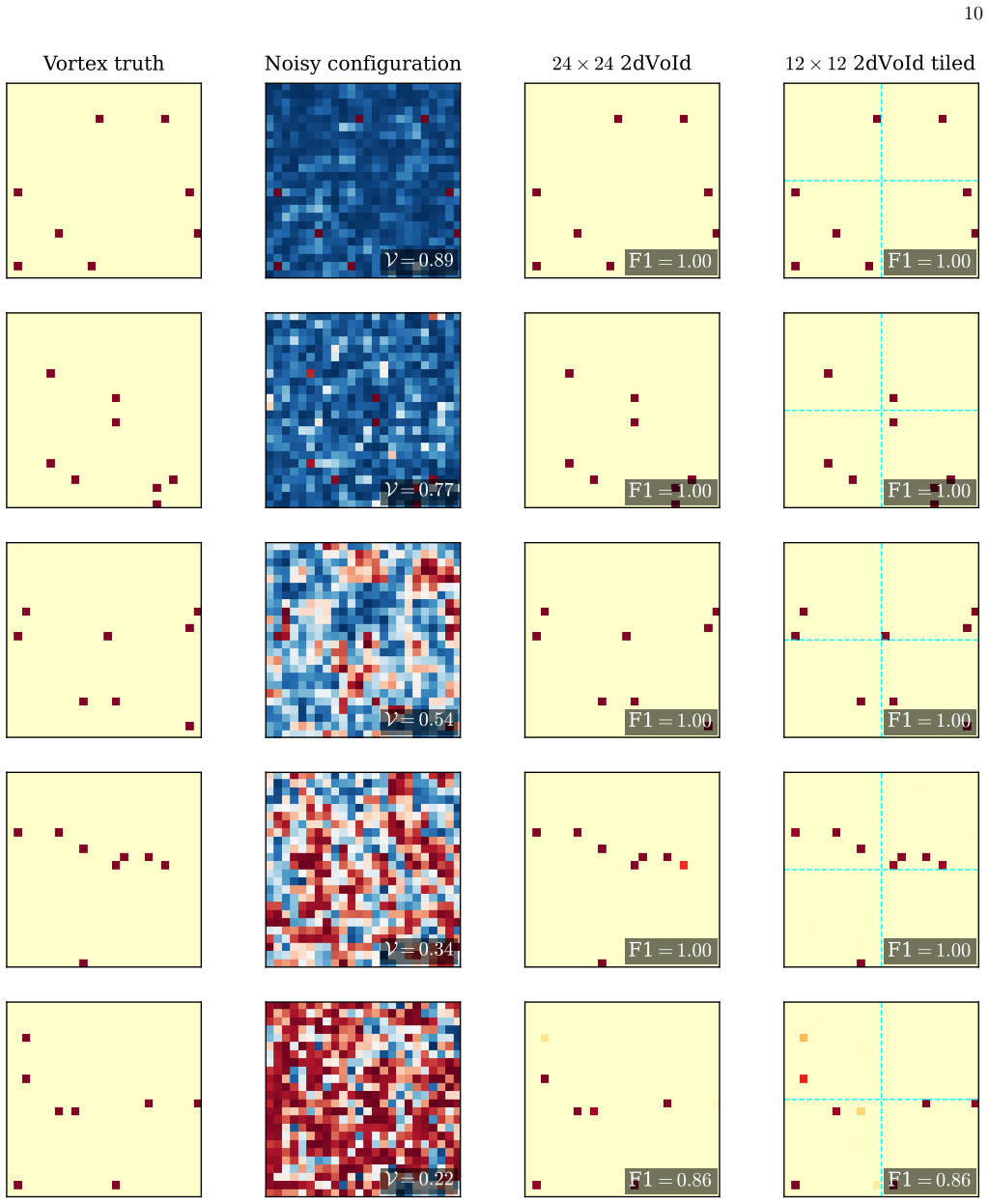
The 2dVoId model, trained on zero-action SU(2) lattices containing inserted thin Z2 vortices that have been subjected to random gauge transformations, added noise, and cooling, succeeds in identifying vortex locations whenever visibility remains moderate; tiling further permits extension to larger or higher-dimensional systems without proportional growth in training expense.
What carries the argument
The 2dVoId machine learning model, which processes lattice field configurations to output vortex locations after the configurations have undergone gauge transformations and noise.
If this is right
- Tiling strategies reduce the computational cost of training when extending the method to higher dimensions.
- Successful identification at moderate visibility levels indicates the model can handle the level of distortion expected in real simulations.
- Gauge-independent detection becomes feasible once the model generalizes beyond the two-dimensional training set.
- The same training pipeline can be reused for other confining objects by changing the insertion procedure.
Where Pith is reading between the lines
- If the model generalizes to four dimensions, vortex density measurements could be performed directly on gauge-invariant configurations to test their contribution to the confining potential.
- Combining vortex identification with similar models for monopoles or instantons could map the joint distribution of multiple topological objects without gauge fixing.
- The tiling approach suggests that local patches of a large lattice can be analyzed separately and then stitched, which may apply to other lattice observables that are expensive to train globally.
Load-bearing premise
The chosen distortions of random gauge transformations, noise, and cooling applied to zero-action lattices with inserted vortices create statistical properties close enough to those of thermalized lattice simulations.
What would settle it
Apply the trained model to independently generated thermalized two-dimensional SU(2) lattices and compare the reported vortex locations against those obtained from standard gauge-fixed vortex-finding algorithms or from direct inspection of plaquette phases.
Figures
read the original abstract
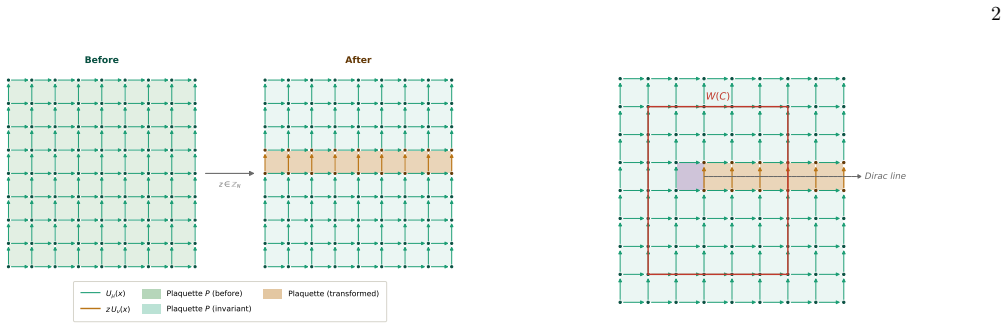
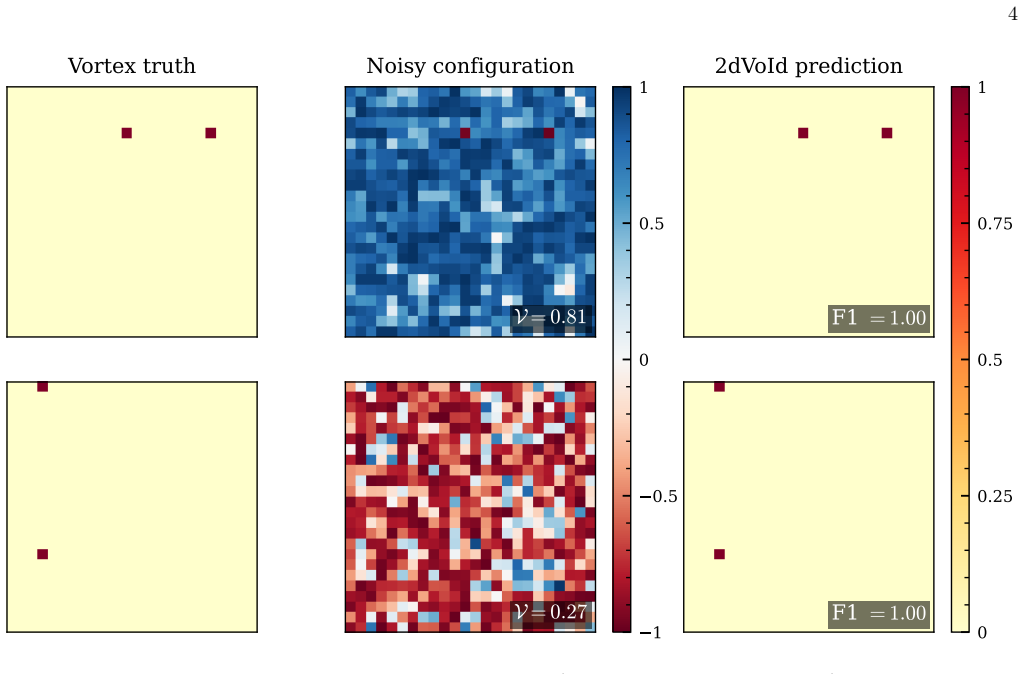
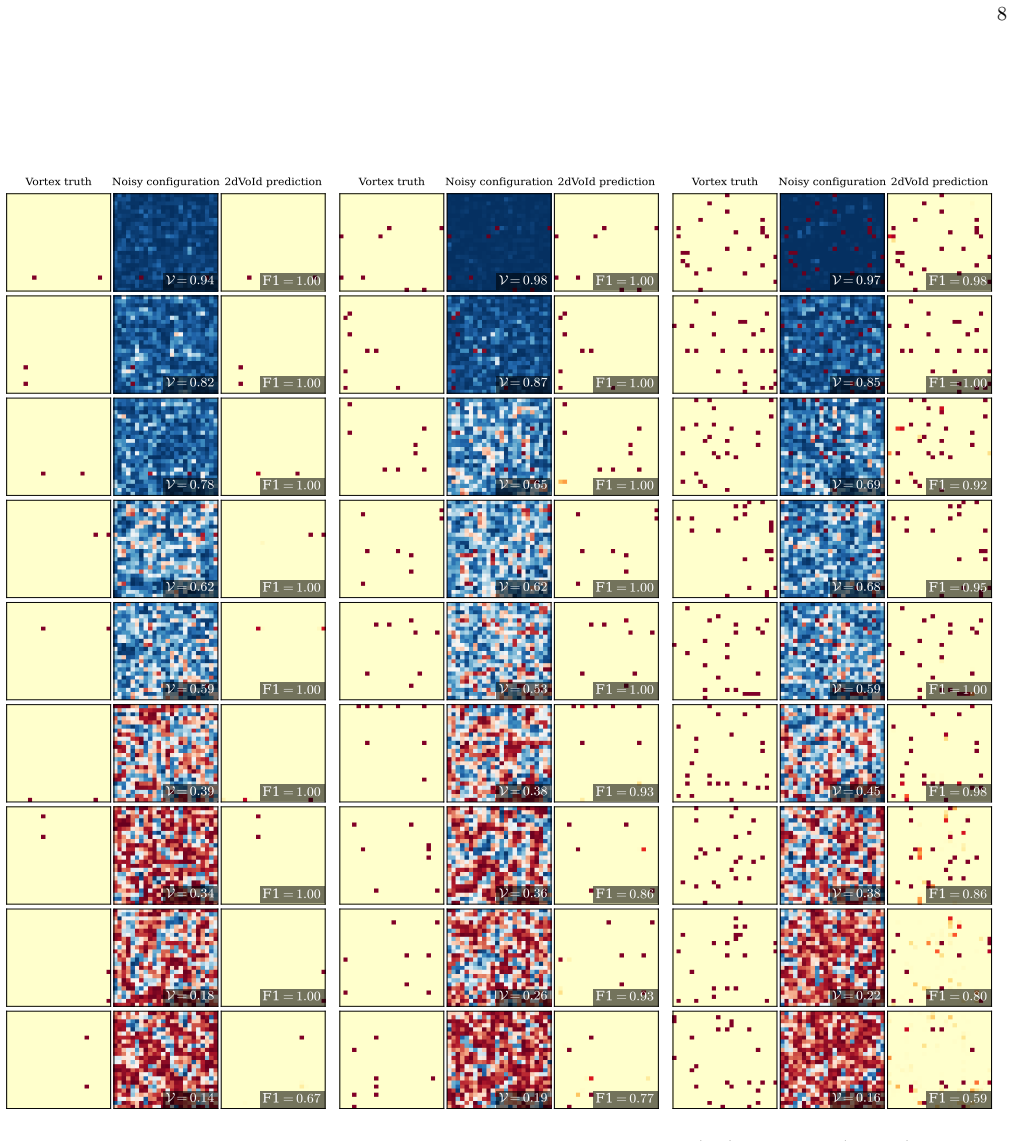
As a first step towards machine identification of confining objects in thermalized lattice gauge configurations, we present our 2dVoId model for center vortex identification on pure SU(2) lattices in $D = 2$ dimensions. We create a training set by inserting thin Z2 vortices at various locations on a zero action lattice, and then distort those configurations by applying random SU(2) gauge transformations, noise, and by thickening the vortices via cooling. For moderate vortex visibility, our model is able to reliably identify the location of center vortices. We additionally demonstrate scalability through tiling strategies, which will enable generalization to higher dimensions while reducing training costs.
Editorial analysis
A structured set of objections, weighed in public.
Referee Report
Summary. The manuscript presents the 2dVoId convolutional neural network for center-vortex identification on two-dimensional pure SU(2) lattices. Training configurations are generated by inserting thin Z_2 vortices into zero-action lattices, followed by random SU(2) gauge transformations, additive noise, and cooling to produce thickened vortices of varying visibility. The authors report that the trained model reliably locates vortices at moderate visibility levels and demonstrate a tiling strategy intended to reduce computational cost when scaling to higher dimensions.
Significance. If the performance claims are substantiated by quantitative metrics and the synthetic training distribution is shown to capture essential features of thermalized ensembles, the work would constitute a concrete first step toward gauge-independent, data-driven identification of confining objects. The explicit construction of training data from known vortex insertions avoids circularity and supplies a controlled test bed; successful transfer to Monte Carlo configurations would be a useful methodological advance for lattice studies of confinement.
major comments (2)
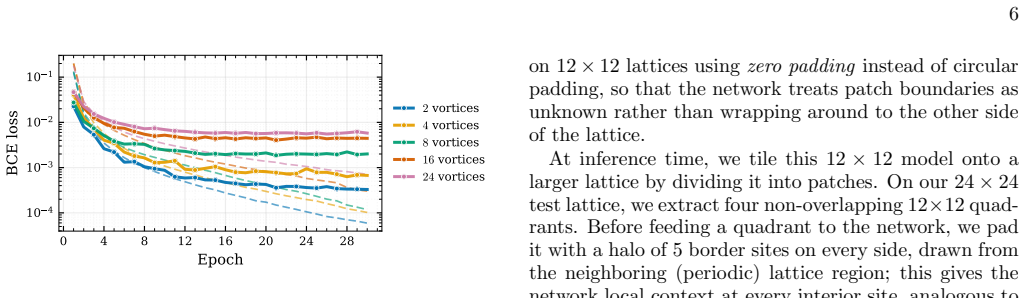
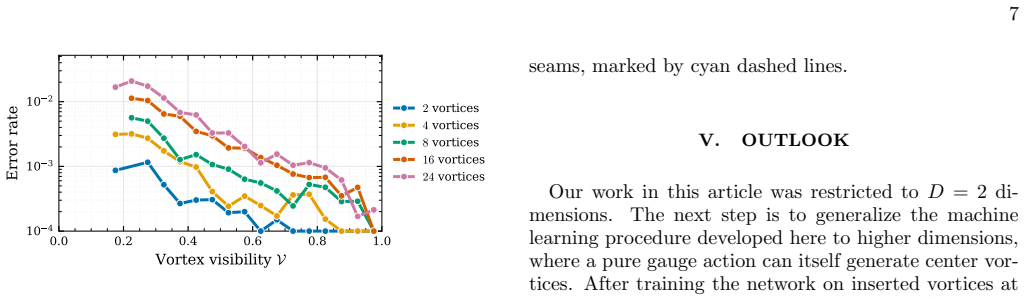
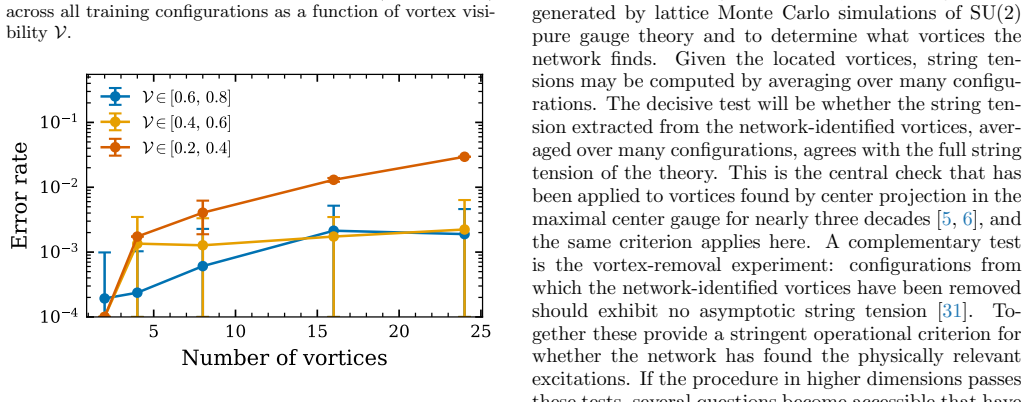
- [Abstract and Results] The central claim that the model 'reliably identifies' vortices for moderate visibility is not supported by any reported quantitative metrics (precision, recall, F1, or comparison against a baseline such as a simple plaquette-based detector) in the provided abstract or summary. Without these numbers and an explicit definition of 'moderate visibility,' the reliability statement cannot be evaluated.
- [Training data generation and validation] All reported results use configurations generated from zero-action lattices with explicit vortex insertions, followed by gauge transformations, noise, and cooling. No comparison of plaquette histograms, action density, or vortex-core profiles against thermalized Monte Carlo ensembles at finite β is presented. This leaves open whether the learned detector exploits generation-specific artifacts rather than universal vortex signatures, directly affecting the stated goal of applicability to thermalized lattices.
minor comments (2)
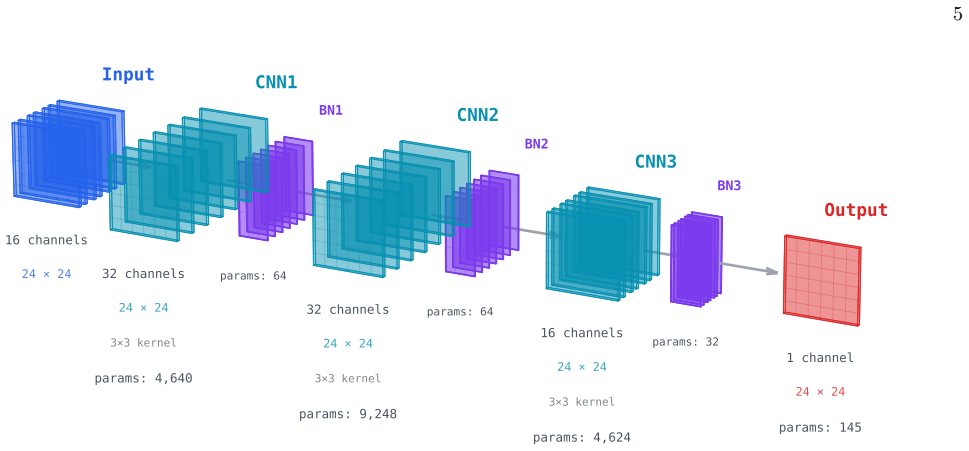
- [Model architecture] The manuscript should clarify the precise architecture of 2dVoId (number of layers, filter sizes, activation functions) and the loss function used for training.
- [Figures] Figure captions should explicitly state the lattice volume, the range of cooling sweeps, and the noise amplitude used in each panel.
Simulated Author's Rebuttal
We thank the referee for the constructive report. We address each major comment below. We agree that quantitative metrics are needed to support the reliability claim and will add them. The second point highlights a genuine scope limitation of this first-step study on synthetic data.
read point-by-point responses
-
Referee: [Abstract and Results] The central claim that the model 'reliably identifies' vortices for moderate visibility is not supported by any reported quantitative metrics (precision, recall, F1, or comparison against a baseline such as a simple plaquette-based detector) in the provided abstract or summary. Without these numbers and an explicit definition of 'moderate visibility,' the reliability statement cannot be evaluated.
Authors: We agree that the abstract lacks explicit numerical metrics. The full manuscript presents identification results via figures that show successful localization across a range of visibility parameters, but these are qualitative. In revision we will add precision, recall and F1 scores evaluated on held-out test configurations at several visibility levels, together with an explicit definition of moderate visibility (e.g., the interval of cooling steps and noise amplitudes where the vortex is thickened yet still topologically identifiable). A simple plaquette-based baseline comparison will also be included if space allows. These additions will be made in the revised abstract and results section. revision: yes
-
Referee: [Training data generation and validation] All reported results use configurations generated from zero-action lattices with explicit vortex insertions, followed by gauge transformations, noise, and cooling. No comparison of plaquette histograms, action density, or vortex-core profiles against thermalized Monte Carlo ensembles at finite β is presented. This leaves open whether the learned detector exploits generation-specific artifacts rather than universal vortex signatures, directly affecting the stated goal of applicability to thermalized lattices.
Authors: We acknowledge that the training set is entirely synthetic and that no direct distributional comparison to thermalized Monte Carlo ensembles is provided. The controlled insertion of known thin vortices followed by gauge transformations, additive noise and cooling was chosen precisely to supply ground-truth labels while introducing realistic distortions; this avoids circularity in the initial proof-of-concept. We do not claim that the current detector is already applicable to thermalized lattices. In revision we will expand the discussion section to state this limitation explicitly and to outline the planned next step of transfer to Monte Carlo configurations. No change to the reported results is required, as they concern only the synthetic test bed. revision: partial
- Direct quantitative comparison of plaquette histograms, action densities and vortex-core profiles between the synthetic training ensemble and thermalized Monte Carlo ensembles at finite β
Circularity Check
No circularity: training labels supplied by explicit construction, independent of model outputs
full rationale
The paper generates labeled training data by explicitly inserting thin Z2 vortices into zero-action lattices, then applies gauge transformations, noise, and cooling; the model is trained to recover these known insertion locations. Evaluation occurs on held-out synthetic configurations whose ground-truth vortex positions are likewise known by construction. No equations, fitted parameters, or self-citations are invoked to define the target quantity or to rename a fit as a prediction. The derivation chain is therefore self-contained and does not reduce to its own inputs.
Axiom & Free-Parameter Ledger
axioms (1)
- domain assumption Center vortices are the relevant confining objects whose locations can be identified independently of gauge choice in SU(2) gauge theory.
Reference graph
Works this paper leans on
-
[1]
’t Hooft, Nucl
G. ’t Hooft, Nucl. Phys. B138, 1 (1978)
1978
-
[2]
J. M. Cornwall, Nucl. Phys. B157, 392 (1979)
1979
-
[3]
H. B. Nielsen and P. Olesen, Nucl. Phys. B160, 380 (1979)
1979
-
[4]
Ambjorn and P
J. Ambjorn and P. Olesen, Nucl. Phys. B170, 265 (1980)
1980
-
[5]
Center Dominance and Z2 Vortices in SU(2) Lattice Gauge Theory
L. Del Debbio, M. Faber, J. Greensite, and S. Olejnik, Phys. Rev. D55, 2298 (1997), arXiv:hep-lat/9610005
work page internal anchor Pith review Pith/arXiv arXiv 1997
-
[6]
L. Del Debbio, M. Faber, J. Giedt, J. Greensite, and S. Olejnik, Phys. Rev.D58, 094501 (1998), arXiv:hep- lat/9801027 [hep-lat]
-
[7]
M. Engelhardt, K. Langfeld, H. Reinhardt, and O. Tennert, Phys. Lett.B431, 141 (1998), arXiv:hep- lat/9801030 [hep-lat]
-
[8]
T. G. Kovacs and E. T. Tomboulis, Phys. Rev. Lett.85, 704 (2000), arXiv:hep-lat/0002004 [hep-lat]
work page internal anchor Pith review Pith/arXiv arXiv 2000
-
[9]
D. Leinweber, J. Biddle, W. Kamleh, and A. Virgili, EPJ Web Conf.274, 01002 (2022), arXiv:2211.13421 [hep-lat]
-
[10]
C. G¨ uvendik, T. Schaefer, and M. ¨Unsal, JHEP11, 163 (2024), arXiv:2405.13696 [hep-th]
-
[11]
Greensite,An Introduction to the Confinement Prob- lem, 2nd ed., Lecture Notes in Physics (Springer Cham, 2020)
J. Greensite,An Introduction to the Confinement Prob- lem, 2nd ed., Lecture Notes in Physics (Springer Cham, 2020)
2020
-
[12]
V. G. Bornyakov, D. A. Komarov, and M. I. Polikarpov, Phys. Lett. B497, 151 (2001), arXiv:hep-lat/0009035
work page internal anchor Pith review Pith/arXiv arXiv 2001
-
[13]
Center Vortices and the Gribov Horizon
J. Greensite, S. Olejnik, and D. Zwanziger, JHEP05, 070 (2005), arXiv:hep-lat/0407032 [hep-lat]
work page internal anchor Pith review Pith/arXiv arXiv 2005
-
[14]
LeCun, Y
Y. LeCun, Y. Bengio, and G. Hinton, Nature521, 436 (2015)
2015
-
[15]
Machine learning phases of matter
J. Carrasquilla and R. G. Melko, Nature Phys.13, 431 (2017), arXiv:1605.01735
work page internal anchor Pith review Pith/arXiv arXiv 2017
-
[16]
S. J. Wetzel and M. Scherzer, Phys. Rev. B96, 184410 (2017), arXiv:1705.05582 [cond-mat.stat-mech]
work page internal anchor Pith review Pith/arXiv arXiv 2017
- [17]
-
[18]
Y. Nagai and A. Tomiya, Phys. Rev. D111, 074501 (2025), arXiv:2103.11965 [hep-lat]
- [19]
-
[20]
Tomiya, J
A. Tomiya, J. Phys. Soc. Jap.94, 031006 (2025)
2025
- [21]
-
[22]
Casimir Scaling from Center Vortices: Towards an Understanding of the Adjoint String Tension
M. Faber, J. Greensite, and S. Olejnik, Phys. Rev. D57, 2603 (1998), arXiv:hep-lat/9710039
work page internal anchor Pith review Pith/arXiv arXiv 1998
-
[23]
D. Gaiotto, A. Kapustin, N. Seiberg, and B. Willett, JHEP02, 172 (2015), arXiv:1412.5148 [hep-th]
work page internal anchor Pith review Pith/arXiv arXiv 2015
-
[24]
M. Engelhardt, K. Langfeld, H. Reinhardt, and O. Tennert, Phys. Rev.D61, 054504 (2000), arXiv:hep- lat/9904004 [hep-lat]
-
[25]
D. Trewartha, W. Kamleh, and D. Leinweber, Phys. Rev.D92, 074507 (2015), arXiv:1509.05518 [hep-lat]
-
[26]
LeCun, L
Y. LeCun, L. Bottou, Y. Bengio, and P. Haffner, Pro- ceedings of the IEEE86, 2278 (1998)
1998
-
[27]
Goodfellow, Y
I. Goodfellow, Y. Bengio, and A. Courville,Deep Learn- ing(MIT Press, 2016)http://www.deeplearningbook. org
2016
-
[28]
PyTorch: An Imperative Style, High-Performance Deep Learning Library
A. Paszke, S. Gross, F. Massa, A. Lerer, J. Bradbury, G. Chanan, T. Killeen, Z. Lin, N. Gimelshein, L. Antiga, A. Desmaison, A. Kopf, E. Yang, Z. DeVito, M. Rai- son, A. Tejani, S. Chilamkurthy, B. Steiner, L. Fang, J. Bai, and S. Chintala, inAdvances in Neural Infor- mation Processing Systems 32, edited by H. Wallach, H. Larochelle, A. Beygelzimer, F. d'...
work page internal anchor Pith review Pith/arXiv arXiv 2019
-
[29]
D. P. Kingma and J. Ba, inInternational Con- ference on Learning Representations (ICLR)(2015) arXiv:1412.6980 [cs.LG]
work page internal anchor Pith review Pith/arXiv arXiv 2015
-
[30]
J. Long, E. Shelhamer, and T. Darrell, inProceedings of the IEEE Conference on Computer Vision and Pattern Recognition(2015) pp. 3431–3440
2015
-
[31]
On the relevance of center vortices to QCD
P. de Forcrand and M. D’Elia, Phys. Rev. Lett.82, 4582 (1999), arXiv:hep-lat/9901020 [hep-lat]
work page internal anchor Pith review Pith/arXiv arXiv 1999
-
[32]
D. Trewartha, W. Kamleh, and D. Leinweber, Phys. Lett.B747, 373 (2015), arXiv:1502.06753 [hep-lat]
-
[33]
F. V. Gubarev, A. V. Kovalenko, M. I. Polikarpov, S. N. Syritsyn, and V. I. Zakharov, Phys. Lett.B574, 136 (2003), arXiv:hep-lat/0212003 [hep-lat]. 10 Vortex truth V = 0.89 Noisy configuration F1 = 1.00 24 × 24 2dVoId F1 = 1.00 12 × 12 2dVoId tiled V = 0.77 F1 = 1.00 F1 = 1.00 V = 0.54 F1 = 1.00 F1 = 1.00 V = 0.34 F1 = 1.00 F1 = 1.00 V = 0.22 F1 = 0.86 F1...
work page internal anchor Pith review Pith/arXiv arXiv 2003
discussion (0)
Sign in with ORCID, Apple, or X to comment. Anyone can read and Pith papers without signing in.