Modular non-Hermitian topology and its application to critical sensing
Pith reviewed 2026-06-29 11:13 UTC · model grok-4.3
The pith
Modular non-Hermitian chains with periodic distinct couplings show enriched skin effects and criticality-enhanced sensing near topological transitions.
A machine-rendered reading of the paper's core claim, the machinery that carries it, and where it could break.
Core claim
Modular structures in non-Hermitian topological systems, defined by periodic distinct coupling values at regular intervals, enrich the non-Hermitian skin effect and breakdown of conventional bulk-boundary correspondence while enabling criticality-enhanced sensitivity for precision metrology, with the enhancement achievable in multi-parameter estimation scenarios.
What carries the argument
Modular structure consisting of periodic distinct coupling values at regular intervals, which enriches topological attributes and produces criticality-enhanced sensitivity near phase transitions.
Load-bearing premise
Introducing periodic distinct coupling values at regular intervals will systematically enrich non-Hermitian skin effect and produce criticality-enhanced sensitivity.
What would settle it
An experiment showing that modular couplings do not increase sensing sensitivity near the phase transition compared to uniform couplings would falsify the claim.
Figures
read the original abstract
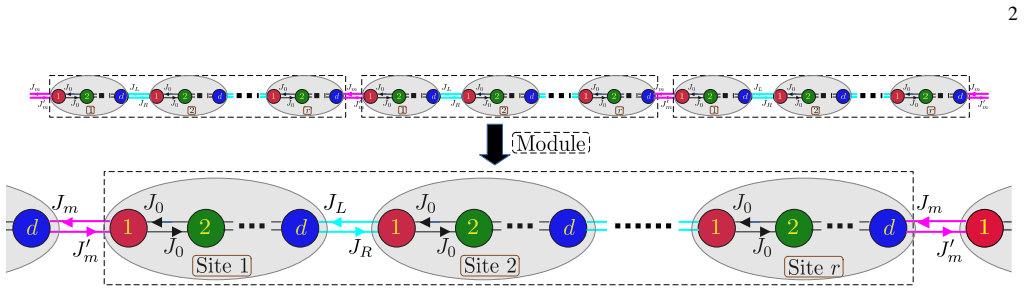
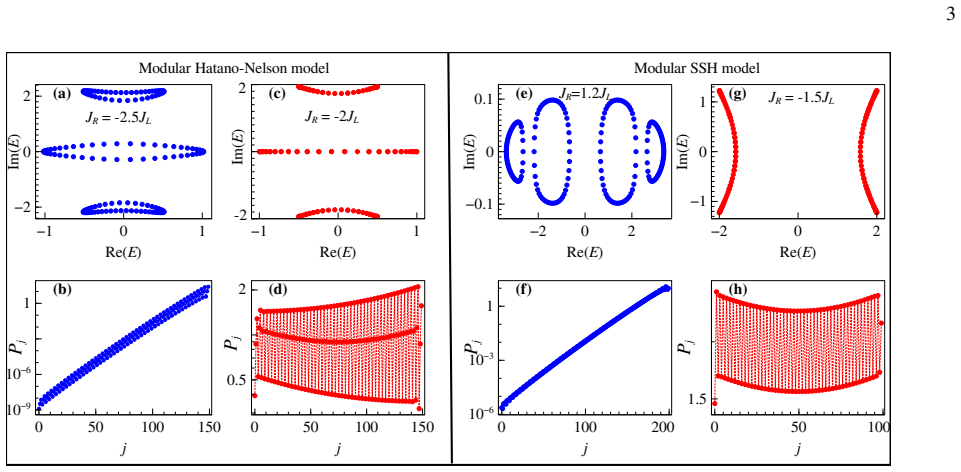
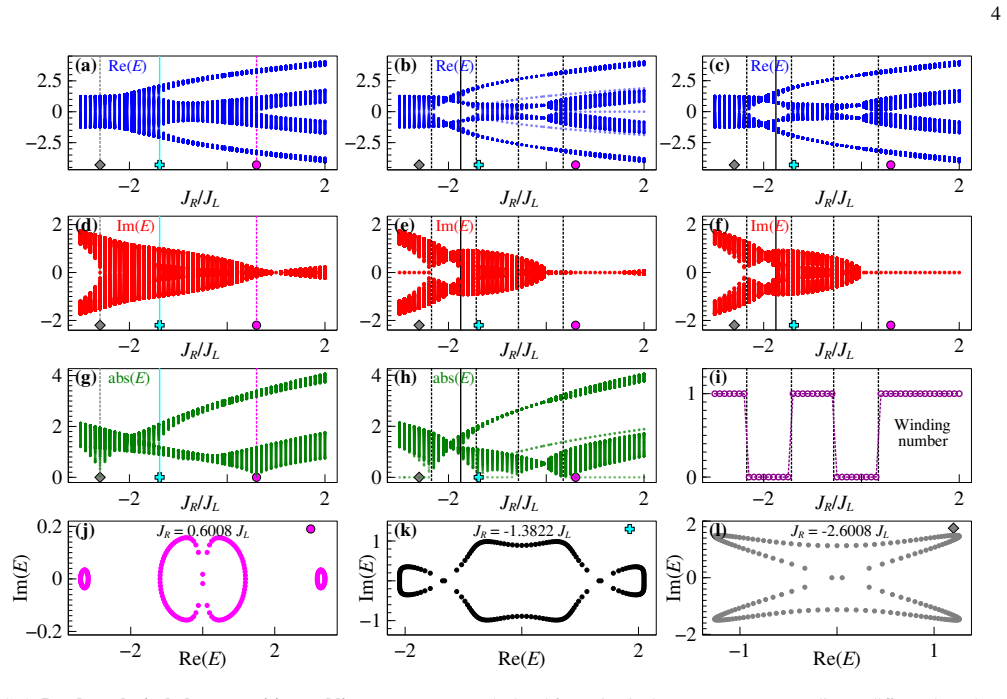
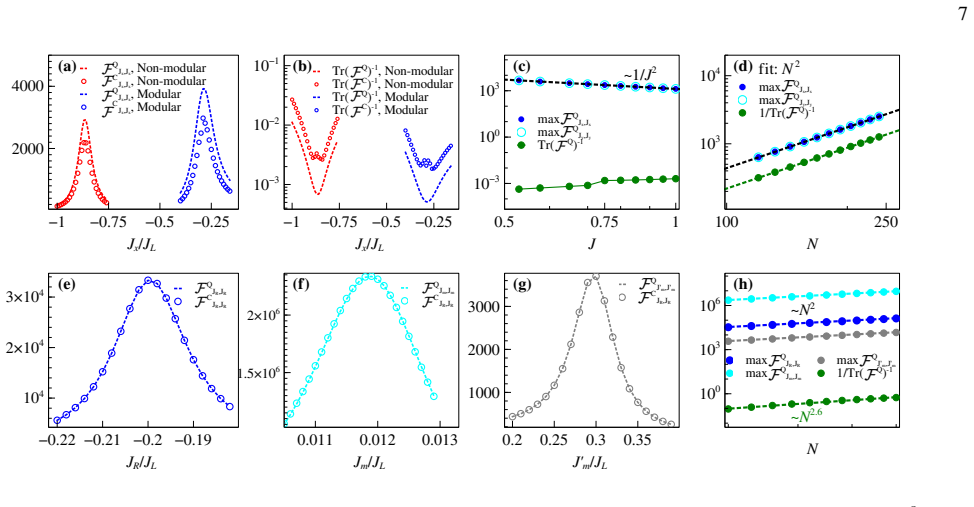
Non-Hermitian topological systems have attracted a lot of research activities in recent times, both theoretically and experimentally, due to their unique physical properties and association with open quantum systems. We show that modular structures, where specific couplings at regular intervals take distinct values, enrich the unique topological attributes of these systems such as the non-Hermitian skin effect and the breakdown of conventional bulk-boundary correspondence. These systems also possess the capability of displaying criticality-enhanced sensitivity for precision metrology. We establish how the modular structure enhances their sensing performance near spectral topological phase transitions and show that the enhancement can be achieved in multi-parameter estimation scenarios as well.
Editorial analysis
A structured set of objections, weighed in public.
Referee Report
Summary. The manuscript introduces modular non-Hermitian systems in which couplings at regular intervals take distinct values. It claims that this construction enriches the non-Hermitian skin effect and the breakdown of bulk-boundary correspondence, and that the resulting spectral topological phase transitions produce criticality-enhanced sensitivity that improves precision metrology, including in multi-parameter estimation scenarios.
Significance. If the modular periodicity demonstrably yields new topological invariants or quantitatively larger Fisher information near the transitions without post-hoc parameter tuning, the work would supply a concrete route to topology-assisted sensing in open quantum systems.
major comments (2)
- [Abstract] Abstract, paragraph 2: the central claim that periodic distinct couplings 'systematically enrich' the skin effect and produce criticality-enhanced sensitivity rests on an unstated model; without the explicit Hamiltonian, the definition of the modular period, or the derived topological invariant, it is impossible to verify whether the enhancement follows from the construction or from auxiliary choices.
- [Abstract] The manuscript asserts applicability to multi-parameter estimation, yet supplies no explicit multi-parameter Fisher-information matrix or comparison against the single-parameter case; this leaves the multi-parameter claim unsupported by any visible derivation or numerical test.
Simulated Author's Rebuttal
We thank the referee for their report and address the two major comments point by point. The requested details on the model, Hamiltonian, invariants, and multi-parameter analysis are contained in the main text; we clarify their locations below.
read point-by-point responses
-
Referee: [Abstract] Abstract, paragraph 2: the central claim that periodic distinct couplings 'systematically enrich' the skin effect and produce criticality-enhanced sensitivity rests on an unstated model; without the explicit Hamiltonian, the definition of the modular period, or the derived topological invariant, it is impossible to verify whether the enhancement follows from the construction or from auxiliary choices.
Authors: The explicit Hamiltonian appears as Eq. (1) in Section II, where the modular period is defined as the integer spacing m at which selected couplings assume distinct values while the remainder follow a uniform pattern. The topological invariant is constructed in Section III via a modular-adapted non-Bloch winding number whose quantization directly tracks the enriched skin effect. Sections IV and V then demonstrate, through both analytic dispersion relations and numerical spectra, that the criticality-enhanced sensitivity arises from the modular periodicity itself rather than auxiliary parameter choices, as confirmed by direct comparison with the m=1 (non-modular) limit. revision: no
-
Referee: [Abstract] The manuscript asserts applicability to multi-parameter estimation, yet supplies no explicit multi-parameter Fisher-information matrix or comparison against the single-parameter case; this leaves the multi-parameter claim unsupported by any visible derivation or numerical test.
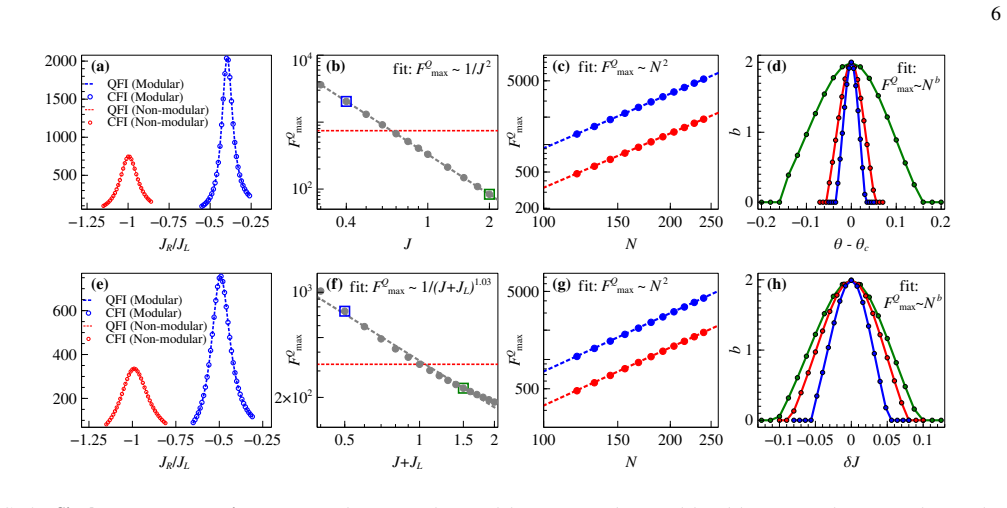
Authors: Section VI derives the multi-parameter quantum Fisher information matrix for the modular sensor near the spectral topological transition, giving its explicit block form in terms of the modular eigenmodes. Figure 6 and the accompanying text provide numerical comparisons showing that the modular construction yields a larger determinant of the Fisher matrix (hence higher multi-parameter precision) than the corresponding single-parameter scaling, without additional tuning. revision: no
Circularity Check
No derivation chain visible; abstract-only text precludes circularity assessment
full rationale
The provided paper text consists solely of the abstract, which states high-level claims about modular structures enriching non-Hermitian skin effect and criticality-enhanced sensing without any equations, model definitions, derivations, or self-citations. No load-bearing steps exist to inspect for self-definitional reductions, fitted inputs called predictions, or self-citation chains. The derivation chain cannot be walked, so no circularity is identifiable. This is the expected honest non-finding when source material supplies no explicit mathematical steps.
Axiom & Free-Parameter Ledger
Reference graph
Works this paper leans on
-
[1]
Colloquium: topological insu- lators,
M. Z. Hasan and C. L. Kane, “Colloquium: topological insu- lators,” Rev. Mod. Phys.82, 3045–3067 (2010)
2010
-
[2]
Colloquium: Zoo of quantum-topological phases of matter,
X.-G. Wen, “Colloquium: Zoo of quantum-topological phases of matter,” Rev. Mod. Phys.89, 041004 (2017)
2017
-
[3]
Non-Abelian anyons and topological quantum computation,
C. Nayak, S. H. Simon, A. Stern, M. Freedman, and S. Das Sarma, “Non-Abelian anyons and topological quantum computation,” Rev. Mod. Phys.80, 1083–1159 (2008)
2008
-
[4]
Anomalous edge state in a non-Hermitian lattice,
T. E. Lee, “Anomalous edge state in a non-Hermitian lattice,” Phys. Rev. Lett.116, 133903 (2016)
2016
-
[5]
Topological Band Theory for Non-Hermitian Hamiltonians,
H. Shen, B. Zhen, and L. Fu, “Topological Band Theory for Non-Hermitian Hamiltonians,” Phys. Rev. Lett.120, 146402 (2018)
2018
-
[6]
Edge States and Topological Invari- ants of Non-Hermitian Systems,
S. Yao and Z. Wang, “Edge States and Topological Invari- ants of Non-Hermitian Systems,” Phys. Rev. Lett.121, 086803 (2018). 11
2018
-
[7]
Non-Hermitian physics,
Y . Ashida, Z. Gong, and M. Ueda, “Non-Hermitian physics,” Adv. Phys.69, 249–435 (2020)
2020
-
[8]
Excep- tional topology of non-Hermitian systems,
E. J. Bergholtz, J. C. Budich, and F. K. Kunst, “Excep- tional topology of non-Hermitian systems,” Rev. Mod. Phys. 93, 015005 (2021)
2021
-
[9]
Non-Hermitian Topological Phe- nomena: A Review,
N. Okuma and M. Sato, “Non-Hermitian Topological Phe- nomena: A Review,” Annu. Rev. Condens. Matter Phys.14, 83–107 (2023)
2023
-
[10]
Topological Phases of Non- Hermitian Systems,
Z. Gong, Y . Ashida, K. Kawabata, K. Takasan, S. Hi- gashikawa, and M. Ueda, “Topological Phases of Non- Hermitian Systems,” Phys. Rev. X8, 031079 (2018)
2018
-
[11]
Symme- try and Topology in Non-Hermitian Physics,
K. Kawabata, K. Shiozaki, M. Ueda, and M. Sato, “Symme- try and Topology in Non-Hermitian Physics,” Phys. Rev. X9, 041015 (2019)
2019
-
[12]
Generalized bulk–boundary correspondence in non-Hermitian topolectrical circuits,
T. Helbig, T. Hofmann, S. Imhof, M. Abdelghany, T. Kiessling, L. W. Molenkamp, C. H. Lee, A. Szameit, M. Greiter, and R. Thomale, “Generalized bulk–boundary correspondence in non-Hermitian topolectrical circuits,” Na- ture Physics16, 747–750 (2020)
2020
-
[13]
Recip- rocal skin effect and its realization in a topolectrical circuit,
T. Hofmann, T. Helbig, F. Schindler, N. Salgo, M. Brzezi´nska, M. Greiter, T. Kiessling, D. Wolf, A. V ollhardt, A. Kaba ˇsi, C. H. Lee, A. Bilu ˇsi´c, R. Thomale, and T. Neupert, “Recip- rocal skin effect and its realization in a topolectrical circuit,” Phys. Rev. Res.2, 023265 (2020)
2020
-
[14]
Non-Hermitian Skin Effect in a Non-Hermitian Electrical Circuit,
S. Liu, R. Shao, S. Ma, L. Zhang, O. You, H. Wu, Y . J. Xi- ang, T. J. Cui, and S. Zhang, “Non-Hermitian Skin Effect in a Non-Hermitian Electrical Circuit,” Research2021(2021), 10.34133/2021/5608038
-
[15]
Acoustic non-Hermitian skin effect from twisted winding topology,
L. Zhang, Y . Yang, Y . Ge, Y .-J. Guan, Q. Chen, Q. Yan, F. Chen, R. Xi, Y . Li, D. Jia, S.-Q. Yuan, H.-X. Sun, H. Chen, and B. Zhang, “Acoustic non-Hermitian skin effect from twisted winding topology,” Nat. Commun.12, 6297 (2021)
2021
-
[16]
Anomalous Floquet non-Hermitian skin effect in a ring resonator lattice,
H. Gao, H. Xue, Z. Gu, L. Li, W. Zhu, Z. Su, J. Zhu, B. Zhang, and Y . D. Chong, “Anomalous Floquet non-Hermitian skin effect in a ring resonator lattice,” Phys. Rev. B106, 134112 (2022)
2022
-
[17]
Topological funneling of light,
S. Weidemann, M. Kremer, T. Helbig, T. Hofmann, A. Stegmaier, M. Greiter, R. Thomale, and A. Sza- meit, “Topological funneling of light,” Science368, 311–314 (2020)
2020
-
[18]
Two-dimensional non-Hermitian Skin Effect in a Synthetic Photonic Lattice,
Y . Song, W. Liu, L. Zheng, Y . Zhang, B. Wang, and P. Lu, “Two-dimensional non-Hermitian Skin Effect in a Synthetic Photonic Lattice,” Phys. Rev. Appl.14, 064076 (2020)
2020
-
[19]
Non-reciprocal robotic metamaterials,
M. Brandenbourger, X. Locsin, E. Lerner, and C. Coulais, “Non-reciprocal robotic metamaterials,” Nat. Commun.10, 4608 (2019)
2019
-
[20]
Observation of non-Hermitian topology and its bulk–edge correspondence in an active mechanical metamaterial,
A. Ghatak, M. Brandenbourger, J. van Wezel, and C. Coulais, “Observation of non-Hermitian topology and its bulk–edge correspondence in an active mechanical metamaterial,” Pro- ceedings of the National Academy of Sciences117, 29561– 29568 (2020)
2020
-
[21]
Engi- neering tunable local loss in a synthetic lattice of momentum states,
S. Lapp, J. Ang’ong’a, F. A. An, and B. Gadway, “Engi- neering tunable local loss in a synthetic lattice of momentum states,” New Journal of Physics21, 045006 (2019)
2019
-
[22]
Tunable Nonreciprocal Quantum Trans- port through a Dissipative Aharonov-Bohm Ring in Ultracold Atoms,
W. Gou, T. Chen, D. Xie, T. Xiao, T.-S. Deng, B. Gadway, W. Yi, and B. Yan, “Tunable Nonreciprocal Quantum Trans- port through a Dissipative Aharonov-Bohm Ring in Ultracold Atoms,” Phys. Rev. Lett.124, 070402 (2020)
2020
-
[23]
Observa- tion of topological edge states in parity–time-symmetric quan- tum walks,
L. Xiao, X. Zhan, Z. Bian, K. Wang, X. Zhang, X. Wang, J. Li, K. Mochizuki, D. Kim, N. Kawakami,et al., “Observa- tion of topological edge states in parity–time-symmetric quan- tum walks,” Nature Physics13, 1117–1123 (2017)
2017
-
[24]
Non-Hermitian bulk–boundary correspondence in quantum dynamics,
L. Xiao, T. Deng, K. Wang, G. Zhu, Z. Wang, W. Yi, and P. Xue, “Non-Hermitian bulk–boundary correspondence in quantum dynamics,” Nat. Phys.16, 761–766 (2020)
2020
-
[25]
Detecting non-Bloch topological invariants in quantum dynamics,
K. Wang, T. Li, L. Xiao, Y . Han, W. Yi, and P. Xue, “Detecting non-Bloch topological invariants in quantum dynamics,” Phys. Rev. Lett.127, 270602 (2021)
2021
-
[26]
Quantum sens- ing,
C. L. Degen, F. Reinhard, and P. Cappellaro, “Quantum sens- ing,” Rev. Mod. Phys.89, 035002 (2017)
2017
-
[27]
Quantum-enhanced measurements without entanglement,
D. Braun, G. Adesso, F. Benatti, R. Floreanini, U. Marzolino, M. W. Mitchell, and S. Pirandola, “Quantum-enhanced measurements without entanglement,” Rev. Mod. Phys.90, 035006 (2018)
2018
-
[28]
Essay: Quantum Sensing with Atomic, Molecular, and Optical Platforms for Fundamental Physics,
J. Ye and P. Zoller, “Essay: Quantum Sensing with Atomic, Molecular, and Optical Platforms for Fundamental Physics,” Phys. Rev. Lett.132, 190001 (2024)
2024
-
[29]
Journey in quantum metrology and sensing from foundations to applications: a review
P. Ghosh, T. K. Konar, D. Rakshit, A. S. De, and U. Sen, “Journey in quantum metrology and sensing from foundations to applications: a review,” arXiv:2605.21702 (2026)
work page internal anchor Pith review Pith/arXiv arXiv 2026
-
[30]
Quantum- enhanced measurements: beating the standard quantum limit,
V . Giovannetti, S. Lloyd, and L. Maccone, “Quantum- enhanced measurements: beating the standard quantum limit,” Science306, 1330–1336 (2004)
2004
-
[31]
Quantum metrol- ogy,
V . Giovannetti, S. Lloyd, and L. Maccone, “Quantum metrol- ogy,” Phys. Rev. Lett.96, 010401 (2006)
2006
-
[32]
Advances in quan- tum metrology,
V . Giovannetti, S. Lloyd, and L. Maccone, “Advances in quan- tum metrology,” Nat. photonics5, 222–229 (2011)
2011
-
[33]
Squeezing metrology: A unified framework,
L. Maccone and A. Riccardi, “Squeezing metrology: A unified framework,” Quantum4, 292 (2020)
2020
-
[34]
Mach-Zehnder Interferometry at the Heisenberg Limit with Coherent and Squeezed-Vacuum Light,
L. Pezz ´e and A. Smerzi, “Mach-Zehnder Interferometry at the Heisenberg Limit with Coherent and Squeezed-Vacuum Light,” Phys. Rev. Lett.100, 073601 (2008)
2008
-
[35]
Squeezed states of light and their applications in laser interferometers,
R. Schnabel, “Squeezed states of light and their applications in laser interferometers,” Physics Reports684, 1–51 (2017)
2017
-
[36]
Photonic quantum metrology,
E. Polino, M. Valeri, N. Spagnolo, and F. Sciarrino, “Photonic quantum metrology,” A VS Quantum Science2(2020)
2020
-
[37]
Quantum spin squeezing,
J. Ma, X. Wang, C.-P. Sun, and F. Nori, “Quantum spin squeezing,” Physics Reports509, 89–165 (2011)
2011
-
[38]
Quantum critical metrology,
I. Fr ´erot and T. Roscilde, “Quantum critical metrology,” Phys. Rev. Lett.121, 020402 (2018)
2018
-
[39]
Review: Quan- tum Metrology and Sensing with Many-Body Systems,
V . Montenegro, C. Mukhopadhyay, R. Yousefjani, S. Sarkar, U. Mishra, M. G. A. Paris, and A. Bayat, “Review: Quan- tum Metrology and Sensing with Many-Body Systems,” Phys. Rep.1134, 1–62 (2025)
2025
-
[40]
Quantum critical scaling of the geometric tensors,
L. C. Venuti and P. Zanardi, “Quantum critical scaling of the geometric tensors,” Phys. Rev. Lett.99, 095701 (2007)
2007
-
[41]
Quantum critical- ity as a resource for quantum estimation,
P. Zanardi, M. G. Paris, and L. C. Venuti, “Quantum critical- ity as a resource for quantum estimation,” Phys. Rev. A78, 042105 (2008)
2008
-
[42]
Phase transitions and Heisenberg limited metrology in an Ising chain interacting with a single-mode cavity field,
S. Gammelmark and K. Mølmer, “Phase transitions and Heisenberg limited metrology in an Ising chain interacting with a single-mode cavity field,” New J. Phys.13, 053035 (2011)
2011
-
[43]
Quantum metrology for the Ising Hamiltonian with transverse magnetic field,
M. Skotiniotis, P. Sekatski, and W. D ¨ur, “Quantum metrology for the Ising Hamiltonian with transverse magnetic field,” New J. Phys.17, 073032 (2015)
2015
-
[44]
At the limits of criticality-based quantum metrol- ogy: Apparent super-Heisenberg scaling revisited,
M. M. Rams, P. Sierant, O. Dutta, P. Horodecki, and J. Za- krzewski, “At the limits of criticality-based quantum metrol- ogy: Apparent super-Heisenberg scaling revisited,” Phys. Rev. X8, 021022 (2018)
2018
-
[45]
Critical quantum metrology with a finite-component quan- tum phase transition,
L. Garbe, M. Bina, A. Keller, M. G. A. Paris, and S. Felicetti, “Critical quantum metrology with a finite-component quan- tum phase transition,” Phys. Rev. Lett.124, 120504 (2020)
2020
-
[46]
Global sensing and its impact for quantum many-body probes with critical- ity,
V . Montenegro, U. Mishra, and A. Bayat, “Global sensing and its impact for quantum many-body probes with critical- ity,” Phys. Rev. Lett.126, 200501 (2021)
2021
-
[47]
High- Density Quantum Sensing with Dissipative First Order Tran- 12 sitions,
M. Raghunandan, J. Wrachtrup, and H. Weimer, “High- Density Quantum Sensing with Dissipative First Order Tran- 12 sitions,” Phys. Rev. Lett.120, 150501 (2018)
2018
-
[48]
Supersensitive quantum sensor based on criticality in an antiferromagnetic spinor condensate,
S. S. Mirkhalaf, E. Witkowska, and L. Lepori, “Supersensitive quantum sensor based on criticality in an antiferromagnetic spinor condensate,” Phys. Rev. A101, 043609 (2020)
2020
-
[49]
Exponentially- enhanced quantum sensing with many-body phase transi- tions,
S. Sarkar, A. Bayat, S. Bose, and R. Ghosh, “Exponentially- enhanced quantum sensing with many-body phase transi- tions,” Nat. Commun.16, 5159 (2025)
2025
-
[50]
Driving enhanced quantum sensing in partially accessible many-body systems,
U. Mishra and A. Bayat, “Driving enhanced quantum sensing in partially accessible many-body systems,” Phys. Rev. Lett. 127, 080504 (2021)
2021
-
[51]
Free- Fermionic Topological Quantum Sensors,
S. Sarkar, C. Mukhopadhyay, A. Alase, and A. Bayat, “Free- Fermionic Topological Quantum Sensors,” Phys. Rev. Lett. 129, 090503 (2022)
2022
-
[52]
Floquet time crystals as quantum sensors of ac fields,
F. Iemini, R. Fazio, and A. Sanpera, “Floquet time crystals as quantum sensors of ac fields,” Phys. Rev. A109, L050203 (2024)
2024
-
[53]
Quantum metrology with boundary time crystals,
V . Montenegro, M. G. Genoni, A. Bayat, and M. G. A. Paris, “Quantum metrology with boundary time crystals,” Commu- nications Physics6, 304 (2023)
2023
-
[54]
Stark Localization as a Resource for Weak-Field Sensing with Super-Heisenberg Pre- cision,
X. He, R. Yousefjani, and A. Bayat, “Stark Localization as a Resource for Weak-Field Sensing with Super-Heisenberg Pre- cision,” Phys. Rev. Lett.131, 010801 (2023)
2023
-
[55]
Localization-driven quantum sensing,
A. Sahoo, U. Mishra, and D. Rakshit, “Localization-driven quantum sensing,” Phys. Rev. A109, L030601 (2024)
2024
-
[56]
Saturable global quantum sensing,
C. Mukhopadhyay, M. G. Paris, and A. Bayat, “Saturable global quantum sensing,” Phys. Rev. Appl.24, 014012 (2025)
2025
-
[57]
Experimental critical quantum metrology with the Heisenberg scaling,
R. Liu, Y . Chen, M. Jiang, X. Yang, Z. Wu, Y . Li, H. Yuan, X. Peng, and J. Du, “Experimental critical quantum metrology with the Heisenberg scaling,” npj Quantum Inf.7, 170 (2021)
2021
-
[58]
Enhanced metrology at the critical point of a many-body Rydberg atomic system,
D.-S. Ding, Z.-K. Liu, B.-S. Shi, G.-C. Guo, K. Mølmer, and C. S. Adams, “Enhanced metrology at the critical point of a many-body Rydberg atomic system,” Nat. Phys.18, 1447– 1452 (2022)
2022
-
[59]
Criticality-enhanced quantum sensing with a parametric superconducting res- onator,
G. Beaulieu, F. Minganti, S. Frasca, M. Scigliuzzo, S. Fe- licetti, R. Di Candia, and P. Scarlino, “Criticality-enhanced quantum sensing with a parametric superconducting res- onator,” PRX Quantum6, 020301 (2025)
2025
-
[60]
Y . Yu, R. Liu, G. Xue, C. Yang, C. Wang, J. Zhang, J. Cui, X. Yang, J. Li, J. Han,et al., “Experimental Realization of Criticality-Enhanced Global Quantum Sensing via Non- Equilibrium Dynamics,” arXiv:2501.04955 (2025)
-
[61]
Non-Equilibrium Criticality-Enhanced Quantum Sensing with Superconducting Qubits
H. Li, Y . Yang, Y .-H. Shi, Z.-A. Wang, Z. Wang, J. Li, Y . Zhang, K. Zhao, Y .-S. Xu, C.-L. Deng, Y . Liu, W.-G. Ma, T.-M. Li, J.-C. Zhang, C.-P. Fang, J.-C. Song, H.-T. Liu, S.-Y . Zhou, Z.-H. Liu, B.-J. Chen, G.-H. Liang, X. Song, Z. Xiang, K. Xu, K. Huang, A. Bayat, and H. Fan, “Non-Equilibrium Criticality-Enhanced Quantum Sensing with Superconductin...
work page internal anchor Pith review Pith/arXiv arXiv 2025
-
[62]
Quan- tum enhanced metrology based on flipping trajectory of cold Rydberg gases,
Y .-J. Wang, J. Zhang, Z.-Y . Zhang, S.-Y . Shao, Q. Li, H.-C. Chen, Y . Ma, T.-Y . Han, Q.-F. Wang, J.-D. Nan,et al., “Quan- tum enhanced metrology based on flipping trajectory of cold Rydberg gases,” Nat. Commun. (2026)
2026
- [63]
-
[64]
Modular Many-Body Quantum Sensors,
C. Mukhopadhyay and A. Bayat, “Modular Many-Body Quantum Sensors,” Phys. Rev. Lett.133, 120601 (2024)
2024
-
[65]
Fundamental Limits of Metrology at Thermal Equi- librium,
P. Abiuso, P. Sekatski, J. Calsamiglia, and M. Perarnau- Llobet, “Fundamental Limits of Metrology at Thermal Equi- librium,” Phys. Rev. Lett.134, 010801 (2025)
2025
-
[66]
Enhancing the Sensitivity of Frequency and En- ergy Splitting Detection by Using Exceptional Points: Appli- cation to Microcavity Sensors for Single-Particle Detection,
J. Wiersig, “Enhancing the Sensitivity of Frequency and En- ergy Splitting Detection by Using Exceptional Points: Appli- cation to Microcavity Sensors for Single-Particle Detection,” Phys. Rev. Lett.112, 203901 (2014)
2014
-
[67]
No exceptional precision of exceptional-point sensors,
W. Langbein, “No exceptional precision of exceptional-point sensors,” Phys. Rev. A98, 023805 (2018)
2018
-
[68]
Fundamental limits and non- reciprocal approaches in non-Hermitian quantum sensing,
H.-K. Lau and A. A. Clerk, “Fundamental limits and non- reciprocal approaches in non-Hermitian quantum sensing,” Nat. Commun.9, 4320 (2018)
2018
-
[69]
Quantum Noise Theory of Exceptional Point Amplifying Sensors,
M. Zhang, W. Sweeney, C. W. Hsu, L. Yang, A. D. Stone, and L. Jiang, “Quantum Noise Theory of Exceptional Point Amplifying Sensors,” Phys. Rev. Lett.123, 180501 (2019)
2019
-
[70]
Sensitivity of parameter esti- mation near the exceptional point of a non-Hermitian system,
C. Chen, L. Jin, and R.-B. Liu, “Sensitivity of parameter esti- mation near the exceptional point of a non-Hermitian system,” New Journal of Physics21, 083002 (2019)
2019
-
[71]
Non-hermitian topological sensors,
J. C. Budich and E. J. Bergholtz, “Non-hermitian topological sensors,” Phys. Rev. Lett.125, 180403 (2020)
2020
-
[72]
Quantum non-Hermitian topologi- cal sensors,
F. Koch and J. C. Budich, “Quantum non-Hermitian topologi- cal sensors,” Phys. Rev. Research4, 013113 (2022)
2022
-
[73]
Nonreciprocal response theory of non- Hermitian mechanical metamaterials: Response phase transi- tion from the skin effect of zero modes,
H. Schomerus, “Nonreciprocal response theory of non- Hermitian mechanical metamaterials: Response phase transi- tion from the skin effect of zero modes,” Phys. Rev. Research 2, 013058 (2020)
2020
-
[74]
Exponentially-enhanced quantum sensing with non-Hermitian lattice dynamics,
A. McDonald and A. A. Clerk, “Exponentially-enhanced quantum sensing with non-Hermitian lattice dynamics,” Nat. Commun.11, 5382 (2020)
2020
-
[75]
Sensitivity of non-Hermitian systems,
E. Edvardsson and E. Ardonne, “Sensitivity of non-Hermitian systems,” Phys. Rev. B106, 115107 (2022)
2022
-
[76]
Fundamental Sensitivity Limits for Non-Hermitian Quantum Sensors,
W. Ding, X. Wang, and S. Chen, “Fundamental Sensitivity Limits for Non-Hermitian Quantum Sensors,” Phys. Rev. Lett. 131, 160801 (2023)
2023
-
[77]
Metrology withPT-Symmetric Cavities: Enhanced Sensitivity near the PT-Phase Transition,
Z.-P. Liu, J. Zhang, i. m. c. K. ¨Ozdemir, B. Peng, H. Jing, X.- Y . L¨u, C.-W. Li, L. Yang, F. Nori, and Y .-x. Liu, “Metrology withPT-Symmetric Cavities: Enhanced Sensitivity near the PT-Phase Transition,” Phys. Rev. Lett.117, 110802 (2016)
2016
-
[78]
En- hanced sensitivity at higher-order exceptional points,
H. Hodaei, A. U. Hassan, S. Wittek, H. Garcia-Gracia, R. El- Ganainy, D. N. Christodoulides, and M. Khajavikhan, “En- hanced sensitivity at higher-order exceptional points,” Nature 548, 187–191 (2017)
2017
-
[79]
Experimental Investigation of Quantum PT-Enhanced Sensor,
S. Yu, Y . Meng, J.-S. Tang, X.-Y . Xu, Y .-T. Wang, P. Yin, Z.- J. Ke, W. Liu, Z.-P. Li, Y .-Z. Yang, G. Chen, Y .-J. Han, C.-F. Li, and G.-C. Guo, “Experimental Investigation of Quantum PT-Enhanced Sensor,” Phys. Rev. Lett.125, 240506 (2020)
2020
-
[80]
Petermann-factor sensitivity limit near an exceptional point in a Brillouin ring laser gyroscope,
H. Wang, Y .-H. Lai, Z. Yuan, M.-G. Suh, and K. Vahala, “Petermann-factor sensitivity limit near an exceptional point in a Brillouin ring laser gyroscope,” Nat. Commun.11, 1610 (2020)
2020
discussion (0)
Sign in with ORCID, Apple, or X to comment. Anyone can read and Pith papers without signing in.