A Lorentzian construction of timelike Liouville field theory on the cylinder
Pith reviewed 2026-06-29 01:02 UTC · model grok-4.3
The pith
Analytic continuation from torus regularization yields exact Lorentzian correlators and locality for timelike Liouville theory on the cylinder.
A machine-rendered reading of the paper's core claim, the machinery that carries it, and where it could break.
Core claim
Starting from a renormalized finite-volume torus regularization, infinite-volume Euclidean correlation functions are constructed, analytic continuation in the time variables is proved, and the Lorentzian boundary values are identified by explicit contour formulas. This yields exact Lorentzian correlators for a natural class of exponential observables. Locality is proved by showing that spacelike separated vertex operators commute in the Lorentzian theory. For smeared observables generated by the integer-charge fields, these expectation values define a vacuum functional on an ordered *-algebra and support an AQFT-type quantization without positivity, producing isotone local algebras, a comple
What carries the argument
Renormalized finite-volume torus regularization of correlation functions, followed by analytic continuation in time variables and explicit contour formulas that identify the Lorentzian boundary values.
If this is right
- Exact Lorentzian correlators exist for exponential observables generated by the integer-charge fields.
- Spacelike separated vertex operators commute in the Lorentzian theory.
- The vacuum functional supports isotone local algebras on an ordered *-algebra.
- A continuous cyclic representation exists on a space with a nondegenerate Hermitian form that is indefinite for b below 8 to the power of minus one half.
- Cylinder translations act by continuous linear homeomorphisms and the represented local net satisfies locality.
Where Pith is reading between the lines
- The same regularization-plus-continuation route might be testable on other manifolds or for non-integer screening sectors if analogous finite-volume approximations can be controlled.
- The indefinite Hermitian form raises the possibility that expectation values of certain observables remain well-defined even when standard positivity fails.
- Explicit contour formulas could be used to compute concrete multi-point functions that were previously inaccessible in the Lorentzian signature.
- The survival of locality and algebraic closure without a Hilbert space suggests that parts of reconstruction theorems may apply more broadly to indefinite-metric settings.
Load-bearing premise
The renormalized finite-volume torus regularization produces correlation functions that admit analytic continuation in the time variables whose boundary values satisfy the required locality and algebraic properties in the integer screening sector.
What would settle it
A direct computation for a specific pair of observables showing that the contour formula does not match the boundary value of the analytically continued correlation function, or that two spacelike separated operators fail to commute, would disprove the construction.
Figures
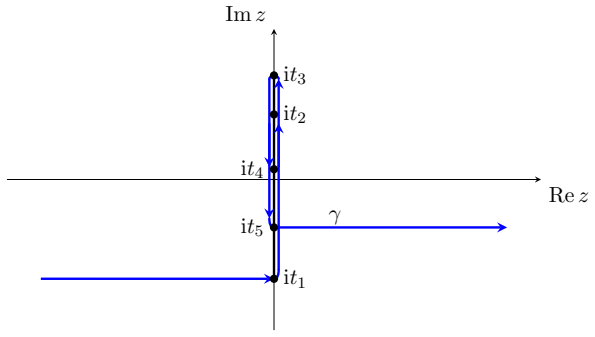
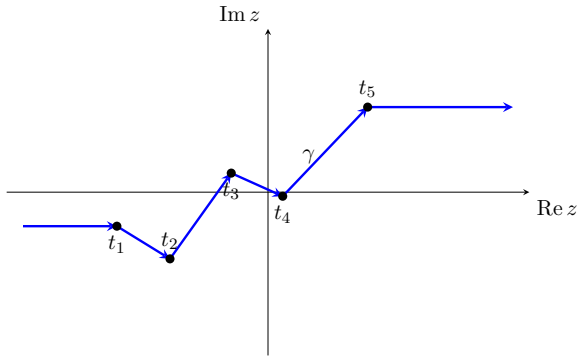
read the original abstract
Timelike Liouville field theory is a candidate model for positive curvature two-dimensional quantum gravity, but a mathematically controlled Lorentzian formulation has remained elusive. In this paper we construct the theory on the cylinder $\mathbb{R}\times \mathbb{S}^1$ in the integer screening sector for a natural algebra of renormalized exponential observables. Starting from a renormalized finite-volume torus regularization, we construct infinite-volume Euclidean correlation functions, prove analytic continuation in the time variables, and identify the resulting Lorentzian boundary values by explicit contour formulas. This yields exact Lorentzian correlators for a natural class of exponential observables. We then prove locality: spacelike separated vertex operators commute in the Lorentzian theory. For smeared observables generated by the integer-charge fields $e^{2nb\phi}$, these Lorentzian expectation values define a vacuum functional on an ordered $*$-algebra and support an AQFT-type quantization without positivity. More precisely, we obtain isotone local algebras, a complete locally convex space $\mathcal H$ with dense algebraic subspace $\mathcal H_0$ carrying a nondegenerate Hermitian form (shown to be indefinite for $b<8^{-1/2}$), a continuous cyclic representation, operator-topologically closed represented local algebras, an action of cylinder translations by continuous linear homeomorphisms, and locality for the represented local net. The construction does not produce a Hilbert space or a Haag-Kastler net of local von Neumann algebras in the usual sense, but it shows that a substantial part of the Euclidean-to-Lorentzian and algebraic reconstruction mechanism survives in this nonpositive setting for timelike Liouville theory on the cylinder.
Editorial analysis
A structured set of objections, weighed in public.
Referee Report
Summary. The manuscript constructs timelike Liouville field theory on the cylinder R × S¹ in the integer screening sector. Starting from a renormalized finite-volume torus regularization, it obtains infinite-volume Euclidean correlation functions, proves analytic continuation in the time variables, identifies the Lorentzian boundary values via explicit contour formulas, derives exact Lorentzian correlators for a class of exponential observables, and proves that spacelike-separated vertex operators commute. These data are used to define a vacuum functional on an ordered *-algebra of smeared observables generated by e^{2nbϕ}, yielding isotone local algebras, a complete locally convex space H with dense algebraic subspace H₀ carrying a nondegenerate Hermitian form (indefinite for b < 8^{-1/2}), a continuous cyclic representation, operator-topologically closed represented local algebras, continuous action of cylinder translations, and locality of the represented net—while explicitly noting the absence of a Hilbert space or Haag-Kastler von Neumann net.
Significance. If the regularization and continuation steps are controlled as claimed, the result is significant: it supplies the first mathematically rigorous Lorentzian formulation of timelike Liouville theory on the cylinder and demonstrates that the Euclidean-to-Lorentzian reconstruction and algebraic net structure survive in a manifestly non-positive setting. The explicit contour identification of boundary values and the locality proof are concrete technical contributions that could serve as a template for other non-unitary models.
minor comments (3)
- The abstract and introduction should state the precise range of the parameter b for which the indefinite Hermitian form and the integer screening sector are defined; the single inequality b < 8^{-1/2} appears only in the abstract and is not cross-referenced to a theorem or proposition.
- Notation for the renormalized exponential observables (e.g., the precise definition of the integer-charge fields and the screening charges) is introduced without an early dedicated subsection; a short preliminary section collecting all renormalized vertex operators would improve readability.
- The statement that the represented local algebras are 'operator-topologically closed' would benefit from an explicit reference to the topology in which closure is taken (e.g., the strong operator topology on the space of continuous linear maps on H).
Simulated Author's Rebuttal
We thank the referee for the positive assessment of our manuscript, the accurate summary of its contents, and the recommendation for minor revision. No specific major comments were raised in the report.
Circularity Check
No significant circularity; derivation proceeds from independent Euclidean regularization via analytic continuation
full rationale
The paper's chain begins with an external renormalized finite-volume torus regularization to produce Euclidean correlators, followed by analytic continuation in time variables and explicit contour identification of Lorentzian boundary values. No step equates a claimed output (e.g., locality, Hermitian form, or local algebras) to an input by definition, fitting, or self-citation reduction; the indefinite Hermitian form for b < 8^{-1/2} is explicitly derived rather than assumed. The construction is self-contained against the stated Euclidean starting point and does not invoke load-bearing self-citations or rename fitted quantities as predictions.
Axiom & Free-Parameter Ledger
free parameters (1)
- b
axioms (2)
- domain assumption Analytic continuation in time variables from Euclidean to Lorentzian signature is valid for the renormalized observables.
- ad hoc to paper The integer screening sector admits a consistent algebra of renormalized exponential observables.
Reference graph
Works this paper leans on
-
[1]
G. E. Andrews, R. Askey, and R. Roy.Special Functions, volume 71 ofEncyclopedia of Mathematics and its Applications. Cambridge University Press, Cambridge, 1999. ISBN 0-521-62321-9; 0-521-78988-5. doi: 10.1017/CBO9781107325937. URLhttps: //doi.org/10.1017/CBO9781107325937
-
[2]
Anninos, T
D. Anninos, T. Bautista, and B. Mühlmann. The two-sphere partition function in two-dimensional quantum gravity.Journal of High Energy Physics, 2021(9):1–30, 2021
2021
-
[3]
D. Anninos, T. Hertog, and J. Karlsson. Quantum Liouville cosmology, 2025. arXiv:2512.15969 [hep-th]
work page internal anchor Pith review Pith/arXiv arXiv 2025
-
[4]
Bautista and A
T. Bautista and A. Bawane. Boundary timelike Liouville theory: Bulk one-point and boundary two-point functions.Phys. Rev. D, 106(12):126011, 2022. doi: 10.1103/ PhysRevD.106.126011
2022
-
[5]
Bratteli and D
O. Bratteli and D. W. Robinson.Operator Algebras and Quantum Statistical Mechanics
-
[6]
Springer, New York, second edition, 1987
1987
-
[7]
R. Brunetti, K. Fredenhagen, and R. Verch. The generally covariant locality principle: A new paradigm for local quantum field theory.Communications in Mathematical Physics, 237(1–2):31–68, 2003. doi: 10.1007/s00220-003-0815-7
-
[8]
Chatterjee
S. Chatterjee. Rigorous results for timelike Liouville field theory.Forum of Math., Sigma, 14(e71):1–76, 2026. 84
2026
-
[9]
S. Chatterjee. Exact calculations beyond charge neutrality in timelike Liouville field theory.arXiv preprint arXiv:2601.19097, 2026
-
[10]
Chatterjee and E
S. Chatterjee and E. Witten. Liouville theory: An introduction to rigorous approaches. Journal of High Energy Physics, 2025(2):1–41, 2025
2025
-
[11]
Collier, L
S. Collier, L. Eberhardt, B. Mühlmann, and V. A. Rodriguez. The Virasoro minimal string.SciPost Physics, 16(2):057, 2024
2024
-
[12]
Collier, L
S. Collier, L. Eberhardt, B. Mühlmann, and V. A. Rodriguez. The Complex Liouville String.Physical Review Letters, 134(25):251602, 2025
2025
-
[13]
David, A
F. David, A. Kupiainen, R. Rhodes, and V. Vargas. Liouville quantum gravity on the Riemann sphere.Communications in Mathematical Physics, 342:869–907, 2016
2016
-
[14]
Dorn and H.-J
H. Dorn and H.-J. Otto. Two- and three-point functions in Liouville theory.Nuclear Physics B, 429(2):375–388, 1994
1994
-
[15]
Duplantier and S
B. Duplantier and S. Sheffield. Liouville quantum gravity and KPZ.Inventiones Mathematicae, 185(2):333–393, 2011
2011
-
[16]
I. M. Gelfand and M. A. Naimark. On the imbedding of normed rings into the ring of operators in hilbert space.Rec. Math. [Mat. Sbornik] N.S., 12(54)(2):197–217, 1943
1943
-
[17]
G. Giribet. Timelike Liouville three-point function.Physical Review D—Particles, Fields, Gravitation, and Cosmology, 85(8):086009, 2012
2012
-
[18]
G. Giribet and B. Sivilotti. The disk 1-point function in timelike Liouville theory, 2026. arXiv:2603.12084 [hep-th]
-
[19]
Glimm and A
J. Glimm and A. Jaffe.Quantum Physics: A Functional Integral Point Of View. Springer-Verlag, New York, second edition, 1987
1987
-
[20]
M. Goulian and M. Li. Correlation functions in Liouville theory.Phys. Rev. Lett., 66 (16):2051–2055, 1991. doi: 10.1103/PhysRevLett.66.2051
-
[21]
Grafakos.Classical Fourier Analysis
L. Grafakos.Classical Fourier Analysis. Springer, New York, third edition, 2014
2014
-
[22]
C. Guillarmou, A. Kupiainen, and R. Rhodes. Compactified imaginary Liouville theory. arXiv preprint arXiv:2310.18226, 2023
-
[23]
Guillarmou, T
C. Guillarmou, T. S. Gunaratnam, and V. Vargas. 2d Sinh-Gordon model on the infinite cylinder.Communications in Mathematical Physics, 407:97, 2026
2026
-
[24]
Haag.Local Quantum Physics: Fields, Particles, Algebras
R. Haag.Local Quantum Physics: Fields, Particles, Algebras. Springer, Berlin, second edition, 1996
1996
-
[25]
R. Haag and D. Kastler. An algebraic approach to quantum field theory.Journal of Mathematical Physics, 5(7):848–861, 1964. doi: 10.1063/1.1704187. 85
-
[26]
Harlow, J
D. Harlow, J. Maltz, and E. Witten. Analytic continuation of Liouville theory.Journal of High Energy Physics, 2011(12):1–105, 2011
2011
-
[27]
Hörmander.An Introduction to Complex Analysis in Several Variables
L. Hörmander.An Introduction to Complex Analysis in Several Variables. North- Holland Publishing Company, Amsterdam, second edition, 1973
1973
-
[28]
R. V. Kadison and J. R. Ringrose.Fundamentals of the Theory of Operator Algebras, Vol. I: Elementary Theory. Academic Press, New York, 1983
1983
-
[29]
Kupiainen, R
A. Kupiainen, R. Rhodes, and V. Vargas. Integrability of Liouville theory: Proof of the DOZZ formula.Annals of Mathematics, 191(1):81–166, 2020
2020
-
[30]
Lacoin, R
H. Lacoin, R. Rhodes, and V. Vargas. The semiclassical limit of Liouville conformal field theory.Annales de la Faculté des sciences de Toulouse: Mathématiques, 31(4): 1031–1083, 2022
2022
-
[31]
Mühlmann
B. Mühlmann. The two-sphere partition function from timelike Liouville theory at three-loop order.Journal of High Energy Physics, 2022(5):1–25, 2022
2022
-
[32]
B. Mühlmann, V. Narovlansky, and I. Tsiares. On the three-point functions in timelike N= 1Liouville CFT.arXiv preprint arXiv:2505.08890, 2025
-
[33]
Y. Nakayama. Liouville field theory: A decade after the revolution.International Journal of Modern Physics A, 19:2771–2930, 2004. doi: 10.1142/S0217751X04019500
-
[34]
A. M. Polyakov. Quantum geometry of bosonic strings.Physics Letters B, 103(3): 207–210, 1981
1981
-
[35]
H. Reeh and S. Schlieder. Bemerkungen zur unitäräquivalenz von lorentzinvarianten feldern.Il Nuovo Cimento, 22(5):1051–1068, 1961. doi: 10.1007/BF02787889
-
[36]
Ribault and R
S. Ribault and R. Santachiara. Liouville theory with a central charge less than one. Journal of High Energy Physics, 2015(8):1–26, 2015
2015
-
[37]
Rudin.Real and Complex Analysis
W. Rudin.Real and Complex Analysis. McGraw-Hill, Inc., USA, third edition, 1987. ISBN 0070542341
1987
-
[38]
Schomerus
V. Schomerus. Rolling tachyons from Liouville theory.Journal of High Energy Physics, 2003(11):043, 2003
2003
-
[39]
I. E. Segal. Irreducible representations of operator algebras.Bull. Amer. Math. Soc., 53(2):73–88, 1947. doi: 10.1090/S0002-9904-1947-08742-5
-
[40]
I. E. Segal. Postulates for general quantum mechanics.Ann. of Math. (2), 48(4): 930–948, 1947. doi: 10.2307/1969387
-
[41]
A. Sen. Rolling tachyon.Journal of High Energy Physics, 2002(4):048, 2002
2002
-
[42]
A. Sen. Tachyon matter.Journal of High Energy Physics, 2002(7):065, 2002. 86
2002
-
[43]
Strominger and T
A. Strominger and T. Takayanagi. Correlators in Timelike Bulk Liouville Theory. Advances in Theoretical and Mathematical Physics, 7(2):369–379, 2003
2003
-
[44]
Teschner
J. Teschner. On the Liouville three-point function.Physics Letters B, 363(1-2):65–70, 1995
1995
-
[45]
J. Teschner. Liouville theory revisited.Classical and Quantum Gravity, 18(23): R153–R222, 2001. doi: 10.1088/0264-9381/18/23/201
-
[46]
R. Usciati, C. Guillarmou, R. Rhodes, and R. Santachiara. Probabilistic construction of non compactified imaginary Liouville field theory.arXiv preprint arXiv:2505.09390, 2025
-
[47]
A. B. Zamolodchikov and A. B. Zamolodchikov. Structure constants and conformal bootstrap in Liouville field theory.Nucl. Phys. B, 477:577–605, 1996. Appendix This appendix collects material that would have interrupted the main narrative: details on the torus Green’s function, technical lemmas used at isolated points in the proofs, and general background o...
1996
-
[48]
Sinceλ m,0 =π 2m2/T 2, we have π 2T B∗ 0 = T 2π X m∈Z\{0} eimπt/T m2 .(A.20) Whenever|t| ≤T, we haveπt/T∈[−π, π], and therefore Lemma A.9 gives π 2T B∗ 0 = πT 6 − π|t| 2 + πt2 4T .(A.21) Next, forn̸= 0, note that π 2T Bn = T 2π X m∈Z eiαm m2 +n 2T 2 . Applying Lemma A.2 witha=|n|Tandθ=α=πt/T, we get π 2T Bn = 1 2|n| X k∈Z e−π|n||t+2kT| .(A.22) Since t̸ = ...
-
[49]
eventually
Ifu≥ 1 2, then |1−e −u+iv| ≥1−e −u ≥1−e −1/2. Ifu < 1 2, then|v| ≥ √ 1−u 2 > √ 3 2 and|v| ≤π, and so, |1−e −u+iv|2 ≥2e −u(1−cosv)≥2e −1/2(1−cos( √ 3/2)). Thus in either subcase,|1 −e −u+iv| ≥c 4. This proves the lower bound. For the upper bound, first use|e−u| ≤1to get |1−e −u+iv| ≤1 +e −u ≤2. Also, |1−e −u+iv| ≤ |1−e −u|+e −u|1−e iv| ≤u+|v|, where we use...
-
[50]
Locality.If O1 and O2 are spacelike separated, then every element ofA(O1)commutes with every element ofA(O2)
-
[51]
Because each A(O)is a C∗-algebra, it is already complete in itsC∗-norm
Covariance.If a symmetry group G acts on spacetime, then one has a corresponding action by∗-automorphisms αg :A(O)→A(gO), g∈G. Because each A(O)is a C∗-algebra, it is already complete in itsC∗-norm. One also forms the quasilocal algebra A by taking the norm-closed C∗-algebra generated by the local algebras. This is the representation-independent level of ...
discussion (0)
Sign in with ORCID, Apple, or X to comment. Anyone can read and Pith papers without signing in.