REVIEW 1 major objections 30 references
Reviewed by Pith at T0; open to challenge.
T0 means a machine referee read the full paper against a public rubric. The mark states how deep the mechanical check went, never who wrote it. the ladder, T0–T4 →
T0 review · grok-4.3
Traditional machine learning matches deep learning accuracy on protein structure classification from dynamic graphs but runs over 10 times faster.
2026-06-29 08:35 UTC pith:75RXR7EB
load-bearing objection Traditional ML matches DL accuracy on dynamic PSN protein classification but runs over 10x faster, with the head-to-head comparison as the main addition. the 1 major comments →
Traditional machine learning vs. deep learning from dynamic graph representations of proteins' 3D folds in the task of protein structure classification
The pith
A machine-rendered reading of the paper's core claim, the machinery that carries it, and where it could break.
Core claim
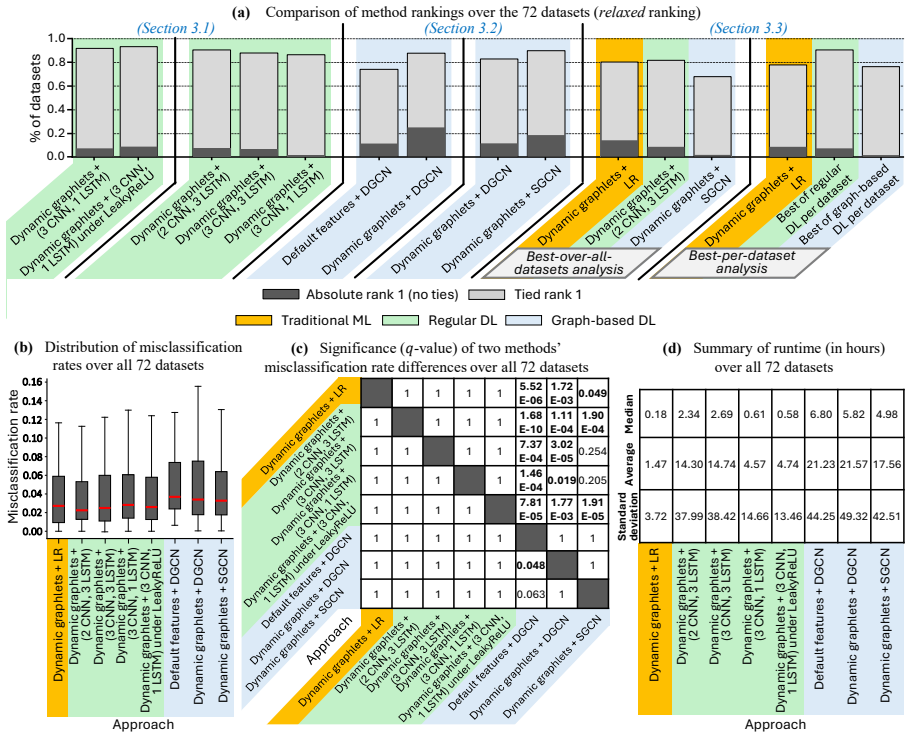
Our evaluation on 72 datasets spanning ~44,000 CATH- or SCOPe-labeled dynamic PSNs reveals that in terms of PSC accuracy, traditional ML and DL are (close to) tied for a large majority of the datasets, while DL is on average 10+ times slower. We are the first to evaluate traditional ML vs. DL in the dynamic PSN-based PSC task.
What carries the argument
Dynamic protein structure networks (PSNs) that represent 3D protein folds, used either for manual feature engineering with traditional classifiers or for automatic feature learning with deep learning.
Load-bearing premise
The dynamic PSN construction and feature extraction steps supply an equivalent starting point for both traditional ML and deep learning methods.
What would settle it
A fresh collection of dynamic PSN datasets on which deep learning produces markedly higher classification accuracy than traditional ML at similar or lower runtime cost.
If this is right
- Traditional ML remains a practical default choice for this task when runtime efficiency matters.
- Dynamic PSN representations continue to support competitive performance even against automatic deep learning.
- Switching to deep learning is not required to gain accuracy in dynamic-PSN protein classification.
- Prior advantages shown for dynamic over static PSNs with traditional ML extend to the deep learning case without reversal.
Where Pith is reading between the lines
- Hand-crafted features from these networks appear to capture most of the signal that deep learning would otherwise discover automatically.
- Similar speed-accuracy trade-offs may appear in other bioinformatics tasks that convert molecular structures into dynamic graphs.
- Hybrid pipelines that start with dynamic PSNs and apply lightweight traditional classifiers could be worth testing for larger protein collections.
Editorial analysis
A structured set of objections, weighed in public.
Referee Report
Summary. The manuscript evaluates traditional machine learning (with manual features) versus deep learning for protein structure classification (PSC) on dynamic protein structure networks (PSNs) derived from 3D protein folds. Building on prior work showing dynamic PSN features outperform static PSNs/sequence/direct 3D features, it reports results across 72 datasets (~44,000 CATH/SCOPe-labeled dynamic PSNs): traditional ML and DL achieve (close to) tied accuracy on a large majority of datasets, while DL is on average >10x slower. The work claims to be the first such comparison in the dynamic-PSN PSC setting.
Significance. If the empirical comparison holds after full experimental details are provided, the result would indicate that automatic feature learning via DL confers no accuracy advantage over manual feature engineering in this domain, while incurring substantial computational cost. The scale (72 datasets) is a strength that supports generalizability claims within the dynamic-PSN modeling framework; this could usefully inform method selection in structural bioinformatics by quantifying the accuracy–efficiency trade-off.
major comments (1)
- [Abstract] Abstract: the summary of tied accuracy and the 10x speed difference supplies no details on experimental setup, statistical tests, dataset construction, model architectures, or error bars, making it impossible to verify whether the data supports the central claim.
Simulated Author's Rebuttal
We thank the referee for their detailed review and constructive comments. We address the major comment below and agree to make revisions to improve the manuscript.
read point-by-point responses
-
Referee: [Abstract] Abstract: the summary of tied accuracy and the 10x speed difference supplies no details on experimental setup, statistical tests, dataset construction, model architectures, or error bars, making it impossible to verify whether the data supports the central claim.
Authors: We agree that the abstract, as currently written, provides limited information on the experimental details, which could make it difficult for readers to immediately assess the strength of the claims. The full paper includes comprehensive descriptions of the dataset construction (72 datasets from CATH and SCOPe with ~44,000 dynamic PSNs), the models (traditional ML with manual features vs. DL architectures), the evaluation protocol (including cross-validation and statistical comparisons), and results with error bars or variance measures. To address this, we will revise the abstract to concisely incorporate key elements such as the scale of the evaluation, the use of statistical tests for comparing accuracies, and mention of error bars, while maintaining brevity. revision: yes
Circularity Check
No significant circularity
full rationale
The paper presents an empirical comparison of traditional ML and DL methods applied to dynamic PSN representations for protein structure classification across 72 datasets. The central claim rests on reported accuracy and runtime results from this evaluation rather than any derivation, parameter fitting, or self-referential definition that reduces the output to the inputs by construction. Self-citations to prior modeling of static and dynamic PSNs exist but are not load-bearing for the current tie/speed result, which is externally falsifiable via reproduction on the CATH/SCOPe-labeled datasets.
Axiom & Free-Parameter Ledger
axioms (1)
- domain assumption Dynamic protein structure networks (PSNs) can be used to extract features for protein structure classification
read the original abstract
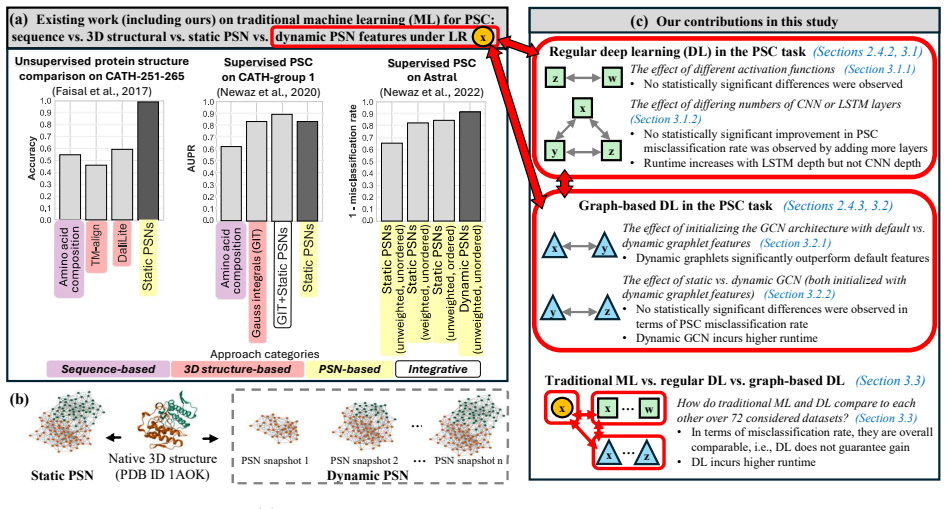
Protein structure classification (PSC) uses supervised learning to predict a protein's CATH/SCOP(e) class from the protein's sequence or 3D structural feature(s). We already modeled 3D structures as (static) protein structure networks (PSNs), demonstrating the competitiveness of PSN-based features to sequence or direct (i.e. non-network) 3D structural features in the PSC task. More recently, we demonstrated the power of features extracted from dynamic PSNs over features extracted from static PSNs (and thus by transitivity over sequence and direct 3D structural features) in the same task. That dynamic PSN approach used traditional machine learning (ML), combining manual (pre-engineered) features with an off-the-shelf classifier. Here, we evaluate whether automatic deep learning (DL) from the dynamic PSNs yields improvements. Our evaluation on 72 datasets spanning ~44,000 CATH- or SCOPe-labeled dynamic PSNs reveals that in terms of PSC accuracy, traditional ML and DL are (close to) tied for a large majority of the datasets, while DL is on average 10+ times slower. We are the first to evaluate traditional ML vs. DL in the dynamic PSN-based PSC task.
Figures


Reference graph
Works this paper leans on
-
[1]
Berenberg, V
D. Berenberg, V. Gligorijević, and R. Bonneau. Graph embeddings for protein structural comparison,
-
[2]
Talk at the Intelligent Systems For Molecular Biology and European Conference on Computational Biology.https://www.youtube.com/watch?v=1SuojEkR6ZA
-
[3]
Chandonia, N
J.-M. Chandonia, N. K. Fox, and S. E. Brenner. SCOPe: classification of large macromolecular structures in the structural classification of proteins—extended database.Nucleic Acids Research, 47(D1):D475– D481, 2019
2019
-
[4]
D. Chen, A. Manolache, M. Niepert, and K. Borgwardt. Protein Fold Classification at Scale: Bench- marking and Pretraining.arXiv preprint arXiv:2605.18552, 2026
work page internal anchor Pith review Pith/arXiv arXiv 2026
- [5]
-
[6]
F. E. Faisal, K. Newaz, J. L. Chaney, J. Li, S. J. Emrich, P. L. Clark, and T. Milenković. GRAFENE: Graphlet-based alignment-free network approach integrates 3D structural and sequence (residue order) data to improve protein structural comparison.Scientific Reports, 7(1):14890, 2017
2017
-
[7]
Z. Feng, R. Wang, T. Wang, M. Song, S. Wu, and S. He. A comprehensive survey of dynamic graph neural networks: Models, frameworks, benchmarks, experiments and challenges.IEEE Transactions on Knowledge and Data Engineering, 2025
2025
-
[8]
Gligorijević, P
V. Gligorijević, P. D. Renfrew, T. Kosciolek, J. K. Leman, D. Berenberg, T. Vatanen, C. Chandler, B. C. Taylor, I. M. Fisk, H. Vlamakis, et al. Structure-based protein function prediction using graph convolutional networks.Nature Communications, 12(1):3168, 2021
2021
-
[9]
L. H. Greene, T. E. Lewis, S. Addou, A. Cuff, T. Dallman, M. Dibley, O. Redfern, F. Pearl, R. Nambudiry, A. Reid, et al. The CATH domain structure database: new protocols and classification levels give a more comprehensive resource for exploring evolution.Nucleic Acids Research, 35:D291–D297, 2007
2007
- [10]
-
[11]
Hulovatyy, H
Y. Hulovatyy, H. Chen, and T. Milenković. Exploring the structure and function of temporal networks with dynamic graphlets.Bioinformatics, 31(12):i171–i180, 2015
2015
-
[12]
Johnson, M
R. Johnson, M. M. Li, A. Noori, O. Queen, and M. Zitnik. Graph artificial intelligence in medicine. Annual Review of Biomedical Data Science, 7(1):345–368, 2024
2024
-
[13]
T. N. Kipf and M. Welling. Semi-supervised classification with graph convolutional networks. In Proceedings of the 5th International Conference on Learning Representations, 2017
2017
-
[14]
Malod-Dognin and N
N. Malod-Dognin and N. Pržulj. GR-Align: fast and flexible alignment of protein 3D structures using graphlet degree similarity.Bioinformatics, 30(9):1259–1265, 2014
2014
-
[15]
Manessi, A
F. Manessi, A. Rozza, and M. Manzo. Dynamic graph convolutional networks.Pattern Recognition, 97:107000, 2020
2020
-
[16]
A. G. Murzin, S. E. Brenner, T. Hubbard, and C. Chothia. SCOP: a structural classification of proteins database for the investigation of sequences and structures.Journal of Molecular Biology, 247(4):536–540, 1995
1995
-
[17]
Newaz, M
K. Newaz, M. Ghalehnovi, A. Rahnama, P. J. Antsaklis, and T. Milenković. Network-based protein structural classification.Royal Society Open Science, 7(6):191461, 2020
2020
-
[18]
Newaz and T
K. Newaz and T. Milenković. Graphlets in network science and computational biology.Analyzing Network Data in Biology and Medicine: An Interdisciplinary Textbook for Biological, Medical and Computational Scientists, pages 193–240, 2019
2019
-
[19]
Newaz, J
K. Newaz, J. Piland, P. L. Clark, S. J. Emrich, J. Li, and T. Milenković. Multi-layer sequential network analysis improves protein 3D structural classification.Proteins: Structure, Function, and Bioinformatics, 90(9):1721–1731, 2022
2022
-
[20]
Newaz, G
K. Newaz, G. Wright, J. Piland, J. Li, P. L. Clark, S. J. Emrich, and T. Milenković. Network analysis of synonymous codon usage.Bioinformatics, 36(19):4876–4884, 2020
2020
-
[21]
Pržulj, D
N. Pržulj, D. G. Corneil, and I. Jurisica. Modeling interactome: scale-free or geometric?Bioinformatics, 20(18):3508–3515, 2004. 15
2004
-
[22]
Van Kempen, S
M. Van Kempen, S. S. Kim, C. Tumescheit, M. Mirdita, J. Lee, C. L. Gilchrist, J. Söding, and M. Steinegger. Fast and accurate protein structure search with Foldseek.Nature Biotechnology, 42(2):243–246, 2024
2024
-
[23]
Z. Wang, Z. Liu, T. Ma, J. Li, Z. Zhang, X. Fu, Y. Li, Z. Yuan, W. Song, Y. Ma, et al. Graph foundation models: A comprehensive survey.arXiv preprint arXiv:2505.15116, 2025
work page Pith review arXiv 2025
-
[24]
Wells, K
A. Wells, K. Newaz, J. Morones, J. Cheng, and T. Milenković. Unavailability of experimental 3D structural data on protein folding dynamics and necessity for a new generation of structure prediction methods in this context.Bioinformatics, 42:btag020, 2026
2026
-
[25]
Whitford.Proteins: Structure and Function
D. Whitford.Proteins: Structure and Function. John Wiley & Sons, 2013
2013
-
[26]
Protein Data Bank: the single global archive for 3D macromolecular structure data
wwPDBconsortium. Protein Data Bank: the single global archive for 3D macromolecular structure data. Nucleic Acids Research, 47(D1):D520–D528, 2019
2019
-
[27]
Ö. N. Yaveroğlu, N. Malod-Dognin, D. Davis, Z. Levnajic, V. Janjic, R. Karapandza, A. Stojmirovic, and N. Pržulj. Revealing the hidden language of complex networks.Scientific Reports, 4(1):4547, 2014
2014
-
[28]
Zhang and J
Y. Zhang and J. Skolnick. TM-align: a protein structure alignment algorithm based on the TM-score. Nucleic Acids Research, 33(7):2302–2309, 2005
2005
-
[29]
N. Zhou, Y. Jiang, T. R. Bergquist, A. J. Lee, B. Z. Kacsoh, A. W. Crocker, K. A. Lewis, G. Georghiou, H. N. Nguyen, M. N. Hamid, et al. The CAFA challenge reports improved protein function prediction and new functional annotations for hundreds of genes through experimental screens.Genome Biology, 20(1):244, 2019
2019
-
[30]
Zitnik, M
M. Zitnik, M. M. Li, A. Wells, K. Glass, D. Morselli Gysi, A. Krishnan, P. Radivojac, S. Roy, A. Baudot, et al. Current and future directions in network biology.Bioinformatics Advances, 4(1):vbae099, 2024. 16 Supplementary Information Supplementary Section S1 Supplementary methods Supplementary Section S1.1 Data Here, we add more details about the data. A...
2024
discussion (0)
Sign in with ORCID, Apple, or X to comment. Anyone can read and Pith papers without signing in.