Wait! There's a Way Out: A Decision Mechanism for Forecasting Conversational Derailment
Pith reviewed 2026-06-29 08:16 UTC · model grok-4.3
The pith
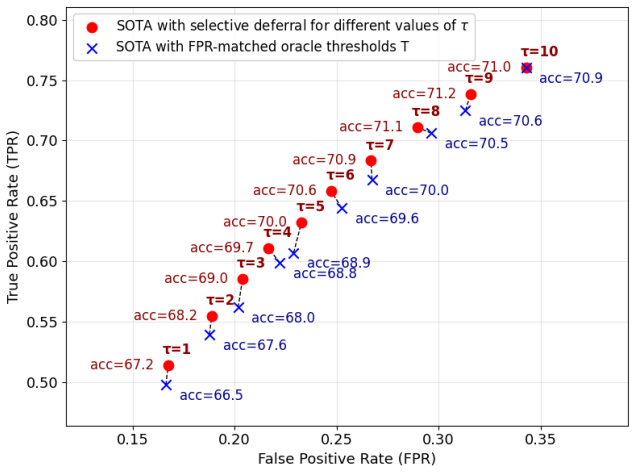
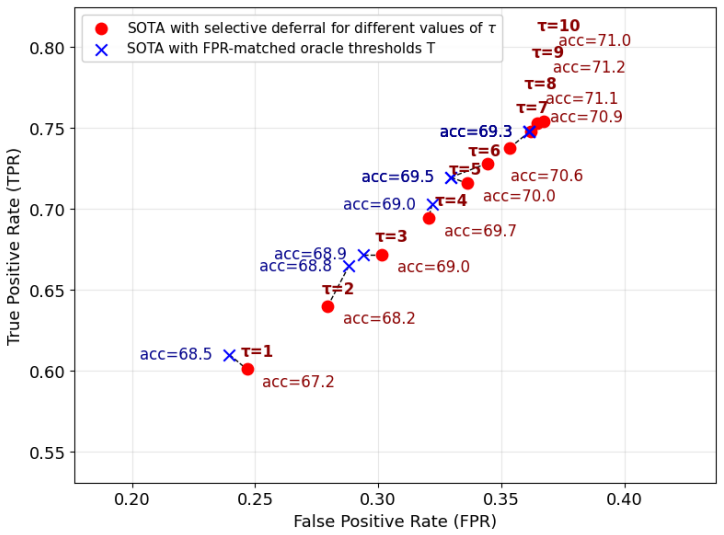
A deferral mechanism using forward-looking simulations reduces false positives in conversational derailment forecasting without losing accuracy.
A machine-rendered reading of the paper's core claim, the machinery that carries it, and where it could break.
Core claim
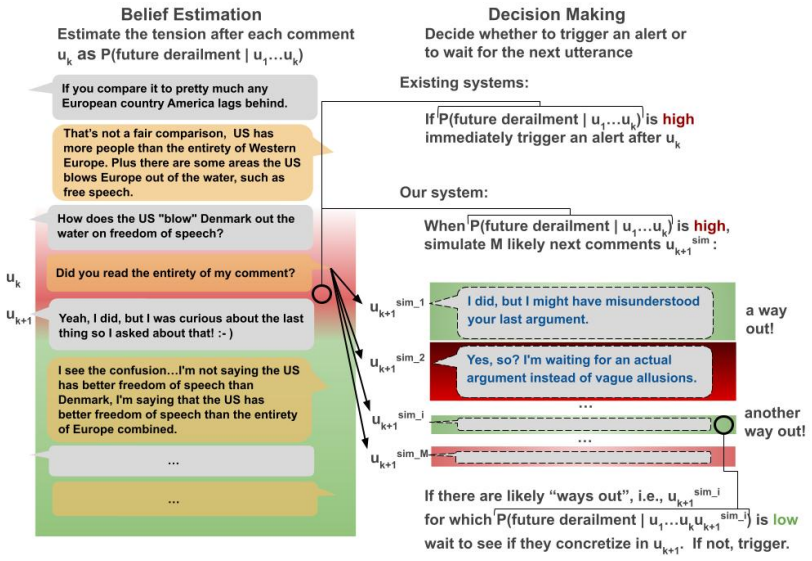
Existing approaches decide to trigger alerts solely based on the estimated likelihood of derailment given preceding utterances, implicitly assuming the conversation's future trajectory is fixed. This leads to unnecessarily high false positives by ignoring the possibility of future recovery. The work proposes decoupling the trigger decision from likelihood estimation via a deferral mechanism that uses forward-looking simulations to assess whether a tense moment admits plausible paths to recovery. Incorporating this mechanism into a state-of-the-art forecasting model substantially reduces false positives without sacrificing forecasting accuracy, and the paper positions decision-making as a fir
What carries the argument
The deferral mechanism that runs forward-looking simulations to determine if a tense conversation moment has plausible paths to recovery.
If this is right
- State-of-the-art forecasting models experience a substantial drop in false positive rate.
- Overall forecasting accuracy is preserved after adding the mechanism.
- Treating the decision to trigger as separate from likelihood estimation improves practical performance.
- Human selective deferral behavior can be operationalized to guide model decisions.
Where Pith is reading between the lines
- The separation of prediction from decision-making could apply to other online forecasting domains where false alarms carry high costs.
- The approach implies that simulation-based checks for recovery potential may become a standard add-on for moderation tools.
- If the simulations prove robust, systems could achieve lower intervention rates while still catching real derailments in time.
Load-bearing premise
Forward-looking simulations can reliably assess whether a tense moment admits plausible paths to recovery.
What would settle it
A controlled test in which the mechanism's deferral decisions fail to match actual conversation outcomes, such as deferring on conversations that derail or triggering on those that recover.
Figures

read the original abstract
Forecasting conversational derailment is the task of predicting, as the conversation unfolds, whether it will eventually derail into personal attacks. Since forecasting models operate in an online fashion, they must decide whether to "trigger" an alert after each utterance--for example, to notify participants or a moderator that the conversation is at risk of derailing. Existing approaches make this decision solely based on the estimated likelihood of derailment given the preceding utterances, implicitly assuming that the conversation's future trajectory is fixed. As a result, they ignore the possibility of future recovery and incur an unnecessarily high rate of false positives. In this work we propose a method for decoupling the decision to trigger from derailment likelihood estimation. Our approach is inspired by the first human baseline on this task, which shows that humans achieve dramatically lower false positive rates by selectively deferring their decision to trigger when they anticipate that tension is likely to subside. We operationalize this insight with a deferral mechanism that uses forward-looking simulations to assess whether a tense moment admits plausible paths to recovery. Incorporating this mechanism into a state-of-the-art forecasting model substantially reduces false positives without sacrificing forecasting accuracy. More broadly, this work highlights the value of treating decision-making as a first-class component of forecasting systems.
Editorial analysis
A structured set of objections, weighed in public.
Referee Report
Summary. The paper claims that existing derailment forecasting models trigger alerts based solely on estimated likelihood, ignoring possible future recovery and leading to high false positives. It proposes a deferral mechanism, inspired by human baselines, that uses forward-looking simulations to assess whether a tense moment admits plausible recovery paths; when added to a state-of-the-art model, this is claimed to substantially reduce false positives without sacrificing forecasting accuracy.
Significance. If validated, the separation of decision-making from likelihood estimation could improve the practicality of online conversational forecasting systems by reducing unnecessary alerts while preserving predictive power.
major comments (2)
- [Abstract] Abstract: the claim that 'incorporating this mechanism into a state-of-the-art forecasting model substantially reduces false positives without sacrificing forecasting accuracy' is presented with no quantitative results, simulation details, baselines, error analysis, or empirical validation against ground-truth outcomes.
- [Abstract] Abstract: the forward-looking simulations are described only at a high level with no information on how they are constructed, how many paths are sampled, what recovery criteria are used, or how their reliability is assessed, which is load-bearing for the claimed benefit of the deferral step.
Simulated Author's Rebuttal
We thank the referee for the careful reading and constructive feedback on the abstract. We agree that the abstract would be strengthened by including key quantitative results and additional methodological details, and we will revise it in the next version of the manuscript.
read point-by-point responses
-
Referee: [Abstract] Abstract: the claim that 'incorporating this mechanism into a state-of-the-art forecasting model substantially reduces false positives without sacrificing forecasting accuracy' is presented with no quantitative results, simulation details, baselines, error analysis, or empirical validation against ground-truth outcomes.
Authors: We agree that the abstract, constrained by length, presents the claim at a summary level without specific numbers. The full manuscript reports these details in the Experiments section, including quantitative reductions in false positives (while maintaining accuracy), comparisons against the base forecasting model as baseline, and evaluation against ground-truth derailment labels. We will revise the abstract to include the key empirical findings, such as the reported false-positive reduction and accuracy metrics. revision: yes
-
Referee: [Abstract] Abstract: the forward-looking simulations are described only at a high level with no information on how they are constructed, how many paths are sampled, what recovery criteria are used, or how their reliability is assessed, which is load-bearing for the claimed benefit of the deferral step.
Authors: We agree that the abstract keeps the simulation description high-level. The full manuscript details the construction (sampling future conversation trajectories via a conditional generative model), number of paths (50 per decision point), recovery criteria (trajectories that do not contain personal attacks per the task definition), and reliability (validated via alignment with the human baseline study). We will revise the abstract to concisely incorporate these parameters. revision: yes
Circularity Check
No circularity: deferral mechanism is an independent addition
full rationale
The paper introduces a deferral mechanism based on forward-looking simulations as a new component decoupled from existing likelihood estimation. The abstract and description present this as an operationalization of human baseline insights without any equations, fitted parameters, or self-citations that reduce the claimed false-positive reduction to prior inputs by construction. No self-definitional steps, fitted-input predictions, or load-bearing self-citation chains appear. The derivation remains self-contained against external benchmarks.
Axiom & Free-Parameter Ledger
axioms (1)
- domain assumption Conversations have plausible recovery paths that forward-looking simulations can assess.
Reference graph
Works this paper leans on
-
[1]
InPro- ceedings of WWW
Conver- sations Gone Alright: Quantifying and Predicting Prosocial Outcomes in Online Conversations. InPro- ceedings of WWW. Penelope Brown and Stephen C. Levinson. 1987.Po- liteness: Some Universals in Language Usage. Cam- bridge University Press. Jonathan P. Chang. 2024.Towards Computational Meth- ods for Proactively Supporting Healthier Online Dis- cus...
1987
-
[2]
The Llama 3 Herd of Models. ArXiv:2407.21783. Ivan Habernal, Henning Wachsmuth, Iryna Gurevych, and Benno Stein
work page internal anchor Pith review Pith/arXiv arXiv
-
[3]
Gemma 2: Improving Open Language Models at a Practical Size
Gemma 2: Improving open lan- guage models at a practical size. ArXiv:2408.00118 [cs.CL]. Son Quoc Tran, Tushaar Gangavarapu, Nicholas Chernogor, Jonathan P. Chang, and Cristian Danescu- Niculescu-Mizil
work page internal anchor Pith review Pith/arXiv arXiv
-
[4]
Conversations Gone Awry, But Then? Evaluating Conversational Forecasting Models. ArXiv:2507.19470. Che Wei Tsai, Yen-Hao Huang, Tsu-Keng Liao, Di- dier Fernando Salazar Estrada, Retnani Latifah, and Yi-Shin Chen
-
[5]
We train for 1 epochs using batch size 16, and the 8-bit AdamW optimizer (Loshchilov and Hutter, 2019)
simulate utterances in these conversations using a LLaMA 3.1 8B generative model (Grattafiori et al., 2024), finetuned in 4-bit quantization with LoRA (r, α= 16 , no dropout or bias) on a subset of the training portion of the CGA-CMV dataset (Hu et al., 2022). We train for 1 epochs using batch size 16, and the 8-bit AdamW optimizer (Loshchilov and Hutter,...
2024
-
[6]
full reserve banking
Phenomenon Example (distinguishing phrase in bold) Confrontational questioning » Yeah I don’t think this is effective. [...] Also taxing assets the same as income is impossible because assets aren’t liquid. That means you can be getting taxed either too much, or too little for the cash equivalent of the assets you receive. That’s why they’re on an entirel...
2017
-
[7]
9.0 0.44 4 Speaker 2 I’ve gone ahead and deleted the section. I hope you won’t take this as confrontational [...] 10.0 0.53 5 Speaker 1 Perhaps I can accept it’s not generally useful, but I disagree with the rest of your judgement [...] This fact [...] allows GPS correc- tions to work correctly [...] 9.0 0.35 6 Speaker 2 The GPS example you gave is helpfu...
2005
discussion (0)
Sign in with ORCID, Apple, or X to comment. Anyone can read and Pith papers without signing in.